New Feminist Lecture Series: Praba Pilar "Situated Embodied Resistance to 21 Century Necro-Techno-Colonialism" Images below (c) Robert Barry Francos / FFanzeen, 2018 Description and flyer from the University of Saskatchewan
This lecture was held at the Gordon Snelgrove Gallery on March 7, 2018. Introduced by Dr. Marie Lovrod (Coordinator of the WGST Program) and videotaped by the Marcus Miller (Director of the Snelgrove Gallery), it was described as addressing "how contemporary technological corporations such as Facebook, Google and others from a global apparatus of surveillance capitalism; this is ...necro-techno colonialism that adapts the 'salvation narrative' to proclaim a future of liberation ad instrumentalize faith. In this way, online data brokers convert biological life into an extra-judicial colony in service of exploitation, dominance and control."
Essentially, this can be viewed as a Media Ecological view of how the use technology can be used to control aspects of a users life in a way they were not expecting. While she did not use the term, it falls close to the "First we use technology, and then technology uses us" way of thinking.
After the lecture was a performance by Pilar which fell into three segments, the first being aggressive, the second passive, and the third was giving maize products to indicate life, all for viewing the militancy of technology, and the earth's forgiveness (at least that's my interpretation of it).
There was a question and answer period afterwards.
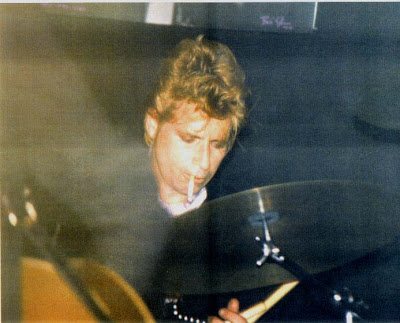
This column was originally printed in FFanzeen, issue
#14, dated 1986. It was written by musician, photographer and friend Jim Downs.
Though I met Jim in New York in 1981 by sheer coincidence, l
we had been having a pen-palish relationship about his band from Boone, NC,
called Gangrene (no relation to the Boston hardcore group with a similar name).
We were good buddies for years after that, though eventually, as things often
do, we have lost touch. Would love to hear from you, Jim! Meanwhile, this
column is a fun mix of band life and, well, “real” life. – RBF, 2018
“Hello Benjamin.”
“Jim, how are you? I haven’t heard
from you in so long. Where are you, in New York?”
“Well, no. I’m here in Boone. See, I broke my collarbone in three places.”
“Good Grief…”
“Yeah, so I really can’t do anyting.
I was going crazy just sitting in my apparmtnet and watching TV, so I decided
to come down here for a vacation.”
* * *
“Attention passengers. Piedmont
Flight No. 114 to Greensboro, North Carolina, will now begin its pre-boarding
procedures. Any persons needing assistance in boarding or with small children,
should go to the gate at this time.”
* * *
So it starts, “Escape From New York
2.” I grab my camera case and go toward the gate. In front of me is an old lady
with a walker. She has on a blue house dress, Ace bandages around her calves,
and pure white Brillo Pad hair. A flock of flight attendants cluster around her
in order to catch her if she falls. I, on the other hand, am dressed in black,
with black hair, looking like I’ve just gotten off stage with the Stranglers.
The only sign that I need “assistance” is the dirty white sling my arm is in.
“Would you like me to help you with
that bag?” The attendant smiles and extends his arm. I feel like I’m in a
commercial. “Uh, sure, I guess.” As we walk towards the door, I see the other
passengers eyeing me and the sling. “A scam,” they’re thinking, “but I’ll use
it next time.”
We preboarders and escorts head down
toward the plane. Progress is slow, the old lady and the walker are having
trouble with the ramp. She keeps trying to pitch forward over the top of the
walker and onto the ramp. If she succeeds in doing this, she and I will be able
to trade notes on how bad our collarbones hurt.
Slowly, slowly the door of the plane
gets closer. I take shuffling steps to avoid knocking the lady over and, as I
walk, I make moaning noises as my shoulder starts to hurt again. I really want
to sit down and rest, but instead of the ol’ subway rush hour
push-em-out-of-the-way, I shuffle along as quietly as I can. After all, the
attendants wouldn’t like it, and there’s more of them than there are of me.
Only 10 more feet… 8… 6…
* * *
“…So, Benjamin, how’s the music coming
along? Do you have a band?”
“Oh, yes, it’s called Discord. We have
drums, guitar, me playing bass, and a percussionist.”
“Percussionist?”
“He’s from the West Coast. He has
congas, timbales.”
“And the music?”
“Well, it’s hard to describe. Sort of
loud and different, like Bauhaus and Scrapping Foetus Off the Wheel, but
different. You know, we’re playing on campus tomorrow night at this club called
Happys.”
“Happys?”
“It’s where those cover bands play.
But there’s a festival that I helped organize of local original bands. They’ll
be 3 bands each night. We’ll be playing last, tomorrow.”
“Sounds good. How much is admission?”
“Uh, you see, you can’t get with
without being a student, and you have to have an ID. I know, I’ll tell them you’re
this reporter from New York…”
* * *
I’m standing in a large room about a
block square, with a low ceiling. It used to be a supermarket before the
university bought it and turned it into a recreation hall. Mom would buy
groceries while I would beg and plead for comic books and cereals with prizes
inside.
I’m wearing a suit. People are saying,
“Look at the reporter from New York.” People who know me are going, “Look at
Jimmy Downs with the broken collarbone.” I took off the sling (it didn’t go
with the suit, and besides, I need both arms to take pictures), but word has
gotten around to all my old friends about the accident.
The crowd is quite – err – diverse.
It’s a strange mixture of flower dresses, beards and long hair, Izod shirts and
tan slacks, teased mops of hair a la
the Cure and Sig Sig Sputnik, and an occasional white Rastafarian. I’m impressed.
It’s like the set for a high school B-movie. The different factions lend a
surreal air about the whole event. It’s almost as though it’s a theme event: “Come
as Your Favorite Lifestyle.” Sort of the Village People of ’86.
All along I’m thinking, “I’m not
really in my home town.” I remember all too clearly just a few short years ago
the abuse my old band would get from the frats. Just because of the music we
played and the clothes we wore. But now, M-TV has changed all that. It’s cool
to be “different.” In a town where there are pickup trucks with shotgun racks,
there are replicas of Robert Smith (of the Cure), but with a Southern drawl.
And these guys are playing their own music and people love it. Too many times
in the past, people have asked sincerely for “Freebird” and “Stairway to Heaven”
while you were trying to break some new ground. On the other hand, those
insincere screams for the above mentioned songs just meant you stunk.
The bands came on stage, played, and
left, and while they were all good, the one that impressed me the most was
Discord. Not from the fact that I knew one of the members, but that they really
were original. You couldn’t say that they sounded like Bauhaus or the Cure or
the Clash; they sounded like themselves. The fact that sounds like that could
come from Boone, North Carolina, is strange enough, but that you could hear it
live in this town is stronger still.
“I’m not really in my home town.”
* * *
“I can’t believe that you were in
Gangrene with Benjamin.” Colby is sitting across the table from me, eating
pizza. “And that you’re from New York, too.”
He had an amused and puzzled
expression on his face.
“Well, reality is stranger than
fiction. But why do you say that?”
“Uh, you just don’t look like it.”
I glance across the table at
Benjamin. In his blond mop he has braided two strands of hair, and with his
sharp features and French accent, he looks dangerous. I, on the other hand,
with my sling, look like someone was dangerous with me.
“You see, Colby, it’s not how you
look, it’s how you play and feel. Most of the bands I know look pretty normal, although
the hair is getting longer.”
What I’m not telling him is that this
is making me feel old. The combination of the town changing, my shoulder hurting,
being in Gangrene “back when,” and seeing bands in a room full of college kids
makes me feel old. Benjamin and I naturally spend time talking about “back when”:
back when people would walk out of the shows; back when people would yell at us;
back when we got thrown out of our rehearsal space. I feel older by the second.
* * *
“So, Jim, when are you going back to
New York?”
“Tomorrow, Benjamin. It was great to come back, but I don’t fit in this town
anymore. It’s changed, but not enough. I’m too used to the freedom in New York.
To be able to do what I want. I’m a tourist this time around.”
Note that there are no ads on this site, so I do not profit off other's work
This article / interview was
originally published on the YWCA Saskatoon Website/blog on February 13, 2018.
Its original title was "A Heart of Gold: Passion for Working at the YWCA.”
The link to the original article is HERE.
Robert Francos is a team member at the YWCA
Employment and Learning Centre, a YWCA staff long service award recipient with
a passion for his chosen career. He shared what makes his role at the YWCA so
rewarding, not only to the clients he helps, but also for him.
Francos, who has been part of the YWCA team for
since 2012, highlights the skills and experience that can be gained through the
resources offered at the Employment and Learning Centre and illustrates some of
those services through the multifaceted nature of his own role.
“I have two positions,” said Francos. “The first is
the Computer Lab Instructor. I teach a number of different classes:
Introduction to Computers, Internet & Email, two levels of Word, two levels
of Excel, PowerPoint, Publisher, Social Media, and Job Search Online in a
non-judgmental, patient way. My second job title is Skills Coach, where I help
people look for jobs online, assist with wording and formatting of résumés and
cover letters, and aid with emails and applying for online jobs.”
Improving
employable skills
The YWCA’s Employment and Learning Centre supports
both women and men who are seeking skills that will further them in finding a
career. Francos speaks on the variety of resources at the centre, which has
something for anyone who is trying to improve their skills.
“Everyone who comes into my computer lab is
different, and the challenge is to figure out what they need, and what is the
best way to help them approach their search,” said Francos. “Some people are
desperate, or scared (scared of computers, or scared about where their next
rent payment is going to come from), and it’s my job to figure out the best
path in how to help them.”
A
newfound satisfaction
Prior to joining the YWCA team, Francos worked for a
Fortune 500 management consulting firm. He admits the corporate experience
was draining at times, but now he has a newfound satisfaction in directing
others on their own search for the right career by giving them the tools and
teaching them the skills that will ultimately aid in their success.
“Here, I get to help people find
jobs,” expresses Francos. “As for the most rewarding? First, when I am
instructing a computer class and I see someone get it, that makes me feel
great. My favorite thing to hear is when someone tells me, ‘I wish I would have
known this when . . . It would have made my job a lot easier.’ Second, when I’m
out and about in the city, and I run into a former student working at their
job, and they tell me that I helped them learn the skills to get that position.
That really feels great.”
Conquering
the fear of technology
Francos teaches skills that are beneficial in each
step of the job hunt process. This starts with résumé help, and then continues
with training in computer programs like Excel and PowerPoint, considered
valuable skills by companies who are seeking a well-rounded candidate to fill a
position. Not surprisingly, many of those sought-after skills are
technology-related. Francos asserts that there is something for everyone who is
willing to learn and enhance their chances of starting a career.
Something
for everyone
“There are many resources in the Employment and
Learning Centre,” explains Francos. “For example, beyond what I do, there are a
number of Employment Counselors who do one-on-one services for job searching,
résumés and email; a comprehensive program called Trade Journey to help women
begin careers in the trades; a library of job search/résumé writing/interview
questions books; a three-week program called the Job Finding Club; and shorter
workshops. I’ve been through many of the other programs in the city, and have
found that the YWCA is incredibly comprehensive and suited to most people.”
The Trade Journey program Francos describes is a
16-week program that assists women in beginning and succeeding in construction
trades, such as carpentry, plumbing, welding, electrical or sheet metal. The
program teaches participants the necessary skills and knowledge in order to
advance in their chosen trade.
Keeping
an open mind
Searching for the correct job or career path can
sometimes be a job within itself. Francos’ words of advice? Perseverance and
keeping an open mind are keys to success when it comes to finding the right
career.
“Nearly every job I’ve had has started as part-time,
temporary, or casual, and has grown from that, including this one,” confesses
Francos. “It’s important to not be intimidated by a lengthy job posting,
because there are a lot of transferable skills you already possess that may
make you more suited for that job than you realize.”
In my opinion, the punk rock that is generally
acknowledged by the mainstream as Punk Rock officially started with the
Ramones.However, the role of both
the proto-punk New York Dolls and paradigm-changer the Heartbreakers cannot be
under-appreciated for bands like the Ramones to have existed, and more
importantly, to succeed.
The first time I saw the Dolls play,
it was just after guitarist Johnny Thunders and drummer Jerry Nolan had left the
band, I’m sorry to say (I started in the scene in Spring of 1975). For me, my
love affair of the music of Johnny and Jerry started at CBGBs in early ‘76, at
the premiere of Amos Poe’s film, Blank
Generation. The band that opened that night, with the tiny stage still on
the left side of the club, was the Heartbreakers, when the “lead” was still
Richard Hell. I found the musicianship kind of rattling and lovingly sloppy. Johnny
style of guitar and Hell’s bass playing was all over the map, but they could do
that because of the consistency of Jerry’s drumming.
After Hell was ousted, I saw Jerry in
many different incarnations, including the revamped Heartbreakers with Thunders
and Walter Lure up front (probably the band I’ve seen live more than any other),
the Rockats, and the final time at Johnny Thunders’ memorial just a few short
months before it was Jerry’s turn to join Johnny one more time.
Johnny and Jerry, pic (c) Robert Barry Francos
It’s true that Johnny received more
relative fame than Jerry. Hell, Walter was technically a better guitarist and
just as enjoyable onstage as Johnny, but Johnny had that danger element that Walter lacked (not meant as an insult; I’m
looking forward to someone doing a book about him as I find Walter fascinating),
and Jerry was so consistent and
excellent, that it almost worked against him for standing out. However, other musicians
knew how good he was, including the author of this book, Curt Weiss, a drummer
in his own right.
There are definitely some themes that
flow through the Jerry Nolan story, such as style,
women, music, temperament, and especially drugs. It’s hard to underestimate
just what a lynchpin hard drugs were to the New York scene on the Lower East
Side, which is one of the reasons why I would go see these bands and write
about them, but did not hang out with them very much; they scared the shit out
of me. This book does not shy away from it, and rightfully so.
Depending on whom you talk to, Jerry
Nolan was either a really nice guy or a complete self-absorbed shit. Johnny had
a reputation of being more on the asshole side, but Jerry could be either, depending
on what his needs were, what he could get out of you, or what condition his
state of fix was in at the moment.
The term “Wild Ride” is appropriate
for Jerry’s life, and there was so much about him I did not know, such as his
being a member of the Suzi Quatro band early on (I saw them in 1975, after
Jerry left, opening for Alice Cooper at Madison Square Garden), his relationship with Bette Midler, and that’s only
the tip of the story.
Told in mostly chronological order, right
from birth, Curt manages to avoid many of the traps of biographies (and
autobiographies) that seem to follow the same path: troubled youth, find an
instrument, bunch of bands, hit the big time, and then fun and trouble brings
it all down. Yeah, there is some of all of that here, but it’s kept
interesting. I like how rather than quoting people by saying “Joe Blow recalls
that…” and similar passages, Weiss breaks it down to simple “Joe Blow: quote”. It may not be as literary, but it’s certainly more
effective. My one complaint about this, though, is that after the person is quoted
later, even if it’s dozens of pages than being introduced, he just uses the
first name. As someone familiar with the scene, I usually knew who he was
quoting, but a casual follower, with this many people interviewed, it’s easy to
get lost in the names of who is who. My rule of thumb would have been if the
person isn’t mentioned in 10 pages, give both names as a reminder. Perhaps I’m
nitpicking?
Still, the book and especially the
story kept me drawn all the way through. There is no doubt in my mind, and
Weiss also makes this pretty clear that he holds the same belief, that Jerry
tended to blame others for his own lack of success, but that falls straight into
his own lap. Or vein, anyway. Jerry hated sloppy drug users, but he did not see
past his own blinders. Sure, he could play under the influence better than,
well, just about anyone in his bands, but that does not mean when he wasn’t on
stage he wasn’t sabotaging himself at every turn. That’s why managers of his
bands always warned other managers about him, another consistent theme in the
book.
One of the more powerful and
interesting motifs here is the relationship between Jerry and Johnny. Someone
mentions near the end of the book how they were like an old married couple, and
that’s pretty accurate. Johnny was always his best when he was backed by Jerry –
but I want to add that Johnny was especially effective when he shared a stage
with Walter more than anyone else, in my opinion; their verbal putdown
exchanges were part of the reason to go see them perform. With Jerry and Johnny
though, it was more their between gigs interactions that made them the best of
friends and the worst of enemies, sometimes at the same time. Walter has told
stories about how Jerry would beat the hell out of Johnny if he was acting up
or sloppy-drugged. Yet, it was obvious when they worked together in front of any
crowd, it was a bond that was hard to break. Even at times when they despised
each other, they would still find a way to play. And it was a joy to watch.
As enjoyable as the book is, there is
some controversy about it, such as questions about the means Weiss used to get
some of the information. He made some of the people mentioned and quoted in the
book not too happy, one in particular threatening to take legal actions. The
question here is one of whether the ends justify the means. I’m not going to
judge one way or another.
My other issue with the book is that
there is a certainly level of assumptions, with Weiss stating things like “Jerry
felt that…” or “Jerry thought that…” That’s solid Victor Bockis territory. Second
hand “feelings” are untrustworthy, and I would have preferred if he had more
often used the style on page 231, where he has the direct source of Swedish
musician Hank Eriksson quoting Jerry saying, “Don’t worry about it. It’s rock ‘n’
roll.” Other people quoting him is not the same as assuming what Jerry was
thinking or feeling, unless a direct source is given.
Jerry at Johnny's memorial concert, pic (c) Robert Barry Francos
Towards the end of Jerry’s life – and
the book – is where Weiss makes the most assumptions, mostly about his
relationships and his means of death. I’m not saying Weiss is right or wrong, I
don’t know as I do not have the direct sources, but in this case when he states
on page 256, “There was no doubt…”, it is still an assumption on his part,
unless someone in the medical field or someone close to him told him directly,
and he can use that person as a citation.
To be fair, I have read an “Advance
Uncorrected Reader’s Proof,” so I’m not sure what has been changed between this
and the final printing. Heck, I don’t even know if there are photos added. What
I do know is despite all the possibly rightful controversy over this biography
of arguably one of the best drummers to every hit the rock’n’roll skins, it is
an enjoyable read, and an important piece about someone, under different
circumstances, would (and should) be on everyone’s list of important musicians in
his field.
This interview was originally printed in FFanzeen, issue #8, dated 1981, by Managing Editor Julia Masi. – Robert Barry
Francos, 2018.
She has the smooth, clear voice of a
1940s chanteuse, the guts of a hard rocker, and the theatrical presence of
Marcel Marceau. Scurrying about the stage, her pale skin is made whiter by
make-up. With hair a strikingly unnatural shade of red, she is the perfect
mime, creating characters to personify her songs. But Hazel O’Connor refuses to
be manipulated.
On her own since the age of 16 when
she left home in Coventry, England, Hazel has traveled from Beirut to Tokyo,
working odd jobs as a singer, painter, dancer, and actress. Once penniless in
the Sahara Desert, she is now a movie star on two continents, thanks to her portrayal
of Kate in Breaking Glass [see film
trailer below – RBF, 2018]. And now, she is embarking on a recording and
concert career.
Sitting in her room at the Iroquois
Hotel on an afternoon before her New York City debut last April, Hazel sipped
tea, toyed with her corned-beef sandwich, and speculated about her career, her album
Sons and Lovers on A&M Records,
and the music scene.
“Singing is what I want to do. For
me, that’s my major form of expression. It makes me feel the most.” She claims to have started her career with a “poxie
Minnie Mouse voice,” but soon learned to sing with her guts when she found
situations that she wanted to sing about. She learned the piano from an old
boyfriend, who wrote the notes on the keyboard with a felt-tipped pen. Then she
learned “a bit of guitar,” and asked her brother Neil to teach her to write
songs.
“The first songs I wrote were about
this girl, Montana Wildhack. She was the porno star in Slaughterhouse Five who gets kidnapped from Beverly Hills to mate
with Billy Pilgrim. I have about three songs on her because of that book.” But
her first single, “E-I-Addio,” was inspired by the fights her parents had
before they broke up. And the 13 songs she wrote for the Breaking Glass soundtrack were laced with political overtones.
“I would never want to be a politician,”
she admits. “I hate people pushing a point down at me in a too obvious way. I
write about what I see around me, what I feel. People can make what they like
out of my observations; like, people get meaning out of an artist painting
pictures. I try to see lyrics in double images. My lyrics are quite pointed.
They have their meanings underlying, of what I want to say, for anyone who
wants to dig deeper. Sometimes, it starts with the obvious on the top level,
and goes to the less obvious, with an underneath level, which a lot of people
don’t bother to find out unless they listen.”
Influenced by the Velvet Underground
and the Small Faces, she follows a definite formula when writing music: “Both
of those groups have very structured ideas as far as songs are concerned, even
though they played very loose. It was always verse, chorus, verse, chorus. Or
possibly, middle eight or solo, finish on a chorus, or stop; end of song. I
like that cos I’m one of those people who works well around a structure. If you
put limits around what you’re doing, you can go past your limits and set new
limits. I haven’t got past my first set of limits.”
Sons and Lovers
is a reaction to what she has seen on the European music scene. After the
release of Breaking Glass, Hazel was
invited to all the “in, clique-y dos.” While making public appearances at clubs
and discotheques, Hazel tried to stay out of the limelight and just drink in
what was happening around her.
“In those days (1979), it was sort of
a new regime where fashion hadn’t really been established. It was a
cabaret-like setting with everyone coming up and wriggling around. It reminded
me of Berlin back in World War days, with people watching other people and
getting their rocks off.”
The passions of love and war are the
central theme of her album, which includes an unusual cover of the traditional
Irish song, “Danny Boy.” “I just imagined this smoky desolate field that had
been a battleground forever, which was, like, in Ireland in the days of the
Revolution, and always picking up arms against the oppressor, with this girl
who’s singing about her lover. And gradually you change the coin, and you’ve
got this lovely, lilting tune, then suddenly it goes, ‘Par-rump-par-rump,’” she
started to imitate the drum and sings, “’Oh, Danny Boy…,’ because they gave
people lively songs to make them march better.
“People are redundant. Whenever
there’s economic declines, people start looking for scapegoats and that’s the
first problem. And we have all these fuckin’ arms problem. And Big Money. Who
needs it? They’re living life in true rock’n’roll fashion; let’s all destroy ourselves.
I’m not interested in the destruction of the planet. People get so small-minded
about what politics is about. Politics is about living together as people with
feelings, and it’s been institutionalized to the point where my music comes in,
because I really believe in feelings. It’s been said that I’m a ‘silly girl
who’ll probably never hurt anybody but myself,’ but I don’t really care, if
that’s the point.”
But what Hazel does care about is
conveying her kaleidoscopic visions to her audience. By combining her
theatrical talents with rock’n’roll, she had come up with a rowdy, regimented
stage show.
“As big a love as I have of racing
around on stage, I have a love of old-time cabaret. Not musical cabaret, but
that sometimes seedier side of life that I know from being a dancer and stuff
like that. I’d like to be able to stand up there with a piano, or even without
anything, and be able to sing. I think that must be a great feeling.
“In England, my medium is mostly
rock’n’roll concerts, but in France, we had a hit with ‘Will You,’ off the Breaking Glass album.” Naturally, having
a hit song meant that Hazel had to make personal appearances and do a barrage
of French rock’n’roll television shows. “And because everybody is so
penny-pinching, all they wanted was just me to go over and mime to a tape. I at
least waned to take my keyboard player. So me and Roots went over and he played
piano and I sang it live. It was real good fun, cos that’s like another part of
me.
“I really love stuff like
old-fashioned jazz. I love Gershwin, Cole Porter, Ella Fitzgerald, Billie
Holiday, Judy Garland and Edith Piaf. Women singers like that mean more to me
than Grace Slick or Janis Joplin any day. I listened to the heavy rock scene. I
liked Nico. She was maybe the first one I liked, but she didn’t go up there and
sing and try to be a man. After that, I like all my contemporary girl singers
that are happening now. I think they’re far more exciting than in the ‘60s,
like Siouxie from the Banshees. And Debbie Harry; I like what she does.”
Kate, Hazel’s cinematic alter-ego, seems
to be a composite of all her contemporaries, but with a few similarities to the
real-life O’Connor: “I’m not going to disown my character. A lot of this that
happen to (Kate) happened to me later, like going a bit nuts in the end. But
some of the reasons I felt like going nuts were totally different. The real
reason why people go nuts in any artistic sense is that people never recognize
them for what they want to be recognized for; I just was not getting much
recognition for being a musician, or being a writer. I was being recognized for
being a puppet and a dummy.”
Hazel, who sees herself as “resilient
and stable,” diagnoses the death of the punk movement: “The media has made
bands inaccessible. They just started off on one track and finished up on
another. Like the Clash started out as a street band, and eventually they had
to give into commerciality to make money. That is classed in some people’s
opinion as ‘selling out.’ I don’t see it that way. They’ve just become
inaccessible. I understand how that happens. I used to see Mick Jones hanging
out a lot. It gets to be difficult. I still think they make good music; it’s
just that things are not the same anymore. Things can’t stay the same.
“We did this pop show, ‘Top of the
Pops,’ when Breaking Glass was in its
height. I’d been taken there in some old mini-cab; when we came out to be met,
in what we thought would be our cab, there was a bloody Bentley waiting for us.
I’d never felt so embarrassed in all my life, as getting into that Bentley. The
record company had sent it as a present to sort of cheer me up. All I could
think was, ‘Oh, no! What am I going to do with this thing?’ When we got to the gates of the television studio,
there were loads of kids waiting for the stars to come out. And I remember
physically sliding down in my seat and saying, ‘Oh, no!’ But that’s not fair to
the kids, so I kind of popped up again and went, ‘Oh, hello!’” She demonstrated
by sitting straight up with a stiff, toothy smile on her face.
“See, I believe in a certain
commercial process. There’s two ways of looking at it: being absolutely against
the media; then you shouldn’t do interviews. You should do nothing. You should
just stick to your guns, if that’s what you believe in. Or, you believe in the
art of commerciality. And I think there is a certain art to it. I think
publicity is a very interesting phenomenon and I think media happenings are
great to get involved in. I know I’m not a product, and I’m not going to be
told I am by anybody.”
Video (c) Gareth Lewis:
* Please note that I make no financial gain from any image, as I do not have any advertising on this site.
Pussy Riot is now more than just a
band, they are the symbols of a social movement that have spawned a few
documentaries. Unlike the United States, in many countries it’s the art
students that are on the forefront of revolution. They see an imaginative
vision of what is possible and what is needed through eyes of those who have
studied philosophy, art history, and culture, and have the education to
extrapolate from what is to what can be. This scares a lot of politicians.
This documentary wisely starts off
with this theme, interviewing painters and art historians, and showing how the
“artist” has been at the forefront of activism, even in the time of Ivan the
Terrible. This motif is picked up repeatedly as a subtopic throughout the film.
When we first meet our heroes, however, they are at trial, stating their names,
places of birth, etc., to the judge.
Once we get to know identify the trio
that make up the core of Pussy Riot (PR), we “meet” see them individually,
talking to the director on camera, discussing how they came to where they met,
and from there forward. Present are some consistent themes, such as politics,
art, and especially Feminism. Some might call them post-Feminists (a term of which I am not fond), as they are seen in
feminine make-up and wearing fine dresses, as opposed to the stereotypical gear
(plaid shirts, overalls, etc.). To me, PR is more punk rock Feminism, by taking
on the oppressive image of sexualized women and reclaiming it as something else. This is the empowerment that
spawned PR.
PR played a post-punk rock sound music
reminiscent musically of the likes of Black Flag’s “Rise Above,” spitting out
lines of protest like bullets, but spiritually they are closer to the riot
grrrls of the mid-1990s (aka the
better half of grunge), and ideologically leaning toward anti-capitalists like the
Crass. In a few impromptu performances, they played guerrilla style in places
like on top of a bus in a terminal, or in front of a prison. However, it was an
attempted show which was shut down
before they could even play that got them arrested for “hooliganism,” which was
in the main Russian Orthodox Church – the equivalent of St. Peter’s in Vatican
City – whose congregation includes Putin. The head priest had come out in favor
as Putin for President, and this was PR’s comment on that. Before they could
even play, they were overwhelmed by a bunch of men, and shortly were arrested.
It was at this point PR became a
meta-symbol for revolutionary vision and tactics as art. The video posted of
them went viral and the music actually became secondary to what they stood for, which is, in my opinion,
unfortunate. Movements can come and go, but the message of the music will
remain afterwards. But I’m adding to what is beyond the scope of the
documentary.
It’s very well put together in a
mostly chronological order, mixed with post-event interviews with the trio of
PR (Nadia, Masha, Katia; though up to 11 others have been in and out of the
band over time), as well as thought-out placements of art-as-activism, as I
mentioned. The whole she-bang is in Russian, of course, and there are subtitles
throughout.
By switching back and forth between
PR and art-proper, the interest in both is kept at high levels, never sinking
to overexposure of people nor ideology.
An interesting aspect for me is how
what is going on in Russia in this documentary is echoed in current United
States under a Republic president, House and Senate. The assumption of power,
the use of religious symbolism by the government (here it’s Evangelicals, there
Russian Orthodox), and having an emboldened right wing – err – wing that uses
force to smash their counterparts in a cowardice of indirect contact by
officials; in the film, we see muscular men destroying peaceful protests by
kicking down tents, and assaulting people who they deem as threats.
Charlottesville, anyone?
My one complaint about the whole PR
movement, and this documentary in particular, is that as a punk rocker, I am
interested in the music, as well as the activism. Talking about, say, the SoCal
scene without hearing “Holiday in Cambodia,” for example, sort of confuses the
point, and takes out a key factor of both why
and especially how the protests
work.
There’s lots of footage of various marches
of protest both in support of PR (mostly outside Russia), and those who oppose
(the largest segment inside Russia). An interesting one that is massive is led
by the Church, full of women in traditional babushka headgear reminiscent of
the hijab, or sheitels. It’s almost like religion does not want women to have
hair. But I digress…
In a very short time, Pussy Riot went
from relative obscurity to them and their crude woolen hats turned into
hood-type balaclavas becoming iconic to the 2010s (arguably replaced in culture
by the anti-Trump pussy hats); that is the political cache of PR. And yet, the
name Pussy Riot immediately gets a nod from everyone. Yet, very few in the West
know what they look like, what they actually stand for, and what is their
musical direction. That’s part of why this documentary is so important on the
world stage. It humanizes both the movement and
who is behind it.
This is especially necessary in today’s
political environment, where societies in general are becoming more isolated
and reactionary, and religious fanaticism (in the guise of fiscal conservativism)
threatens the fabric of modern culture and the social bonds. As much as I appreciate
and respect the real #metoo movement,
I’m glad this came before it,
otherwise it would just most likely be lumped into a single wheelhouse.
With Madonna
The movement is worldwide, but the
focus is on Russia here, with protesters, and bands like Faith No More (“We
Care a Lot”) playing in Moscow while wearing PR-inspired woolen headgear. When PR
are sentence to prison in Russia, the worldwide protests are compiled into a
powerful montage while we hear the song “Free Pussy Riot” by Peaches and
Simonne Jones.
The extras are English subtitles,
chapters, a 2:00 photo slideshow (mostly taken from the film proper), over the “Free
Pussy Riot” song, and the trailer. I would have liked to have had a couple (at
least) of their music videos included, if possible).
The documentary ends at the same time
as the trial does in 2011, which is not surprising considering the film’s title.
What happened after, well, I’m guessing that may just be a sequel, which I will
also look forward to seeing.
When
searching for a job it’s good to realize that the way forward is not black and
white, nor one sided. There are many ways to look at your approach, and further
steps. To paraphrase what they say in Twelve Step programs, not all of it is in
your power, which leads me to my first point:
1.
When you go
on a job interview, and the person behind the desk seems a bit tense, if they
answer the phone in the middle of your speaking, or you feel like they are
trying to rush you, do not take that personally. Odds are, as they probably
manage a department or section, they are also under a lot of stress and
probably have meetings to attend or need to get immediate business done. This
does not include if you are asked something inappropriate, such as age,
religion, orientation, etc.; I’m referring more towards mood. During one interview I had, the person doing the hiring was unconsciously
moving their finger in a circular pattern, as if to say, “Move it along.” Some
might have felt they did not care about me and wanted me out of there to get to
the next candidate. Well, I was hired at that company.
For another,
more recent interview, it was for a large financial firm. The conference felt
like it was going great: I was there for half an hour, and we were smiling and
it seemed very positive. Then I was asked where I saw myself in five years. My
answer was, “It would be nice to move up at some point,” indicating I am a hard
worker and intend to stay at the job rather than move on. The response I received
from one of the two people in the room doing the interviewing was, “The only
place to move up is my job.” Two more
quick questions and I was out the door.
After that,
I took a couple of computer classes to update my skills, and towards the end of
the second and final course, the instructor asked everyone what their plans
were for their new-found skills. When it was my turn, I responded, “I’ve worked
in an office for most of my life, and I assume I’ll continue to do that, but I
think teaching a class like this would be fun.” Two days later I was given the
opportunity to be the instructor for a three-hours-a-week night class for by
that instructor. Having never taught before, I naturally said, “Yes.” I received
decent evaluations from the class, so I was given all the night classes for
three months. Then the instructor left, and I applied for the job. Being the
inside candidate, I was hired on permanently.
In both cases,
of the financial firm and the computer class, I pretty much gave the same
answer, but the responses were polar opposites: one received my comment as a
threat, the other as an opportunity. As all things are subjective, this was how
they heard it, which had little to do with me. Therefore, it is pointless to
take it personally.
2.
When talking
about part-time, temporary or casual positions, most people do not take them
seriously. I find this to be a mistake. Nearly all the employment I have had in
my life had started out that way. I maintain that working hard at these kinds
of positions are important and can lead to much better things for a few
reasons.
In today’s
work culture, it’s getting harder to find full-time jobs that are permanent
right from the start. When a worker is hired as a part-time, temp or casual, it
gives the employer a chance to see what kind
of worker you are, which can lead to something more permanent. For example, I
once worked for a media company where I was hired for one week as a temp. For those
5 days, all I did was call radio stations across the United States and asked
them if they covered medical topic stories, checking yes or no on a spreadsheet.
A silly job, but I worked hard at it, and a couple of months afterwards, I was
called by the company and offered a position as a Data Processer, because they
were happy with what I did with the radio stations.
Just because
you are hired as a part-time, temp or casual for a certain position, does not
mean that is where you will end up. You have heard about the Hidden Job Market? Those are jobs that
never make it to the public sphere, and are usually filled internally. When you
work as a part-time, temp or casual, you still have access to the internal
listings, and if you make a good impression, that puts you in a good position
as the inside candidate.
3.
When you
look at a job listing, it may be quite long. Do not panic; do not get
discouraged. Other than certifications (e.g., a truck driver’s license, Food
Safety, Fall Protection), it is important to think of the ad as a wish list. The longer the notification,
the better the odds are that anyone applying will not have all of the requirements requested. In fact, if there are ten items listed
and you can do the core three, they will probably take you over the person who
has only the other seven.
For example,
let’s say the ad requires knowledge of Word, Excel and Access. Odds are they
will hire someone who knows Word and Excel over someone who knows Word and
Access. It all comes down to the needs of the company, and since that probably
will not be known beforehand, you have nothing to lose by trying. Another
example is if the ad states “five years’ experience.” If you have a good record
of keeping jobs for long periods, there is a good chance they will take you
with three years’ experience over someone with five years’, but had seven jobs
over that time period.
This is also
a good time to look at transferable
skills. For instance, if the ad states the candidate must organize events,
you may think, “I’ve never done that.” However, if you have put together a
wedding, a child’s birthday, a parent’s anniversary, then you have probably
worked harder organizing an event than the company will require, since those
who came before you will have already set up the procedures. All you would be
required is to fill in the blanks. They probably reuse the same hall, the same
caterer, etc., so you will have all the contacts pre-set.
4.
If you come
across any company that offers to find you a job for a fee, tread carefully and
think before you respond. The standard is that fees are paid by an employer, not the
employee. As an example, there is a company, whose name I will not mention
because they are just one of many, who offer to help you find employment in a
particular field for $75. If you send them the money, they send you a list of
companies in that line of work, which you can get online for free. Period. They
have technically aided your search as promised so they have met their bare
legal obligation, but it is still a rip-off.
* * *
Searching
for a job is time consuming, and it is a job in itself, but there are ways to
look at it that can increase your odds, lower your anxiety level, and help you
keep a cool perspective. Thinking outside the box is not just a commonly used phrase;
it can aid you in securing employment.
Currently living in Saskatoon (email at RBF55@msn.com for address). From 1977-88, I used to publish a print version of a music magazine in New York called FFanzeen, which dealt with the wide-ranging independent music scene. I also photographed many bands from the period (and since). Now I write this blog. And the beat goes on.







 Posts
Posts

