Showing posts with label Media Ecology. Show all posts

Friday, January 20, 2023

Study: An Open Letter to C.P. Snow About “The Two Cultures and the Scientific Revolution”

Text © Robert Barry Francos / FFanzeen, 2023
Images from the Internet

This is a paper I presented for my Master’s in Media Ecology at New York University, for the class Communications Revolution and Culture in America II, led by Neil Postman and assisted by Janet Sternberg. The footnotes will be in brackets where applicable. Information about CP Snow and his treatise can be found HERE, thanks to Wikipedia. 

An Open Letter to C.P. Snow About The Two Cultures and the Scientific Revolution

“Closing the gap between our cultures is necessary in the most abstract intellectual sense, as well as in the most practical.” – C.P. Snow, The Two Cultures

Mr. Snow:

Having read your 1959 Rede lecture, I would like to share some of my thoughts on your theory of the existence of two distinct cultures among scholars and examine how that theory relates to the present time [1990s].

I acknowledge the fact that your lecture presented a viewpoint regarding the intellectual community of England at the time. I will explore your ideas in relation to the contemporary American intelligentsia.

You state that you believe the “intellectual life of … Western society … is split into two polar groups” [C.P. Snow (1959). The Two Cultures and the Scientific Revolution. New York: Cambridge University Press; p. 3], with one pole representing scientists (i.e., physical) and those in literary studies at the other [Ibid., p. 4]. You add that not only are these groups polarized, but “the separation between scientists and non-scientists is much less bridgeable among the young than even thirty years ago” [Ibid., p. 17]. Although that may have ben the situation in the United Kingdom up to the late 1950s, it appears to have become less true over the years in the United States.

You posit that the separation between science and literary studies, which arises in part through education, is less severe in the States [Ibid., pp. 16-17], and that the American system in “hoping to take the problems in hand within 10 years” [Ibid., p. 18]. This trend in American education in the late 1950s may explain the reduced polarity of these two intellectual changes within the American scientific and literary cultures, as I will discuss below.

Your belief that the “industrial society of electronics, atomic energy, automation … will change the world much more” [Ibid., p. 18], appears to have been prophetic. Due in part to an occurrence that seems to be a by-product of the atomic age, one outgrowth that I believe has helped fade the self-imposed line of segregation between science and literature is a genre of publication known as science fiction.

As the power, possibilities, and potential harm of the atomic age have become known over the decades following the end of World War II, the imagination of both scientists and non-scientists alike have been captured by the phenomenon of fission. Writers such as Arthur Clarke and Theodore Sturgeon turn to science for their source of inspiration and use technical scientific information and phraseology to help spread this technological information to both poles. Despite the definite “pop culture” of the genre, scientists were intrigued by the information and the forum in which it was presented, and the literary community learned the metaphors and processes of the scientific rationale. The scientist was also exposed to a form of writing that was fictional, yet presented a literary world with which they could make some association.

One of the leaders of the field of science fiction, for example, was Isaac Asimov. As you point out yourself [Ibid., p. 1], Asimov was trained in both the scientific and literary realms, capable of moving freely between the two. He wrote fiction and nonfiction, and analyses of both science (i.e., physical and social) and classic fiction (e.g., Shakespeare) – as well as writing original fiction. With credibility in both cultures, he could be a bridge that was needed to reach both shores.

As this fiction began to be accepted by both cultures, the influence became as a pebble in a pond, rippling outward and affecting society as a whole, thereby connecting the cultures on some levels.

In the early 1960s, the space program captured the imagination of both poles in America. This science fiction-made-real had both non-scientists and scientists alike observing the technological advancement, helping to further disseminate technological language to the lay scientist and literary audience.

Through the late 1960s, collegiate curriculum underwent a drastic change. Previously, educational systems in the United Kingdom had “set ourselves the task of producing a tiny elite … educated in one academic skill” [Ibid, p. 19]. This was also true for the United States. As riots over the Vietnam War and the narrow choice of subjects allowed in core programs exploded on campus after campus in America, the narrow views presented to the students were broken down, and the choice of topics available became more flexible. This situation helped open a door to educational elasticity.

With this opening up within some of the divisions of culture, each of these previously polarized groups began taking ventures into the other’s area of expertise.

Social scientists were among the first to venture out by publishing mostly nonfictional works that were read by both cultures, including Alvin Toffler’s Future Shock (1970) and Neil Postman’s Amusing Ourselves to Death: Public Discourse in the Age of Show Business (1985). The physical scientists tended to write more fiction, such as physician Robin Cook’s Coma (1977) and scientist Michael Crichton's The Andromeda Strain (1969). All these excursions were being accepted and read by both sides of the intelligentsia.

It does appear that even at present, literary-based thinkers still use science fiction as an outlet for technological meanderings. A reason for this occurrence may be referenced to the comment in which you suggest that you believe writers must learn and develop their craft, whereas scientific learning is more innate, coming naturally [Ibid., pp. 10-11].

A further step along the path of joining the two intellectual cultures you posit in Western society has been the spread of the global-village mentality. As non-Western cultures influence the West, they bring other philosophies and ways of study with them, sometimes subtly changing the overall method a society uses to view itself and others, thus generating new ideologies. Innovative ideas have merged into the Western mindset, helping to further melt the barriers that were once a solid element in the West.

Therefore, I believe that in the United States, whereas there may be some separation between the cultures of the intellectual communities, the black and white borders you fear becoming further stratified have changed and continue to gray under the very Second Law of Thermodynamics, with which you referred [Ibid., p. 15].

C.P. Snow's full lecture in PDF form can be found HERE

Wednesday, December 1, 2021

Documentary Review: You Can’t Kill Meme

Text © Robert Barry Francos / FFanzeen, 2021
Images from the Internet

You Can’t Kill Meme
Directed by Hayley Garrigus
Utopia
79 minutes, 2021

Media is fascinating. I have been a student in the field of Media Studies for decades, so when this particular “anti-documentary” came up, I just jumped on it. I have been saying for as long as the Trump administration has dumbed down the culture, that the right is more interested in memes than facts.

According to the Oxford Languages Website, which gives two main definitions of a meme that are both accurate to this film, it is ”an element of a culture or system of behavior that may be considered to be passed from one individual to another by nongenetic means, especially imitations.” It is also described as “a(n)… image, video, piece of text, etc., that is copied (often with slight variations) and spread rapidly by Internet users.”

The film describes the meme process with a bit more flamboyance, as “memetic magick.” Any way, you want to designate it, it is created on a computer and then hoisted upon the Internet, via social media such as Facebook (yes, I am still calling it that), Instagram, etc., and it is spread around through like-minded individuals who often accept it as truth, in part because it is in print, but more because it falls into their own ideology. While used by both sides of the political aisle, it is especially accepted as gospel by the alt-right, who are willing to accept conspiracy theories without seeking out the sources, because receiving a piece of sometimes amusing art from someone who has like-minded leanings is easier to digest than the often-complex text of those who they have chosen to distrust (such as a quick meme about COVID, rather than the complex and changing science). It is apparently easier for them to believe a meme than known fact, because it is beyond their ken and not in their realm of belief systems.

Billy Brujo

As an interesting point of entry to the meme, the director chose to focus on R. Kirk Packwood’s 2004 book Memetic Magick: Manipulation of the Root Social Matrix and the Fabric of Reality. This was at the rise of the 4chan Website and, of all things, the Pepe the Frog meme, which became one of the first viral memes, especially one that was adopted by the politically right leaning, according to Chaos magician (yeah, I have no idea what that is), YouTube personality, and apparently goth by his make-up (observation, not criticism), Billy Brujo. He states, “We’re looking for magick until we find it” on social media. Sounds a bit like the equivalent religious search for the god-being. In Brujo’s case, to me that could be another way to describe an algorithm. I actually felt sad for him, as I do for religious fanatics.

Marshall McLuhan’s theories turn up here and there, such as one anonymous government worker who states, “…this myth [is] that the Internet opens people up to new ideas. It doesn’t; it actually allows them to close down”. McLuhan famously said that most technologies do the exact opposite of what it was supposed to do (e.g., a car was supposed to make it possible to visit relations far away, but it makes it easier to go so far you may not come back).  

Pepe Trump

The main focus of the beginning narrative of the film starts in earnest with the Trump presidential campaign, and the use of Pepe to promote the Trump team and to mock Hillary Clinton.

While director and narrator Garrigus breaks down the meanings of the coded language of “magick” and “memetics,” she also does not talk down to the audience. Occasionally it sounds a bit “New Agey” for my tastes, but her point is valid and worth noting. That being said, Garrigus seems to come from a higher (or is that deeper) tech world than I do. She claims around 2014, the acronym “LOL” was replaced by “KEK,” who was the frog-headed Egyptian god (symbolizing the bringer of light after the darkness, or chaos). Really? I don’t remember that, and I still see the former to this day, but have never noticed the latter. But then again, I have never been on 4chan, nor hang out at alt-right sites.

The documentary, I find, is a bit disconcerting. We are facing civil unrest, “the big lie,” voter suppression, the scrapping of voter right and rights to abortion,” and the documentary is discussing mixing the internet with magick – literal metaphysicality – with speakers like Dave Mullen-Muhr, a right-wing pundit (to give you an example of his trustworthiness, he deals in Bitcoins) who believes in the Matrix, and calls Trump the “red pill.” And people listen to him, why? And why should we? Or there is Carole, a New Age Buddhist, who discusses the “science of spirituality.” There’s an oxymoron for you. She is part of a group of Lightworkers, who “are awakened beings who bear the highest interests of all living beings and Earth in their minds,” according to www.happiness.com. One of them that we meet is Nick Peterson, a “scientist magician.”

Sometimes it is hard to tell whose “side” Garrigus is on, stating Mullen-Muhr is a dear friend, while pointing out the evils of KEK (or as I now call it, pre-QAnon, which is quoted a bit here, as well). Rather than pointing out what right wingers are doing, she almost gleefully gives them a voice. Remember, sometimes things are actually opposite of what they are intended.

I must confess, I went through the New Age movement indirectly in the early 1980s when I dated someone neck-deep in it. I never believed, but I saw with her friends the reliance on crystals, psychics, and yes, magick. This deep-dive look at a very technical product (memes and social media) has the same woo-hoo as that. It was hard to take the topic seriously, and that’s on me, not the film itself. Harold Innis may have called it a bias of communication, both as sender and receiver (I could bring up Shannon-Weaver at this point…oh, I did; never mind).

Taking out all the New Age Shaman stuff, to put it simply in my opinion, a better way to describe memetic magick is a word that was once incredibly popular in big business during the 1990s: synergy. That is when something grows beyond one’s control and gains a life of its own. The expression “Jump the shark,” for example, has gone beyond “Happy Days” and is now a description for an act of desperation. That’s synergy. Memes do not use magick to become powerful, they are used enough to become cultural icons – for good or in this case bad – and go beyond the originator’s control until they become something broader with a wider base.

It is really hard to take a lot of this seriously. I mean, Carole discusses how Obama went to Mars in a secret space program with someone who started time traveling when they were 5 years old; another woman pulls four assault rifles out from under her bed as well as a huge army/Bowie knife while spouting she likes Trump because he’s a “disrupter.” There is a belief expressed that both the left and the right use wizards and witches to cast spells on the other side but the right uses dark magick. It also would be quite easy to just substitute the word “magick” with “Jesus.”

Carole

As the film gets to the last quarter, the narration starts sharply turning anti-Liberal (Garrigus claims they hate the Middle Class, like the Conservatives help them with tax cuts for the uber rich?). At some point, the memetic fades away, and it’s the magick that becomes forefront through the middle section. This documentary isn’t as much about social media as New Age philosophy with a right-wing twist.

Towards the third act of the doc, Garrigus brings it around again by interviewing Packwood, author of the book that foisted this film, Memetic Magick. He humorously declares that he and 12 others can change the course of the world, while describing himself as  “underrated,” and numerous times as “intelligent.” Okay, then. It’s around this point where the meme topic raises its head again, as the meme is claimed to have elected Trump in 2016, according to the film. No focus at all on Russian hackers or the interference of James Comey.

As far as the form of the film, Garrigus makes it personal as she narrates opinions, films a variety of people (sometimes a bit too long), adds some nice stock footage as well as her own, animation, and 4chan screenshots, and does her best to avoid the dreaded talking head syndrome. Kudos for that. I just wish the documentary was more about what it claimed, how the right uses memes, than a guide to magickal thinking. The narrative straddles the fence (a metaphor for right/left politics) between technology and mysticism, and perhaps it would have been less whiplashy if it had been two separate accounts.

You can find the documentary on Altavod, Apple TV and Video on Demand.


Thursday, November 18, 2021

Space and Time: The Context of Museums and Locations with Holocaust Thoughts

Space and Time: The Context of Museum and Locations with Holocaust Thoughts

 Text © Robert Barry Francos / FFanzeen, 2021
Images from the Internet

The way one approaches a space can be affected by its history, and especially time. It can also be warped by our own perceptions of context.

We have all visited museums, a place where objects are taken out of its original space/framework, and placed in an unrelated location where it becomes a collection of objects, often transforming it into something else devoid of meaning. For example, at the British Museum,  there are a number of dead bodies on display, from the “Bog Man” (also known as Lindow Man) to Ancient Egyptian mummies. Museums can be, in fact, cemeteries, but because there is no tomb, no hole in the ground, the meaning of the persons’ life and especially death, becomes trivial for the observer. Their existence transforms into a museum art object rather than the corpse of someone who had a life that was either recognized or not at its time. But more about this later.

In 1993, while my partner was at a conference in Washington, DC., I visited the newly opened Museum of Jewish Heritage – Holocaust Museum. Being the age I am, and that I grew up in a neighborhood with Middle-Class Jews like myself, the Holocaust was not unfamiliar to me: for example, the couple who ran the local grocery store of my childhood had numbers tattooed on their forearms. As I managed my way through the museum, I saw the edicts showcased on the walls, the photos and videos strewn here and there, and felt, honestly, nothing much. It was all so out of context, bright and shiny, soaked in neon lights, and familiar at the same time.

Making my way along the pathway, it took me through a boxcar, one that was used to transport the Jews to the death camps. As soon as my foot hit the bare wooden floor, suddenly everything changed. I was no longer in a museum, but in an actual place. Truthfully, I immediately felt different. The context had changed. No longer was it images posted on a wall, or videos on closed circuit televisions, I was in the place. Frankly, it took me by surprise, how uncomfortable and disoriented I felt about my surroundings. When I crossed to the other side, and stepped back onto the polished linoleum museum floor proper, the feeling instantly vanished. Deep down, I did not understand what happened, or what intergenerational trauma was at the time.


During the Summer of 1998, I had the opportunity to visit the beautiful city of Krakow, Poland, the buildings of which mostly were untouched by World War II. Charming houses, squares, and parks are for the locals and tourists on which to marvel.

From Krakow, we took bus tours to various destinations, such as a 22-minute ride southeast to the Salt Mines that were, indeed, turned into amazing works of art.

We also went to Auschwitz, the German death camp, which was an hour west of Krakow. I was surprised by how green it had been transformed. Rather than keeping it in the state of mud and dirt that pervaded it while 1.1 million Jews, gays, Gypsies, and political dissidents were systematically killed, the land was full of grass and flowers. I found that odd and almost uncomfortable that they would try to make it peaceful, like it was a living non-sequitur.

During the tour of the camp, some of the buildings were filled with luggage, others with hair, shoes, or eyeglasses, and the like. I noticed at least three bags that had the name “Weiss” on it. In grade school, I had a friend named Joel Weiss who lost much of his family to the camps, and I wondered if any of these belonged to them.


There was a lot of unease, as one might expect in a place like that, but it was more the way the space was projected and described. At one point, we passed a wall that had been used as a backdrop to a firing squad to execute people. Our tour guide, a middle-aged woman, pointed to it and said loud and plain, “Against this wall, they shot the great Polish martyr [his name].” And then in a lower, quick voice as if it were secondary, “And 10,000 Jews.” Going to another building, there was a cell, and she announced, “In this cell, the great Polish poet [his name] was tortured and brutally killed,” and again lower, “…and 30,000 Jews.” I found it quite startling.


Towards the end of the tour, we approached the gas chambers. I stepped inside, and for a few moments, I was the only one in there. It was quite profound for me, looking around this surprisingly large room with non-functioning shower heads and numerous finger scratchings along the walls. This felt incredibly visceral to me, and I had the thought, “If I was here in the 1940s, while I would have been conscious walking in, I would not be aware going through the back door,” which led to the crematorium.

I stepped through that back door and there was a younger couple already ahead of me. The woman was pointing to the oven like Vanna White when she just-turned a letter on “Wheel of Forturn,” with a big grin on her face, while her boyfriend was taking some vacation snapshots. I was appalled, and my partner and I had a long talk about it on the bus ride back to Krakow.

What I have come to realize is that there is a difference between the space in a museum and the actual location where an event happened. A museum tends to be safe, its dangerous material like weaponry or other material of a violent past is removed from context, and it becomes benign, turned into artifacts. That certainly is its goal, I would wonder.

Despite it being before the big Internet boom, that young couple who were taking the vacation photos in the crematoria was separated from that real/museum dichotomy, and did not really comprehend the difference. They had grown up with museums, and for them, this was merely one of them, a site they had probably heard about in class from teachers that were as far removed from reality as the tour guide. That’s part of culture, that the Other is distanced from the every day. There was no connection for them as it was for me, who had also lost family to this death machine. It went beyond mere history books to  a personal, instinctive level for me, but not for them.

Since moving to Saskatchewan, I have wondered if the local First Nations and especially Metis people have that intergenerational trauma experience when they visit Batoche, the site of the Louis Riel Rebellion of 1885, or the stone circles near Eastend left by First Nations peoples who were starved by the North-West Mounted Police. Do the Settler generations react the same as that couple, that it is a story from a book, even though they are in the actual spot where a rebellion occurred? Do the tour guides discuss the brave Canadian soldiers, and blithely mention the genocide that let up to the rebellion?

It is all in the context of the place and how it is approached as either a museum or a location of angst. It is also in the perspective of the person viewing it, and their relationship to the events, if any. In her 2012 book, A Geography of Blood, I believe that author Candace Savage, though of Settler stock, was tuned in enough to the land to realize of what the rock circles were indicative. If I went to Batoche, I am not certain I would feel that, but I would hopefully be more aware of my consciousness and take a check on my own placement in its violent history.

It should be noted that I did take a single picture of myself on the grounds of Auschwitz: on the way out, I stood under the gate sign that reads “Arbeit Macht Frei” (work will set you free). I did this in defiance, to say in my own way, “You didn’t get me, you Nazi bastards!“


Friday, June 25, 2021

The Book of the Dead: Control and Entropy in Ancient Egypt

Text © Robert Barry Francos / FFanzeen, 2021
Images from the Internet

 The Book of the Dead:
Control and Entropy in Ancient Egypt

In 1993, while going for my Master’s in Media Ecology at New York University, I took an independent course which took place in Egypt, titled “Communication and Culture in Ancient Egypt,” led by Dr. Terence P. Moran. We visited the Giza Pyramids and Sphinx, the tombs of Im-Ho-Tep (architect of the Pyramids) and Tutankhamun, the Valley of the Kings and Queens, Karnak, and many other monuments. This is the paper I wrote as my final project, about the religion of Osiris, and how the Ancient Egyptians looked at the technology of textual communication regarding life, and especially death. I have included the notes written by Dr. Moran.

* * *

Socrates was apprehensive of the written word and the harm to society that may arise from its use. Quoted by Plato, in Phaedrus, Socrates stated [Moran: speaking as Amun]:

“The discovery of [the written word] will create forgetfulness in the learners’ souls, because they will not use their memories; they will trust to the external written characters and not remember of themselves… You give your disciples not truth but only the semblance of truth; they will be heroes of many things, and will have learned nothing; they will appear to be omniscient and will generally know nothing.”

Plato wrote down this statement during the third century BCE.

Scribe

Nearly four millennia before Socrates expressed his conviction, writing had already been in wide use in Egypt in the form of hieroglyphics, or word-pictures (from the Greek hieros, “sacred,” and gluptein, “to carve in stone) [Quirke and Spencer, p. 121]. An entire caste of society was trained as scribes. Through years of training, a scribe would know as many as seven hundred hieroglyphs. Nearly every statue, temple, tomb and wall were inscribed with stories of the artists, or the pharaoh, or with religious legends of mythology. Meticulously carved into stone, or painted on wood or sheets of papyrus, the scribes’ work survived over the centuries to describe like during this flourishing period of Egyptian History. [Moran’s comment: It is worth noting that all the Pharaoh’s family were also taught how to read and write. Then, as now, communication meant control.].

Many of the surviving texts of this civilization describe invoices of textiles, livestock and other goods. There also remain texts of poetry, daily religious prayers and magical incantations, ceremonies and beliefs, histories of gods, the origin of the universe, and a large quantity of information on the afterlife of the dead. The latter has been collected into what is commonly known as The Book of the Dead, or Pert em hru, literally translated as Chapters of the Coming Forth by Day [Hope, p. 17] [Moran: Note the differences between these two titles; the original one tells so much about how the Egyptians viewed life and death].

Thoth and Ammit

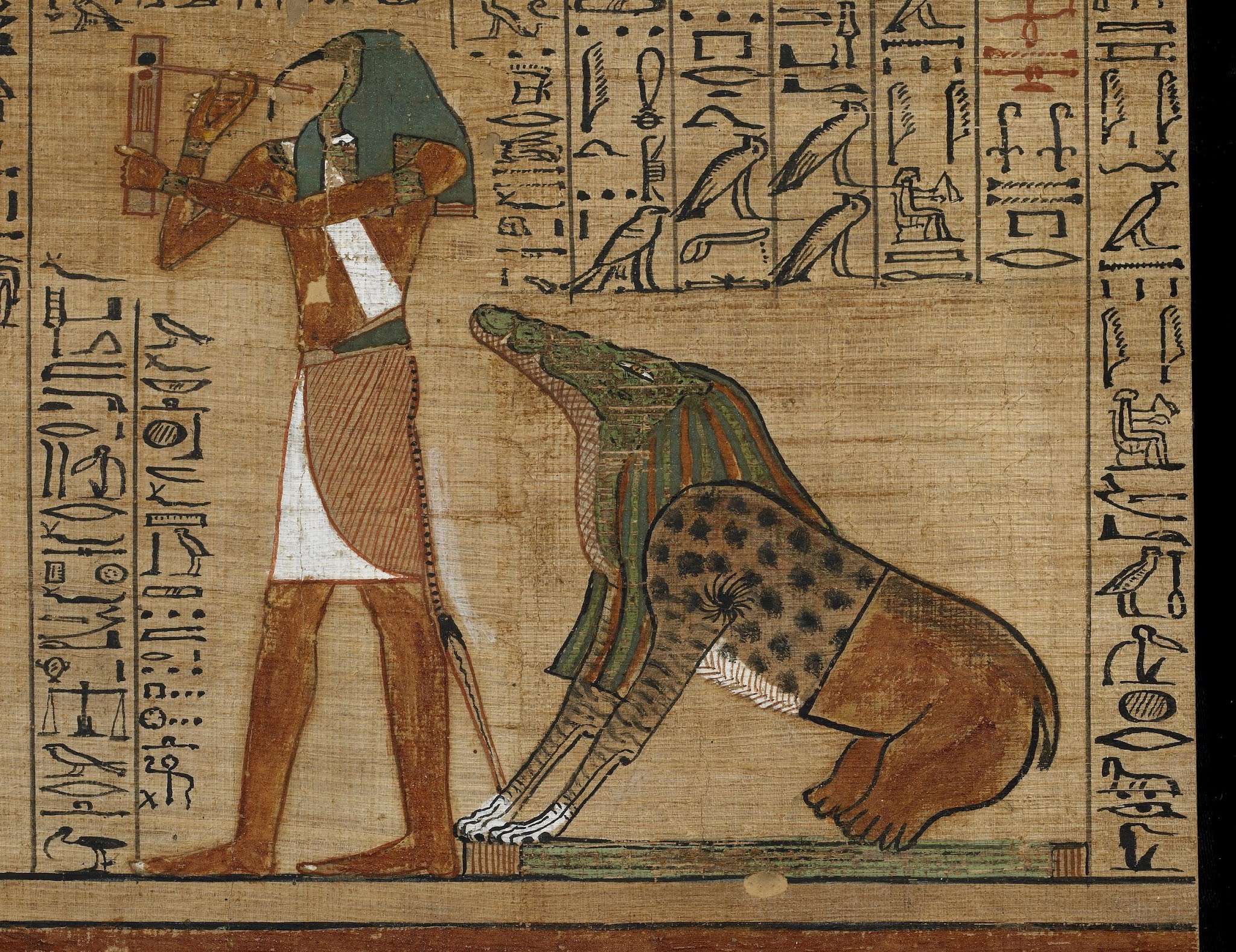
The Book of the Dead, which dates from the early New Kingdom (c. 1567-1320 BCE) [Armour, p. 10], is a primer for the recently deceased, a guide to understanding how to protect oneself from the dangers of the afterlife, how to get servants to do the required labor for the basic necessities (food, shelter, clothing), and especially how to behave and converse with the gods when one meets them (including Thoth, Anubis, Horus, and especially Osiris, the Lord of the Dead) as, for instance having to avoid the devouring of one’s heart by the demon goddess Ammit (whose body was part lion and hippopotamus, with the head of a crocodile).

The origin of The Book of the Dead, a compilation of numerous texts collected from fragments of papyri, is unknown and may be older than the Egyptian culture itself. The beliefs were possibly brought by immigrants or invaders. For the Egyptians, The Book of the Dead dealt with the realm of the mystic, and was controlled by the clergy.

Saqqara

The earliest known recorded versions of these passages and stories are usually referred to as the Pyramid Texts, beginning approximately 2345 BCE. The texts were taken from hieroglyphic inscriptions on the walls of various pyramids and tombs as ancient as the V and VI Dynasties in Saqqara (Memphis).

The Pyramid Texts, also known as the Heliopolitan Recension, were made up of 714 “utterances,” which had a number of functions, including “a funeral ritual and a ritual of mortuary offerings at the tomb, magical charms, very ancient rituals of worship, ancient religious hymns, fragments of old myths, and prayers and petitions on behalf of the dead king” [Breasted, 71]. The oldest texts are based on the dominant belief in the sun-god Ra (or Re). There is no mention of death in the early Pyramid Texts except in reference to the unworthy or a foe. The pharaoh did not die, bur rather went to join Ra and other gods in the celestial hereafter, becoming an equal with the gods.

Pyramid Texts

In the religious tradition of the solar faith [Breasted, pp. 65-93], there was no heaven or hell, but a heaven-like celestial place which the dead follower shared wit the gods, as one of their members. Osiris, on the other hand, “represented the realm and the dominion of death, to which the follower of Re was not delivered up” [Breasted, p. 93]. Osiris’ acceptance rose later in Egyptian mythology.

The tradition of Osiris as the king of the netherworld, which grew more popular with the collective community, originated in the Delta region of Northern Egypt (e.g., Alexandria) and “migrated up the Nile” [Breasted, p. 107]. This belief came in direct conflict with the State’s official religion of a celestial afterlife for the pharaoh and Ra. In much of the early Pyramid Texts, there was an open hostility towards the Osiris netherworld by the celestial hereafter, including some exorcisms to keep Osiris and his family (e.g., Isis, Horus, Set, Nephthys) from entering the solar tomb of the pyramid. Diametrically opposed, Ra ruled the afterlife of the sky and Osiris ruled the underground netherworld. In time, the popularity of the netherworld would overcome that of the celestial sun-god. Part of this acceptance was the belief in a resurrection by Osiris from death. As with Christianity, the possibility of a life-after-death meant a hard life might have its rewards (as well as punishments) in the next “world,” even if it meant as a servant to the pharaoh and his god companions.

Osiris and Maat

Also rising out of the Osiris myth was the Maat (the concept of truth and ethics, as she is the goddess of truth who judged the deceased and was the daughter of Ra; sometimes known as Ma’at) [Armour, pp. 161-162]. This trial increased the possibility of resurrection and regeneration if the heart of the deceased is lighter than the feather (or total obliteration in the jaws of Ammit, the “devouress,” if the heart outweighs the feather).

Through the found fragments in the pyramids at Saqqara and Heliopolis, it has become evident that as “the Pyramid Texts were eventually Osirianisied” [Breasted, p. 109], which included some editing of the Pyramid Texts by priests following each successive pharaoh, found throughout the chiseled hieroglyphics in a series of five pyramids.

The mortuary passages of this period were excavated exclusively in the royal tombs and were meant only for the kings and gods, and especially Ra. The Pyramid Texts were mostly absent in the tombs of the nobles [Breasted, p. 72].

The information encased within the Pyramid Texts were held closely by the priests of the Solar religion. What information they “published” was chiseled into tombs that were sealed, never to be opened or seen, thereby creating a cybernetic system to control the contents of knowledge that was the privilege of the priests, pharaohs, and gods. The priests and scribes were not permitted to use the information for their own “souls” to guide them to the celestial grounds.

Ra

The purpose of any cybernetic system is to effect control, and any system is vulnerable to entropy, including information. Over time – in this example, hundred of years – as the religion itself changed from a Ra-based center to the overwhelmingly popular Osiris-based center, as explained above, belief in Osiris became egalitarian: everyone dies. It is the favourability of the possibility of resurrection through Osiris that became the religious equalizing factor, among the peasant classes, though the nobles were the first to employ the mortuary texts [Moran: Note how writing was used to control death (entropy), first by the pharaohs, the by the nobles, later by everyone].

Through the centuries, as the priests slowly lost their thrall-like grip on the funerary texts, it became common to find sections of what has been collectively known as the Pyramid Texts painted on the many layers of the sarcophagi of nobles, who could afford to hire the priests to prepare the texts, and the highly trained scribes to do the writing and art work needed to prepare the to meet Thoth, on the path to join Osiris. At this stage the funerary texts are known as the Coffin Texts because of the location of their inscriptions. The time frame for this function is the Middle Kingdom, or XI to XIII Dynasties [Hope, 186].

Coffin Text

This period, approximately 2080 to 1650 BCE, saw the reunion of the Two Lands (North and South), private burials in mastabas and rock tombs, and the appearance of human-shaped sarcophagi. It was on these multi-layered anthropoid inner (wooden) and outer (stone) casings that the Coffin Texts began to appear.

There were still differences between the pharaoh’s burials and those of lower classes in the elaborateness of the ceremonies and the size of the burial place, and in the hearing of the priests to recite prayers and magic spells. However, the texts and rituals – and the resurrection – were shared by all. These texts were similar to the later Pyramid Texts, serving the same functions, but having been appropriated and adopted by the middle and official classes, they included the addition of “unofficial” popular mortuary literature. In theory, even the lowest class of peasants could be allowed to purchase the possibility of deification, but they could not afford the fee [Wilson, p. 117].

The influence of the previous Ra-based celestial religion was a strong foundation on which the beliefs were raised, so there was a coalescing of the celestial and netherworld afterlives. James Breasted states that “in the Pyramid Texts Osiris was lifted skyward, while in the Coffin Texts and The Book of the Dead, Re was dragged earthward” [Breasted, p. 237].

Much of the funerary literature of the time consisted of charms to protect the deceased from various dangers, such as having one’s head removed or the body decaying in the netherworld. As the priests found the selling of these charms quite lucrative, they became more creative about the possible dangers in the hereafter, continually writing new charms and spells that became part of the increasing Coffin Texts.

Due to the desegregation of the funerary texts to numerous classes of people, a need arose for a more substantial number of coffins to have the information inscribed upon them. No longer needing to be carefully chiseled on the stone walls of pyramids, stelas and tombs, as they had been for royal personages, the Coffin Texts, carved and written with pen-and-ink onto wood, were often copied from previous texts with “carelessness and inaccuracy, the effort being to fill up the planks with writing as fast as possible” [Breasted, p. 236]. Often the same chapters were rewritten a number of times for this purpose.

Whereas redundancy tends to defeat entropy, in this case the repetition did not overcome this process due to the lack of consistency in the information. This produced a text that proved more erratic and less understood, rather than clarified by repetition. The information, rather than evolving into precision, becomes superfluous due to the dissimilarities in story and detail. At the early stages of the texts, much of the content was dogmatic rhetoric not wholly understood by most who used it; as it was copied more and more inaccurately, it was increasingly misunderstood and communicated by rote. It is this lack of concordant detail that proves the entropic character of the textual information.

The final stage of the funerary text, the aforementioned The Book of the Dead, was made possible by the rise of the use of papyrus paper which was relatively inexpensive and, more importantly, portable. As the centuries passed, it was becoming more impractical for nobles to have large tombs built, especially for those of the lower classes and of lesser wealth. As the population grew, space became more precious and less affordable, both economically and geographically.

Book of the Dead: Anubis weighs heart and feather, 
while Thoth and Ammit watch and wait to left,
with negative confession judges above

One of the inclusions to the funerary texts of this period is a higher sense of moral vision to achieve divine recognition and a joyous afterlife. Besides Thoth, Anubis and other principal gods of judgment, there were now forty-two additional judges who had names such as “Bone Breaker that Came out of Hierakonpolis” and “Blood Eater that Came out of the Place of Execution” [Breasted, p. 257]. For these gods arose what became known as the negative confession, in which the deceased must state one confession to each of the forty-two judges (e.g., “I did not rob,” “I did not make falsehoods in the place of truth”) [Breasted, p 257]. The newly departed must know the names of each of the gods verbatim, and chapters of The Book of the Dead were produced by the priests to guide the deceased’s progress through these trials.

The term “Book of the Dead” is actually a misnomer, as the “guide” is not actually a “book” but a collection of random chapters to prepare the deceased for the next world, as well as religious invocations and ceremonial prayers.  Written on papyrus scrolls ranging from 20 to 90 feet in length, 14 to 18 inches in width, and containing from 75 to well over 100 chapters [Budge, p. xxx], the scrolls were usually placed between the legs of the deceased before mummification.

The popularity of the papyrus invocations was so widespread that priests and scribes pre-prepared scrolls and later filled in the names of the deceased, such as with the most complete copy of The Book of the Dead presently known, called The Papyri of Ani, which is housed in the British Museum. Dating from the XVIII Dynasty (1500-1400 BCE), it was found at Thebes in the 19th Century CE.

As with the Pyramid and Coffin Texts, there is no fixed order for the vignettes; it was up to the scribes or priests to choose which selections would be included and in which order. The amount of money paid determined how many chapters would comprise a particular roll (The Papyri of Ani contained 186 chapters and was 78 feet long [Budge, pp. cxliii-clii]).

Due again to economics, one of the major changes in the evolution of the Pyramid texts to The Book of the Dead was the addition of the ceremonial chapters.  Previously, priests and mourners would be hired to sing prayers and hymns for the deceased. Through the entropic necessity of catering to a mass population, the texts became more common, less specified, and less complex. Much of the ceremonial texts were eventually removed. What remained of the highly ritualistic mortuary texts were the prayers and chants to be said by the deceased themselves in the netherworld [Budge, p. xxx].

As well as the religious significance of The Book of the Dead, the technological aspects leading up to the mass use affected is “time binding.” [McLuhan, p. 37] [Moran: McLuhan is here using a concept he learned from Harold Innis’ The Bias of Communication], inherently cybernetic due to its resistance to modification, as well as low accessibility to the general population, resulting from its lack of mobility. A high degree of skill, artistic endeavor, and training (“technic”) were necessary to become a scribe who worked with a stone medium. This was especially true concerning the funeral carvings, which were located inside sealed tombs. Even in many temples, the inner chambers were sealed to all but a hierarchy of priests, with only a solitary high priest(ess) allowed into the core cell.

Although McLuhan refers to the hieroglyphic form of writing as a cool medium, the use of papyri caused its “hotting up,” thereby “unifying spaces horizontally, both in political and entertainment empires” [McLuhan, p. 37]. This is also true for religious – as well as funerary – texts. As the information pluralized, the knowledge of the texts centralized a larger portion of the civilization. The accessibility of the papyri medium resulted in a speeding up of communication technique, enabling the religious authority a means to extend further throughout the kingdom [McLuhan, p. 96].

In this case, a hotter medium, or technology, can dominate over an older, cooler one. Through the rise of the use of papyri, the spread of the information of the possibility of a life-after-death as presented in The Book of the Dead was no exception. Despite this outgrowth, the Egyptian culture managed to survive for many centuries beyond the introduction of the revolutionary process of recording and transporting information on a portable medium. Partially, this was due to the need for the development of transportable culture [Ellul, p. 116]. As the Egyptian civilization crept upriver on the Nile, further from the Delta and toward Aswan and beyond, the stories of the gods and an Osirian netherworld came with it.

Despite the flexibility of content imparted by the copied text, which exposes the communication method to an entropic loss of information, part of the reason why the culture remained strong for so many millennia, was the older, cooler medium of “writing” hieroglyphics on stone. Since some information was chiseled in rock, some consistency was preserved in the stories that remained throughout most of the texts. This was solidified more after the rise of the Osiris myth since it was not until after Ra was superseded that the texts were preserved in more public places (e.g., obelisks, or stelas), rather than in the sealed tombs.

Through the long history of Egypt’s fascination with the soul (ba) after death, the leading cause of change in the stages of culture pertaining to the mortuary texts was not the advancement of hieroglyphic writing, but the technological advancement of the medium upon which it was stored. Starting on static stone, moving to painted and cared wood, and then to transportable papyrus, the dissemination of information, which started from the aloof royalty alone, was able to reach the mass population. Paradoxically, despite the many changes, growth, and “hotting up” of this culture, it was able to maintain some level of consistency, somewhat holding at bay the ever-raging tides of entropy, by having at its core a heart of stone.

Bibliography

Armour, Robert A. (1986). Gods and Myths of Ancient Egypt. Cairo: The American University in Cairo Press.

Breasted, James Henry (1933). The Dawn of Consciousness. New York: Charles Scribner’s Sons.

Budge, E.A. Wallis (1967). The Book of the Dead… The Papyrus of Ani in the British Museum: The Egyptian Text with Interlinear Transliteration and Translation, a Running Translation, Introduction, Etc. New York: Dover Publications (Reproduction of 1895 edition).

Campbell, Jeremy (1982). Grammatical Man: Information, Entropy, Language, and Life. New York: Simon & Schuster, Inc.

DeFleur, Melvin L. and Sandra Ball-Rokeach (1966). Theories of Mass Communication. New York: David McKay Company, Inc.

Ellul, Jacques (1964). The Technological Society. New York: Vintage Books.

Hope, Murray (1984). Practical Egyptian Magic. New York: St. Martin’s Press.

Ions, Veronica (1982). Library of the World’s Myths and Legends: Egyptian Mythology. New York: Peter Bedrick Books.

McLuhan, Marshall (1964). Understanding Media: The Extensions of Man. New York: Penguin Books.

Quirke, Stephen and Jeffrey Spencer, Eds. (1992). The British Museum Book of Ancient Egypt. New York: Thames and Hudson.

Wilson, John A. (1951). The Burden of Egypt: An Interpretation of Ancient Egyptian Culture. Chicago: The University of Chicago Press.


Wednesday, May 5, 2021

MTV: Watching Rock’n’Roll History [1983]

By Julia Masi / FFanzeen, 1983
Introduction © Robert Barry Francos / FFanzeen, 2021
Images from the Internet


This article was originally printed in FFanzeen, issue #10, dated 1983, by FFanzeen Managing Editor, Julia Masi.

There is a maxim in Media Ecology theory that states that when a technology is introduced to a culture, it does not change any one thing, it changes everything. With the state of MTV these days, it’s hard to fathom just how revolutionary MTV was during its heyday. You know, when they actually played music rather than be a boring, same-old-same-old reality television station; “Big Brother”? More like “Why Bother”?

How did MTV chance the face of music since its inception in 1981? It introduced a lot of music to the culture that would have normally been missed. Ultravox is mentioned below as an example, but it went well beyond that. But as another Media Ecological bon mot goes, every positive thing a technology brings, there is an equally powerful negative that comes with it that is unforeseen (what Marshall McLuhan called “Reave View Mirror Thinking”). In this case, it became such a juggernaut that if a band didn’t have a professional-level video, it went unnoticed on the station. As it became bigger and more powerful, other stations would try to show music videos (such as “New York Hot Tracks” (WABC), “Friday Night Videos” (WNBC), “Night Flight”(USA Network), and U68 in New York and V66 in Boston), but MTV insisted on exclusivity or nothing.

As much as J.J. Jackson talks below about MTV being more “progressive” than radio, yeah, it started that way, but it was not long before you saw the same videos over and over, making it merely a visual Top-40. Also, Jackson posits about how people were into the looks of bands. MTV actually became a leader in this due to its visual nature. If the band was not “pretty,” odds were they were not seen.

As MTV became more popular, the videos also started to change to try and try harder to catch the eye. The editing quickened from a few seconds at a time, to rapid-fire, shortening the attention span of its audience. This quickening of edits would influence feature films, video games, and so many other aspects. In short, MTV became everything it proposed to be against in this article.

What ended MTV as it was when this article came out? In my opinion, it was their fight against R&B music. Other than the likes of Michael Jackson and a few other artists, it’s could have been called WhiteTV. I can’t remember if it was an actual lawsuit or the threat of one, that they added hip hop and rap to their roster, introducing it to a white, suburban audience. This was also ground breaking in spreading rap beyond its East and West Coast bailiwicks. But as much as it turned on a new audience to the style, it also lost a lot of its older audience, and eventually its stock just couldn’t mandate its shareholder profit demand. MTV became…something else. Sure, it began VH1, MTV2, MTV Classics, and the like, but it never really held the sway it once did.  – Robert Barry Francos, 2021.


Slightly more than a year ago, Warner Amex Communications set the cable industry on its ear when they launched MTV, Music Television, the most unique and successful concept ever to hit the airwaves. Offering 24 hours, 7 days a week, of non-stop rock’n’roll music, videos, interviews, concerts and movies, MTV has captured the hearts and viewing time of the 12 to 36 year-old market in over six million homes. And as it sheds a much deserved spotlight on up and coming music and video artists, it also gives a boost to the sagging sales for the record companies.

MTV sprang forth from the dreams and dedication of Bob Pitman and John Lack. Pitman, Senior Vice President of Warner Amex and a veteran of commercial radio, had always wanted to do something with music on television, but felt stagnated by the old format of simulated concerts or just watching kids dancing to records. As more and more bands began making videos, Pitman became inspired with the concept of MTV. He realized that music television could be a viable program at Warner Amex, and was willing to experiment with its possibilities.

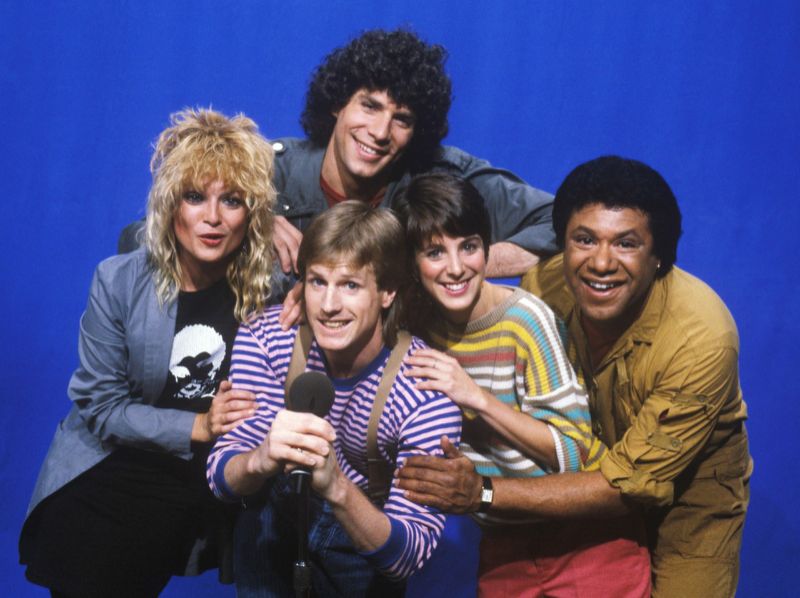
JJ Jackson, Nina Blackwood, Mark Goodman, Martha Quinn, Alan Hunt
He spent months researching his target audience before recruiting a dedicated crew of 23 technical people, three directors and five “perfect” personalities to act as VJs – Video Jockeys – to host particular segments of the programming day, as well as special interviews, concerts and MTV parties. Each of the VJs, Nina Blackwood, J.J. Jackson, Mark Goodman, Alan Hunt and Martha Quinn, have either a background in radio or theater. But the common denominator among everyone at MTV is the endless enthusiasm and unlimited energy that they’re willing to pour into the project.

Executive Producer Julian Goldberg believes that MTV is “advancing the speed at which cable was going to go anyway. One of the promises of cable,” he claims, “was that it would not be an imitation of the networks. You can have 100 channels and each one could be a specific channel. You could have a channel of comedy all day, a channel of finance, a channel of cooking all day. But people were afraid to tackle that and MTV, and other Warner Amex channels, The Movie Channel and Nickelodeon (programming for children) are the first to actually take on one specific audience all day long. We don’t want you to tune in if you want the news or sports information, or financial information. We want you to tune in when you want music. And we don’t mind if you leave us a while because we know that you’ll always come back for the music because that’s what we give you 24 hours a day, every day.”

Before he made the move to MTV, Goldberg was happily employed as a freelance Field Producer for a number of magazine programs, including “Kids Are People Too,” “Hour Magazine,” “Real People,” and “Good Morning America.” Although he’s given to working 10 hours a day, 5 days a week, he still possesses an elegant demeanor and athletically trim physique that would be just as at home in front of the camera, as in a Brooks Brothers ad. “I came over as a consultant to the television end,” he recalls, “just to get the visuals together as a producer, without the producer’s title. I liked it so much, and was so blown away by how innovative it was, and the opportunity to build something that was new and completely different, that I’ve stayed.” He is extremely proud that MTV “has the fastest growth of any cable system anywhere, ever. We’re getting 25 million letters a week from viewers, which is unprecedented by anything anybody has ever done. And, at the same time, we’re pulling it off. Nobody’s ever tackled anything for 24 hours a day where they’re really producing it all the time and getting it on the air. A telethon is the only thing I can think of. And that only once a year. We’re doing it every day and we’ll continue to do it far, far in to the future.”

Actress Nina Blackwood first heard about MTV while wrapping up her work on the film Vice Squad. “I first saw an advertisement in one of the trades for this new music channel and quickly sent in my resume,” remembers the sultry blonde. She’s been involved with some form of rock’n’roll for quite a while, having made a bit of a name for herself singing and playing rock’n’roll harp in clubs around Los Angles. “From my outlook, it’s an obvious metamorphosis of the industry. Video is a logical progression. People really seem to watch hours and hours of it. And the artists are benefiting from the sales. I love video. I went home on vacation and sat up until dawn with my friend who works on them. I just did the interworks, with ideas. I’ve never actually done the editing but I know what it takes to be done. And I know that your eyes go and everything starts looking like a video.” Nina, who is an art buff, is pleased with the way MTV offers outlets for those who “have really been pushed aside for a long while. They really starve, literally, and can get jobs with videos, by doing set designs.

“Russell Mulcahy, he’s an artist who has done the Ultravox videos, and they are just gorgeous. People I know that are that kind of artist, are getting involved in video. It’s a very valid form of art. It’s also a retrospect going back to opera, in a funny way. When opera was in its heyday it was the story with the music. It’s not the same type of singing, but it’s the same type of thing with the technical aspect.”

Alan Hung came to MTV by way of the Shakespearean theatre and television commercials. With his quick open smile and smooth Southern drawl, he doesn’t have to try to be charming. “I don’t think video will have an adverse effect on theatre or film,” he states, “or that the entertainment media has an effect on video. In other words, you’re getting all these film directors that are really starting to get involved, but maybe as a sideline, some as a full-time thing. Russell Mulcahy is a Video Director / Producer that has been talked about a lot, and he’s done some super videos that are film quality. Actually, he does them in film. So, we’ll see the film industry or theatre side of things; there are certainly a couple of clips that are theatrical in that sense. The Tubes do theatrical stage work in their shows and that transfers to video.

“It will all help video; it will make the rock’n’roll artist come out of their shell a little bit more, if they’re gonna do video work. And a lot of them like the chance. They like that thought of ‘now I get to act a little,’ and in some concept, like storyline videos, they play a little character. But I think video will come from theater, or from quality film rather than video having an effect on the others. Theater will be what they are, regardless of where this video thing goes. But video is gonna take off because of its roots.

“If they get the television screen down, like they think they will, I’ve heard all sorts of things about holography and three-dimensional television. I think that certainly is going to come. And we’ll have laser TVs or whatever. Video you can’t say anything, but it’s gonna be like the thing. It’s gonna be up there with the films and the theatre. And video music is ‘here to stay,’ as they say. A cliché.

“You’re gonna get artists with whole albums, you know, like Blondie and Olivia Newton-John. There’s probably a financial problem with that right now in the record industry. They just can’t afford to put the money into that. And they’re not quite sure of the market yet. MTV is starting to prove that there is a market for this thing called viewing music, video music. So they’re starting to see the advantages of not only marketing the records through radio stations, but making videos of the artists as well, ‘cause that doubles the pleasure, I guess. Not only to hear your favorite artist, but to see him, too, in stereo.

“I think video music is going out the top of the roof. There’s no stopping it. Everything is going to be visual. You’re gonna have everything right in your own home. And if you can see it as well as listen to it, why not? Radio may take a different form, but people will always want to listen to the radio. Sometimes you may feel you’re inundated with too much by all your senses and you might want to just rely on your ears. I still think it’s a whole lot of fun to listen to a story told on the radio and invent your own imagery. There will still be a place for radio because certainly we’ll still have a car and people won’t want to watch television while they’re driving. As far as the kind of music that will be played on radio, it’s hard to say. I don’t think it’s going to just be Top-40 AM radio. It will always have a talk format. But I still believe there is an audience for music radio. (MTV) won’t be the death of the radio.”

The very first nationwide VJ was Mark Goodman. A former Philadelphia disc jockey, Mark interrupted his 7-year stint in radio to be part of MTV. Although soft-spoken and seemingly sincere, you can’t help but notice the spirit of a frustrated comedian in his bright brown eyes. When pushed for an answer, he admits that he “sort of” plays an instrument. “I play the stereo,” he quips. “I used to play the drums; in Junior High, I was in a band called Mach Five. We played one gig and I decided, ‘This is not for me’: small problem with the beat. Just a minor thing. So I figured, I’m out of this. I love music. What am I going to do to make my living at it? So I became a DJ, and this was the next step. The rest is rock history!

“It’s gonna grow and mean the birth of a new kind of artist and a new kind of musician who will think in terms of a broader concept than other artists have. I don’t think it’s the death of radio; I think it’s going to do a wonder for radio because television, just by its nature, is just more crass. I can’t remember which  side of the brain – I think it’s the right side - that’s working harder when you need your associate functions, your imaginative functions; when you read something you have to use that side of your brain to put things together to give you a picture. Television shuts that off. Here it is – blah! That’s both a blessing and a curse at the same time. That’s why I’m checking into video art, because all of a sudden then it starts to work outside the brain.

“Radio is magic in and of itself. Because it’s only audio, it’s magic to me. We’re never going to replace that. (MTV) is the next step. It can be the future of rock’n’roll. I think it can give it this shot in the arm that it needs. I think we’re gonna shake up the networks. Cable TV, in general, is gonna shake up the networks, and us specifically, because we have people watching us in the middle of the night. They’re (network executives) thinking they’d better do something at night. We’ve got people watching. Where it goes, for me is another question.”

Petite, blue-eyed Martha Quinn began her broadcasting career as the soul DJ at the New York University Radio Station (WNYU), “the magic of radio.” Her musical tastes include “everything from folk to funk,” and the variety of MTV’s videos is one of the reasons she’s so proud to be a VJ.

“I really believe your cable dial will be similar to your radio dial in that you can find these kinds of formats. We will by no means be the only one. We can always say we were the world’s first. As far as what it will do to radio, I think it will always find a niche. You cannot take MTV with you in your car. You can’t run around the block listening to MTV on your headphones. You just can’t do it. You’d run into somebody! It’s the same thing when television came in: people thought it would destroy radio. They just found their own place.”

J.J. Jackson [d. 2004, age 62 – RBF, 2020] had been a rock’n’roll DJ for 13 years. Most of that time he spent in Los Angeles, where he made a name for himself as a pioneer in FM radio. He was attracted to MTV because it reminded him of everything that was good about Progressive Radio. “One of the problems, what’s missing today, is that kids don’t’ know enough about music as it was before. They think that guitar started and stops with Jimmy Page. And it really didn’t. And if they’d listen to what Page had listened to they’d know more about their own instruments, but that’s neither here nor there.

“American kids today are really uninformed. It’s like, my record library, which is really quite extensive, sometimes you walk into a place where you have too much choice, therefore you don’t make a very good one. That’s why I think the English have dominated the music scene for so long, because they have very little choice in radio and so little money to play with, that it means an awful lot more to them. Having been over there a number of times, when they go out to buy a record, they don’t buy it because Joe Blow is cute. Where in this country, an awful lot of your success depends on how good looking you are, not how well you play your instrument. And I’m not putting America down, it’s just that sometimes it’s just too much.

“I think that’s why the music came to a head in the late ‘60s. If nothing else, what the hippies gave to the kids, which is rarely mentioned, was how to appreciate music. Which, unfortunately, has been bastardized to the point where kids don’t know anymore, because FM radio has gotten very much like Top-40 radio was in the ‘60s.

“When I was doing FM at WBCN [Boston], it was free form radio. The only record a disc jockey knew he was going to play was the first record, and that’s because he had it in his head. From then on it was a spin-off. He didn’t care about names or labels or whose record was selling like hotcakes in Seattle. You played it ‘cause you liked it, or whatever.

“Also, you could build themes. You could play Django Reinhart and Stockhausen and Mozart, and as the night progressed, evolve into ELP. Therefore you could entertain and be quite educational.

“A good example of what I’m talking about is, you take Led Zeppelin’s second album, where Robert Plant says, ‘Squeeze my lemon,’ which, when it came out, was a very salacious line, which it is no longer. Then a kid could learn on a radio station like WBCN that it wasn’t an original line, but that it was taken from Robert Johnson, and not the Robert Johnson we know now with “Read Hot,” but the Robert Johnson from 1936, an old Black blues star, because Plant’s very much into those kinds of people: Elmore James and Robert Johnson. That (line) was taken from an old 1936 song. You could play that one line from the record and go into Led Zeppelin and the kids not only become entertained but educated. And the kid learns that there really is nothing new under the sun, and that all those riffs have been done before.

“It’s a shame that we’re living in a time when you can turn on the radio, with the possible exception of WNEW, and hear an Elvis Presley, and not hear an Elmore James, not hear a Muddy Waters, on a so-called rock station.

“One of the things I do take pride in MTV is that it is more progressive than radio stations are; it truly is. Where else are you going to find Spandau Ballet on the radio stations in New York City? Spandau Ballet is no big deal for us. We play a lot of unsigned bands, New Wave bands, and mainstream bands. Since video is fairly new and there’s not that many things you can go back to, radio stations, and in this case television stations, should reflect what happened yesterday, because that has a great deal to do with what’s happening today. And today has a great deal to do with what will happen tomorrow. And if you can reflect that in your programming, and at the same time entertain as well as inform, then you’re giving them the whole ball of wax.

“I think we’re doing a service that radio doesn’t do any more. It’s easier to get a video on MTV than it is to get your record played on most radio stations in the country. I’m really proud that MTV is that progressive, but I’m really sorry for the state of radio.

“It’s nice to get letters in from, say, the Midwest, that has been a bastion of supporting bands like REO Speedwagon and basic mainstream rock’n’roll bands, saying ‘I thought I hated New Wave,’ because they thought New Wave was a term that appealed to everything from Black Flag and X, to Fear, all the way over to Ultravox. Maybe they’ve found that they can’t handle Black Flag, but they can handle Ultravox. Or some of them can handle Black Flag. But that’s the whole thing, once they see them; Ultravox’s ‘Vienna’ is an incredible piece of work and I think that bands will do an awful lot better when they come through America again because of video.”

And from the looks of things, America seems to think that video equals MTV.