By Julia Masi / FFanzeen, 1983
Introduction © Robert Barry Francos / FFanzeen, 2021
Images from the Internet

This article was originally printed in FFanzeen, issue
#10, dated 1983, by FFanzeen Managing
Editor, Julia Masi.
There is a maxim in Media Ecology theory that states that when a
technology is introduced to a culture, it does not change any one thing, it
changes everything. With the state of MTV these days, it’s
hard to fathom just how revolutionary MTV was during its heyday. You know, when
they actually played music rather
than be a boring, same-old-same-old reality television station; “Big Brother”? More
like “Why Bother”?
How did MTV chance the face of music since its inception in 1981? It
introduced a lot of music to the culture that would have normally been missed. Ultravox
is mentioned below as an example, but it went well beyond that. But as another
Media Ecological bon mot goes, every positive thing a technology brings, there
is an equally powerful negative that comes with it that is unforeseen (what
Marshall McLuhan called “Reave View Mirror Thinking”). In this case, it became
such a juggernaut that if a band didn’t have a professional-level video, it went
unnoticed on the station. As it became bigger and more powerful, other stations
would try to show music videos (such as “New York Hot Tracks” (WABC), “Friday
Night Videos” (WNBC), “Night Flight”(USA Network), and U68 in New York and V66
in Boston), but MTV insisted on exclusivity or nothing.
As much as J.J. Jackson talks below about MTV being more “progressive”
than radio, yeah, it started that way, but it was not long before you saw the
same videos over and over, making it merely a visual Top-40. Also, Jackson posits
about how people were into the looks of bands. MTV actually became a leader in
this due to its visual nature. If the band was not “pretty,” odds were they
were not seen.
As MTV became more popular, the videos also started to change to try and try
harder to catch the eye. The editing quickened from a few seconds at a time, to
rapid-fire, shortening the attention span of its audience. This quickening of
edits would influence feature films, video games, and so many other aspects. In
short, MTV became everything it proposed to be against in this article.
What ended MTV as it was when this article came out? In my opinion, it
was their fight against R&B music. Other than the likes of Michael Jackson
and a few other artists, it’s could have been called WhiteTV. I can’t remember
if it was an actual lawsuit or the threat of one, that they added hip hop and
rap to their roster, introducing it to a white, suburban audience. This was
also ground breaking in spreading rap beyond its East and West Coast bailiwicks.
But as much as it turned on a new audience to the style, it also lost a lot of
its older audience, and eventually its stock just couldn’t mandate its shareholder
profit demand. MTV became…something else. Sure, it began VH1, MTV2, MTV
Classics, and the like, but it never really held the sway it once did. – Robert Barry Francos, 2021.

Slightly more than a year ago, Warner
Amex Communications set the cable industry on its ear when they launched MTV,
Music Television, the most unique and successful concept ever to hit the
airwaves. Offering 24 hours, 7 days a week, of non-stop rock’n’roll music,
videos, interviews, concerts and movies, MTV has captured the hearts and
viewing time of the 12 to 36 year-old market in over six million homes. And as
it sheds a much deserved spotlight on up and coming music and video artists, it
also gives a boost to the sagging sales for the record companies.
MTV sprang forth from the dreams and dedication
of Bob Pitman and John Lack. Pitman, Senior Vice President of Warner Amex and a
veteran of commercial radio, had always wanted to do something with music on
television, but felt stagnated by the old format of simulated concerts or just
watching kids dancing to records. As more and more bands began making videos,
Pitman became inspired with the concept of MTV. He realized that music
television could be a viable program at Warner Amex, and was willing to
experiment with its possibilities.
 |
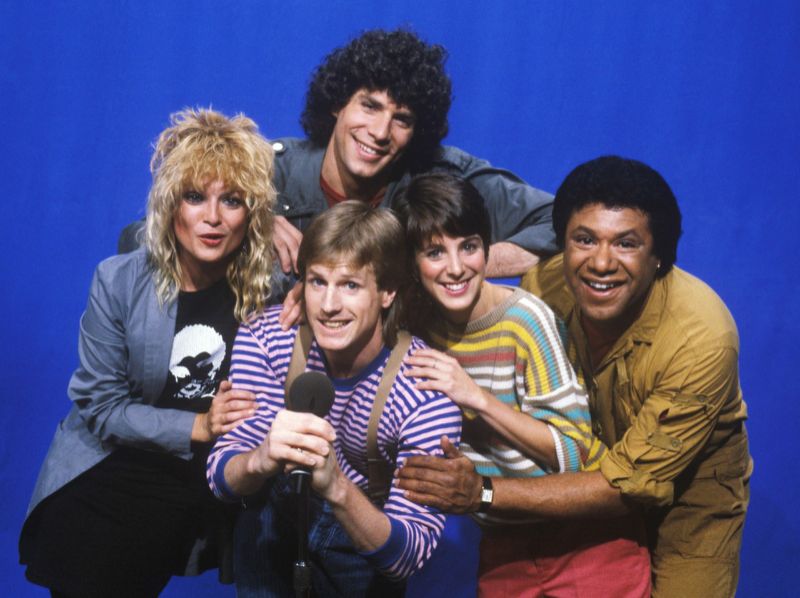
| JJ Jackson, Nina Blackwood, Mark Goodman, Martha Quinn, Alan Hunt |
He spent months researching his
target audience before recruiting a dedicated crew of 23 technical people,
three directors and five “perfect” personalities to act as VJs – Video Jockeys
– to host particular segments of the programming day, as well as special
interviews, concerts and MTV parties. Each of the VJs, Nina Blackwood, J.J.
Jackson, Mark Goodman, Alan Hunt and Martha Quinn, have either a background in
radio or theater. But the common denominator among everyone at MTV is the
endless enthusiasm and unlimited energy that they’re willing to pour into the
project.
Executive Producer Julian Goldberg
believes that MTV is “advancing the speed at which cable was going to go
anyway. One of the promises of cable,” he claims, “was that it would not be an
imitation of the networks. You can have 100 channels and each one could be a
specific channel. You could have a channel of comedy all day, a channel of
finance, a channel of cooking all day. But people were afraid to tackle that
and MTV, and other Warner Amex channels, The Movie Channel and Nickelodeon
(programming for children) are the first to actually take on one specific
audience all day long. We don’t want you to tune in if you want the news or
sports information, or financial information. We want you to tune in when you
want music. And we don’t mind if you leave us a while because we know that
you’ll always come back for the music because that’s what we give you 24 hours
a day, every day.”
Before he made the move to MTV,
Goldberg was happily employed as a freelance Field Producer for a number of
magazine programs, including “Kids Are People Too,” “Hour Magazine,” “Real
People,” and “Good Morning America.” Although he’s given to working 10 hours a
day, 5 days a week, he still possesses an elegant demeanor and athletically
trim physique that would be just as at home in front of the camera, as in a
Brooks Brothers ad. “I came over as a consultant to the television end,” he
recalls, “just to get the visuals together as a producer, without the producer’s
title. I liked it so much, and was so blown away by how innovative it was, and
the opportunity to build something that was new and completely different, that
I’ve stayed.” He is extremely proud that MTV “has the fastest growth of any
cable system anywhere, ever. We’re getting 25 million letters a week from
viewers, which is unprecedented by anything anybody has ever done. And, at the same
time, we’re pulling it off. Nobody’s ever tackled anything for 24 hours a day
where they’re really producing it all the time and getting it on the air. A
telethon is the only thing I can think of. And that only once a year. We’re
doing it every day and we’ll continue to do it far, far in to the future.”

Actress Nina Blackwood first heard
about MTV while wrapping up her work on the film Vice Squad. “I first saw an advertisement in one of the trades for
this new music channel and quickly sent in my resume,” remembers the sultry
blonde. She’s been involved with some form of rock’n’roll for quite a while,
having made a bit of a name for herself singing and playing rock’n’roll harp in
clubs around Los Angles. “From my outlook, it’s an obvious metamorphosis of the
industry. Video is a logical progression. People really seem to watch hours and
hours of it. And the artists are benefiting from the sales. I love video. I
went home on vacation and sat up until dawn with my friend who works on them. I
just did the interworks, with ideas. I’ve never actually done the editing but I
know what it takes to be done. And I know that your eyes go and everything
starts looking like a video.” Nina, who is an art buff, is pleased with the way
MTV offers outlets for those who “have really been pushed aside for a long
while. They really starve, literally, and can get jobs with videos, by doing
set designs.
“Russell Mulcahy, he’s an artist who
has done the Ultravox videos, and they are just gorgeous. People I know that
are that kind of artist, are getting involved in video. It’s a very valid form of
art. It’s also a retrospect going back to opera, in a funny way. When opera was
in its heyday it was the story with the music. It’s not the same type of
singing, but it’s the same type of thing with the technical aspect.”
Alan Hung came to MTV by way of the Shakespearean
theatre and television commercials. With his quick open smile and smooth Southern
drawl, he doesn’t have to try to be charming. “I don’t think video will have an
adverse effect on theatre or film,” he states, “or that the entertainment media
has an effect on video. In other words, you’re getting all these film directors
that are really starting to get involved, but maybe as a sideline, some as a
full-time thing. Russell Mulcahy is a Video Director / Producer that has been
talked about a lot, and he’s done some super videos that are film quality.
Actually, he does them in film. So, we’ll see the film industry or theatre side
of things; there are certainly a couple of clips that are theatrical in that sense.
The Tubes do theatrical stage work in their shows and that transfers to video.
“It will all help video; it will make
the rock’n’roll artist come out of their shell a little bit more, if they’re
gonna do video work. And a lot of them like the chance. They like that thought
of ‘now I get to act a little,’ and in some concept, like storyline videos,
they play a little character. But I think video will come from theater, or from
quality film rather than video having an effect on the others. Theater will be
what they are, regardless of where this video thing goes. But video is gonna
take off because of its roots.
“If they get the television screen
down, like they think they will, I’ve heard all sorts of things about
holography and three-dimensional television. I think that certainly is going to
come. And we’ll have laser TVs or whatever. Video you can’t say anything, but
it’s gonna be like the thing. It’s
gonna be up there with the films and the theatre. And video music is ‘here to stay,’
as they say. A cliché.
“You’re gonna get artists with whole
albums, you know, like Blondie and Olivia Newton-John. There’s probably a
financial problem with that right now in the record industry. They just can’t
afford to put the money into that. And they’re not quite sure of the market
yet. MTV is starting to prove that there is a market for this thing called
viewing music, video music. So they’re starting to see the advantages of not
only marketing the records through radio stations, but making videos of the
artists as well, ‘cause that doubles the pleasure, I guess. Not only to hear
your favorite artist, but to see him, too, in stereo.
“I think video music is going out the
top of the roof. There’s no stopping it. Everything is going to be visual.
You’re gonna have everything right in your own home. And if you can see it as
well as listen to it, why not? Radio may take a different form, but people will
always want to listen to the radio. Sometimes you may feel you’re inundated
with too much by all your senses and you might want to just rely on your ears.
I still think it’s a whole lot of fun to listen to a story told on the radio
and invent your own imagery. There will still be a place for radio because
certainly we’ll still have a car and people won’t want to watch television while
they’re driving. As far as the kind of music that will be played on radio, it’s
hard to say. I don’t think it’s going to just be Top-40 AM radio. It will
always have a talk format. But I still believe there is an audience for music
radio. (MTV) won’t be the death of the radio.”
The very first nationwide VJ was Mark
Goodman. A former Philadelphia disc jockey, Mark interrupted his 7-year stint
in radio to be part of MTV. Although soft-spoken and seemingly sincere, you
can’t help but notice the spirit of a frustrated comedian in his bright brown
eyes. When pushed for an answer, he admits that he “sort of” plays an
instrument. “I play the stereo,” he quips. “I used to play the drums; in Junior
High, I was in a band called Mach Five. We played one gig and I decided, ‘This
is not for me’: small problem with the beat. Just a minor thing. So I figured,
I’m out of this. I love music. What am I going to do to make my living at it?
So I became a DJ, and this was the next step. The rest is rock history!
“It’s gonna grow and mean the birth
of a new kind of artist and a new kind of musician who will think in terms of a
broader concept than other artists have. I don’t think it’s the death of radio;
I think it’s going to do a wonder for radio because television, just by its
nature, is just more crass. I can’t remember which side of the brain – I think it’s the right
side - that’s working harder when you need your associate functions, your
imaginative functions; when you read something you have to use that side of
your brain to put things together to give you a picture. Television shuts that
off. Here it is – blah! That’s both a
blessing and a curse at the same time. That’s why I’m checking into video art,
because all of a sudden then it starts to work outside the brain.
“Radio is magic in and of itself.
Because it’s only audio, it’s magic to me. We’re never going to replace that.
(MTV) is the next step. It can be the future of rock’n’roll. I think it can give
it this shot in the arm that it needs. I think we’re gonna shake up the networks.
Cable TV, in general, is gonna shake up the networks, and us specifically,
because we have people watching us in the middle of the night. They’re (network
executives) thinking they’d better do something at night. We’ve got people
watching. Where it goes, for me is another question.”
Petite, blue-eyed Martha Quinn began
her broadcasting career as the soul DJ at the New York University Radio Station
(WNYU), “the magic of radio.” Her musical tastes include “everything from folk
to funk,” and the variety of MTV’s videos is one of the reasons she’s so proud
to be a VJ.
“I really believe your cable dial
will be similar to your radio dial in that you can find these kinds of formats.
We will by no means be the only one. We can always say we were the world’s
first. As far as what it will do to radio, I think it will always find a niche.
You cannot take MTV with you in your car. You can’t run around the block
listening to MTV on your headphones. You just can’t do it. You’d run into
somebody! It’s the same thing when television came in: people thought it would destroy
radio. They just found their own place.”
J.J. Jackson [d. 2004, age 62 – RBF, 2020] had been a rock’n’roll DJ for 13
years. Most of that time he spent in Los Angeles, where he made a name for
himself as a pioneer in FM radio. He was attracted to MTV because it reminded
him of everything that was good about Progressive Radio. “One of the problems,
what’s missing today, is that kids don’t’ know enough about music as it was
before. They think that guitar started and stops with Jimmy Page. And it really
didn’t. And if they’d listen to what Page had listened to they’d know more
about their own instruments, but that’s neither here nor there.
“American kids today are really uninformed.
It’s like, my record library, which is really quite extensive, sometimes you walk
into a place where you have too much choice, therefore you don’t make a very
good one. That’s why I think the English have dominated the music scene for so
long, because they have very little choice in radio and so little money to play
with, that it means an awful lot more to them. Having been over there a number
of times, when they go out to buy a record, they don’t buy it because Joe Blow
is cute. Where in this country, an awful lot of your success depends on how
good looking you are, not how well you play your instrument. And I’m not
putting America down, it’s just that sometimes it’s just too much.
“I think that’s why the music came to
a head in the late ‘60s. If nothing else, what the hippies gave to the kids,
which is rarely mentioned, was how to appreciate music. Which, unfortunately,
has been bastardized to the point where kids don’t know anymore, because FM
radio has gotten very much like Top-40 radio was in the ‘60s.
“When I was doing FM at WBCN [Boston], it was free form radio. The
only record a disc jockey knew he was going to play was the first record, and
that’s because he had it in his head. From then on it was a spin-off. He didn’t
care about names or labels or whose record was selling like hotcakes in
Seattle. You played it ‘cause you liked it, or whatever.
“Also, you could build themes. You
could play Django Reinhart and Stockhausen and Mozart, and as the night
progressed, evolve into ELP. Therefore you could entertain and be quite
educational.
“A good example of what I’m talking
about is, you take Led Zeppelin’s second album, where Robert Plant says, ‘Squeeze
my lemon,’ which, when it came out, was a very salacious line, which it is no
longer. Then a kid could learn on a radio station like WBCN that it wasn’t an
original line, but that it was taken from Robert Johnson, and not the Robert
Johnson we know now with “Read Hot,” but the Robert Johnson from 1936, an old
Black blues star, because Plant’s very much into those kinds of people: Elmore
James and Robert Johnson. That (line) was taken from an old 1936 song. You could
play that one line from the record and go into Led Zeppelin and the kids not
only become entertained but educated. And the kid learns that there really is nothing
new under the sun, and that all those riffs have been done before.
“It’s a shame that we’re living in a
time when you can turn on the radio, with the possible exception of WNEW, and hear
an Elvis Presley, and not hear an Elmore James, not hear a Muddy Waters, on a
so-called rock station.

“One of the things I do take pride in
MTV is that it is more progressive than radio stations are; it truly is. Where
else are you going to find Spandau Ballet on the radio stations in New York
City? Spandau Ballet is no big deal for us. We play a lot of unsigned bands,
New Wave bands, and mainstream bands. Since video is fairly new and there’s not
that many things you can go back to, radio stations, and in this case
television stations, should reflect what happened yesterday, because that has a
great deal to do with what’s happening today. And today has a great deal to do
with what will happen tomorrow. And if you can reflect that in your
programming, and at the same time entertain as well as inform, then you’re
giving them the whole ball of wax.
“I think we’re doing a service that
radio doesn’t do any more. It’s easier to get a video on MTV than it is to get your
record played on most radio stations in the country. I’m really proud that MTV
is that progressive, but I’m really sorry for the state of radio.
“It’s nice to get letters in from,
say, the Midwest, that has been a bastion of supporting bands like REO
Speedwagon and basic mainstream rock’n’roll bands, saying ‘I thought I hated
New Wave,’ because they thought New Wave was a term that appealed to everything
from Black Flag and X, to Fear, all the way over to Ultravox. Maybe they’ve found
that they can’t handle Black Flag, but they can handle Ultravox. Or some of
them can handle Black Flag. But that’s the whole thing, once they see them;
Ultravox’s ‘Vienna’ is an incredible piece of work and I think that bands will
do an awful lot better when they come through America again because of video.”
And from the looks of things, America
seems to think that video equals MTV.


 Posts
Posts

