Wednesday, February 10, 2021

Singles/Video Reviews: February 2021

Text © Robert Barry Francos / FFanzeen, 2021
Images from the Internet

Singles/Video Reviews: February 2021
Note that these reviews are alphabetical, not listed in a “ratings” order.

Anya Marina
“Notice Me (Live from Rockwood, NYC)”
www.anyamarina.com
This is off her sixth album, Alive and Alone in New York, which was recorded at the great Rockwood Music Hall on the Lower East Side, which has sort of become the CBGBs of singer-songwriters (with cleaner bathrooms). “Notice Me” is one of her signature songs, and on the original album, it is produced with a wall of sound that accentuates the mood with overdubs, and a much larger group behind her. For this recording, it’s just her and her guitar, and feels way more personal. With a chantable “do-do-do” chorus, it can easily be a pleasurable ear worm as she feels neglected by her lover. It’s a bit of an upbeat song and doesn’t actually feel as desperate as the topic sounds. It’s coyer and sexier, with a hint of frustration, with Anya’s lovely falsetto voice playfully calling out. The album has 17 tracks covering her career, and this is the first single. You can find the original version on YouTube if you’d like to compare.
Can be heard HERE 


Ben Howard
“What a Day”
Republic Records

From the upcoming album, Collections from the Whiteout, Ben’s fourth full release is a “pastoral” sound as the singer reminisces about where the time goes. It’s a nice, light sounding ballad that has some deep thoughts imbued with a mild, melody backed up by what sounds like a drum machine (though I could be wrong). The production is high, but it doesn’t necessarily overwhelm here. It’s also pretty catchy, which is always a good thing. His British inflection is also endearing. The video seems almost straight out of a Monty Python sketch, with a bit more seriousness. I might actually go listen to the album, at some point.
Can be heard HERE 


Carla Geneve
“Dog Eared”
Dot Dash; Remote Control Records
Australian 22-year-old music teacher hits the pop rock trail on her solo album, Learn to Like It. Filled with encouraging girl power – as one can see in the song’s video – Carla has a strong voice and belts out on choruses, hovering the line between alt pop and rock. Dealing with finding self-worth because she “always feel so useless,” but acknowledges she “still has something to lose,” meaning there is some possibility of positivity. It’s a really good song, the production is tight without being overbearing, and it’s lyrically smart. The road trip video filled with her friends is cheerful, as is, on some level, the song, as she pulls herself up. Liked this one a lot.
Can be heard HERE 


The Cavemen
“Am I a Monster”
Pig Baby Records
Thematically, what if the early Cramps had been a hardcore band instead of voodoobilly? That is one way to look at New Zealand “ghoul punks,” The Cavemen. The song is a three-chord mosh fest with a horror motif. While I heard the recording rather than seeing a video, I have seen picture of them, and they seem quite energetic, which is definitely present in their music that seems highly influenced by the early 1980s H/C and garage scenes. The melody of the song is certainly catchy, though it’s hard to tell what they’re saying much beyond the chorus, which is the song’s title, and a few snippets here and there about loneliness, due to a garage-rock level of vocal fuzz. This definitely harkens back to a minimalist period, pre-extended guitar solos by the likes of Ginn and Mascis, but that’s okay with me; there is a brief and raucous burst, though. A Ramones-ish slagging of basic chords and speed is just what I like. These guys sound like they’re a lot of fun, and this one will get some more listens by me over time.
Can be heard HERE 

Elise Davis
“Yellow Bed”
Tone Tree

Nashville singer-songwriter Davis released her single, “Yellow Bed,” from her third album Anxious, Happy, Chill. I have seen a few of her videos performing live in her bedroom or on stage, and she is really amazing. Her songs are poignant, such as this one about relishing time with her husband. That being said, I had a bit of trouble with this song, recorded in a studio. The sound is very flat and electronic, including the processing of her voice via reverb, which makes it lose its beautiful tone, giving it a kind of impersonal feel when the song should be emotional. I hate saying this since I like her and I enjoy her voice, but it is the production here that squashes her sound. I believe if I saw her do this live, I would enjoy it a lot more. I say go seek her out, find her videos and enjoy. This is the only song off the album I have heard and I’m hoping the rest of it is more loyal to what she has to offer.
Can be heard HERE 


Half Waif
“Orange Blossoms”
Anti- Records
The first single by Half Waif – aka Nandi Rose – is quite lovely, albeit sad. As described by her press, it is “a desperate plea to be rescued from wrestling with everything.” In a voice perfectly suited for the song, the protagonist is in urgent need for help kick-starting her life at the moment, asking repeatedly for “someone” to do things like answer an email, or “make me think I’m worth something.” Thematically, it reminds me of The Allen-Ward Trio’s “I Need a Friend,” but rather than folk, this is more modern singer-songwriter. Yes, she’s listed as alt pop, but I would not personally put this song in this category. There is some lovely harmonies snuck in, backed by an electric piano in the forefront. It’s a powerful, lovely tune and is both bleak and, at the end, hopeful. It’s a keeper.
Can be heard HERE 


Lost Horizons, featuring Marissa Nadler
“Marie”
www.bellaunion.com
www.losthorizonsmusic.com

Lost Horizons is the collaboration, among others, of Simon Raymonde (Cocteau Twins) and Richie Thomas (Dif Juz), and this single is included in their new album, In Quiet Moments, Part 2. They are joined by Marissa Nadler to front it (other songs on the double album are voiced by different singers). As one might expect from Raymonde and Thomas, the song is strongly studio-enhanced, moody and I might add gothic. The shadowy reverb is ramped up and it almost sounds like a ghost is singing it. Nadler has a good voice, somewhere in there, and I would have liked to have actually heard it clearer through the production. The song itself is a quiet, slow, and soft footed ballad, reminiscent of XTC’s “Somnambulist.” After a couple of listens, it is starting to grow on me, more for Nadler, honestly. Because of the production, I couldn’t make out much of the lyrics; however, it sounds melancholic.
Can be heard HERE 


Thee Sacred Souls
“It’s Our Love”
Daptone Records; Penrose Records

Hailing from the San Diego area, this soul trio (perhaps they could have called themselves “Three” Sacred Souls?) fit somewhere in the post-Motown category with the likes of the Ohio Players (sans horns) and Al Green. Vocalist and lyricist Josh Lane uses his falsetto voice to lull the listener about his love in a Barry White ballad speed. Soul is not my forte, honestly, but I was charmed by the sound here, as Sal Samano and Alex Garcia skillfully back him up with their rhythms (guitar and drums). The video is quite simple, as is the tune, mostly shot with the band in the studio.
Can be heard HERE 


Yonaka
 “Seize the Power”
https://www.facebook.com/weareYONAKA/
This track is listed as “Dark Alt Pop with Heavy Riffs” on their Facebook page. That feels accurate. It’s definitely modern, with heavy production and added with some pop fusion. It’s like if Lady Gaga’s style was thrown in a blender with some electronica and white rap, fed through some anger and entitlement. It’s decent, as even the rappish parts aren’t too stereotypically done. The positive behind it is its power, as Theresa Jarvis forcefully infuses her lyrics with drive, almost yelling above the British band’s studio-infused minimalist melody.
Can be heard HERE 


Zadar
“Upstairs Room”
https://zadars.bandcamp.com/
Not to be confused with the Yiddish “Zaydeh,” nor the city in Croatia, their publicity calls them “scathing post punk [sic] from Philadelphia,” sounding like Sisters of Mercy. Really? This song is essentially based on a dissonant B-52s-type rhythm played electronically over an over, with Fred Schneider-style vocals without the charm. Even the lyrics are repetitive and kind of monotonously mundane. I’m not a fan. But then again, I was bored by Sisters of Mercy, as well.
Can be heard HERE 

Friday, February 5, 2021

FFuture FFile reprinted from FFanzeen Magazine, Part 2 [1981-83]


Text © Robert Barry Francos / FFanzeen, 2021
Images from the Internet

One of the reasons I started my print fanzine in 1977, was to help publicize all the unknown bands that I was going to see that did not get enough notice. In the early 1980s, I started a column called “FFuture FFile,” which were short blurbs about new and up-and-comers, so they could use it for publicity. There were written by different authors. Below, I have reprinted the musicians or bands in alphabetical order (rather than chronologically and by first name if a single artist) who wrote it, and in which year/issue, the piece was published. Even though they had various levels of success, they all deserve some notice. On occasion, I will add an update. Where I can, I will attach a photo and/or video.

Lyn Todd
By Julia Masi
Issue 8; 1981
Lyn Todd’s voice smolders with the seductive raspiness that comes from smoking too many cigarettes and being a life-long veteran of local rock’n’roll bands. She’s been singing since she was 13 and formed her first all-girl band, The Mermaids, in Los Angeles, California. Two years later, she ran away from home to become entrenched in East Coast underground culture. After drifting in and out of a few bands – most notably Peroxide – and hobnobbing with the most influential of New Wave glitterati, she recorded a self-titled album (Lyn Todd on Vanguard Records) and then slipped into a year of self-imposed retirement. The Eastside Angels, her present band, are three Southern gentlemen: Chuck Talbot, guitar; Greg Roberts, drums; and David Piper, bass, who made their way out of Atlanta, Georgia, by backing up rock’n’roll artists on the road. Together, Lyn Todd and the Eastside Angels are an assault on the vacuum surrounding the New York music scene. Having only officially formed in August 1981, the band has already begun headlining in New York City clubs and has been getting ready to record. “The band is young,” says Talbot, who writes most of the songs, “because we want something with a bit of longevity.” The melodies are effervescent pop, but Lyn’s sultry style is suitable for almost any song, from Bowie’s “Rebel, Rebel” (the single from her album), to ballads, like her own composition, “Looking for You,” or the rockabilly numbers she hopes to incorporate into the act. And that’s what will give Lyn Todd and the Eastside Angels the edge on an ephemeral scene.
[Lyn passed away in 2010. – RBF, 2021]


Mental Notes
By Stacy Mantel
Issue 7; 1981
Recipe: Take one Scott Severin, intelligent lyricist and vocalist whose influences including Cannonball Adderly, Joy Division, Animals, Ramones, and Motown. Stir in Hank Wyatt with his Gibson Les Paul Jr. (circa 1957). Fold in Joe Fish’s powerful funkified bass riffs and some Steve Stagename on skins. Allow to cook for a couple of seconds at 98.6 and what have you got? Fever! And what makes them outstanding? Scott says, “I guarantee no one will get passive when they see us. Our music ranges from rock’n’roll, funk-punk to art dance. It’s very aggressive, baiting music, but there’s show business in there as well.” He explained how their music is intended to be “disturbing.” He expects that the disturbing effect will “appeal to the audiences’ psychological sadomasochistic tendencies and they’ll come back for more.” Although quite a danceable brew, one wonders how they can dance to songs about apocalyptic visions and mind-mutating syndromes. “What I’ve done is tapped onto military and sexual metaphors and used them for amusement and for a statement,” says Severin. “We’re not trying to raise consciousness. What it comes down to is entertainment.”
[Severin resides in Brooklyn, and still records with Scott Severin and the Milton Burlesque. – RBF, 2021]

Nekron 99
Julia Masi
Issue 9; 1982
Nekron 99 is the only Chinese-American rock’n’roll band in the world. This New York City-based trio consists of guitarist/singer John Seetoo; bassist James Seetoo; and drummer Joanna Cerew. The brothers John and James write the bulk of the material, ranging from the hopeful anthem, “Survive,” to the eerie, Doors-like, “Secrets,” to the raw-edged accelerated fun of “This Temptation” and “Astro Fighter.” Not surprisingly, they cite John Cale, Johnny Thunders, Jefferson Airplane, and the Pirates as important influences. They are concerned with both political issues and the raising of Asian-American consciousness. “We’re aware that we are two out of a handful of Asian-American musicians,” said John and James. “Although (Joanna’s not Asian), that’s not the point. What does matter is that every time Nekron 99 plays on stage we break down stereotypes of Asian people on both the Asian and the non-Asian sides. The songs “ABC,” Ancestry,” and “East/West/Man/Girl” deal with the Asian-American’s missing cultural identity and stereotypes perpetrated by the media.” Besides the release of their first record, Nekron 99 will also be featured on the upcoming documentary on Asian-Americans, East/West People (tentative title) by Bonita Lei. The film, which includes performances of several songs, plus an interview with the band during a recording session, will premiere this year. The above-mentioned record, The Commercial Success EP, has been named as such for several reasons: “We want this record to appeal to the greatest, most diversified audience possible. Therefore, we didn’t include anything too avant-garde or politically offensive to anyone. If people like this record and go to see us live well, then they’ll definitely get their money’s worth, as well as a better idea of our real strengths.” Incidentally, all four tracks were recorded live with no instrumental overdubs. The band’s sound is an original, unique musical entity.
[There is no indication online that the documentary was released. Nekron 99, named after a character created by Ralph Bakshi, became a foursome before breaking up. – RBF, 2021]


The Numbers
By Julia Masi
Issue 10; 1983
The Elf is a fast-talking, witty, personification of energy, with a sixth sense for spotting a perfect pop band, which he has recently formed as The Numbers. They are Kevin McCabe, vocals, and guitar; Damien Kim, bass; Shawn McCabe, guitar, and The Elf, drums. As a fledgling record producer, The Elf could name a viable pop tune in two notes. And when he heard Devin’s cleaver and catchy compositions, he knew he’s stumbled on a few potential smash hits. The only problem was that Kevin, who’d been in a few to many stagnating bands, had given up performing. Of course, such minor obstacles cannot deter The Elf. He enlisted the aid of Damien and Shawn, who were equally enthusiastic about the material, booked the band’s first gig, and “tricked” Kevin out of retirement. Kevin originally agreed to just one gig, but one gig led to another, and now the Numbers have committed themselves to entraining the crowds on a regular basis. “We all just clicked,” says Damien. “There’s definitely a chemistry there. Each gig we get better. We get more confident; there seems to be a natural progression. But we’re kind of hard on ourselves. We always think we can do better.” “I’ve always had confidence in his songwriting,” says Shawn of his older brother. It seems like every time he writes a song, we all seem to agree he’s getting better. And that’s what keeps us wanting to play.” With songs like “Smash Hit” and “Live it Up,” they bring with them a fresh breath of originality. Kevin’s voice is incredible. He sings with a sweet androgynous sound that stuns you into sitting up and taking notice. The rest of the band plays with equal competence, and with enough energy to get anyone but a paraplegic dancing.


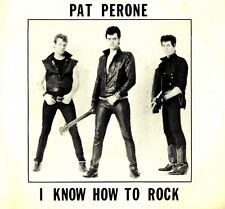
Perone
By Julia Masi
Issue 10; 1983
In another era he would have been the matinee idol. With his thick, dark hair, hypnotic brown eyes, and self-possessed stance, Pat Perone was born for the spotlight. But when he fronts Perone, with John Lee, drums; Peter Bliss, bass; and Pat on vocals and guitar, his visual appeal is upstaged by their music. Incorporating “the swing of the ‘50s” with the essence of rockabilly, while adding a heavier hand on the drums and guitar, Perone has captured a sound that offers an edge of originality to the vacuum of the New York scene. “Actually,” we’re trying rock’n’roll with a ‘50s feel,” says Pat, “because it’s danceable. And what good is a band if you can’t dance? We’re not exactly like some bands that do their rockabilly like it was done in 1955.” He admits that maybe their style isn’t as clean as Bill Haley and the Comets, or the Stray Cats. But that’s because they’re “more geared to a new approach that is going to give the listener something to remember.” And one of the things you’re most likely to remember about Perone is that they are very upbeat and uncomplicated, while still being serious about the music. “A twelve-year-old kid can like it as much as a 75-year-old. It’s real simple rock’n’roll. High energy. It’s not like there’s a cloud around rockabilly. This kind of music is just right there, on the table. There’s nothing to figure out.” Their songs “Stuck Up Girl,” “High School Romance” and “Going Steady” cover the basic love-struck themes, but as Peter points out, “The sincerity is real obvious. There are no pretentions. I don’t have to play like others. I just do what I do. And it comes out and it fits into what we’re doing.” What Perone is doing is very entertaining.
[The best I can figure out, Pat Perone is now an Elvis impersonator. – RBF, 2021]

The Public Servants
By Stacy Mantel
Issue 7; 1981
She proves that the human female voice is virtually limitless in its capacity to charm. Her staccato parrot voicings and vibrato should soon rank her as one of the more popular New Wave vocalists since Lene Lovich, although her style is clearly different. She, like Lovich, uses her voice as an obscure, non-traditional instrument, one brought back, perhaps, from extraterrestrial horizons. She’s Shelley Hirsch, lead singer for the Public Servants, which include: two fire-breathing and squeakingly talented sax artists, Philip Johnston (soprano and alto) and Dave Sewelson (baritone and alto); Wayne Horvitz on keyboards; David Hofstra on fretless bass; Bill Horvitz on prepared and electric guitar; and Richard Dworkin on the skins and some tropical-looking plants. Together, this futuristic ensemble blends art-rock, jazz, swing, pop and rock into a stimulating sound which Johnston things of as “Elephants marching through the jungle doing some sort of funky strut… it’s danceable-funky, but has sinister and mysterious aspects to it at the same time.” They’ve just released “Jungle Hotel” b/w “A Mistake” on their own J-Edible Records (motto: “It’s danceable, but is it Edible?”) to be distributed by Rough Trade. Surely no newcomers to music, the group has played together in different bands for many years and in different styles, which explains their versatility. The plants are cute, too.
[From Wikipedia: Hirsch won a DAAD Residency Grant in Berlin 1992, a Prix Futura award in 1993, and multiple awards from Creative Capital, the Foundation for Contemporary Arts, the New York State Council for the Arts, four from NYFA and six from Havestworks Digital Media Arts Center. She was a recipient of the Guggenheim Fellowship in Music Composition in 2017... In 2018, New York University Special Collections acquired her archive. - RBF, 2021] 


The Shakes
Julia Masi
Issue 9; 1982
With equal parts of enthusiasm, imagination and fun, the Shakes – Anna Bosch, keyboards; Eston, bass; Susan Holt, guitar; Daryl Leoce, drums; and Julie Miller, vocals – have blended together a sound that is fresh, versatile, and cerebral, without being pretentious. “Everybody in the band is nuts in a kind of clean way. It’s a natural nuts,” says Anna, who writes and arranges about 95% of the songs. I try to come up with different styles, but I have an insistence on melody. Something for people to remember that flows nicely. We do everything from pop to syncopated jungle. I think we tend to write about pertinent things instead of just, ‘I love you’/boy-meets-girl, but a lot of things that affect ordinary people. Like assuming other roles while still being yourself.” Daryl says, “Basically, we try to keep our stuff danceable. Being about to dance to the music is important ‘cause It’s a fun band. Danceable material is sort of an extra-added attraction, because if you want to start dancing you can. People like to be entertained, especially in light of what’s happening today. I think you can say things as controversial and poignant, but in a lighter way,” as he demonstrates in songs like, “Watch Your White Count,” “Incognito,” and “Blood in Vein.” But despite the strange sounding titles, the Shakes have nothing to do with ghoul rock. “When I think of blood, I think of strength,” adds Daryl. And strength maybe the most accurate adjective to describe this band who are incredibly tight in all aspect of their performances. Or as Julie explains, “We’re not stagnate. We just keep fanning out I think we have a strong sound. As musicians, we’re solid and can grow.”

Tru Fax & the Insaniacs
By Robert Barry Francos
Issue 10; 1983
Pop music…in its literal translation, is a must to avoid nowadays, since it would consist of people like Neil Diamond, Hall & Oats, and REO Speedwagon, to name just a few. But the pop sound has become sort of a section of rock’n’roll unto itself. Usually sung with a tenor (or higher) voice, it has a light, wistful sound that make you want to dance, without being slammed back down. Until recently, the Fast were, at their height, the ultimate pop band on the underground local level. They have now been non-violently usurped by a band originating out of Washington, DC, called Tru Fax and the Insaniacs. Their recent LP, Mental Decay, on DC’s Wasp Records, is a solid piece of work that seems almost impossible to top. Songs like “Washingtron” and “In the Air” (“A man who has orange hair/A man who is not all there/A man who loves the chair/That my President Reagan”) show how clever they are in songwriting, as well as topical. The main components of the group are David Wells and Diana Quinn. David, guitar, has done many solo projects, working on overdubbing tapes, as well as working with Harrison Fisher, the Rhode Island poet. Diana, lead singer and guitarist, is a person of many talents. Not only is she the focal point fronting this band, but she has sung opera in London, played in medieval groups on lute, recorder, and guitar, and sings with a group called the Dynettes. This accomplishment is added to her early training as a classical artist. Formed in 1979, Tru Fax and the Insaniacs released their first single in 1980, “Washingtron.” Despite the overwhelming raves to the record, their album is their first release since that point. This is due to a lackadaisical attitude towards their music, which has caused at least one member of the band, Tim Carter (who appears on the album), to leave because of “unacceptable artistic and financial compromises,” states Bill Asp, their manager, in a press release. Although they have played with major bands who have passed through the Washington area, they have not toured extensively, which is a shame. What the world needs now is pop, sweet pop. Let’s hope they decide to spread their sound around and show us how it is done. We could all use a breath of fresh air right now.
[Quinn is weekend desk manager, writer and producer for CBS News and a member of several local bands, like Honky Tonk Confidential, the Fabulettes, and yes, Tru Fax & The Insaniacs. – RBF, 2021]


Wednesday, January 20, 2021

Music Reviews: January 2021

Text © Robert Barry Francos / FFanzeen, 2021
Images from the Internet

Music Reviews: January 2021
Note that these reviews are alphabetical, not listed in a “ratings” order.


Ben Sutin Quartet
Hard Bop Hanukkah: Live @ Rockwood Music Hall
www.MEIIenterprises.com
www.bensutinmusic.com

Hard bop, a subgenre of bop jazz, was fomented by the likes of Miles Davis and Coltrane. It is wild and a bit musically asymmetrical, relying more on sharps/flats and a tempo of its own and often changing nature. The opening of the six cuts, “Have a Little Dreidel,” shows exactly what is expected right off the – er – spin. Ben Sutin, who leads the Quartet, is the arranger and violinist, who tends to play at the high end of the instrument. He is met evenly by Sam Javitch’s piano. They are backed by Cole Davis on bass and Evan Sherman’s drums. But it is the violin and piano that are out front on this live recording in one of my favorite spaces to hear non-punk/rock music in New York, Rockwood Music Hall, down on the LES of NYC. The third song, “Neroit Dolkim,” has the bones of Klezmer (which I thoroughly enjoy). Sutin’s modified V-necked electric violin gives him access to the very high ends of the strings, while Javitch uses his piano for both melody and part of the rhythm section simultaneously. “Sevivon, Sov, Sov, Sov” (translated as “Dreidel, Spin, Spin, Spin), the longest cut on the release, gives the rhythm section a chance to solo in smatterings. This may sound blasphemous, but parts of “Maoz Tzur” (or “Ma’oz Tzur” aka “Strong Rock”), from the 13th Century, sounds like it could be off Vince Guaraldi’s Charlie Brown Christmas album (I am saying that in a positive way, as that is the only Xmas record I can tolerate). The musicianship is superb, as would have to be to play in this style, and the Quartet go full force. As with many jazz styles, the songs are all instrumentals, and tend to average around 6 minutes, but they do both swing and bop. Might be good to get this now and have it ready for the next time Hanukkah rolls around.

Cro-Mags
2020
Mission Two Entertainment
The Cro-Mags are to hardcore what the Ramones were to the first wave of punk. These New Yorkers blazed a trail that was picked up by a disenfranchised youth into a movement of fury, anger, and moshing. In fact, Cro-Mags founder Harley Flanagan was the first mosher I ever saw when he was still with the Stimulators in the early 1980s, at a Siouxsie and the Banshees show at Irving Plaza. The Cro-Mags called it quit for a few decades, and now have come back with the second release this year, in this six-song opus that lasts, yep, 20 minutes and 20 seconds. Needless to say, it covers the topics of the year, including COVID-19 and street rioting. Starting off strong, the band wails with “Quarantine,” which leads pretty strongly with Garry “G-Man” Sullivan on bass, and Rocky George on Greg Ginn/J. Mascis-ish lead shred guitar (note that George used to be with Suicidal Tendencies). As with the rest of the songs – “2020,” “Life on Earth,” “Violence and Destruction,” “Chaos in the Streets,” and the instrumental “Confusion,” there is an atonal element that pounds and works, even with the chant-worthy choruses such as with “Life on Earth.” There’s even a bit of New Agey reverb used on occasion, such as the beginning of “Violence and Destruction,” before it descends into hardcore madness.  Despite the screechy, amazing guitarwork by George, parring with Gabby Abularach on rhythm, the songs are more rhythm focused on top of almost No Wave-inspired hardcore with Flanagan (bass) giving some thrash metal growl lyrics. Honestly, without a lyric sheet, I couldn’t make out what they were saying, but the songs stand up, especially “Chaos in the Street,” which is more traditional hardcore, and is by far my fave here. It concludes with a bit of just a part of an in-studio freestyle jam. The Cro-Mags have not lost their edge and deserve a listen.


Jordan Rabinowitz
A Couple Songs
@jordanrabinowitz
For years, Rochester, NY native/Washington, DC-based Rabinowitz has bounced around the music scene playing bass with other groups before settling down and working on his own material. He has now released a five song EP (available on YouTube HERE).  His songs feel like light, singer-songwriter style, but actually are kind of dark, talking about break-ups, love ending, and leaving. Jordan’s voice is pleasant without being same-old-same-old, with a hint of pitchiness that works for him. Note that the songs are fully backed by a band in which sometimes the feel of the song gets a bit mired in a way that would not happen if he were a solo-performer, but that’s the nature of the beast in today’s studio-produced world. It’s a good listen, though, and for a debut record, the songs are well written and performed.


Rockower
It’s Alright But It’s Never Enough
Mark Rockower Music
Great name for the band; fortunate that the center of it has this appellation. Mark Rockower is on vox, guitar and synthesizer (and songwriting), Derek Hughes plays bass, backed mostly by Jax Bowers on drums. But essentially, this is a two-man outfit, even recording it in Hughes studio (garage? basement?). This harmonious (i.e., overdubs of Rockower’s vocals) almost pop rock has all the hallmark sounds of a demo. Now, to be fair, a demo sound is so much more preferred by us aficionados than the cold, overproduced music mostly found on the radio today. It reminds me of the likes of The Nerves (who originally sang “Hanging on the Telephone”). The amateurishness (of the sound, not the playing ability) is refreshing and enjoyable, starting right off with the upbeat “American Dope.” Each song going forward is a bit different, but the overdubbing is pretty consistent, though I believe it should be used more sparingly, such as on choruses; overdubbing vocals also make it harder to hear the lyrics. “The Other Side” sounds a bit more garage from the late ‘60s, or possibly less formulaic than the early ‘80s. As the CD plays on, it definitely grew on me more. Sure, “Simple Minds” is a bit of filler, but they make up for it with the very next up-beat poppy number, “Lunar Star.” For a miss, like “Vacation Girl,” a synth noise mess, there are others that are worth the listen, like (again) the following cut, “Driving Force” and the title number, which closes out the 10-song disc. Basically, the entire zeitgeist is about American culture in the here and now, which makes it an interesting timepiece. I definitely liked it more on the second listen.  Weirdly, the biggest mistake is not printing the name of the band or CD on the disc proper, rather than just an image. Good way to get the disc lost.


TASTE
Brothers Vol 1
Melodicrock Records
Taste-music.com
TASTE is a “legendary” rock group from Down Under which originally formed in the 1970s, but I am not sure I have ever heard of them before, as this kind of ‘70s rock (they are often compared to the likes of Queen and 10cc) that never held my attention. But this is a new 5-song EP. It starts off with a kiss-off to a “horrible year” with “2020’s Gone.” It’s a power ballad celebrating the coming of a new year and hopefully new – err – hope. The production level is high, but it has a catchy and flamboyant chorus. Its follow-up “Hello Hello” is almost more rock power pop, which feels stuck in the ‘70s reminding me more of REO Speedwagon than Queen. Lots of harmonies, especially on the choruses. Ken Murdoch’s vocals are not traditionally rock tenor-and-above rock screeching, but rather it’s quite pleasant. He is well backed by Joey Armenta on guitar, Michael Tortoni on bass, and Damian Corniola on drums. “(We All) Stand Up” is a ballad paced bit of a corny and cliché rock with lyrics that are a bit insipid; what would at one time may be called “filler.” It’s follow-ups are live (or live in studio) versions of their previous songs, “Rock is Dead”  and “I Don’t Wanna Be Like You,” which are a bit better as rockers with the band getting to exercise a bit more of its instrumental prowess (including an extended drum solo on “Rock,” and clocking in at over six minutes). “I Don’t,” which is more guitar-focused, has an Aerosmith feel during their prime. Note that all proceeds go to benefit Beyond Blue, to help those affected by anxiety, depression, and suicide. A noble cause, indeed.


Friday, January 15, 2021

WALTER LURE On the Gross State of the Art, Part III (1980 Interview)

Text by Nancy Foster / FFanzeen, 2021
Introduction by Robert Barry Francos / FFanzeen, 2021
Images from the Internet

WALTER LURE On the Gross State of the Art, Part III

“Uncle” Walter Lure left us suddenly on August 22, 2020. The man was a New York legendary musician and guitarist/songwriter, as well as stockbroker with an advanced Chemistry degree. He made his claim to fame with bands such as The Demons, The Blessed, The Heroes, The Waldos, but especially as Johnny Thunders’ foil in the revamped (i.e., post-Richard Hell) version of The Heartbreakers. This band released two astonishingly influential albums during their tenure, L.A.M.F. and Live at Max’s. Heck, he even had a call out at the end of Eater’s 1977 single, Thinkin’of the USA.” 

Superfan Nancy Foster did an extensive interview with Walter just as they were closing Max’s Kansas City’s back room, locking it for good as she and Walter left, on December 10, 1980. It was printed in two parts in FFanzeen #7 and #8 in 1981, subsequently reprinted in this blog (Part I HERE and Part II HERE). It was so in-depth that sections of the 50 typed pages had to be cut out for length, and it was still quite large.

In honor of Walter’s passing, here are the parts of the interview that were edited out of the original two pieces, and has never been published before this. – RBF, 2021

FFanzeen: [Referring to Lennon’s assassination two days earlier] It’s been like a wake here. They’ve been playing “Imagine” and stuff like that. I’m going oo-we-oo! It’s getting to be too much.
Walter Lure: Yeah, they’re going to overdose everybody on it. Still, it’s incredible. I didn’t realize that I like the guy that much. I wasn’t all that hot about The Beatles. Well, in the beginning, I was. The Stones were always my favorite. So, I’d play the Stones against the Beatles. I still respect them for what they did – even later on. Now that he’s gone, you realize the incredible effect that he had on the whole generation. Without him, none of us would be where we are today.

FF: He was like my number one hero when I was 13, but you don’t see me lining up down at the Dakota.
Walter: That’s like another weird thing. People just go there and they stand there – the power of the guy. There’s nothing happening – no services or people to see or talk to; they’re all just standing there drawn like a magnet to this weird moment.

FF: And some people just want to be on the news. The newscaster says, “All these people are mourning!” and then you see all these kids smiling and waving at the cameras.
Walter: Yeah. They bring their radios and start hopping around and get in the paper: “Hey, mom!”

FF: Also to pick up and console girls.
Walter: Shocking! Shocking!

* * *


Walter: [About fanzines] …Cheap magazines. We used to see billions of them in England. There were some in New York, but not that many, I guess.

FF: I’ve been doing New Age [Nancy’s then-fanzine started while she lived in Greensboro] for five years. It started out as a Lou Reed fanzine and evolved into something else.
Walter: North Carolina?! What happens in North Carolina? Are there punk groups down there?

FF: Not that much: Most groups are cover bands because there isn’t that much of a market for punk or places for the groups to play.
Walter: Do bands get places to play?

FF: Yeah, but most kids still seem to like hard rock more than rock’n’roll.
Walter: They’d rather hear, like, Kansas or Foreigner. That’s always the case for places outside New York, LA, and maybe Chicago.

FF: Greensboro is a large secondary market and we get all the hoopla bands like the ones you named, but nothing like The Heartbreakers, obviously.
Walter: What about the groups from Georgia, like the B-52s?

FF: No, there aren’t that many good clubs to play in North Carolina. We’re trying to build it up. I put on shows last winter and lost a lot of money.
Walter: In theaters? How many people did the place hold?

FF: About 500, but only a handful of people showed up. Things didn’t start opening up until this summer.
Walter: What bands did you put on?

FF: The dBs. Then there was this band called The Leeches that I managed. I sang “Chinese Rocks” with them.
Walter: [cracking up with laughter] You sang “Chinese Rocks”?! What a nutcase!

FF: I’m going to do it with [Greensboro band] Butchwax and change it to “Flintstone Rocks” on December 20. I’m changing all the people to Flintstones characters. Inspired by who, I wonder.
Walter: New Wave needs a small club to start booking groups, advertise, and become something regular. 

FF: It’s fun, though. When I did it, it was more like having a party.
Walter: Not that many people into it down there?

FF: No, unfortunately.
Walter: Outside of the major cities, it takes years to catch on.

FF: It’s not a media-oriented city. Greensboro’s idea of punk is something like the B-52s.
Walter: At least that’s new. I even like them a little bit.

FF: Yeah, but the kids have a few groups that they think are cool. I always had a grudge against the B-52s because they were always the group that the pseudo–New Wave fans cited when the said [mocking a big, moronic jerk] “Oh! I’m really into New Wave!” Yet I have to admit that some of the songs are fun.
Walter: I didn’t like the first album that much, but I liked “Rock Lobster.” The rest of it didn’t do much for me. They used to be funny live. The girls are real cool. I like the girls. They’re funny. They go, “Oo-oo-oo” – little bean heads. They look like pinheads.

* * * 


FF: I hear that [drummer Jerry Nolan, died January 14, 1992 – Ed.] totally retired from rock’n’roll. He’s very bitter.
Walter: I don’t blame him.

FF: Did he leave The Rockats or did he get sacked?
Walter: He split them, actually.

FF: That’s really stupid – just as they’re signing an eight-album deal.
Walter: I know. That’s typical of Jerry. Every band that he’s been in, he splits when they’re just about to make it or when something good is happening. The only band that he actually split when they were dying was the [New York] Dolls. The going started getting rough for the Dolls. They couldn’t get any more gigs. They weren’t as popular anymore. Jerry just decided to split. Every album that Jerry’s ever made or been on, as soon as it comes out, he says the album sucks. It should’ve been remixed, and that it’s terrible. He’s got this thing that no matter what he does, he fucks himself up. With the Rockats, he splits just before they are going to get their album deal and he knew it was going to happen, because they all had these important gigs lined up with the record company people coming down. He splits saying that the band is not professional enough. Like, he’s the most unprofessional person. He’s, like, 34 years old, has been in about eight bands, and doesn’t have a dime in his pocket. And he says that he’s too good for The Rockats?! BuddyBowser said the other day that he’s starting a band with Jerry [Jerry Nolan and the Profilers – Ed.], but I don’t know if that’s true or not. Jerry doesn’t go anywhere. He just sort of hangs out. Yet, he’s probably the best drummer I’ve ever played with. He’s a natural.

* * *


FF: Like [comedian] Dave Street said, [Blondie] didn’t sell out, they bought in! I really respect Clem Burke for producing that great, young group called The Colors.  They are really fun. I like them. They are perfect pop.
Walter: Yeah, they’re real pop. The one kid looks like he’s a double of Brian Jones. The bass player is from Australia.

FF: Robert Vickers. He’s a really good songwriter, too.
Walter: Yeah, he is.

FF: They might be like a hardcore Bay City Rollers.
Walter: Yeah, exactly! They remind me of the Bay City Rollers or something like that. They all look a lot younger than they are, apparently. They’re all real cute and have that poppy look. They might make it.

FF: What was the first guitar that you had?
Walter: Apart from these beginning things that we used to rent called Ks, the first one I got was a Hagstrom. My brother [Richie Lurie – Ed.] started playing guitar the same time that I did. He’d go take the lessons and come home and teach me what he learned. We started out together. But he used to go to school and I was out of school. I used to stay home all night and play all the time. I learned quicker because I was older and had a bigger brain. Then he got a Telecaster, which was a better guitar than the Hagstrom. The Hagstrom was cool, but it was gross, too. You would put it into an amplifier and it would just feed back. The strings are about two inches away from the fret board. You needed a sledgehammer to make it ring out. It’s good for the muscles in your hand. It builds them up. He got his Telecaster and I used to like that. That was nice. Then I got a Gibson SG when I was in college for a couple of hundred bucks. That was good. Then I got a Les Paul.

FF: Is the one you play now your most favorite guitar in the whole wide world?
Walter: The best Les Paul I had was Custom and it was red. It was cherry red like my brother’s is now. I traded that to the other guitar player in The Demons for the one I now have, the brown one. That’s the guitar that I like to play the most because I’m most used to it. I have another one. It’s an old Gibson. It’s sort of like Johnny’s old one, but it’s a bit different. It’s a Junior, I think. It’s a different year and it only has one cutaway instead of two. The old Gibson has these fat, black pickups that gets the greatest sound. That’s what Johnny had. It gets this great cutting sound. The trouble is that the neck isn’t as easy to play. So, I haven’t really played it that much onstage. I used it once with The Blessed and once with The Heartbreakers at the Village Gate [in 1977 – Ed.]. I haven’t played it onstage since. I will, sooner or later, I suppose.

FF: Do you ever play acoustic guitar?
Walter: I play it at home, but never onstage. It’s good to write songs on because you don’t’ have to worry about plugging it into an amp.

* * *

FF: When did you start giving guitar lessons?
Walter: A few kids would come over every now and then. I’d teach them a few things and they’d be too fucked-up or not have any money or guitar. There’s this one girl I’m giving lessons to now. Well, I’ve given her one lesson in the last month. She didn’t have a guitar. So, I gave her the first lesson and said that there’s no sense in taking more lessons until you have a guitar to practice with. So, I took her to 48th Street and picked out a good guitar and she practiced for a week or so. She was supposed to come over for a second lesson on the fifth, but she got lost. I’ll give sessions to anyone who wants them.

FF: How much does it cost?
Walter: I’m charging $10 an hour, which is actually cheap. When I was taking piano and guitar lessons years ago, people charged me $10 and then raised it to $15. I’ve only given one lesson so far.

* * *


FF: Have you heard those Clause Bolling things, like “Jazz Suite for Flute and Piano”? That’s really beautiful.

Walter: I’ve heard of him, but I’m not really familiar with it. I like Jean-Pierre Rampal. I like Tchaikovsky’s symphonies a lot and his ballets; and Schubert.