Text by Nancy Foster / FFanzeen, 1985 / 2021 Images from the Internet
The
Power of Paisley
This
article was originally published in FFanzeen, issue #13, dated 1985. It was written
by ultracool Nancy Foster.
When one
thinks of 1980s underground garage revival music, the tendency is to lean
towards hardcore punk or either springy or dirge-like synthesizers. For me,
that period was alive with the garage revival, with bands like the Chesterfield
Kings, the Tryfles, the Vipers, the Mosquitoes, the Brood, the Cheepskates, and
of course, The Mystic Eyes. This also revived a clearly defined retro-look that
was a post-Hippie/post-punk style. Nancy took a look a what makes a cool,
neo-garage fashion statement. – RBF, 2021
To quote The Catalog of Cool! [by Gene Sculatti],
“Cool is not a fad or a fashion. Therefore, cool’s enemies are not ‘preppy’
or ‘punk’ or last month’s unearthed or invented sensibilities. Cool’s beef is
with misapplied style, false expression-attitudes and tastes that have nothing to
do with the person who adopts them. Thousand-bucks cowboy ensembles, idle
jet-setters who send nanny out of find them New Wave togs for the cocktail party,
‘Fatigue chic’ (you want khaki parachute pants? Enlist).”
If you want to think you are hip and that you
are a trendsetter instead of a lemming, since all fashion is cyclical, take
some hints from the swinging ‘sixties. As the mini-skirt is the only logical
garment for a modern girl to wear, with parental supervision grab the scissors and
start cutting six to eight inches pre-knee for minis, and if you’re really
daring, seven inches pre-knee for micro-minis.
A cool place to find clothes is the closet,
attic, or basement of mom, an aunt, or an older sister, especially if one of
the aforementioned relatives was a teenager in the ‘sixties. Black jeans are
also a must! White is great if you’re into beachcombing. They deflect the sun’s
deadly rays. Try Trash and Vaudeville on St. Mark’s Place. Yet, to get that
painted-on look, expect to do some altering.
Paisley shirts can also be found at Trash at
reasonable prices.They also have a lot
of nice, well-tailored, sharp looking shirts for the discerning mod-strips,
dots, paisley, etc. These shirts are gorgeous. So, if you’re into Paul Weller,
the Mod Revival or Wall Street, these are for you.
Shoes and Boots
The Chesterfield Kings have their “Puerto
Rican fence climbers” made for them. You can get Beatle Boots at Trash.Girls, pumps are a classic, but flats and
go-go boots are better if you want to go-go all night. Go-go boots are got-got
gotten at Manic Panic and Trash. For ‘sixties style flats, check out Capezio or
Bandolino. They haven’t lost their touch. Danskin makes a great folk-dance shoe
so you will be ready for the hootenanny!
Legs Galore
Da foot bone connected to da leg bone,
and you have to decorate that, too. You can pull an Edie Sedgewick and wear
black tights exclusively. They are great for hiding any imperfections and they
don’t run. Fishnets, windowpanes, any texture – lacey, dots, etc. – are all
groovy. Shazam. Manic Panic and Trash have a wide array of colors and styles.
Accessories
Chain belts are great, especially with
a short, A-line mini of body-hugging, clingy fabric. For pocketbooks, try the
little girl’s department of the 5 and 10 stores. I found some great chain, shoulder
bags and groovy green and yeah-yeah yellow plastic.
Make-up
Maybe suntans figure into the Paisley
Underground in L.A., but I’m not into that. Being cool means being extreme;
contrasts. Dye your brown hair black. Dye your auburn hair flaming red. Dye
your blonde hair platinum. Lancome made a perfect shade of foundation called Ivory
Mist, but they discontinued it. A good substitute is Ivory, by Stagelight.
Black eyeliner is a must – draw out to there! Cleopatra style!
Pale lipsticks – whites, silvers, golds,
sometimes with a hint of pink – are great! Barone has a fab shade calledStrawberry Ice Cream, but don’t eat it!
Chorus Line has a great mother of pearl shade called (get this British Invasion
fans) Moody Blue. Revlon remembers the ‘sixties with white lipstick and nail
polish – White On White.
Someone, please import some Yardley.
Twiggy used to wear their triple layer false eyelashes. Cake on the mascara and
make it waterproof because Fuzztones’ Rudi Prodrudi is sure to make the little
girls cry!
Street Chic
For the urban and suburban guerilla,
black jeans, black t-shirt, black boots, black leather jacket, and Wayfarer
shades are the best gear! Though if you can’t use camouflage to protect yourself,
blind the muggers with neon color a la Stephen Sprouse.
“Pleasant Screams”
Radio Podcast
http://jeffandnancy.airtime.pro/
To be honest, I have not
yet met Boston musician Jeff Kabot, who fronted The Superkools through all its incarnations,
and The Downtowners. His co-conspirator for the “Pleasant Dreams” podcast,
though, is Nancy Neon, and we have been good friends since the days of hanging
out at Max’s Kansas City, frequently seeing bands like The Heartbreakers, and
eating at the original Dojo’s on St. Marks Place.
Thing is, there is
probably no one I trust more with music than Nancy. Her tastes have always been
precise, and she has turned me on to some of my favorite bands, especially both
the 1960s and ‘80s garage sounds. The music she has fixated on in the time I
have known her has included the likes of The Chesterfield Kings, DMZ/Lyres,
Bob Dylan, Jakob Dylan/Wallflowers, Marc Bolan/T.Rex, and said Heartbreakers. Heck,
way back in the day, she was president of the North Carolina chapter of
the Wayne County Fan Club, before forming numerous fanzines, including New
Age and Groove Associates.
Now Nancy and Jeff
have joined forces and have set up their own podcast radio station called “Pleasant
Screams” at KABT FM 100.9 Hollywood, that focuses on, according to the site’s
keywords, “Garage, Punk, New Wave, ‘60s-‘70s Pop, Rock Steady, Folk, Blues.” On
one particular episode, they covered the likes of Sam the Sham and the
Pharaohs, The Miracle Workers, The Swinging Neckbreakers, Timebox, Elvis, Mad
Violets, Love, The Seeds, The Remains, The Ramones, Blur, The Breeders, X-Ray
Spex, James Brown, even the Monkees, and of course, Dylan, Lyres and The C.
Kings (my fave cut of theirs, “She Told Me Lies”). Not a clinker among them.
I sent Jeff and Nancy
some questions to answer and comment on which to respond, so here they are:
FFanzeen: What
were you guys working on before KABT? Nancy Neon: When I met
Jeff in April 2016, his band The Downtowners had been rehearsing for two years. I
said "I gotta get you some gigs." I got him two gigs with Chris
Horne, formerly of The Brood. One gig was with her cover band, The Flipsides.
The other was with her all-girl band, Tiger Bomb;-both were a blast at the
Bayside Bowl in Portland, ME. The band also was honored and flattered to play
David Bash's IPO. The Downtowners played live on Brian Young's “Crash Course,” for
The Ravers at Tufts' WMFO, as well as getting positive reviews in the legendary
Boston Groupie News.
FF: Why radio?
Why now? Nancy: While the COVID-19
pandemic has been tragic on many levels, it has had a positive effect on our
creativity. I have been bugging Jeff for almost 5 years to do a project or
projects together, like writing songs and doing a radio show. Now we have done
both.
Jeff Kabot: It started with Nancy wanting to do a radio show. When I started
looking into the software, I found it would not be that hard to do a whole,
automated station. Living in a seven-story building made it feasible,
logistically.
FF: What niche
are you trying to fill? Nancy: We created or
are creating the station that we love; that we would want to listen to all the
time.
Jeff: We are not shooting for a particular demographic except our friends and
likeminded people on social media. Basically, we are creating a station we
would like, and if others like it, that's great.
FF: How do you
choose the songs for “Pleasant Screams,” as well as your general playlist? Jeff: Nancy puts
together the playlist for “Pleasant Screams.” As far as the general KABT
playlist, I program songs that I like, and have liked throughout my life. There
is some quirky stuff, but these songs have resonance for me as someone whose
life was shaped by radio from my earliest memories.
Nancy: For “Pleasant Screams,” I pick out 20 songs for each of the two hours.
The last four songs of the first hour is a segment called the "Scream
Spotlight," highlighting songs people send us or tell us about. I pick a
cool instrumental to close the show. That is the format, but if you listen and
you know me, you will see there is a lot of free association going on.
FF: I notice
you go beyond the most familiar tracks by the artists you choose. Jeff: We like to
introduce listeners to music they haven't heard or don't often hear.
Nancy: While being known or popular is not an automatic disqualifier for me, I
am always on the lookout for lesser-known artists and deeper cuts from known or
lesser-known artists.
FF: Do you
find yourself disagreeing on which songs to include? Jeff: No, our tastes
are similar enough to be compatible, but dissimilar enough to complement each
other's. This broadens the variety for our listeners more than if we were
clones as far as our musical tastes.
Nancy: Jeff Kabot has the most impeccable music taste of anyone I have ever
known. I hope and believes he feels the same about me.
FF: Where do
you see KABT going? Jeff: Tonight is only
our tenth episode of “Pleasant Screams.” I hope the shows continue to sound
better, include features, and expand our listener base.
Nancy: I hope to parlay “Pleasant Screams” and KABT into a horror hostess gig
where I can successfully shill for a wide array of mass marketed “Pleasant
Screams” merchandise!
FF: What would
you like to add? Jeff: I would like to
thank: Shelly Ganz of The Unclaimed, Hyper Loop recording artist Art Guy, Bobby
Hart of Boyce & Hart, Daryl Hooper of The Seeds, Paul Kopf of The Seeds and
Strangers in a Strange Land, James Lowe of The Electric Prunes, Vince Melouney
of the Aztecs and The Bee Gees, Barry Tashian of Barry and The Remains, and Tony
Valentino of The Standells.
Nancy: I would like to thank Jynx Lynx & Dino Sorbello (with the CDs Feel Free and Real Surreal), and Jonathan Lea of both the
Jigsaw Seen and the Dave Davies Band, for the beautiful rock 'n' roll care
packages. Also, I want to thank my artistic co-conspirator, Kabot. Whereas many
men have promised me stardom, Jeff has delivered the goods!
Text by Nancy Foster / FFanzeen, 2021 Introduction by Robert Barry Francos / FFanzeen, 2021 Images from the Internet
WALTER LURE On the Gross State of the Art, Part III
“Uncle” Walter Lure left us suddenly on August
22, 2020. The man was a New York legendary musician and guitarist/songwriter,
as well as stockbroker with an advanced Chemistry degree. He made his claim to
fame with bands such as The Demons, The Blessed, The Heroes, The Waldos, but
especially as Johnny Thunders’ foil in the revamped (i.e., post-Richard Hell)
version of The Heartbreakers. This band released two astonishingly influential albums
during their tenure, L.A.M.F. and Live
at Max’s. Heck, he even had a call out at the end of Eater’s 1977 single, “Thinkin’of the USA.”
Superfan Nancy Foster did an extensive
interview with Walter just as they were closing Max’s Kansas City’s back room,
locking it for good as she and Walter left, on December 10, 1980. It was
printed in two parts in FFanzeen #7 and
#8 in 1981, subsequently reprinted in this blog (Part I HERE and Part II HERE). It was so in-depth that sections of the 50 typed pages had to be cut out for
length, and it was still quite large.
In honor of Walter’s passing, here are the
parts of the interview that were edited out of the original two pieces, and has
never been published before this. – RBF, 2021
FFanzeen: [Referring to Lennon’s assassination
two days earlier] It’s been like a wake here. They’ve been playing “Imagine”
and stuff like that. I’m going oo-we-oo! It’s getting to be too much. Walter Lure: Yeah, they’re going to
overdose everybody on it. Still, it’s incredible. I didn’t realize that I like
the guy that much. I wasn’t all that hot about The Beatles. Well, in the
beginning, I was. The Stones were always my favorite. So, I’d play the Stones against
the Beatles. I still respect them for what they did – even later on. Now that
he’s gone, you realize the incredible effect that he had on the whole
generation. Without him, none of us would be where we are today.
FF: He was like my number one hero
when I was 13, but you don’t see me lining up down at the Dakota. Walter: That’s like another weird thing.
People just go there and they stand there – the power of the guy. There’s nothing
happening – no services or people to see or talk to; they’re all just standing
there drawn like a magnet to this weird moment.
FF: And some people just want to be on
the news. The newscaster says, “All these people are mourning!” and then you
see all these kids smiling and waving at the cameras. Walter: Yeah. They bring their radios
and start hopping around and get in the paper: “Hey, mom!”
FF: Also to pick up and console girls. Walter: Shocking! Shocking!
*
* *
Walter: [About fanzines] …Cheap
magazines. We used to see billions of them in England. There were some in New
York, but not that many, I guess.
FF: I’ve been doing New Age [Nancy’s then-fanzine started while
she lived in Greensboro] for five years. It started out as a Lou Reed fanzine
and evolved into something else. Walter: North Carolina?! What happens in North Carolina? Are there punk
groups down there?
FF: Not that much: Most groups are
cover bands because there isn’t that much of a market for punk or places for
the groups to play. Walter: Do bands get places to play?
FF: Yeah, but most kids still seem to
like hard rock more than rock’n’roll. Walter: They’d rather hear, like,
Kansas or Foreigner. That’s always the case for places outside New York, LA,
and maybe Chicago.
FF: Greensboro is a large secondary
market and we get all the hoopla bands like the ones you named, but nothing
like The Heartbreakers, obviously.
Walter: What about the groups from Georgia, like the B-52s?
FF: No, there aren’t that many good
clubs to play in North Carolina. We’re trying to build it up. I put on shows
last winter and lost a lot of money. Walter: In theaters? How many people did
the place hold?
FF: About 500, but only a handful of
people showed up. Things didn’t start opening up until this summer. Walter: What bands did you put on?
FF: The dBs. Then there was this band
called The Leeches that I managed. I sang “Chinese Rocks” with them. Walter: [cracking up with laughter]
You sang “Chinese Rocks”?! What a nutcase!
FF: I’m going to do it with [Greensboro
band] Butchwax and change it to “Flintstone Rocks” on December 20. I’m changing
all the people to Flintstones characters. Inspired by who, I wonder. Walter: New Wave needs a small club to
start booking groups, advertise, and become something regular.
FF: It’s fun, though. When I did it,
it was more like having a party. Walter: Not that many people into it
down there?
FF: No, unfortunately. Walter: Outside of the major cities,
it takes years to catch on.
FF: It’s not a media-oriented city. Greensboro’s
idea of punk is something like the B-52s. Walter: At least that’s new. I even
like them a little bit.
FF: Yeah, but the kids have a few
groups that they think are cool. I always had a grudge against the B-52s
because they were always the group that the pseudo–New Wave fans cited when the
said [mocking a big, moronic jerk] “Oh! I’m really into New Wave!” Yet I have
to admit that some of the songs are fun. Walter: I didn’t like the first album
that much, but I liked “Rock Lobster.” The rest of it didn’t do much for me.
They used to be funny live. The girls are real cool. I like the girls. They’re
funny. They go, “Oo-oo-oo” – little bean heads. They look like pinheads.
*
* *
FF: I hear that [drummer Jerry Nolan,
died January 14, 1992 – Ed.] totally retired from rock’n’roll. He’s very
bitter. Walter: I don’t blame him.
FF: Did he leave The Rockats or did he
get sacked? Walter: He split them, actually.
FF: That’s really stupid – just as
they’re signing an eight-album deal. Walter: I know. That’s typical of Jerry.
Every band that he’s been in, he splits when they’re just about to make it or
when something good is happening. The only band that he actually split when they
were dying was the [New York] Dolls. The going started getting rough for the
Dolls. They couldn’t get any more gigs. They weren’t as popular anymore. Jerry
just decided to split. Every album that Jerry’s ever made or been on, as soon
as it comes out, he says the album sucks. It should’ve been remixed, and that
it’s terrible. He’s got this thing that no matter what he does, he fucks
himself up. With the Rockats, he splits just before they are going to get their
album deal and he knew it was going to happen, because they all had these important
gigs lined up with the record company people coming down. He splits saying that
the band is not professional enough. Like, he’s the most unprofessional person.
He’s, like, 34 years old, has been in about eight bands, and doesn’t have a
dime in his pocket. And he says that he’s too good for The Rockats?! BuddyBowser said the other day that he’s starting a band with Jerry [Jerry Nolan and the
Profilers – Ed.], but I don’t know if that’s true or not. Jerry doesn’t go
anywhere. He just sort of hangs out. Yet, he’s probably the best drummer I’ve
ever played with. He’s a natural.
*
* *
FF: Like [comedian] Dave Street said, [Blondie]
didn’t sell out, they bought in! I really respect Clem Burke for producing that
great, young group called The Colors. They are really fun. I like them. They are perfect pop. Walter: Yeah, they’re real pop. The one
kid looks like he’s a double of Brian Jones. The bass player is from Australia.
FF: Robert Vickers. He’s a really good
songwriter, too. Walter: Yeah, he is.
FF: They might be like a hardcore Bay
City Rollers. Walter: Yeah, exactly! They remind me
of the Bay City Rollers or something like that. They all look a lot younger
than they are, apparently. They’re all real cute and have that poppy look. They
might make it.
FF: What was the first guitar that you
had? Walter: Apart from these beginning
things that we used to rent called Ks, the first one I got was a Hagstrom. My
brother [Richie Lurie – Ed.] started playing guitar the same time that I
did. He’d go take the lessons and come home and teach me what he learned. We
started out together. But he used to go to school and I was out of school. I
used to stay home all night and play all the time. I learned quicker because I
was older and had a bigger brain. Then he got a Telecaster, which was a better guitar
than the Hagstrom. The Hagstrom was cool, but it was gross, too. You would put
it into an amplifier and it would just feed back. The strings are about two
inches away from the fret board. You needed a sledgehammer to make it ring out.
It’s good for the muscles in your hand. It builds them up. He got his
Telecaster and I used to like that. That was nice. Then I got a Gibson SG when
I was in college for a couple of hundred bucks. That was good. Then I got a Les
Paul.
FF: Is the one you play now your most
favorite guitar in the whole wide world? Walter: The best Les Paul I had was Custom
and it was red. It was cherry red like my brother’s is now. I traded that to
the other guitar player in The Demons for the one I now have, the brown one.
That’s the guitar that I like to play the most because I’m most used to it. I
have another one. It’s an old Gibson. It’s sort of like Johnny’s old one, but
it’s a bit different. It’s a Junior, I think. It’s a different year and it only
has one cutaway instead of two. The old Gibson has these fat, black pickups
that gets the greatest sound. That’s what Johnny had. It gets this great
cutting sound. The trouble is that the neck isn’t as easy to play. So, I haven’t
really played it that much onstage. I used it once with The Blessed and once
with The Heartbreakers at the Village Gate [in 1977 – Ed.]. I haven’t
played it onstage since. I will, sooner or later, I suppose.
FF: Do you ever play acoustic guitar? Walter: I play it at home, but never
onstage. It’s good to write songs on because you don’t’ have to worry about plugging
it into an amp.
*
* *
FF: When did you start giving guitar
lessons? Walter: A few kids would come over
every now and then. I’d teach them a few things and they’d be too fucked-up or
not have any money or guitar. There’s this one girl I’m giving lessons to now.
Well, I’ve given her one lesson in the last month. She didn’t have a guitar.
So, I gave her the first lesson and said that there’s no sense in taking more
lessons until you have a guitar to practice with. So, I took her to 48th Street
and picked out a good guitar and she practiced for a week or so. She was
supposed to come over for a second lesson on the fifth, but she got lost. I’ll
give sessions to anyone who wants them.
FF: How much does it cost? Walter: I’m charging $10 an hour,
which is actually cheap. When I was taking piano and guitar lessons years ago,
people charged me $10 and then raised it to $15. I’ve only given one lesson so
far.
*
* *
FF: Have you heard those Clause
Bolling things, like “Jazz Suite for Flute and Piano”? That’s really beautiful.
Walter: I’ve heard of him, but I’m not
really familiar with it. I like Jean-Pierre Rampal. I like Tchaikovsky’s
symphonies a lot and his ballets; and Schubert.
Sudden
Signs of Grace is the fourth solo album by guitarist/songwriter Tom Guerra. It
follows American Gardenin 2018, Trampling out the Vintage in 2016, and All of
the Above in 2014. Guerra is also known as a collaborator of the world’s
greatest band, The Yardbirds and for his tastefully name rock‘n’roll band, The
Mambo Sons.
“It’s
All In The Skies” is a singer/songwriter plus alternative country amalgam like
Tom Petty writing for Old 97s. There is something about the lovely, wistful
vibe that brings the Hummingbird Syndicate to mind. In fact, when the
quarantine lifts, Jon Macey and Tom Guerra should book a show or tour together.
“Lonely
No More” is an uplifting ballad about “being back amongst the living.” Guerra
says in the liner notes: “Everybody starts out lonely, and with luck and grace,
we find ourselves, and then each other.” Matt Zeiner paints this number with
warm washes of color, using piano and Hammond organ.
As
far as “Lover’s Time,” Guerra and I aren’t on the same page – we are on the
same word! I have always thought a guitar – especially a twelve-string guitar –
and a male voice were beauty personified. Guerra says that he has “always
enjoyed twelve-string, poppy tunes,” like similar tunes in his songbook, “Here’s
Tomorrow” and “Tell The World.” For me, this is in a Dave Edmunds/Nick Lowe
mode: multi-layered harmonies and driving power chords on a pleasant wave of
nostalgia, all delivered anthemically.
“Sudden
Signs Of Grace,” the title track, features Kenny Aaronson on fretless bass. If
Aaronson’s name sounds familiar, it may because of his association with Bob
Dylan and George Harrison. Guerra wrote this after a walk in the woods on New
Year’s Day. It is delivered in a world music mode.
When
Guerra heard Eddie Money was ill, he recorded one of his favorites by Money and
sent it to him. “Gimme Some Water” takes me back to high school days when the
Southern Rhythm and Blues of the Allman Brother ruled the radio. I am hearing a
pastiche that includes The Eagles, Jackson Brown, and Steve Miller.
“The
Greatest Show On Earth” was inspired by a Syd Barrett quote: “I’ve got a very
irregular head.” Something about the line, “Welcome to the greatest show on
earth!,” is deflating. Guerra, here and throughout this recording, captures
happy/sad ideas and emotions. That dichotomy sums up our conflicted times.
Being on the edge of a cliff is exhilarating because the joy of life is
the strongest at the moment when it is all at the most risk of being ripped
away.
“Just
Like The Sun” is a thirty-year-old lyric that Guerra discovered and resurrected
to put to music. It features Matt Zeiner and Morgan Fisher of Mott The Hoople
and Queen on keyboards, giving the song an exalted, hymn-like power. Aaronson
crafted the strings and string arrangements on “Inspiration Memories,” which
Guerra dedicates to his father. The sense of the weight of the passage of time
is emphasized intermittently through percussive sounds that represent a ticking
clock. (Or maybe a ticking bomb considering our current political landscape!)
“Down
The Farm” sounds like an unholy union of Chuck Berry and Jerry Lee Lewis. A Rainbow
Coalition collaboration on an alternative plane. It is transporting to hear
“Streets Of Baltimore.” Whether you are Team Bare or Team Parsons, Guerra
delivers the best musical theater since Scott Walker took Jacques Brel to a
whole new level with “Amsterdam” and “My Death.” I can’t help but envision the
angel wings of Chet Atkins embracing Guerra and the musical soulmates here.
“The Sleep Song” closes this bittersweet, nuanced recording with a cool
instrumental that is both mellow and majestic.
As I unwrapped the gift,
the album cover radiated a golden glow. The photograph was of a figure playing guitar
in front of a gigantic amplifier. The guitar player was surrounded by an electric
halo. There was something reverent, even religious about the image. Now, I would
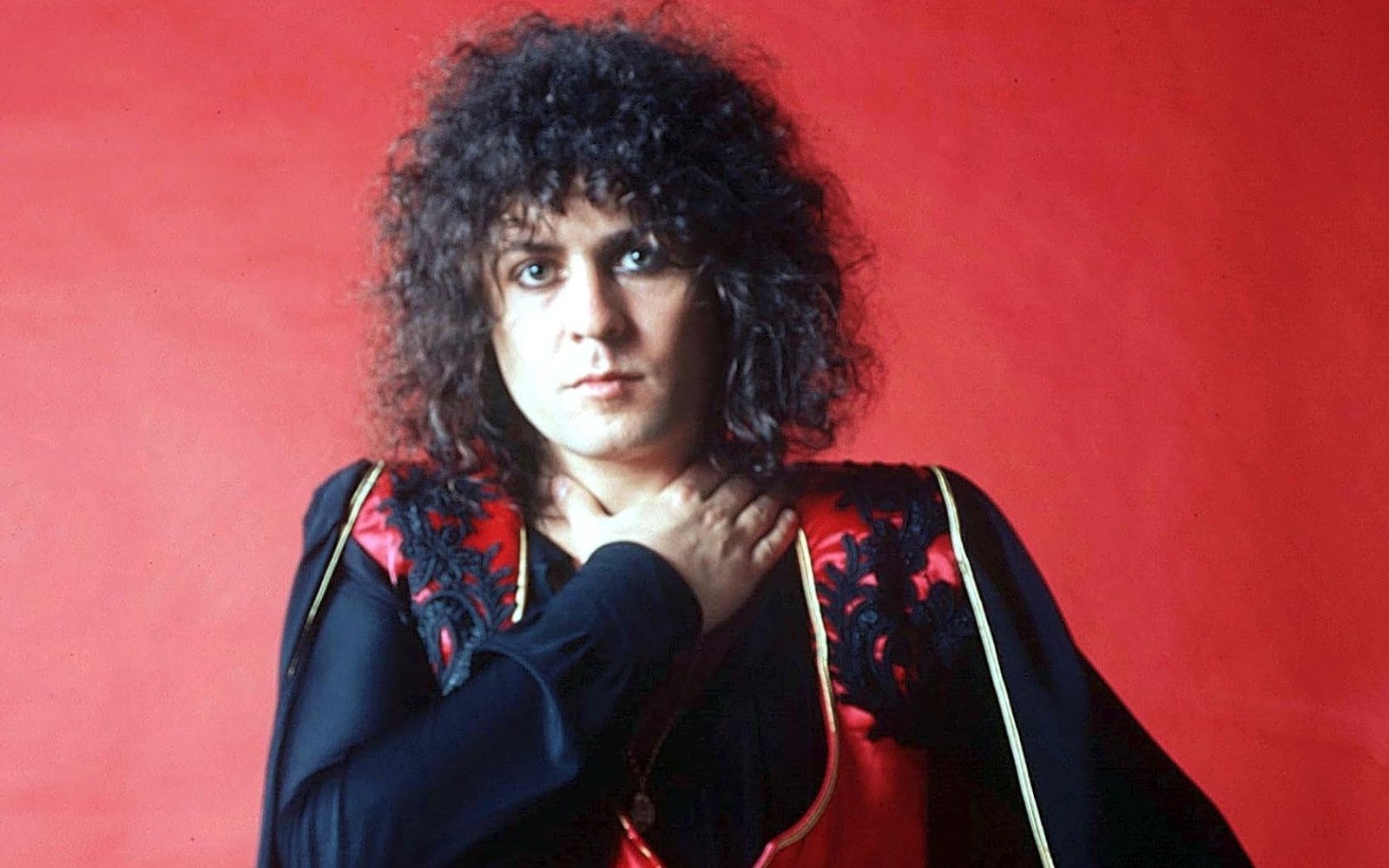
call the cover of T. Rex’s Electric Warrior iconic. The cover was designed
by British art group Hipnosis, based on a photograph by Kieron “Spud” Murphy.
The mystique of this album
cover art and the poetic rock’n’roll seduction within changed me and my life forever.
I had recently turned 14, but I was still a sheltered child until T. Rex thrust
teenhood upon me for the very first time. T. Rex brought color, sparkle, fun, and
glamor. Before Marc Bolan burst out, fully formed majestically from his own brow,
rock’n’roll meant Elvis Presley and the Beatles, seemingly safe-as-milk music that
your mother and grandmother could love. T. Rex was the private territory and personal
property of teenagers.
There were no Glamrock boutiques
in Greensboro, North Carolina, in 1971, so, I had to use my imagination and creativity
to remake myself from a little antisocial nerd-bird to the first glitter girl on
my block. I pincurled my hair, wore rhinestone earrings and necklaces borrowed from
mommy’s jewelry box, put together strange ensembles from vintage finds, and changed
from a Coco Baroque or Too Too Bamboo-lipped mod doll to candy apple-lipped glamrock
vixen. At concerts, grown ups called me “acid queen,” although I had barely kissed
a boy (a birthday kiss!!!) and I had not touched any drug! When a sweet,
innocent former Girl Scout hears T. Rex, there is no turning back.
“Bang A Gong” hit the US
airwaves in July 1971, and that was T. Rex’s only Top Ten hit in the US. It sounded
like sex, even if I didn’t know exactly what sex was. Those "dirty and sweet”
power chords and the explosion of the percussion’s primal boom shot through my head,
my heart, and my body.
“Bang A Gong” was often referenced
by many bands over the decades, most notably on the first Oasis single, ”Cigarettes
and Alcohol.” The single sounded like Johnny Rotten fronting T. Rex, a perfect amalgam
for me in the Britpop ‘90s. This proved how much staying power T. Rex had, and when
you hear the song today it still sounds fresh and exciting.
Some of my other long-time
favorites like Paul Weller of the Jam and Bobby Gillespie of Primal Scream count
Electric Warrior as among the greatest. Weller said it is “one of my all-time
favorites. The guitar playing is really unique – you know the sound instantly.”
Gillespie said “’Bang-A-Gong’ is one of my all-time favorite pop songs. When I was
growing up, singles were an art statement. T. Rex was changing all the time. As
a fan, you wanted to know what they wore and whether you could follow them to that
new place.”
With Electric Warrior,
I was hooked. So, I started delving into the past for Bolan treasures and searched
for the key to the alchemy that helped create the beautiful and perfect man-child
with celestial curls, with his Les Paul as an integral appendage; the fact that
Bolan compared his love interest to a car was no small part of the attraction. Bolan
conjured lyrics that were equal parts cosmic poetry and rock’n’roll heart.
Marc Bolan’s roots included
joining a psych rock group that dressed all in white called John’s Children, with
an album and several singles, including “Desdemona.” Next came the folk rock psychedelia
of Tyrannosaurus Rex that recorded four albums between 1968-1970. Bolan was on acoustic
guitar with first Steve Peregrin Took and then Mickey Finn on percussion The band’s
first single, ”Debora,” was released in 1968, and was included on their first album,
My People Were Fair and Had Sky in Their
Hair But Now They’re Content to Wear Stars on Their Brow, was released in June
1968. Bolan’s warble was so exotic that the producer, Tony Visconti, thought Bolan
was singing in a foreign language. T. Rex, released in December 1970, was
the first album under the T. Rex name and bridged the gap between the folk rock
psychedelia of Tyrannosaurus Rex and the power chord orgy and hysteria-inducing
T. Rex.
Although this was six years
after Dylan was booed by folk purists for going electric, Bolan experienced his
own “Judas” moment when long-time supporter and personal friend John Peel dismissed
the electric phase of his musical career as being a “sell out.” Like his hero Dylan,
I doubt Bolan ever did anything to sell out. Bolan, from the earliest age, wanted
to be a teen idol. Whatever Bolan did, he did it on his own terms and to fulfill
his vision of his ideal self. Bolan, who was always assured of his impending
superstardom, was an iconoclast who sought to please himself and his fans. In July
1972, The Slider was released. By this point, it was clear that Bolan was
trying to concoct some magical, alchemical sound and spectacle for fans who knew
about Presley, the Beatles, and Hendrix but were too young to experience them live.
The rock’n’roll cocktail Bolan served up with splashes of Presley, Chuck Berry,
Eddie Cochran, Beatles, the Who, and Hendrix, shaken not stirred for the coolest,
most iconic superstar potion, like the visitor from Lord of the Rings reimagined
as a Dylan coiffed vampire troubadour who rocked a Les Paul, not a lute. Such perfect
pop, but so deliciously strange like a sweet drink with a bitter, yet addictive
after-taste.
Was this really 48 years
ago?! Bolan’s songs retain power and relevance, and have even more resonance for
me today despite their being close to half a century old. Right now, we have the
bad orange man failing to lead during a worldwide pandemic and we need songs
like “Metal Guru.” It is comforting to me, imagining a futuristic extraterrestrial
with corkscrew hair serenading me, freeing my body like Presley, and freeing my
mind like Dylan. “Mystic Lady” seduces. “Buick Mackane” takes you by force. “The
Slider,” ”Baby Boomerang,” ”Spaceball Ricochet,” “Telegram Sam” and “Baby Strange,”
and the rest, are all a part of me on a cellular level. Every nuance of every song
is in my DNA.
Tanx was released in January
1973, and was described as “interstellar soul,” which I believe influenced David
Bowie’s Young Americans. Some wonder if there ever would have been a Ziggy
Stardust had there been no T. Rex. I feel Bowie – as well as Prince – owe debts
to Bolan musically, fashion- and image-wise. “Born to Boogie” and “Life Is Strange”
stand out on the 1994 CD version of Tanx, along with other greats like “Children
of The Revolution,” ‘Solid Gold East Action,” and “20th Century Boy.”
Zinc Alloy and the Hidden
Riders of Tomorrow released in February 1994 was celebrated by neither fans nor the
critics. “Teenage Dream,” which reached #14 was Bolan’s last hit until “New York
City” in 1975.
Light of Love was a US-only album in 1974,
with 3 tracks from Zinc Alloy, with eight songs recorded at Music Recorders
in Hollywood that would end up on Bolan’s Zip Gun, released in February 1975.
Ken Barnes wrote in a Rolling Stone review, ”Bolan’s vocals still retain
the amphetamine amphibian warble, but at times his snarl is tough enough to rival
the Seeds, a considerable achievement.”
Zip Gun was Bolan’s tenth album.
Bolan continued in an R&B-influenced vein, joined by Gloria Jones of “Tainted
Love” fame. Futuristic Dragon brought a return to form in January 1976. “New
York City” is a blast and ushered in the moment where Bolan reinvented himself as
the “godfather of punk.” This phase saw him promoting punk era bands like the Jam,
Generation X, Eddie and the Hot Rods, andthe Boomtown Rats on his television show, “Marc.” Moreover, Bolan booked
a sellout show in London with the Damned.
Dandy in the Underworld, the eleventh album, was
a swan song of sorts, about six months before Bolan left this mortal coil due to
an auto accident just short of his 30th birthday. Great title, great photo, great
songs-helping fans keep a little Marc in their hearts. Sadly, I never saw Marc Bolan
live, but I asked a friend, Binky Philips of the Planets what it was
like to experience the splendor of T. Rex in the flesh. Binky said, “I saw T. Rex
at Carnegie Hall on February 27, 1972. I was crazy about their singles they had
put out and I was intrigued by how Marc Bolan was a one-man Beatlemania in the UK.
I’d been an Anglophile since February 9, 1964. So, I was well-versed on all things
Brit. The Carnegie Hall show might have been the most exciting first ten minutes
of any gig I have ever seen. The band hit the stage with every stage light blazing.
Marc was wearing a satin jacket over a white t-shirt that had his own face covering
his entire torso. I was just dazzled by that over-the-top ego trip. They launched
into my own top five favorite T. Rex song, ”Cadilac”(no typo), a track relegated
to a B-side and not on any album. I thought that was fantastically ballsy. The whole
audience felt like it was on the verge of screaming like 13-year-old girls, the
opening was so strong that Marc and Mickey and Steve and Bill just could not sustain
the excitement. But T. Rex made a delicious ungodly noise that I can still hear
in my mind’s ear.”
The delicious ungodly
noise is what got T. Rex inducted into the Rock and Roll Hall of Fame this year.
I voted for the band and was excited more than any induction before. The event was
supposed to be held May 5, but because of the pandemic, the festivities were rescheduled
for November 7, 2020. Congratulations to
drummer Bill Legend, the only living member of T. Rex. Congrats to Bolan’s son, Rolan, and
his mother, Gloria Jones, and all the band’s family, friends, and admirers. Congratulations and thanks to Mark
Feld Bolan, who is still the prettiest star.
I believe Bolan is grinning
down from his “armor plated chair” (throne?) on the astral plane and there is an
angel polishing his “hub cab diamond star halo.”
Introduction by Robert Barry Francos / FFanzeen, 2019
Images from the Internet
This article was originally published in FFanzeen, issue #14, dated 1986. It was written by the effervescent North
Carolinian native Nancy Foster, now better known as Nancy Neon.
To be honest, I still am pretty unfamiliar with
this Georgia-based band. They were mostly around for the period of 1981 through
1989, but have reunited on and off over the years. Often, they are compared to
the scene that gave us quirky college rock bands like R.E.M., Pylon and Let’s
Active. In total they produced one EP, four studio albums, nine singles, and a
later live album. – RBF, 2019
Guadalcanal Diary has been lumped in
with the Athens and Southeast scene. Yet, they are really a Marietta, GA, band
with diverse influences that come together to make an arresting, hybrid. Some
connect them with the Byrds-like jingle/jangle magic of R.E.M., others try to pigeon-hole
them with the so-called country punk of Jason and the Scorchers and Rank and
File.
Yet, Guadalcanal Diary defies
categorization. Just as the Athens / Atlanta / Marietta axis is a crossroads where
lots of transient influences and ideas meet, so is Guadalcanal Diary a blend of
several styles. Whereas some bands sound like a variety show, jumping from one
genre to another, they diversify without being incoherent; they’re stylized
without being static or predictable.
I love the way they put the headbangers
off guard with startling versions of Cab Calloway’s “Minnie the Moocher,” a decidedly
non-headbanging, esoteric version of “Johnny B. Goode,” and a scathing,
sarcastic rendering of Syndicate of Sound’s “Hey Little Girl.”
It is, however, their original
material that really bewilders. Murray Attaway, the lead singer / guitarist’s
command post is the eye of the storm. He stands at attention in the middle of
the twin cyclones of Jeff Wallis and Rhett Crowe, who whirl dervish-like on
either side.
They set up a scenario that is both
musically and visually thrilling. Before their show, we had been talking about
how someone who had been talking about how the dBs fail to push the audience
past a certain point of excitement. I was coming out against histrionics and spoon-fed
hysteria. They agreed, but they said that they, themselves, did not put an emphasis
on entertainment. However, the spontaneous combustion that takes place onstage
ignites because of their love for, and dedication to, their music. This isn’t
choreography or rock star flexing, or self-parody.
We talked about how certain acts like
Billy Idol had been reduced to a set of conventional poses, i.e., the pout and
the fist. What you’re seeing with Guadalcanal Diary isn’t showbiz, it’s pure
joy.
The band expresses some concern that
their New York City Christmas Holiday ’84 debut had not ben auspicious. Yet, it
was so inspiring to see them gradually win over the Peppermint Lounge Saturday
night crowd, many of whom resembled “Dance Fever” outtakes as opposed to music
lovers. Despite that obstacle, they bombarded the audience with their
high-quality material. Pure Pop for Now
People was “Pillow Talk.” Rhett Crowe was so powerful on bass, and despite what
some myopic critics say about kudzu-covered confederate bodies, she is
definitely female. Her grass skirt with t-shirt, lei, and cowboy boots was the
fashion statement of the year. It’s the perfect embodiment of their
cross-cultural pollination. It's what you wear to a “Watusi Rodeo.”
Being in a changing environment,
experiencing the class of Old World Southern values and the modernization of
cities like Atlanta is part of what establishes the tension in their music. When
I asked whether being from the South brought a certain romantic and mystical
element to their music, Rhett agreed. Religion is a big theme with songs like “Walking
in the Shadows of the Big Man” (“Big Man” meaning God) and “Why Do the Heathen
Rage?” The latter is highly reminiscent of fellow Southerners from Memphis, Big
Star, circa 1974 [Big Star’s singer, Alex
Chilton, sang “The Letter” and “Cry Like a Baby with the Box Tops – NF, 1986].
When asked if something about the
water in Athens area makes great pop with a twist, the guys confided that once
the B-52s made it, “lots of bands came out of the woodwork.” They are, as I am,
amazed how every band with a Rickenbacker is called “Post-R.E.M.”
Other than their home state, they
also share a producer with R.E.M., Don Dixon of Chapel Hill, NC. Dixon was
suggested by their rec rod company, DB. They have played dates with the
Psychedelic Furs, Beat Rodeo, the Bongos, R.E.M., etc. They get some of their best
reactions in Rome, GA, Louisville, KY, Richmond, VA, etc.
One of the most unusual places they
played was Greensboro, NC’s Secret Garden, which had a garden in front of the
stage. Back to the show: the groovy Georgia quartet gradually won over the basically
stoic audience. Enlightenment is usually a gradual process. Yet when Guadalcanal
Diary moved in for the kill on “Trail of Tears,” it was musical cataclysm.
Murray Attaway was especially moved and moving on this one. Maybe it was my own
mist, but he looked misty-eyed.
Guadalcanal Diary accomplished a lot
on their second New York City gig, especially for a band on an indie label with
little exposure. Rave reviews of the album, heavy airplay for “Watusi Rodeo”
and a push on their video is remedying that fast!
“Watusi Rodeo” was the rave-up of the
night. Their Western influences (they did Johnny Horton, George Jones, etc.)
showed on this hilarious portrait of a rodeo star doing his thing on a rhino,
much to the dismay of African natives. Is this an exaggerated analogy of being a
hardcore Southerner in the wilds of the North? It is culture shock for both
parties.
As Jeff and Rhett said, “You can be wild
in New York City and have no one give you a second glance. But once they hear a
Southern accent, you’re an instant curio item.”
When I said that I thought it was a
healthy trend for bands like R.E.M., Let’s Active, and themselves to stay in
their hometowns instead of automatically moving to New York because of the
changes it could cause in their perspective and the music, Rhett said, “I
couldn’t live in New York City. It gives me claustrophobia. I think Southerners
are very close to the land; very territorial. Like, my father lived his whole
life in Smyrna (Georgia),” and they really want to keep the influences and
change out. They would build a wall, if they could.
This was intriguing me. It was all
becoming clearer: the world is changing so fast and vales are changing, too. In
this modern world, the Old South seems like an ancient culture. It’s solid and
secure. People like the music and are intrigued with the perspective because it’s
exotic – all those snake handlers and faith healers. The Southern world seems
as far away from cosmopolitan New York City as Hong Kong.
Guadalcanal Diary invites you on a
trip into another world full of beauty, soul and mysticism.
Currently living in Saskatoon (email at RBF55@msn.com for address). From 1977-88, I used to publish a print version of a music magazine in New York called FFanzeen, which dealt with the wide-ranging independent music scene. I also photographed many bands from the period (and since). Now I write this blog. And the beat goes on.




 Posts
Posts

