Sunday, February 10, 2019

Review: Alan Vega • Martin Rev • Suicide: Five Films by Marc Hurtado

Text © Robert Barry Francos / FFanzeen, 2019
Images from the Internet

Alan Vega • Martin Rev • Suicide: Five Films by Marc Hurtado
Written and directed (etc.) by Marc Hurtado
La Huit / MVD Visual
113 minutes, various years / 2018
www.mvdvisual.com

When the term Transgressive (capital “T”) is used for art, most are going to think of it in relation to cinema, with films created by the likes of Richard Kern, Scott and Beth B., and Lydia Lunch. When it comes to other forms, such as music, at best it tends to be considered transgressive (small “t”). This is not fair, especially for a period of the mid-to-late 1970s and early 1980s, when there were combative bands like Red Transistor (led by Von LMO, who would chase patrons out of bars with a chainsaw) and especially Suicide. It makes sense to combine art forms of film and music, perhaps to make something new: TRANSGRESSIVE (all caps).


Suicide in concert
I had the… pleasure to see Suicide play once at CBGBs in the early 1980s. Knowing their reputation for confrontation with the audience, I sat near the bar, but that didn’t help. As singer/provocateur Alan Vega (d. 2016) roamed the club while keyboardist Martin Rev stuck to the stage sending out punkabilly pulse waves. I’d been a fan of the band since their first eponymous album in 1977 on Red Star Records. “Cheree” caught my attention first, but one listen to the 10-miniute plus “Frankie Teardrop” was what reeled me in.

Suicide should have been everything I hated back in 1977: it was pure electronica, and to this day I mostly find that to be, well, musical suicide. But there was an artistic intensity that Vega and Rev brought to the minimalism that was different than, say, Teenage Jesus and the Jerks’ factory-like clunky and metallic rhythms. They were not just musical terrorists, they also were seducing the audience at the same time, like a snake charmer coaxing a cobra, except if the reptile was the safer choice.

Morocco-born director Marc Hurtado filmed a bunch of mostly shorts with Suicide before Vega’s death, and these are collected onto this dual DVD set. Both discs contain the same films, but one is in the original French, and the other in English. I’ll let you guess which one I chose.

First up is the 16 minute-long The Infinite Mercy Film (2009). Here is a mixture of an artist’s muse and its outcome. The locus is on Vega’s use of light and lighting as a paradigm in his paintings, as the camera focuses in and out of various mixed-media, while Rev’s rhythms wind their way around the image in a reflexive way to match Vegas’s use of cords, twine and light bulbs. Interspersed is Vega himself, as he describes the origin of his use of light and what feeds his influences. The level of avant-garde artistry used to mix the music, the artist, the filmmaker and the synergy they create together should come as no surprise.


Alan Vega posing oddly
At 6 minutes, we are given Saturn Drive Duplex (2011), which is essentially a music video for a collaboration of Vega’s speak-sing voice and Hurtado’s music. Where the first film was focused on light, this one is on motion. We follow the clips as they zoom along traffic in Manhattan (often on the side of the East River), close-ups of boxers sparring, and Vega posing oddly in his studio. Hurtado also uses shadows and, yes, light, to highlight his focus both in high contrast and subtle ways.

Saturn Drive Duplex Redux (2014) is 4 minutes and artfully combines and condenses the three previous films, using light, travel, and art into a different Vega/Hurtado music video for a remix. We also get to see b-roll images of Vega on stage added to the recipe. Perhaps it’s the shorter length, but this feels like the most rewatchable of all I’ve seen so far, and this material is the kind you really need multiple viewings to let the whole Zen of it wash over the experience.

One could refer to Infinite Dreamers (2016) as the main feature, due to its 82 minutes’ length. Essentially, this is Martin Rev’s film: a stream of consciousness from the mostly silent member of the duo with a mixture of clips of Suicide playing in various venues, such as Frioul Islands, France, and of course lots of B-rolls. This makes total sense, as they are considered cult heroes in that part of the world, and Vega even had a solo hit in the area with “Jukebox Babe” in the day. It’s quite obvious that the sound is camera-oriented, rather than through the mixing board, so it is kind of rough, with lots of echo and reverb, even beyond the band’s normal tone. It’s also way less confrontational, with Vega looking very frail as it was close to his end; he stays on stage rather than rampaging through the crowd.


Martin Rev
But like I said, this is Rev’s turn to step into the spotlight. Despite his talking, I would never use the word “narrative” to describe the whole thing, but it is as close to a storyline as we have seen so far. It is, rather, various clips of Rev speaking – both on camera and off – and discussing the history of the group, and Suicide’s role in the artistic world; especially their philosophy as far as art is concerned. It’s deep and meaningful, and while these monologs doesn’t seem to follow a particular path, it still all falls together into a transgressive (small “t”) pattern that can be put together as a whole in the end in the mind for the viewer.

The fifth film is Saturn Drive (2016), at 5 minutes, which was released posthumously after Vega’s passing. Essentially, it’s a one-camera shot of Vega in the Hospital after a bad fall where he did serious harm to his hip. He looks drugged out of his mind on pain meds. He talks about being in “Saturn Drive” (heaven? hospital? stoned?), his religious affiliation, and seeing 9/11. I’m willing to assume this is the last footage of Vega before he went over the rainbow bridge, and it’s touching.

So, overall, Hurtado seems to model himself a bit on filmmaker Stan Brakhage, who used the media form as his easel to let the film itself tell the story (a true “Medium is the Message” kind of mindset that would have made Marshall McLuhan proud). For Hurtado, the visual scape is as important as to what he is trying to convey to the audience, that art is multi-layered, and should be addressed as so. While I have always preferred the narrative framework over the stream of consciousness kind of art in various modes, I enjoyed the films and getting to see some of Vega and Rev at work is always enlightening.


Bonus video:

Tuesday, February 5, 2019

BEING JAPANESE: The British Business of “New Music” [1984]


Text by Jim Downs / FFanzeen fanzine, 1984
Introduction © Robert Barry Francos / FFanzeen, 2019
Images from the Internet

This column was originally printed in FFanzeen, issue #12, dated 1984. It was written by musician, photographer and friend Jim Downs. In 2011, Jim also interviewed cult band Human Switchboard for us, for which I was fortunate to be present. And just to make a quick note, at the time, Jim was a fan of the Smiths, who didn’t get much radio play back then. I’m just sayin’. – RBF, 2018

I sit across from my cousin-in-law. Both of us have been talking and playing records for a good part of eight hours. Occasionally he’ll urge me on and I’ll roll the knobs on my guitar amp to “11” and he’ll don the headphones (which surely kept my aunt from calling my parents and the police about that @#*S%! noise) and he’ll squint and giggle while I drill  a hole through his eardrums and into his brain.

“Man, that was great!” he says. “You know, you should be in a band.”

I barely smile at him and am grateful for the compliment, but mumble something about getting it really together before that.

“Well, man, if you want to really be tight, you should listen to the British bands. The only really good bands come from Britain. Like Zed Zeppelin or Cream, or the Yardbirds. What does America have? Kansas! The J. Giles Band! The Eagles! No, man, the British know what to do with music!”
* * *
It seems that “New Music” programming has taken firm grasp of American’s entertainment consciousness. More and more people want to “rock” more. Jackson Browne and his sky blue electric guitar, Billy Joel and his nylon curtain (Levolor Blinds), Michael Jackson beating it, Kenny Loggins trying to be less cute. Why? Is it really because it’s time to get back to basics, or take a good “hard” look at music? No, I don’t think so. I think that it’s time for these guys to get back to making money. Because rock, or as it’s called, “New Music,” is helping to pull a desperate music business out of financial limbo.

As I am writing this, the cold weather seems to have taken a firm foothold on Manhattan. But only about a month or so ago I was watching the return of kids back to school. On NBC’s “Overnight,” a segment was shown about fashion for the student ’83-’84, and the word was “New Wave.”

Minis, straight-legs, colored-spiked hair, sneakers (not the old fashioned Nikes), shades, and lots of black, purple and pink. Just think: all those kids and they’re going to need this year’s New Wave note pads, pencils and lunch boxes. Thank God for the U.S. Patent Office!
* * *
“Well, uh, I mostly wear, well… you know. New Wave or punk clothes; it’s in, you know?”
* * *

“So,” you ask me, “What does this have to do with your cousin-in-law and the British?”
“Well,” I say, “Lots.”

Let’s think back over this past year, specifically the new bands that broke through chart-wise, or as the accountants look at it, bands that finally made money. Now name for me all the British New Music bands that had a breakthrough this Summer: Madness; Duran Duran; Culture Club; Kajagoogoo; Big Country; Eurhythmics; A Flock of Seagulls. Great, now name all the American bands that were able to come up with the goods: … Well? … Come on, I’m waiting! Give up?

 Well, it seems that radio has also given up on American bands, or more accurately, has never given them much of a chance in the first place. I can turn on the radio and listen to a so-called “progressive” station play rehashed rockabilly, Blues, Motown, punk or rock’n’roll by groups who got their inspiration from the U.S. artists, but what about the U.S. artists? Hell, it’s gotten so bad that they’re taking credit for originating forms of music that started here. Bernard Rhodes, manager of the Clash, was quoted by Rolling Stone magazine as saying, “When Malcolm (McLaren) and I invented punk in 1976…” What is this?!?! That’s like saying that “When George Martin invented rock’n’roll…” or “When Mick Jagger invented Country & Western…”

Seems to me there were bands such as the New York Dolls, the Ramones, the MC5 and the Stooges long before Malcolm McLaren decided to sell clothes to “trendies.”

But what difference does this make to radio? Absolutely none whatsoever. Have you ever heard the New York Dolls, the Ramones, MC5 or the Stooges on the “hip” radio stations? I sure haven’t. Granted these bands have been around for a while (or haven’t been around for a while) and most of the “New” stations play current music. Well, so what happened to the Dream Syndicate (taken off the air in L.A. after only 30 seconds of play), the Minutemen, the Blasters, X, Pylon, Black Flag, the dB’s, the Cyclones, the Individuals, etc.?

The logical mind reasons that if a record or song is good, people will want to hear it, so it will get airplay. Or that Program Directors and DJs have your interests in mind, so when hearing some good music, they’ll want you to hear it, so… that you will hear it and like it, then buy the record, see the concert, so… the group will create more music which the Program Directors and DJs will like, then play the music, etc.

However, it isn’t this way a great deal of the time. In fact, it goes more like this: the Program Director and DJ hear music which is easy to digest and not obtrusive. They figure you’ll put up with it and not turn the radio off, so they play the hell out of the bland record with the catchy hook (you know, where it goes “da-da Da-da”) until you can’t help but think about the music. It’s pleasant and doesn’t upset you about the real world, so… you go out and buy the album ‘cause it’s as pleasant as the single, but it’s longer, so the group makes money and churns out more mood music, the DJs and Program Directors keep their jobs ‘cause nobody (almost nobody) turned off the radio, and you’re stuck with a musical vocabulary, a stack of records, and radio station that all sounds exactly the same: bland.
* * *
“Bland? Are you crazy? Have you seen what these groups look like, let along sound like? I mean, just one look at that Boy George will clue you in that something new is happening to music…”
* * *
In an anniversary issue of Guitar Player magazine, Frank Zappa wrote a mini-parody of the music business from dust to diamonds and back again. In the article (which outraged many in the conservative guitar community that Guitar Player support) Frank talks of a boy who puts on his mother’s dress, figures out how to bash out some songs, and ta-da – instant fame. So, in 1983, we have this bloke who puts on his mother’s dress, cops lots (tons) of licks off of every Motown and Stax record that you’ve ever heard and some you haven’t, and ta-da – instant fame [“So ya wanna be a rock’n’roll star / Well listen now to what I say…” – RBF, 2019]. He’s now at the top of the MOR New Music pile, and all the mums in Britain love him and have placed him numero uno on all the music polls.
* * *
“But Christ, he looks like a girl!”
* * *
Sorry, but not in all my wildest dreams would he ever look like a girl. He looks like what he is: a guy dressed like a girl. It’s a joke and people love it and think it’s cute. He doesn’t sing about hate, poverty, war, anarchy or anything that’s unsettling. He sings about love, time, and great stuff like that. Plus, he’s got a good voice and smiles on stage a lot. What more could you want? It’s just alike Pat Boone or Paul Williams: mellow, happy and cute.

And this happens to be the spearhead of the British Invasion. The rest don’t quite measure up to the standards that Boy George sets. Great! New bands make it across the Atlantic weekly and all of them are trying to take the crown away from Culture Club, the crown for rampaging mediocrity.
* * *
“Well, as the Jackson Five once said, ‘One bad apple don’t…' So is there still hope for the British?”
* * *
Sure, not by any stretch of the imagination are all British bands bad. There are quite a few people turning out good-to-great music; it’s just that this Invasion consists of only what the radio will allow to fit in next to Billy Joel and Air Supply. Sure there’s hope for the British, but what I wish for is hope for the Americans.
* * *
Paul Revere races along the road trying to make the seconds last as long as they can. He feels the British close, very close behind him. “Just a little bit more,” he thinks. “Just a little bit more and we’ll have a nice surprise for them,” he chuckles to himself. “The Minutemen will enjoy this.”

Saturday, January 5, 2019

THE CUCUMBERS: When Cute is Cool [1986]


Text by Julia Masi / FFanzeen, 1986
Introduction by Robert Barry Francos / FFanzeen, 2018
Images from the Internet


I had the chance to meet Deena Shoshkes and her partner Jon Fried during a taping of cable access show Videowave around the time this article was written. I never saw them play live, but I always liked their quirky music and videos. They are definitely a New Jersey lynchpin group from the 1980s that do not get as much play or attention for which they deserve.

This interview was originally published in FFanzeen, issue #14, dated 1986. It was written by FFanzeen Managing Editor, Julia Masi. – RBF, 2015

Deena Shoshkes’ voice is the sound of a smile: it’s light, warm, clear and destined to help the Cucumbers carve their niche in pop music history.

With two albums to their credit, Fresh Cucumbers and Who Betrays Me… and Happier Songs, on Fake Doom Records, the Cucumbers are already collecting compliments from the critics on the college and underground circuit throughout the country [By the end, they would have 5 LPs of original music – RBF, 2018]. The video for their first single, “My Boyfriend,” a colorful animation, has become a staple on many cable and marathon music video programs. And their latest visual effect, a cover of “All Shook Up,” made its way onto M-TV last Summer.

Their music is cute, clever and very catchy. The songs are written by Deena (guitar and vocals) and Jon Fried (guitar). They started writing together in 1980, although they did not officially form a band until ’82. “My Boyfriend” was the first song they’d ever written together.

“The words for ‘My Boyfriend’ were just little scribbles (that) I wrote down for myself,” recalls Deena. “I wasn’t trying to express the modern relationship. I didn’t even want Jon to see them, but he found them.” He also found the melody on a tape of one of their many jam sessions that tend to go off in all directions. “Jon is really good at wading through all the stuff until he finds the two bars of good music.” Once he finds a chord or melody, he quickly persuades Deena to write the lyrics.

She confesses that when she first started writing, she wasn’t always confident about her work. When she wrote “Susie’s Getting Married,” she was convinced that it wasn’t’ up to par and threw the lyrics in the trash. Secretly, Jon retrieved them from the garbage. About a month later, he came up with some chords. He played them for Deena. She was stumped for words, so Jon promptly handed her the crumpled lyrics.

“Our first songs were really spontaneous and fresh. And then when you decide you’re in it for a while you start writing more songs and start being more serious about it. I got a little more self-conscious. I started looking more closely at what I was doing. I had trouble adjusting to taking myself seriously as a musician because in the beginning it was all fun and games.”

Now, she sometimes worries that the band isn’t taken seriously. It’s not that they’ve taken much flack for being pop; in fact, the reviews are more than favorable. It’s just that they’re so wholesome and unpretentious.

Deena is as sweet as she sounds. The type of girl who could easily steal your boyfriend, but deep in your heart you know she won’t. She exudes that rare strain of confidence that is devoid of conceit.

“I seem to get a lot of attention in the articles that have been written about us, but inside the band I’m not the most important person. We’ve played with a couple of different people. The people we’re playing with now (Yuergen Renner, drums; John Williams, bass) have been with us for a while. As time goes by they have more and more involvement in the arranging and songwriting. I write all the songs with Jon, but the other guys have written melodies. Their input is more involved with rhythm.

“Yuergen has created a couple of drum beats that we’ve written music over. And John Williams is really good at arranging songs and helping out with the dynamics, and improving the part that everyone’s playing.

“Collaboration is really the most wonderful thing about the group, because a lot of times, you see a band and it’s one person fronting the band. They write the songs; they sing them. That can be very good if the person is interesting. But somehow, the interplay of more than one ego being involved makes it more interesting.

“We’re trying to get over our cute image. Some people say we’re ‘too cute,’ but I think that’s because of our name, which started as a joke.”

Jon used to jam with two friends. One would call out a song title. The other would start singing lyrics and John would provide the music. One night they came up with a silly song called “The Cucumbers.” Deena used to love to sing it because she thought it was funny. And when she and Jon started to play together they adopted the name. They never intended to name a band after a song, but it just stuck with them.

It conjures up artistic expectations that they actually deliver. They’ve never been particularly concerned with image or marketing. “We’re hopeless with that,” Deena laughs. “We’re trying to be sincere. The strength of our music is that it’s personal and that we’re ourselves.


Thursday, January 3, 2019

Nancy Neon’s Notes: THE JACKETS’ Jack, Schmidi, and Chris Reveal the Spark That Fires Their Sound

Text by Nancy Neon / FFanzeen, Jan 2019
Images from the Internet

Kenne Highland of The Gizmos and The Boston Groupie News' Editor-at-Large explains what sets The Jackets apart from the current barrage of garage rock bands: he describes them as having "the gymnastics of the Monterey Pop era Who and Love It To Death Alice Cooper spider eyeliner, while playing The Kinks at Kelvin Hall feedback-inducing solos while crowd surfing." My introduction to The Jackets came with "Wasting My Time," 3 minutes and 53 seconds of pure Dionysian frenzy.

The band is based in Bern, Switzerland. The lineup is Jack Torera aka Jackie Bruschte on guitar and lead vocals, Samuel "Schmidi" Schmidiger on bass and vocals, and Chris Rosales, from Southern California, on drums and vocals. Jack’s and Schmidi's vocal interplay is distinctive, adding an extra layer of interest to the band's vocal arrangements. At the Cambridge, MA show, October 5, 2018, Torera's vocals were described by Jeff Kabot of The Superkools and The Downtowners as a "grittier Chrissie Hynde" or in a "Grace Slick mode.” As Michael Passman, garage maven and photographer in Austin, TX, remarked "Jack can scream!" Torera mixes up a potent elixir of rhythm and lead guitar prowess that hooks the fans. She is constantly in motion, kicking, gesticulating wildly, and even executing arabesques like a garage rock prima ballerina.

The Jackets 'songs are rebellious and defiant-Youthquaker anthems of autonomy. The Jackets cite their influences as The Music Machine, The Monks, and The MC5. The trio does deliver a kick out the jams level of impact, mixing ‘60s punk with ‘70s punk into a potent, irresistible, and addictive cocktail. I have never seen such a fierce band that is also full of good humor, high spirited fun, and full blast excitement. .No band has ever answered the "Where Have All The Good Times Gone" question so definitively-The good times are here and now with The Jackets.

Torera has a magnetic presence and binds the crowd together and pulls them into a tribal dance like a shaman. John Keegan, writer and photographer of The Boston Groupie News counted the show's highlights as "Keep Yourself Alive," "Hands Off Me," and "Freak Out.” For me, it was my first and favorite: the wild, frenetic "Wasting My Time,” the angry admonition to a bad boyfriend, "Hang Up,” the exhilarating "Don't Turn Yourself In,” and the autonomy anthem delivered as a pure punk assault, “Be Myself."

Michael Passman describes The Jackets as "raw fuzz like The Cynics, but loud like Billy Childish"(who helped make Toe Rag studios in London famous). Passman adds, "The Jackets’ record label, Voodoo Rhythm, is the best label as far as great bands go, including Jackets’ friends and tour mates, The Darts."

It has been two weeks since The Jackets show and I am still asking myself " Why did the band make me feel like a wild, uninhibited teenager again, and what made seeing The Jackets like hearing rock 'n' roll for the first time? " Mike Stax of The Loons and Ugly Things magazine responded, "The Jackets strip rock 'n' roll down to its basic, essential components. Then they build something fresh, something that is unique to their personalities and need for self-expression. It feels new because it is unique and free of cliché and gimmickry"

The Jackets’ drummer, Chris Rosales, explains the rock'n'roll kinship that brought together: The Jackets, with The Loons and The Darts with whom they toured and who helped bring The Jackets to the US,” of which Rosales says, "The connection is good ole rock and roll. As far as my connection with Mike Stax, I first met Mike when I was a regular at Greg Shaw's Cavern Club in the ‘80s. As for The Darts, we met in France a few years ago. Nicole Laurenne invited us to tour with The Darts and we just did it. Then there is the ”Little Steven Underground Garage” connection. So put that all in a pot and stir it vigorously, and that is how The Jackets came to the USA.

When asked what it was like to tour with The Jackets, Nicole, The Darts' singer, who was also brilliant and a personal fave in The Love Me Nots and Motobunny, said "Touring with the Jackets is the most comfortable, easy tour we've done to date. They are not only top-notch musicians but sweet and genuine people with a strong work ethic. They love Indian food as much as we do. We miss them so much. We know they burned Boston right to the ground." Buy The Jackets records, but absolutely do not miss experiencing them live because just as Kabot says, "Just when you thought it had all been done with three chord garage rock, The Jackets have not just reinvented it, they own it!.”


Jack Torera (guitar, vocals);"Schmidi" Schmidiger (bass);Chris Rosales (drums)  
Nancy Neon: Who or what made you want to be a singer?
Jack Torera: It was more of an accident when a friend convinced me to join their punk band when I was 19 to play guitar and sing. Shortly after that, we had a gig and it was like an explosion for me. There was this wild, raw thing that came out of me onstage that I didn't know before.

Nancy: And who influenced your vocal style?
Jack: Playing in many bands and many concerts over the years. I never had an idol or a certain style I wanted to achieve. I just do what I do in my own way and that is good.

Nancy: What artist or songwriter made you want to create your own songs?
Jack: Not a specific artist or songwriter. It was more the DIY movement and the culture from ‘60s garage punk bands... the idea that "everybody can play music" as long as it is authentic and direct from the heart. I always wanted to play my own songs. For me, that is what makes a band a real band.

Nancy: What songwriters made the most positive impact on your writing style?
Jack: A great inspiration for songwriting is Arthur Lee of Love and Sean Bonniwell of The Music Machine. I never get bored of their songs because they are varied which I like, and always sound authentic.

Nancy: Which musicians inspired you to play music?
Samuel "Schmidi" Schmidiger: I am originally a guitar player. My main guitar influences are Jimi Hendrix, Robert Johnson, and Reverend Beat Man[Reverend Beat Man and his band The Monsters are The Jackets’ label mates on Voodoo Rhythm Records - NN]

Nancy: What bass players do you admire?
Schmidi: John Entwistle of The Who definitely inspired me as a bass player. I admire Noel Redding of the Jimi Hendrix Experience and Robert Butler of The Untold Fables and Miracle Workers that introduced me to the world of Mosrite basses.

Nancy: How did you get your start as a drummer?
Chris Rosales: I started playing in my garage in the ‘80s. I had a record player next to my drum set turned up to the highest volume on one of those ‘70s portable record players. I would play along to The Seeds and The Doors because I was into the ‘60s garage rock revival of the ‘80s. The Seeds' drummer, Rick Andridge, had a very basic style that was easy to copy, like the beat on "Can't Seem To Make You Mine." From The Doors' drummer, John Densmore, I learned the Bossa Nova and single and double stroke drum rolls. The Sonics' drummer, Bob Bennett had a huge influence on me with the way he played that bass drum. But it was probably Ringo Starr, Mickey Dolenz, and my Dad – who was a jazz drummer in the late ‘50s – who influenced me aesthetically to want to sit behind a band and play drums.

Nancy: The Loons and The Darts helped bring The Jackets to the US. You are also tight with The Woogles and have recently toured with them. How did you get hooked up with The Woogles?
Chris: I met The Woogles in the early 2000s in Switzerland when I was playing in the Get Lost with members of The Miracle Workers [The Miracle Workers had their debut album, Inside Out on Bomp! Records and were based in Portland, OR and in Los Angeles, CA – NN] The Get Lost played a few gigs with The Woogles and we hit it off. I also got to know their drummer, Dan Electro while I was producing a podcast in the 2000's on the garagepunk.com network where he was also a podcaster.


Sunday, December 30, 2018

Documentary Review: Otway, the Movie: Rock & Roll’s Greatest Failure

Text © Robert Barry Francos / FFanzeen, 2018
Images from the Internet

Otway, the Movie: Rock & Roll’s Greatest Failure
Directed by Steve Barker
[No company listed]
97 minutes, 2013
www.johnotway.com/
https://vimeo.com/79400234

When discussing cult legends, certain names continually come up, like Alex Chilton, Nick Drake, Willie Alexander, and for those in the know, British musician John Otway is up on that list. His fans are fanatical and essentially paid for this documentary, for which I am grateful to be able to finally catch up on viewing.

Y’see, I interviewed the dude in New York for my ‘zine FFanzeen back in 1980 (HERE), and more recently (relatively) reviewed his second autobiography (HERE). He’s a charming dude whose skills include amazing live performances, lyrics that can be either completely deep and emotional or simply silly and whack-a-doodle, and he’s an expert in manipulation. I mean that, of course, in a totally respectful and admiring way. But more on that later.

While most of what is covered in this documentary is also in the book I reviewed, there is a difference. First, let me state that the autobio is a great read, and recommend it either way, as Otway ha a sharp turn of a phrase. But the opening minutes of the documentary show why this film is so special when he see him performing his signature hit, “Beware of the Flowers ‘Cause I’m Sure They’re Gonna Get You (Yeah),” in front of a huge hometown crowd in Aylesbury, outside London, in 1978. There ae a lot of performances here, and if I may be so bold, perhaps a compilation of live shows over the years for a next project?

Having seen him play in New York, I know he’s an exciting performer. And at the time I interviewed him (the day before he played) I learned that yeah, he can be a bit of a (in his own words) prat. He had rock star idealism and especially an ego that both served him well and also helped torpedo what might have been a solid career. He worked against his own self-interests by focusing only on his self-interests in the past, isolating his partner at the time, the appropriately titled guitarist Wild Willie Barrett.

Let me digress here a moment… In the late 1990s, I saw a “Teen Idol” show. The opening was Bobby Sherman, who had a moment of stardom only to have it fade quickly. He was gracious and really happy to be there. The middle act was Davy Jones (d. 2012), someone who had a similar path, but was obviously bitter to the point where the person next to me started to cry.

My point is, Otway falls somewhere in the middle. When I interviewed him way back when, I had (and have) no issues with him at all. If the fame had stuck, who knows where his ego would have taken him; I imagine not to good places, considering what he did with his first Polydor paycheck, as shown in this film. However, with his being a “rock and roll failure,” his perspective is different than when we met, and he seems (to this viewer) to appreciate what he has, rather than expecting it.

The arrogance part has transformed into something else: exuberance, which I would more accurately call chutzpah. By accepting and embracing his fate as a “rock and roll failure” (much as Leonard Nimoy did with Spock), this opened up a whole new world of self-promotion that led him to rent out some of the biggest and prestigious halls in England to perform in as marketing himself (and yet real gigs), and sell them out. Once the Internet opened in the early 1990, Otway was one of the first musicians to not only embrace the technology, but used/uses it to his own advantage in, again, self-marketing. Brilliant albeit scary stuff to his (again) management, who knew that if it didn’t work, the finances would be disastrous. But they did it and most of the time succeeded.

Watching the film, you can see the sparkle in Otway’s eyes as even he is amazed at what he has gotten away with over the years. And it seems like as scary as it was/is, he is enjoying it wholeheartedly. My question, and of course there is no way to know this, is if his success had been ongoing rather than a very bumpy road, would he still be so appreciative?

Otway uses his teaching of a music business class at the Grange School in Aylesbury as the framework for the film, going back and forth between his lecture that is frank yet fun and informative, and additional interviews with himself and others, some of which are archival, though most are for the documentary. Nearly all these are with first-hand people, such as musicians who played with him like Wild Willie and Steve Harley, his management team that has worked hard to help Otway meet most of his outrageous dreams, media personalities like Bob Harris of the “Old Grey Whistle Stop,” and various producers, including the great John Peel and Neil Innes. Mixing my metaphors, that’s just scratching the iceberg.

By far, though, it’s Otway’s fans – and this focuses more on those in England of course – that have saved his ass on numerous occasions (and I mean that in the best of ways), helping him finance his dreams, fill the halls, and give him a 50 birthday present of a second Top 10 hit 25 years after his first in 1978. He even let the fans choose which song to put into the stores (they chose disco-ish “Bunsen Burner”; I would have picked “Too Much Air, Not Enough Oxygen”)

Documentaries can be a bit dry, but this one is episodic to the point of being epic, and there is absolutely not a minute that is wasted, even when it’s just people talking. The projects, the ambition, the successes and the failures are all part of a complex musical life of someone who is a bit manic, bold, and exceedingly talented.

Now, let’s make this the big documentary, proper!


Bonus Videos:


Wednesday, December 5, 2018

Trying Hard to CLASH: Rude Boy Review [1980]

Text by Lisle McKenty / FFanzeen fanzine, 1980
Introduction by Robert Barry Francos © FFanzeen blog, 2018
Images from the Internet

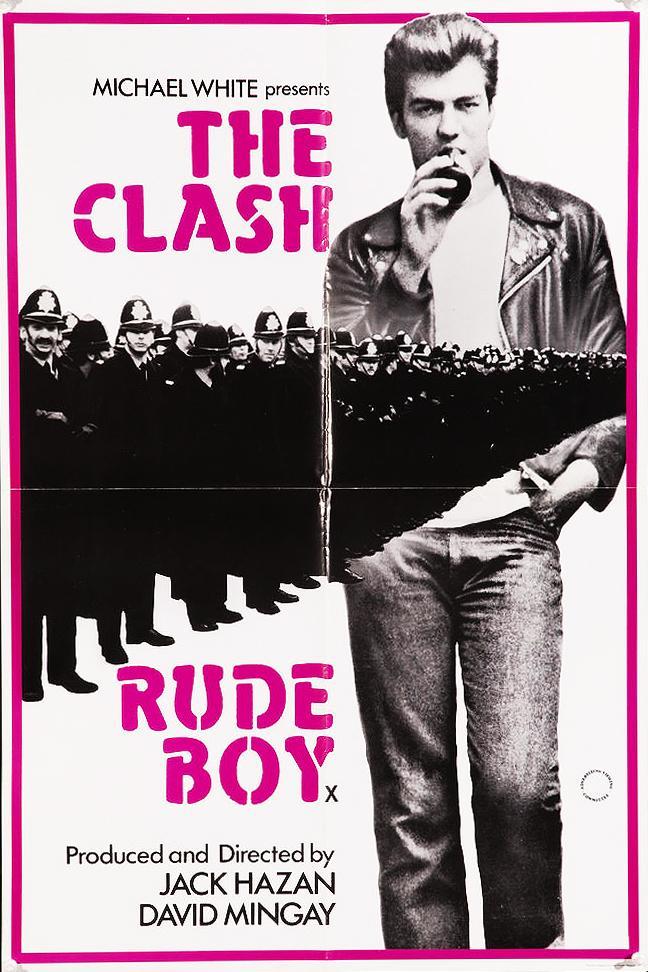
This review was originally printed in FFanzeen, issue #6, dated Year-End 1980. It was written by Lisle McKenty. The article below was based on seeing the Clash’s 1980 film Rude Boy.

In the very early 1980s, Lisle worked in the same office as me, and we didn’t really know each other well, as she was the assistant to my boss, who kept her apart from the staff. One day, at about three in the afternoon, I was having my daily fix of wake-up tea, and Lisle walked by. Under her breath, she murmured, “Boy was in a hallway drinking a glass of tea.” My ears immediately perked up. I stated, “From the other end of the hallway a rhythm was generating.” She whipped around, shocked that anyone knew the secret of Patti Smith, and we became close friends for a few years after that. Our boss was not happy about it.

As for the Clash themselves, my friend Nancy Neon and I had tickets in 1981 to see them play in Times Square at Bonds Casino, which is around the same time period as meeting Lisle. Nancy found out that the Rockats were recording their Live at the Ritz album the same night. We both easily agreed to scalp the tickets (at no profit as we were in a rush) in Front of Bonds, and then we rushed down to the Ritz to see an amazing rockabilly set. – RBF, 2018


Rude Boy comes under the heading, “A Michael White Presentation.” Michael White’s London productions list includes Oh! Calcutta!, Joseph and the Amazing Technicolor Dreamcoat, The Rocky Horror Show, A Chorus Line, and Annie…  His previous films include Monty Python and the Holy Grail, The Rocky Horror Picture Show, and Jabberwocky. Wild stuff. He’s big time.

David Mingay and Jack Hazan directed and produced Rudy Boy. You have to wonder about Jack Hazen. For an ex-cameraman, his shot sequencing is that of a film illiterate. Of course, I don’t know a lot about English films; I’m not what you would call a buff. David Mingay supposedly is. He studied English literature at Cambridge, then spent a year doing Film and Drama at Bristol. He also directed and edited a thirteen-part TV series, “Cinema: The Amazing Years (1897-1916)” before starting Rude Boy.

Rude Boy is distributed by Atlantic Releasing Corporation. Shall I bring up a fairly famous lyric-shall-we-call-it that says something about Atlantic?

As all the ads promised, the Clash is “in” Rude Boy. But how can you get guaranteed personality when you’re lost in the supermarket? Rude Boy is not about the Clash. It’s about Ray Gange [who also co-wrote the film – RBF, 2018], who roadies (don’t get confused) for the Clash when he’s not working in the Soho sex shop that passes for local color. There is also an obscure subplot, but I’ll get to that later. Well, Ray’s in California now, by the way of the money Hazan and Mingay paid him, and Freddy Laker. He has a Green Card, a job as a construction worker, and an American wife. I hope he’s happy. At least, I hope he doesn’t try any more flicks. Somebody please, I hope he doesn’t start a band. Time to go back to anonymity [he mostly DJs now, with a rare acting gig – RBF, 2018]. His best point might be said to be that he is from Brixton. And he did seem to like the Clash, even if his most memorable utterance was when he said to Joe Strummer, “Left-wing is gonna fuck everybody up.”

Ray’s best scenes, and the best in the movie, are the scenes of the Clash playing. No surprise if you’ve ever seen the Clash (and so what if it was over the screen at The Ritz). They’re electrifying. This dumb artsy flick doesn’t even begin to make sense visually or literally. Then you read in the paper that twenty minutes of the original film were cut (must have been the part that explained the subplot – I half-wondered what was up with those pick-pocketing scenes and the subsequent arrest of that Black guy).

Then again, maybe Hazan and Mingay thought that playing the first eight bars of “Revolution Rock” twenty times in less than two hours would drive an audience into an inspired punk madness.  Hazan and Mingay see punk as a “phenomena of the working class consciousness” and a “fusion of New York white punk and England’s polarized reggae, disco, and rock.” They don’t feel it.

The Clash has been there. They formed in 1976, when Joe Strummer (previously of the 101ers) joined up with Mick Jones and Paul Simonon, under the management of Bernard Rhodes, a partner of Malcolm McLauren, who “discovered” the Sex Pistols.  They toured as a support group to the Pistols on their Anarchy Tour of England, before pulling out in a dispute over the use of Swastika armbands. Topper Headon joined the band as drummer in 1978. The Clash on Parole Tour (featured in Rude Boy) shortly followed.

After their second LP, Give ‘Em Enough Rope was released, they split with Rhodes and announced self-government, with Caroline Coon as a representative (she’s the pretty blonde who travels with Mick and Paul on their pigeon-shooting charges in Rude Boy [she also wrote the excellent book 1988: The New Wave Punk Rock Explosion – RBF, 2018]). They toured the US twice in 1979, completing London Calling, and began a new formal management with Blackhill Enterprises.


Without a doubt, the funniest line in Rude Boy is when Strummer tells Gange that the Brigade Rossi (the Red Brigade) is an Italian restaurant. Rude Boy did try to give an impression that the Clash are revolutionaries. In the film, their performance at the Rock Against Racism concert almost causes a riot (helped by Gange) and audience control is near disaster at Glasgow when Strummer sings “White Man Looking for Fun.” Then there were Gange’s political conversations with the band, but I’ve already given an example of those.

It seems like a million people have asked me if I think the Clash sold out with London Calling. To tell the truth, I’ve wondered a bit myself when I saw the Clash up there on a wall, in-between Linda Ronstadt and KISS, in a suburban record rip-off store. It was nice back in the old days, having them to ourselves. But everything depends on what you mean by selling out.

Selling out usually means trading musical and lyrical quality and morality for commercial success. London Calling is better produced than The Clash or Give ‘Em Enough Rope, let alone the singles (it took me weeks to understand any lyrics on ”White Riot”). “Revolution Rock” is not “Clash City Rockers.” The Clash have contained, purified and polished their riot on London Calling.

“Lost in the Supermarket” is at once more subtle, more pointed, and funnier than “I’m So Bored With the USA” (not that I don’t love “Bored…”). “Spanish Bombs” won’t get airplay in Spain or in any other of what I call non-countries. If “Guns of Brixton” doesn’t incite you, then nothing will. The Clash have retained and strengthened their sense of “unreal politick” and their sense of humor. They haven’t turned us off with any cloying songs, like “Alison” [a song of Elvis Costello I like – RBF, 2018], or distorted reggae to the extent of the Police. In London Calling, they haven’t traded a thing. Just check out “Working for the Clampdown”: “Kick over the wall / Cause governments to fall / How can you refuse it?... / To these days of evil presidents / Working for the clampdown.”

Paul and Caroline
So if they aren’t a sellout crew (and they’re not), why did the Clash participate in Rude Boy? By the time of Clash on Parole, they were packing houses all over England, and their first LP had appeared a year earlier in 1977. Well, until recently, the Clash was denied airplay on both the BBC and Capitol Radio networks (maybe it was just Mick’s affiliation with the Shepherds Bush anarchists?).

As far as I know, they have been continually in debt to their record company, CBS (Epic’s just a trademark). I don’t know if Mingay and Hazan first approached Ray Gange, or the Clash, to make the film, but I’ve got a horrible feeling it was Gange.

In any case, these people wanted to make a “serious film” about punk rock and the working-class consciousness. A band’s a band and a gig’s a gig; the Clash needed the PR, the money, and they wanted the platform. And as far as a sell-out goes, didn’t I use the term “commercial success”?

Rude Boy was made two years ago. Obviously, Mick and Paul and Joe and Topper were a lot less sophisticated than they are now. In my mind, hell, they were damned naïve. Maybe I can blame it on Caroline Coon (or was it Rhodes?). Rude Boy is a terrible flick, excluding the music scenes (“I Fought the Law” was especially great), made by terrible people, in my book.

To bring in the inevitable Beatles comparison (are you ready?), it’s like when Brian Epstein stuck them in suits, albeit without collars. I don’t feel bad panning Rude Boy, and I’m a Clash fanatic. If you like the Clash, then you’re like me – you’ll go see it anyway. If not, maybe you should listen to “Jimmy Jazz” or “The Right Profile” for a while.

To conclude: I often wear a tee-shirt proclaiming “The Clash: The only band that matters.” I’ve seen lots of others around on various other bodies. According to the rumor, the Clash now wants to make their own film. A terrific idea [didn’t happen – RBF, 2018]. Hopefully, next time they’ll make a worthy one – humor, politics, emotion, a riot – one that matters.