I became acquainted with Shari while she worked at Max’s Kansas City, in
the late 1970s. She is an amazing artist and cartoonist, and I published a few
of her humorous Max’s Funnies in the print version of my physical FFanzeen in
the early 1980s. This is a reprint of a Facebook blog on May 19, 2023 that she
wrote about the first time she was Joey Ramone perform in a pre-Ramones band
which shared a bill with SUICIDE, reprinted with her permission. – Robert Barry
Francos, 2023
Sniper
The First Time I Saw Joey Ramone: For His Birthday (May 19, 1951)
The very first time I saw
Joey Ramone perform live was as “Jeff Starship,” fronting the glam rock band
(we called it “glitter” back then) SNIPER, at Coventry, on Queens Blvd in
Sunnyside, Queens in 1973. I was 16 at the time and going to Art & Design High
School in the city. SNIPER was opening for a duo that my Art & Design
friends and I had heard much about, and we’d gone to check out: SUICIDE. We
knew the singer was a painter/sculptor/installation artist that was getting a
lot of attention, so we were intrigued.
When we got to the club,
we found a place to sit on the floor about twelve feet from the stage. The
crowd all found seats on the floor around us. The room filled up fast.
When the lights went down,
and SNIPER got on stage, I was immediately spellbound by the lanky front man
with bangs and sunglasses. First of all, he was taller than anybody I had ever
seen in my entire life – let alone someone fronting a rock and roll band. Even
without the 8-inch-high hot pink platform boots he was wearing, he would’ve
been taller than anyone I’d ever seen. Super long skinny legs in hot pink shiny
hip-hugger spandex pants, hot pink platform boots, and a dangling long black
scarf. Long dark wavy hair with short bangs, big cheekbones, and round shades.
And he had a stance that looked as if he was hardly moving, but even without
moving much, his delivery actually seemed quite aggressive. He had a unique
vocal style. Everything about him was unique.
I don’t recall the music
very well to tell you the truth. And I don’t recall the other members of the
band because I couldn’t keep my eyes off the singer. I just remember thinking “I
will never forget this front man for the rest of my life.”
After their set, we were
anxious to see the headliner. I’ll make this next part short because this story
is really about Joey, but I can’t leave out my first impression of SUICIDE.
Suicide
It got dark, and all of us
in the audience were sitting on the floor, waiting for what seemed like an
interminable amount of time, looking at the door behind us from which the duo
would be entering. Finally, a guy dressed all in black leather comes into the
room, dragging a large thick chain behind him. Slowly approaching the stage, he
wields the chain menacingly around the edge of audience, shouting
unintelligible stuff, and being incredibly menacing. I can’t remember if he was
on a mic yet, but he was loud. And I don’t remember if the keyboard player,
Marty Rev, was on stage yet at that point. I only remember my first glimpse of
the singer, Alan Vega, and he held us all in thrall. I was sitting there, and I
remember thinking, “Okay this is scary. If I get up now and try to leave, I’d
have to make my way out by stepping over all these people in the dark, and he’s
gonna see me, and he’s gonna come running after me with that goddamn chain...”
I had no choice but sit there and wait and see what happens next. So, I stayed.
When they were finally on stage, the music was deafeningly loud and strange,
and different from anything I’d ever heard before. And despite the terrifying
theatrics of Alan’s entrance, the music was actually mesmerizing, and I became
of a big fan of SUICIDE. Years later at Max’s, Alan and I would become great
friends. He was a real sweetheart. A true innovator.
Back to my Joey story…
For three years, after
seeing that show at Coventry, I would remember that strange looking singer I
saw fronting that opening band, wondering what ever happened to him, if he was
still performing.
By 1976, I was still
living at home in Queens, and going to SVA (School of Visual Arts) in the city.
One day I was at my boyfriend’s place. He had just bought a new album. It was
by this band THE RAMONES; he said that I just had to hear because they were
great. Totally different than anyone. Then he showed me the album cover. I
couldn’t believe it. I was like, “Oh my God, that’s the GUY!!! That’s
the GUY!!! That’s that front man I told you about! The lanky one with
the bangs and the glasses! It couldn’t be anyone else! That’s the singer of
SNIPER!” It was so weird that I was the only one in my crowd that ever saw him
play in any band before THE RAMONES. Needless to say, that was a great first
album, and the rest is history.
I saw them for the first
time at Hurrah’s in August 1978 with my friend Jane. She and I were up front
and center, standing right against the stage. And many years later I met his
beautiful mom, Charlotte, a very sweet lady. And it was obvious that he
inherited those big high cheekbones from her.
“What Walks There Walks Alone”: A
Comparison of Shirley Jackson’s The Haunting of Hill House and Robert
Wise’s The Haunting
While going
for my advanced degree in Media Ecology at New York University, I took a class
with Professor Joy Boyum, “Fiction into Film,” and wrote this as a report. It matches
one of my favorite books with one of my best-loved films. The paper is dated
May 5, 1993. Please note for those who have neither read the book or viewed the
film, there are spoilers.
Clown:
“O mistress mine, where are you roaming?
O, stay and hear, your true-love’s coming.
That can sing both high and low
Trip no further, pretty sweeting;
Journeys end in lovers meeting.
Every wise man’s song doth know.”
– Twelfth Night, Act 2, Scene 1
Robert Wise’s direction of The Haunting (1963),
an adaptation of Shirley Jackson’s The Haunting of Hill House (1) (1959),
remains one of the more memorable psychological supernatural thrillers brought
to the screen. The film’s success has much to do with the cinematic elements
brought to the story as the tale itself.
Wise’s choice to not show the apparition(s),
with one brief exception a heartbeat long, is an effective tool for presenting
a stronger psychological narrative edge to the story that perhaps might have
been lost if he had chosen the easier “fright” route of wraith effects. The
doorknob jiggling and mysterious hand-holding is all the more convincing because
of the riddle of who or what is roaming the halls of Hill House.
Wise also emphasizes an element of
claustrophobia that is sometimes lacking in the novel. Jackson places much of
the action during the day on the grounds and hills surrounding the house;
invisible footfalls in the grass appear less horrific. Wise, however, used the darkness
of mahogany interiors, earth tones and shadows to give the viewer a sense of
entrapment and depraved evil. Once the lead protagonist, Eleanor, arrives at
Hill House, the only outdoor scenes are two on the terrace (first in daylight,
then at night) and two on the grounds, by the front door, when Mrs. Markway
arrives (day) and Eleanor’s final departure from the house (night).
One of the perplexities of Hill House is the
way the house is designed. Eighty years earlier than the story is set,
the house’s architect, the overbearing Hugh Crain, build a structure that was as
distorted and enigmatic as its contriver. Wise sets a somber tone through the
use of quick, jerky editing and especially irregular camera angles to reveal
the skewed house design and a conundrum of doors that shut themselves (by
design, not spirit).
The key theme of the film, as well as the
novel, is loneliness. Both are introduced by a prologue (narrated on film),
“Hill House, not sane, stood by itself against its hills, holding darkness
within… and whatever walked there, walked alone.” Entering into this dark
isolation are four characters, each lonely in his or her individual way.
Eleanor Lance (Vance, in the novel), played by Julie Harris, arrives after
years of isolation spent taking care of her domineering and sickly mother.
Eleanor views her stay at Hill House as a chance to flower, to belong. In the
novel, she repeatedly utters a line from Shakespeare’s Twelfth Night: “Journey’s
end in lovers meeting.” Though this is only quoted once in the film, the theme
remains the same: there is a sense of love’s absence, of a desire to find a
place in the universe where she is her own person, accepted by others for who
she is. Eleanor has no real home (she lives with her sister’s family), no one to
love, and no one to love her.
There is an almost claustrophobic feel of
dread and naivete about the world within her, as she created a dream life of an
apartment of her own with matching stone lions on the mantlepiece. Eleanor is desperate
to fit in and gain back what she believes she had lost through many years of
solitude.
The future owner of Hill House, Luke Sanderson
(Sannerson in the film, played by Russ Tamblyn), is also rejected by his
family. His lonely past has produced a “liar…also a thief.” The novel presents
Luke as an in-depth character who is a scalawag, but also has a heart, and is
merely acting out of his sadness and need to be accepted. He is presented as
the first possibly lover at “journey’s end” for Eleanor. In the film, however,
he remains undefined, reduced to comic relief.
Whereas in the novel, Dr. John Montague
(Markway in the film, Richard Johnson), who leads the supernatural “expedition”
into the house, is known by Eleanor to be married from his first introduction;
this fact is hidden from her in the film, setting up a possible liaison between
them. Is John the lover at “journey’s end”? Many of the romantic actions taken
by Luke in the book are given to John in the film, such as offering a steadying
hand to Eleanor as she looks up at the tower (nearly toppling over a balcony),
or rescuing her from the shaky ladder in the library. The novel presents John
as lonely, due to the shrewish nature of his wife, unnamed except as Mrs.
Montague. She is presented as a person who has no regard for her husband’s methods,
dismissive of Montague as a person, self-promoting, and a supernatural
“expert.” The film merely hints that John is lonely, and might end up in
the company of Eleanor.
A subplot of possible lesbian romance is then
presented by the last of the four main characters, introduced by Theodora
(Claire Bloom). This theme is interjected in the novel as Theo arrives at Hill
House after a painful fight with her “roommate,” feeling dejected and somewhat
bitter. In the film, Theo’s orientation is broached through dialogue, presented
more as the reason for her loneliness: “By the time I’m through with you
Nell, you’ll be a different person”; elsewhere asked what she is afraid of, Theo
responds, “Of knowing what I really want.” Her sarcastic manner is treated as
rooted in the sexual orientation, as well. Though Eleanor is repulsed by
Theodora’s sexuality in the film (“The world is full of inconsistencies.
Unnatural things. Nature’s mistakes, they’re called. You, for instance.”), in
both the film and the novel, Eleanor eventually wants to go off and live with
Theodora. The author posits this as another possibility of “journey’s end where
lovers meet”.
A third theme of the story is that of
parental/daughter relationships. Although Hugh Crain designed the house, he
barely resided there, and eventually died in Europe. It is his warped vision
that dominates the house, however, with a malevolent (male-violent) influence.
His evil is that of control. Even in designing the house, he materialized his
own vision rather than relying on others, with skewered angles and unmatched
lines, going against architectural conformity to express his will. It was with
this will that he ran his house while occupying it with his daughter(s). His
religious fanaticism, which evolved from his bitterness over his wife’s/wives’
demise led him to warn his daughter, “Honor thy father and thy mother,
daughter, authors of your being, upon whom a heavy charge has been laid, that
they lead their child in innocence and righteousness, along the fearful narrow
path of everlasting bliss…” Though his physical presence in the house was
minimal, his influence remains, and it is this warped domination which seems to
affect the weakest of those who enter the house, subduing them to the power of
his control.
Hugh Crain’s malevolence is directed at women.
All who die at Hill House are women: first the wife of Crain, who is killed in
an accident on the grounds before even viewing the house; second, their eldest
daughter (only daughter in the film), Abigail (Sophia in the novel), who dies of
pneumonia at an elderly age in her bedroom, the nursery (“the heart of Hill
House”), while her young servant/companion “dallied in the garden with some
village lout”; third is the companion, who inherits Hill House, who hangs
herself in the library. The last woman to die is Eleanor herself, a possible suicide
who seeks to remain at Hill House, under the influence of the evil will of Hugh
(2) Crain.
There are overlapping images in the context of
the story. An example is that both Eleanor’s mother and Hugh Crain’s daughter
die while banging on the walls for help. This “mother/daughter” parallel is
further mirrored by Eleanor’s guilt over presumed negligence in having slept
through her mother’s knocking, as did the companion, who “dallied” while her
mistress died in distress. Both Eleanor and the companion become obsessed with
the house and the staircase in the library. Both eventually commit suicide. Similarly,
Hugh Crain’s wife died without ever having entered the house, whereas Eleanor
dies driving into a tree at the same spot on the grounds so she does not have
to leave.
In Wise’s vision even more than Jackson’s,
Eleanor is treated by all as a woman-child, though she is in her early 30s,
because of her innocent and cloistered life. In a scene where she is seeking
permission to use what is essentially her half-owned car from her sister’s
family, the relatives reject her request because they view her as childlike and
consequently irresponsible. This scene is dramatized while a child’s melody is
played in the background. Also, throughout the film, again more than the novel,
Theo often calls her by the nickname “Baby,” sometimes in a patronizing tone.
This, of course, reflects back to the nursery, the heart of Hill House, which
has been collecting victims for years. The inflection is present in the novel,
but in a more subtle, sardonic way.
The characterization that is most changed from
novel to film is that of Mrs. Montague (named Grace for the film, played by
Lois Maxwell). Whereas she is a totally disagreeable character in the book
owing to her obnoxious ego and dismissal of concern for nearly all others, the
cinematic version lives up to her first name, presenting her as a strong and
decent person who is unintentionally triangled between John and Eleanor. In the
movie, Eleanor suggests Grace sleep in the “evil” nursery in a pique of jealous
spite, while in the novel, John makes this suggestion because he is acquiescing
to his wife.
Two other characterizations that are altered
from the original source are those of Dr. Montague/Markway and Luke Sannerson/Sanderson.
In the book, Montague, while the leader of the psychic exploration to Hill
House, is seen as a three-dimensional character who is sometimes flawed and
always human. In the film, perhaps because he is presented as a potential love-interest
for Eleanor, Markway becomes a near-swaggering Petruchio-type hero; one can
almost her him slap his knee in self-righteousness. Luke, on the other hand, is
treated the opposite: whereas Montague to Markway comes from human to hero,
Luke Sanderson to Sannerson goes from possible love-interest to practical
joking comic chorus.
An obvious problem in adapting the novel to
the film would be similar that of any phycological drama, the inner narrative
voice. Thought processes are the crux of psychological drama, as the
protagonist struggles with distressing events, and the consequences that are
faced become more severe. Wise takes the most direct approach, and has
Eleanor’s thoughts presented via voice-overs. Though this may be a potentially
overbearing and distracting technique, Wise uses it to optimum effect, holding
back and letting the actor’s expressions tell us of her own inner turmoil in particular
scenes, while voice-overs detail the trauma in others.
In the novel form, the horror story, be it temporal,
spiritual or psychological, has its work before it. Unless the subject matter touches
on the personal fear of the reader, such as something/someone hiding in a
closet or a phobia, like fear of heights (e.g., Vertigo, 1958), the
printed word needs to be worked harder to be shocking, especially to those who
grew up watching film. Historical horror novels such as Mary Wollstonecraft
Shelley’s Frankenstein (1818) or Nathaniel Hawthorne’s “Rappaccini’s Daughter” (1844), were
written when there were no moving images that could shock with a sudden “Boo!”,
so the imagination of the reader of the stories is needed to be able to
horrify. Present-day writers such as Clive Barker and sometimes even Stephen
King manage to frighten, but their shocks come from the gross and the gory. The
Haunting of Hill House was published during a period when the horror novel
was based more on the psychological than “visual” manifestations, therefore
crating a timeless horror that does not need to go “boo” or bleed.
Film has a great potential for
frightening the viewer. Whereas the novel can horrify by leaving the terror “unnameable”
(as H.P. Lovecraft was fond of doing) and inviting the reader to realize his or
her worst fear. A film can frighten by presenting a haunting image or a sudden
shock. For example, while the echoing, pounding on walls and jiggling of the
doorknob as “whatever walked there” searches for Eleanor and Theodora in the
Haunting of Hill House creates fear, in The Haunting, the dimension
of fear is heightened by watching the door bend under the weight of the
spirits, the wall- and door-pounding becomes deafening (especially as the
cadence gets perceptually louder, faster and more menacing), and the dissonant disembodied
voices of the mysterious forces (such as what sounds like hard fire and
brimstone preaching by Hugh Crain to his daughter) fill the senses by filling
the screen. Add to this the cinematic touches of shadow and light, juxtaposing
camera angles, eerie music (3) by Humphrey Searle, and dissonant editing
(4).
Through cinematic devices, Wise hold
back on visual information about the antagonistic spirits, to heighten the
sense of mystery and fear through the unknown. He uses the occasional lack
of music to make the terror feel more imminent and tangible, and skewed
closeups to place a fearful image immediately before the viewer in arresting
perspective. While Jackson has Eleanor see spirits in one form or another
(spying invisible foots falls in the grass or viewing ghostly picnics), Wise
chooses not to rely as much on the visual to frighten, but by way of a literary
perspective, employing the imagination, all the while using the cinematic
process to make the viewer’s imagination hold one in terror. The fear of the unknown
usually tends to be less challenging to accept on film because of the
temptation to show precisely what is there for which to be afraid. By choosing
not to display some blatantly showy special effects (other than an occasional
breathing door, for example), and relying on cinematic techniques, wise raises
the stakes from cheap thrills to high horror, without gore and without
hackneyed effects (5).
By viewing the film before reading
the novel, I was able to grasp some concepts that may not have been so obvious
from using the book as the primary source. Details in print are usually more
thorough in pointing out specifics, consequently more information is passed to
the reader. Due to the time in literary history the book was published,
however, less emphasis was placed on the homosexual aspects of the characters
of Theodora and, more subtly, Eleanor (6). The subtlety of this aspect
may have been lost on the reader, but to the viewer, these themes were clearer
and more straightforward.
Another interesting aspect of the
film that Wise added is having the final prologue spoken by Eleanor, after her
death. The closing line was changed from “Whatever walked there, walked alone,
to “We who walk there, walk alone.” By adding this change, Wise
solidifies the realization that the main character and antagonist in both the
film and the novel is Hill House itself. It is the neediest and most demanding.
It is the most appalling, and yet seductive. It is Hill House that is the lover
Eleanor meets at “journey’s end.”
Footnotes:
1. Screenplay by Nelson Gidding.
2. “Hugh” is Old German for “Will”.
3. Music by Humphrey
Searle.
4. Editing by Ernest Walter.
5. For the opposite school of thought, see the Roger Corman films of the same
period.
6. Though novels such as Radclyffe Hall’s The
Well of Loneliness (1928) and Lillian Hellman’s play, The Children’s
Hour (1934) had already been published with the themes, mainstream fiction
still apparently considered the subject a taboo.
Alan Vega • Martin Rev • Suicide:
Five Films by Marc Hurtado
Written and directed (etc.) by Marc
Hurtado La Huit / MVD Visual 113
minutes, various years / 2018 www.mvdvisual.com
When the
term Transgressive (capital “T”) is used for art, most are going to think of it
in relation to cinema, with films created by the likes of Richard Kern, Scott
and Beth B., and Lydia Lunch. When it comes to other forms, such as music, at
best it tends to be considered transgressive (small “t”). This is not fair,
especially for a period of the mid-to-late 1970s and early 1980s, when there
were combative bands like Red Transistor (led by Von LMO, who would chase
patrons out of bars with a chainsaw) and especially Suicide. It makes sense to
combine art forms of film and music, perhaps to make something new:
TRANSGRESSIVE (all caps).
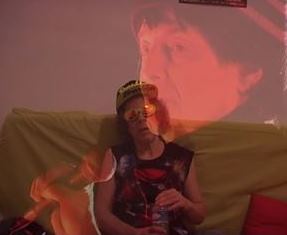
Suicide in concert
I had the…
pleasure to see Suicide play once at CBGBs in the early 1980s. Knowing their
reputation for confrontation with the audience, I sat near the bar, but that
didn’t help. As singer/provocateur Alan Vega (d. 2016) roamed the club while
keyboardist Martin Rev stuck to the stage sending out punkabilly pulse waves.
I’d been a fan of the band since their first eponymous album in 1977 on Red
Star Records. “Cheree” caught my attention first, but one listen to the
10-miniute plus “Frankie Teardrop” was what reeled me in.
Suicide should
have been everything I hated back in 1977: it was pure electronica, and to this
day I mostly find that to be, well, musical suicide. But there was an artistic
intensity that Vega and Rev brought to the minimalism that was different than,
say, Teenage Jesus and the Jerks’ factory-like clunky and metallic rhythms.
They were not just musical terrorists, they also were seducing the audience at
the same time, like a snake charmer coaxing a cobra, except if the reptile was
the safer choice.
Morocco-born
director Marc Hurtado filmed a bunch of mostly shorts with Suicide before Vega’s
death, and these are collected onto this dual DVD set. Both discs contain the
same films, but one is in the original French, and the other in English. I’ll
let you guess which one I chose.
First up
is the 16 minute-long The Infinite Mercy
Film (2009). Here is a mixture of an artist’s muse and its outcome. The locus
is on Vega’s use of light and lighting as a paradigm in his paintings, as the
camera focuses in and out of various mixed-media, while Rev’s rhythms wind
their way around the image in a reflexive way to match Vegas’s use of cords,
twine and light bulbs. Interspersed is Vega himself, as he describes the origin
of his use of light and what feeds his influences. The level of avant-garde artistry
used to mix the music, the artist, the filmmaker and the synergy they create
together should come as no surprise.
Alan Vega posing oddly
At 6
minutes, we are given Saturn Drive Duplex
(2011), which is essentially a music video for a collaboration of Vega’s speak-sing
voice and Hurtado’s music. Where the first film was focused on light, this one
is on motion. We follow the clips as they zoom along traffic in Manhattan
(often on the side of the East River), close-ups of boxers sparring, and Vega
posing oddly in his studio. Hurtado also uses shadows and, yes, light, to highlight
his focus both in high contrast and subtle ways.
Saturn Drive Duplex Redux (2014) is
4 minutes and artfully combines and condenses the three previous films, using
light, travel, and art into a different Vega/Hurtado music video for a remix.
We also get to see b-roll images of Vega on stage added to the recipe. Perhaps it’s
the shorter length, but this feels like the most rewatchable of all I’ve seen
so far, and this material is the kind you really need multiple viewings to let
the whole Zen of it wash over the experience.
One could
refer to Infinite Dreamers (2016) as the main feature, due to its 82 minutes’
length. Essentially, this is Martin Rev’s film: a stream of consciousness from
the mostly silent member of the duo with a mixture of clips of Suicide playing
in various venues, such as Frioul Islands, France, and of course lots of
B-rolls. This makes total sense, as they are considered cult heroes in that
part of the world, and Vega even had a solo hit in the area with “Jukebox Babe”
in the day. It’s quite obvious that the sound is camera-oriented, rather than
through the mixing board, so it is kind of rough, with lots of echo and reverb,
even beyond the band’s normal tone. It’s also way less confrontational, with
Vega looking very frail as it was close to his end; he stays on stage rather
than rampaging through the crowd.
Martin Rev
But like I
said, this is Rev’s turn to step into the spotlight. Despite his talking, I
would never use the word “narrative” to describe the whole thing, but it is as
close to a storyline as we have seen so far. It is, rather, various clips of
Rev speaking – both on camera and off – and discussing the history of the
group, and Suicide’s role in the artistic world; especially their philosophy as
far as art is concerned. It’s deep
and meaningful, and while these monologs doesn’t seem to follow a particular path,
it still all falls together into a transgressive (small “t”) pattern that can
be put together as a whole in the end in the mind for the viewer.
The fifth
film is Saturn Drive (2016), at 5
minutes, which was released posthumously after Vega’s passing. Essentially, it’s
a one-camera shot of Vega in the Hospital after a bad fall where he did serious
harm to his hip. He looks drugged out of his mind on pain meds. He talks about
being in “Saturn Drive” (heaven? hospital? stoned?), his religious affiliation,
and seeing 9/11. I’m willing to assume this is the last footage of Vega before
he went over the rainbow bridge, and it’s touching.
So,
overall, Hurtado seems to model himself a bit on filmmaker Stan Brakhage, who
used the media form as his easel to let the film itself tell the story (a true “Medium
is the Message” kind of mindset that would have made Marshall McLuhan proud). For
Hurtado, the visual scape is as important as to what he is trying to convey to
the audience, that art is multi-layered, and should be addressed as so. While I
have always preferred the narrative framework over the stream of consciousness kind
of art in various modes, I enjoyed the films and getting to see some of Vega
and Rev at work is always enlightening.
Text (c) Robert Barry Francos, 2011
Images are owned by the artists
Also, images can be enlarged by clicking on them.
As stated in an earlier blog, throughout the years I have collected flyers, especially from the 1970s and '80s. Many were sent to me directly by the bands while I was publishing FFanzeen. Below are some scans I made from my personal collection, in no particular order. I did see many of them, but not all, and I will comment on them from time to time. Note that I do not financially profit off of publishing them, but only do so to honor the work that was involved, and for archival purposes.
The Fuzztones and the Vipers were two great bands from the psychedelic revival movement of the early 1980s, but they were both so different in sound. The 'Tones had that Rolling Stones sense of danger with Rudi Protrudi on vox guitar and vocals, and Deb O'Nair on keyboards doing mostly back-ups and if I remember correctly, an occasional lead. At the time, she was an embodiment of Nancy Sinatra in her biker flicks days. The band is still around and putting out records, albeit it is based in Germany, and Deb's spot is filled with Lana Loveland, who has her own eponymous band worth checking out, as well. As for the Vipers, they were more poppy, but sharp as a tack. Their song "Cheated and Lied" remains one of my favorites from the period. Last time I saw vocalist / maracas shaker Jon Weiss, he was emceeing a garage theme show at the Acme Underground a few years ago. I had the pleasure of interviewing both bands, at different times.
Geek Maggot Bingo was a bizarre film staring Richard Hell and blues belle Brenda Bergman. This invite was for the opening showing and party at Danceteria.
The Cynics run the Get Hip label out of a Pittsburgh suburb. They are an odd yet compelling mix of psychedelic, metal and pop, and had a video of their song "Girl You're On My Mind" (written by Bernie Kugel of Mystic Eyes, who were on Get Hip) that appeared on MTV for about a second. Worth seeking out the YouTube of it.
This is definitely a show I wish I had seen. I mean, Joan Jett and Darlene Love? Wow.
Along with the psych revival, New York was also diving into the deep end with hardcore. The False Prophets were one of the big ones.
At one point, Binky was the guitarist for a fun New York band called the Planets. They would sometimes play Top 10 (aka disco) songs totally rocked out. I specifically remember them blowing the roof off of "Boogie Fever" one night at Max's Kansas City. Plus, Binky also was one of the cool guys to talk to behind the counter at Sounds, on St. Mark's Place.
I only saw Suicide play once, and that was at CBGB. It was a totally intense experience that lives with me even now. Plus, their song "Frankie Teardrop" still works at getting under my skin. Minimalist heaven, it is the only synth band I can listen to, even now.
Robert Poss lead Tot Rocket, before Band of Susans. He played around a lot in the 1980s, and I have many fliers he sent me to prove it. A really good band (both, actually).
The Mosquitoes were more than just the writers for the last hit song by the Monkees during their 1986 reunion. They reminded me of a psych version of Gerry and the Pacemakers.
The Comateens were a cult band then, and remain so now. But their fans will tell you how good they were.
Currently living in Saskatoon (email at RBF55@msn.com for address). From 1977-88, I used to publish a print version of a music magazine in New York called FFanzeen, which dealt with the wide-ranging independent music scene. I also photographed many bands from the period (and since). Now I write this blog. And the beat goes on.




 Posts
Posts

