Showing posts with label Richard Gary. Show all posts

Saturday, January 1, 2022

Favorite and Not Favorite Horror Films for 2021

 Favorite and Not Favorite Horror Films for 2021

Text © Richard Gary / FFanzeen, 2022
Images from the Internet


As always, I will first republish the rules I have about such lists as these:

I have an issue with “Best of” and “Worst of” year-end lists for the following reasons: most are chosen from either those that play in theaters. For me, I like to watch the DIY ones, for these tend to have more heart. My list consists of films that I saw and reviewed in 2021, not necessarily ones that were originally n that year.


As for Best and Worst, I never liked those terms; art is just way too subjective, which is why I called them Favorites and Not Favorites. That being said, even the “Not” ones have redeeming qualities, and the fact that I felt they had issues means nothing. I have hated films that have won tons of awards, and liked some that other find abhorrent, so don’t take anything I say, good or bad, as the definitive. It’s just opinion, and I welcome you to agree or disagree. It’s all good.


These two lists are alphabetical, rather than ranked (another thing I don’t believe in).

These are condensed reviews. The link to the full, original review is at the bottom of each listing.

Favorites:

Dante’s Shadow of Sin
Directed by Dakota Ray
I ask you: in the time of Covid, what’s a man supposed to do? Easy, just down a glass or two of absinthe, get a new and sharper lens for your camera, and direct your eighth film of nihilistic behavior, as has done Denver-based director/writer/cinematographer/editor Dakota Ray. Ray’s characteristic use of monochrome-colored filters, in this case one that is a rich, dark blue hue, the new lens really is incredible at showing details. As is his wont and right, the title character is played by the director and his insanely deep voice, who in the first line, explains the nihilism that clouds his very soul: “My name is Dante, and I serve no man but myself.” He is remorseless, unhinged from reality, and a complete narcissist. There is a lot of fine editing by Ray, which improves with every film, between characters, objects, Satanic symbols, and insects in various states of health. These, their use as subliminal commentary on the action, all become characters in their own right in a way, rather than just be filler. Two years after committing a horrific murder, Dante is contacted by an acquaintance, Mahoganny who has inherited the Boleskin House (referencing the Boleskine House in Scotland, owned by renowned Satanist Aleister Crowley and guitarist Jimmy Page). Mahoganny suggests they get together and go to the house. The name Mahoganny is more symbolic for the hardness and darkness of his heart rather than skin color. Throughout the film, we hear the thoughts of the two central characters more than words are spoken, which makes sense since so much of the planning of these two are secretive, so we become cognizant of just what the hell is going on. We also hear the drug-induced disembodied voices of objects such as dolls, a white rabbit and a goat head who represent the Satanic elements. Dante, though not redeemable, kills for a purpose, even if it is self-gratification. With Mahoganny, however, slow and painful control and sadism is more his speed. These two both know that the time in the vacation house will not end well, and each has a motive to be the only one out, but the build-up to the confrontation is a large part of what is going on through the story. With hexes, drugs, alcohol and just sheer deviance of a multitude of natures, these guys have a deep hatred that Ray manages to convey quite strongly. It a steadily intensifying to-the-death duel, both mentally and physically. The lightening in the sky is a foretelling of the bad actions to come. The film is broken into a number of chapters via long title cards. This is also common among Ray’s films. However, story-wise, this is the most cohesive of the eight, being rather threadbare in its plot. Rather than mixing a number of different stories into one, here he focuses on the two main characters, and yes, you could say that it still two tales into one, but its focus is more exact, with less opaque moments. As much as I have enjoyed all of Ray’s releases, I think this one could be a turning point as far as a pathway. As much as I like the past ones, I look forward to the swing in this direction.
Full review and trailer HERE 


The Forever Room
Directed by Kevin Hicks
This psychological thriller starts off with Claire, a young woman who is chained by her ankle in a basement somewhere that has basic necessities, and a bucket for, well, you know. However, there is naught but herself to spend the time. She is way angrier than she is scared of her captor, an older woman named Helen. The latter accuses Claire of committing a heinous crime and states, “You have a lot of skeletons in your closet, dear,” which Claire vehemently denies. That’s just the opening. As the film progresses, things are not always what they seem at first, and much of the story is the basis of the relationship between these two women. Claire is confused and angry, and Helen is (mostly) calm and calculating, many of their exchanges being when it is feeding time. Each conversation builds on the previous one, with bits of information to the audience to fill them in. Despite the claustrophobia of the small room in which Claire forcibly occupies, the story is interesting, and the viewer wants to know more and more of what put these two people in this dire situation. Claire doesn’t remember anything before being chained up, but parts of her past are telegraphed by both events that happen to Claire in the room, and the things she hears. Meanwhile, people keep appearing when Claire is alone, such as a middle aged man, Ethan, Rebecca, who is closer to her age, and a boy named Michael who seems to be playing a game of hide and seek with Claire. Rebecca explains how she is a figment of Claire’s imagination (“Haven’t you ever had an imaginary friend?”), but something dark brings out these three…and a couple of sock puppets. No, I’m not kidding. Possibly it is a bit like Gerald’s Game (2017) in that the imagination runs havoc, perhaps it is dreams, or is it something more sinister or supernatural than that? Over time, the frequency of the pop-ins increases and become more intense. Sometimes it is incredibly creepy, especially with Ethan and Michael. Rebecca is sort of a Greek Chorus in that she helps with some self-questioning and pieces of exposition for the viewer. Or perhaps it is Claire’s own brain eating itself because she refuses to eat for days on end. Despite the small, narrow space, the filming work is well staged, almost like a three-camera television shoot, keep the elbow room still tight, but not too claustrophobic. The two female leads prove themselves to be naturalistic actors who makes it look easy, making them both empathetic and unhinged in fearless performances. The lighting is phenomenal, with shades of primary colors, but not to the Creepshow (1982) level, but more of a realistic tone, and with the editing gives some expansion to the space. Speaking of the basement, this could actually be a one-set play, using shadows and dark spots for characters to “pop” in and out quite easily. It almost seems like it was written that way. For a troupe of five (not counting the two puppets), the story stays engaging for the full run time, and even though the space is small, as is the cast, it remains compelling. The final act is full of unexpected moments and answers quite a few questions. A good watch.
Full review and trailer HERE 


A Ghost Waits
Directed by Adam Stovall
Most of us have seen hauntings films, where the spirits are present in the home and they are going to probably scare the inhabitants away. This is the job of a particular ghost, Muriel, and she is a champ at it. No one will stay at the Cincinnati house, which is – in the alive world – possessed by a management company that just wants the problem of constantly rotating lease-breaking tenants solved. To get the house ready for the next renters, handyman employee Jack clean sup and takes care of any issues. It becomes pretty obvious early on that what is there walks alone, and steals his pizza. Jack is a bit of a ne’er-do-well though good at his job, and is just floating through life in a job that doesn’t really mean much to him. It is pretty obvious that Muriel and Jack are going to connect on some level. It takes a while, but these two lost souls are looking for something and someone. Muriel has her own issues with her by-the-book spook supervisor, Ms. Henry and a fellow up-and-coming “spectral agent” Rosie. This film definitely has a comic vibe to it, though it is more of a “dramedy.” It is well written, especially the way it uses the soundtrack as another major character. It is also interesting to see the differences between the two main haunting ghosts. Rosie is newer, and more up-to-date in her language as a teenager, while Muriel talks with no contractions, as in “I do not,” as opposed to the more modern “I don’t”. I thought this was a really smart, deliberate, and subtle choice. Another one of the understated points of the film, though written by men, is that the strongest characters here are the women. Jack is kind of weak and generally unmotivated in life, but Muriel likes what she does and is, to say the least, fierce. And yet she has a lot to learn in the experience which makes her more independent and a leader (such as over Rosie), taking control of her own life – er – death to make choices. This pro-women aspect is one of the finer themes of the film for me. Because, in part, due to the use of sharp shadows, especially on Muriel’s face as she is consistently lit from below (as are all the spectral agents), the film works so much better in Black and White and, again, it was a wise choice. It’s just the right amount of grainy, which gives the look a sense of texture. There are also many very long shots, some static and others following the characters, rather than a jumble of quick edits. It works for the pace of the story. While I thought the ending was predictable, it was really the right way to end this, so I did not let that get in the way of the story. Overall, it was the right length to keep the interest up, and had some really fine moments. The acting is top notch and helps make the film even more enjoyable. This is fun, and may play well as a date night film without being too Hallmarky over-schmaltz. For a director’s first film, this is quite compelling and a positive release.
Full review and trailer HERE 


Lake Michigan Monster
Directed by Ryland Brickson Cole Tews
Almost like a Terry Gilliam fever dream, we are introduced to Capt. Seafield (director Ryland Brickson Cole Tews) who explains that his dear ole dad was killed by the titular creature, and gathers a crew together to find and slay it. There is snarky weapons expert Sean Shaughnessy (Erick West), Sonar “individual” Nedge Pepsi (Beulah Peters), and former Naval Officer Dick Flynn (Daniel Long), or as Seafield calls them, “The Team of the Century.” There is more to the cast, such as the director’s father playing his pirate-clad brother Ashcroft (Wayne Tewsd), and his 87-year-old grandmother playing his wife, Martha (Lucille Tews). The cool-yet-chincey-in-a-good-way looking sea hag monster is played by the director, Ryland, that looks a bit like the titular The She-Creature (1956). Of course, things don’t go as planned, as if there were a real plan, though that not-real plan gets played out more than once, leading to a mutiny of sorts. I will not give away much of the story, such as it is, and will instead revel in its insanity. Through what looks like it may be Paper Mache masks, scenery and monsters, along with the graphics, Tews’ vision is brought to life, in its own twisted world within our world. There are some amazing set pieces, mostly either on or under the water, in Milwaukee (beer plays a key role in this, as should be, as beer could be what made Milwaukee famous), the North Point Light Station (lighthouse), or on the Lake X-press ferry. The whole third act’s setting is ridiculous at best, which is part of what makes its charm. The film is shot in contrasty and grainy black and white with “film scratches” added in to “age” it. Even so, there is a lot of animation work going on; when it was filmed it was with a green screen to add texture and said computer graphics. There are three ways to watch this film. The first is get shitfaced and to just mock it like you’re on “Mystery Science Theater 3000”; have a blast! The second is to see it straight, pay attention to the humor and catch the lines the stoners are bound to miss, and feel righteously smug (my category). Third is to just think it’s a stupid mess and turn it off after five minutes as you would with the likes of Monty Python and complain that “SNL” hasn’t been funny since John Belushi left. For me, I found it quite amusing, knowing I would be watching it again to dig for the jokes I missed, and I’m guessing there are a few. There are some influences here and there, such as Guy Maddin, and there is a bit of the good Capt. playing checkers with a ghost a la Ingmar Bergman’s The Seventh Seal (1957). It took me three happy days to watch the film and all the extras.
Full review and trailer HERE 


Making Monsters
Directed by Justin Harding and Rob Brunner
The story centers around a couple: Christian runs his prank site, and then there is the focus of his vicious pranking, his fiancĂ© Allison. Merry prankster, indeed, making money off people that he terrorizes. Allison is stressed out and done, and asks him to cut it the fuck out, so they decide to take some time and visit friends out in the country. In genre films, is it ever good to go out to a house – actually, a deconsecrated church – in the middle of nowheresville (a fancier cabin-eth in the woods)? This one is owned by Chris’s long-lost school friend Jesse and his fiancĂ©, the very odd and off David, who is an uber fan of the prank videos. In the words of that other great thinker, Astro, “Ruh-row.” After a night of some sex and drugs, this leads to something unworldly. Up to now, it’s been in our realm, but post-hallucinogenic, the audience is not sure what we are seeing is supernatural or part of a mind-bender, leading to some nice and creepy shit, and some decent jump scares. The question is what happens when a prankster meets the dark Web real deal? A taste of his own medicine? You see some of this coming early on in the second Act, but certain elements keep the tensions taut, I am happy to say. This is definitely a watch between the fingers kind of film, and not just because of the violence, but the expectation of it. That’s what makes this enjoyable. This could have been really corny, but the acting, especially by the two leads, and the way it was shot and stylishly put together by the directors (who have worked extensively in television, such as “Top Chef Canada” and “Canada’s Worst Drivers”), make this a pretty solid scarefest. By the end, the tension really ramps up and becomes quite a frenetic film as our killer, in a mask that I suppose is meant to reflect Chris’s look with long hair and a somewhat beard, makes his way through the small cast with quite gruesome and beautifully done SFX. As I have indicated earlier, there is a supernatural element to the film in the form of a ghost, which was fine for some jump scares, but honestly, there really did not need to be anything like that needed, as the spookie really does not advance the story at all (though it looks cool), and the human part of it is certainly terrifying enough. That being said, this is one of the better slasher films I have seen in a while, being innovative while not going too far off the mark for some effective genre tropes. Yeah, I enjoyed this one a lot.
Full review and trailer HERE  


Winifred Meeks
Directed by Jason Figgis
Asthmatic Anna James (Lara Belmont) is a popular author of youth mysteries on a deadline, who has hit a dry patch. What better way to rekindle a writing block than to rent a stunning house in the middle of nowhere? This particular trope is well; perhaps the underlying connection is that the creative mind is more open to spirituality. Anyway, the Seaview House in Suffolk, England, is beautiful, but imbued with a darkness (filters help) that could have come right out of Shirley Jackson’s iconic opening paragraph of her novel The Haunting of Hill House (1959). At once both modern (such as a flat-screen TV) and rustic (lead pane windows and a dial phone), it is a perfect place for a spookie to be hanging around, doncha think? I really enjoyed how he would situate the camera in a different room, and you would watch the character of focus through the doorway. The first act is mostly atmospheric, as Anna settles in for the night, with a beautiful score and long and luxurious shots at the start, other than a quick jump scare. We get familiar with the sadness of Anna, reflecting these moody views of her temporary life at the house. It definitely starts as a slow burn, with one subtle indication that there is something not right, shown almost as a throwaway line (okay image), and another warning of what’s to come. Ever slowly, but increasingly so, the presence of a previous owner, the titular Winifred makes herself known. She vacillates between sadness and anger, both reflecting the mood of Anna, but bringing her own story with it, which is the mystery behind the film of which Anna seeks to learn in the second act. While this is a contemporary story – albeit with an older ghost from a hundred years ago – I would definitely define this as gothic, with its turn-of-the-century (at least) house and what inhabits within its walls (and beyond). I believed I figured out the ending pretty early on, but I’m happy to say I was wrong, Figgis did not take the easy and obvious route, which is refreshing. With only two living on-screen characters and one un-, the rest of the cast is either on the phone or mostly the radio. Perhaps the disembodied voices are to reflect the spirits of the world, or specifically Winifred. It is a solid choice. The photography and drone work are excellent, over the beautiful West Coast of England. There is no blood, no violence, no nudity (other than an upper back), and no contact, and yet this still manages to be extremely creepy, which is a credit to Figgis. My appreciation of his work just keeps growing.
Full review and trailer HERE 


Witness Infection
Directed by Andy Palmer
We are introduced to two rival mob families from Jersey, who went into the witness protection program, and by an FBI mistake, both get sent to the same small city of Temecula, California. Needless to say, there are a lot of bowling shirts and jumpsuits. Rather than go to war and kill each other, they pull a Dark Ages type deal between them, where Carlo – who runs a pet grooming shop – and rival gang daughter Patricia have one week to get married, and then produce a kid. Neither is happy about this arrangement, especially Carlo’s co-groomer, Gina, who loves him. If you have already figured out where this goes, it will not matter in the long run. Along for the ride is Carlo’s older letch and cinephile cousin and (further) comic relief Vince, who has the best line in the film. Anyways, there’s a popular street meat food truck selling sausage sangwiches that is having a disastrous effect on people, turning them into zombies, but while stumbling around can also be fast, and definitely with a George A. Romero-style hunger. Oh, and their skin starts to boil and melt.While the humor is mostly verbal and pretty consistent, it is worth paying attention because there are a lot of throw-away lines that are easy to miss, and are too good to ignore (even the groaners). Part of the fun is the many other film references, from the verbal mentioning of a few films to the more subtle ones like two hit men who seem to be right out of Pulp Fiction (1994), and then there’s Rose, presenting a fine Pam Grier/Coffy-like (1973) pose; her meta-commentary on blacks in genre films is a hoot.The first two acts, which are totally worth watching, is mostly comedy, but then the bloodbath starts in earnest in the third act. There is a huge body count, and copious amounts of blood, guns, gore, and guts, and looks spectacular.Usually in a film like this, the tendency is to play the characters broadly – usually too much so – but director Andy Palmer manages to squeeze out some really nice performances, even though a bit over the top in stereotypes. This is a good thing. It is not surprising to me, though, because the cast is well-seasons with large amounts of credits on IMDB. This is one of the better zombie films I have seen in a while, especially in the comic vein (pun not intended).
Full review and trailer HERE 

 Not Favorites:


Bigfoot’s Bride
Directed by Erick Wofford
Bigfoot ain’t the only thing retro going on here. W set foot in the woods with an old-film-into-VHS-style filter that occasionally adds scratches and “rolling” distortion to the images, and an oversaturation of color. There is also an ‘80s-style synth soundtrack (not counting the excellent Americana music over the credits). The film appears to be shot on a single-camera in Georgia, including the beautiful Chattahoochee National Forest, about two hours northeast of Atlanta. And because it’s a throwback, it should come as no surprise that there are Bigfoot POV shots using what I believe is an infra-red, fisheye lens. It definitely is not taking itself too seriously and is a very dry comedy, and I like that. However, it is more humorous than funny, making the occasional bits stand out all the more. The titular bride is Heather. She’s pitched her tent in the woods on her own (who does that?), with you-know-who watching her every move, including some cringy bathroom moments. It’s love at first sight for Biggie, as he follows her around like a schoolboy, trying to get up the courage to approach her (you heard me). Meanwhile there is fish to try and catch, and RVs to rummage, and other campers/body count upon which to chomp. It’s all a matter of survival for our Bigfoot, which seems to not be too easy. The creature’s head and the film’s make-up look pretty good, even at its cheesiest. He does look more like Toxie or a later version of Jason Vorhees than Bigfoot – plus he wears overalls with a nametag and his upper hair is an obvious jacket – but in the words of Liam Lynch, whatever. There is a lot of practical effects, even a touch of cartoonish gore, but the occasional time there is blood spray, it is hysterically cartoonish CGI, reminding me of the “Pow” balloons in the old “Batman” television show from 1965. I have no doubt this was done purposefully, and it made me laugh out loud. One of the interesting aspects of this film is that even when Biggie interacts with others, it’s rare to see him and the other person in the same shot, but rather goes back and forth like they weren’t filmed at the same time. Perhaps this was filmed in the height of Covid, and that was their workaround? From a technical perspective, this intrigued me. I had an issue with the use of the Bigfoot name, as it is incredibly inaccurate. There is no explanation as to why this deformed guy with Bigfoot feet and talons is given that name; that being said, in the middle of the end credits, its origin and nods at a possible sequel are hinted. Those fans of the hairy Sasquatch may be turned off by that association. While the director shows quite a bit of heart and some beginning filmmaking skills, there were definitely some issues with the film. For example, the first two acts are merely set pieces strung together with little connection other than his lust for Heather. It isn’t until the third act that the story begins to find some cohesion into an actual storyline. For me, the biggest problem was in Wofford’s editing, as in not enough. This would have been a more solid hour film: it could use some serious and judicious snipping, especially early on, such as the way-too-long scene at the river where we see someone fishing and Bigfoot finding a clown mask in the water. The film loses momentum in these moments. Also, I could have done without the lingering shots of fish being gutted and cleaned. This is the director, Erick Wofford’s first full feature film, but this is certainly a family affair as a number of the cast and crew is actually members of his clan, and I’m sure many others are friends. That’s a smart financial move and I respect that a lot. I look forward to seeing his skills grow.
Full review and trailer HERE 


Demented (aka The Demented)
Directed by Nigel Hartwell
This Canadian film falls well into the category of torture porn, with a supernatural touch. And in an extremely micro-budget way. Lovebirds Senica and Amanda go up to Senica’s cottage on the lake. After dropping a ring on her, they spend the night. When Senica awakes, Amanda is gone. According to a police detective (the ever-fun Felissa Rose), so are her parents. Meanwhile, somewhere there is a room where women are systematically tortured and snuffed for the Dark Web by a burly guy dressed in black, including a bullet-proof vest, and a leather hood. His voice is digitally manipulated, and honestly, I can only make out about half of what he says. We watch as he’s a-rapin’ (with his pants all the way on and her underwear intact) and a-chokin’ and a-tauntin’ his chained-to-a-bed victims. There is also some playing with time, with numerous flashbacks to various periods and present day, making the narrative timeline a bit confusing for a while. In one of these vignettes (past? present? future?), Amanda is a chainee, abused by the dark and mysterious man. Between the patterns of abuse, Amanda is visited by knowing spirits, who are helpless to aid her, but communicate quite easily. Don’t get me wrong, this supernatural element is actually what made the film for me. The violence compared to most torture porn is relatively mild and mostly threats (and yes, full-dressed rape). But the rules of the film change with Amanda. Her accomplishments are the closest this comes to empowering women. They are generally are seen as torture victims and strippers, not counting that the main authority figure is the police detective. Misogyny? Maybe, but it felt good to have these women get some of their umph back, a lot of good it will do them in the long run. There is nothing real to talk about in the blood department. There are some cheesy CGI effects at a point, but I believe it was meant to be that way. The film is overlong at 96 minutes, but there is easily quite a bit that could be excised and not lose any of the story. For example, the “torment” scenes on for what feels like a really long time of just the killer yakking away. Too many of the scenes and shots – especially the punishment ones – also just seem too “samey.” The acting is okay, though as always, Rose easily holds her own; the two main leads often don’t look like they are trying too hard. There are some really well-done shots, including some drone work, which was refreshing after some obvious green screen parts. The production pattern is a bit different. Many times, especially in the police station scenes with Rose, it is pretty obvious that – despite some similar motifs on the walls that I am pretty sure are green-screened – the detective and two of the people she is interviewing are single shots and not in the same room. It seems like those interviewed, including a porn/snuff provider, Brad (Canadian wrestling champion Bret Hart), doesn’t know which direction to look, often off to the wrong side of where the Detective would be standing. There is an almost amusing moment when we hear a character’s thinking processes, and it was obviously recorded later in a studio by how well it sounds, but also that there is a comment when the actor obviously accidentally falls during the filming, and the narration goes, “Oh, that hurt.” I am so glad they put that in. If I had my druthers, I would like to see them take this film, re-edit it or have someone other than the director do it, and see where it goes. It has some nice potential, and I would like to see that fulfilled.
Full review and trailer HERE 

Wednesday, December 5, 2018

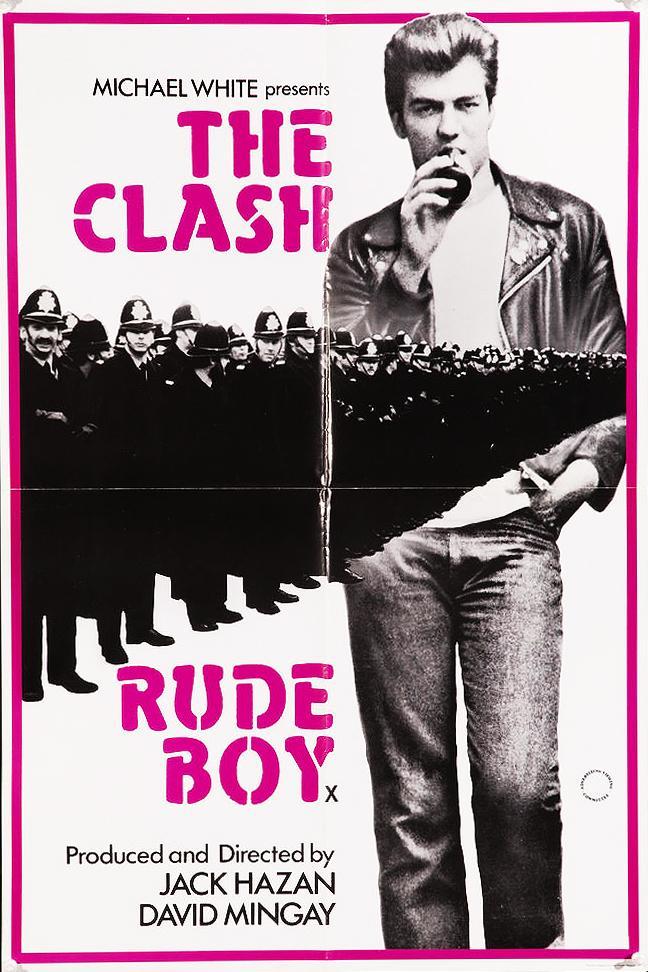
Trying Hard to CLASH: Rude Boy Review [1980]

Text by Lisle McKenty / FFanzeen fanzine, 1980
Introduction by Robert Barry Francos © FFanzeen blog, 2018
Images from the Internet

This review was originally printed in FFanzeen, issue #6, dated Year-End 1980. It was written by Lisle McKenty. The article below was based on seeing the Clash’s 1980 film Rude Boy.

In the very early 1980s, Lisle worked in the same office as me, and we didn’t really know each other well, as she was the assistant to my boss, who kept her apart from the staff. One day, at about three in the afternoon, I was having my daily fix of wake-up tea, and Lisle walked by. Under her breath, she murmured, “Boy was in a hallway drinking a glass of tea.” My ears immediately perked up. I stated, “From the other end of the hallway a rhythm was generating.” She whipped around, shocked that anyone knew the secret of Patti Smith, and we became close friends for a few years after that. Our boss was not happy about it.

As for the Clash themselves, my friend Nancy Neon and I had tickets in 1981 to see them play in Times Square at Bonds Casino, which is around the same time period as meeting Lisle. Nancy found out that the Rockats were recording their Live at the Ritz album the same night. We both easily agreed to scalp the tickets (at no profit as we were in a rush) in Front of Bonds, and then we rushed down to the Ritz to see an amazing rockabilly set. – RBF, 2018


Rude Boy comes under the heading, “A Michael White Presentation.” Michael White’s London productions list includes Oh! Calcutta!, Joseph and the Amazing Technicolor Dreamcoat, The Rocky Horror Show, A Chorus Line, and Annie…  His previous films include Monty Python and the Holy Grail, The Rocky Horror Picture Show, and Jabberwocky. Wild stuff. He’s big time.

David Mingay and Jack Hazan directed and produced Rudy Boy. You have to wonder about Jack Hazen. For an ex-cameraman, his shot sequencing is that of a film illiterate. Of course, I don’t know a lot about English films; I’m not what you would call a buff. David Mingay supposedly is. He studied English literature at Cambridge, then spent a year doing Film and Drama at Bristol. He also directed and edited a thirteen-part TV series, “Cinema: The Amazing Years (1897-1916)” before starting Rude Boy.

Rude Boy is distributed by Atlantic Releasing Corporation. Shall I bring up a fairly famous lyric-shall-we-call-it that says something about Atlantic?

As all the ads promised, the Clash is “in” Rude Boy. But how can you get guaranteed personality when you’re lost in the supermarket? Rude Boy is not about the Clash. It’s about Ray Gange [who also co-wrote the film – RBF, 2018], who roadies (don’t get confused) for the Clash when he’s not working in the Soho sex shop that passes for local color. There is also an obscure subplot, but I’ll get to that later. Well, Ray’s in California now, by the way of the money Hazan and Mingay paid him, and Freddy Laker. He has a Green Card, a job as a construction worker, and an American wife. I hope he’s happy. At least, I hope he doesn’t try any more flicks. Somebody please, I hope he doesn’t start a band. Time to go back to anonymity [he mostly DJs now, with a rare acting gig – RBF, 2018]. His best point might be said to be that he is from Brixton. And he did seem to like the Clash, even if his most memorable utterance was when he said to Joe Strummer, “Left-wing is gonna fuck everybody up.”

Ray’s best scenes, and the best in the movie, are the scenes of the Clash playing. No surprise if you’ve ever seen the Clash (and so what if it was over the screen at The Ritz). They’re electrifying. This dumb artsy flick doesn’t even begin to make sense visually or literally. Then you read in the paper that twenty minutes of the original film were cut (must have been the part that explained the subplot – I half-wondered what was up with those pick-pocketing scenes and the subsequent arrest of that Black guy).

Then again, maybe Hazan and Mingay thought that playing the first eight bars of “Revolution Rock” twenty times in less than two hours would drive an audience into an inspired punk madness.  Hazan and Mingay see punk as a “phenomena of the working class consciousness” and a “fusion of New York white punk and England’s polarized reggae, disco, and rock.” They don’t feel it.

The Clash has been there. They formed in 1976, when Joe Strummer (previously of the 101ers) joined up with Mick Jones and Paul Simonon, under the management of Bernard Rhodes, a partner of Malcolm McLauren, who “discovered” the Sex Pistols.  They toured as a support group to the Pistols on their Anarchy Tour of England, before pulling out in a dispute over the use of Swastika armbands. Topper Headon joined the band as drummer in 1978. The Clash on Parole Tour (featured in Rude Boy) shortly followed.

After their second LP, Give ‘Em Enough Rope was released, they split with Rhodes and announced self-government, with Caroline Coon as a representative (she’s the pretty blonde who travels with Mick and Paul on their pigeon-shooting charges in Rude Boy [she also wrote the excellent book 1988: The New Wave Punk Rock Explosion – RBF, 2018]). They toured the US twice in 1979, completing London Calling, and began a new formal management with Blackhill Enterprises.


Without a doubt, the funniest line in Rude Boy is when Strummer tells Gange that the Brigade Rossi (the Red Brigade) is an Italian restaurant. Rude Boy did try to give an impression that the Clash are revolutionaries. In the film, their performance at the Rock Against Racism concert almost causes a riot (helped by Gange) and audience control is near disaster at Glasgow when Strummer sings “White Man Looking for Fun.” Then there were Gange’s political conversations with the band, but I’ve already given an example of those.

It seems like a million people have asked me if I think the Clash sold out with London Calling. To tell the truth, I’ve wondered a bit myself when I saw the Clash up there on a wall, in-between Linda Ronstadt and KISS, in a suburban record rip-off store. It was nice back in the old days, having them to ourselves. But everything depends on what you mean by selling out.

Selling out usually means trading musical and lyrical quality and morality for commercial success. London Calling is better produced than The Clash or Give ‘Em Enough Rope, let alone the singles (it took me weeks to understand any lyrics on ”White Riot”). “Revolution Rock” is not “Clash City Rockers.” The Clash have contained, purified and polished their riot on London Calling.

“Lost in the Supermarket” is at once more subtle, more pointed, and funnier than “I’m So Bored With the USA” (not that I don’t love “Bored…”). “Spanish Bombs” won’t get airplay in Spain or in any other of what I call non-countries. If “Guns of Brixton” doesn’t incite you, then nothing will. The Clash have retained and strengthened their sense of “unreal politick” and their sense of humor. They haven’t turned us off with any cloying songs, like “Alison” [a song of Elvis Costello I like – RBF, 2018], or distorted reggae to the extent of the Police. In London Calling, they haven’t traded a thing. Just check out “Working for the Clampdown”: “Kick over the wall / Cause governments to fall / How can you refuse it?... / To these days of evil presidents / Working for the clampdown.”

Paul and Caroline
So if they aren’t a sellout crew (and they’re not), why did the Clash participate in Rude Boy? By the time of Clash on Parole, they were packing houses all over England, and their first LP had appeared a year earlier in 1977. Well, until recently, the Clash was denied airplay on both the BBC and Capitol Radio networks (maybe it was just Mick’s affiliation with the Shepherds Bush anarchists?).

As far as I know, they have been continually in debt to their record company, CBS (Epic’s just a trademark). I don’t know if Mingay and Hazan first approached Ray Gange, or the Clash, to make the film, but I’ve got a horrible feeling it was Gange.

In any case, these people wanted to make a “serious film” about punk rock and the working-class consciousness. A band’s a band and a gig’s a gig; the Clash needed the PR, the money, and they wanted the platform. And as far as a sell-out goes, didn’t I use the term “commercial success”?

Rude Boy was made two years ago. Obviously, Mick and Paul and Joe and Topper were a lot less sophisticated than they are now. In my mind, hell, they were damned naĂŻve. Maybe I can blame it on Caroline Coon (or was it Rhodes?). Rude Boy is a terrible flick, excluding the music scenes (“I Fought the Law” was especially great), made by terrible people, in my book.

To bring in the inevitable Beatles comparison (are you ready?), it’s like when Brian Epstein stuck them in suits, albeit without collars. I don’t feel bad panning Rude Boy, and I’m a Clash fanatic. If you like the Clash, then you’re like me – you’ll go see it anyway. If not, maybe you should listen to “Jimmy Jazz” or “The Right Profile” for a while.

To conclude: I often wear a tee-shirt proclaiming “The Clash: The only band that matters.” I’ve seen lots of others around on various other bodies. According to the rumor, the Clash now wants to make their own film. A terrific idea [didn’t happen – RBF, 2018]. Hopefully, next time they’ll make a worthy one – humor, politics, emotion, a riot – one that matters.


Tuesday, November 22, 2011

DVD Reviews: House of the Damned and Lust for Vengeance


The reason these two reviews by Richard Gary are grouped together is that they are both made by African-American auteur Sean Weathers, who is based in Brooklyn, New York. He started making films in the genres he liked at a young age, usually with the assistance of producer Aswad Issa and cinematographer George Lopez.

Text © Richard Gary / FFanzeen, 2011
Images from the Internet


House of the Damned: 15th Anniversary Edition
Written and directed by Sean Weathers
Full Circle Filmworks, 1996 / 2011
72 minutes, USD $9.95
Fullcirclefilmworks.com

MVDvisual.com

This is the 15-year rerelease of indie filmmaker Sean Weather’s first film. Shot in glorious black and white, and mostly in Brooklyn, it doesn’t get very deep, but it’s built on an imaginative foundation.

Here’s the basic diggity (and I’m not giving away anything that’s not on either the box or common literature about the film): Liz (Valerie Alexander) comes home after her dad’s murder (in his own house). Living there is her youthful-looking mother, Emily (Monica Williams) and grandfather. They both have a secret that Liz is about to find out before the end of the night, which happens to be her 21st birthday. Four friends (aka the fodder help her celebrate, and while they all meet their fate in sometimes ghastly, other times questionable ways, Liz is actually the target of the whole affair, and so naturally is the only one that delays that doom.

There is a lot packed into the film, including witchcraft, slasher elements, zombies (the voodoo-forced-to-obey kind, not the braaaaaains ones), all with a haunted house feel. In many ways, this is a very successful film, especially considering it’s a first one by this collective, though one may say it arguably tries to cover too much. I don’t have a complaint with that, though, since Weathers doesn’t attempt to overlap genre types often enough to make it confusing. Heck, there is even a bit of nudity and a hint of lesbianism, as well as a moment of bad rapping (purposeful, I believe, considering a comment by Liz at one point).

I’m not sure what element he was using, be it VHS or s-VHS (I’m guessing one of those by the age of the film), but the black-and-white is highly grainy, and the handheld camera looks it. Still, there is a consistent tone throughout which holds up even after all this time and changes in technology (e.g., if this was some form of videotape, then odds are it was cut on editing bay equipment, rather than on a computer, which is much more time consuming and laborious).

There are a few holes here and there that are common with both indie and especially first-time writer/directors which are kind of blatant. For example, when one of the friends is done in while in the basement, we see the reaction of Liz and her erstwhile rapper boyfriend as they stand in the doorway, but we never see what they saw (the moment in is the trailer, below).

But the biggest flaw for me is the lighting, or lack thereof. The scenes on the roof and in the basement, for example, are creepy for certain, and in that they’re effective, but sometimes the shots are so dark that we’re left not being certain at what we’re seeing.

It is important to remember that writer / director Sean Weathers was 16 when he made this film, not actually something that is well-publicized, but his IMDB bio states he was born in 1980. For someone that young age, this is a pretty complex feature with lots of elements. I’m guessing many of the actors are among the same age group, and good on them for that.

It’s obvious what some of the roots of this film are, such as the Evil Dead and The Return of the Living Dead series. Weathers is evidently a fan of the genre, and that he wants to create his own and give back is a beautiful thing.

As far as I know, none of Weathers’ films, including this one, went the theater route, but rather direct to home market. This was actually quite smart maneuvering on his part, especially if he hit the horror convention circuit. Bet they did really well locally at the neighborhood video stores that were prevalent at the time.

The extras include some of his subsequent trailers, such as this one and the film below, and others like Hookers in Revolt (2006). There are also outtakes and clips from his The Unfinished Works of Sean Weathers (2004).

There are two interesting featurettes also included. One is a present-day interview with the lead actress, Valerie Alexander, who discusses what the shooting experience was like, filmed by an unseen interviewer (a self-deprecating Weathers). Some of the questions are just plain worthless, such as querying which male cast members would she “marry, fuck, or kill” The more interesting bits were actual anecdotes about the filming. The second short takes the viewer back to the house in the present, and starting from top to bottom, Weathers discusses the shooting with the camera person. The basement part is as creepy as the film, so that’s effective.


Lust for Vengeance: 10th Anniversary Explicit Edition
Written and directed by Sean Weathers
Full Circle Filmworks, 2001 / 2011
85 minutes, USD $9.95
Fullcirclefilmworks.com

MVDvisual.com

The director, Sean Weathers, watched over 100 Giallo films before he made this picture. What’s a Giallo? He explains in a title card at the beginning: Giallo is the name for a distinct set of Italian thrillers from the 60’s [sic] that combined crime, murder, eroticism, nudity, mystery and whodunits, with stylish visuals.

Weathers had come a long way in the five years from his first release, above. He seems more assured about his direction, and the narrative is complex, yet cleaner. Ah, yes, the storyline.

Five women who have been friends since childhood are being picked off, one by one, possibly by a male acquaintance from their junior high days named Michael Richards (I am assuming that he was named for the “Kramer” actor, ironically half a decade before his racist rant) who had, after some false accusations, accosted one of them and was sent away to the sanitarium. The story of the events that surround these women meeting their fate is told to us, as described in another early title card, in five separate chapters (averaging about 13 minutes), in non-linear order. Helpfully, though, we are told the order by each chapter’s title card, such as “Anna (4).” If this sounds confusing, it’s actually not while watching the film, which is kudos to Weathers. There is very little suspense on who is the killer, though he is dressed in black leather with a motorcycle helmet with dark visor (what confused me is the person in disguise who kills Stephanie (2) looks to be female…).

Each of these women has a vice, be it drugs, bulimia, or sexual addiction, and we get to see it all in detail. While not stated, I am assuming that their relationship with this guy from their past who was seen leaving the first killing (victim’s name is Jennifer Lopez!), according to a police detective who questions the women a few times, has affected them to the point where they do these self-abusive behaviors as an escape from the memory.

Using grainy video to emulate 16mm, I am again assuming (let me know, Sean), the camera often floats around the actors (who are fully nude at some point or another, including women and most of the men), in a very Mario Bava way. While there are few sharp zooms and super close-ups of eyes, as is common in Giallo (especially Dario Argento), Weathers does an interesting thing with the film’s hue: whether the film is in black and white or color, there are extreme tints used so the image is either red, yellow, blue, green, orange, or others, varying from scene to scene. This was a really nice touch.

As with the previous film, there is a dark sense of humor, such as a character here named being Putney Swope (if you haven’t seen the film by that name, you really need to do so; not only is it smart and hilarious, it has a similar feel to Weathers’ and was directed by Robert Downey Sr.). Another is when a character is being held by the killer with his hand over her mouth, and a roommate walks right by shielding her eyes because she thinks the noise she’s hearing is her pal having sex.

Many of the actors in this film are non-pro, with this or other Weathers’ films as their only credits, but they all do relatively well for their experience at the time, and the nature of the film (i.e., a low budget indie). However, they all bravely are willing to simulate (I’m assuming, once again) sex or at least be naked as they wind their way through their first cinematic endeavor in most cases.

Weathers makes few missteps, which is common in the genre. A key one is that we never see Lisa (5), the last on the murderer’s list, done in. Does she survive? This is unclear. And why is someone who is smitten with Stephanie killed, other than being a clingy creep? I believe perhaps he was in her apartment (as he’s smelling a female’s underwear at the time), but if so, how did the killer get him out? Another is a gratuitous lesbian scene on a beach between two characters in the Jennifer section that have nothing I can tell to do with the actual storyline. One minute they’re complaining about their boyfriends, and the next they’re nude and, well… The biggest bug in my bonnet, though, is that I would have liked to have had more detail about Richards and his motivations.

The extras are similar to the first film above, with trailers for Weathers’ films, and clips of outtakes of various projects. In one section are more title cards, this time with trivia about the making of the film. There is also an interview with Weathers on the steps of the Metropolitan Museum of Art, one of the few location shots in the film outside of apartments. Here he discusses the film’s progress, but I would have liked to have had a more thorough commentary track, as well. Weathers is a remarkable guy with interesting ideas, and his work process seems to be something worth hearing.

While I figured out the final shot of the film about 20 minutes in, this was still a fun ride to see where it was going, and how it got there. As a low budget indie goes, sure there is more that ‘Weathers and crew can do to improve, but all things considered – especially comparison to some other films of this nature in the genres he’s hooked into – it shows so much promise. With all sincerity, I would love to see what Weathers could do with some real mentor guidance and bigger bucks backing him up. That could prove his real mettle or his downfall. It would be nice if someone gave him the chance to find out. Meanwhile, I will pay respects to Weather’s Full Circle Filmworks, whose slogan is “Stickin’ it to the man 24/7.”


Tuesday, November 15, 2011

DVD Reviews: ThanksKilling and The Night Shift

Text © Richard Gary / FFanzeen, 2011
Images from the Internet


I reviewed these two independent films together because they both set out to achieve some comedy along with the horror. Plus, I get to mention the Fonz, either directly or indirectly, in both. Peter Griffin  must be smiling somewhere…

ThanksKilling
Directed by Jordan Downey
MVD Visual, 2009 / 2011
66 minutes, USD $16.95
Thankskillingmovie.com

MVDvisual.com

According to the commentary track with director Downey and co-writer Kevin Stewart, the purpose of this $3,500 film, shot in 11 days back while they were both in college, was not to make a horror film per se, but by aiming towards the “so bad it’s good” (SBIG) category, rather make it a comedy with horror elements. It is true that when one goes for SBIG, usually horror is the genre on which to point.

From the box alone, you know the territory is going to be no-prisoners: make the viewer laugh at any expense, no matter how low, no matter how silly, no matter how forced. And have they achieved their goal of making a comedy and the worst horror film ever made? Well, yes and no. Let’s discuss…

As promised on the box, the first shot in the film is of a naked breast, apparently that of a healthy and hefty pilgrim running topless through the woods, played in cameo by older adult star Wanda Lust (nee Shelia Hansen). She is fleeing something raised by the Indians (this film is intentionally not PC, so I won’t bother with the terms Native Americans or First Nations) to kill the Pilgrims on the first Thanksgiving. Let’s stop there a moment and ponder. Totally realizing that there is an abnormally large need for suspension of disbelief, let me say that if this had happened, we certainly wouldn’t be celebrating the holiday, would we? But as far as stretching credulity goes, this is one of the minor ones, relatively speaking. Again, though, that’s part of the point. It’s important to keep remembering that, going forward.

After the pilgrim prologue, we meet five high school students (okay, there goes that credulity thing again in my head…easy now, brain, this is just the beginning of the ride) who are going to be both heroes and victims of… well, it’s pretty obvious from the box, so I don’t think I’m revealing anything by saying it’s the killer turkey, imaginatively named Turkie (if they really wanted it to be scary, it could have been named Tofuerkie). I must say right now that for a killer puppet turkey, Turkie looks pretty good. Kudos guys. Perhaps they could pair up with the makers of The Puppet Monster Massacre, as both these films are sequel bound? Or perhaps even Poultrygeist: Night of the Chicken Dead? But I digress…

So, the teens are totally (and purposefully, according to the commentary track, which I highly recommend if you’re going to watch this… ha, bet you thought I was going to say “turkey”!) cinematic clichĂ©s, including Johnny, the jock with a heart of gold (Lance Predmore), his goofy hick pal, Billy (Aaron-Ringhiser-Carlson, doing his best Tyler Labine impression), Billy’s nerd hanger-on Darren (Ryan Francis, who in “real life” is the drummer of the female-fronted Ohio punk band Overated , as Huge Euge), good girl Kristen (Lindsey Anderson, whose only previous notation was in Troma’s Terror Firmer, 10 years before this), and bad girl Ali (Natasha Cordova, in full John-Lithgow-sitcom-overacting style, coming closest to what the commentary states they wanted).

The five set off on Thanksgiving break (yeah, I know and the writers acknowledge in the commentary) to go camping. Of course, they run into said Turkie in the woods, who was resurrected by the pee of the dog owned by a hermit named Oscar (as in “the Grouch,” played well by General Bastard, who is the singer of his own punk-garage band). 

Of course, this meeting of late-twenty-year-old teens and Turkie turns into a battle that takes it back to town, where Turkie does away with a bunch of townsfolk, including relatives as well as some of the main cast. While Kristen’s dad, the town sheriff (Chuck Lamb, who has made a mini-career out of playing dead bodies in films and television), may have the fakest looking moustache in recent cinema memory (though it works for his character, and I’d like to say Lamb did well in his rare speaking role), probably the goofiest moment is when Turkie disguises himself as the sheriff by putting on a hat and a plastic Groucho glasses / nose / moustache, so not even his daughter can tell them apart. It is one of the few moments that I actually laughed out loud, in sheer audacity. Well played, Jordan Downey.

One of the two most infamous scenes, though, is Turkie disguised as a woman, and then getting picked up as a hitchhiker who is obviously aroused, thinking he’s a (human) girl. Let’s just say it doesn’t end well, especially for the audience. The other is when Turkie has his way with someone (“You’ve been stuffed,” he states after), though it should be noted that it was done safely (at the scene is found an extra small condom, gravy flavored).

As with Freddie Kruger, Turkie gets a whole bunch of groaner puns to state at specific times that, yes, I have to admit, are memorable and I’m sure repeatable at some time or another in life (though, I can’t think of anything needing a “Gobble-Gobble Motherfucker,” except for it’s own sake; hey, it’s even on the box).

So, is this the worst movie ever made? No, of course not, because it doesn’t take itself seriously, and tries too hard. For a film to be truly bad, it has to be done straight, such as Plan Nine From Outer Space, Cape Canaveral Monsters, or Lara Croft: Tomb Raider. But again, even as an acknowledged bad film, such as Bill Zebub’s The Worst Horror Film Ever Made, there is more a sense of either general goofiness or laziness than planned direction. That’s what is wrong with films like Epic Movie or Date Movie, in that they try too hard in a way that Fonzie kept trying so to keep his cool that he actually wasn’t.
The viewer has to be careful how to approach a film that intentionally tries to be bad. For example, I watched this the first time with a group of people who are a bit older (i.e., around my age), and even though they knew they were in for something bizarre (they did read the box, after all), they found it kind of silly more than anything else. I must admit, I appreciated it more after listening to the commentary by the director and writer (shame there were no captions because it would have been great to do both). Obviously, the demographic the film is aiming for is high school to college kids who either like inanity for inanity’s sake (hey, I’ve been there), or the alcohol and weed stoners who will laugh at a fart joke.

For me, the film definitely had its moments, and I was glad to watch it a second time by myself and actually see it (as opposed to in a talk-back crowd), and then, dare I say it, a third with the commentary. Waste of time? Sure. Sorry I saw it? No. While it may not have been the worst movie (I’m with Elaine about the film The English Patient, a book I thoroughly enjoyed, though), nor even a great comedy, it was a fun way to waste an afternoon.

Meanwhile, I’ve got my bag of popcorn ready for the nuker when the sequel (with a budget of $100,000) comes around.
Trailer below


The Night Shift
Written, produced and directed by Thomas Smith
Fighting Owl Films / Distributed R-Squared Films, 2010
126 minutes, USD $19.95
fightingowlfilms.com

rsquaredfilms.com
MVDvisual.com

No, this is not the Ron Howard-directed film starring Michael Keaton and Henry Winkler (1982), nor any of the other recent productions with similar names, but rather a new horror comedy. At first, from reading the treatment on the box, I was wondering if it had anything to do with the wonderful 1994 Italian film, Dellamorte Dellamore,  but I was mistaken (though there are some similarities).

In a lovely landscaped cemetery, where all of the action takes place (filmed in Mobile, ‘Bama), there are two shifts (12 hrs each?) of caretakers. The first, during the day, is unconventional beauty Claire Rennfield (played by Erin Lilley, who is also producer, and did sound, art, make-up, has a history in opera and dance – and did I mention she’s also married to the director?; her character is named after Renfield, in Dracula), who works during the days, and is the intermediary between the residents of the cemetery and the mysterious people who run it. The night shift is run by custodian Rue Morgan (as in Poe’s “Murders in the Rue Morgue,” portrayed by Khristian Fulmer), who died in 1929, a week before the Great Depression. As official custodian, he does not rot along with the rest of the residents. Oh, yes, the other residents… well, I’ll get to them.

Because Rue is mort and Claire is vive, there is sexual tension betwixt ‘em, but she won’t have anything to do with him because, well, he’s dead, and will never age. What to do, what to do… Rue talks it over with his best friend, a limbless and dressed up skeleton named Herbie West (voiced by Soren Odom, who is also the assistant director, cinematographer, and wrote the music; any horror fan will recognize the character’s name as coming from Re-Animator). Herbie, played by a skeleton puppet, is a smart ass and adds further comic relief.

While they all try to figure out this complicated relationship, there’s shenanigans afoot. Apparently, the cemetery is connected to another, rival one, and by connecting the two, it will cause a rift that will cause the apocalypse (nah, didn’t make sense to me either, but I’ll go with it). Who is the enemy here? Is it the teen werewolf (modeled, of course, after Michael Landon’s I Was a Teenage Werewolf, including pompadour)? The Rebel officer from the Civil War who is Rue’s biggest nemesis? The demon who shows up unexpectedly that Rue must distinguish? Perhaps the higher-ups themselves are behind it all? Honestly, 20 minutes in, if you can’t figure it out, hang your head.

Along with the questionable characters, there are some nice guys, too, such as the preppy guy who’s entire make-up is a pastel blue on his face who acts mentally slow, or a teen who was obviously killed when hit in the head with a baseball (it’s still lodged there), among others.

Apparently, it’s no big whoop to have the dead roaming around all night from either Claire or any of the others who sneak in. Rue’s job is to keep the residents in at night, and visitors out. Rue is dressed in suspenders and loose cap, looking and talking like a Bowery Boy (sans New York accent), but gee, that’s swell. Claire is a bit of a hard-ass, but one might even consider her harassed by this dead compadre who keeps hitting on her (though I doubt that came across the thoughts of the writers).

There’s no great special effects that happen, and just about no blood, with any violence shown (other than an intentionally humorous sword fight), this is actually less scary than, say, The Pirates of the Caribbean.

While some of the acting is stiff (pun intended), such as Jonathan Pruitt’s Reb captain Roderick, whose line reading is, well, awful (though he’s not the only one), there is still a positive feel to the production. Shot for an estimated $10,000, the film has a good look to it.

For a first (and so far only) full feature by director Thomas Smith, it really is a encouraging starting point. Hey, it even won Best Fantasy Feature at the Shockerfest International Film Festival 2011. 

If you are squeamish and have problems with some of the blood, gore, and sexuality of most of the (especially) indie films out these days, this is a safe place to start.


Saturday, November 12, 2011

DVD Review: A Serbian Film (Srpski Film)

Text © Richard Gary / FFanzeen, 2011
Images from the Internet

A Serbian Film: Unrated Version
Produced and directed by Srdjan Spasojevic
Invincible Pictures, 2010
103 minutes, USD $19.95
Invinciblepictures.com
Serbianfilmmovie.com
MVDvisual.com

”It’s dangerous, Max…it’s more – how can I say – more political than that… It has something you don’t have, Max. It has a philosophy, and that’s what makes it dangerous.”
– Marsha, in Videodrome

David Cronenberg’s Videodrome should almost be a prerequisite for watching this film from the former Yugoslavia. They both deal with the issue of violence through media with a political bent. But Videodrome only brushes where Srpski Film takes off.

We are introduced to retired porn star Milos (Srdjan Todorovic), whose specialties were having a bit of a violent streak and being fatigueless. But now he has a (understanding) wife, Marija (Jelena Gavrilovic) and a six-year-old son. He is struggling to not only survive financially, but part of him misses the action, though he won’t admit it to himself.

Asked to come back for just one film by an ex-co-star, Lejla (Katarina Zutic), he is hesitant, but the promise of a big paycheck and “the itch” calls him. With Marija’s blessing, he meets with the director, Vulkmir (Sergei Trifunovic), who states that he wants Milos to just be himself, and so refuses to let him know what the film is about. Reluctantly, Milos agrees. And you just know it’s not going to end well.

Now, the North American audience has spent years watching graphically violent and disturbing films like Wolf Creek, and the Hostel and Saw franchises. This genre has come to been labeled by the term “torture porn.” Well, A Serbian Film pushes the scale ever further toward the latter. The most graphically and disturbing scene that comes to mind in previous films I have seen is the fire extinguisher incident from Irreversible, but parts of this one if not beat it, come thisclose.

Slowly but surely, through his own dark nature and a bit of an injected “sex drug” (a comment on Viagra or Calais?), Milos doesn’t just lose whatever is left of his moral compass, he becomes the pawn in a game that is completely out of his control as he suffers blackouts, only to find out later through videos and flashbacks just what kind of sick actions he’s been in the middle of performing.

No, I won’t go into detail, but there is a point to it all. Truthfully, I’m not aware of much Serbian history or politics, so a great deal of the context is stripped away leaving mostly the violence and sex (sometimes graphic, landing somewhere between softcore and hardcore in various degrees, including an erect penis, though I’m assuming it is a prosthetic, considering the length), without the point of a good deal of it.

I do get some of it, though, such as when Milos is wandering around Belgrade in a sex-drug-induced fog, and seeing all different forms of acceptable sexually suggestiveness, such as lingerie billboards, and magazines at a deli.

But it is pretty obvious that the film has, as posited at the beginning, a philosophy. It’s not simply violence for violence sake, especially when viewed in the Serbian historical perspective, but as I said, the message is hazy to one (e.g., me) unfamiliar with the background.

On YouTube, you can find lots of videos of people watchg the film, the most I've seen since the infamous two women and the cup reactions.

How far can one man go into the depths of his own depravity? And who is there to push him over that line? And to what purpose? The answer lay at the end of the film, but it’s not a pretty picture, both figuratively and literally, and as I said and which is pretty obvious, it does not end well for many. Does art imitate life/politics?

Does politics/life imitate art? Where does art begin and politics end, and vice versa? These are chicken-and-egg questions that the film addresses. Whether they answer it or not seems unimportant since, as one philosophy states, the question is as – if not more – important than the question.