Showing posts with label punk documentary. Show all posts

Sunday, February 10, 2019

Review: Alan Vega • Martin Rev • Suicide: Five Films by Marc Hurtado

Text © Robert Barry Francos / FFanzeen, 2019
Images from the Internet

Alan Vega • Martin Rev • Suicide: Five Films by Marc Hurtado
Written and directed (etc.) by Marc Hurtado
La Huit / MVD Visual
113 minutes, various years / 2018
www.mvdvisual.com

When the term Transgressive (capital “T”) is used for art, most are going to think of it in relation to cinema, with films created by the likes of Richard Kern, Scott and Beth B., and Lydia Lunch. When it comes to other forms, such as music, at best it tends to be considered transgressive (small “t”). This is not fair, especially for a period of the mid-to-late 1970s and early 1980s, when there were combative bands like Red Transistor (led by Von LMO, who would chase patrons out of bars with a chainsaw) and especially Suicide. It makes sense to combine art forms of film and music, perhaps to make something new: TRANSGRESSIVE (all caps).


Suicide in concert
I had the… pleasure to see Suicide play once at CBGBs in the early 1980s. Knowing their reputation for confrontation with the audience, I sat near the bar, but that didn’t help. As singer/provocateur Alan Vega (d. 2016) roamed the club while keyboardist Martin Rev stuck to the stage sending out punkabilly pulse waves. I’d been a fan of the band since their first eponymous album in 1977 on Red Star Records. “Cheree” caught my attention first, but one listen to the 10-miniute plus “Frankie Teardrop” was what reeled me in.

Suicide should have been everything I hated back in 1977: it was pure electronica, and to this day I mostly find that to be, well, musical suicide. But there was an artistic intensity that Vega and Rev brought to the minimalism that was different than, say, Teenage Jesus and the Jerks’ factory-like clunky and metallic rhythms. They were not just musical terrorists, they also were seducing the audience at the same time, like a snake charmer coaxing a cobra, except if the reptile was the safer choice.

Morocco-born director Marc Hurtado filmed a bunch of mostly shorts with Suicide before Vega’s death, and these are collected onto this dual DVD set. Both discs contain the same films, but one is in the original French, and the other in English. I’ll let you guess which one I chose.

First up is the 16 minute-long The Infinite Mercy Film (2009). Here is a mixture of an artist’s muse and its outcome. The locus is on Vega’s use of light and lighting as a paradigm in his paintings, as the camera focuses in and out of various mixed-media, while Rev’s rhythms wind their way around the image in a reflexive way to match Vegas’s use of cords, twine and light bulbs. Interspersed is Vega himself, as he describes the origin of his use of light and what feeds his influences. The level of avant-garde artistry used to mix the music, the artist, the filmmaker and the synergy they create together should come as no surprise.


Alan Vega posing oddly
At 6 minutes, we are given Saturn Drive Duplex (2011), which is essentially a music video for a collaboration of Vega’s speak-sing voice and Hurtado’s music. Where the first film was focused on light, this one is on motion. We follow the clips as they zoom along traffic in Manhattan (often on the side of the East River), close-ups of boxers sparring, and Vega posing oddly in his studio. Hurtado also uses shadows and, yes, light, to highlight his focus both in high contrast and subtle ways.

Saturn Drive Duplex Redux (2014) is 4 minutes and artfully combines and condenses the three previous films, using light, travel, and art into a different Vega/Hurtado music video for a remix. We also get to see b-roll images of Vega on stage added to the recipe. Perhaps it’s the shorter length, but this feels like the most rewatchable of all I’ve seen so far, and this material is the kind you really need multiple viewings to let the whole Zen of it wash over the experience.

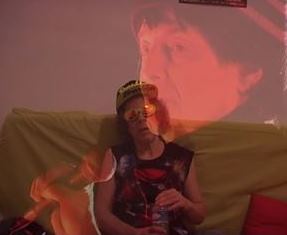
One could refer to Infinite Dreamers (2016) as the main feature, due to its 82 minutes’ length. Essentially, this is Martin Rev’s film: a stream of consciousness from the mostly silent member of the duo with a mixture of clips of Suicide playing in various venues, such as Frioul Islands, France, and of course lots of B-rolls. This makes total sense, as they are considered cult heroes in that part of the world, and Vega even had a solo hit in the area with “Jukebox Babe” in the day. It’s quite obvious that the sound is camera-oriented, rather than through the mixing board, so it is kind of rough, with lots of echo and reverb, even beyond the band’s normal tone. It’s also way less confrontational, with Vega looking very frail as it was close to his end; he stays on stage rather than rampaging through the crowd.


Martin Rev
But like I said, this is Rev’s turn to step into the spotlight. Despite his talking, I would never use the word “narrative” to describe the whole thing, but it is as close to a storyline as we have seen so far. It is, rather, various clips of Rev speaking – both on camera and off – and discussing the history of the group, and Suicide’s role in the artistic world; especially their philosophy as far as art is concerned. It’s deep and meaningful, and while these monologs doesn’t seem to follow a particular path, it still all falls together into a transgressive (small “t”) pattern that can be put together as a whole in the end in the mind for the viewer.

The fifth film is Saturn Drive (2016), at 5 minutes, which was released posthumously after Vega’s passing. Essentially, it’s a one-camera shot of Vega in the Hospital after a bad fall where he did serious harm to his hip. He looks drugged out of his mind on pain meds. He talks about being in “Saturn Drive” (heaven? hospital? stoned?), his religious affiliation, and seeing 9/11. I’m willing to assume this is the last footage of Vega before he went over the rainbow bridge, and it’s touching.

So, overall, Hurtado seems to model himself a bit on filmmaker Stan Brakhage, who used the media form as his easel to let the film itself tell the story (a true “Medium is the Message” kind of mindset that would have made Marshall McLuhan proud). For Hurtado, the visual scape is as important as to what he is trying to convey to the audience, that art is multi-layered, and should be addressed as so. While I have always preferred the narrative framework over the stream of consciousness kind of art in various modes, I enjoyed the films and getting to see some of Vega and Rev at work is always enlightening.


Bonus video:

Monday, March 7, 2016

DVD Review: The Dicks from Texas

Text © Robert Barry Francos / FFanzeen, 2015
Images from the Internet

The Dicks from Texas
Produced and directed by Cindy Marabito
MVD Visual
70 minutes, 2015
www.thedicksfromtexas.com
www.mvdvisual.com

Bands less-subtly named after body parts arose in the late ‘70s. The first I knew of was the Tits (from Rhode Island, I believe), an art rock performance duo that I saw at Max’s Kansas City. This was followed by the Clits (saw them at Irving Plaza), the Cunts, the Kuntz, and arguably, the Dickies. Likewise, Queercore has its forerunners to the Dicks, such as Lance Loud and the Mumps, the Student Teachers, and again arguably, the Speedies (who were definitely more pop, but had a punk edge). But the Dicks were a whole ‘nother ball of leather.

At a time when Texas was possibly even more rigid than it is now (including Austin), the ‘80s spawned a number of scenes around the State that would change and charge up some of the less countrified young’ns, if not the old guard (or most of the rural countryside, as their voting direction indicates). The Dicks were in the front line of that change, fronted by the self-proclaimed out of the closet and overweight Maoist, Gary Floyd. The rest of the band kind of formed around him, from 1980 through 1983, and then again in 2004.

This doc is, on one hand, your basic history of the nascent scene (basically Southern Rock), how the Dicks formed, and then how an almost new scene emerged around the band. Most of the talking head interviews are from the Dicks, the other bands on the scene such as the Torn Panties, Sister Double Happiness and especially the band-members-in-arms, the Big Boys (no mention that I noticed of MDC), and from other regular members of the audience (including the film’s director), many of whom went on to their own fame as writers, photographers and artists. Then, of course, there are the big name cameos that all punk/hardcore docs must have these days, in this case the nearly omni-documentary-presence of Ian MacKaye (of Minor Threat, Fugazi, etc.), Henry Rollins (Black Flag) and Mike Watt (Minutemen, fIREHOSE, etc.). Making a rare appearance is Texas Terri, who is an interesting person in her own right. But I digress…

But then, on the other hand, this comes across more like an Oral History, which improves the narrative a bit. Rather than single set-ups where the person tells his story and then has it sewn into the fabric of the story, the main players are shown in various locations, and also with others, who spurn on stories that would probably not have been inspired if they were by themselves (such as Floyd bringing his mother to… well, you’ll have to see it). Amusingly, for example, three members of the aforementioned Torn Panties are laying (dressed, but under the covers) in a twin-sided bed that is too small for all of them, or others are sitting in bars, at home, etc.

Laced into the history are tons of still photos and videos (b-roll type) of the Little Mexico area (the Bowery of Austin, apparently) both then and now, including of many of the people in the video. The documentary, though, is actually broken into two pieces, which is appropriate because the Dicks had more than one life. After moving to San Fran, the band went on tour, and when they played their home turf at the end of it, the band stayed and Floyd went back to SF.

Following that segment and a brief “In Memorium” not just for Glen Taylor, the guitarist from the Dicks who passed, but also members of the scene, the band reformed on a lark in 2004, and is still playing. It picks up Phase 2 at 55 minutes or so, and continues on. At 70 minutes, the film is the perfect length to keep the audience both informed and interested.

There are some fun outtakes during the credits, and the only extra is actually quite a special one, namely two live shows from 1982 and 1983, when the band was in its prime and with the original line-up. Considering it was obviously VHS tape masters, the first is pretty clear in both sound and visual. The second has a bit more noise and fuzz in the sound, but still helps give a better picture of why the Dicks had its cult following.

One of the differences between this and most of the other band/scene combo documentaries is that this does not discuss the end of the scene, its main focus at the end is the band. This was a nicely done film.


Friday, May 15, 2015

Film Review: D.O.A. (Don’t Overlook Any-Of-It) [1980]

Text by Lisa Baumgardner / FFanzeen fanzine, 1980
Introduction © Robert Barry Francos / FFanzeen, 2015
Images from the Internet

This review was originally printed in FFanzeen, issue #4, dated May/June 1980, page 11. It was written by Lisa Baumgardner Falour, who published Bikini Girl fanzine at the time.

Sadly, Lisa passed away early this year in Paris. Lisa was an incredibly interesting person, as was her fanzine. She worked as a writer, photographer, artist, and for a while as a BDSM pin-up model. She was also known for always carrying a hidden cassette recorder, on which she taped all conversations, and then would publish them in her fanzine when she found them interesting. But hardly anyone she transcribed was as thought-provoking as her. I was introduced to her by Diana Torborina, someone who I worked with at Dimensional Sound Studios, and with whom I became friendly (Diana, if you read this, please feel free to contact me).

For my first half-tabloid newsprint issue of FFanzeen, Lisa wrote a review of Lech Kowalski’s then-new, and now-classic 1980 documentary about the Sex Pistols, D.O.A. As a side note, Lech took out a full page ad for the film, for which he never paid the $100. I’m just sayin’. – RBF, 2015

D.O.A. will soon be released to theaters around the world as a feature-length punk rock documentary. It’s definitely worth seeing, but requires a lot of patience and objectivity. Punk rock and its spin-offs in the fashion, art and political world are both important and inconsequential, and tell a story about the ‘70s, yet doesn’t say much at all.

Lech Kowalski’s Film is hard to sit through but bears a number of incredible scenarios. Beginning with a baptism and a soundtrack peppered with corny heartbeats, we are led through the doorway of X-Ray Spex’s rehearsal studio for an astounding performance of “Oh Bondage, Up Yours!” Cut away to an interview with the president of Warner Bros. Records, who sneers and mentions, “You know, we are not a non-profit organization!”

These perplexing statements are part of a much larger onslaught of visual sludge known as D.O.A. (Dead on Arrival), a 100-minute-long documentary film on punk. Not the “punk” I grew up with. Hopefully, you too were spared because it’s ugly and disturbing, and when I saw it, my own youth suddenly seemed too close and fresh and unsettling. Yuck!

A pretty girl with heavy makeup and short hair is interviewed in a prone position in a parking lot in Texas. She has just been literally thrown out of a theater where the Sex Pistols were playing. Her crime? “Hangin’ out,” she moans. Apparently, the police have used direct physical force to eliminate a group of fans loitering in the lobby. She looks pretty seriously hurt, at the very least extremely distraught. Can she get up? “This is why punks gotta carry chains!” she says. Violence is breeding further violence. “What are you doing tonight?” Lech Kowalski asks her from behind-camera. “Who cares?” she replies, starting to cry. “I don’t care. If you care, you get let down.”

The film is full of gruesome vignettes. The comedy relief? An interview with Sid and Nancy, O.D.-ing and barely coherent in his all-black bedroom in London. The only time Sid seems aware of anything is when Nancy peels off her black rubber t-shirt, glistening with sweat. He picks it up, sniffs it, and smiles with a look of wonder. “’Ey, it smells just like you, Nancy!” “Well, it ought to,” she replies, “I’ve been wearing it since the first day I got to London.”

“I ain’t afraid to walk down the street looking totally ridiculous,” one serious-looking London punk musician explains. “It don’t matter what ya got on. You’re a human bean, just like everybody else. You’re messed up.”

The message behind this film, as well as the continuity, is obscure. Punk is a reflection of decay, one might say, and as the title implies, was born dead. The similarities between British and American audiences are the boredom, pent-up frustration, and search for freedom of expression of the anger youth feels. British public officials are quoted ridiculing punk and insisting, “They can’t win.” Can’t win what? “I’m ashamed of the world we’ve made,” one female official says, “if our children are growing up with attitudes like this.”

There are moments in D.O.A. that come close to capturing the feeling at a band rehearsal. Four or five young musicians are kidding around in an old, garage-like converted studio, and they begin to belt out a tune as if their lives depend on it. Yes, we conclude, it does start out positive. It’s energetic self-expression, and it beats the fuck out of boredom. But by the time it gets to be performed before thousands of kids who’ve paid ten bucks to see it, it’s pretty sorry stuff.

D.O.A. is negative, but very thought-provoking. It is exciting to see a film with guts these days. It is straightforward, raunchy, and has no plot. It seeks to reveal glimpses of a fascinating phenomenon. Lech Kowalski has a lot of energy and determination to have traveled extensively with a crew numbering from four to thirty, and the footage shot of the Sex Pistols’ tour in the South, particularly Georgia and Texas, is priceless. He has not tried to be arty. He presents a variety of conflicting circumstances and opinions, and allows us to be voyeurs without getting spit on at a crowded rock arena full of young people looking and behaving like assholes. He shows us Sham 69, the Dead Boys, and Bleecker Bob, too. He also makes us wonder about money – the concert promoters, the record companies, the media – and the way they present punk to the world. One of the British officials insists the individual musicians are doing it for the money. We think of Sid and Nancy. In it for the money?

Bonus D.O.A. footage:
 

Wednesday, February 25, 2015

DVD Review: Black Lips – Kids Like You & Me

Text © Robert Barry Francos / FFanzeen, 2015
Images from the Internet

Black Lips – Kids Like You & Me
Written and directed by Bill Cody
Subterranean Productions / A Middle East Tour Film
MVD Visual
79 minutes, 2012 / 2013
www.mvdvisual.com

A week after huge anti-United States riots in Cairo in 2012 that included storming of the embassy, the Atlanta-native pop-punk band Black Lips began a tour of the Middle East. It was two years of preparation to line up all their punks in a row, and they were on their way.

I was touring around in Egypt for a week in 1993, and while there was a level of happiness by businesses that we were there spending tourist money, there was also an undercurrent of suspicion, even then, about us scholars from New York University traipsing around the Nile tombs and valleys. I certainly did not hear any Western music there back then, never mind punk rock. Post-9/11, it is even more astonishing to have this band touring the countries of Cyprus, Egypt, U.A.E., Iraq, Jordan and Lebanon. I am going to assume that no member of the band was a – er – of the Hebraic faith.

The documentary of this tour begins with news broadcasts of the riots, leading into a live performance by the band. This is a nicely handled juxtaposition. There are a couple of other wise choices, such as starting in Cyprus, which is an easier country to transition into the tour. The band also picks Lebanese “indie rockers” Lazzy Lung to share the bill. The lead singer moved to Lebanon just as the Israeli conflict happened and formed his band then.

For the first show in Egypt (where a majority of this documentary takes place), we see a clip of the band playing, the audience bouncing, mixed with annotated film excerpts of the Arab Spring two years earlier. The added historical video bites include sound that drowns out the band, which does seem like an unwise choice because in this context it sounds preachy. See the band or hear a history lesson? Both important, but both conflict. It’s the same mindset as having a PowerPoint slide that says one thing and the person at the podium saying something else. Well, it can be read or heard, but not both. By presenting the history lesson during the song, it takes the emphasis away from both.

The band also starts off coming across as a bit shallow to me, I’m sorry to say, but I think that's more of the director's choices. I mean, we follow one of them in an excursion to buy aftershave. You’re in Egypt and that’s what interests you? Then they’re skateboarding on some steps; well, falling more than skating. I would have not bothered including that footage, as it has nothing to do with anything. Plus, they’re touring with a band that speaks the language, so why not show them as interpreters (which they probably were)? The answer is probably that theoretically, cinematic “confusion = chaos = interest.”

Now before you think I’m talking all doom’n’gloom, there are way more positive things about the film than not. Besides many shots of Black Lips playing, as well as giving some nice time to Lazzy Lung, we do get to see some really interesting current news, such as a brief commentary by an ex-pat (woman) writer, and we watch the band listen to an NPR report about them being in the Middle East.

More interesting than bad skateboarding is seeing them at the Giza pyramids (a life highlight when I did it), and talking to locals who are interested in who the band are, and what Westerners are doing there, braving possibly dangerous waters of political and cultural change. I met up with some of that as well. It’s both scary and thrilling to have complete strangers in that part of the world walk up to you and try to talk to you because you are different.

One thing I noticed is that at their shows, there seems to be a lot of Westerners, including blonde women. However, you never see the band do any hook-ups, with men or women (I have no idea about their orientation, honestly), which is fine with me. Another female-related aspect I was interested in is that the film is shown being shot by a Western woman with dyed blonde hair, and wondered how the locals would react to her. Apparently, this is never mentioned or touched upon, which I think is a mistake, even if she isn’t a member of the band.

It gets more interesting as they head off to play in Erbil, Iraq, not a place you may imagine as being welcoming to an American band. Also, comparing the extreme opulence of Dubai to the more austere Erbil is a lesson all in itself to this viewer.

I also found the interviews with members of Lazzy Lung talking about living through the civil war in Lebanon, and how “normal” life became in the midst of it, more fascinating than most of what is said by Black Lips, and wanted to hear more about that.

For me, the big flaw of the film is that we never really get to know much about the band as individuals. Yes, they are interviewed separately, but nothing deep. I know as little about the band’s personnel as when I started the film, other than they like to skateboard, nearly all have facial hair of some sort, one of them is a “news junkie,” and one of them always annoyingly wears an oversized baseball cap. What we do learn about them, and this is a strong point in the film for me, is that we see the band interviewed on numerous media in various countries, including Cairo and Dubai.

Also, it would have helped if their music had a caption crawl. Speaking of which, to be honest, I wasn’t really familiar with the Black Lips, musically, before this, and I was grateful to have the opportunity to hear what they sound like. Definitely not my taste, and they reminded me of the slickness of the Eagles of Death Metal more than punk, which is fine, just not something I’m going to run out and buy. I found the music of Lazzy Lung more interesting.

There isn’t anything really controversial here; nothing to make you say “wow,” but it is interesting how the news footage is interspersed with the location of the band. The closest they get is a very quick discussion of how one of the venues cancelled because the band had once been in Israel, but they get another gig in that city in Egypt, so all is good, I guess. The tour seems to have been a success, and when they talk about how an earlier excursion in India did not go well or as expected, I wanted to see the film of that. Perhaps a prequel?

The extras are the trailer (natch), an almost three minute clip in Cairo of the complete song “Oh Katrina” by Black Lips, a (more interesting) complete song by Lazzy Lung at the same venue, and a nearly 8-minute interview on Lebanese MTV (I kid you not).

If you’re a fan of the band, or curious about them, this is a release that is worth the view; if not, well…


Monday, June 3, 2013

DVD Review: SpokAnarchy!

Text © Robert Barry Francos / FFanzeen, 2013
Images from the Internet
 

Spok@narchy!
By David W. Halsell, Erica K. Schisler, Jon Swanstrom, Heather Swanstrom, Theresa Halsell and Cory Wees
Carnage and Rouge
80 minutes, 2011 / 2012
www.Spokanarchy.com
www.MVDvisual.com

Like many small city in the late 1970s and ‘80s, a punk rock culture grew. Be it Phoenix or Akron, the scenes started off scattered and became arguably more cohesive in an us vs. them stance than some of the more populated and larger scenes, such as New York, Boston, San Francisco and Los Angeles. Starting in 1978, this springboard scene could be described in the isolated urbania of Spokane, Washington.

I’m totally in favor of all of both the centers and outposts to have oral histories of local scenes, in either book form or film, and it’s good that Spokane can be included in the ever growing market of such a chronicle.

Like many autobiographies of musicians, most scenes follow a similar path: a band tries to find a venue for their original music in an area that caters to cover bands, and either the place appears organically or the group finds its own space, which becomes the home-away-from-home for its followers. For Spokane, it was Moe’s Body Shop, where bands like the proto-punk/new wave Sweet Madness led to the harder Vampire Lezbos and Social Bondage.

The scene grows with fanzines and flyers, and individual dress codes for that (anti-)social group, with everyone working together against the local government who tries – and eventually succeeds – to shut venues down. And just when things are going good in three to four years, drugs make their way in – usually heroin to replace the pot and booze – and the group of musicians and fans alike fall apart and most scatter, destroying the scene from the inside out.

This documentary clearly shows that Spokane also followed that organic process, and it is dutifully and sometimes painfully laid out for those of us who did not live there during these halcyon days. Spokane was as an important center in the Northwest, equaling the more well-known Seattle, where alternative (not punk, as it would mistakenly be called) would break out a decade later.

There are two areas of this doc that I question, as I feel it is lacking, one picky, and one aesthetic. First, they appreciatively give the names of everyone interviewed from the scene, and there are over 30, according to the dust jacket. It is quite amazing the array people they managed to reach from that scene for this documentary, and kudos for it.

However, because this is not a nationally known scene where everyone knows of, say, a Patti Smith or Joey Shithead, it is onus of the documentarian to give the context of the people being preserved. For example, if under the name caption they could have stated which band the person was in, or even the affiliation such as “fan” or “flyer artist,” that would have helped enormously. It’s a bit egocentric to think that everyone would or should know. Given that, for a few musicians, there will be a clip with the name to connect with the talking head. Heck, it’s been 30 years since some of this has gone on, and seeing an interview now and an image from then doesn’t always make the connect when you add on the years.

The other thing I felt lacking was a demonstrative statement of what made this scene unique. As I stated at the beginning of this review, the trajectory of this scene, even though the bands have gone through their own location filters, it is hard for an outsider to tell exactly what makes Sweet Madness, say, any different than The Fast, in New York. I kept waiting to hear about that distinctiveness.

Now a lot of that is forgiven because of the clips of the bands from back then, which are priceless. The music is great and worthy of recording. I’m just sorry it was only clips (though some are extended), and would love to have the full music videos included as extras. Fortunately, some could be found on YouTube, which I have been enjoying.

I actually remember some of these bands during the days I published FFanzeen (1977-88), and actually have some (not many) in my collection. The music was exciting, and despite their isolation (as remote as one can get in a relatively modern technological society, even pre-Internet), they fit in well with the scenes from around the country (note that touring as a concept for indie bands from smaller cities was not yet totally a given, as it would be when the hardcore scene started to flourish by the mid-late 1980s, as it were.

There are many extras here without being overly long, which is nice, including a few films about some of the people involved in the scene, four nice outtakes, and a slideshow of fanzines and flyers images.

There was a Spokane punk days retrospective in 2009, whereas New York didn’t have one until 2013. Well played, Spokane!


Bonus videos: