Text (c) Robert Barry Francos, 2012 Images are owned by the artists. Also, images can be enlarged by clicking on them.
As stated in an earlier blog, throughout the years I have collected flyers, especially from the 1970s and '80s. Many were sent to me directly by the bands while I was publishing FFanzeen. Below are some scans I made from my personal collection, in no particular order. I did see many of them, but not all, and I will comment on them from time to time. Note that I do not financially profit off of publishing them, but only do so to honor the work that was involved, and for archival purposes.
1. WayneCounty, Max’s Kansas City Wayne didn’t receive enough props for helping to bring punk to the UK from New York, and vice versa. It was always a good night at Max’s when he (remember, this is pre-Jayne) was behind the DJ booth.
2. Get Hip Showcase
The garage label from the Pittsburgh area is still going strong after all these years, run by members of the Cynics.
3. Folk City Psychedelic Nights
For a while, Todd Abramson, who published the fanzine Young Fast and Scientific, booked a couple of nights at the folk stalwart that introduced such rockers as Bob Dylan, Simon and Garfunkel, and Peter, Paul and Mary. His shows are the ones in black. I saw the Nov 18 and 19th shows. Todd is now a co-owner of Hoboken’s best nightclub, Maxwell’s.
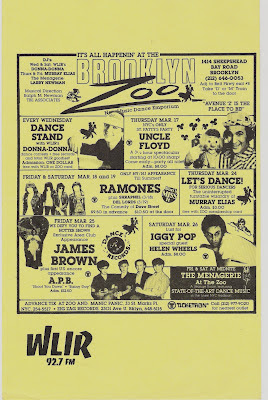
4. The Brooklyn Zoo, March 1983
While the Brighton Beach-based club wasn’t open very long, as you can see they had quite a line-up going.Unlike now, Brooklyn was not looked upon in favorable light in the downtown Manhattan scene, and one can say it’s arguably still true beyond Williamsburg (aka Greenwich Village East, as opposed to the EastVillage). I saw many a good show there (including the Iggy Pop / Helen Wheels one on the flyer, where I interviewed Helen – RIP), such as BowWowWow, Joe “King” Carrasco and the Crowns, and many others.
5. The Rat
I’m sure people in Boston hate it when their Ratskeller was referred to as “the Boston CBGBs.” “Actually, it works for me, because they were both holes in the wall. I saw quite a few good shows there, as I was up in the area for many Memorial Day and Labor Day weekends, hanging out with, in alphabetical order, photographer and Bang! fanzine publisher Rocco Cippilone, cult legend Kenne Highland, future legend Donna Lethal, and music impresario Joe Viglione. Though I’ve seen Willie Alexander a few times, I would have liked to have seen most of the others on this as well.
6. Peppermint Lounge
While some of the larger clubs were more an annoyance than anything else (e.g., Danceteria), with their hindering door policies where you were never sure if you were wasting a trip, the Pep Lounge was wide open and many wonderful shows were to be seen there. Some I caught were the Stiff Little Fingers show listed here, the Fuzztones, Chesterfield Kings, and Husker Du, to name a smidgen. Great venue to see bands.
7. When People Were Shorter and Lived Near the Water
Yes, WPWSaLNeW is a great name (or horrible, depending on your taste), but they were mostly a joke band. A side project for a bunch of local New York City musicians; they did bizarre covers (only) of songs that were classic rock, punk, or even Top 10. Usually, the sound was distorted and very guitar heavy. But they did play pretty often in CBGB’s Jr., aka the CBGBs Record Canteen (next door to Sr.).
8. New Music Awards, Beacon Theater, 1985
I had been to the awards the year before, at Studio 54 (hosted, in part, by Al Franken in wedding dress drag), but did not make it to this one. Perhaps it was the Cheech and Chong emceeing that scared me off, because I never found them funny (“Who is it, maaan?!”).
9. Art
Led by New York punker extremeo Mykel Board, Art was actually a very sharp, biting band that skewered some of the bigger releases from the scene in a very nasty (re: fun), Weird Al re-writing way. If you can ever find their Live at Carnegie Hall release, it is amazing.
10. Artless, The Pyramid, 1986
After the collapse of Art, it only makes sense that Mykel Board’s next group was called Artless. It continued in a more hardcore way, but just as biting.
The following article/interview with The Skels was originally published in FFanzeen magazine, issue #9, in 1982. It was conducted and written by Julia Masi, and I was also present for the rehearsal, interview and brief photoshoot on St. Mark’s Place, though my memory of the whole experience is kind of weak.
Bassist Gerry Lambe (not to be confused with the British musician of the Skunks) died around 1986 after a long career on the New York scene. Cheetah Chrome, infamous for so many reasons, including his tenure with the Dead Boys, now has a powerful new autobiography out called A Dead Boy’s Tale, which had been reviewed last month in this blog (ffanzeen.blogspot.com/2010/09/book-review-dead-boys-tale-by-cheetah.html). In the book, there is little mention of the Skels, so here is my contribution to honor the history of Cheetah. – RBF, 2010 In a dark, musty studio on West 27th Street, Cheetah Chrome and his band, the Skels – Gerry Lambe, bass, and Jeff Miller, drums – are absorbed in practice for an upcoming gig in Baltimore. Almost oblivious to an audience of two jaded rock’n’roll journalists, the Skels seem every bit as intense, polished, and energetic in rehearsal as they do in actual performance.
But the band isn’t satisfied. In unison, they interrupt the flow of smooth-sounding “Sonic Reducer,” crack a few jokes, tune their guitars, pinpoint their problem and try it again. A series of similar stops and starts punctuate the rehearsal, magnifying the camaraderie, seriousness and sweat that make the Skels one of the tightest new trios in New York.
All three have been in bands before: Cheetah, who started out in his native Detroit with Frankenstein, and Rocket From the Tombs, reaches his peak of success with the Dead Boys in the late ‘70s; Jeff’s been a studio musician here and abroad, as well as playing with bands like Wayne County & the Electric Chairs, and the Fast; and Gerry’s a veteran of the local scene, most recently with Disgrace. From their combined experience, they know what it takes to make or break a band, and the Skels is where they put their knowledge to the test.
“Three creative people all working together. That’s a band. That’s this band, at least,” said Cheetah. “It’s a real exclusive club. The only way anybody’s gonna join is if they are brought in by another member of the band. It’s like the Guardian Angels. You’ve gotta be sponsored.” They frequently kick around the idea of having another member, but at this point it’s not in their immediate plans. “I’ve decided it’s a five piece band, ‘cause me and the drummer are both skitz,” Cheetah quipped. “Before this band started, before I had these two buys, it was a four piece or a three piece, depending on who showed up for the gig. It became a big pain in the ass for me to do a three piece. I had to sing, play guitar, dance around and balance an egg on my heard or something. It got to feel like I was doing too much work. With these guys, they’re so solid; I can play whenever I want to.
“Before I was playing in a trio that should have been a four piece. Now, I’m playing with a trio. Another guitar would be nice, but at the same time it isn’t necessary. And I like the extra bread!”
“Three piece, if you screw up it’s more evident. But four piece, it’s sloppier,” noted Jeff. “To me, it’s convenient. We only have one guy doing his job. If we have another player, what am I gonna tell him about lead guitar? What is he gonna tell me about drums? And vice versa. We each do our own thing. He can hear, obviously, if all of a sudden I screw up and I play in 7/8 when I’m supposed to be playing in 4/4.
“The thing that’s great about this group is that nobody’s retarded. Like in almost every group I’ve played there’s always been one guy you had to drag along. It’s like, ‘Duh, what do I play here?’ And you have to do [he imitates a guitar] do-do-do. ‘Oh, yeah, right. That riff.’ But everybody knows what the hell they’re doing. Like he’ll [Cheetah] start a song and we’ll come in.”
“I think the band falls into different categories,” explains Gerry. “We could do a bill with somebody like Iggy Pop and be compatible. We have the same raw energy he has. Whereas we can also do gigs with a band like the Stray Cats. ‘Federal Case’ and ‘I Don’t Know’ are basic 12 bar rock’n’roll. Or we could open for a heavy metal band.”
But the only type of music that they all feel they are incompatible with is hardcore punk. Jeff feels “a responsibility” to his audience because he knows that “there are young drummers in the audience. I don’t want them to see us and go back and pick up sloppy habits. What will it be in a year? Hardcore will be dead and we’ll have another trend. Why can’t we just have bands anymore?”
“It’s real weird ‘cause I’m the oldest in the band; I’m 27,” said Cheetah. “And when I was with the Dead Boys, I met Jeff. He was just this young whipper-snapper. He’s two years younger than me. I watched Jeff grow from this kid form Queens who used to come to our gigs and playin’ with the Fast and the Dictators, and playin’ with Wayne (County) and watchin’ him develop. And Gerry, the Dead Boys were to Gerry like the Stooges were to me: somebody to identify with. It’s great because I’m playin’ with two people that I’ve influenced, in a way.
“I met a little kid who came up to me and said, ‘I learned to play guitar to your records.’ It makes me feel good that somebody sat down with my records and took the time to learn. ‘Sonic Reducer’ is a standard for bar bands to cover. The Bad Brains, I think, said in their press kit, that the band was formed after one of the members listened to a Dead Boys album. To me that’s mission accomplished.
“Right now, we’re gonna do our gigs with the set we’ve got, but we’ll enlarge the band every time. We’ll add a couple of new tunes. With these guys, I really find myself trying to develop more as a guitar player and extending myself more, which is something I haven’t done. I haven’t felt such a creative outburst like this (before)!”
As the band evolves, they intend to get Gerry up to the mic to sing. “Yeah, let it be said,” commented Jeff, “that our bass player can sing very, very well. He just doesn’t want to.”
“If Gerry would just get off his ass…’ nagged Cheetah in feigned annoyance, “I’d get a break. This guy can sing the ‘Hippy Hippy Shake’ real good, but he won’t do it. You know why? ‘Cause he’s shy.” Although the brown-eyed bass player didn’t seem the least bit shy during this interview, he still won’t sing no matter how much this reporter begged.
“Eventually Gerry is gonna sing,” Cheetah confirmed. “It’s a fact of life he’ll just have to deal with. During the set we’ll time it so that he does the song and I’ll take a break and just play guitar. I’d like to do some instrumentals.” He also intends to incorporate more of Jeff and Gerry’s songs, which are heavily influenced by the ‘60s and rhythm & blues, into their act.
“We’re looking forward to gettin’ into that,” Cheetah noted, “but right now the main thing was to get a set down that we could stand by.
“As soon as we got this band together, all of a sudden it just clicked. And I just said, ‘Let’s get to work.’ The creative spark is there. If I don’t have a part for a song, these guys will come up with it. We don’t just rehearse together and let things happen. We talk about it. I didn’t want back-up musicians. I had that. That’s why it’s just ‘The Skels.’ Right now, it’s ‘The Skels featuring Cheetah Chrome,’ but that’s only so everybody knows what the name of my new band is. Eventually, I don’t see why it can’t be the Skels featuring all three of us.”
“We wanna be one of the top new groups,” admitted Jeff. “The problem in New York is that nobody wants to forget. I used to like the Dead Boys, but we’re not trying to be the Dead Boys. We’re not tryin’ to be anybody but the Skels.
“And there’s another thing that Cheetah pointed out at the first gig we did. He gave a rap about how there are a lot of hardcore band out there, bands that are going back to punk and ska, everything but good rock’n’roll bands. That speech was really weird, but it means something.”
What it means is that there is a rock’n’roll audience ready and waiting for the Skels, as they found out when they played Baltimore. Despite all their anxiety over a slightly imperfect rehearsal, the gig came off without a hitch and the crowd loved them.
About Baltimore, Cheetah remarked, “The band was incredible. They just kept me going. They just fired me up. It was the best gig I had since the Dead Boys. I got this rush, and I just started sweatin’. I can always tell how good a gig is by how much I sweat.”
The following interview with musical impresario Lee Black Childers was originally published in FFanzeen magazine, issue #9, in 1983. It was conducted by Nancy Foster, credited under “NanSuzy Foster.”
Back in the ‘70s and ‘80s, Leee Black Childers was everywhere, but where I encountered him the most was Max’s Kansas City (introduced to me by Nancy). Before anything about the man, I must say that I so coveted his leather motorcycle jacket, which had an amazing painting of Eddie Cochran’s face on the back.
Childers has had an astonishing carreer behind the scenes to levels that have changed the scope of the music world. When he wasn’t running David Bowie’s MainMan empire, he was managing the Heartbreakers (with Johnny Thunders), or he was photographing living icons into household memories with shots that were published worldwide.
I liked Leee the first time I met him, and though he probably doesn’t remember me, well, I still want that jacket! – RBF, 2010
/www.leeeblackchilders.com/
FFanzeen: When was the first time you came to New York from down South?
Leee Black Childers: Well, I kept leaving and going back. The first time was the Summer of Love, 1967. Me and this girl from England, who was down in Kentucky – the Israeli war happened and she got all crazy and decided the world was gonna end and we’d have never seen New York, so we got on a plane and come. I arrived with eight dollars in my pocket at Kennedy Airport, didn’t know a soul in New York; a solider picked us up and took us to the “Y” and paid for our rooms and everything for a few days. He could see that we were helpless. He housed us until we made friends with someone and we moved in with him.
[Wayne County, Max's Kansas City, 1976]
FF: When and how did you connect with people like Cherry Vanilla?
Leee: Well, Cherry was back in the old underground theater days. There’s this brilliant director named Tony Engrassia who did Off-Off-Broadway shows like La Mama and New York Theater Ensemble, and the day the men landed on the moon, Jackie Curtis got married. Do you know who Jackie Curtis is?
FF: A transsexual; an Andy Warhol starlet.
Leee: Sort of. Whatever. A drag queen. She got married on a rooftop that same evening. She was supposed to marry Eric Emmerson, but he didn’t turn up, so she married someone else.
FF: A publicity stunt?
Leee: Yeah, you know, it was just a joke. And everyone was up there, so we got invited up to that, me and Wayne County. Wayne County was my roommate at the time, and at that thing up there we met Tony Engrassia and Holly Woodlawn, and all those people. So Tony invited Wayne down to start being in the plays, and I became stage manager. And that’s when Cherry Vanilla turned up for the one Wayne wrote, called World.
[Cherry Vanilla, Max's Kansas City, 1976] FF: What year was that?
Leee: ’68 or ’69; I guess ’69. Yeah, it would be ’69, because then the most successful one (play) was Pork, which went to London in 1970, with Cherry in the title role. [Laughs]
FF: Could you tell me a little bit about your work with MainMan, and how you got associated with Tony DeFries, David Bowie –
Leee: Right. That comes through Pork. I was stage managing and Cherry was in it, and Wayne County was in it, and Tony Zennetta played the Andy Warhol figure in it, and we took it to England. Cherry and I were pulling this scam at that time in England, saying that we wrote for Circus magazine. She was supposed to be the writer and I was supposed to be the photographer and, in fact, we didn’t write for them, of course, but who’s to know? We were loud Americans. They believed us, so we got into all the rock shows free.
FF: Love it!
Leee: Right, so one day I was reading this thing, and in a little garage behind a shopping center in Haberstock Hill, was David Bowie. So I say, “Oh, I read about him somewhere. He wears dresses and things. Let’s go see him.” So Cherry, and Wayne and I went to see David and, of course, David was entranced ‘cause we were doing an Andy Warhol thing. So David came to see the opening when Pork opened up and he came to see the show, I don’t know, eight or ten times. When the show closed, we came back to New York and we all said we’d keep in touch; then we hadn’t heard from David in about a year. Then Tony DeFries called up Tony Zennetta and said that David was planning his first American tour. In that year, David had become a big success in England. And so Tony said he was planning his first American tour and he didn’t want the normal sort of crew that you get – you know, a bunch of hippies and everything; he wanted us, would we be the crew? I was working at 16 Magazine at the time, Tony Zennetta was working in a photo lab, Cherry Vanilla wasn’t working at all and was deeply in debt – so of course we all said yes – of course, we’ll be MainMan – and so we were. We had no experience, which make it work out, because we were able to ask for the impossible because we didn’t know you couldn’t get it. So we’d walk into the record company or into the club where we were going to perform and make all these impossible demands, and just because we didn’t know that you couldn’t ask for things like that, we’d end up getting it. When I was in St. Louis, we were at this strange little hotel and I was on the phone with Lisa Robinson, who was in Los Angeles, ‘cause we were going to Los Angeles next. She said, “Where are you staying?” – and I forget where it was, somewhere weird – and she said, “Oh, that place is awful, you can’t stay there,” and I said “I’ve never been to Los Angeles, where should I stay?” She said the Beverly Hills Hotel, so I said, okay, and I called up RCA and I said switch our reservations to the Beverly Hills Hotel. Forty people. In the Beverly Hills Hotel. The bill there alone was, like $60,000 or something.
[Holly Woodlawn, set of "Good Night America" with Geraldo Rivera, 1975]
FF: Bless their abuse.
Leee: I didn’t know what the Beverly Hills Hotel was; RCA couldn’t say no to me, so they booked us in. I don’t know why they couldn’t. The roadies would go down to Hollywood and pick up tourists and say, “Come back to the Beverly Hills Hotel with us, you can have a complete Beverly Hills Hotel dinner for five dollars a head.” All these people would come back with them, they’d collect the five dollars, and the tourists would order anything they wanted.
FF: That’s incredible!
Leee: So these tourists would get $250 meals for five dollars. The roadies, in turn, would make fifty dollars a night, plus tips. Now, if RCA reads this, they’ll know what happened.
FF: Around ’75 or so, I joined the Wayne County Fan Club, and I was in touch with this guy named Eve Emmerson, and he said that David Bowie thwarted Wayne’s musical career by saying Wayne was an actor, rather than a singer. Was there any truth to that? Did David Bowie sort of encourage Wayne to concentrate on acting?
Leee: Yeah, a lot of people say that. Even looking back now over the years, it’s really hard to remember exactly what happened. Because those were really peculiar times. There was an incredible amount of money, which none of us had ever had before, all of it really stemming from David. Tony DeFries was such a charismatic character; everyone thought everything he said and did at the time was just perfect. We thought he was a genus. So he moved us out of this crummy apartment on the Upper West Side, where in the bathroom, when we went to the toilet, we had to open an umbrella because there was a constant leak. We moved from that into an Upper East Side duplex, with a balcony and the whole number; you know, got us video tape machines, gave us anything we wanted. We had charges at restaurants all over town; we had American Express cards and MasterCharge. And then, Tony DeFries announced to Wayne, “Now you won’t work.” ‘Cause Wayne had been playing a lot, you know. He said, “The idea is to sit. And wait. And not make you available.” In the course of that, he said, “So you wont’ be doing nothing, we’ll concentrate on some acting and we’ll make a movie and stuff like that.” It could have been David’s idea, ‘cause now we know that 90% of those brilliant ideas we thought Tony DeFries was having had really been coming from David, who was in England at that time. And so we sat. And nobody complained much. He wasn’t just doing it to Wayne, he was doing it to a girl-singer named Ava Terry, he was doing it to Dana Gillespie, he was doing it to Amanda Lear; everybody was getting huge salaries, living in style, and being told to do nothing.
FF: Where can I get a job like that?
Leee: Now there are people who say that David did that particularly to all those people to keep them out of the limelight while he, you know, did his number. And he’ll be the first to tell you he used all of those people’s ideas. Periodically, he would either visit, or the people would be sent to England and live with him for a while. He’d pick their brains and he’d get ideas for songs and concepts and everything, I mean, Tony Engrassia wrote a play named Fame a year before David Bowie wrote a song named “Fame.” And Tony spent, like, two months with David, supposedly working on a script of a play about 1984, and in the course of it, of course, he told him all about Fame and his concept, you know, of the whole idea of the destructiveness of it. Out came the song. What can you do? David would say, “Yes, I got the idea (from someone else),” but David’s great genus is knowing which ideas are the good ones. So, we sat, and Wayne couldn’t do a thing, not even acting for that matter. Every once in a while a film crew would come around and point a camera at us, at whatever we were doing. I’d love to see that film now – I don’t know where it is – ‘cause they spent thousands on it. Finally he went crazy and demanded to be allowed to play. So then they did this one show, which was Wayne County at the Trucks, which cost a fortune to put on. Which wasn’t really Wayne. Wayne would put on garbage and would dance around in the back room of some slezoid dive. Suddenly they had this theater down on West Street, that Arts Center, and Tony Engrassia staged and directed it, and they had dancers and they had lights and costumes, and it cost fortunes, and it was an all-invited audience. Nobody could get in who just wanted to play. Champagne and all kinds of stuff that costs fortunes and only the wrong people saw it; a bunch of snobs and businessmen, and people like that. And then he was told to sit again, so then he stared going crazy. Flipping out, you know. And so that’s when Tony (DeFries) said, “I don’t think we can work together,” and that was the end of the relationship. And, of course, as soon as all of the money was cut off and Wayne was back on the Upper East Side, and had to fend for himself, then everything was fine and he wasn’t crazy anymore. Before, he was out all night, taking pills like crazy. He’d come storming into the house at six in the morning with a string of the most dreadful people hanging on him. I’d be throwing them out, you know, and Wayne would be shouting, “Theah mah friends, theah mah friends.” “No, they’re not, get them out; out you go.” And as soon as he was back working for himself, well then, everything went back to normal. He was fine; puttin’ on shows for $25, making $35, and being very happy, and it was great again. It was very peculiar times and we’ll never know how much of it was Tony DeFries megalomania, how much of it was David.
FF: Tony was probably the hatchet man.
Leee: Right. [Laughs] Perhaps David meant well. Perhaps he really thought Wayne shouldn’t do anything. The other thing that’s nice is since that time – all those people got dropped at the same time, Amanda, Ava, and everybody – they’ve all gone on to great success.
FF: I’m being a typical gossip mongering reporter here, but can you tell the story of how David Bowie’s “Space Oddity” single first got played on New York radio? Or is that too risqué?
Leee: You’ll have to ask Cherry that! [Laughs] I think everybody knows!
[Johnny Thunders, Irving Plaza, 1978]
FF: When and where was the first place you saw the Heartbreakers, and what was your first impression?
Leee: Well, the same thing everyone said. Actually, it was Tony Zennetta who went to see them somewhere – CBGB’s or somewhere – and I hadn’t gone. Tony went crazy, and he was on the phone with me and he said, “You can’t believe how completely destroyed these people are. If they manage to live to another set you must go.” And, of course, that’s what everyone then said, and everyone still does. “Catch them before they die.” A thousand shows later, they’re out-living everybody; they’ll out-live us all. It was very macabre, but that’s what I went for at first, to see how physically destroyed – Johnny (Thunders) and Jerry (Nolan) were old friends of mine and I wanted to see what sort of shape they’d fallen into. But then, of course, I really liked the music. It really, immediately, got me. “Blank Generation,” I thought was brilliant. I remember once, at CBGB’s – Cherry Vanilla had this boyfriend named Michael Linder who was a radio talk show type person, and he did reviews and things. Very, very straight: Brooks Brothers suits and this naturally blond hair cut perfectly and all. Clean fingernails and the whole number. So she brought him down to CBGB’s. They were sitting sort of at the back, and the music was going on, but they couldn’t really see anything, and he liked the music. So then, I was so gun-ho on it at the time. I gave him the speech about this music is the future of rock’n’roll and it’s finally getting rid of guitar solos and all this Eric Clapton shit, and I went on and on an on, and I got him real excited, and he said, “Oh, do you think I could talk to one of the Heartbreakers?” And I said, “Sure, sure, I’ll go get one.” So the set was over and I got Richard Hell and brought him and set him down, and then Cherry and I both realized what we’d done. Here was this perfectly groomed person talking to Richard Hell. His (Hell) lips were all cracked and chapped and he had scabs on his face, and his hair was cut in all different directions and he was dirty and his clothes were falling off, and one eye was closed and he was sitting there. And, of course, Richard was adoring it; he was putting it on as much as he could, to see how horrified he could get this poor man. Michael Linder was sitting as far back in the booth as you can get. It was great. I didn’t start managing (the Heartbreakers) until Richard left, unfortunately, ‘cause I adore Richard. I guess it’s just as well, though, ‘cause I hear he’s suing Sire Records and everything, saying Sire destroyed his career. If any of us look back, if anybody could get anything in edgewise as far as destroying with, Richard was doing a very good job himself.
[Billy Rath, Irving Plaza, 1978]
FF: Could you give us a few words on the personalities of each of the Heartbreakers?
Leee: Yeah. It’s funny to do it now, not working with them. Probably this is the best time to do it. Johnny (Thunders) is totally adorable. He could be a great con man if he weren’t so self-destructive, ‘cause he’s a very good con artist. But he’s too greedy, so he gets you madly in love with him – and this is anyone – everybody he meets just thinks he’s so sweet and wants to protect him. And to help him. And he is; he’s very good-hearted. But he’s greedy and so he’ll get a little bit. Someone that he could con out of $500,000, he cons him out of $500 instead, and rips him off and then ruin the relationship. He goes for the moment. He over-indulges everything, you know? When we first started recording [the album L.A.M.F. – RBF] for Track Records in England, I told these people – they were all well meaning, I guess, but they were used to the Who and everything, and you’d think they’d have known better – “When we get in the studio, it’s nothing but Coca-Colas and no drugs and not anything that’s destructive.” So they said, “Okay, Okay.” I said, “Please trust me, that’s the way it must be.” Of course, we got in the studio and Johnny said, “I don’t want any drugs or anything, I want to work, but c'mon, I gotta loosen up. How about some Scotch? Just Scotch.” And I was saying, “No, no, no,” right? The record company people, Chris Stanton, they though I was crazy. “We can’t turn him down for that,” so they went out and got him a bottle of Scotch, which he downed instantly, and then fell on the floor. First day of recording. All I could say was, “See, I told you.”
[Jerry Nolan, Johnny Thunders' Memorial, 1992]
FF: No moderation.
Leee: No moderation, which, I guess, helps make him an artist. Walter (Lure) is possibly the most talented one, creatively, in the group. I don’t want to say the most talented, but creative. Because he always had new ideas, he was already ready to try new things, and he didn’t realize, and probably still doesn’t, that he had become a really big star in England. There were as many kids imitating him and cheering for him and freaking out over him as there were for Johnny. He always acted like it was Johnny and assumed it was Johnny. I don’t think he ever really realized that if he ever went back – Johnny has since been back to England a few times. Walter’s never gone back – he’d be a big draw; he was really a big star. The kids loved him ‘cause he’s a psycho.
[Walter Lure, CBGB's, 1980]
FF: That might be what the Heroes (Walter’s group) have to do because in New York, it’s Johnny, and Walter will always be in Johnny’s shadow according to, like, the club owners and stuff, and the Heroes really get a hard time.
Leee: Really not so in England. In fact, Walter might be even more fashionable ‘cause England has gone very psycho right now. And Walter has the look and delivery to go with that. I think he’d really do well.
FF: Maybe if he gets a record deal they could send him over there. There’s this real anti-rock’n’roll backlash in New York right now. But I think the rockabilly here’ll knock that right out. That’s gonna be the pervasive thing. It seems like it’s the most healthy branch of the music right now. It’s alive.
Leee: That’s why I got into it. That’s why I was first working with Levi (Dexter), and I realized I couldn’t work with both him and Johnny. I talked to Johnny about it, and I said, this is fun for me. I enjoy every (Levi) show, I enjoy touring, and much to Johnny’s credit, he completely understood. He said, yeah, he could see that that would be much more what I would enjoy than working with him, so we parted on the best-of-friends.
FF: Levi’s like a big breath of fresh air; he’s so anti- that junkie jadedness that pervades New York.
Leee: After two years with the Heartbreakers, you can imagine what it was like to suddenly be with little sixteen and seventeen year-old kids who were saying, “Ohhh, can we really play? Can we really do a gig?? Two gigs in one night? What fun! [Laughs] With Johnny, I’d have to slap him and say you will do this show. “No, I’m not getting out of bed.” And we’d have a rough ‘n’ tumble and eventually he made every show but one in two years, which is fully to his credit, really. Because sometimes he was in no shape to, but he did. He always made it while I was working with him.
FF: What about Jerry (Nolan)?
Leee: I can’t talk about Jerry.
FF: What was your most memorable thing about working with the Heartbreakers?
Leee: Oh, well, besides them, generally, which was some experience, I guess that whole period in England when we did the Anarchy Tour [1977 – Ed.]. It came as such a surprise to us; none of us knew what was going on over there. From playing Max’s (Kansas City), it had become very routine here. Then three days later we had to run with our coats over our heads while photographers were trying to get our pictures, and keep our hotel room locked. There were people meeting us at the edge of town with pickets, turning us away, not even letting us in the town. It was such a weird experience. It didn’t know that much anti-rock’n’roll feeling – which is what it came down to – existed anymore, and there it was. It was really such a strange experience. That’s why I told everyone in New York to come to England. Cherry Vanilla sold everything in her apartment. She put a “for sale” sign on her door and sod everything – everything –to get all the money she could to come to England. She was there in a month. Wayne was there in a month. They came fast and cashed in.
FF: Where did the Heartbreakers get the best response?
Leee: Well, I guess in London. Pretty well all over England. There was a lot of hysteria in Scotland. Scottish audiences are dangerous. Liverpool, they go crazy for ‘em. They built a very, very good following in Amsterdam. It’s much more hysteria there, and in France, then they ever got in New York because half the people in the audience in New York had slept with them. Some of the glamour isn’t there, where kids in Leeds had only ever seen their pictures and heard the rumors – and suddenly there they were on stage in front of them. It was fantastic to them.
FF: They still had that aesthetic distance.
Leee: Yeah, right.
FF: Do you ever go see the Heartbreakers any more?
Leee: Do the Heartbreakers play any more?
FF: Yeah. Tony (Coiro) from the Knots plays bass because Billy Rath went to Cape Cod and became a father. He moved in with his girlfriend, Marsha. He got hepatitis in, like, December (1980), and that sort of turned his head around. He said, “Enough of that.”
Leee: He’ll probably be a lot happier. He was never really happy doing that (music).
FF: He’s supposed to be really happy getting up six in the morning and doing farm chores, and that kind of thing.
Leee: He got very self-destructive, too, but it always seemed sort of imitated, like he thought, “Oh, well, I might as well be self-destructive, too, otherwise what am I gonna do? Read a book?” So he’s probably very happy and Marsha probably is, too. Good, I’m glad. Sure, I’d go see them (the Heartbreakers). It would be a great experience.
FF: Have you seen the Heroes yet?
Leee: No, but I haven’t –
FF: Mucho upbeat. Walter’s my favorite dresser and comedian, too. What did you do between managing the Heartbreakers and managing Levi? Or was it straight to Levi?
Leee: Straight from. I was in England, and the punks / Teddys war started, and I’d see pictures of Teddy Boys in the papers and they looked awfully glamorous to me – more glamorous than the punks. So I began going in disguise to Teddy Boy shows. It would always be dark so they never knew. Although my hair was quiffed, it had an electric blue streak through it. But they never knew. So I started going and eventually the show where I met Levi the lights went on and I was about to be killed, but I met him. He just got up – it was a Shakin’ Stevens show – and did a couple of songs and I thought he was great, so I asked him to come around to the office. He didn’t have a band and didn’t know anything about starting a band, so I started working with him while I was still working with the Heartbreakers. Then all the trouble with Jerry started. That was in July, when I met Levi, and by about September, Jerry Nolan was pulling his numbers and quitting the group and then going back when Johnny would cry, “Come back for a week.” Then he’d come back if we’d pay him $1,000 a show and things like that, and I was going crazy with all that anyway. So eventually then, Jerry left. And we did whole tours with other drummers – Terry Chimes (of the Clash) and people – and then it really began getting crazy until it was clear the Heartbreakers were gonna break up. So Johnny asked if I’d continue to work with him as a solo artist, so I said yes. But by then, Levi had begun playing, too [with the Rockats – Ed.]. In fact, the very first show Levi ever did, it was the worst show you ever saw in your life. [Laughs] Johnny Thunders did the greatest thing: it was at the Royal College of Art, and Dibbs (Preston) didn’t even come on stage, you only saw a guitar cord go off-stage to nowhere for him to play; and Smutty (Smiff) wasn’t plugged in because he couldn’t play the bass at all; Levi was off-tune on nearly every song. The rhythm guitarist we had at that time jumped off-stage in the middle of the show to dance with his girlfriend – he just laid his guitar down.
FF: Oh, wonderful.
Leee: The drummer couldn’t drum. It was just awful! We were on supporting Steel Pulse, and it was a big show at the Royal College of Art, you know, and our agent had just bragged us into it. So everybody was just ready to die, and you could see Levi was just mortified. He was so terrified, he felt so horrible. So all of a sudden, Johnny got on stage – and Johnny could hardly stand up – grabbed a guitar, and he started playing, and he did this, like, Chuck Berry thing, a medley. And soon as he finished one song he’d go into the next one, and he forced Levi to sing along with him, and he forced the band to keep playing and it went for, like, twenty minutes solid. And the audience, of course, by then was going completely crazy, cheering and screaming. When they came off and were back in the dressing room, Levi said, “Oh, Johnny, thank you, thank you. You saved the show. I was horrified.” Johnny said, “I just did it to teach you one thing: it’s impossible to make a fool of yourself on stage.” It was great. We loved him for that. Levi still adores him.
FF: That is a wonderful story.
Leee: Yeah, and it was so good of him. So by then, Levi was touring a lot. We did the whole tour with Wayne County – the Eddy and Sheena Tour – all over England and Scotland, and everywhere. A lot started to happen. It was then that Johnny and I mutually realized that I was better off working with Levi.
FF: Which person or persons have you enjoyed photographing the most?
Leee: Oh, Lord! Probably the most fun I’ve had taking pictures were (of) a lot of people you probably wouldn’t know. A lot of the early drag queens and everything. They’re all dead now, or old. And also I really enjoyed a series I started and will someday finish photographing people as – I don’t want to say my favorite movie star as much as the movie star they would have been if they had been a movie star, instead of whatever they are. And that’s when I did that Wayne County session of Wayne as Thedda Bara, that picture that’s up at Max’s.
FF: Oh, yeah. When I was in the Wayne County Fan Club, they sent me that one for Christmas.
Leee: Yeah? Great! And that picture of Cherry that’s up at Max’s is Cherry Vanilla as Clara Bow. And that was fun ‘cause we’d build whole sets and create characters, and it was really fun. Some day I’ll finish the series. Do Levi as Rudolph Valentino [Laughs].
FF: If you could photograph anyone you haven’t yet, who would it be?
Leee: Who are still alive? There are a lot of people I feel very –
FF: They don’t’ have to be alive now.
Leee: ‘Cause there are a lot of people I’m really sorry I missed. Great, classic people like Tallulah Bankhead, with brilliant faces. Even when she was old and ravaged – you know, she drank spirits of ammonia for eight years. She gave up booze during the war. She swore she would never drink another drop of booze as long as Hitler was in Europe, and so she drank spirits of ammonia instead.
FF: I would imagine that wouldn’t do very much for your skin.
Leee: Right, so she was real ravaged by the time she finally died, but still amazing. I’d love to have done her. Of people that are around now, I wonder who would be really good. I can’t think. Old people still, I think. The real classics, like Estelle Winwood and James Cagney, and people like that. I’d be astounded just to be in their presence. And would like to photograph them. Other than that, probably my next favorite sort of people to photograph are completely unknown. You know, really young kids, because you can do anything with them because they’re excited at being photographed. People like Robert Redford or something; think of how many times he’s been photographed. What more can he do? But you get somebody like – another one of my favorites was a Debbie Harry session I did, you know, when she was just starting, and I don’t know if it was the very first time, but it was one of the first times she had ever been in a real studio with full lights and, you know, seamless paper backdrop, and the whole thing, so she just went bananas. She was wonderful to photograph ‘cause she was living her fantasy.
Currently living in Saskatoon (email at RBF55@msn.com for address). From 1977-88, I used to publish a print version of a music magazine in New York called FFanzeen, which dealt with the wide-ranging independent music scene. I also photographed many bands from the period (and since). Now I write this blog. And the beat goes on.




 Posts
Posts

