An Interview
with TOM HAMILTON of Little Triggers: Rock’n’Roll’s
Highest Hope
By Nancy Neon / FFanzeen, 2022
Images from the Internet
Nancy Neon: Tell us about your early group, The 45's. Tom Hamilton: The 45's were my school
band that I started when I was about fourteen. We started out playing at the school
disco. We were a rhythm and blues outfit and loved playing loads of Dr. Feelgood
songs, the old Rolling Stones' covers, a bit of The Small Faces, and loads of The
Beatles as well. We played around pubs and clubs in Carlyle and around the North
of England. We played around caravan parks. We played everywhere from night clubs
to pubs Then we started getting a bit of a name around the UK from the videos we
put online and started. playing all over the UK. We played France and Belgium with
Elvis Costello. We played with McFly and The Stranglers. We played with some members
of The Damned. We recorded a full album's worth of material and loads of singles.
We were offered a deal by Sony/BMG, but we broke up before we could sign anything.
Nancy: Tell us about your Cavern Club residency. Tom: I play there about twice a week,
sometimes more, sometimes less, depending on what's going on. I play load of Beatles'
songs and songs by other acts who played there in the ‘60s like The Who, Wilson
Pickett, Stevie Wonder, etc. That is the music that I love so it is perfect for
me. I have been playing the Cavern for about a year now.
Nancy: How did you meet Wilko Johnson (of Dr. Feelgood), and how
did he end up giving you one of his guitars? Tom: I met Wilko Johnson backstage
at a one of his gigs in Kendall. I was 14 or maybe younger and my mum got me backstage
to meet him. He let me play his guitar and we had a conversation about music. The
45's opened for him in Glasgow and he joined us onstage in Canvey Island [this
is the place where Dr. Feelgood hail from! – NN]. He gifted me with a guitar
at a Blues festival in Yorkshire. Fender had just come out with a special Wilko
Johnson black Telecaster with a red scratch plate. It was one of his personal ones
which I still have. That's pretty cool, I think.
Nancy: Did WJ give you any advice about the pitfalls of being a young
rock 'n' roller? Tom: No, he didn't give me any advice.
We just talked about music. I was just in awe having one of my heroes right in front
of my face.
Nancy: Tell us about the equipment you use to get that really huge
sound with a 2-piece group. Tom: Live, I use all British-made
Vox, Martin, and Orange amps. I have an octave pedal because there's no bass player,
just me. So, we have the bass sound coming out of one, sometimes two. That's how
I split it. Then I have a cleaner one and a fuzzier one for the guitar bits depending
on how I'm feeling or the size of the venue. If the venue is small, I use two amps
or if it is really tiny, just one. For recording, I don't use any of my own amps,
I use a great ‘70s Marshall combo that belongs to the studio: the Motor Museum in
Liverpool, just right around the corner from my house. The Artic Monkeys recorded
their first album there. Oasis recorded their first single there. It is a great
studio and we know the producer, Al (Groves) very well, so it is a real collaborative
effort. As far as our process, we record a load of demos then cherry pick the best
bits and try to make good songs out of those.
Nancy: After hearing you sing " Whatcha Gonna Do About It"
by The Small Faces, I can see how much of an influence Steve Marriott's voice is
for you. Who else influences you as a performer? How about as a guitarist? Tom: Small Faces are my second favorite
band of all time. I love the way The Hives perform with loads of energy. Steve Marriott
is the main voice I aspire to; him, Robert Plant, Mike Harrison of Spooky Tooth,
Stevie Winwood...I also love Wilson Pickett and Otis Redding, but I don't try to
sound like them. As a guitar player, it is Hendrix. He is the main one for me really.
Nancy: What inspired you to start writing your own songs? Tom: I don't know why The 45's switched
from being a covers band to writing and playing originals. It just sort of happened.
I am influenced by anything that I can steal and get away with. That's my writing
process [laughs].
Nancy: Any parting words? Tom: Thanks for having me and I hope
you all enjoy the tunes!
As I unwrapped the gift,
the album cover radiated a golden glow. The photograph was of a figure playing guitar
in front of a gigantic amplifier. The guitar player was surrounded by an electric
halo. There was something reverent, even religious about the image. Now, I would
call the cover of T. Rex’s Electric Warrior iconic. The cover was designed
by British art group Hipnosis, based on a photograph by Kieron “Spud” Murphy.
The mystique of this album
cover art and the poetic rock’n’roll seduction within changed me and my life forever.
I had recently turned 14, but I was still a sheltered child until T. Rex thrust
teenhood upon me for the very first time. T. Rex brought color, sparkle, fun, and
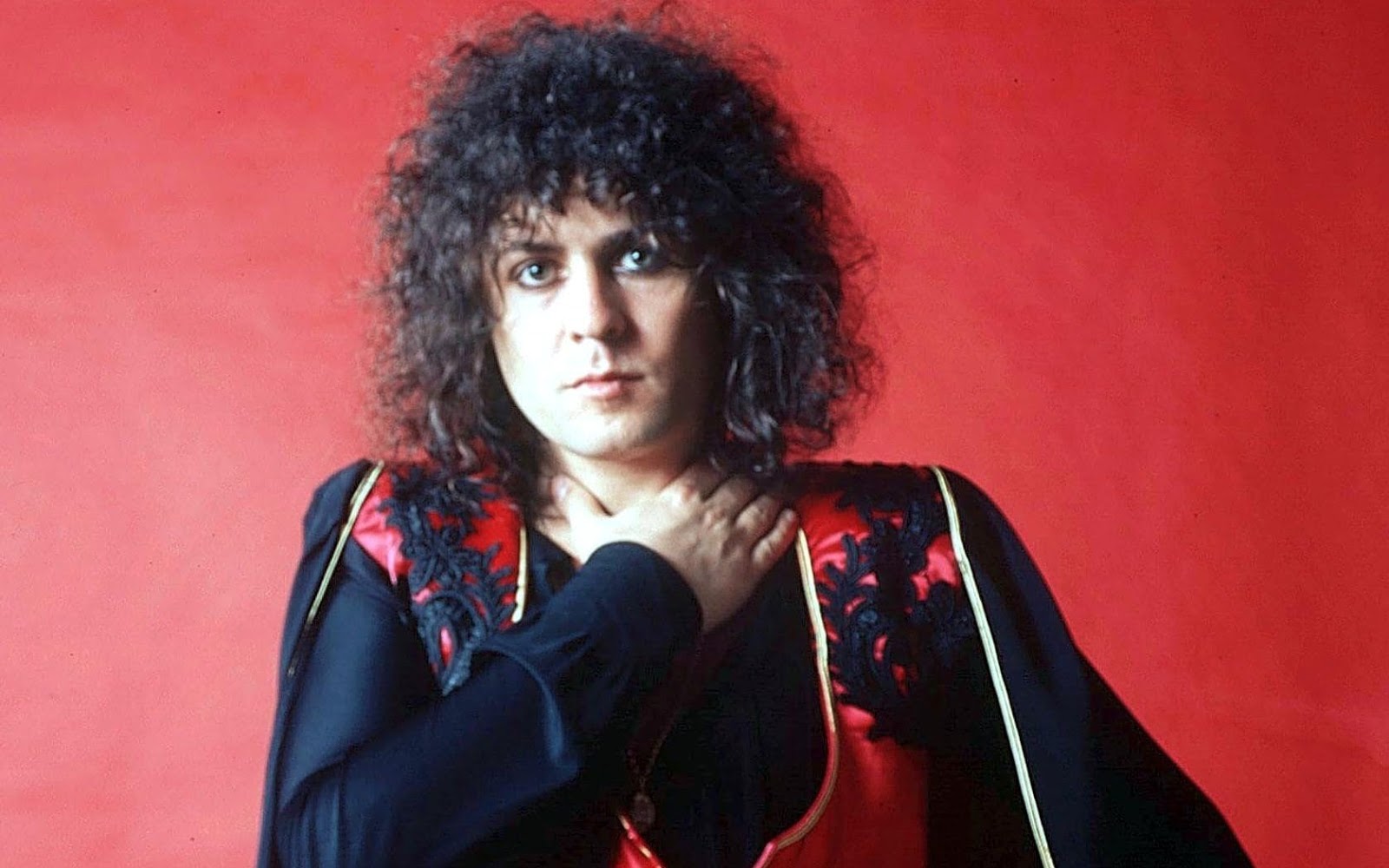
glamor. Before Marc Bolan burst out, fully formed majestically from his own brow,
rock’n’roll meant Elvis Presley and the Beatles, seemingly safe-as-milk music that
your mother and grandmother could love. T. Rex was the private territory and personal
property of teenagers.
There were no Glamrock boutiques
in Greensboro, North Carolina, in 1971, so, I had to use my imagination and creativity
to remake myself from a little antisocial nerd-bird to the first glitter girl on
my block. I pincurled my hair, wore rhinestone earrings and necklaces borrowed from
mommy’s jewelry box, put together strange ensembles from vintage finds, and changed
from a Coco Baroque or Too Too Bamboo-lipped mod doll to candy apple-lipped glamrock
vixen. At concerts, grown ups called me “acid queen,” although I had barely kissed
a boy (a birthday kiss!!!) and I had not touched any drug! When a sweet,
innocent former Girl Scout hears T. Rex, there is no turning back.
“Bang A Gong” hit the US
airwaves in July 1971, and that was T. Rex’s only Top Ten hit in the US. It sounded
like sex, even if I didn’t know exactly what sex was. Those "dirty and sweet”
power chords and the explosion of the percussion’s primal boom shot through my head,
my heart, and my body.
“Bang A Gong” was often referenced
by many bands over the decades, most notably on the first Oasis single, ”Cigarettes
and Alcohol.” The single sounded like Johnny Rotten fronting T. Rex, a perfect amalgam
for me in the Britpop ‘90s. This proved how much staying power T. Rex had, and when
you hear the song today it still sounds fresh and exciting.
Some of my other long-time
favorites like Paul Weller of the Jam and Bobby Gillespie of Primal Scream count
Electric Warrior as among the greatest. Weller said it is “one of my all-time
favorites. The guitar playing is really unique – you know the sound instantly.”
Gillespie said “’Bang-A-Gong’ is one of my all-time favorite pop songs. When I was
growing up, singles were an art statement. T. Rex was changing all the time. As
a fan, you wanted to know what they wore and whether you could follow them to that
new place.”
With Electric Warrior,
I was hooked. So, I started delving into the past for Bolan treasures and searched
for the key to the alchemy that helped create the beautiful and perfect man-child
with celestial curls, with his Les Paul as an integral appendage; the fact that
Bolan compared his love interest to a car was no small part of the attraction. Bolan
conjured lyrics that were equal parts cosmic poetry and rock’n’roll heart.
Marc Bolan’s roots included
joining a psych rock group that dressed all in white called John’s Children, with
an album and several singles, including “Desdemona.” Next came the folk rock psychedelia
of Tyrannosaurus Rex that recorded four albums between 1968-1970. Bolan was on acoustic
guitar with first Steve Peregrin Took and then Mickey Finn on percussion The band’s
first single, ”Debora,” was released in 1968, and was included on their first album,
My People Were Fair and Had Sky in Their
Hair But Now They’re Content to Wear Stars on Their Brow, was released in June
1968. Bolan’s warble was so exotic that the producer, Tony Visconti, thought Bolan
was singing in a foreign language. T. Rex, released in December 1970, was
the first album under the T. Rex name and bridged the gap between the folk rock
psychedelia of Tyrannosaurus Rex and the power chord orgy and hysteria-inducing
T. Rex.
Although this was six years
after Dylan was booed by folk purists for going electric, Bolan experienced his
own “Judas” moment when long-time supporter and personal friend John Peel dismissed
the electric phase of his musical career as being a “sell out.” Like his hero Dylan,
I doubt Bolan ever did anything to sell out. Bolan, from the earliest age, wanted
to be a teen idol. Whatever Bolan did, he did it on his own terms and to fulfill
his vision of his ideal self. Bolan, who was always assured of his impending
superstardom, was an iconoclast who sought to please himself and his fans. In July
1972, The Slider was released. By this point, it was clear that Bolan was
trying to concoct some magical, alchemical sound and spectacle for fans who knew
about Presley, the Beatles, and Hendrix but were too young to experience them live.
The rock’n’roll cocktail Bolan served up with splashes of Presley, Chuck Berry,
Eddie Cochran, Beatles, the Who, and Hendrix, shaken not stirred for the coolest,
most iconic superstar potion, like the visitor from Lord of the Rings reimagined
as a Dylan coiffed vampire troubadour who rocked a Les Paul, not a lute. Such perfect
pop, but so deliciously strange like a sweet drink with a bitter, yet addictive
after-taste.
Was this really 48 years
ago?! Bolan’s songs retain power and relevance, and have even more resonance for
me today despite their being close to half a century old. Right now, we have the
bad orange man failing to lead during a worldwide pandemic and we need songs
like “Metal Guru.” It is comforting to me, imagining a futuristic extraterrestrial
with corkscrew hair serenading me, freeing my body like Presley, and freeing my
mind like Dylan. “Mystic Lady” seduces. “Buick Mackane” takes you by force. “The
Slider,” ”Baby Boomerang,” ”Spaceball Ricochet,” “Telegram Sam” and “Baby Strange,”
and the rest, are all a part of me on a cellular level. Every nuance of every song
is in my DNA.
Tanx was released in January
1973, and was described as “interstellar soul,” which I believe influenced David
Bowie’s Young Americans. Some wonder if there ever would have been a Ziggy
Stardust had there been no T. Rex. I feel Bowie – as well as Prince – owe debts
to Bolan musically, fashion- and image-wise. “Born to Boogie” and “Life Is Strange”
stand out on the 1994 CD version of Tanx, along with other greats like “Children
of The Revolution,” ‘Solid Gold East Action,” and “20th Century Boy.”
Zinc Alloy and the Hidden
Riders of Tomorrow released in February 1994 was celebrated by neither fans nor the
critics. “Teenage Dream,” which reached #14 was Bolan’s last hit until “New York
City” in 1975.
Light of Love was a US-only album in 1974,
with 3 tracks from Zinc Alloy, with eight songs recorded at Music Recorders
in Hollywood that would end up on Bolan’s Zip Gun, released in February 1975.
Ken Barnes wrote in a Rolling Stone review, ”Bolan’s vocals still retain
the amphetamine amphibian warble, but at times his snarl is tough enough to rival
the Seeds, a considerable achievement.”
Zip Gun was Bolan’s tenth album.
Bolan continued in an R&B-influenced vein, joined by Gloria Jones of “Tainted
Love” fame. Futuristic Dragon brought a return to form in January 1976. “New
York City” is a blast and ushered in the moment where Bolan reinvented himself as
the “godfather of punk.” This phase saw him promoting punk era bands like the Jam,
Generation X, Eddie and the Hot Rods, andthe Boomtown Rats on his television show, “Marc.” Moreover, Bolan booked
a sellout show in London with the Damned.
Dandy in the Underworld, the eleventh album, was
a swan song of sorts, about six months before Bolan left this mortal coil due to
an auto accident just short of his 30th birthday. Great title, great photo, great
songs-helping fans keep a little Marc in their hearts. Sadly, I never saw Marc Bolan
live, but I asked a friend, Binky Philips of the Planets what it was
like to experience the splendor of T. Rex in the flesh. Binky said, “I saw T. Rex
at Carnegie Hall on February 27, 1972. I was crazy about their singles they had
put out and I was intrigued by how Marc Bolan was a one-man Beatlemania in the UK.
I’d been an Anglophile since February 9, 1964. So, I was well-versed on all things
Brit. The Carnegie Hall show might have been the most exciting first ten minutes
of any gig I have ever seen. The band hit the stage with every stage light blazing.
Marc was wearing a satin jacket over a white t-shirt that had his own face covering
his entire torso. I was just dazzled by that over-the-top ego trip. They launched
into my own top five favorite T. Rex song, ”Cadilac”(no typo), a track relegated
to a B-side and not on any album. I thought that was fantastically ballsy. The whole
audience felt like it was on the verge of screaming like 13-year-old girls, the
opening was so strong that Marc and Mickey and Steve and Bill just could not sustain
the excitement. But T. Rex made a delicious ungodly noise that I can still hear
in my mind’s ear.”
The delicious ungodly
noise is what got T. Rex inducted into the Rock and Roll Hall of Fame this year.
I voted for the band and was excited more than any induction before. The event was
supposed to be held May 5, but because of the pandemic, the festivities were rescheduled
for November 7, 2020. Congratulations to
drummer Bill Legend, the only living member of T. Rex. Congrats to Bolan’s son, Rolan, and
his mother, Gloria Jones, and all the band’s family, friends, and admirers. Congratulations and thanks to Mark
Feld Bolan, who is still the prettiest star.
I believe Bolan is grinning
down from his “armor plated chair” (throne?) on the astral plane and there is an
angel polishing his “hub cab diamond star halo.”
Text by Robert Barry Francos / FFanzeen, 2013
Images from the Internet
10cc in Concert: Featuring Graham Gouldman and Friends Directed by [not released]
Weinerworld Limited / New Wave Pictures
108 minutes, 2007 / 2013 www.newwavepictures.com www.MVDVisuals.com
Going into this DVD, I was trying to remember anything at all about 10cc. I knew they were a British pop art band (re: prog) from the first half of the 1970s. In the early ‘80s, I interviewed Jonathan King, who claims to have given them their name (which I believe, considering what it means). But I don’t own a single one of their many records, and off the top of my head, I couldn’t think of a single one.
The second song in, there was one with which I was familiar, “The Things We Do For Love.” I remember equating it, at the time, with the likes of REO Speedwagon, or some of the other glossy prog pap. Sort of the Brit version of the likes of Toto and the Eagles. This is also shown in another overproduced hit later in the show, “I’m Not in Love.”
Let me make this clear, whatever my opinion for the output of the band as a whole, I have incredible respect for their musicianship, their voices per se, and the work they do. However, as a collective, I find them incredibly insipid. That is to say, they make a perfect Top 10 band for their time period. And they have not lost their knack over the years. Sure, most of this is rehashing of material from back when, but if you’re a fan of the band (nothing to be ashamed of), this is golden.
The audience reaction alone shows that 10cc is loved, and this reunion tour, filmed in 2007 at Shepherd’s Bush Empire (London) and originally released as Clever Clogs, is perfectly catered to them. They are a two-pronged – or progged? – group, comprised of a couple of songwriting teams. The first is more pop, the other more artsy. Truthfully, I don’t know which style I find more meh. I’ve never been a prog fan of any kind, from its nascent form and onward. If I never heard another song by ELP or ELO, I don’t feel like I’d be missing, well, anything.
Okay, that being said, I feel a bit gushy about a segment of this where Graham Gouldman covers songs he had written for others, including “Bus Stop” (in my opinion, the best song the Hollies ever did), “No Milk Today” (one of my favorite Herman’s Hermits hits that was more popular in the UK than the US), “Look Through Any Window”( another Hollies hit), and the phenomenal Yardbirds classic “For Your Love” (even if it made Clapton leave the band). The covers by 10cc are obviously not the originals, but they are still good songs that hold up, nonetheless. Perhaps, in part, the reason I liked this part of the DVD, other than nostalgia, is that for the first three songs, it’s just two acoustic guitars and four vocals. No overwhelming gloss, no show-off instrumentalism (and contraptions, such as chimes). Just some basic killer riffs over decent lyrics. With “For Your Love,” it is back to full-band mode, but again, it’s not hyper-glazed. And besides, it’s such a great song, period.
For “Old Wild Men” and the relatively newer “Beautifulloser.com,” original 10cc drummer and vocalist Kevin Godley comes back and shows that he has a better voice than Gouldman, as does Mick Wilson, who does his solo with the likes of “Donna,” “The Dean and I” and the aforementioned “I’m Not in Love.” That’s not to say Gouldman has a bad voice, far from it, but it’s lost the most range over the years. But he still comes strong, such as when he brings up “The Bridge to Your Heart,” which is a tune from his other band Wax (which Gouldman had formed with Linda Rondstadt stalwart, Andrew Gold (2011).
For the finale, “Rubber Bullets,” Goldley joins again for vox and percussion. The song makes me think of a more poppy version of a cross between Elvis’s “Jailhouse Rock” and Stiff Little Fingers’ “Suspect Device,” if they had tight harmonies and was a bit, well, limp (other than Rick Fenn’s blazing guitar solo).
Of course, the image is HD, and the sound top notch (one of the joys of recent recordings). Fans of the band will be happy to release a little 10cc.
There are some interesting extras. First is a 50 minute talking head interview with Gouldman who discourses about his writing process, discussing it song-by-song from the show. He also describes recording the pieces, and other matters regarding the band history. The second extra is a 17 minute clip from a show on March 19, 2007, at St. David’s Hall in Cardiff, where the band plays “Old Wild Men” and “Rubber Bullets”; it was Godley’s his first show in 30 years. The sound and visual is a bit fuzzier, but important music history to some. There is also some backstage footage. Interestingly, he’s wearing the exact same thing in the London show. The last extra is the 10-minute “The Art of 10cc with Storm Thorgerson,” which is an interview with the man who created the graphic design for 10cc’s sheet music and album covers.
Band: Graham Gouldman: Vocals / bass/guitar Rick Fenn: Guitar/bass / vocals Mick Wilson: Percussion / vocals Mike Stevens: Keyboards /sax / vocals Paul Burgess: Drums Kevin Godley (special appearance): Vocals
Set list: The Wall Street Shuffle
The Things We Do For Love
Good Morning Judge
I’m Mandy, Fly Me
Life is a Minestrone
Art for Art’s Sake
Bus Stop
No Milk Today
Look Through Any Window
For Your Love
Old Wild Men
Beautifulloser.com
Silly Love
Donna
The Dean and I
Bridge to Your Heart
I’m Not in Love
Dreadlock Holiday
Ready to Go Home
Rubber Bullets
David Bowie Under Review – The Calm Before the Storm: 1969-1971 Executive Producer Rob Johnstone
Narrated by Thomas Arnold
Sexy Intellectual
65 minutes, 2012 Chromedreams.co.uk MVDvisual.com
David Bowie has always been an enigma to me, quite frankly. Sure, I understood what he was doing, and how he latched on to what he wanted – even if it originated with someone else – and made it his own. While I respect that, he has always felt pretty contrived to be, especially from his theatrical Ziggy period onward.
And yet, I have always found his story interesting, and have followed his career somewhat over the years. Now at age 66 with a new recording about to come out, here is a British documentary in the Chrome Dream collection that starts at the very beginning of his rise to superstardom.
Of course, the problem with this DVD is that Bowie’s career has been so carefully documented in every possible medium, there really isn’t too much here that’s pretty common knowledge to a true fan. But as someone who is unaware of the pre-Ziggy career, this is a treasure trove, especially all the interviews which are new, and the clips, many of which are rare.
Bowie (often pronounced as Bow-wee on this) started his public career apparently not as a musician, but as an activist for a bogus group he started for the protection of men with longer hair, back in 1964. This managed to get him his first televised experience, a clip of which is shown.
We follow him through his less-successful folkish-mawkish period, influenced by the likes of Anthony Newley (1999), when he was supposedly inspired by Bob Dylan (I don’t see the root). But as journalist Chris Roberts states in an included interview clip, “He’s always had a good ear for musicians and a good eye for collaborators. He always surrounded himself with useful people.” A special talent indeed, and I mean that with no hint of sarcasm.
After the release of his self-titled album, which bombed when first released, he came up with his break-out song, “Space Oddity,” a true rock gem. Then with the help of the likes of collaborators like guitarist Mick Ronson (d. 1993) he began to evolve through the likes of the LPs The Man Who Sold the World (1970) and Honky Dory (1971), and he became more flamboyant.
The tone started changing when Bowie opened for Tyrannosaurus Rex, and started adopting more of Marc Bolan’s proto-Glam style. Friendship turned into jealousy as Bowie’s career began to eclipse Bolan’s, though they stayed friendlimies for the rest of the latter’s short life (d. 1977). The birth of Ziggy Stardust’s androgyny started to click in Britain. Apparently, star-maker and producer John Peel (who is shown here in a 2004 interview, shortly before his death that same year) never really forgave Bowie for his alleged treatment of Bolan, and states so explicitly.
And where did that fashion style originate? Mostly from a of a cast of New York-based performers that showed up to act in a gender-ambiguously play called Pork, namely Cherry Vanilla (the woman who single-handedly helped introduce and break Bowie to the American audiences), the lovely Wayne (now Jayne) County, and publicity maven / photographer Leee Black Childers. Personally, I think these three should have been interviewed on this film because David Bowie may never have become David Bowie if it weren’t for this amazing trio (testify, Jimi L!). Luckily, they are at least given credit by one of the journalists who are part of the commentary.
That kind of style “borrowing” and eclipsing would not historically end there with Bowie. One needs just look at Boy George’s appropriation of bands like Hayzee Fantayzee. But I digress…
The other half of from what was Ziggy Stardust formed was the Andy Warhol Factory group, where Bowie is stated here as essentially saying that he wanted ‘“the mind of Lou Reed and the body of Iggy Pop. Ziggy Stardust was Bowie’s attempt to be that." Leee Childer’s once told one of FFanzeen’s writers in the 1980s that Bowie’s genius is knowing what to steal, and when. Very subtly, this DVD agrees.
There is a gaggle of journalists interviewed here mostly stating opinions, such as David Stubbs, Andrew Mueller, and Paolo Hewitt. As always, what fascinates me more are the people who are more intimately involved, like collaborators from the early years like Keith Christmas and Bob Solly. Shame they couldn’t get Angie Bowie, she certainly would have joyously livened up the volume on the DVD.
As always, there’s lots and lots of rare clips, both video and sound, from the entire period under discussion, including interviews with Bowie, of some of his influences (like Bolan and Donovan), and even a snippet of a telly advertisement in which he participated before his rise. Of course, all of these clips are short and incomplete; otherwise this would be five hours long.
In Chrome Dream fashion, this is a well-released and solidly-put together. It also feels a bit more even than some of the earlier histories, in that some interviewed are actually critical of the man at the center, rather than merely full of hyperbole (though some of that is here, too).
Now that I have finished this enjoyable history, I’m going to watch an alternative version with Velvet Goldmine.
Currently living in Saskatoon (email at RBF55@msn.com for address). From 1977-88, I used to publish a print version of a music magazine in New York called FFanzeen, which dealt with the wide-ranging independent music scene. I also photographed many bands from the period (and since). Now I write this blog. And the beat goes on.




 Posts

