Introduction by Robert Barry Francos / FFanzeen, 2020
Images from the Internet
This article was originally published in FFanzeen, issue 4, dated May/June 1980. It was written by David G, whose
musical tastes ran towards the avant-garde, especially British.
As much as the Sex Pistols were known to enflame their audience with antagonism
via their antics, PiL were no better; but with the latter, it seems their hostile
stance was more of a void than a taunt. In an infamous gig at the Ritz, for
example, PiL infamously stood behind a curtain, so the audience could only see
their silhouettes, while canned music played. This caused a riot.
All things considered, when one looks at Lydon’s artistic/philosophical heroes,
the very act of antagonism is art. This also explains most of the interviews he
has given, be it print or on-air. – RBF,
2020
Johnny Lydon (nee Rotten) is continuing the work he began with the Sex Pistols,
the crusade to realign the music public’s consciousness, in Public Image
Limited (PiL). Now, with the release of Metal
Box (the second PiL album, called Second
Edition in the States), Lydon has decided once again to take to the American
stage. He originally wanted to do Roseland, but he got the Palladium instead. And
it was an event.
After a muddy sounding, but forceful
set by Ornette Coleman disciple James “Blood” Ulmer, PiL’s drummer Marty Atkins
and bassist Jah Wobble walked on stage and immediately established the pulse:
that dark, brooding rhythm that runs through most of PiL’s music. The bass, fat
and prominent like on a dub record, wove a serpentine pattern around the crowd’s
growing anticipation.
Unannounced, Lydon, followed closely
by guitarist Keith Levene, bounded onstage. A rush of near hysteria swept the
crowd, their screams mingling with the random cries of the synthesizer Levene
casually stroked. The pulse became “Memories,”
from Metal Box, with Lydon painfully
screeching the lyrics. Despite profound differences between the Sex Pistols and
PiL on record, on stage Lydon is once again Johnny Rotten, a moving, screaming
bundle of intense anger and energy. His charisma was very much in evidence at
the Palladium, but it didn’t last long.
Two songs into the set, Levene’s amp gave
out, the time needed to replace it filled with bass and drum coping.
Lydon/Rotten took this opportunity to hand the mic over to the audience, who didn’t
do a bad job approximating his anguished wails.
All fixed, Levene went back into “Memories,”
but Lydon/Rotten decided to lengthen his cigarette break by inviting a few
punters on stage for more impromptu vocalizing. This practice was curtailed
when Rotten/Lydon led an overly enthusiastic loon on stage who was duly removed
by security.
Temporarily repossessing the mic, our
hero sang another song or two and demonstrated some dance steps he copped from
Bob Marley, before once again bringing some audience members on stage. After a
little coaching, Rotten, with guitarist Levene in tow, left the stage.
Wobble and Atkins, still on stage,
continued to dispense the pulse. After mumbling something to the audience, they
too left the stage. The confused and slightly dazed audience slowly began to applaud.
When a moment later, the lights went up, a few boos and much grumbling was heard.
No more music was forthcoming.
Leaving the Palladium, I noticed it
had rained during the show.
This
documentary of the later part of the early days of punk rock, namely the
late-1970s, is now considered the granddaddy of non-fiction films about the genre,
much as Please Kill Me is viewed,
though in book form. While I’m not trying to imply that this or Kill Me was the first, I do posit that
they are both game changers and have since become iconic.
There
are generally two schools of thought: one that punk started in New York in
1974, and others that believe it began with the Sex Pistols in England, in late1975.
They can be both right, as they were different in both politics and sound, with
the occasional overlap. Rather than thinking of them as one or the other, I
like to believe they are both concurrent and inter-serving. Yeah, I am in the
New York school, and believe it started there, but am also comfortable knowing
that they are both different and alike at the same time, as long as both
acknowledge each other.
The
film is essentially three acts that are intertwined, and yet remain unique: one
is the Sex Pistol’s tour of the Southern United States (including post-tour),
the governmental and record company reaction to the Pistols directly and
therefore British punk as a whole, and live performances of various bands.
The
film starts with the Pistols playing in Atlanta, including a clip of them performing
“Anarchy in the [U.S.A.].” Of course, it’s the audience interviews that are equally
as interesting as the music. The haters are a drawling hoot, but even the fans
present a level of pretention that’s hard to explain. In New York, I remember
seeing Eddie and the Hot Rods play Max’s Kansas City, and they were disgusted
with the lack of audience frenzy, despite the applause after the songs. The
First Wavers (aka the Blank Generation), including me, were too cool, after
years of the Heartbreakers, Ramones, Dead Boys, et.al. By the way, the Damned
were a more interesting live band than the Hot Rods, but I digress.
The
point is that the audience in Georgia that were pro-Pistol appeared just a bit off
and pretentious to me in their going out of their way to be “different,” such
as one who said, “They made me want to vomit, they were so beautiful.” It’s
like the two girls fake fighting in the ticket-buying line to see the Ramones
in the film Rock and Roll High School.
I just said, “Hunh?” to the person I was with at the RaRHS New York premiere on Bleecker St. For me, the whole idea of
punk was the lack of pretention and
social norms, not necessarily creating a new one for this scene (which became especially codified by the time hardcore –
aka, the Third Wave – came about).
I’m
not sure if the interviews with the British politicians and such were
specifically for this film, or taken from newscasts (or both), but it’s an
interesting corollary between them and the hyper-sensitive Evangelical
Republicans on the Hill today as I write this, seeing anything different as evil
(e.g., “Make America Great Again” is much more regressive than, say, “Make
America Greater”). To be fair, ironically (and hypocritically), much of what
these people say about punk is how I feel about most of the modern Top 10.
Yeah, I’m old.
The
live music is part of what makes this film great, such as the underappreciated
X-Ray Spex doing “Oh Bondage, Up Yours!”, the post-Pistols’ Glen Matlock band
the Rich Kids (I saw them play Harrah’s in New York opening for Sylvian Sylvian’s
14 Street Band, and was not impressed; Matlock was a great songwriter, but not
as much as a front man), Generation X playing “Kiss Me Deadly,” and Sham 69,
who were underrated in the States, doing a couple of numbers, including “Borstal
Breakout.”
While
a bit confusing on the why part, I am
certainly not complaining that two thirds into the film, it shifts to the “U.S.A.”
(as the John Holmstrom drawn title card states) and the Dead Boys – a band I
saw many times – are playing “All This and More.” I really miss those shows, so
it put a smile on my face to see them again in their glory; to me, they were
the one of the rare bands that had an affinity to the British punk style (which
would explain why they shared a bill with the Damned so often), and can
arguably be seen as the first genuine hardcore band, fitting into all three
Waves in function.
Of
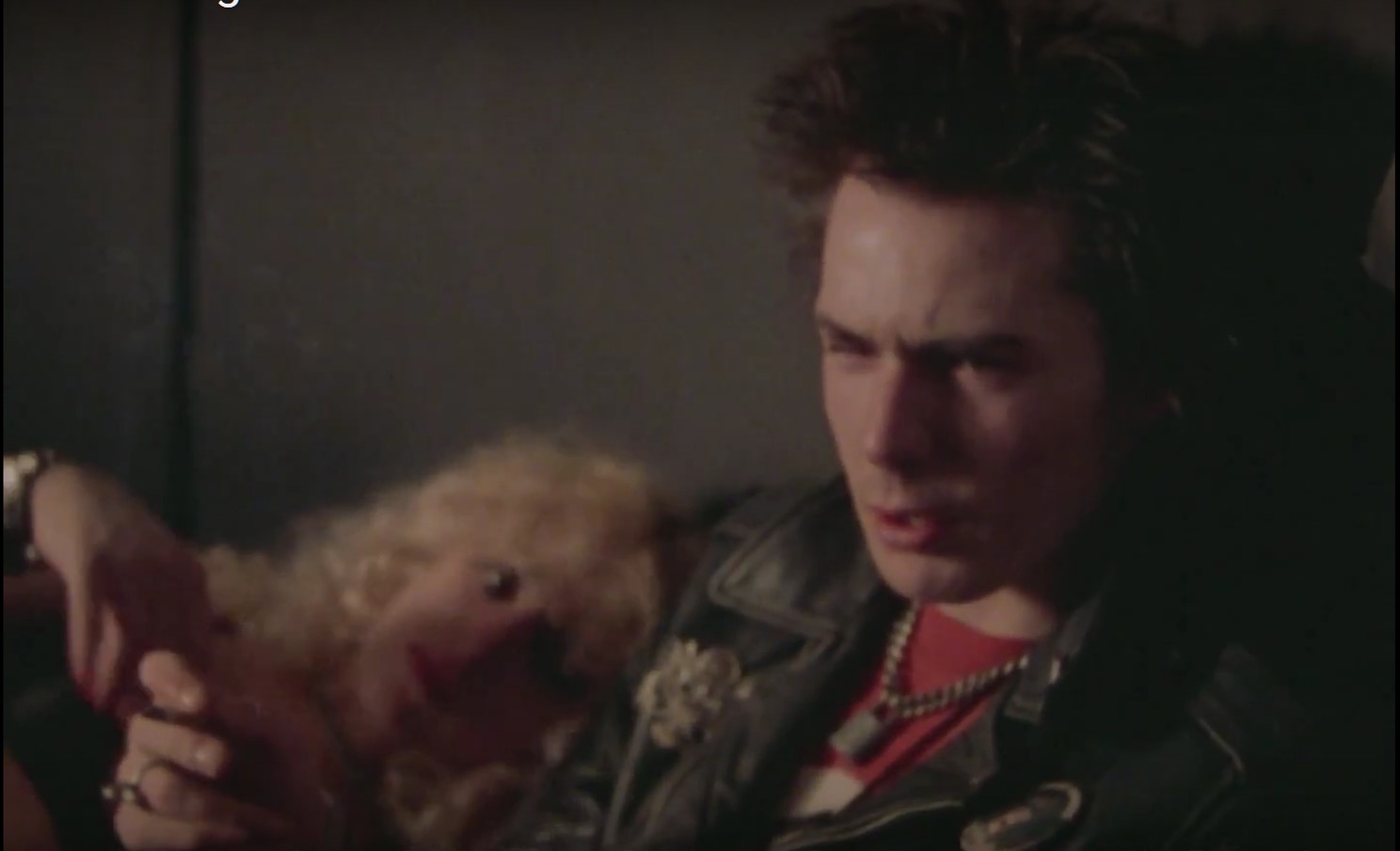
course, the most infamous scene occurs about an hour in: sort of the absolute
antithesis of the John and Yoko Toronto bed-in interview is the Nancy Spungen
and Sid Vicious conversation (such as it is) where Sid is totally nodding off
while wearing a Swastika tee. Nancy’s odd accent that’s a cross between Philly high-line,
New York Lower East Side and London-esque is as disarming and alarming as Sid’s
drug-induced mumbling.
For
the film’s final act, it’s a mix of the Pistols’ last show of the tour and what
came to be their final performance before reforming decades later with Matlock
replacing Sid, the police presence and fans outside the club, and more wacked
out Sid and Nancy at the Chelsea Hotel. This includes the infamous Rotten onstage
comment about “being cheated,” playing over some woman spontaneously pretending
to masturbate for the camera in a totally unsexy, fakey way.
Terry Sylvester
The
ending is a nice mash-up of the band playing “Bodies” with clips from all their
American shows melded together. And yet, even though they are the centerpiece,
the Pistols turn out to really not the entire theme of the film, but rather a creamy
layer of the whole cake. One of the points of focus is Terry Sylvester (not to
be confused with the singer from the Swinging Blue Jeans), who was the lead
singer of Terry and the Idiots. Not lasting long, they were pretty
terrible-but-enjoyable; they remind me of New York’s Student Teachers, who were
a better act, and arguably modeled themselves on the Mumps. We follow Terry
around and listen to him philosophize about punk, and tell a very bad joke
based on innuendo that really had nothing to do with the point of the film, but
whatever. There’s also an amusing
interview with New York stalwart Bleecker Bob in his infamous shop (Lenny Kaye
worked there at the time, but you don’t see him). He talks about some bands,
and they pan a bunch of singles on the wall, most of which I own (bought at
Disc-O-Rama, though, not from him).
Worth
it merely for the live band footage alone, but that is only a small helping of
what is good here. Yeah, when it was reviewed by the late-great Lisa
Baumgardner in the pages of FFanzeen back in the day, it was slagged (HERE). I remember it being really grainy and rambling, but I’ve always been kinda fond
of the film, being somewhat neutral on the which
is better front (though not on where
it all started). The current release, however, while still obviously taken from
the print by the wear and tear, it’s much clearer than I remember.
Lech Kowalski
The
basic extras are an Image Gallery, the original film trailer, and a trailer for
(I kid you not) the classic Attack of the
Killer Tomatoes, which was put out by the same distribution company as this
one. There is also a nice and thick booklet with photos, and some text by Holmstrom, and a folded film poster.
The
most notable extra is a complete and full-length documentary about the making
of D.O.A. titled Dead on Arrival: The Punk Documentary That Almost Never Was. Put
together by Richard Schenkman especially for this Blu-ray and DVD 2-disc set,
at 115 minutes, it actually lasts longer than the feature it is about.
The
two main talking heads are Punk magazine
co-founder and the key New York Scene illustrator John Holmstrom and Scene
photographer Robert Bailey, both of whom became part of the D.O.A. caravan through the American Sex
Pistols’ tour, and Holmstrom then also continued on with the British phase
after the American leg ended. Others who appear extensively in new material
include (but not only) New Musical
Express writer Chris Salewicz, musician Midge Ure (who was in the Rich Kids
at the time of filming, and would go on to his own cult fame leading Ultravox),
cinematographer Rufus Standefer, and crew members David King (U.S.) and Mary
Killen (U.K.).
Along
with some historical interviews with Malcolm McLaren and Billy Idol that are
included from television shows, one of those in the new segments is Lamar St.
John, the woman who is laying on the ground in the film as part of a group of
teenypunkers from Los Angeles who drove to see the Pistols in Dallas. She’s
also the one who bloodied Sid’s nose.
While
the Pistols’ tour was infamously and covered from the inside with tons of snark
by roadie Noel E. Monk and writer Jimmy Gutterman in the book 12 Days on the Road: The Sex Pistols and
America (1990, Quill/William Morrow & Co.), which is name checked in
this follow-up documentary, the view presented here was more from the outside
looking in, which actually makes it extremely interesting in a whole different
light. They lived in a circumstance of being within the crowd, with near
constant threats of violence from the audience, from the clubs’ personnel, and
even the Pistols’ Warner Bros. team. It’s definitely an interesting bookend to the
Monk self-serving version.
Part
of what kept me riveted is that everyone who discusses the events was at the
filming, giving first-hand accounts of the events, rather than from other
journalists who were told what
happened. John and Roberta are experienced at telling of events of the 1970s,
so this practiced hand keeps off the stumbling around for words or remembrances,
keeping the pace up.
I
especially liked when Holmstrom comments that punk was the last musical form created
totally in an analog world, before digital music and CDs temporarily replaced
vinyl. As a student of media and technology, this spoke to me.
What
makes the film D.O.A.: A Right of Passage
so palpable is that it is not news footage, but rather a group of fans who
put together a film trying to express a positive point. Back then, and I remember
this strongly, most of the media attention was on the negatives, about how punk
would degrade culture rather than put a mirror up to it, as is expressed by the
officials in the U.K. within the documentary. This (and I do believe the
follow-up, modern Dead on Arrival) is
a better indication of what was actually going on in a three-dimensional way,
from multiple directions rather than just pro- or anti-.
Oh,
and Lech? You still owe me the $100 for the full page ad you took out in FFanzeen when this film came out. Just
sayin’…
Text by Robert Francos / FFanzeen, 2014 Images from the Internet
The Sex Pistols on TV: The TV Interviews
(Un)Censored Directed by Mark Sloper Odeon Entertainment A2B Media / ITN Source 120 minutes, 2010 www.mvdvisual.com
Before I
start the review, first some wavy lines of a flashback: when VHS first started
to be mass marketed, there were a series of tapes of popular groups like the
Beatles and Elvis that just showed press conferences and news pieces, without
any music by the artists they covered. The reason was simple in that music
meant royalty fees. Fast forward to this release.
I need to
cover this review in two pieces, first the content and then a bit deeper.
Perhaps not on a Greil Marcus level, but here we go. Wheeeee.
There is no real flow here, just a
semi-chronological order as we follow the boys through their careers. Smartly,
it starts with just a brief clip from
the infamous Bill Grundy interview that everyone who is interested in this has
probably seen soooooo many times EV-rywhere. Thank you for that, director
Sloper.
Separated by
title cards displaying year(s) and focus of a particular set of clips, we are
shown television shows and interviews with the group, some band members, or
those associated with them. Clips run from pretty short at a couple of minutes
to extended pieces, resulting in 2 hours of all-Pistols-and-Pistols-related-all-the-time.
Which has its good and bad points.
The good is
that there are many clips here I’ve never seen from British shows, including those
culled from music news programs, something the US did not really have during
the Pistols’ tenure (unless you want to count the ridiculous segments on the
likes of Tom Snyder’s Tomorrow Show,
or Phil Donohue). There’s a couple of
Janet Street Porter, a tall woman with big teeth and a thick north U.K. accent,
for example, trying to get a decent answer out of Lydon (I admired when Johnny
then-Rotten gives an bemused, off-hand side comment on how her obviously dyed red
hair is the same color as rhubarb; see video below). Mostly they’re met with
derision while being accused of being devious. It’s a joy watching Lydon take
the piss out of them, never storming off the set, but just sauntering off after
acknowledging the bias against the band. Then again, he walks around with a
joyful metaphorical target on his vest.
The bad part
is that all of the news stories are somewhat taken out of context. Captions
stating the names of the programs or interviewers would certainly have been
most helpful. I’m sure the audience in England will know the program(me)s, but
we Yanks may not. I found that really annoying. Also, all music is taken off,
even if set in the background, and replaced with a generic piece that has sort
of a Pistols feel to it, albeit with all the life sucked out of it. It is also
repeated throughout the whole collection. By the end of the two hours, it made
me question whether I will ever watch this again.
Of course,
there are some news clips that were used in some previous documentaries about
the Pistols, especially on the US tour (let’s see the redneck jocks makin’ fun
of the punkers, before they would realize that they could inflict some serious body
damage in a mosh pit if they joined in). And there are the New York City news
reports of Sid’s death, especially my favorite one of Roger Grimsby (ABC News)
pronouncing that it all happened at the “Chel-sah” Hotel. See, I knew that one
because it was local for me. Anyone outside of NYC would not have a clue; even
then I wanted some caption so everyone can know.
The quality of the pieces ranges from sharp to obviously
taken from old home-recorded off the television VHS grainy. Yes, there is a lot
of information in this, and it is especially interesting to watch Rotten stay
the same and yet evolve at the same time as far as using the media as much as
it used him. With the exception of Sid and Johnny, nearly all the others
(Jones, Cook, and Matlock) get very brief vocal time. There are also no clips
talking about Rotten getting slashed with a knife on the street (perhaps it was
before Grundy? No, I’m not going to look it up).
As far as
face time goes, more is given to Malcolm McLaren and Vivienne Westwood than to
the rest of the band. Sure, Rotten gives some snide comments about them here
and there, but he and Sid are the focus of this. Gotta say, though, I did see
Matlock’s Rich Kids - which is never mentioned here, though Lydon’s post-Pistol’s
PiL is - a couple of times, once opening for Sylvan Sylvan’s 14th
Street Band at Hurrah’s, and they weren’t all that interesting. I remember
Jones being on a “stay away from drugs kids” commercial and a couple of mentions
in a book by the lovely Miss Pamela DesBarres, but the rest of the band didn’t
really have much other than the Pistols.
Some of the
news segments include the aforementioned PiL, a couple of the Pistols reunions,
brief pieces on the US tour (mostly the southern end rather than California),
and a pretty interesting section from the early 1990s on how they affected
Manchester by playing there, leading to the formation of bands like the
Buzzocks. There are interviews with Howard Devoto, Steve Diggle, Pete Shelley,
and members of other bands as well. There is even a news story on the making of
Sid and Nancy.
What I found
most interesting, however, is a 20-plus minute interview in a bar near the end with
a jetlagged Lydon-Rotten where he is actually answers questions (the next
interviewer – or previous one, it’s not clear – was not so lucky). He happily
and intelligently talks – and often talks over – without giving in to the usual
“ask an intelligent question” mode he tends to fall into. He seems to be having
fun, and is quite informative. This piece alone is worth the watch, though as a
whole it’s an important piece of collected history; this one, however, is the
keeper.
One last
thing before I become more of an academic: why does Sloper call himself the
director? He should, more likely, be called the curator or producer, as he does
not really have anything to do with the content, other than grouping them into
sections with titles, and digitally replacing decent music with a terrible one.
I’m sure it’s a lot of work, but calling it “directing” is a misnomer. He does
more actual directorial work on his next film, Sid!, of which a really nice 20-minute preview is given on this
DVD.
Switching
gears a bit (okay, a lot), I was paying attention to what Lydon was saying
through the years, and came to realize that he was a Media Ecologist.
Whether he’s read it or not, he aligns well with the likes of Neil Postman,
Harold Innis and Daniel Boorstein, discussing how mass media such as news organizations
are interested in a pre-set bias and agenda, and focus on made up, or non-events
(Boorstein calls them “pseudo-events). He constantly posits about how the media
is rubbish, the focus of their stories are more on sensationalism than reality,
and that the questions they ask are meaningless other than to be “shocking” (or
what he calls boring). Of course, I’ve always seen him being grumpy at
reporters, especially when he’s heard the same question over and over (e.g.,
“how are you guys getting along?”), but I really listened to what he was saying. Much like Bobcat
Goldthwait, there is more beneath the demeanour that just acting out. He’s actually
saying something important; something that is becoming more so all the time as
the Tea Party tries to steal the United States and set up a theocracy through
lies and distraction.
Now, Lydon
keeps saying that the rest of the band is into the reunions for the money, but
not him. Honestly, I don’t know how true that is, but it really is irrelevant,
isn’t it? I mean, the whole group
kind of took the wind out of that sail by calling their rejoining “The Filthy
Lucre Tour.” But that doesn’t stop the questions. This only feeds Lydon’s
fervor and avering about the true focus and bias of mass media.
A quick
couple of comments and then we’re outta here. First, it drives me crazy when
news reports state that the Pistols “started punk rock.” Well, they don’t call
it the British scene “second wave punk” for nothing. By the time the Pistols
formed, the New York scene had been going on for two years, with hundreds of
bands. Yes, however, they did transform it into something else, as did the
“third wave,” hardcore, shortly after the Pistols broke up. Second, the bias
against the Pistols is shown clearly by the often reference of “Sid killed his
girlfriend Nancy,” especially in the British press. This has never been proven,
and there are enough contradictory stories to this line of thought to put forward
serious doubt. Personally, I believe she was stabbed by a drug dealer that she
refused sex while Sid was passed out from “sampling.” My theory is no less
credible than theirs, and is actually based more on people who knew them than
the press or police reports.
On a
positive note, one of the most touching moments is Lydon discussing the death
of Joe Strummer. Through the years there has been the hint of animosity between
them, but Lydon clearly sets that straight.
As a
collective historical document, this is an interesting-to-say-the-least
release, and possibly an important one to have all of this info at hand in one
place. That being said, there are substantial problems with it, and I have
avered above. If you’re a Pistols fan, it’s good to have all these clips in one
spot.
Public Image Limited: Live at Rockpalast 1983 Directed by Christian Wager
MIG / WDR, 1983 / 2011
58 minutes, USD $19.95 MIG-music.de MVDvisual.com
Public Image Limited (aka PiL) is not just the band that John Lydon formed after his time with the Sex Pistols, but once it’s initial members left (and pretty early on in the 1980s), essentially it became the name of Lydon’s back-up group, since musicians came and went so fast during it’s initial 14-year run (1978-1994; though a version reformed in 2009).
There is certainly a marked difference between the Pistols and PiL, despite both starting with the letter “P,” and that is certainly to Lydon’s credit. While the former were musically talented, they were certainly not very disciplined. The latter, on the other hand – and this is especially true in later incarnations of the band – were a tight and consistent unit.
For a series of shows in Germany and Japan – part of which was taped for this release when they appeared at the “uberdisco” Zeche, in Bochum, Western Germany, on Halloween 1983 – Lydon assembled a collection of touring musicians to join him and original PiL drummer Martin Atkins. While the rest of the band doesn’t necessarily look the part (guitarist Joseph Guida, for example, looks like he should be in a pre-hair-metal rock band), they certainly play like they do, giving Lydon a strong backing for his music.
During the Pistol days, in “Johnny Rotten” mode, it seemed all Lydon did was give that tilt-headed, unblinking glare which works for about a minute, and snarl out some lyrics while being a living embodiment of sarcasm. In PiL, however, while some of that still exists, he seems a lot more relaxed, and, dare I say it without destroying his public image (pun intended), he seems to be having a good time. Rather than just hanging on the mic stand, hunched over and screaming, he jumps off the stage and approaches the audience pretty often, and frequently does that reggae-style skank dancing. Heck, he even smiles repeatedly. No, this is not JR, this is JL, even though he still occasionally leans in and sings into the camera.
As this excellent performance shows, PiL take an early Stooges and / or later Flamin’ Groovies influence and base many songs on a single riff, such as with “Religion,” that is played in a round, over and over, with slight changes. Mix in a bit of atonal No Wave, and this makes it hypnotic. PiL creates something of their own though, by also adding a reggae touch (just a smidge) and an elaborate keyboard set-up that would make Rick “I’m Boring” Wakeman notice.
If I had to pick a quintessential PiL-styled song from this DVD, it would be “Memories,” though my fave is by far one of their biggest successes, relatively speaking, “Bad Life.” In this one Lydon doesn’t sing as much as atonally caterwaul. It’s more known, however, for the repeated line, “This is what you want / This is what you get…” On the DVD box, however, they state that the band’s biggest hit was “(This is Not a) Love Song.” Fair enough.
While it may not be the classic Lydon-Wobble-Levene-Atkins version of PiL, this put-together band still delivers the sound. [Two quick sidebar PiL stories: when PiL first played in New York City at the Ritz in 1981, they stood silhouetted behind a curtain while the club played prerecorded tracks. The ticket-paying fans were not impressed, and the resulting riot did a lot of damage to the club. Second, while I was working for cable access show Videowave, PiL was scheduled to appear for an interview, but the story we heard from their management was that Levene was MIA looking for drugs, so the rest of the band decided not to bother showing up, being the only non-shows in Videowave history, other than a new, young singer named Madonna Ciccone.] Quite honestly, I was not impressed with PiL back then, finding them too contrived for my Ramones-Heartbreakers-Dictators taste, but this DVD shows that there was definitely something there quite interesting, in a more primal way. This especially shown in the song “Under the House,” where everyone on stage other than Lydon rhythmically pounds drums together, while he sings / chants.
As a surprise, for the eighth song Lydon dusts off his Rotten character and delves into “Anarchy in the U.K.,” showing he still has some of the fire that lit up the Pistols. While played a bit too sterile (i.e., not sloppy, like the Pistols, but sounding more precise like the studio album/single), I’m not complaining; I sang along with it and enjoyed it. And as not a surprise, after the song, Lydon says goodnight and leaves the stage with the band. Short 33-minute set?
Well, as you can see below, they came back and played nearly as long an encore as the set itself, thankfully. Between each of these songs, though, they leave the stage and then return. Oddly, they end their show with “Public Image.” Why is this odd? Because they began the gig with the exact same song. Happily, it’s a good one.
In all, there is a total performance from beginning to end, and nearly an hour of music. Lydon’s between-song comments are kept to a minimum (thankfully), and the music stands out.
The Rockpalast series was/is far superior to any of the then-contemporary American relatives like Don Kirshner’s Rock Concerts or In Concert, because the German version played the entire show (I have no idea if the original airing had commercials or not), and did not resort to any of the ridiculous special effects that the U.S. ones did, such as split screens, flipping the images, annoying angles, or the dreaded kaleidoscope effect (that’s where there are five images in a circular pattern, and they twirl around the center). Rather, you have clear images using multi-camera editing, and a dynamic sound for its time period (i.e., pre-HD).
There are two extras: the first is a six-minute interview with Lydon done by Rockpalast host Alan Bangs. Lydon seems to be wearing pajamas and a bathrobe (I should go back and see if he’s wearing slippers…). He asks some decent questions, about such topics as the original PiL members (Lydon states that they’re busy with their “own projects,” which is to musicians what “spending more time with their families” is to politicians) and Lydon’s experience working on the film Cop Killer. Before long though, Lydon being Lydon, he gets bored and says, “Are we done?” and walks off. Y’see, Lydon is solid ego. His public persona has always (well, since joining the Pistols anyway) believed that what he feels at any particular moment, is the most important thing, regardless of anyone else’s needs. Now, one can look at this admiringly, as being his own person. I find it’s easier to be like that than have to attended to someone behaving in that manner. Being obnoxious is only good in the first person, but again, Lydon being Lydon, he has never been able to think beyond his own skin. I mean this as an observation rather than a judgment… Okay, maybe it’s a bit of both…
The second extra is the band – with Lydon still in PJs and robe – soundchecking “Annalisa” and “Chant.”
I would recommend this without hesitation. It’s Lydon and his music at the top of his game, and an easy groove with which to have some fun.
Band: John Lydon: Vocals Joseph Guida: Guitar Louis Bernardi: Bass Arthur Stead: Keyboards Martin Atkins: Drums
Set List: Public Image Limited Annalisa Religion Memories Flowers of Romance Solitaire Chant Anarchy in the U.K. Encores: (This is Not a) Love Song Low Life Under the House Bad Life Public Image II
The following article about the Sex Pistols was originally published in FFanzeen magazine, issue #3, in the Winter-Spring 1978-79 issue. It was written by Sue Starstruck.
Do I really need to go into any background or detail about the Pistols? Didn’t think so, thereby let me say that Sue Starstruck, along with her cohort Alex, used to live in Whittier, California (near Disneyland), and published their own fun and fabulous fanzine, called / (which as subtitled “The fanzine without a name”). I was friendly with them, and somehow, when they both moved to England, I lost contact with them. If anyone knows their whereabouts or what happened to them, please let me know. – RBF, 2010 It’s fucking St. Valentine’s Day, and I celebrated by playing a Bryan Ferry record. Now I’m in my room, there’s a kite on the bed – but no wind outside.
So: The Sex Pistols. When Alex and I first worked out the idea of doing their fan club, we knew it wouldn’t be ordinary. That wasn’t what the Pistols were about. We just wanted to share information, to give people a chance to get t-shirts, posters, all that; and to just DO SOMETHING, in a personal, non-boring way.
Well, the fan club never got off the ground due to delays and the increasing possibility that it would be run by a merchandiser – the same one who supplies the KISS Army.
Time dragged on; the album was released, the film off and on and finally off (good). Then it hit. The Pistols were coming to America. Then they weren’t. OK, they were. It was enough to drive a crazy person sane!
Knowing I didn’t want to see them at Frisco’s Wonderland (too big and too crowded), I scraped together fanzine money and some I was saving up to move out, and went to Dallas.
As soon as the show at the Longhorn Ballroom was underway, I thought I’d wasted my money and my effort. The Sex Pistols were so bad; they reminded me of the New York Dolls, who I don’t think were ever what they are now thought to have been – Sid Vicious was so gone, but we’ve probably all read about this in Rolling Stone…The band was furious, but the music wasn’t. It was just sloppy and self-centered.
The next night was Tulsa – Cain’s Ballroom. I waited for hours in the snow, but I’m not complaining. I thought it was great! (It was only the second time I’ve ever been in snow, so you’ll have to excuse me.) The Pistols arrived late afternoon in their tour bus. They clowned around in the snow. Another kid who had been waiting outside went to shake Sid Vicious’ hand. Sid hit him, not hard tho. I thought it was funny and I was glad it wasn’t me.
I managed to see some of the soundcheck. Boy, I saw enough to know. “Let’s do it together this time,” Rotten pleaded. During “Liar,” which I don’t think they ever did in the actual shows, John (I must be trendy and call him John) just sat on the edge of the stage and looked out, hollow, empty – what am I doing here?
The show that night was fantastic despite the fact that Rotten had the flu. Paul played well as ever, Steve (who looked none too happy) explored a new guitar, Sid was carefully watched by a guard as he fought the temptation to swing his bass at the people like myself who were smashed together right in front of the stage. And John – definitely on, like a man possessed, his performance sliced by his cat-and-prey stares with the crowd. It occurred to me as I caught his stare, “It’s all for him. He’s putting forth so much but he’s doing it for himself, and not for the audience.” I stared back with a vengeance.
But this was the show I had waited for since way back when. I’m glad they had it in ‘em like I’m glad I wasn’t wrong.
A few days later was the SF show topped off by the break-up. Why it happened, who threw out who more exactly we may never find out. But what will happen next: Paul & Steve form a power pop band (here we go again with labels!). John does reggae – “I mean it, mon.” Sid with Jerry Nolan… is luckily yet to be learned.
By the way, I really recommend a book that is, as far as I know, only out in England: The Sex Pistols by Fred & Judy Vermorel it’s called, and try writing to Tandem Publishing… It’s pieces of interviews, news stories, and best of all, portions of Sophie’s (McLaren’s secretary) insightful diary. The book’s loosely done but it speaks for itself as in “look afar and see the beginning” – I got that in a fortune cookie once.
Currently living in Saskatoon (email at RBF55@msn.com for address). From 1977-88, I used to publish a print version of a music magazine in New York called FFanzeen, which dealt with the wide-ranging independent music scene. I also photographed many bands from the period (and since). Now I write this blog. And the beat goes on.




 Posts
Posts

