Text © Robert Barry Francos / FFanzeen,
2018
Images from the Internet

D.O.A.: A Right of Passage
Written and directed by Lech
Kowalski
High Times Films / MVD Rewind Collection
90
minutes, 1980
Blu-ray
and DVD
This
documentary of the later part of the early days of punk rock, namely the
late-1970s, is now considered the granddaddy of non-fiction films about the genre,
much as Please Kill Me is viewed,
though in book form. While I’m not trying to imply that this or Kill Me was the first, I do posit that
they are both game changers and have since become iconic.
There
are generally two schools of thought: one that punk started in New York in
1974, and others that believe it began with the Sex Pistols in England, in late1975.
They can be both right, as they were different in both politics and sound, with
the occasional overlap. Rather than thinking of them as one or the other, I
like to believe they are both concurrent and inter-serving. Yeah, I am in the
New York school, and believe it started there, but am also comfortable knowing
that they are both different and alike at the same time, as long as both
acknowledge each other.
The
film is essentially three acts that are intertwined, and yet remain unique: one
is the Sex Pistol’s tour of the Southern United States (including post-tour),
the governmental and record company reaction to the Pistols directly and
therefore British punk as a whole, and live performances of various bands.

The
film starts with the Pistols playing in Atlanta, including a clip of them performing
“Anarchy in the [U.S.A.].” Of course, it’s the audience interviews that are equally
as interesting as the music. The haters are a drawling hoot, but even the fans
present a level of pretention that’s hard to explain. In New York, I remember
seeing Eddie and the Hot Rods play Max’s Kansas City, and they were disgusted
with the lack of audience frenzy, despite the applause after the songs. The
First Wavers (aka the Blank Generation), including me, were too cool, after
years of the Heartbreakers, Ramones, Dead Boys, et.al. By the way, the Damned
were a more interesting live band than the Hot Rods, but I digress.
The
point is that the audience in Georgia that were pro-Pistol appeared just a bit off
and pretentious to me in their going out of their way to be “different,” such
as one who said, “They made me want to vomit, they were so beautiful.” It’s
like the two girls fake fighting in the ticket-buying line to see the Ramones
in the film Rock and Roll High School.
I just said, “Hunh?” to the person I was with at the RaRHS New York premiere on Bleecker St. For me, the whole idea of
punk was the lack of pretention and
social norms, not necessarily creating a new one for this scene (which became especially codified by the time hardcore –
aka, the Third Wave – came about).
I’m
not sure if the interviews with the British politicians and such were
specifically for this film, or taken from newscasts (or both), but it’s an
interesting corollary between them and the hyper-sensitive Evangelical
Republicans on the Hill today as I write this, seeing anything different as evil
(e.g., “Make America Great Again” is much more regressive than, say, “Make
America Greater”). To be fair, ironically (and hypocritically), much of what
these people say about punk is how I feel about most of the modern Top 10.
Yeah, I’m old.

The
live music is part of what makes this film great, such as the underappreciated
X-Ray Spex doing “Oh Bondage, Up Yours!”, the post-Pistols’ Glen Matlock band
the Rich Kids (I saw them play Harrah’s in New York opening for Sylvian Sylvian’s
14 Street Band, and was not impressed; Matlock was a great songwriter, but not
as much as a front man), Generation X playing “Kiss Me Deadly,” and Sham 69,
who were underrated in the States, doing a couple of numbers, including “Borstal
Breakout.”
While
a bit confusing on the why part, I am
certainly not complaining that two thirds into the film, it shifts to the “U.S.A.”
(as the John Holmstrom drawn title card states) and the Dead Boys – a band I
saw many times – are playing “All This and More.” I really miss those shows, so
it put a smile on my face to see them again in their glory; to me, they were
the one of the rare bands that had an affinity to the British punk style (which
would explain why they shared a bill with the Damned so often), and can
arguably be seen as the first genuine hardcore band, fitting into all three
Waves in function.
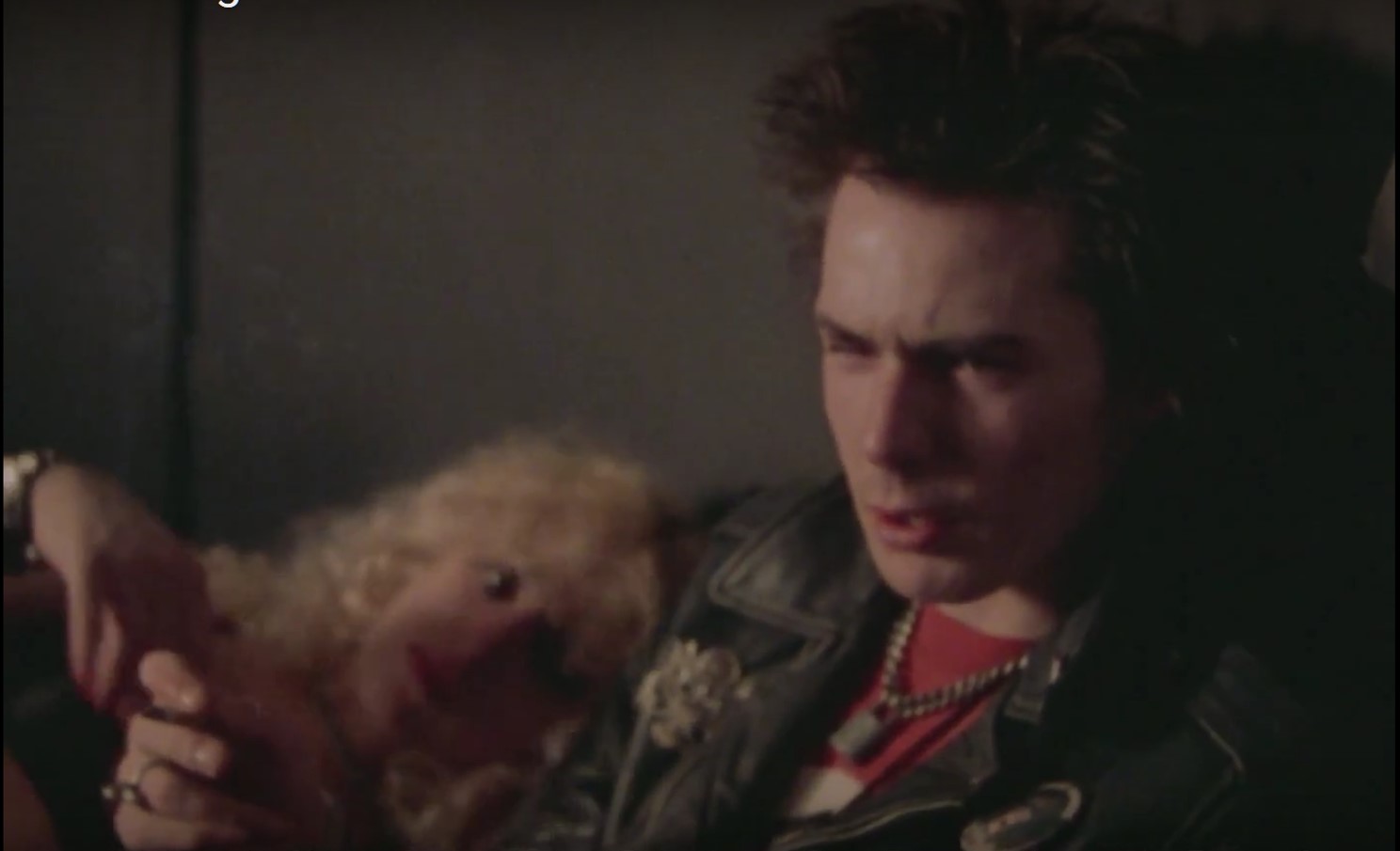
Of
course, the most infamous scene occurs about an hour in: sort of the absolute
antithesis of the John and Yoko Toronto bed-in interview is the Nancy Spungen
and Sid Vicious conversation (such as it is) where Sid is totally nodding off
while wearing a Swastika tee. Nancy’s odd accent that’s a cross between Philly high-line,
New York Lower East Side and London-esque is as disarming and alarming as Sid’s
drug-induced mumbling.
For
the film’s final act, it’s a mix of the Pistols’ last show of the tour and what
came to be their final performance before reforming decades later with Matlock
replacing Sid, the police presence and fans outside the club, and more wacked
out Sid and Nancy at the Chelsea Hotel. This includes the infamous Rotten onstage
comment about “being cheated,” playing over some woman spontaneously pretending
to masturbate for the camera in a totally unsexy, fakey way.
 |
| Terry Sylvester |
The
ending is a nice mash-up of the band playing “Bodies” with clips from all their
American shows melded together. And yet, even though they are the centerpiece,
the Pistols turn out to really not the entire theme of the film, but rather a creamy
layer of the whole cake. One of the points of focus is Terry Sylvester (not to
be confused with the singer from the Swinging Blue Jeans), who was the lead
singer of Terry and the Idiots. Not lasting long, they were pretty
terrible-but-enjoyable; they remind me of New York’s Student Teachers, who were
a better act, and arguably modeled themselves on the Mumps. We follow Terry
around and listen to him philosophize about punk, and tell a very bad joke
based on innuendo that really had nothing to do with the point of the film, but
whatever. There’s also an amusing
interview with New York stalwart Bleecker Bob in his infamous shop (Lenny Kaye
worked there at the time, but you don’t see him). He talks about some bands,
and they pan a bunch of singles on the wall, most of which I own (bought at
Disc-O-Rama, though, not from him).
Worth
it merely for the live band footage alone, but that is only a small helping of
what is good here. Yeah, when it was reviewed by the late-great Lisa
Baumgardner in the pages of FFanzeen back in the day, it was slagged (HERE). I remember it being really grainy and rambling, but I’ve always been kinda fond
of the film, being somewhat neutral on the which
is better front (though not on where
it all started). The current release, however, while still obviously taken from
the print by the wear and tear, it’s much clearer than I remember.
 |
| Lech Kowalski |
The
basic extras are an Image Gallery, the original film trailer, and a trailer for
(I kid you not) the classic Attack of the
Killer Tomatoes, which was put out by the same distribution company as this
one. There is also a nice and thick booklet with photos, and some text by Holmstrom, and a folded film poster.
The
most notable extra is a complete and full-length documentary about the making
of D.O.A. titled Dead on Arrival: The Punk Documentary That Almost Never Was. Put
together by Richard Schenkman especially for this Blu-ray and DVD 2-disc set,
at 115 minutes, it actually lasts longer than the feature it is about.
The
two main talking heads are Punk magazine
co-founder and the key New York Scene illustrator John Holmstrom and Scene
photographer Robert Bailey, both of whom became part of the D.O.A. caravan through the American Sex
Pistols’ tour, and Holmstrom then also continued on with the British phase
after the American leg ended. Others who appear extensively in new material
include (but not only) New Musical
Express writer Chris Salewicz, musician Midge Ure (who was in the Rich Kids
at the time of filming, and would go on to his own cult fame leading Ultravox),
cinematographer Rufus Standefer, and crew members David King (U.S.) and Mary
Killen (U.K.).
Along
with some historical interviews with Malcolm McLaren and Billy Idol that are
included from television shows, one of those in the new segments is Lamar St.
John, the woman who is laying on the ground in the film as part of a group of
teenypunkers from Los Angeles who drove to see the Pistols in Dallas. She’s
also the one who bloodied Sid’s nose.
While
the Pistols’ tour was infamously and covered from the inside with tons of snark
by roadie Noel E. Monk and writer Jimmy Gutterman in the book 12 Days on the Road: The Sex Pistols and
America (1990, Quill/William Morrow & Co.), which is name checked in
this follow-up documentary, the view presented here was more from the outside
looking in, which actually makes it extremely interesting in a whole different
light. They lived in a circumstance of being within the crowd, with near
constant threats of violence from the audience, from the clubs’ personnel, and
even the Pistols’ Warner Bros. team. It’s definitely an interesting bookend to the
Monk self-serving version.
Part
of what kept me riveted is that everyone who discusses the events was at the
filming, giving first-hand accounts of the events, rather than from other
journalists who were told what
happened. John and Roberta are experienced at telling of events of the 1970s,
so this practiced hand keeps off the stumbling around for words or remembrances,
keeping the pace up.
I
especially liked when Holmstrom comments that punk was the last musical form created
totally in an analog world, before digital music and CDs temporarily replaced
vinyl. As a student of media and technology, this spoke to me.
What
makes the film D.O.A.: A Right of Passage
so palpable is that it is not news footage, but rather a group of fans who
put together a film trying to express a positive point. Back then, and I remember
this strongly, most of the media attention was on the negatives, about how punk
would degrade culture rather than put a mirror up to it, as is expressed by the
officials in the U.K. within the documentary. This (and I do believe the
follow-up, modern Dead on Arrival) is
a better indication of what was actually going on in a three-dimensional way,
from multiple directions rather than just pro- or anti-.
Oh,
and Lech? You still owe me the $100 for the full page ad you took out in FFanzeen when this film came out. Just
sayin’…


 Posts

