There
are lots of stories surrounding the making of this important, yet Grade C level
film. One of my favorites – and I am not positing it is true or not – that the
director, Ulli Lommel (d. 2017), was so envious of the love scenes between stars
Richard Hell and Carole Bouquet, that he wrote himself into the plot so
he could possibly have his own chance with her. This jealousy also took
a simple story and flushed it down the toilet as far as plotline quality goes.
Well, to be honest, I have not seen the film since around the time it came out
and saw it at some art house in New York City, so this will honestly be like
watching it for the first time.
After
a brief prologue, we get smacked in the face with the title song, one of my all-time favorites (it’s the Voidoids version, not the original Ork release).
The sound is crisp and clear, but we only get to hear the first two stanzas,
and it fades out after Hell tells Bob Quine to “take it.”
Richard Hell
Richard
Hell plays up-and-coming punk singer Billy. Musically, it’s Hell pure and simple,
no matter what name they give him. He’s vying for a record contract and while in
the recording studio (singing “New Pleasure”). It is there he meets French video journalist Nada (Bouquet), and sparks fly
while we get to hear the complete song. Yay. This leads of a volatile, almost schizophrenically
up and down relationship between the two.
Billy
is quite cynical about the music biz and is trying to figure out his role
either in or out of it, while his long-suffering manager with a thick NYC
accent, Jack (Howard Grant), is trying to guide his career, though the question
is whether it is for Billy or his own financial stake that he is there.
Carole Bouquet
At
some point, German journalist Hoffritz (Lommel) enters the picture as Bouquet’s
former lover who has shown up looking for Andy Warhol (d. 1987), who makes a
cameo in the film. This sets up a dynamic of a “who will she choose?” scenario:
the rock star who wants nothing more to do with music (with no reference on
what he would do instead) or the cynical journalist who is obsessed with
Warhol. While Nana is hooking up with Hoffritz, Billy is with Lizzy (Suzanna
Love), another filmmaker. One minute it’s Billy and Nada, then it’s not, then
it is, then it’s …
Whatever
the weaknesses in the storyline and especially the dialogue, which often borders
on the ridiculous (the “beach” conversation in the car is a perfect example),
this film is a must-see just for the visuals of the gritty New York City of the
late 1970s, including under the West Side Drive, on a rooftop with the iconic
water towers, and especially the scenes in CBGB, which are both a joy and
heartbreaking. [As they scanned the tables, I realized that I have sat at just
about every table there; small digression that has nuthin’ to do with nuthin’:
I was in the hospital having a procedure, and as the doc was getting ready to
give me a huge needle, he said, “think of a happy place, like a beach or a
mountain.” My mind went immediately to sitting at a table at CBGB waiting for the
band to start…] It was also fun to see the backstage (a room I have been in
numerous times) which highlights some graffiti of The Senders. Meanwhile, the
Voidoids (Hell, bass/vox, Quine on guitar, Ivan Julian on guitar, and Mark Bell
– the future Marky Ramone – on drums) get to show off live on CBGB’s stage. Warms
the cockles of my heart. Amusingly, perhaps, there is a scene shot at CB’s of
Nada interviewing a bunch of club denizens (I am assuming they are real rather
than actors), reminiscent of the early Amos Poe film, TheBlank
Generation, reviewed below.
Ulli Lommel, Andy Warhol
There
are lots of cameos by some who were critical and omnipresent to the scene at
the time, such as violinist Walter Steding, fashion maven Natasha, and of course, Warhol.
Bouquet is quite beautiful, and Hell is in his prime
(1977 Big Star magazine interview with Hell from 1977 HERE), (with his original teeth and all). What he lacks in acting talent, he makes up
for in enthusiasm and making some amazing music that helped spark the whole
British punk movement when Malcolm McLaren (d. 2010) infamously ripped him off
from sound to fashion.
Most clips I have seen of the film over the years have
been taken from VHS copies, and were highly grainy (as VHS tends to be), but
this Blu-ray is crisp, as it is a 2K scan taken from the only remaining 35mm print!
That only one survives is something I am both grateful for, and indignant about
its lack of care of the rest of the prints. That being said, for a Blu-ray
release, there are zero extras on this, but I don’t care because the main meat
of the matter, the film itself, is the rightful focus.
Speaking of technology, it is fun to see the state of
art mechanics of the time, such as video recorder cameras that are separate from
the tape deck, dial phones, old cars, and the such.
The biggest problem with the film is that it is
inconsistent to its own theme, jumping back and forth between stories with gaps
in-between that make the viewer feel a bit shell shocked and while it’s not
confusing, it really doesn’t make much sense. I was more interested in the Billy/Nada
relationship, and the adding of Hoffritz
just feels superlative. If the film could have focused on just the couple, with
their ups and downs, it would have been much more interesting. Though the live
music helps, even though there is excessive use of the title cut throughout,
and there is obvious reuse of some shots such as Billy coming up from the CBGB
bathrooms, and of the Voidoids on stage (shown at least three times). I
understand why this film has a rep for being a muddled mess, because on one
hand it is just that, but if you were there at the time, or if you wanted to
know what it was like, this is more an important time binding document than
story.
According
to IMDB, Lommel still presently has projects in works, both as director and actor, 5
years after he has died; his other big success might arguably have been The
Boogyman, a film he directed that came out the same year as this release.
His later works seemed to rely on stories of real serial killers.
This
film documents, what it calls, the birth of punk rock in New York during the
early 1974-75 CBGB (mostly here; closed 2006 and is now a clothing store) and
Max’s Kansas City (closed 1981 and is now a deli), with some shots from other
venues such as the Bottom Line (closed in 2004, and is now a student’s residence
for New York University). But in some ways, it overlaps with its own midwife,
but more on that later.
The film is jumpily shot by Patti Smith Group
guitarist Ivan Kral on silent 16mm, and is then audibly superimposed by the
sounds of the band’s recordings, either legitimate releases, demos, or live
cassettes.
The premiere of the film was held in CBGB,
when the stage was still on the left side, so needless to say in all the CBGB
footage in the documentary, that is where the infamously (and hotly debated) Television-built
stage was located. It is nice to see the huge photos sans stickers and band
graffiti that would eventually cover them up in the 1980s and ‘90s. The band
that played the night of the opening was the Heartbreakers, with Richard Hell
still a member. I saw the Heartbreakers so many times on stage, but that was
the only time with the Hell line-up, before Billy Rath replaced Hell on bass), and
Johnny Thunders and Walter Lure moved to the front permanently out of Meyer’s shadow.
The Patti Smith Group
The film is broken up, essentially though not
officially, into three chapters. The first one is the “birthers of punk,” for
lack of a better term, starting with The Patti Smith Group performing in various venues (as is true with most of the bands) to the
soundtrack of “Gloria (In Excelsis Deo)” off the Horses album, followed
by a live version of “We’re Gonna Have a Real Good Time Together.” It would
make sense to start off with her group since they were considered the first
“punk” band to be recorded…though I do wonder who filmed the footage since not
only was Kral in the band, but there are shots of him playing. Anyway…
The Ramones
Other major bands flow into each other
visually, with the songs starting abruptly. That’s no issue at all, though I
thought it would be good to have some kind of crawl that said which band was
which, rather than just waiting until the end credits. But that’s punk, do
what’s unexpected, right? Patti flows into Television’s “Little Johnny Jewel (Parts I and II)” (with a shot of Terry Ork for good
measure, who released the single on his own Ork Records), and then to theRamones playing over only live recordings as their seminal eponymous album had not yet
been released. It was interesting to hear them doing a song that would show up
on their second album. Then there are the likes of Talking Heads.
Wayne County
The second section is the next level of bands,
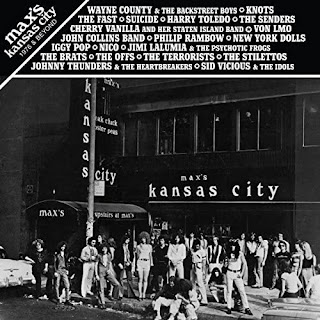
or first-level Max’s groups, such as the trendsetting Wayne County, The Miamis, Harry Toledo, the Marbles (one of my favorites back then, doing almost a music video), the Shirts, and Tuff Darts (with Robert Gordon).
The third is an odd mix of non-venue related
footage (though the music concept stays the same) of bands such as backstage.
There is also the post-Thunders/Jerry Nolan New York Dolls that focuses only on David Johansen while “Funky But Chic” plays, and there is the Hell version of the
Heartbreakers to end it with the title song. The Dolls were kind of the midwife
to the New York punk scene, and the Hell version of the Heartbreakers almost
the transition into the now more infamous version of the band.
I’m proud to say I have seen all of these
bands perform live save two (Miamis and Tuff Darts, though I did interview the founder
and lead guitarist, Jeff Salen). When I first saw the film at its premiere, I
was a bit flustered by the dissonance between the footage and the sound, but
over the years, I have come to admire it. Many of the songs are not shown all
the way through (cut short or edited), but it just means more songs. The film
is a treasure.
When I started
to collect pieces for the second issue of FFanzeen, I decided to begin with
a band I enjoyed: The Marbles were an amazingly entertaining band. Their sound was
a unique combination of power-pop / rock’n’roll that they made their own.
I was a fan of
the group and saw them often, sharing bills with bands like Television, Mong, the
Mumps, and Milk & Cookies (another personal power pop fave). And yes, they shared
the bill with the infamous CBGB AC/DC show, which was Bon Scott’s last New York
performance, to which I was present (the enclosed pictures by me here are from
that night).
The musicians had
similar pageboy hairstyles and looked very boy-next-door, in fresh pressed white
shirts and slacks. Their main power lay in their songs, which were hard-hitting,
killer pop tunes, fueled by Howard Bowler’s lead guitar and bolstered by Eric Li’s
keyboard. This is evidenced especially in their first single, on Ork Records, “Red
Lights” b/w “Fire and Smoke” (“Red Lights” was also included on ROIR’s excellent
Singles cassette collection). Eventually they would come out with another single,
“Forgive and Forget” b/w “Computer Cards.” Unfortunately, these two 45s represent
all the existing officially released catalog of the Marbles. What happened to the
tapes they refer to in the interview following is a mystery. According to their
ex-manager, Alan Betrock (d. 2000), they no longer exist. It’s a shame, because
they had some killer tunes, like “Closing Me Down,” “She’s Cool,” “Jealousy,” “She’s
Pleased,” and especially the bouncy “You Tomorrow.” Live versions of many of these
songs can be found online. After all this time, I still remember the tunes to many
of these songs. Despite being a pop band, they also had a snotty attitude, which
help them fit into the scene.
I was fascinated
with Jim Clifford’s bass, and bass playing style. It was Clifford’s bass that made
me first notice the Rickenbacker brand. I couldn’t figure out how anyone could play
a bass with a neck that long. I was also amazed at his technique, which I have rarely
seen since. Rather than just bending his wrist around the bass and curling his finger
to play the frets, his wrists were turned at an almost ninety-degree angle so the
fingers were nearly straight. I tried duplicating it, but couldn’t come close.
This interview
was published in FFanzeen No. 2, dated October 31, 1977.
The Marbles – For Rockers of All Ages
The Marbles are really one of
the better bands around now-a-days. I have been a fan of theirs for a few years
now and have caught their act whenever I could. Recently they went on vacation.
When they left, they were very good, but now, they are just great. I had to interview
them, and below is the outcome.
It was a hot night when I visited
the Marbles’ loft, that last day of August 1977. The entire band, Howard Bowler
(guitar, vocals), Jim Clifford (bass, vocals), Eric Li (keyboards, vocals) and David
Bowler (drums, vocals), was present:
FFanzeen: How did
the first single (“Red Lights”) sell? Jim Crawford: There were 1,500 copies made at
the most, and they all sold out.
David Bowler: We’re negotiating for a re-pressing.
FFanzeen: How did
Terry Ork [d. 2004] approach you to do the record? Jim: Over a joint.
David: He got us our first gig at CBGB on the same bill as the Ramones. And I work
at Cinemabilia [with Ork]
Howard Bowler: He likes the band. He wanted to do a single … and he was picking
bands he wanted to record. He started with Television [“Little Johnny Jewel, Parts 1 and 2” – RBF, 2022]. The second was …
Eric Li: Hell. Richard Hell [“Blank Generation”
b/w “Another World” – RBF, 2022].
David: Then we came out.
Jim: Then he went berserk.
Howard: And we haven’t seen him since [laughs].
FFanzeen: His next
single is going to be with Teenage Jesus and the Jerks. [Note: either this
never happened or was not released – RBF, 2022] Jim: Yeah? The New Wave bands have to make a splash
with the critics.
FFanzeen: Are you
satisfied with the single? Jim: No. The master recording we did for Terry
Ork was very clear; you could hear every instrument. You could hear the vocals:
... We’re satisfied with our performance on the record. There’s a lot of energy
on that record, but as far as the actual pressing and mastering of the record, it
was done – well, face it, Terry Ork doesn’t have that much money to work with. He
tried the best he could but with the things he was using, the best is very sub-standard.
Plus, this was one of the first recordings he put out, so he was still experimenting
with different pressing companies. And unfortunately, the ones he experimented with
us were really crummy. I mean, the first press cuttings of the single came back
and it wasn’t even printed on the record straight. You’d put on the needle and it
would speed up and slow down. It wasn’t on the central axis. The second one had
a skip on it that was printed on the record. And five test pressings later, we finally
decided to just go ahead with it. The third test pressing sounded like there were
five thousand mosquitoes in the room. We were not satisfied with the sound quality,
but we were satisfied with the energy. We like the record. The songs come through
anyway.
Eric: After the last pressing, we just got so disgusted we just said, “Go ahead
with it,” ‘cause it was just taking so long.
Howard: We had planned to release it in September, and by the time we were finished,
it was January when it was released.
David: Now it’s over a year old to us and we know we could do it better.
Jim: Anyway, we’re gonna put out a new one now.
Eric: That’s the main thing.
Jim: I don’t know if it’s gonna be by Ork or not, but we’re going to record a new
single, “Free World” and “Love Today.”
FFanzeen: Are they
new songs? Howard: No, they’re about a year old now, but
they’re very mature, and ripe for recording them. One of the songs is sort of a
political statement, “Free World.” “Love Today” is, well, a love song about “every-man.”
Jim: It’s a revolutionary single. You have never heard a single like this.
David: Next question.
Eric Li (ffoto by Robert Barry Francos)
FFanzeen: I was
going to ask if you were satisfied with the way Ork promoted the single, but … David: He didn’t do any promotion, so we’re very
satisfied.
Eric: We did about what we expected.
David: No, really. He told all his friends.
Jim: Well, actually, they sold out so we can’t be unimpressed. He only pressed 1,500
copies, and the fact that it was an Ork record and we were a part of the New York
rock scene. We were just so disappointed in the sound quality, that before he printed
any more, we wanted it pressed at a different place. He has to come up with the
money to do that before we’ll go ahead with it. (We) want to do it, but it’s just
a matter of getting the monkey wrench out of the works.
FFanzeen: Was “Jailbait”
recorded at the same time? Howard: Yeah.
David: There were two others. “From Me For You” and “Closing Me Down.” All recorded
at Douglaston.
FFanzeen: Will
you release those? Jim: No, actually those will be burned.
Eric: We’re thinking of changing the B-side to “Jailbait.”
FFanzeen: When
was the last time you played together publicly? David: Our last New York job was four months earlier.
Jim: In May
Howard: We took a summer break. We went to Minneapolis. And we played there three
nights.
David: It was great. Parties every night. Encores every night.
Eric: Unqualified success.
Jim: Everyone liked us a lot.
Howard: The bar owner there did the best he had ever done, and they want us back.
That’s part of this tour. The reason we set up this tour is because we did so well
in July when we played there and he asked us back in October, and we figured if
we’re going out there in October, this time let’s make some money, so we want to
have jobs stopping off in Cleveland and Ann Arbor. We have connections for a few
jobs on the way out and hopefully on our way back. And we’ll be playing. That’s
another thing.
Eric Li, David Bowler, Jim Craford, partial Howard Bowler (ffoto by Robert Barry Francos)
FFanzeen: Did you
enjoy your vacation? Eric: Oh, yeah!
Howard: It was great.
FFanzeen: Why did
you take a break? Jim: Because we couldn’t get a job in New York.
Summer in New York is so hot, and Hilly [Kristal, of CBGB] at that point was not
really excited about hiring us. We didn’t want to play at Max’s because – eh – we
just didn’t want to play there. And the summer here was just very dead.
David: We had to get our heads together.
Eric: We just wanted a break. We needed a vacation and it was really fun.
David: We kept on rehearsing, we worked on our material, and we were going through
managerial problems that was taking up a lot of our attention.
FFanzeen: That
was Alan Betrock? Jim: Boy, you leave no stone unturned. Next question.
FFanzeen: How did
you get to play at the ECHO convention (two years ago)? David: Our first manager [Betrock] got us the
convention. Next question.
FFanzeen: OK, I'll
pass on that one. Never let it be said I couldn’t take a hint. Jim: He’s a fine rock writer.
FFanzeen: What
do you call what you play? Jim: Music. Definitely music.
Howard: Noise with a sprinkling of screaming. No, I call it Alfred.
David: Marbles Music Mania.
Jim: It’s hard to classify us. We’re somewhere between AM and FM, whatever that
means.
Howard: Nirvana.
FFanzeen: What
do you think of some of the other New York bands? Howard: We like the Mumps. I like the Heartbreakers.
I like the Voidoids, despite their music. I used to like Television. Blondie’s gotten
better. Patti Smith is dead. She was great.
Jim: That about covers it.
Howard: You see, the bands that we listen to are not the so-called New Wave bands
that have cropped up in the last eight months. Teenage Jesus, the Cramps. They’re
just awful. There's a fundamental philosophy that if you get on stage with an instrument,
you should know how to play it.
Jim: I just find it boring. I have no place in my mind for the thoughts those people
have.
David: I mean, what does it mean to be “cramped?”
FFanzeen: If you
had a choice, what band would you choose to play with? Jim: Marbles and Mumps are the strongest. Actually,
the Rolling Stones.
FFanzeen: What
are your ultimate goals? Jim: To be the first rock band on the moon.
David: First goal is Number One single, ten gold albums.
Jim: Right now, my ultimate goal is to have enough money to buy a TV set. We’d like
to tour Europe. I don’t know. Just to be rich and famous. To have fun. Pleasure.
Eat a lot of beans. I want to be a major political force: ... for the youth of America.
We want to lead America out of the depression. To give people something to believe
in again.
David: We want to put rock music back on the map.
FFanzeen: What
kind of fan is a Marbles fan? David: Beautiful. Female. Eighteen.
(At this time, Jim got up to
show me something and accidentally knocked my tape recorder off the table, and being
consistent, my tape recorder stopped taping).
The publishing
of this interview, in part, may have led to the dissolving of the band. At a time
when CBGB and Max’s were the two key places in the city to play, the Marbles were
considered a CB’s band. And from this interview, you can tell that not only did
they insult Max’s, they were not on Hilly Kristal’s A-list either. At the time this
interview was completed, the Cramps were CBGB’s Number One house-band. A week after
this issue came out, the Marbles were booked to open for, who else, the Cramps.
The story I heard is that when the Cramps read the interview, they told Hilly it’s
“them or us.” Of course, Hilly went with the money (who wouldn’t) and blackballed
the Marbles.
Having burned their
bridges with Max’s, there really was no decent venue for them, and they could either
move out of the city or dissolve. For a long time, I felt guilty for printing their
comments about the Cramps, but in retrospect, I did not ask the Marbles about specific
bands, they spoke up voluntarily, and on the record.
The band was very
antagonistic in the interview. They were fresh and just back from vacation, excited
about their material, and yet they were bitter about the whole scene. Others who
have worked with Terry Ork were disappointed in his production, management of the
promotion, and especially his handling of the cash, so that’s understandable. David
told me years later, with some chagrin, that they were “young and arrogant.”
After Clifford
left the band (he became a teacher in Minneapolis), they broke up, and then reformed
with the late Richie Lurie (who would eventually join the Waldos with brother Walter
Lure), calling themselves the Volts. I had the chance to catch them on February
13, 1981, at the long-since-gone Botany Talk House (Sixth Avenue and 27 Street).
When that ended,
as David later explained to me, “Eric, Howard and I formed a production company
called Atomic Records, and began writing and producing records for other artists.
In 1988, we had a number one dance record with Denise Lopez, whom we had signed on to A&M. During this time, unbeknown to Howard and me,
Eric developed a drug habit. Our record actually went Top 40 with … Denise Lopez,
and we did two LPs for A&M Records [Truth in Disguise in 1988, and Every Dog Has Her Day in 1990 – RBF, 2022].
At any rate, Eric didn't show up at rehearsal for a few days and we knew something
was up. So, I went to his apartment and found him. He'd been dead about 2 days.”
In the early
2000s, the Bowler brothers formed a new band called Contraband, leaning more towards
a roots/folk rock sound. I have since regained contact with them and have even taken
some publicity photos, including one that is incorporated in their second CD.
The core of The
Fast, previous to when this interview was conducted, consisted of the three
Zone brothers from Brooklyn, Miki, Paul and Armand (aka Mandy). Miki Zone was
the leader of the group, writing the songs and playing a wild guitar. With dark,
spiked hair and pencil-thin mustache, Miki Zone drove the band, with flourishes
that would have made Pete Townshend proud; he used pencils and other-purpose
implements as picks, to achieve new and strange sounds. Paul Zone had long hair
consisting of rows and rows of tight curls and movie star good looks. Mandy
Zone, who played keyboards, usually sat in the upper left corner of the stage,
with Phantom of the Opera type dark clothes. His falsetto background vocals
helped give the band their distinctive sound.
And then, just
as Dylan had gone electric, The Fast decided to go metal-lite. Armand left to
form another band called Ozone, and Miki and Paul went all-out leather. The
biggest physical shocker was Paul cutting off his idiosyncratic locks. One had
the feeling The Fast were just tired of playing and not really getting anywhere
out of Brooklyn. They decided to overhaul their sound. You can hear it in the band’s
two versions of their song, “Kids Just Wanna Dance.”. Occasionally changing the
band name/brand to Miki Zone Zoo didn’t help.
My then-Managing
Editor, Stacy Mantel, arranged for this interview, and so she came along and
therefore became an integral part of it. The intro, however, I wrote. It was
published in FFanzeen, Issue No. 5, dated August-September 1980). – RBF, 2022
Kids Just Wanna Hear The Fast By RBF and Stacy Mantel; intro by RBF
There it was, almost eight
o’clock in the evening on May 19, waiting to be picked up by Miki and Paul
Zone, the lead guitarist and vocals, respectively, of The Fast, one of the
premier rock’n’roll groups that have been around since the early days
(pre-1975), when the new rock’n’roll sound was known as “underground” and punk
as we know it didn’t yet exist.
The first time I had seen The
Fast was at a free concert they gave in Prospect Park (Brooklyn, where we all
live), Summer of ’74, before Paul was in the group. Their songs included the
“Batman Theme” and early Who stuff. Years passed and they added Paul and started
playing at Max’s Kansas City and Rockbottoms. They went through a phase known
as “super-pop,” but were unsatisfied with that sound. Eventually, brother Mandy
(keyboards/falsetto) left to form his own group, Ozone, and Miki and Paul went
“hard.” It took a while to get used to – and now their first album is coming
out on Sounds Interesting Records, a label formed by Charles (Record Raves fanzine) Lamey – but that’s another story.
As we waited, there was a
tension in the air. FFanzeen’s resident record reviewer Richard Gary had semi-panned the last Fast
(Miki Zone Zoo, actually) single, “Coney Island Chaos” b/w “These Boots Are
Made For Walking,” and we did not know what would be their attitude toward us.
Eventually their van pulled
up and we climbed into the back. We stopped off to buy some beer and pulled up
along the service road to the Verrazano Bridge, between 86 and 92 Streets, and
drank and talked. And it went like this:
FFanzeen: Tell
us a little about the album. Miki Zone: It’s done and it’ll be out in
July. One side was produced by Ric Ocasek [The Cars; d. 2019] and the other
side is produced by Ian North (d. 2021) of Neo [also of Milk
and Cookies – Ed., 2022]. It’s going to be on Sounds Interesting Records.
FFanzeen: That’s
an independent label. Miki: Yeah, and it’s the way we want to go at
this point. It’s the best way. I’m in total control of the sleeve, total
control of the recordings which I’ve produced, control over where I want it
sold, how much I want sold, everything – even as far as where I want it
distributed, what countries. At this point it’s cool because I can make a lot
of money on it whereas if I was at a record company, I’d just be selling
everything away.
FFanzeen: The
album’s been done for a couple of months now. Miki: The stuff we’ve done with Rick Ocasek. That
was done in December.
Paul Zone: We did everything in December, except it’s going to have the “These
Boots Are Made For Walking” 45 on it that we made over a year ago, and all the
rest of it is “Cars Crash” and two new tracks than the old “Boots” single. So
that’s six songs.
Miki: We had a tune on Sharp Cuts (compilation) on Plant Records [Elektra Records]. One of the tracks
that’s going to be on our album is on the Planet Records compilation LP that
Ric Ocasek produced, “Kids Just Wanna Dance.” We did a version of that with Ric; this is a new version of it –
today’s Fast version. That’s out now and it’s getting a lot of airplay in a lot
of cities, even New York.
Paul: WNEW’s playing it.
FFanzeen: How
did your involvement with Ric start? Miki: He came to see us at
a club in Boston – he didn’t really come to see us, he came to see a band that
was on the bill with us, and when the night was over, we had a date to play
with them in a 20,000-seat auditorium and he offered to produce an album for us
– and this was all in one night. Paul: Just from seeing one show at a small club. We played with the Cars on
Halloween at that 20,000-seater in Portland, Maine.
FFanzeen: How
were you received? Paul: All of The Cars were on the stage
watching us after the first two songs, not believing it, because every band,
with or without albums – name groups – were booed off the stage, and we did a
45-minute set and went down really well. By our second or third song, they were
all in the wings watching us ‘cause they were flipping that we were able to
pull it off for our first time at such a large place. We just did a concert up
in Toronto with Mi-Sex. We do real well up there, like club dates. We sell
advance tickets ... A lot of our friends had albums out and then the record
companies sent them on tour and after their first tour they either broke up or
had nervous breakdowns ‘cause they really weren’t used to it – they didn’t know
what it was like to go out and struggle in all these little clubs.
Miki: That’s also an advantage where doing it ourselves is concerned ... where
the album sales are the best is where they’ll go and play more often and that
will be an easier thing for us to do, so we’ll have proof that there’ll be an
audience for us and we’ll just zoom out there and do a show.
Paul: Two years ago we played in Washington, DC. with the Police and there were
50 people there three nights in a row.
FFanzeen: As
long as I can remember, you’ve had this big cult following. These Long
Island/Queens girls would stare and swoon. Miki: You see, that was like a different
stage for us. In ’75, the band was different then it is now. Then we had a
couple of weird looking people in the band.
Paul: Now we still can’t realize what we’ve got.
Miki: We had so many crossovers of images that we were attracting different
audiences, like young girls, people who came for crazy guitars, and we still
maintain that image today. The reason we benefited by changing around The Fast
today is that the music is better. I haven’t changed in two years. It took me
this long to find a band I was happy with. I realized that I didn’t want to
play with a keyboard player, that had to come out of me. Not because he was my
brother.
Paul: It just wasn’t right for the sound.
Miki: Right. The songs that I was writing, certain sounds I was hearing, were
too much for keyboards.
FFanzeen: On
stage, you have changed a lot – like Paul used to have long hair with those
amazing curls, and Miki’s hair was forked. Miki: So many people would just look at us
and say, “What the hell is going on?” like we were the rock’n’roll Village
People because everyone was so totally different.
Paul: We didn’t plan on anything; I guess it’s just what happened, as we are
now. We didn’t go in for thinking of things, things just came natural; the way
we acted on stage and looked. We just act as we are personally and visually,
and maybe enhance it a bit. We don’t go out of our way; it’s just not
comfortable.
FFanzeen: I
realize this is not a very intellectual question, but I’m really curious: Paul,
why did you cut your hair? Paul: I just got tired of it. I didn’t like
it any more.
FFanzeen: Miki,
your guitar style is very varied, ranging from very rock to avant-garde. Who
are your influences, if any? Miki: Pete Townshend – not today, but up to
about 1970. He, at that period was, like, my mentor, but not like anything after
late ‘60s because what he was doing with guitar then was not really playing –
he was playing it like a machine, playing the electronics of it, getting sounds
out of it that Eric Clapton never could have gotten. That’s why when we do
extended things on stage, I’ll play every piece of the guitar and get as many
sounds out of it without even using the fret board.
Miki (ffoto by Robert Barry Francos)
FFanzeen: Pencils. Miki: Ha, yeah, pencils or feedback – you
could do such amazing things. We have a couple of tapes of live performances
and I didn’t even hear those sounds when I was making them on stage. It sounded
like a plane or something and I said how it’s great that you don’t know where
it’s coming from but you’re making it. Coming out of your guitar and amp put
together. That’s where guitar could be as revolutionary as synthesizer, if you
just take it that far and not play it as a conventional instrument.
FFanzeen: Isn’t
“Cars Crash” done with synthesizer? Miki: No, it’s guitar. I’m using some phasing
on it, which I have in my amp, and everyone asks us who’s playing synthesizer
and it’s totally guitar.
Paul: Queen never used synthesizer, it’s all guitar and you’d never know it if
you listen to Queen albums.
FFanzeen:
Isn’t it done with the aid of the mixing board in the studio? Miki: No, it’s just if I layer or overdub
certain parts over each other, it doesn’t even sound like guitar after a while.
I like to do things where the voice comes in and matches with the guitar and
you don’t know what’s what, and there’s a part in “Boys Will Be Boys” that’s
like that. This new single, “Cars Crash,” I’m playing the guitar in a different
way than I do live for the first time. It’s very spacey and danceable. We just
wanna do something different.
FFanzeen: So I
guess there’ll be no more go-go dancers. Miki: Ha-ha, no, that’s not true. I mean,
there’s so many things we got to say. I’ve got a backlog of material that The
Fast did years ago that just had to be shelved because I was writing so much
new stuff. All that will be out eventually.
FFanzeen: Who
writes most of the lyrics? Miki: I write all the music and lyrics. The
only thing I’ve ever co-written with anyone was this last single with Charles
Lamey (“Cars Crash”). I agreed to write a couple of songs with him because I
like the lyrics that he writes, so I put music to them and it worked so well
that we said, “Let’s do a single,” and then from there the whole album stemmed.
Paul: I’m the interpreter.
Miki: After the year’s end we may probably have a 12-inch live EP. You see,
that’s the thing about independent labels. Whatever I think is a good idea they
think is good and they‘re just as into it as I am. The big money isn’t there,
but a lot can be made.
FFanzeen: Aren’t
you afraid of producing “culture shock” with people expecting to come in to see
the old Fast? Miki: No, because they’re never disappointed.
All they find missing is the keyboard. What we lost in a keyboard and
high-pitched voice, we gained in different songs and in different live
presentations, which is a lot more forceful and gutsier – what The Fast should
have been all along. We didn’t lose any of our visual things.
FFanzeen: On
stage, you said that heavy metal will make a comeback. Did you mean that or was
it said because of the way the song was going? Miki: Ha-ha, well, I don’t know ...
Paul: I guess it was the way it was going. Heavy metal is very big in England.
Miki: Yeah, that’s kind of why I said it ...
Paul: Listen to Blondie’s “Hardest Part” – it’s as heavy metal as you can get. Heavy
metal and pop is the result of “power pop,” which everyone’s been using for a
while. It’s just harder sounding pop songs.
Miki: There’s a lot of things we do that I would consider heavy metal that we
do live because there are some things that I would like to hear heavy. There
are just some things that I don’t want to hear harmonies and “la-la-las” with.
FFanzeen: You
were talking about your influences ... Miki: Yeah, beside Pete Townshend and the
early Who, next has to be early Alice Cooper, even though what he’s doing today
– his new record [Flush the Fashion] is great. I think it’s smart of him to get contemporary – Love It To Death, I was totally blown away by. That and, of course, the early Stooges. I
like people in their initial years – that’s when their best stuff comes
shootin’ out. If you can follow that stuff, great.
Paul: Iggy isn’t famous now for the stuff he’s putting out now, because the
records he’s making now really aren’t that great. The only reason he’s big now
is because of the things he’s done with the Stooges.
Miki: It’s always that way. We used to listen to a lot of pop. I like to listen
to a lot of vocalists, too. I like Gene Pitney. [Miki would
later go to perform Gene Pitney solo shows; see HERE – Ed., 2022]. He’s my idea of pop. No one will ever be able to put that stuff down. At one
point, rock’n’roll was just one sound you heard on AM radio – WMCA was the Good
Guys – that’s what rock’n’roll was. And whatever you heard there would
influence everybody if you were a certain age at that time. Now you just have
to go and decide what you want to hear, from reggae to hardcore punk to
whatever, country ... I don’t put any style down, it’s just that there are so
many different categories where people are taught to be enlightened to it.
Paul: Like New Wave, anything is really New Wave and every other New Wave
artist that’s making it is just taking an old style and reworking it. The
Police and Joe Jackson are taking every old reggae riff there was and they’re
New Wave now. You’re New Wave if you have a nice sounding pop record – that’s
New Wave: Blondie, Linda Ronstadt ... It’s just really strange, like anything
that comes out now in the ‘80s is New Wave.
FFanzeen: Can
you tell us a little about the band before Paul joined? Paul: They were just a band for about two
years and that was it. I was too young to be in the band then.
Miki: I guess the band was first conceived in 1973 where I’d be sitting in
school and failing everything because all I would think about was having my own
group, and it came about because I was influenced by all the groups I mentioned
before. I just put together friends I went to high school with in Brooklyn ...
we’d do “Batman” and we’d dress in polka dots and stripes and do things like
throw Cheerios boxes all over the place.
FFanzeen: The Speedies do that now. Miki: Yeah, I wonder where they got it from?
Paul: I wonder where they got their name from?
Miki: We’d just throw Cheerios and use fire extinguishers, and every song would
be a “la-la-la” in it. That’s when we were set up like we are now. There was
still no keyboards – just guitar, bass, drums and vocals, and we’d have, like,
two stacks of amps behind us painted with arrows. I didn’t even take them
seriously when I look back. I don’t even remember having a real guitar until
maybe 1974, when I finally bought a real amp, real guitar, and took myself
seriously. But the two years from 1974-76, we started playing New York clubs. We
were one of the first groups to play. It was like Wayne County, us, Teenage
Lust. Blondie wasn’t even around as the Stilettos then.
Paul: It was just like, The Dolls, the [Forty-Second Street] Harlots.
Miki: Maybe Suicide ... and we’d play the Coventry, any place you could play. You’d
either play at a loft party or you’d rent your own place out. Clubs wouldn’t
book us then, any group then.
Paul: All there was, was a place called the Mercer Arts Center and Max’s.
Miki: Max’s, which didn’t have anything except label acts that would attract a
huge following.
Paul: Max’s used to have Bruce Springsteen, Sparks, Aerosmith, the Stooges.
Miki: This was late ’73.
Paul: They didn’t have, like, rock’n’roll – I guess you’d call it Glitter Rock,
except the Dolls, and of course the Dolls were number one – the biggest thing,
locally.
Miki: The thing that really started it all, of course, The New York Dolls and
their popularity, and then everything started bursting open. The Hotel Diplomat
would be able to rent you out a ballroom to have your own shows, like three or
four bands together that would spring up overnight like they do now.
Paul: It’s just like, the Dolls were just kids that didn’t know how to play
their instruments. And once everyone started going wild over it, every other
person in the world wanted to be in a band.
Miki: We formed after seeing the Dolls.
Paul: Just like thousands of bands formed after seeing the Ramones.
Miki: Exactly ... and we played Max’s for a while, and then a guy took us into
the studio to record like an album’s worth of songs in late ’75, and while we
were in there recording we decided to let Paul become the lead singer because
he was just as popular as the rest of us because he was always seen with us
so...
Paul (ffoto by Robert Barry Francos)
FFanzeen: So
this is your first band. Paul: Yeah, when we played at Max’s, our
first show, I was only eighteen.
FFanzeen: A
lot of people thought you were in the navy, because of “Boys Will Be Boys.” Paul: I was in the navy, for three days; I
got a dishonorable discharge.
Miki: Ha, and then we recorded this whole album’s worth of material, which
“Boys Will Be Boys” came off of, the Max’s version [Live at Max’s,
Vol. 1]. The rest of it got canned.
Paul: Except, “Wow, Pow, Bash, Crash.” Someday it will be on the “Long Lost
Fast Album”. I have demos that big New York bands did before they got their
deals, like the Ramones, Blondie.
FFanzeen: I’m
surprised; you were so popular, that a major label didn’t sign you. Paul: We had all the offers also, and we
weren’t going in any good direction. We weren’t really happy with the band. Everybody
liked us but we knew something was wrong with the sound. We made that “It’s
Like Love” and “Kids Just Wanna Dance” single and it just didn’t spin our heads
around; we liked it but we knew we wanted to do something different.
Miki: You just can’t keep it going if there’s clashing in the band. Now, these
members of The Fast [Miki Zone, guitar;
Paul Zone, lead vocals; Louis Brian Bova, bass/vocals; Joe Poliseno, drums], we work together as one, musically and personally; we don’t have any
management problems so everything we’re doing now is coming totally from us,
even negotiating our record contract and putting out our albums; it’s just down
to what The Fast believes – we have nobody telling us what to do. We get
references and help from people, but it comes down to us in the end. If we fail
we don't have anyone to blame but ourselves, and if we succeed it will be all
ours. We’ve seen all our friends make it.
Paul: Experience in the music, too. The different versions of “Kids Just Wanna
Dance” is like day and night, really.
Miki: Sometimes I wish that [first] version didn’t exist, but I wouldn’t be
here now if it didn’t.
Paul: We’re not gonna put it down.
Miki: I’ve changed my style of writing, because being that we played so much
live in the last two and a half years all around America and played in front of
every kind of audience.
Paul: It’s not like New York.
Miki: No, not at all. Everyone dances from the beginning to end of your set. If
they’re not out on the dance floor after two songs, you know you’re not going
to get anywhere.
Paul: Just recently, all that started in New York with Heat and Hurrah and Club
57, but about two-to-three years ago at CBGB or Max’s, no one would ever think
of dancing. But we were playing Philadelphia and Boston, and they had dance
floors right in front of the stage and tables all the way in the back.
Miki: And people don’t look at you when they’re dancing.
Paul: They’ll watch for the first two or three songs and then it looks like a
movie from the ’60s where everyone grabs each other’s arms and runs to the
dance floor.
Miki: At first, I thought it was weird. I thought that they thought we must be
the ugliest band they’ve ever seen, but then you realize that they’re just
going crazy ... New Wave is everywhere now, it’s happening in every city.
Paul: You go do a discotheque in Arizona and you’re gonna hear the B-52s.
FFanzeen: Why
did Armand leave? Miki: We made an amicable split because he
wanted to do a lot of writing.
Paul: He wanted to have his own band, to sing and write his own songs.
Miki: He’s got his own band now called Ozone. So, it’s cool, you know, spread
the family out.
FFanzeen: Any
more at home? Paul: Ha-ha, there will be someday.
FFanzeen: What
happened with the Miki Zone Zoo name that you reverted back to The Fast? Miki: I wanted to put out a 45 under my own
name. It just showed people who was behind The Fast, which I wanted to see
happen. If I called it The Fast featuring Miki Zone, it would have done the
same job.
FFanzeen: What
I think is strange is that you have such a big following and you have had very
little written about you. Miki: I’m not really worried about what a
critic has to say about my music. It could destroy a lot of people and it has,
I think that if we were to put out an album when we had a lot of prospective
offers, if we didn’t fuck it up management-wise, we would have had a very
credible relationship with the press, and people taking us seriously.
Paul: You can never boil it down to people taking you seriously. The Cramps are
on the cover of Melody Maker every other week. Do people take them seriously? Yeah ... I guess they
do.
Miki: I’m just glad to put out records. We should have had a record out (every)
year from ’77 on, and we didn’t. This is the first Fast record since 1978, and
at the rate we’re progressing, we hope to have something out every three or
four months. In a lot of places we play at, we’re not The Fast from ’76, we’re
just a New York band they’re happy to see and that’s the neat thing about it. A
lot of people heard “Boys Will Be Boys” and know us because of that. A lot of
feedback came to us from Europe. We may go there in September to do a tour with
Jayne County, and the promoters all know us from “Boys Will Be Boys,” and they
said it will be great. A lot of groups got their names known from just one
song. It should be out on an album and it possibly will be. We’ll make the 1980
version of “Boys Will Be Boys.”
FFanzeen: Every
fifth record will be “Boys Will Be Boys.” Miki: Ha, different ways.
Paul: Electronic.
Miki: Ha, that’s a good idea.
Paul: A cappella, country-western ... reggae.
FFanzeen: Did
you ever think of working with video? Miki: We did a video for our last single,
“It’s Like Love.” Full-color, animated, it looked like something from “Wonderama.”
It looked like the ultimate cartoon-pop group.
Paul: It’s way before anyone did any sort of comical video – way before Devo or
anyone. If you would see the old Fast one, you’d flip. It never got released,
though.
Miki: We’re going to put it on cassette and have it shown at places like Max’s.
Paul: It will flip people out because it was at the peak of the wildest looking
Fast you could imagine.
Miki: It’s wild. I’m wearing yellow rain-boots up to here, big double neck
guitar, and my hair is green and there were no amplifiers.
Paul: It was done in a large TV studio and each member was on a big block
platform with no microphones, all lip-synched. And there’s acting in it,
cutaways to people riding horses. Donna Destri’s in it. We like to use our
associates. She sings on “Cars Crash,” too. [Note: Video
is at the bottom of the blog – Ed., 2022]
FFanzeen: Since
you’ve been through so many changes, how, if at all, do you think your music
will change in the future? Miki: Whatever I do in the future I want to
do in this format – guitars, bass, drum and vocals.
Paul: When people listen to “Cars Crash,” they’ll say it’s not us. The tapes we
did with Ric Ocasek are great; he caught whatever we were live and put it down
and polished it up. We didn’t go into the studio for five months to arrange
every little piece.
Miki: He said we sound like the early Stooges if they knew how to play.
Paul: He had a lot of tricks up his sleeve in the studio, but we never got away
from guitar, bass, drums and vocals, so you’ll hear weird sounds – but mostly
done with guitar and bass. We used feedback and backwards playing, too. We did
all the vocals live. He made us set up together like a real band because he was
turned on to us live. He made us do the songs an amazing amount of times just
to get the energy up there and we got a real adrenaline going.
Miki: I think if I produced the stuff Ric produced, I would have made it sound
pop, but I’m glad to have someone look at our sound another way.
Paul: It’s good to have someone who believes in you and not getting paid to
believe in you ... it’s different when someone is coming after you and saying
they really want to do it and they really want to play with you. He was just as
excited as we were and that was really special.
Miki: Want to know our favorite colors?
FFanzeen: No. Miki: Shoe size?
FFanzeen: Nah,
ha-ha. Where’d you get your tattoos? Miki: Rick Martin. She did Johnny Blitz’s
skull, she did Helen Wheels. The tattooer of the stars!
The album that
came out was The Fast For Sale, whose name
and cover were reminiscent of the Who’s Sell Out. Most of the record, put out
as a joint venture by Recca Records (Miki’s label) and Sounds Interesting
Records, is just what you’d picture some leather boys to be producing, but
there were some fine moments, like the remake of “Kids Just Wanna Dance” and
“Love Me Like A Locomotive.”
The next year,
1981, they released the album Leather Boys From the
Asphalt Jungle, also put out by
Recca/Sounds Interesting. A couple of notable differences include that the
group were no longer The Fast, but just Fast. They were also down to just Miki
and Paul, with other musicians listed under the category “Special Thanks to” (including
Armand, back for one cut). With the exception of a cover of the Stones’ “Paint
It Black” and Ian North’s “Girls in Gangs,” all the songs were new and by Miki.
The cover had photos taken by Cathy Miller (who was one of FFanzeen’s
photographers). While they are wearing lots of leather and chains, they are
also looking like they stepped out a techno sci-fi experimentation. The next
stage for Miki and Paul was an electronic dance band, Man 2 Man, which had some
international hits.
The end was
the death of both Miki (d. 1986) and Mandy (d. 1993) to AIDS. Paul moved out to
California to start a new life focusing on his amazing photography, putting out
an excellent collection in the book, Playground: Growing Up in the New York Underground, and has released a compilation of their releases on
CD called The Best of the Fast 1976-1984.
Currently living in Saskatoon (email at RBF55@msn.com for address). From 1977-88, I used to publish a print version of a music magazine in New York called FFanzeen, which dealt with the wide-ranging independent music scene. I also photographed many bands from the period (and since). Now I write this blog. And the beat goes on.


.jpg)




 Posts
Posts

