Showing posts with label Dee Pop. Show all posts

Friday, January 5, 2018

THE GOODest Story Ever Told: A Semi-Eyewitness Account [1980]

By Dave Meinzer / Rockers Magazine, 1980
Introduction © Robert Barry Francos / FFanzeen, 2018
Images from the Internet
 
This article was originally printed in Buffalo, NY-based Rockers periodical, which was published from 1979-1980.  This article is from the March 1980 issue, and was written by Buffalo musician Dave Meinzer. For a while, Dave was also in a very early version of The Good, and later formed his own cult band, Davy and the Crocketts. They released some great vinyl on local BCMK Records that are worth seeking out. This article is published with his permission.

I still remember where I was when, in high school, Bernie Kugel told me he was thinking of picking up the guitar. And here’s a little known fact: before there was the Good, there was Les Biens. It consisted of Bernie on guitar and vocals, and a pathetic me on bass. Between Bernie’s mom, Goldie, going ballistic about the name (“It sounds like ‘lesbian’!”), my totally admitted ineptitude, and Bernie moving away to attend Buffalo State College, Les Biens soon transformed into the Good when he arrived Upstate. Now, Bernie has been inducted in the Buffalo Musicians Hall of Fame for his work in the Good and the Mystic Eyes. HERE is a photo essay of Bernie.


Dee Pop would move to NYC and become an extremely influencial drummer in bands like the Bush Tetras and the Gun Club. Vincent Gallo would move out West and become a well-known actor, and also direct films like Buffalo '66 (1998), which would be dedicated, in part, to Bernie Kugle [sic].


I'm sure Bernie and Dave won't mind if I dedicate this reprint to Mary Martin Moser. - Robert Barry Francos - 2018.


Photo by Dennis Concepcion

This guy and this girl

Out West in the 1880s
The girl says to the guy
‘I'm goin’ off with your best friend’
He says, ‘Well you can do that but
I’m gonna be back after I
Walk around the world…
To prove my love for you.’
“Walk Around The World,” Bernle Kugel © 1980
 
The Good are on stage at the Muscular Dystrophy Dance Marathon in Buffalo State College’s Social Hall. Most of the captive dancers are having a grand time as are a large number of paying customers. People are yelling and screaming during loud, tightly played versions of such Good songs as “Walk Around The World” and “She’s The Kind of Girl You Can Trust.” Girls are grabbing at the tails of Good leader Bernie Kugel’s oversize T-shirt. People laugh and dance their way through progressively messy but enjoyable versions of rock‘n’roll classics “Road Runner,” “Gloria” and (killing two birds with one stone) a simultaneous medley of “Louie, Louie” and “Wild Thing.”
 
That was November 1979; I was there. I wasn’t in the band then, but there have been times...
 
The Good is Bernie Kugel, plain and simple. Musicians (and other odd sorts) come and go (and come again), but Bernie and his sense of humor and romance stay. He writes the songs. All of his songs are about love: how being in love is “like getting mail on Sunday,” the promise of wedded bliss, or just the reminiscence of a happy time. Bernie says he writes songs “to try to explain what it’s like to walk down Elmwood Avenue alone late at night.”
 
Bernie and RBF - Photo by Suzanne Newman
Bernie first played with a band called the Good In September of 1976, at a Buffalo State arts fair. He set up in the Student Union lobby with three backing musicians and began playing songs he’d written. Things didn’t go well and bass player Vinnie Catera quit toward the end of the set. Drummer Doug Webb packed up during the last song. Guitarist Sean Smith wound up sitting on the edge of the stage with a mandolin; Bernie wound up with bleeding fingers and a reputation.
 
For reasons I don’t remember, I was there that time, too; I helped Webb get his drums home.
 
The Good reappeared in the dormitories of Buffalo State when Bernie was introduced to Marlene Weisman, who had a similar New York City/CBGB’s taste in music. UB journalism student Dee Pop became the drummer after Bernie loaned him $60 for a beat up set of Swap Sheet drums. Marlene played a borrowed bass guitar for a while, but had problems (including falling down a flight of stairs and breaking the bass, leaving it with three strings) so Bernie’s roommate, Steve Lum, took over. This band played one show, with the legendary Blue Reimondoes (now the Party Nuggets), at Buffalo State in May 1977.
 
Marlene rejoined the band in the fall as lead vocalist, singing Bernie’s songs from a female point of view. They performed once, for a class at UB. “They kept telling us to turn it down,” Bernie remembers, “and (Dee) didn’t have anything to hold his drums down, and he had to keep chasing them across the floor in the middle of songs.”
 
A few months later I rehearsed with Bernie and Dee as a bass player, but that version of the band never performed. Mac McKernan also played with them around this time.
 
Bernie’s next appearance was once again at Buffalo State, as a guest playing with the Jumpers during their debut performance in February 1978. In the crowd was guitarist Dave McCreary, who later asked Bernie if he could play In the Good. Dee stayed on drums and Play It Again, Sam’s [a long gone but still beloved record store on Elmwood Ave – RBF, 2018] resident kid, Little John Simon, played the same old bass, which now had four strings again.
 
Photo by RBF
By May, however, Buffalo State photography student Jef Allen had come to me looking for a band to play bass in. I referred him to Bernie (who had left a “Wanted: rock‘n’roll players not into drugs, for original band” notice in my office on the Buffalo State campus). Several other people had suggested the same thing, so Jef replaced Little John, who was too young to play in the bars Bernie hoped would hire the Good.
 
On the same May 1978 night that my band, Davy and the Crocketts, first performed at the Central Park Grill, this version of the Good made their only appearance. Dee (who played for both bands that night) soon quit the Good (and the Crocketts) to play with Kenmore punk band the Secrets full time. Two replacements were auditioned: Tim Switala (Rockers writer, UB Spectrum music editor and now in his own band, Eddie Haskell) and Russ Schoenwetter. Bernie chose Russ, “because he played softer.”
 
The Kugel-Allen-McCreary-Schoenwetter Good played more often, and as a result better, than any previous version of the band. Kugel songs like “Faith in Rock,” “Let’s Get Married” and “Be Truthful,” as well as covers of “Back in the U.S.A.” and “Pipeline,” were features of shows at Buffalo State, McVan’s and Hallwalls.
 
Unfortunately that band broke up when Russ had to leave town, $4,000 in debt. They rehearsed a couple of times for a Play It Again Sam’s sponsored single featuring “Back in the U.S.A.” (with the Jumpers’ Roger Nicol on drums), but the deal fell through and the band split up. Jef joined the then-forming Tourists (now Third Floor Strangers) and Dave started playing with Mark Freeland’s Electroman.
 
January of ’79, Bernie was back with the ninth version (more or less) of the Good. He performed on Gary Storm’s “Oil of Dog” radio show and at the Masthead with Vince Gallo on bass and guitarist Professor Scum (now known as Pfc. Parts of the new band Stripsearch). Professor Scum quit shortly after Larry Galanowitz joined on drums.
 
That winter, the band opened for the Enemies and the Tourists at McVan’s, and played a farewell show at the Masthead before going Into Tom Calandra’s College of Musical Knowledge Studios to record “Looking For You,” “Mail on Sunday” and “I’m Calling You,” all Kugel originals. Within a week Bernie had moved back to his parent’s house in Brooklyn.
 
Though he jammed with various people (including the Zantees, and Chris Stamey and the Db’s) Bernie got nothing going in New York. A visit to Buffalo in late July included a guest appearance at my birthday party (with Jef Allen on bass and Bruce Eaton on drums), and a special show at the Masthead with Russ Schoenwetter, Vince Gallo, and Dave McCreary playing drums and bass, Gary Horowitz and Rachael Weinstein adding keyboards, Bill LeStrange on saxophone and guitarist Bob Kozak (former Jumper and Tourist, one of Bernie’s best friends and a collaborator on several songs). I got to play tambourine on a song.
 
My real chance to play percussion with the Good came a couple of months later when Bernie moved back to Buffalo. He first started playing with Gary Horowitz (Farfisa organ and electric piano) and working out new songs he’d written while living in Brooklyn, most of which were musically more sophisticated than the two and three chord tunes of the early Good. Kathy Moriarty and I volunteered to be a temporary rhythm section. (We turned out to be more temporary than expected.) We played one show in late October with Extra Cheese at McVan’s, introducing Good fans to songs like “Walk Around the World” (written on his front porch in Brooklyn) and “Clouds.”
 
Three weeks later Bernie and Gary played the Buffalo State Dance Marathon with Bob Kozak on bass and Mike Brydalski (ex-Extra Cheese) on drums. Two days later Mike left for California and Bob’s friend Mike Hylant replaced him.
 
This is the band that played the New Wave New Year’s Party at the Buffalo Entertainment Theatre, and accompanied Bernie when he returned to Tom Calandra’s studio recently to record “Walk Around the World” and “Clouds” for a BCMK single to be released later this month. I sang a few high notes and twisted a few dials for which I earned a co-production credit.
 
Obviously Bernie is a survivor. When Bob and Mike quit to form their own band sometime soon, Bernie will search for, and find, a rhythm section for the Good, Mark 14.
 
More recent - Photo by RBF
Bernie is also rather literate. A former fanzine editor (Big Star Magazine) and contributor to the Shakin Street Gazette, Foxtrot, New York Rocker and Lord knows how many other small magazines for rock‘n’roll fanatics, he’s eager to provide quotes. They are the kind of quotes that can be pulled from an article and used as kickers and captions. Here are a few he gave me:
 
“It seems that everybody who’s ever been in a band in Buffalo seems to pass through my band on their way to... something.”
 
“Should I give a list of who all these songs are about so riots go on in Buffalo?”
 
“The happiest times in my life have been playing guitar on stage with a rock‘n’roll l band.”        
 
“I don’t care how much money I have just as long as I have one square meal every two days and my clothes laundered without getting them starchy and making my legs itch.” “My best rock‘n’roll moment came when I tried to teach Vince Gallo ‘Whole Lotta Shakin Goin’ On’ and he asked me if I wrote it.”
 
“I knew I should come back to Buffalo when I played tambourine with Davy and the Crocketts at Dave’s party in the summer time. It was a great party. Send in your petition to have Dave have a birthday party more often!”
 
Whatever... Bernie Kugel still looks two-thirds his actual age, still writes great songs, and still wears pants that don’t fit right.
 
And as you can see, the saga of the Good is a long and involved one. Not every story (Marlene’s bracelets, Dave McCreary’s saxophone, and what Vince Gallo is up to now) could be told and not every person (Brett, Jennifer – owner of the three-string bass, Friday Night Dave...) could be mentioned. If I left your name out, tough bananas.
 
Besides, Bernie Kugel still doesn’t say my name right...
 

Monday, February 16, 2015

Bush Tetras: Not Your Common Garden Variety [from 1980]

Text by David G / FFanzeen, August/September 1980
Introduction © Robert Barry Francos, FFanzeen blog, 2015

I never did get to see the Bush Tetras play live, and now they are about to reform for their 35th Anniversary, despite the passing of one of the trio.

Back in August 1978, I met the drummer, Dee Pop, while he was still living in Buffalo, and saw his band, the Secrets. I even temporarily lent him my spiked bracelet for a night or two. He eventually moved to New York and formed the Bush Tetras with Pat Place (guitar), Cynthia Sley (vox), and Laura Kennedy (bass). The band was hard to categorize, not being New Wave or No Wave, or even punk, but leaning more towards avant-garde dissonant funk. Heck they may have even been the leaders of that sound. For a while, you could not go to a club without hearing their single, “Too Many Creeps,” the recording of which is discussed below.

While reforming occasionally over the years, Laura Kenney succumbed to liver cancer in 2011, and was replaced by Cindy Rickmond, who had a long history on the scene, including a band I enjoyed, Cheap Perfume.  In May 2015, they will be playing a 35 anniversary show in New York. – RBF

The Bush Tetras. Four shrubs? Actually, an amalgam of Bush Babies and Neon Tetras. Tetra means four – that’s convenient – but what about Bush Babies? The name conjures images of the jungle: wild, dangerous – like a big cat; feline, graceful, sensual. Laura Kennedy prowls the stage, her taut, slinky bass figures meshing with Dee Pop’s rolling, tribal toms. Elemental rhythms. Pat Place’s slide guitar cuts through the mix like a bird in a rainforest, as Cynthia Sley, moving nary a muscle, chants a vision of urban life; for the Bush Tetras, the city becomes the jungle.

Song titles like “Tropics” and “Voodoo” only seem to increase the feeling; for anyone who’s ever lived in the city to long, “Too Many Creeps” says it all. Sparse and funky; easy to dance to. The music is oddly magnetic. The Bush Tetras don’t overpower with needless volume, or bore with tired riffs; they draw the audience in with sheer feeling and conviction.

The following interview took place in Pat and Laura’s apartment – carefully watched over by Pat’s amazing collection of miniature monster movie models – the day after the band recorded some tracks for their debut single. Cut sometime in July on the new 99 Records label, the 45 will feature “Too Many Creeps,” “Snakes Crawl,” and “Tropics.”

FFanzeen: How did the band get together?
Dee Pop: I was playing with a friend named Jimmy [Jimmy Joe Uliana – RBF, 2015] , way back when, and me and Jimmy went and jammed with Pat and Laura one day – this is last August – and we fucked around for a few months’ time, getting the group together, but that combination didn’t work. Then Jimmy left the group and we tried to get somebody else to fill in the spot that would be a singer, and we worked with Adele Bertei for a little while, and that didn’t work; we just wanted to do different things. We did one gig with her in November.
Laura Kennedy: At [the club] the Kitchen. It was supposed to be an art performance.
Dee: And we weren’t very arty. That didn’t work and Adele left, and then Cynthia joined and – here we are.

FFanzeen: Did you already have set songs by this time?
Laura: Well, the three of us played together for a real long time, and since it was obvious that the other people hadn’t worked out, we just figured we’d play a while together and wait for the moment when we’d find the person who could actually fit in with us. Cynthia and I have known each other for a long time.

FFanzeen: You’re both from Cleveland?
Laura: We went to art school together and she never sung before, but we just said, “Hey, come on and try it out.” Anyway, it worked really well.
Cynthia Sley: We played out after three weeks.
Laura: Yeah, we spend like two weeks getting together about seven songs.
Dee: Six
Laura: Six songs was it? And then we played [the club] TR3; we opened for the Raybeats.

FFanzeen: About that time, some of the local music press were making a big thing out of the fact that the ex-Contortions were all back on the scene. Pat, what were you doing in the time period after the dissolution of the Contortions and before the Tetras, and how did that press affect this band?
Pat Place: Well, that’s when Dee and Laura and Jimmy and I were just jamming. At that time I felt very open to just experimenting and playing music with different people, and also try to develop my guitar playing. It was really kind of a relief when the Contortions broke up, because that situation was more or less a dictatorship, so in a way, I felt set free. The Bush Tetras are very democratic. We all feel free to throw out ideas and work on them. To find people that you can work with in that way, to me, is the most satisfying way to work.
Laura: That’s how we met Dee and Jimmy; Pat and I did a performance at TR3 with Judy Nylon and another friend – a multi-media thing – and Jimmy saw that and wanted to get together, so we did.

FFanzeen: The lyrics to a song like “Creeps” seem to convey a kind of intolerance towards certain people.
Cynthia: Well, “Creeps” is Pat’s.
Pat: That’s from living in New York too long.
Laura: “Snakes Crawl” was written at the Bleecker Street [Cinema].
Pat: No, it was “Too Many Creeps.”
Cynthia: It’s hard walking around in the street. “Snakes Crawl” and “Creeps” are going to be on the record.
Laura: Yeah, they’re going to come out on a single on this new independent label that Ed Bahlman at [the store] 99 Records on McDougal [Street] is doing. We just recorded it.
Pat: I feel kind of bad about “Too Many Creeps.” I hope people don’t misinterpret that. We rehearse on the lower East Side, where all those, like, junkies (and) creeps hang out and harass us all the time. You get that all the time in the street. I was working at the Bleecker Street and so many creeps would come in there and just bug you, and it was driving me crazy. But I don’t want to make it sound like we’re talking to the audience or anything.

FFanzeen: When do you expect the single to come out?
Laura: We hope it will come out the end of July. I guess you never really know how long it takes these companies to press ‘em or release ‘em.
Dee: We still have the mixing to do and some more overdubs and stuff.

FFanzeen: Do you consider ourselves a dance-oriented band?
Cynthia: Oh, I think so.

FFanzeen: It seems a lot of the new bands are dance-oriented as almost a backlash; rock’n’roll dance music.
Laura: Yeah, it seems like a lot of people are jumping on certain bandwagons, which is kind of unfortunate; but I’ve always liked to dance.
Cynthia: In Cleveland, Laura and I just danced our butts off.
Laura: There was one club in Cleveland where you could hear New Wave music on Thursday nights, and we’d always have Pere Ubu and Devo on a double bill.
Cynthia: The Rubber City Rebels.
Laura: Yeah, so we’d just hang out down there: if you can dance to Pere Ubu, you can dance to just about anything.

FFanzeen: What made you come to New York?
Cynthia: If you ever lived in Cleveland, you’d know why you’d wanna leave.

FFanzeen: You recently opened for Gang of Four at Hurrah. Is it harder to open for a fairly established English band then to gig with another New York band?
Laura: It seems like it’s a hard situation to open for a band that has an established audience, but most of the comments that we’ve had from people, the ones that stick out in my mind, are from people who’ve gone out of their way to come up to us after our sets and say, “You know, I really like your band. I really relate to you.”
Pat: Yeah, that’s a real surprise to me. I’m glad.
Laura: But it seems it’s a real crossover. Even at the 80s Club [with Lydia Lunch’s 8-Eyed Spy] which was a real strange audience for us, and out in Hoboken where we had to really work hard to get across to the audience, because they’re very removed from New Wave music it seems. They don’t know if they’re supposed to like you or not, so they kind of examine you for a while first. It seems like it hasn’t been too hard for us to get across to people in that way. They instantly sort of like us, or I guess if they didn’t like us, they’d leave.
Pat: Or they’d want their money back, saying it’s disco. That happened at [the club] Maxwell’s.

FFanzeen: I think there are similarities because of the beat and the fragmented guitar, but they’re very English, and you’re kind of…Dee: They must listen to the same records as us.

FFanzeen: Like what?
Cynthia: ZZ Top.
Dee: We have a lot of different influences.
Pat: Like Dee likes reggae and I hate reggae, so we sort of compromise.
Laura: Well, reggae is great drum music, and the dub stuff is real cool, too.
Dee: We take all of our influences, and instead of saying, “Okay, now let’s write a reggae song,” when we write a song, I might come in and I’ll be inspired by a particular rhythm I hear on a record or something. Then everyone will add their own different influences to the songs, so it comes out like a conglomeration of a lot of things, instead of just one token label, like “This is the rock song,” and “This is their reggae song,” and “This is their punk song,” or whatever.
Laura: Yeah, instead of trying to come out like one of those punk/funk groups or anything, we listen to a lot of rock’n’roll – it’s pretty good dance music – but I don’t think we sound like a ‘60s rock’n’roll band, either. We don’t sound anything like PiL, but I think we’re all influenced by them because their way of working is real new, and it’s real modern. I think, like Dee said, what we try to do is take all the things that we hear and feel and think about, and when we get together, we just try to pick up on whatever the other person is doing, like a rhythm – it’s all real personal.
Dee: It’s all really democratic. If I have a drum beat that sounds kind of reggae-ish, I won’t go to Laura and say she’s gotta play like Robbie Shakespeare and boost the bass, or something – whatever she does, if it fits and we all like it, that’s the way it works.

FFanzeen: I can hear that diversity in a lot of your stuff.
Laura: Someone once said that we sound more like an English band than an American band, but I’m not really sure what an American band is supposed to sound like.
Dee: Well, it doesn’t really matter, because the English bands steal everything from the Americans anyway.
Cynthia: I think that the diversity is good, ‘cause I like all the different kinds of audiences. I’d rather see a different audience every time rather than just the same audience. It’s really fun.
Laura: There’s something challenging about winning over people that don’t know where you’re coming from or have never heard of you, or they’re there to see something else and they’re sorta surprised.
Pat: Yes, but we’re not Blondie or Tom Petty or, you know, all that slick sounding, bland stuff. I think a lot of people prefer that because it’s familiar – rehashed from the past. It’s easy for them to swallow and it’s what radio pushes.

FFanzeen: Do you feel that the record industry is ignoring a lot of the music that’s coming out of New York, in favor of the “blander” stuff that’s coming out of California and Middle America? There’s a lot of publicity surrounding New York bands, but no recording contracts.
Laura: Well, that’s not really true.
Pat: It’s pretty true because of the state of radio right now. I think it’s really horrible, and it’s all because of big business and the people running it. They don’t want to let the stuff in. They’re afraid to take a chance on anything. I mean, in the ‘60s, you could turn on the radio and hear Jimi Hendrix, the Doors, you know, the new music that was saying something and making changes, but the Middle Class got scared and it decided, it seems, to never let that happen again. I think things are kind of scary right now – reactionary. Most kids in mid-America are not very hip; they’re content to buy new cars and jeans. Radio or the record companies could help, but hey obviously don’t want to. The whole PIX thing proves it [re: the closing down of radio station WPIX, the only station that played punk at the time – RBF, 2015]. I think that was a big setback. The clubs are the only hope for new music right now.
Cynthia: It’s really at a low point right now.
Laura: Well, there are a few bands. Polyrock’s with RCA. The B-52’s didn’t get signed till they came to New York. You can almost consider them a New York band – they were discovered here. They couldn’t have been discovered out in [Athens] Georgia… Talking Heads – but that’s pretty old. There’s a lot of music coming out of New York that is discovered.
Cynthia: On the scale of things, I think they’re in the minority.
Dee: Did you read the article in the Soho Weekly News this week, about independent labels in England and big business in America? They were just saying that there’s more chance in England of being spotted for your own music, rather than being some sort of safe act that you can push on people that don’t know anything at all.
Laura: The whole situation in England is different ‘cause it’s a small country; there’s lot of media that’s ready to pick up on everything. They have weekly music papers. It’s probably as easy to tour their whole country as it is to get gigs here, around the city. And the corporations there are meant to lose money – they have tons of money to get rid of, or they’ll lose it to taxes. So, they’re probably more willing to take chances on unconventional groups.

FFanzeen: There are indepen-dents popping up around the city, like 99 Records. And there are more on the way.
Laura: That’s picking up. There’s still the problem of radio; there’s basically no station, which is pretty outrageous for a city this size.
Dee: Now there’s no station that plays anything; not unless they’re playing the safe stuff. It’s hard even to hear the Clash in New York City on the radio.
Pat: That’s why I’m really glad that Public Image did so well over here. They reached a lot of people. What they’re doing is really different. It’s really great.

FFanzeen: I find that live, the Tetras seem to draw the audience in with the music alone. You don’t seem to be taking the usual, “You have to like us” type stance, you just play.
Pat: Well, it’s hard sometimes doing these gigs. You can’t think about the audience too much. I really like playing with this band, so I just figure, “Alright, so we’re gonna go up there and play, and they either like us or they don’t.” When you go onstage with the attitude, “Well, we’ve gotta win this audience over,” I think it’s pretty hard. Its nerve wracking. So you just have to think, “Well, I don’t care, we’re just playing our music.”
Cynthia: It’s a real gas when people dance.
Laura: It’s great when they respond that way. That’s what I mean about a place like TR3, where it’s so intimate and there’s this immediate response because the audience is right there. And the thing about the way we are on stage is just that we all like playing together so much, and the songs that we do come together out of these things. We put them together like, “Okay this is our presentation of our music,” but we do other things, like some of the songs we do in rehearsal go on 20 minutes, but I don’t think people want to hear that in a club.
Dee: All of our sets are really different. It all depends on the audience.

Fanzeen: When I saw you, I felt that your music prodded the audience without hitting them over the head.
Laura: Well, we’re growing. We’re not really afraid to grow in public.
Cynthia: We’re trying to seduce.
Pat: We wanna play music that puts people in a trace.
Laura: Yeah, music is seductive, and you don’t always have to hit somebody over the head. You don’t have to hit ‘em really hard, anyway.
Cynthia: You just hit ‘em where it counts.

FFanzeen: You really get worked into a nice groove.
Pat: That’s the most important thing: finding that groove.
Laura: It has a lot to do with how you’re feeling that night. Some of our sets have been really fast-paced and over in 20 minutes; and then the same songs could take up 40 minutes if we’re feeling different about it that night.

FFanzeen: Do you have any immediate plans to play out of New York?
Laura: We’ll probably play Philly soon, and Buffalo and Toronto.
Dee: There’s talk of going to Italy in July with the Lounge Lizards.

FFanzeen: Do you have other recordings lined up after the single?
Cynthia: We could make an album if somebody wants to pay for it.
Dee: If this first 45 does well, I could see quickly doing another record for 99. So far, it’s been really great working with Ed. We had an offer to do a single for Fetish Records [an English-based label], but Ed’s a great fan and very open; and he’s right down the block, which makes it easy to check on what’s going on.

FFanzeen: Are you the only act on 99 so far?
Laura: No, they’ve got Glenn Branca.

FFanzeen: Do you feel that there’s a community of musicians in New York, or is every band out for themselves?
Laura: Well, Don Christensen, the Raybeat’s drummer, is helping us produce our single.
Pat: 8-Eyed Spy, the Raybeats, and us are all pretty good friends, and it’s nice. It’s fun to do double bills with them, but you can’t do that too often. It’s just too incestuous or something. Basically, it’s not that everyone is just out for themselves, it’s just that everyone’s busy with their own thing.

FFanzeen: Pat, do you use any special tuning when you play slide?
Pat: No, I just use regular tunings.

FFanzeen: When you started, did you decide to play slide, or did you pick it up later?
Pat: Yeah, well, if you haven’t played guitar before, it’s the easiest way to get by [laughs] – you know, make a lot of noise.
Laura: Tell him how long you played before you did your first gig.
Pat: [Laughs] I’d been playing for a coupla days. But I liked Teenage Jesus; I like the way Lydia [Lunch] used to play slide guitar. I was influenced by her, actually; and Mars, I used to like that band Mars. And I started to learn to play regular now.
Laura: ZZ Top style.
Dee: She’s the only guitarist, so she has to take up more.

FFanzeen: Do you ever consider getting another instrument, to free Pat up for playing more slide?
Laura: We thought about it.
Pat: We tried playing with some other people; it’s just really hard right now ‘cause we work real well together and we have to write songs, and trying to add another person right now is pretty difficult because things are going so fast.
Laura: Right now we have about four days between gigs or recording or something, and if we want to write any new songs, which we’re trying to do at least a couple of times a month, it takes a lot of time. We rehearse a lot, and to bring in a new person at this point, would be…
Dee: Besides that, we would have to change our name, because, among other things, Tetra means four.

Friday, March 26, 2010

GUN CLUB: Hot as a Pistol

Text by Julia Masi, 1983
Brief intro by Robert Barry Francos
© FFanzeen
Images from the Internet

I can’t speak much for the Gun Club, as while I own the record
Las Vegas Story, I never saw them live. Now that lead singer Jeffrey Lee Pierce passed on in 1996, at the age of 37, that’s much less likely to happen. I had met two members of the band though: Jim Duckworth was in the Panther Burns when Julia interviewed them (and I tagged along), and Dee Pop, well, I’ve known since 1978, when he was drumming for the Secrets up in Buffalo, right after he left the Good (I saw a great show at Hallwalls Art Gallery then, with The Good, the Secrets, and George - for $1).

For those who were not around during the period of this interview, the Brooklyn Zoo was a club that existed for a very short time in Sheepshead Bay, Brooklyn, and has no relation to the zoo in Prospect Park. There were some major acts who played there (for example, I saw Iggy Pop, Bow Wow Wow, and Joe “King” Carrasco), despite it’s odd location and its medium size (about half the ground level of Irving Plaza). It was, however, close to the subway, but it was a time before Brooklyn became the “cool” place, and it was way on the other side of the borough from Williamsburg. According to the Website fromthearchives.com/gc/chronology3.html, this interview took place in February 1983. But, back to the band… - RBF, 2010


Jeffrey Lee Pierce slouches in his chair, blond hair falling into his dark brown eyes, his voice softening to the beginning stages of laryngitis, as he reads the headlines from the various rock’n’roll tabloids and daily papers scattered around the dressing room of the Brooklyn Zoo.

Brooklyn was the last stop before the Gun Club (Jeffrey, vocals; Jim Duckworth, guitar; Patricia Morrison, bass; and Dee Pop, drums) hit the road again for a three month European tour. They are anxiously awaiting the release of a single and an EP, both for Animal Records. And earlier that week, they began working on a video.

Jeffrey is noticeably tired. It’s 8:45 PM, and he’s already put in a full day’s work just trying to get the band to their soundcheck. The Brooklyn Zoo is buried like a treasure, in one of the more residential sections of the borough. The cab drivers, gas station attendants and smart-mouthed street kids will point you in the direction of the Prospect Park Zoo, a real zoo, which is nowhere near the club. Consequently, Jeffrey and company drove around in circles before they finally arrived for the soundcheck a mere two hours late.

“I think we went to the Bronx Zoo,” Jeff quips. “I’d thought they’d cleaned out one of the cages and we’d have a show. Play next to the lions. It would fit, too, the way we play.”

He frequently describes the band’s unusual link in the evolution of rock’n'roll as “noise,” a humbly accurate label for the vast stretches of improvised sound that the band unleashes during each set. Could this be a delve into Dadaism? Jeffrey just won’t say, but considering the collective musical backgrounds of the band, their style seems more akin to the structured disorder of Stockhausen, or Lou Reed’s Metal Machine Music, than the racket the Raincoats made a few years ago.

“I don’t see it as anything but noise,” Jeffrey says. “It’s just a bunch of noise right now. And it will be for a little while. Nothing musical really impresses me right now. I really don’t listen to music.

“Right now, I’m mostly listening to ragtime. I don’t play it. It doesn’t affect my music at all; it’s just something I listen to, like listening to Brazilian jazz.” He laughs, “It’s not gonna affect my music at all, not the way I play. It’s just not in my veins, or whatever, to do that kind of stuff. But I dig sittin’ around playin’ it. Ragtime, old vaudeville sound, all that ‘20s and ‘30s stuff. The blues; it's like any other infatuation. You just get bored. I’ve just been bored with that kind of thing. It’s sort of a natural blues influence anyway. It’s always gonna be there. But I don’t necessarily always thing of it as blues or country, or whatever, when we’re doing it. I don’t really think of it as being –“ he shrugs his black leather-clad shoulders and points into space “– standard stuff.

“Your musical knowledge is the same as your regular knowledge. It’s influenced by what you’re raised with. I was raised with lots of country music. I like it. I listen to it more than I listen to rock’n’roll.

“I kind of like all that other stuff. Hokey things with pianos and clarinets. Fats Waller and all that. I just started to really like that stuff lately. It’s sort of a side thing to the blues. All the blues (musicians) of the ’20s and ‘30s divided their time between doing blues and rags, and showtunes. Things like that. Now that they’ve already reissued all of the blues quotients of these guys, they’re still puttin’ out their dumb rags and hokey vaudeville stuff. And I like that better. I’ve even started to like Leon Redbone ‘cause he tries to re-hash all of that. All those songs about the Sheik of Araby.

“Eubie Blake!” He jumps in his chair a he reads a tribute to the late composer. “He’s another one of those dorky rag players!” His fingers dance across the newspaper as he hums a few notes of one of Blake’s chestnuts. “Da-do-din-dink – “ He stops short as his eyes fall on the cover of the New York Post. “We’re doing a video right now, and we were trying to rip off most of the video ideas from Cat on a Hot Tin Roof”. And Tennessee Williams just died today! I felt like I caused it or something. I think he died because he’d seen how we butchered his ideas in the video. He killed himself over that.

We tried to do a rock video, except that we can’t do a rock video. So we tried to do Cat on a Hot Tin Roof, with this girl in a slip and I’m drinking bourbon, and a fan going, and we’re all sweaty. Then I toss her around the room – “ he flings his arms through the air miming a violent slap, “ – Bitch!

“We were trying to combine all our favorite film adaptations of Tennessee Williams’ plays. Then he dies three days later! We haven’t even finished it yet. For the very end of it, we’re just gonna have the cover of the New York Post at the end of a chair. Maybe have a dog.

“We’re doing our famous $2000 video. We’re trying to break the world’s record for the cheapest video ever made. We went to this place called the Stardust Motel. It’s a prostitute joint. But it has this big sign in the lobby,” he stretched out his arms, his finger flashing to echo his ominous words, “’No prostitutes allowed.’ When you’re silent in the room, you can hear people, like some guy (in the next room) going,” his voice becomes a screechy whine, “’You been sleepin’ with my man? I’m gonna kill you!’ A really first-class motel. We did the whole video inside it. It’s just one song. I don’t even know what song it’s gonna be.” He shrugs his shoulders again. “One of the new songs that’s coming out in a couple of weeks. We found out that two of the songs are about the same thing, so it could be a video about either one of them. Different music, but the same subject.”

Reviews of the Gun Club’s last album, Miami, over-emphasized Jeffrey’s use of voodoo imagery and the recurring theme of death. A strange contrast to this irrepressible personality and the band’s jolting sound. “It’s just kind of a subject matter,” offers Jeffrey, as he denies any fascination with the topic. “(I’m not) obsessed with death. Not any more than Skip James or Howlin’ Wolf, or anybody.”

“I love musicians who kill their wives,” Jim Duckworth facetiously chimes in. “Or at least ones who say they’re gonna kill their wives. I was thinking of Spade Cooley on my way over here today. Spade Cooley’s famous quote – he was gonna kill his wife – “ his blue eyes widen and this voices becomes a baritone growl ‘ “’I’m gonna kill her!’ And he said to his daughter, ‘and you’re gonna watch!’

“Come here,” Jim says, motioning towards his guitar case. “I want to show you something.” He flips open the lid of the case to expose its burgundy velour lining and a white patch that says, “Kid C. Powers.” It seems that when Jim was on the road last fall with his previous band, the Panther Burns, he stumbled into a dressing room where “there were all sorts of holy artifacts. Lydia Lunch’s guitar and this,” he points to the white patch. “I said, ‘Look at that! Wow! Somebody’s gonna throw it away,’ so I stuck it in there. And lo and behold, it must have been resting on the strings and that must have caused me to join the Gun Club. It’s pretty amazing. It’s enforced destiny.”

Jim decided to join the Gun Club because he wanted to play “more original music.” And the Gun Club is about as original as a band can get.

Wednesday, November 18, 2009

CD Reviews: A Jersey Beat Special

Text © Robert Barry Francos
Images from the Internet

These reviews originally appeared in my column in
Jersey Beat webzine (www.jerseybeat.com/quietcorner.html), which is well worth checking out.

ANDY BILINSKI started out as a punker here in the New York area, and then became a successful singer-songwriter down in Wilmington, NC. His sophomore release is The Meaning Behind Nothing is Everything (myspace.com/andybilinski). For me, Andy’s strong point (and I’m not the first to say this by a long shot) is his introspective lyrics. In strong songs like “Paper Airplane,” “Silver Gull Motel,” “Strange World,” and “Brooklyn,” Andy looks at his emo side by being poetic rather than melodramatic (From “Silver Gull Motel”: “I reach my hands out across the sand/I part the tide with a fine toothcomb”). Andy either uses a full band or does the self-played-multi-instruments to give a plush sound, and this usually works (the rare exception is the overly electronic “Breathe”). While Andy’s voice is kind of “woody” and earthy, it fits the tone of the song, so it definitely achieves what he apparently sought.

Americana comes in many forms, as does rock’n’roll, such as the ‘20s Appalachian styles of Allison Krauss and Rachel Harrington, through the more bluegrass and country.. Then there is the raw C&W genre, like Emmylou Harris and PATTY BLEE. Her 6-songer, From the Inside (EP) (pattyblee.com), shows a solid feel for various forms of old school country. Right from the start, Patty comes out twangin’ with the what-are-we-waitin’-for? rave-up, “From the Inside.” After a power boogie “Can’t Explain It,” she goes into the love ballad “If I Knew”… Well, I could go song by song, but it really is pointless because this is such a strong release that it has me itchin’ for a full release. This is one of my fave of this batch of reviews.

Possibly the best way to describe KATH BUCKELL & THE FOLKS (c/o kat_uckell@hotmail.com) on their eponymous release is classic Celtic. With an Irish-based lilt, Kath gently jigs her way around topics such as lore, love, and loss. Her voice is soft and it swells and meanders around the song, which, in typical fashion for the genre, rises and falls in scale often (though not as much as, say, modern R&B). Much more pure than the Corrs, also present are all the necessary instrumentation for this style, like flutes and strings. If one is a fan of bands like Renaissance and the Rankin Family, as am I, this will most likely be an exciting find.

No matter what, one has to truly respect DOMENICK CARINO. His six-song, 23-minute The Only Thing That Comes to Mind are Songs About Us (fakechapter.com) contains two disks, which are identical. One is notched as “Yours to keep,” the other “Yours to share.” Brooklyn-born, this ex-singer of Red Engine Nine and Sunday All-Stars once again strikes out in a singer-songwriter genre. With a sweet-sounding voice, Domenick presents life moments, highlighting emotions with people (“Lovers, Neighbor or Friends,” “Streets of Dublin”), places (“Alabama”) and love, of course (“Delicate,” and just about all the others). Luckily, Carino has a nice turn of a music phrase, including lyrically, so the interest stays, especially with his guy-next-door voice.

THE CATERPILLAR BOOK is a collection of a few good friends, who include some cult musicians, such as a member of Hoboken’s Cucumbers (an underrated band) and The Remains from Boston. On their first CD, Maybe This Summer… (myspace.com/thecaterpillar book), they all show their love for pop music, along the lines of, say, Cheap Trick. There is lots of melody, harmonies, and some wicked good vocalizing by Ryan O’Dell. Musicianship and production are in top gear, like a smooth coat of paint that assures they can play at any place from Maxwells to the Sidewalk Café. There are a lot of good songs here, including “Maybe This Summer,” “Time to Go,” “Spring,” “A Girl Like That,” and the catchy coda (which could have been the first song, as well), “Already Wasted.” When some friends who have known each other for a long time assemble and decide to put something together, it can either be self-indulgent or harmonious. Luckily, this is the former.

Haven’t Slept All Year (Scat, c/o cobraverde.com) is a solid release from COBRA VERDE. They do it old school style, reminiscent of the blues-rock of bands like pre-“Shake Some Action” Flamin’ Groovies. Frontman John Petkovic has a bit of a wandering key voice, evocative of Ray Davies, and together with the band form a tight and totally enjoyable release. From beginning to end, there’s one good cut following another, with tales of drink, drugs and women. Even the song titles are clever, like “Riot in the Foodcourt,” “Something About the Bedroom,” “I Could Go to Hell For You,” and “Haunted Heavens.” But don’t be fooled that they are just a turn-of-a-phrase kind of band, coz no, they are a lot of fun. Hell, at one point, it even sounds like there’s a theramin in there (though it’s most likely a keyboard). This was above a pleasant listen.

Hailing from Virginia, SHANE COOLEY opens up Whirlpool (shanecooleymusic.com) with describing his home town as “My Asbury Park,” which of course is going to get the attention of a magazine named Jersey Beat (even though this reviewer is currently in/from Brooklyn). It also helps that the song is so, well, for a simple superlative, great. In the Kevin Devine style, Shane successfully walks two grounds: his catalog, sung with full band as it is mostly here, consists of good rockers; when in just a boy-and-guitar mode, such as with “Breath Sped,” are strong singer-songwriter material. I am on my third time through the CD, and find much to keep my interest, like “Whirlpool,” “Kamikaze,” and “Double-Edged Sword.” Shane’s voice is strong with an occasional warble at the end of the lyric line. Certainly, I can see him catching on, especially as a start with college radio.

THE CROWD SCENE is a trio, based upon couple Grahame Davies (on most instruments and vocals) and Anne Rogers (bass and mostly harmonies), with Evan Pollack adding drums. There are also some other players who contribute on *With Complete Glossary for Squares (wampus.com), such as pop cult icon (and rightfully so), Chris Stamey, who also produced some of the cuts here. This trio+ calls itself “Chamber Pop,” which basically means ballads with high production values and based strongly on melody. Okay, that’s an oversimplification for this collective, since they do not hit the listener over the head with studio work, but still keep in the smooth pop genre. I’ve heard some cathedral pop that makes me feel diabetic, but fortunately, this isn’t one of those. Well, anyone who is familiar with Chris Stamey’s solo work (“Summer Sun” is still a fave) probably has an idea of what kind of tone is set. The lyrics are somewhat bittersweet, jumping from “Walk Up to the Heath” through “Great Jones Street.” Grahame has a sweet voice that is hardly bland, and on her one solo outing, “Which Way,” Anne proves to hold her own. While the songs sometimes seem to blend together in its tone, the Crowd Scene does not lose its direction. It’s been a while since I heard something from Wampus, and it is good to see they have kept going.

JAMES DALTON has a strong, classic singer-songwriter voice, in the way he sings, the way in writes, and the posture he projects on Butterflies and Passerbys (aeriarcords.com). His structure, while being “classic” is hardly formulaic, thankfully, which makes this an easy listen. Sometimes he treads on Greg Brown territory (meant positively), but mostly he covers his material with freshness, right from the start, with “Kiss of the Dark Haired Girl,” straight through to the end. There is even a blues thrown in, with “Alafaya Mama” (named after a road in Orlando, FL, James noted to me). One of my fave cuts is “Wednesday Night Mass,” soaring through people’s lives. A one-man band (writes, plays), Dalton keeps it simple, exposing as much as is needed, rather than everything he has, which makes for a cleaner, clearer recording.

The latest by KEVIN DEVINE AND THE GODDAMN BAND is Brother’s Blood (Favorite Gentlemen; myspace.com/kevindevine), and I may be tipping my hand here, but I think it may my favorite of his releases so far. Kevin has a wide range between rocker and pop balladeer, and here he leans more toward the introspection of the softer side, but never giving in to the easy formulaic tune (like Springsteen did with “Dancing in the Dark,” for example). Quiet and delicate (yet never wanking) pieces like “Fever Moon” and “Yr Husband” share space comfortably with more forceful pieces like “Brother’s Blood” (which he goes full on power mode). There are some cuts that have been noted for possible “single” release, like “I Could Be Anyone,” but there is so much to choose from, like the opener “All of Everything,” “Hand of God,” or the CD’s coda, “Tomorrow’s Just Too Late.” Kevin Devine, if there were any musical justice, would be on the A-list of musicians, and perhaps his release will chip away towards that.

For those who don’t know, RAMBLIN’ JACK ELLIOT is a contemporary of the likes of Woody and Pete. On his umpteenth release, A Stranger Here (anti.com), Jack takes on the blues with both feet in the Delta. Produced by Joe Henry, and accompanied by the likes of David Hidalgo (Los Lobos) and the legendary Van Dyke Parks, Elliot leaves his Americana comfort zone, and here covers a number of pre-‘40s blues that influenced the sound he helped promote (the equivalent may be the Ramones covering the Ronnettes). Sometimes white artists covering the blues sounds disingenuous, but after living a road weary musicians’ life through the ‘50s and ‘60s, and now in his late 70s, his voice fits the emotional form. Some of the stronger cuts include “Rambler’s Blues,” “Richman Women Blues,” “The New Strangers Blues,” and the extremely personal feel of “Please Remember Me” (which emotionally reminds me of Phil Ochs’ “When I’m Gone”). RJE does not disappoint here, even as he stretches at this point in his life.

From the banjo and violin that open Let’s Do Something… (nativeandfinerecords.com), BILL EVANS & MEGAN LYNCH clearly posit their interests’ foundation, in an Americana sound. Megan carries most of the vocals here, with her sweet, high voice, though Bill also handles a few; and on rare occasions, they blend together beautifully. One of the interesting aspects of this particular release is that along with two of Bill’s textured originals, the rest of this is filled with reimagining of others’ songs, such as Van Morrison’s “Into the Mystic” and their beautiful interpretation of John Gorka’s “Morningside.” Bill and Megan aren’t a flashing duo, so they get a chance to play some intertwining complex eclectic folk and bluegrass rather than trying to out blaze anyone, which I so respect.

Battle is the first solo release by the lead singer of the Willowz, RICHIE JAMES FOLLIN (richiejamesfollin.com). Okay, I’m willing to admit that I don’t know the Willowz, so I’m just going to take this for itself. All 72+ minutes of it. There are 12 songs, each with a single-word title. The music here is competent, though pretty generic, classic rock, including those C&W-influenced numbers. Little bit of guitar flash here, stretched out echoed vocals there. The press says, “RJF takes it a step into the future with a nod to the past.” Nod seems an accurate term. The process in which it was recorded is wicked cool, basically done in a single day during a barbeque in CA at the home of Dan Horne (Beachwood Sparks, Mezzanine Owls), who also plays on the collection. I totally respect that, but there just does not seem to be a spark to ignite the music, especially on the vocals. Maybe if they recorded less and focused on fewer songs there would be, well, more. The recording is a functional vanity project, but one would think that some of the excitement of the day would have passed along into what was recorded. This sounds more like a demo. Perhaps it will come across better on the DVD?

In his liner notes for Passing Train (tuition-music.com), JOEL HARRISON posits a treatise for this release, saying that he usually does improvisational jazz, but in this case tried going more “pop.” Actually, what he does is spiritually infused singer-songwriter in most cases. He also claims this was hard for him, though the only time I caught that was on “Midnight.” Okay, now that I’m done whining, nearly all the rest of the CD is actually pretty good. His mildly gravely voice fits well with singer-songwriter style, especially so on numbers like the powerful anti-war “Glory Days Are Gone,” the lyrically moving opener “The Wishing Well,” the Ritchie Havens-esque “Travel On” (with the help of the voice of the ever amazing Toshi Reagon), the twang-infused traveling “Just For the Ride,” and the spiritual finale of “Wash Away,” buoyed by the piano of Henry Hey. On two of the songs, Joel gives away his lead to vocalist Jen Chapin, backing her up on the anti-drug “No One Knows How to Die,” and sharing with her on the down-and-outer “God Loves a Loser.” While I am not familiar with Joel’s seven CDs previous to this, it seems “Regret” may be the closest mix of his jazz style with his singer-songwriter. The only song I was not fond of was the discoy-to-R&B-to-acid rock (and way too long at over 5 minutes) “Northwest Jewel” (a tribute to counterculture cult king Ken Kesey), though it is obvious this song meant a lot to him.

STEVE JAMES takes the title of his latest CD, Short Blue Stories (Hobemian, c/o stevejames.com) to heart. Most songs clock in at just over three minutes, quite short for some blues that have riffs that last longer. Using Delta-style steel strings (though he HQs in Austin), James swamps his way through traditional I-IV-V to breathe some life into 16 originals (in 54 minutes). With aplomb, James (and occasionally collaborator Del Rey, who also adds some interesting vocal counterpoint) wails through great numbers like the finger waggin’ “Sparky’s Tune,” “Factory Girl,” and my fave cut closer, “Why the Blues Don’t Worry Me (part two)”. While “Reckon I Did” sounds like new lyrics to the tune of “Froggy When A-Courtin’,” he mostly takes the classic sound and respects it, even with the humorous “Folk Radio” (which would be ironic considering he’s been on numerous shows, such as NPR’s Prairie Home Companion).

On Slow Dance (krecs.com), JEREMY JAY presents his synth pop style, in which his soft, child-like tenor is either highly echoed or he is overdubbing his own voice (honestly, I can’t tell which). There is, naturally, a strong synthesizer presence that sounds like it came right out of the ‘80s, but without the strong bottom which synth needs so badly. There is a definite in-motion thread running through all the songs, but most of them don’t seem to go anywhere. There are a couple of good songs here, I must say, such as “In This Lonely Town” and “Where Could We Go Tonight,” but that’s about it. Best way I can sum it up is by presenting the lyrics to you. Here are the opening stanzas for four songs in a row. First, there is “Gallop”: “Sometimes we gallop through the forest / Sometimes we gallop through the rain / Sometimes we gallop over moonbeams / Giddy-up horsey giddy-up / Giddy-up horsey giddy-up.” Second, “Canter Canter”: “Canter canter canter / Over moonbeams / Canter canter canter / Over starstreams / Canter Canter Canter / In the night air / Canter canter canter / Going somewhere.” Third is “Slow Dance”: “We are / slow slow slow slow slow / Slow slow slow slow slow / Dancing / We are / Slow slow slow slow slow / Slow slow slow slow slow / Dancing.” Finally, “Winter Wonder”: “Winter wonder winter wonder / Tear / Drop drop drop drop drop drop / Tear / drop drop drop drop drop drop.” Yes, the songs are about motion, but it feels like the “needle” is stuck. I’m not sure if he is trying to be something between early Jonathan Richman or possibly Suicide, but this is, well, let’s just say this is not a CD that will be on any kind of rotation at my casa.

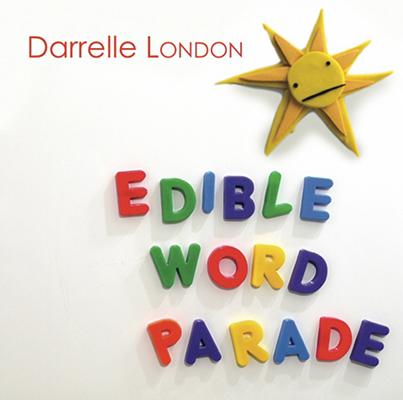
Edible Word Parade (darrellelondon.com) is DARRELLE LONDON’s sophomore release, and even within this short time, I am impressed by her growth, which is saying a lot considering how much I enjoyed her first one. She starts off running with the very catchy “Understand,” and just keeps on going. Her looks at life and love are filtered through her sweet, childlike lilt, but do not hold back on different aspects of relationships. Darrelle not only has a way with a lyric phrase, but also has a strong pop melody sensibility that makes her songs memorable and hummable. Just check out cuts like “These Days” and “Bad” to see what I mean. I can see some critics may lump her into a category with the likes of Kimya Dawson, but that would not be fair, because as good as Kimya is, I find Darrelle’s songs to be more mature and enjoyable. I will definitely be listening to this beyond the reviewing process. Though she hails from Toronto, I so look forward to getting the chance to see Darrelle play at some point. Why is Joe’s Pub waiting to call her?

Yeah, ELLIOTT MURPHY has been around forever…well, since 1973 anyway. Now comes his 30th release, Notes From the Underground (elliottmurphy.com). I had the opportunity to see him play a couple of times in the late ‘70s and early ‘80s. He tours a large chunk of the year, and that is reflected in the strength of his material and playing. Elliott has mellowed a bit through the years, but just because some of his songs are a bit melodious, they still have a strong punch with both melody and deep (yet accessible) lyrics. There are lots of good songs here, including the opener “And General Robert E. Lee” (which is rightfully somewhat of a hit overseas), “Ophelia,” and “Frankenstein’s Daughter” (perhaps a sequel to the Doll’s tune?). He was an under the radar figure back then, let’s hope that people like college radio programmers take notice and start a grass roots swell.

Usually, I don’t review CD-Rs, but I’m happy to make an exception with CHRISTOPHER MORSE and his Here’s to Better Days (myspace.com/christophermorse). Christopher’s style is solid singer-songwriter, and I must say he has a very clear voice that is very listenable, even though his topic on this is not relationship-friendly. From “Super Me” through “Caught in the Headlights” and “Friend Line,” this 5-songer is touching without being treacle, with sharp lyrics and melodies, in a Richard Shindell kind of way.

Like jazz, country is a purely American musical extension. For over 10 years, NASHVILLE PUSSY has been taking the Country genre and wringing it through a metal perspective. Their latest is the hard-hitting From Hell to Texas (SPVUSA.com; nashvillepussy.com), proving that time has not softened them a bit. There are still the expected songs of substance abuse (“Drunk Driving Man,” “I’m So High,” “Dead Men Can’t Get Drunk,” “Give Me a Hit Before I Go”), local pride (“From Hell to Texas”), a look at the larger picture (“Late Great USA”), and the controversial (“Lazy Jesus,” “Pray for the Devil”). This mixed gender band never lets go to take the easy road, with Ruyter Suys laying down the metal crunch twang taking the place of the lap guitar (I was particularly taken with her riff on “Stone Cold Down”), while husband Blaine Cartwright growls and spits his vocals with the best of ‘em. For a crossover release recorded in country stalwart Willie Nelson’s studio, this is sledgehammer subtle. A head-pounding successful release.

It’s not often I get to review something from Israel. HADAR NOIBERG and VLADIMIR KATZ are part of a jazz quartet, who have produced Lunch Special (hadarnoiberg.com.com). As the CD begins, it sounds like it’s going the way of avant-garde, but as the music continues (about 1 minute in), what is presented is more freeform (though probably scripted). Excellent material and musicianship throughout the hour-plus presented here. With a pleasant and heavy use of Hadar’s flute followed secondly by Vladimir’s piano, Gon Amir (drums) and Avri Borochov (standup bass) ably keep the rhythm flowing. The one piece with vocals is the haunting “One for Yulia,” which is sung (in Hebrew) by Hadar (it is translated in the liner notes), and one of the few that is heavily klezmer-influenced. This is not a garden party kind of ensemble, but rather a roll up the sleeve and groove, but mostly it is a beautiful collection of material.

J. SHOGREN has a voice that’s a bit gravely and rough-hewn. Americana can absorb that if the songs hold up, and on American Holly (Jaha!, c/o jshogren.com), they do just that. The opener, the album’s title cut, is obviously meant to be the “single,” but it was the third cut, “Everyman,” that caught my “ear.” As the CD glides along, it really started to reach me. The songs are catchy in a folky singer-songwriter pop kind of way, with melody lines that stay with the listener. There is really nice horn work here, like where they counterpoint with the banjo in “Holes.” Another piece that caught my attention was a sort of revisioning of “Praise the Lord and Pass the Ammunition” with the biting “Hand Grenade” (“I’ll be a hand grenade for Jesus / And spread His word like shrapnel”). It is also amusing (or can be seen as such) that a “women is bad” song like “Relativity” is followed by the romantic “She’s With Me.” While many of his songs are poignant, it is his closing number that touched me the most in my life right now, “Come All This Way.”

I approached the British quartet SITUATIONISTS (why hasn’t anyone used that name before? It seems like such a “duh”) new release, Onward & Upward EP (toughloverecords.com), with a bit of trepidation. Two four-song EPs and a full collection only released in Japan. Seems a bit too designed marketing for a new band. Plus, there are supposed to be only 500 hand-numbered copies, but mine is not. That was all washed away, though, when I actually played the thing. I don’t know if there is such a thing as a “paux de quad,” but it would seem appropriate for this group. Musically – both melodically and vocally – they don’t harmonize as much as move around each other, maneuvering in smooth pop rhythms, reminiscent of a four-way helix. It really is quite well handled, without being overdone. The production is slick, with an occasional slip towards a boy-band sound, but nevertheless, they keep their integrity. Sort of flings right to the edge, and then pulls back in an explosion. Crafty. All four songs are good, with well-done catches, and it never lets the listener down. If they make it, all these EPs and foreign releases are bound to be issued as a “bonus” at some point, but for now, enjoy.

I was fortunate to meet Mo Goldner, the guitarist for SPANKING CHARLENE at a Brian Cogan book signing. Shortly, his band’s release, *Dismissed with a Kiss (spankingcharlene.com) arrived. Fronted (mostly) by Charlene McPherson (does she really enjoy spanking?), the band has a bit of a mainstream rock sound, but without pandering to the lowest common denominator. There is no overproduction; rather the songs are really tight with good hooks. If I may, they have sort of a Cheap Trick feel to them, with perhaps the slightest hint of some country. Charlene’s voice is a solid, straightforward (i.e., non-growl), and enjoyable. Better than nearly anything one can hear on the radio these days, this should be played instead. “I Hate Girls” is a perfect antidote to the lame Katy wazzername’s “I Kissed a Girl,” though SC’s “Pussy is Pussy” probably won’t get much airplay. Some of the other strong cuts include “When I’m Skinny” and “Red Rolling Papers.” Worth seeking out.

MARY GATCHELL once stated in a song that “brutal honesty will set you free.” Well, regarding her new CD, Syretha (marygatchell.com), composed of standards, this was wise choice of material – especially for her. Well versed in jazz pop piano, Syretha (listed as both artist and title, after Mary’s middle name) slides into pieces by the likes of Gershwin (“Summertime”), Kerns (“Yesterdays”), and Ellington (“It Don’t Mean a Thing”), bringing fresh life into some songs that will never get tired. For example, her takes on “Bye Bye Blackbird” and “It Don’t Mean a Thing” is to present these uptempo numbers and slowing them down to smoldering ballads bedded with a jazz-heavily piano accompaniment (surprisingly not played by her), and made them into something that she can keep as her own. In a day when Etta James complains that Beyonce is merely copying her, no one can say that about anything on this release. Songs like “Summertime” and “Bye Bye Blackbird” have been done countless times, so bringing some new breath into them is no small feat. Piano, bass and drums ably accompany Syretha. The only jarring aspect of the CD is the suddenly upbeat “It Don’t Mean a Thing” in the middle of the rest of the collection of relative mellowness; definitely a sudden mood change. That said, even that number is solid. I always look forward to hearing Mary’s work, and will be enjoying this one for a long time.

Let me start off with a digression by saying that Brian Smith did a great job with the artwork on this one, with the cover representing a board game and each space sequentially connected to a song, and the disk looking like a spinner. That being said, TAPE AND WIRE is an interesting melodic New Jersey punk band who present their newest release, Sleep! (formula7records.com/tapeandwire). This power trio (with sometimes help from others) range from acoustic guitar ballads to blast in your face power. It makes for a nice mix. Amusingly, there are a few songs about alcohol, but either in the past tense or in the use by others. Is this a straight-edge band? The lyrics vary from the obtuse (“As the grain goes by, you’re alone again / All you outbound ideas / Caught in the same old inbound delays,” from “We’re Not in Secaucus Anymore”), to the in-your-face introspective (“”In the town that I grew up in, we’re so cool / In the permanent reunion of high school,” from “Church of Beer”), but mostly the songs are looking inward without being navel gazing to the point of wanting to ask them to stop whining. One song, in particular, I could identify with is “Teenage Pricks,” about aging and remembrances hopefully without regrets. It’s a good release ripe with thoughtfulness and retrospection, rather than just a sophomoric “Let’s get drunk and fuck!” Now all they need to do is add their e-address to the CD.

Bob Richert has run the Gulcher label (gulcher.gemm.com) since the ‘70s, and while it is most known for the Gizmos and early releases of John Cougar (Mellencamp), Bob should also be commended for championing and releasing some of the more interesting non-commercial independent music over the years. I haven’t always liked everything the label puts out, but I cannot begin to express my admiration for his devotion. The last release I received from Gulcher is Constant Hitmaker, by KURT VILE. Vile’s music is dripping with electronica, which I usually despise, but on some cuts, he doesn’t hit the listener over the head with it, using it more to promote the music rather than take it over. Sure some are solid variations of noise, like “Trumpets in Summer,” “Intro in Z,” and “American Folded,” but others not as much. Vile’s vocals are usually filtered through heavy echo, but the dissonant pop tunes still shine through, with catchy phrases and offbeat melodies. For me, the best cuts are the ones that are more pure, like “Classic Rock in the Spring” and “Don’t Get Cute.” However, my fave is easily “Slow Talkers,” which is straightforward Vile and an exceptionally played guitar, sans meddling. A lyric sheet would be appreciated to help through the vocal fog, but if one listens to it on an ambient level, it makes it listenable.

British singer-songwriter RUPERT WATES now lives in Brooklyn, but he recorded Dear Life (rupertwates.com) in Washington state. It was recorded live in the studio, usually with one take, which works here because it sounds like he’s playing in the same room. Well done on that. Wates’s voice sounds like a clearer and more theatrical Gordon Lightfoot, and his songs are foisted by his light-fingered guitar work and backing musicians. Each song is a single piece, without any blending into each other, a mark of a true tunesmith. Most of the songs though, are pregnant with death, war, daddy-issues (“The Sound of Applause”), mommy-issues (“Fairy Tales”), and true visions of horror like Katrina (“Please God”) and that man who was murdered by the police in Queens the night of his bachelor party (“Fifty Shots”). Definitely a look at the dark side, though well written, Wates could make Phil Ochs look cheery. There are some potentially hopeful numbers, like “Blackness of the Nights” and “You’ll See Me Again” (and perhaps “I Dream”), but there are more tunes leaning toward the “Elegy for the Coming Man” mode. I especially liked “Please God,” which uses the “Where Have All the Flowers Gone” kind of repetition and is strongly in a traditional folk mode, and his use of lyrics makes it all the more powerful. Wates definitely has a way with words, thought structures, melody lines, and musicianship, so this actually is a positive review, and I truly believe this is worth a listen, just don’t expect the feel good CD of the year.

* * *
The following are released by RESONANT MUSIC, a label run by DEE POP and ANDY HAAS (myspace.com/deepopnyc)

ANDY HAAS and DON FIORINODeath Don’t Have No Mercy (fiorinohaas@hotmail.com): It is probably safe to say that this is abstractly as far above Miles Davis as he was to, say, Louis Armstrong. Using Sax, piri, fife, electronica, guitar, lotar, banjo and dobro, this duo mixes both originals and standards, such as the U.S. national “Anthem,” “Comes Marching Home,” “Que Sera Sera” (whose horn feels closest to Davis), and the title cut. Recorded in a day, there is a definite feel to the songs, almost like this anti-war collection is at war with our sensibilities of sound, especially mixing the feel and sound of the “Civil” War and a Middle Eastern pastiche. Some standouts are “Ashes in the Sand,” “Memorywound” (which reminds me of some of Wendy Carlos’s works), and especially “Sinawi Spirits.”

RADIO I-CHINGLast Kind Words (radioi-ching@earthlink.net): For this recording, Don Fiorino and Andy Haas (who used to play with Martha and the Muffins, by the way), are joined by genre pushing drummer Dee Pop (Bush Tetras, the Good, and so much more). Less “competitive” oriented (both topic and stylistic) than the last release, this one is more focused on the traditional side, even though the music is just as esoteric (get used to that word, because I am sure it will be used a lot in this section). The number of covers has also increased, including a earthy “Brother Can You Spare a Dime,” Duke Ellington’s “Walk on Gilded Splinters” and “The Mooch,” Charlie Haden’s “Song for Che,” and a couple of versions of the spiritual “Let My People Go.” There is still a “gun section,” it may be called, with the original “Fife and Drum” and “Machine Gun Blues,” and a different version of “Battle Hymn of the Republic” than the first disk. Standouts include Geeshie Wiley’s “Last Kind Words,” the before mentioned “Caravan,” and the 8:13-long original “Morsing Code.”

ANDY HAASHumanitarian War: This is Haas’s solo project is definitely closer to the first above than the second, filled with originals. There are two interesting aspects of this collection. First is the instrumentation: shofar, raita, fife, electronics, and taal tarang. Second, this was all improvised live, with no overdubs. Haas continues a sort of Middle Eastern over-theme in an non-melodic, non-sequential, non-formulaic method. I respect the work, but a lot of this honestly goes over my head. The shofar and the taal tarang add some interesting touches, but much of the sound is lost on me. However, if the listener is into no wave electronica, well, have I got a CD for you!

RADIO I-CHINGThe Fire Keep Burning (myspace.com/ radioichingnewyork): The trio of Haas, Fiorino and Pop return with more middle eastern influenced jazz electronica. Again, covers out number the originals, including by the likes of Mohamed Ardel Wahab, Hamza el Din, Thelonious Monk, Jimme Driftwood, and “Abba Zabba” by the ever lovable Captain Beefheart. I also liked their cover of Count Ossie’s “Let Freedom Reign.” This release is by far the most overall modern jazz in some kind of “coherent” form (i.e., there are some definite melodies in there). This is one of my favorite overall recordings from this collection.

ANDY HAASThe Ruins of America: While this solo material by Haas is still more electronica than the others where he performs with others, it has an overarching theme of sort of a dance macabre, as is indicated by the title and cover art (taken from Rowlandson’s 1815 The English Dance of Death). Haas has taken his usual instruments (sax, piri, fife) and fed them through a synthesizer to create the sounds here. Cleaner and clearer than his first solo CD, this release feel more haunting. Much of the music here is based on traditional music from the nineteenth century, or feels like it, even those from Tin Pan Alley (e.g., Irving Berlin makes more than one appearance).