On the morning of May 20, 2017, I
received a text from musician / poet / promoter / band manager Ralph Alphonso suggesting
that I should go check out a band from Montreal that was headlining the Capitol
in Saskatoon that night named The Damn Truth.
When Ralph makes a suggestion, I pay
attention. The Damn Truth [TDT] were
one of three bands playing that night, including John Lee’s Hookers [JLH] (from Rossland, BC) opening and Soft Cotton as the swing group. It’s been too long since I’ve
seen some new live music, so even after a day of weeding, hoeing and planting,
I set off.
I walked into the place, which is run
by one of the ex-members of local town heroes The Sheepdogs – one of my fave
venues in Saskatoon, I would like to add – as The Damn Truth were finishing
their soundcheck. I took a couple of pix, and then settled down to wait for the
show, also sitting through the very brief JLH check.
Through the suggestion via text of
Ralph, I went over to TDT and introduced myself. We ended up having dinner together
in the club (their food is pretty basic hamburger kinda stuff, but well made… I
had the chicken bacon burger, in FYI TMI sharing). I explained my history
briefly to them, and we all shared Canadian themed topics, like weather, crime
statistics, and big vs. small city life. They also explained that while they
are technically the headliners, Soft Cotton would go on after them to help keep the hometown crowd there (unspoken for, I
am assuming, buying drinks; this a business model choice for which I have no
problem).
At some point as I was ending my meal,
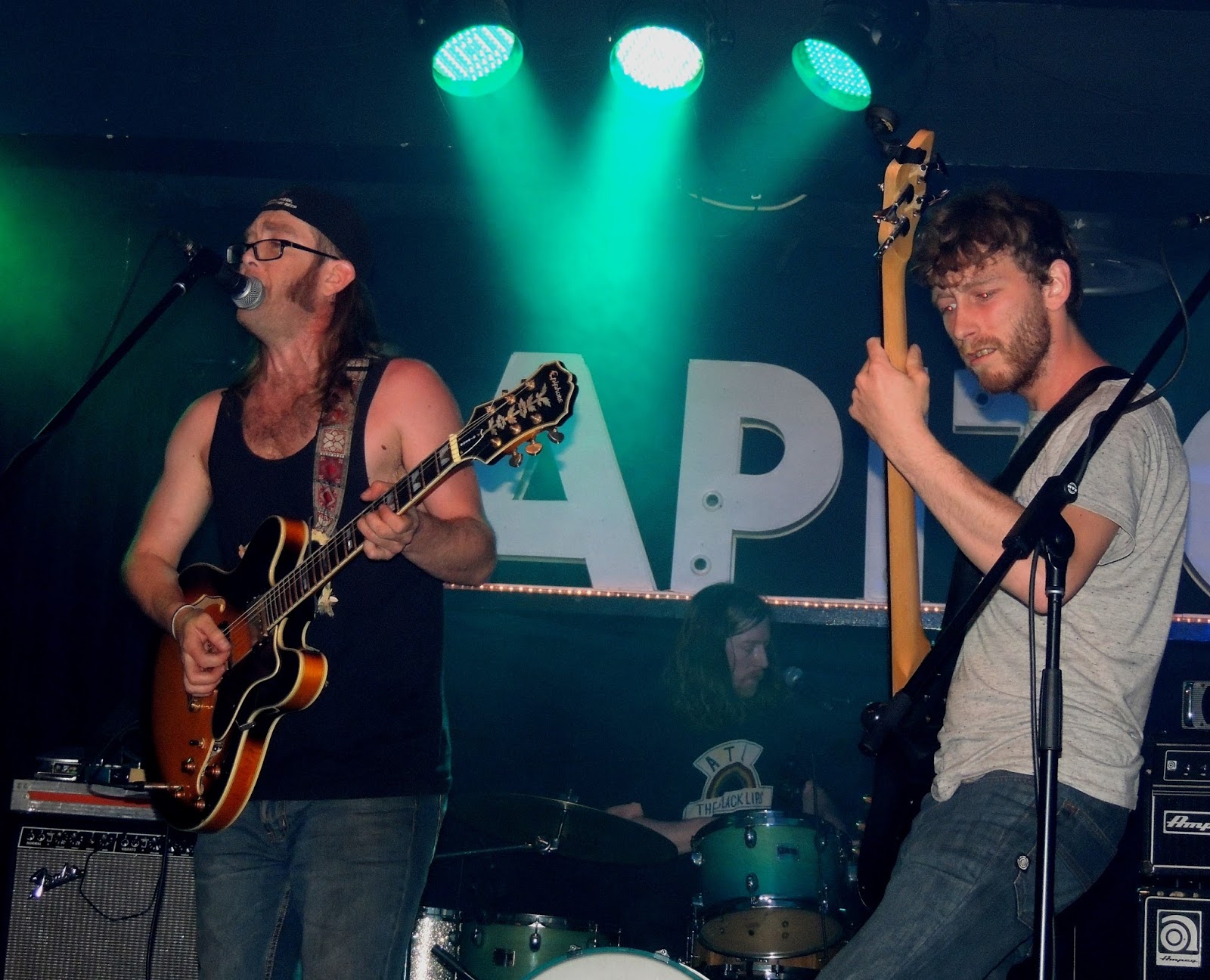
JLH came on, so I excused myself, and went off to see them play close up. That
night it was Brad Mackay on guitar/vocals and Austin Delaye on drums/vocals; I’m
not sure who was on bass (Johnny Dudar?); normally there is a fourth member, as
well. Gotta say, even as a power trio, they kept it going.
Their sound is a southern rock blues,
laying more towards the rock end. Their long hair belays their mode, and they
kicked some butt doing it. The place was still sparse, but those who were there
were enthusiastic, especially one guy who stood right up front (blocking my
camera, I must add) finishing multiple pints
that night, and who had on a shirt that had a Toronto Blue Jays log and said, “I
(heart) BJs.” Um, yeah.
Anyhoo, Southern Rock not being my oeuvre, I didn’t really have too much of a frame of reference so I
couldn’t tell which were originals and which covers (someone behind me wondered
if they would cover “Freebird,” which they happily didn’t), but I certainly
enjoyed the set. If I get the chance to see them again, odds are they will have
a different name though, because apparently three days before the show they
were given a cease and desist from
the estate of John Lee Hooker about their name, and they are actively looking
for another. What about JL’s Hooker?
After TDT set up their extensive amount
of equipment, including stage lights, a box that lit up when stood upon, an
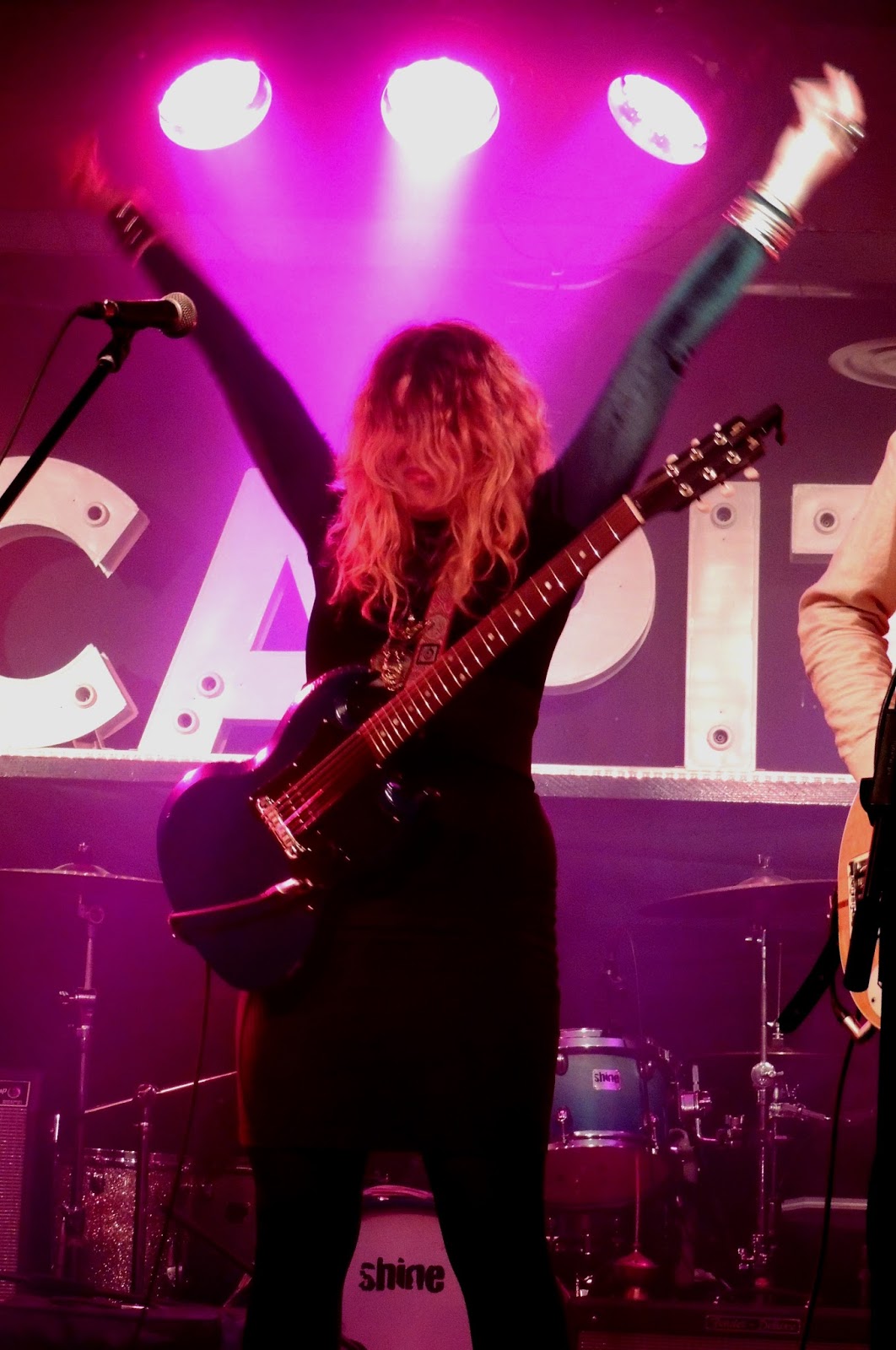
extra drum, maracas, and a huge peace symbol, they came on full tilt. A solid
blues rock band, lead vocalist/guitarist Lee-La Baum took immediate control of
the room, and orally blasted the songs at scorching levels. Accompanying her in
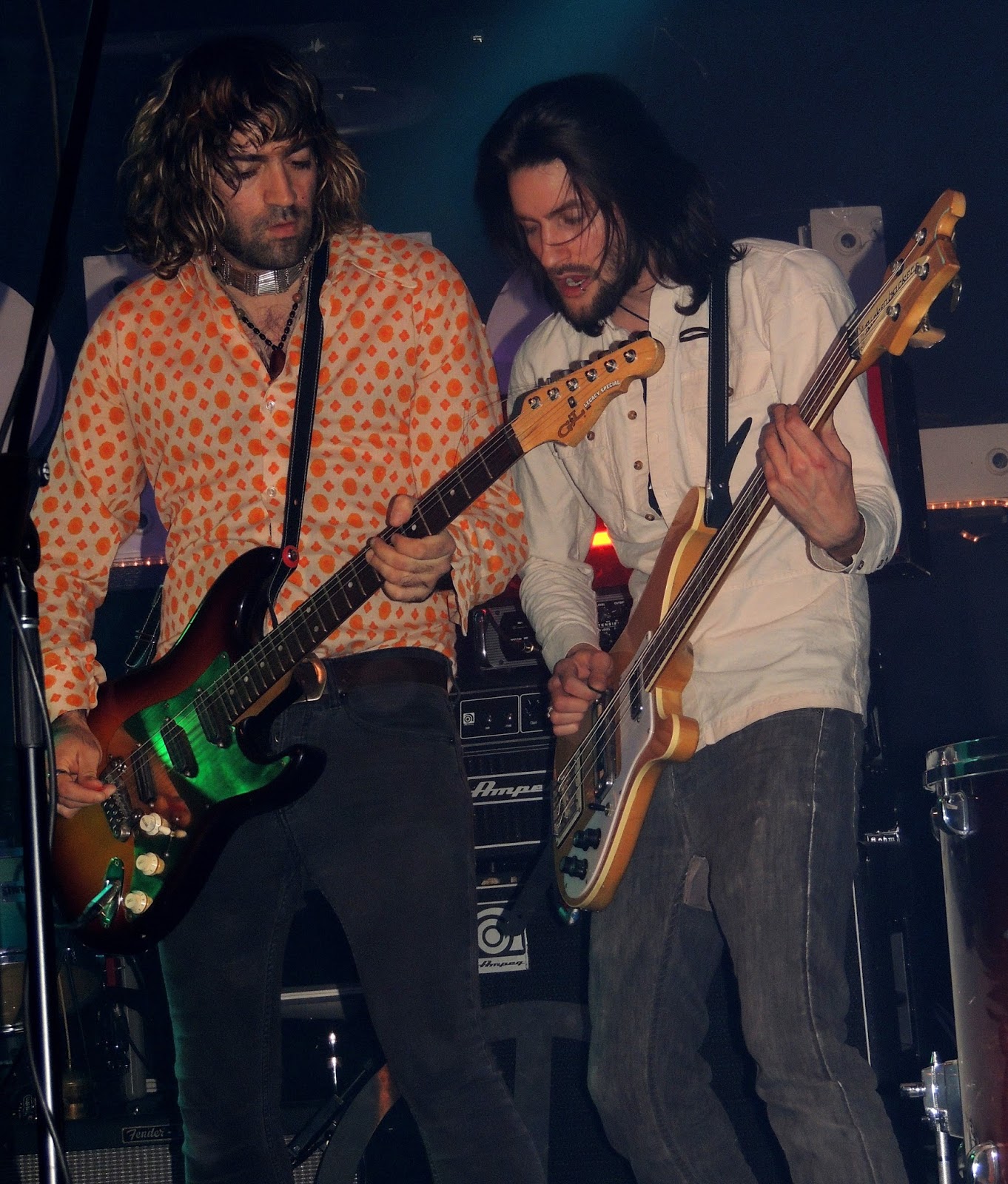
solid musicianship are Tom Shemer on lead guitar, bassist PY Letellier, and
Dave Traina on drums.
Their level of musicianship and stage
presence is solid, with no slacking by any member. There have been comparisons
with Janis J., but I don’t buy that, but only because there is only one Janis. I’m
sure someone will compare them to Heart, but nah: the Wilson sisters are okay, though
have no real bite outside of the studio. However, I can imagine a killer bill
(if I could scoop through time) of TDT, Minnesota’s Sena Ehrhardt Band, and
Brooklyn’s own Flame. But this night, TDT were holding the genre heart high. How
much fun is TDT? Well, they covered a U2 song, “Love is Blindness,” and it did
not make me think of the original, I’m happy to say.
After the set, I was invited back
stage by Dave Traina, and took the opportunity to thank the band for the great
set, and for the change to hang out with them a bit. Next time they come to
town, if they aren’t playing at a stadium sized venue, (a) that would be a
shame, and (b) I will definitely go see them again.
I left at 1 AM, due to physical
exhaustion after a day in the garden under a hot sun, just as Soft Cotton was
setting up. As I really wanted to see them, my rationalization was that I would
hopefully get another chance soon as they are local to Saskatoon. My apologies
to the band.
Thank you Ralph for the suggestion
(right as always), and to The Damn Truth for being open to dinner talk, and a
great show. Videos of the band appear after the photos, which can be enlarged
by clicking on them.
Adventures in Cuntopia: The
Life of a Punk Rock Prom Queen
By Colleen Caffeine
Ellora’s Cave / EC For Real, 176
pages, 2016 Available HERE:
In the wake of the likes of Detroit
icons like Iggy and the Stooges, Alice Cooper and the MC5, and in the shadow of
the Grande Ballroom, came a punk prom queen named Colleen Caffeine. She soon
would become a cult figure in the punk scene thanks to her band Choking Susan.
Her dedication to the music goes even beyond her many tattoos and outrageous
looks. While still in Choking Susan, Caffeine, who is a huge fan of the Ramones
(she has a tat from the Rocket to Russia
LP cover on her arm), joined an all-woman Ramones cover group brilliantly named
the Whoremones. Problem was she didn’t play any instruments. Well,
determination is a great teacher, and as she was filling in the Dee Dee role,
she taught herself to play the bass to beyond a level of just competency.
When her bands play Europe, they sell
out large clubs and her fan base is worldwide. Where she is least known, it
seems, is in the good ol’ US of A, beyond the boundaries of Michigan. Here is a
brief version of how I got to know Colleen, and to call her a friend:
In the mid-2000s, I learned that Choking
Susan was going to play at CBGB, ground zero (along with the Grande) for the
music they play. For some reason, and it’s nothing I’ve ever done before
really, I contacted them and offered to show them around New York, including
some “punk-centric” highlights of the Village. Perhaps it was because they
weren’t kids, having been around a while, and from their MySpace page I could
tell they were coming from a lot of the same music I enjoyed.
Reluctantly (I could tell from the
tone of the response, the reasons for which she also indirectly discusses in
the book), they agreed to meet the day before the show. Among the places I took
them was Trash and Vaudeville, the old Fillmore East site, Gem Spa, where Manic
Panic used to be (Caffeine is known for variant and vibrant hair colors), and
the Joe Strummer mural. We also ate at DoJos, the one that used to be on St.
Mark’s Place; it’s a vaping supply store now...
For the last place, I took them to
Manitoba’s. I knew the band was fans of the Dictators, so I hoped to help them to
meet the man, Handsome Dick, Sure
enough, there was HMD behind the bar, but the band, being the bad-assed punk
rockers that they are, were idol-shy. So I went over to him, and pointed out
the band. Being the mensch that he
is, HD grabbed a flashlight from under the bar and spent quite a bit of time
with them, chatting and explaining a lot of the pictures that covered the walls.
Choking Susan was agog, and it made me happy.
We said our farewells for the
evening, and then I got to see them play a really fun show at CBs the next
night with a local Brooklyn band I knew, Status Quo No Show (SQNS). I took tons
of pix, including the lead singers of both bands in the infamous crappers (both
sexes).
Wow, about 600 words in already so,
since I’ve now given some background, I should probably start talking about the
book…
First and most importantly, don’t let
the title throw you. I’ve read quite a few musician autobiographies, and many
of them – while enjoyable and not taking anything away from them – also have
the formula of: I grew up in tough circumstances, I discovered music, practiced
a lot, joined a bunch of bands, and despite competition, drugs, sex and band
in-fighting, became a legend. Then it all became too much and the band broke up
due to infighting. But Colleen don’t play that.
It is true, the Caucasian Colleen begins
right off discussing her tough background by stating, “I was born a poor black
child,” but she does it with humor and not necessarily focusing on a
chronology-based telling of her life. More stream of consciousness, she jumps
around from subject to subject with a self-depreciating candor while discussing
her inner thoughts about life and what has happened to her. Rather than a
sorrowful slog, even when she is discussing hard topics, like an emotionally
hard breakup, it’s a pinball version with topics being the bumpers to bounce
off of to fly to the next thing. For example, she discusses her demure grandma
being a classy broad to going abroad and her love for the Dominican Republic.
It’s almost an ADHD model for the
first half of the book, and yet it works well for her. It kind of reminds me of
Ulysses S. Grant (bear with me here): the reason he was a great general is
because he failed West Point, so he didn’t follow the expected order of things
in the patterned way of war. This is kind of what this project is like, in that
rather than just an autobiography, it’s more like musical riffs. During a
guitar solo, one can just follow a I-IV-V Blues formula, or one can go off on
tangents and just play. After listening to I-IV-V over and over, a streaming
bowl of riff can be a nice change.
Along with the history of her life,
we get to hear about friends, life and death, break-ups, hook-ups, touring, and
general philosophical ways of looking at what is happening. There really is no
rhyme or reason for the order, just whatever she is thinking at the moment,
though some later chapters do follow through with the thought. That, and you
know she will either brag about herself, or look at herself as incompetent. Honey,
you’re you, and most of your fans are grateful. Period.
Most chapters have a theme title,
which is usually a sexual pun on a song title or expression, such as “A-Dick-Shun,”
“Thimble Tits,” or “Life is a Semi in the Middle of My Colon.” Plus, I kept
wanting to talk to her throughout the book. For example, when she says, “If only
I had a dime for the number of times I’ve been called strange, odd or weird. In
love, I have only ever been treated as a burp and only afforded the smallest
effort of a subconscious poof of air after one had been satiated with whatever
had whetted their appetite.” Oh, honey, I’ve been called all of those things,
too, and you know what, good, and so
what? Punk Rawk! That’s what makes a
rock and roll lifestyle. Also, you just haven’t met the right dude (or woman; I
won’t assume about the future) yet. No, I’m not implying it’s me or anyone
else, but the road is being traveled, that’s important.
She does address that somewhat with “I
hear people say you need to find happiness and fulfillment within yourself,
enjoy your own company. For some reason I’m not able to do that. I don’t know
why either.” Yes, and neither does anyone else. I’m not wagging a finger, I’m
sighing that answer.
Don’t get me wrong, the book isn’t a
downer…well, maybe in certain sections she has some deeper, philosophical life
queries, but Colleen also has an outstanding sense of humor, lyrical timing,
and a keen sense of observation. If I quoted every line I underlined, this
review would be many pages longer.
Colleen expresses her emotion in song
lyrics, and there are many published here within the paragraphs that show how a
particular incident is processed, transformed, and regurgitated and transformed
into something meaningful, and often powerful.
This was an enjoyable read from
beginning to end, and the numerous photos in the back (none of mine, so I’ve
included one) just make it that much better.
The biggest drawback of the book is
that I’m afraid it’s not going to be reviewed as much as it should, or be in
many bookstores thanks to its title. But be sure to buy it in either its print
or electronic form from Amazon.com at the link at the top. Meanwhile, I’m
hoping there is a next book on the horizon.
An earlier version of Choking Susan at CBGB (photo by RBF)
This interview was originally published in FFanzeen, issue #14, dated 1986. It was conducted by then-radio DJ at CFMU-FM,
Bruce “Mole” Mowat. This was transcribed
from an audio tape by Marilyn Saffer. – RBF, 2017
L-R: John Emelin, Rusty Ford, Kim King, Tom Flye (top), Paul Conly
Hello Mole. This is John Emelin,
formerly of Lothar and the Hand People, speaking to you at CFMU-FM, at
Hamilton, Canada. First, let me apologize to you for taking so long to get back
to you, but you know how unreliable these ex-psychedelic musicians can be.
You asked for a musical background,
pre-Lothar. I will give you a little background on the whole group. The group
went through some early personnel changes. It was basically started by me, John
Emelin, and my roommate, Richard Willis, at the University of Denver, in 1965.
We had a jug band at the time, and it became increasingly clear to us that the
way to get girls and make more money was to play the type of music that groups
like the Rolling Stones and the Kinks, who were emerging from England at the
time, were playing. We were taking a lot of drugs in those days. Naturally, the
usual megalomaniacal mindset that goes with that took possession of us and we
decided to start a rock’n’roll band.
So we got a hold of another guitarist
by the name of William Wright, and a drummer by the name of Tom Flye who came
to the University of Denver from Chicago, where he had been in a rock’n’roll
band in high school; and a bass player by the name of Rusty Ford, who also came
to D.U. in 1965. He had been a bass player in a rock’n’roll group called the
Accidentals when he was in prep school at Choate. So we got that group together
and started working around Denver, and let our hair grow and took the usual
‘60s flack for that. We started writing our own material.
Then we had sort of a fateful job in
‘65/’66 New Year’s Eve, a gen-u-ine
professional gig at a bar in Aspen. New Year’s Day, the three of us who were
still in college called home and dropped the bad news that we were going to be
quitting and, at that time, two of the members of the group dropped out and
were replaced by our final lead guitarist Kim King, who we had picked up at the
Denver Folklore Center. He had had some experience in New York, in rock’n’roll.
He was also a folk guitarist; excellent guitarist all the way around. And through
an ad in the paper, we got a hold of Paul Conly, our keyboard player.
I got a Theremin. How I got it, I
can’t remember. The name Lothar and the Hand People came to my roommate, Richard
Willis who, since is long gone and I’m told a holy man high in the Himalayas –
where’s he’s high in them or the Himalayas are high, you’ll have to figure out
for yourself – had a dream in which the name Lothar and the Hand People
appeared, which is where the name came from.
We just sort of naturally applied it
to the Theremin, which is, as I imagine some of your listeners know, the
earliest of the electronic instruments. It was invented in 1928 by a Dr. Leon Theremin
in the Soviet Union. It’s a single oscillator, the type of which synthesizers
are made of many, and has an aerial coming off it which creates a field, which
in turn is broken by the capacitance stored in your body, so by moving your
hand closer to the aerial, or further away from it, you change the pitch, and
create the ooOOoo sound that everyone
is familiar with from old horror films. Actually, I think the Theremin has
dropped out of style and has been replaced by linear-controllers and more
accurate types of electronic equipment.
We were very interested in electronic
music from the beginning. We moved to New York in ’65. There, at that time, we
went up to Corning, New York, to see the guy that built our Theremin, which we
had gotten through the mail from a guy named Robert Moog. He was working on
designing a synthesizer, which could be used outside of the laboratories that
he was selling them to, the music laboratories and universities. So we helped
him develop the necessary adaptations to be the first group to use the
synthesizer live. And we were also the first group to record rock’n’roll music
with a Moog Synthesizer. And in the course of using it in New York, we turned
on a lot of musicians, like Jimi Hendrix, who was a friend of ours, Keith
Emerson, who used to come to see us at The Scene; people who have since become
identified with synthetic music had become introduced to it through Lothar’s
influence, which at that time in New York, in ’66 and ‘7 especially, was
somewhat powerful.
Well, we played around New York from
’65 to ’70. We played at The Night Owl, right after the Lovin’ Spoonful hosted
out of there. Then we played at a variety of light show clubs on the East
Coast: The Boston Tea Party in Boston – “Say, this guy’s real bright” – a club
in Philly called The Trauma, which was a smaller light show club, and we sort
of shuttled back and forth around the East Coast. We did a lot of playing at
The Scene in the ‘60s.
As far as an annotated discography, I
cannot help you. I can tell you we had an album called Presenting Lothar and the Hand People on Capitol in 1968. And that
was rereleased a couple of years ago. There was also one called Space Hymn by Capitol in ’69. And there
was a mixture of both of them called Spores,
which was a bootleg record released in England in the ‘70s. We had a number of
singles which were not on albums, some of which have become collector’s items
for reasons that are hard to understand.
During the course of our career, we
played a lot in New York. That’s where we signed our first record deal and our
first management deal, which was, of course, a bad management deal, which most groups get into the first time out
of the box.
Then we ended up spending a lot of
time hassling – ahem – working in the studio. Our first producer was a guy
named Bob Margouleff, who went on to be the synthesizer programmer for Stevie
Wonder on the Talking Book album, and
on the Capitol stable. He discovered the Beach Boys, Glen Campbell, and Lou
Rawls, and engineered the original Dale Hawkins recording of “Suzie Q,” and so
on. He was a great guy to work with, but never really provided the group with a
whole lot of direction. Lothar always had a problem creating the same
excitement in the studio as we did on the stage. We never really met the right
producer to get the performances out of us in the studio that would come across
the way we did live. That was a problem with a lot of the psychedelic groups.
Let’s see. You asked other questions
here. Why, what, and when did the group spit up? We split up in 1970 because we
got out of all our contracts at once: our personal management contract, our
booking agent’s contract, and our record deal. And rather than get involved in
any more bad deals, we figured we’d all go our separate ways. We are one of the
few groups I know of that had the same five members for five years and did not
split up with any animosity at all, or at least if there was any, it was
certainly well hidden.
As far as what we’re doing nowadays:
our drummer, Tom Flye, is an engineer at The Plan, in Sausalito (California).
And he also has engineered just about everybody you can think of, and has done
a lot of work in recent years with Rick James; Kim King [d. 2016], our guitarist, does road sound for top-notch acts; Rusty
Ford, our bass player, produces television commercials; and our keyboardist,
Paul Conly, is writing film music; and I’m in the process of writing a novel [Note: I have not been able to find any
information about this book, if it was published – RBF, 2017]. Since the
group broke up, I went back to the country and built log cabins, and I’ve had a
small video production company and imported clothing from South America.
As far as any chance of a reunion, we
tried a reunion – three of us did: Paul, Rusty and I tried a reunion about five
years ago, but it just didn’t work out. I’m afraid we’re – we’re too old is
what I think it is. I’m not sure though. It’s hard to say exactly what it is
that would keep us from a reunion. I think probably it’s the prospect of being
on the road again. It’s enough to keep anybody who can avoid it from doing it.
As far as musical projects, as a matter of fact, I’m in the process of writing
some songs now and getting a demo together, and I think I’m gonna be back in
there slugging, looking for a record deal within the next 18 months or so.
There is a book called The Acid Trip: A complete guide to
Psychedelic Music [1984], which has a fairly good feature on us, written
and compiled by Vernon Joynson, published by Babylon Books (England). It’s a
pretty interesting book about psychedelic music, I must say, and I know that I
am proud to have been associated with the psychedelic movement in any way, shape,
or form. And, as a matter of fact, I just got back from Mexico and, while
swathing cable television in a bar, there was a feature on the rise of the use
of psychedelics in Canada. All I can say is keep up the good work, guys, because
you can’t go wrong as far as I’m concerned.
It’s always amusing to me to see
books about – there’s a book out about rock’n’roll hardware that discusses the
history of electric guitars and so forth and they ascribe the first use of the
synthesizer to Keith Emerson, which is extremely amusing to me because I
remember the night that he walked into The Scene and had never seen one before,
and we had been using it for eight months. But that’s the way it is when you’re
ahead of your time, you know. As they used to say in New York, that and 25
cents will get you a ride on the subway [fare’s
up to a buck nowadays – RBF, 1986]; [fare’s up to $2.75 nowadays – RBF, 2017].
A couple of things occurred to me
that might be of interest to your listeners. We played only one gig in Canada
and that was the opening of Expo 67 (in Montreal). We were on the bill with the
Blues Project and Tiny Tim, of all people. It was at the Exposition Hall, and
it was sort of a party that was given for the people who had worked on Expo 67,
which was a very heavy working-class, French-Canadian group, who obviously were
not compatible with the type of music that any of us were playing at the time –
and it was your basic disaster of a job. I remember we were saved – literally
our skins were saved – by the sexy dancing of a young lady by the name of
Suzanne Verdal, about whom Leonard Cohen is supposed to have written the song
“Suzanne.” Those of you who are better versed in Canadian music lore can
probably chuckle up your well-insulated sleeves at my lack of knowledge about
who the real “Suzanne” is.
But what I remember about that job
was when we got to the border we didn’t have the right working papers and we
had to sleep in our car between that small space in the borders overnight,
until the promoter got there with the right papers. And when we got to
Montreal, there was no place to stay, so we went out and found a place. It
turned out to be some sort of mental home which had been emptied out. I don’t
know where the patients went, but a swimming pool on the roof that was two feet
deep throughout was the dead giveaway. There were also signs on the doors that
said things like Physiotherapy and so forth.
Most of our playing was done on the
East Coast for that five-year period. We did some work down the Jersey Shore at
a place called Spray Beach, New Jersey. We worked there quite a bit. We worked
San Francisco twice: once at the Fillmore with the Grateful Dead and the James
Cotton Band in 1966.
Working in San Francisco was always difficult
because it was real easy to be home-teamed there, although I must say that the
Grateful Dead were very gracious to us. When we arrived, there was a note in
the dressing room that said, “Come over to our house.” They had that big house
in the Haight at that time, and we went over there and spent the night sampling
whatever substances there were available in Haight-Ashbury in 1966. We met the
lead singer for the great Big Brother, Janis Joplin, who was unknown to New York
musicians at that time. We stayed up most of the night drinking wine and doing
whatever else with her and the guys from the Grateful Dead.
We also worked a number of jobs in
odd little places, like Casper, Wyoming, and on the downside we worked up in
the Catskills (New York) at a singles weekend at one of the hotels they have up
there. Kutchers’ Country Club, they called it. That was a lot of laughs.
We worked with the Byrds in New York
at the Village Gate. It was the first time rock’n’roll had ever been played at
the Village Gate. That was interesting. There was a groupie there with a camera
chasing after David Crosby by the name of Linda Eastman. Actually, I think she
was after Chis Hillman. I have to ask my pal Rusty about which one she was
after, but she was certainly working her way up in those days, and as we all
know she made it, groupie-wise.
I’ll tell ya, I hope you have some of
our records. Play “Machines,” that’s one of my favorites. I really like that.
That was written by a guy named Mort Schuman, the guy who wrote the wonderful
song “Save the Last Dance for Me.” I’ve always been fond of our version of “Bye
Bye Love,” with the Theremin/pedal steel part. I always thought that it was ahead
of its time. And “It Comes on Anyhow,” which is the last song on the first
album I believe, which is also worth a giggle. Our version of “The Woody
Woodpecker Song” certainly stands on its own. Nothing more need be said about
that. I hope you have a chance to listen to it. Everyone should hear Lothar’s
version at least once.
We released a single called “Midnight
Ranger.” In fact, I think “Midnight Ranger” is on the second album. The out of
tune high voice on that is the first major recording by a then-new to New
York musician by the name of Johnny
Winter, who had been brought into town by the owner of the club, The Scene, at
which we were working. He came up and offered his vocal talents on the song,
and we thought it was a great idea, and everyone afterwards said, “That’s a
pretty good song except who is that high part? That guy can’t sing at all!”
That’s the way these things work out. “Midnight Ranger” is the third song on
the first side of Space Hymn.
“Today is Only Yesterday’s Tomorrow”
is a pretty nasty little song as well, and “Hours Like Backwards,” too. Of
course, this album came out shortly after the first moon shot, and we were
under the mistaken impression that the men walking around on the moon were
going to make a major impression on people all over the planet. And that anyone
who had any tie-in with that would be rolling in gravy. As it turned out, nobody
really cared, and our tie-in with standing on the moon, which is that song
“Space Hymn,” got us absolutely nowhere, which goes to show what you get trying
to predict public taste.
I would be very interested to know if
any of you ever had the opportunity to see Lothar live. We could reminisce
about the old days. You can tell me what you were on and I can tell you how
silly you looked about what you thought was dancing.
Anyway, until next time, I really
gotta go and pull out a TV dinner. See you all later. Bye.
Currently living in Saskatoon (email at RBF55@msn.com for address). From 1977-88, I used to publish a print version of a music magazine in New York called FFanzeen, which dealt with the wide-ranging independent music scene. I also photographed many bands from the period (and since). Now I write this blog. And the beat goes on.











 Posts
Posts

