Showing posts with label psychadelia. Show all posts

Saturday, May 5, 2018

The Heaven That Was ’67: Garage Punk [1985]

By Nancy Foster / FFanzeen, 1985
* = Additions by Robert Barry Francos, 1985
Introduction and live photos © Robert Barry Francos, 2018
Flyers from the personal collection of Robert Barry Francos
Videos from the Internet


This article was originally printed in FFanzeen, issue #5, dated 1985, by the irrepressible Nancy Foster, aka Nancy Neon.

While I enjoyed the hardcore sounds of the 1980s, I was drawn more to the new garage style, often going to see the bands that often played places like the Dive and Irving Plaza. Some of them were quite aggressive, like the Chesterfield Kings, and some were more pop, like the Cheepskates. I remember hanging out with the ‘Skates at the main floor bar while they played pool during one Super Bowl Sunday before a performance in the 1980s. Don’t get me wrong, when I say pop I certainly don’t mean sedate; just listen to the drumming on “Run Better Run,” because it is fierce, but you felt safer with them onstage. For example in the other direction, at one show at Maxwells, Kings’ singer Greg Prevost was jumping from the stage and swinging on the huge amps attached to the ceiling by chains. I moved to the back of the venue, just in case.

Of course, there were other bands that didn’t get mentioned because, well, there were so many of them, such as the Cynics (Pittsburgh) and to some level, even the Cramps.

The bands were exciting, the fashions were cool, the haircuts were wild, and the sounds were driving beats usually backed by an electric organ. Often I’d go with Nancy, or others, to these shows and just let go of all my worries.

Click on the name of the band below to see a sample their work. – Robert Barry Francos, 2018.


Call it garage grunge. Call it neo-psychedelia or punk/psych. There’s a real ‘60s revival going on in NYC, Rochester, Boston, and LA. When one mentions the ‘60s, Joe Q. Public thinks of throngs of naked hippies, Woodstock, and the Grateful Dead. But I’m not talking about love-ins, Haight-Ashbury (hashbury!), or nude herds of mush(room) minds, I’m talking about The Heaven that was ’67: chicks in minis, Yardley cosmetics, Cleopatra eyeliner, fishnets, etc.; guys with pudding basin haircuts in Prince Valiant style, Wayfarer shades, paisleys, and black leather. I’m talking about Vox and Rickenbacker guitars, Vox organs, and bringing sex and danger to rock’n’roll. I mean intense, not mellow. I’m talking about the coolest era in the wild, wild world.

The grooviest groups in NYC are the Vipers, the Fuzztones, Mad Violets, Outta Place, Cheepskates, and the Tryfles. Boston has the Lyres (my fave raves) and the Prime Movers. Rochester has the Chesterfield Kings, and LA has Rain Parade, Long Ryders, 3 O’clock and the Unclaimed.

Whereas the East Coast combos of cool are more influenced by the ominous, sinister sounds of the Sonics, the Standells and the Chocolate Watchband, the LA groups are mostly influenced by the more mystical, melodic, introspective sounds, such as made famous by folk rock sensations, the Byrds (except the Unclaimed, who are pure primitive punk!


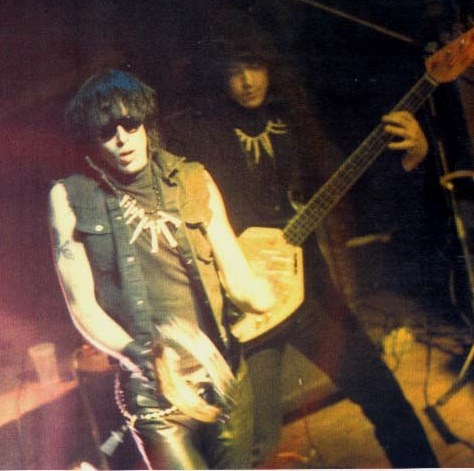
The Vipers
THE VIPERS recently got signed by Passport Records, who are releasing their long-awaited LP, Outta the Nest. Previous to this, they were turning NYC on to their fab sounds at the Dive’s Thursday night Cavestomps. The line-up is Jon Weiss (vocals, sax, harmonica), Paul Martin (lead guitar), Pat Brown (drums), Graham May (bass), and Dave Mann (keys, harmonica, guitar). 
The Fuzztones
THE FUZZTONES have risen like a phoenix from the ashes of Tina Peel,  a warped ‘70s Archies. The Fuzztones pledge their allegiance to the punk/psych sounds of the ‘60s. The original members are Rudi Protrudi (lead vocals, guitar) and Deb O’Nair (keys and backup vocals). Their set includes hot covers of “Shapes of Things to Come” and “Riot on Sunset Strip,” complete with flashing lights and sirens. 

MAD VIOLETS stars Wendy Wild [d. 1996 – RBF, 2018], ex- of Pullsallama.  She’s the wildest dancer and a fab dresser, when she makes the ‘60s scene mushroom queen. One night she pulled a Goldie Hawn a la “Laugh In,” wearing a bikini top, miniskirt, and body paint. Their version of the 13th Floor Elevators’ “You’re Gonna Miss Me” is positively warped! 

THE CHEEPSKATES are one of the top dance bands. Their version of “Little Latin Lupe,” the Kinks’ “I Need You,” and the Yardbirds’ “Over Under Sideways Down” has the kids dancing in the aisles. Their “Run Better Run” single, on Midnight Records, is perfectly primitive.  

The Tryfles
TRYFLES are a great live band that has loads of originals, as well as intense covers like “The World’s Not Round, It’s Square” and “Way to Die.” One of the more visible bands on the circuit today. * 

OUTTAPLACE stars Chandler (lead vocals), Shari (nubile Morticia on keys), Orin (bass), Jordan (guitar), and Andrea (drums). They have a wild, wild record out on Midnight. You’ll seldom see so many groovy looking people in one place. [Late news: Outta Place no longer exist as a band, but their record on Midnight is worth checking out – NF, 1985.] 

The Chesterfield Kings
THE CHESTERFIELD KINGS have a 1982 album on Mirror Records that’s already a garage classic, and have just released a new single, “She Told Me Lies,” on the same label. They dress cool and take their hair style cues from Brian Jones. You might recognize lead singer Greg Prevost as writer of Future fame, and more recently Outasite! 

THE MYSTIC EYES from Buffalo features ex-the Good  leader Bernie Kugel on lead guitar and vocals, with ex-Davy & the Crockets leader Dave Meinser on backing (and occasional lead) vocals and guitar. Their music is wild, raunchy, and Bernie’s vocals are not to be believed! Their main influences are “The Honeymooners” and “Green Acres.” [Note: not to be confused with the German band with the same name – RBF, 2018] * 

THE PRIME MOVERS pump out a powerful potion of mod garage soul. Their hyped-up version of Lou Reed’s “Waiting for My Man” makes them heavy garage contenders. [Thanks to Blair Buscareno for the link - RF, 2019.] 

The Lyres
THE LYRES, who have been called by some as “white soul,” have a real gritty, garage sound. The Lyres put out great records, most recently a fantabulous album called On Fyre on Ace of Hearts Records, and put on mind-bending shows featuring intense frontman Jeff ”Monoman” Connolly. 


Salem 66
SALEM 66 are a cool Byrds-type psychedelic band from Boston, who follow in the footfalls (and far surpass) the likes of Dream Syndicate and the dull Green on Red. Formerly an all-girl trio consisting of Judy Grunwald on guitar and lead vocals, Beth Kaplan on bass, and Susan Merriam on drums, they have invited male guitarist Robert Wilson to join their fold and make the sound even fuller. This band has a rockin’ new album and single out on Homemade Records. * 

THE LONG RYDERS, on 10-5-60, are more devout to their ‘60s pilgrimage. Spectres of the Byrds weave through the melody lines and especially Sid Griffin’s (guitar/vocals) hero, the late Gram Parsons. The Country & Western twang of “You Don’t Know What’s Wrong, You Don’t Know What’s Right” comes complete with steel guitar and it is real good kicks. On the title track, the smooth folk of the Byrds combines with the spunky Rhythm & Blues of the Yardbirds for a provocative musical hybrid. 

THE RAIN PARADE’s Emergency Third Rail Power Trip is my favorite of these three LA releases. The music is more mystical, and lusher with its languorous and magical melodies. The soft, introspective tone vocally, along with the sitar, enhances the ethereal feeling that the record inspires. “I Look Around” sounds like a more cerebral Hollies. 

Pandoras
THE PANDORAS are an incredibly good band that could be a female flip-side of the Chocolate Watchband, giving many East Coast garagers a run for their money. Their LP, It’s About Time, on Voxx Records, has no sense of innocence blocking its way as it raunches out with Paula Pierce’s (d. 1991) scratchy and screaming vocals, along with haunting instrumentals. * 

A couple of other bands you might want to check out for a mild psychedelic sound are the Things and Eyes of Mind, both of whom have albums out on that super label, Voxx. *

If you dig the ‘60s sound ‘80s-style, but you still crave the real thang, check out a groovy French record company called Eva and their extensive listing of cool combos: “Diddy Wah Diddy” (Barry & the Remains), “Calm Before The…” (Rising Storm), etc.

Bomp!/Voxx, “Where the ‘60s never ended,” proves its slogan with great plastic platters like Acid Vision, High in the Mid-Sixties, and my persona faves, Electric Sugar Cube Flashbacks, Vols. I and II, which contain rare British punk/psych ‘60s gems and the reigning ruler of my turntable, The Tongues of Truth by the Grodes, a terrific Tucson combo who did the original version of “Let’s Talk About Girls,” which has often been considered a Chocolate Watchband original.


Friday, May 5, 2017

LOTHAR AND THE HAND PEOPLE: Signals Received! [1986]

By Bruce “Mole” Mowat / FFanzeen, 1986
Introduction by Robert Barry Francos / FFanzeen, 2017
Images from the Internet

This interview was originally published in FFanzeen, issue #14, dated 1986. It was conducted by then-radio DJ at CFMU-FM, Bruce “Mole” Mowat.  This was transcribed from an audio tape by Marilyn Saffer. – RBF, 2017
L-R: John Emelin, Rusty Ford, Kim King, Tom Flye (top), Paul Conly

Hello Mole. This is John Emelin, formerly of Lothar and the Hand People, speaking to you at CFMU-FM, at Hamilton, Canada. First, let me apologize to you for taking so long to get back to you, but you know how unreliable these ex-psychedelic musicians can be.

You asked for a musical background, pre-Lothar. I will give you a little background on the whole group. The group went through some early personnel changes. It was basically started by me, John Emelin, and my roommate, Richard Willis, at the University of Denver, in 1965. We had a jug band at the time, and it became increasingly clear to us that the way to get girls and make more money was to play the type of music that groups like the Rolling Stones and the Kinks, who were emerging from England at the time, were playing. We were taking a lot of drugs in those days. Naturally, the usual megalomaniacal mindset that goes with that took possession of us and we decided to start a rock’n’roll band.

So we got a hold of another guitarist by the name of William Wright, and a drummer by the name of Tom Flye who came to the University of Denver from Chicago, where he had been in a rock’n’roll band in high school; and a bass player by the name of Rusty Ford, who also came to D.U. in 1965. He had been a bass player in a rock’n’roll group called the Accidentals when he was in prep school at Choate. So we got that group together and started working around Denver, and let our hair grow and took the usual ‘60s flack for that. We started writing our own material.

Then we had sort of a fateful job in ‘65/’66 New Year’s Eve, a gen-u-ine professional gig at a bar in Aspen. New Year’s Day, the three of us who were still in college called home and dropped the bad news that we were going to be quitting and, at that time, two of the members of the group dropped out and were replaced by our final lead guitarist Kim King, who we had picked up at the Denver Folklore Center. He had had some experience in New York, in rock’n’roll. He was also a folk guitarist; excellent guitarist all the way around. And through an ad in the paper, we got a hold of Paul Conly, our keyboard player.

I got a Theremin. How I got it, I can’t remember. The name Lothar and the Hand People came to my roommate, Richard Willis who, since is long gone and I’m told a holy man high in the Himalayas – where’s he’s high in them or the Himalayas are high, you’ll have to figure out for yourself – had a dream in which the name Lothar and the Hand People appeared, which is where the name came from.

We just sort of naturally applied it to the Theremin, which is, as I imagine some of your listeners know, the earliest of the electronic instruments. It was invented in 1928 by a Dr. Leon Theremin in the Soviet Union. It’s a single oscillator, the type of which synthesizers are made of many, and has an aerial coming off it which creates a field, which in turn is broken by the capacitance stored in your body, so by moving your hand closer to the aerial, or further away from it, you change the pitch, and create the ooOOoo sound that everyone is familiar with from old horror films. Actually, I think the Theremin has dropped out of style and has been replaced by linear-controllers and more accurate types of electronic equipment.

We were very interested in electronic music from the beginning. We moved to New York in ’65. There, at that time, we went up to Corning, New York, to see the guy that built our Theremin, which we had gotten through the mail from a guy named Robert Moog. He was working on designing a synthesizer, which could be used outside of the laboratories that he was selling them to, the music laboratories and universities. So we helped him develop the necessary adaptations to be the first group to use the synthesizer live. And we were also the first group to record rock’n’roll music with a Moog Synthesizer. And in the course of using it in New York, we turned on a lot of musicians, like Jimi Hendrix, who was a friend of ours, Keith Emerson, who used to come to see us at The Scene; people who have since become identified with synthetic music had become introduced to it through Lothar’s influence, which at that time in New York, in ’66 and ‘7 especially, was somewhat powerful.

Well, we played around New York from ’65 to ’70. We played at The Night Owl, right after the Lovin’ Spoonful hosted out of there. Then we played at a variety of light show clubs on the East Coast: The Boston Tea Party in Boston – “Say, this guy’s real bright” – a club in Philly called The Trauma, which was a smaller light show club, and we sort of shuttled back and forth around the East Coast. We did a lot of playing at The Scene in the ‘60s.

As far as an annotated discography, I cannot help you. I can tell you we had an album called Presenting Lothar and the Hand People on Capitol in 1968. And that was rereleased a couple of years ago. There was also one called Space Hymn by Capitol in ’69. And there was a mixture of both of them called Spores, which was a bootleg record released in England in the ‘70s. We had a number of singles which were not on albums, some of which have become collector’s items for reasons that are hard to understand.

During the course of our career, we played a lot in New York. That’s where we signed our first record deal and our first management deal, which was, of course, a bad management deal, which most groups get into the first time out of the box.

Then we ended up spending a lot of time hassling – ahem – working in the studio. Our first producer was a guy named Bob Margouleff, who went on to be the synthesizer programmer for Stevie Wonder on the Talking Book album, and on the Capitol stable. He discovered the Beach Boys, Glen Campbell, and Lou Rawls, and engineered the original Dale Hawkins recording of “Suzie Q,” and so on. He was a great guy to work with, but never really provided the group with a whole lot of direction. Lothar always had a problem creating the same excitement in the studio as we did on the stage. We never really met the right producer to get the performances out of us in the studio that would come across the way we did live. That was a problem with a lot of the psychedelic groups.

Let’s see. You asked other questions here. Why, what, and when did the group spit up? We split up in 1970 because we got out of all our contracts at once: our personal management contract, our booking agent’s contract, and our record deal. And rather than get involved in any more bad deals, we figured we’d all go our separate ways. We are one of the few groups I know of that had the same five members for five years and did not split up with any animosity at all, or at least if there was any, it was certainly well hidden.

As far as what we’re doing nowadays: our drummer, Tom Flye, is an engineer at The Plan, in Sausalito (California). And he also has engineered just about everybody you can think of, and has done a lot of work in recent years with Rick James; Kim King [d. 2016], our guitarist, does road sound for top-notch acts; Rusty Ford, our bass player, produces television commercials; and our keyboardist, Paul Conly, is writing film music; and I’m in the process of writing a novel [Note: I have not been able to find any information about this book, if it was published – RBF, 2017]. Since the group broke up, I went back to the country and built log cabins, and I’ve had a small video production company and imported clothing from South America.

As far as any chance of a reunion, we tried a reunion – three of us did: Paul, Rusty and I tried a reunion about five years ago, but it just didn’t work out. I’m afraid we’re – we’re too old is what I think it is. I’m not sure though. It’s hard to say exactly what it is that would keep us from a reunion. I think probably it’s the prospect of being on the road again. It’s enough to keep anybody who can avoid it from doing it. As far as musical projects, as a matter of fact, I’m in the process of writing some songs now and getting a demo together, and I think I’m gonna be back in there slugging, looking for a record deal within the next 18 months or so.

There is a book called The Acid Trip: A complete guide to Psychedelic Music [1984], which has a fairly good feature on us, written and compiled by Vernon Joynson, published by Babylon Books (England). It’s a pretty interesting book about psychedelic music, I must say, and I know that I am proud to have been associated with the psychedelic movement in any way, shape, or form. And, as a matter of fact, I just got back from Mexico and, while swathing cable television in a bar, there was a feature on the rise of the use of psychedelics in Canada. All I can say is keep up the good work, guys, because you can’t go wrong as far as I’m concerned.

It’s always amusing to me to see books about – there’s a book out about rock’n’roll hardware that discusses the history of electric guitars and so forth and they ascribe the first use of the synthesizer to Keith Emerson, which is extremely amusing to me because I remember the night that he walked into The Scene and had never seen one before, and we had been using it for eight months. But that’s the way it is when you’re ahead of your time, you know. As they used to say in New York, that and 25 cents will get you a ride on the subway [fare’s up to a buck nowadays – RBF, 1986]; [fare’s up to $2.75 nowadays – RBF, 2017].

A couple of things occurred to me that might be of interest to your listeners. We played only one gig in Canada and that was the opening of Expo 67 (in Montreal). We were on the bill with the Blues Project and Tiny Tim, of all people. It was at the Exposition Hall, and it was sort of a party that was given for the people who had worked on Expo 67, which was a very heavy working-class, French-Canadian group, who obviously were not compatible with the type of music that any of us were playing at the time – and it was your basic disaster of a job. I remember we were saved – literally our skins were saved – by the sexy dancing of a young lady by the name of Suzanne Verdal, about whom Leonard Cohen is supposed to have written the song “Suzanne.” Those of you who are better versed in Canadian music lore can probably chuckle up your well-insulated sleeves at my lack of knowledge about who the real “Suzanne” is.

But what I remember about that job was when we got to the border we didn’t have the right working papers and we had to sleep in our car between that small space in the borders overnight, until the promoter got there with the right papers. And when we got to Montreal, there was no place to stay, so we went out and found a place. It turned out to be some sort of mental home which had been emptied out. I don’t know where the patients went, but a swimming pool on the roof that was two feet deep throughout was the dead giveaway. There were also signs on the doors that said things like Physiotherapy and so forth.

Most of our playing was done on the East Coast for that five-year period. We did some work down the Jersey Shore at a place called Spray Beach, New Jersey. We worked there quite a bit. We worked San Francisco twice: once at the Fillmore with the Grateful Dead and the James Cotton Band in 1966.

Working in San Francisco was always difficult because it was real easy to be home-teamed there, although I must say that the Grateful Dead were very gracious to us. When we arrived, there was a note in the dressing room that said, “Come over to our house.” They had that big house in the Haight at that time, and we went over there and spent the night sampling whatever substances there were available in Haight-Ashbury in 1966. We met the lead singer for the great Big Brother, Janis Joplin, who was unknown to New York musicians at that time. We stayed up most of the night drinking wine and doing whatever else with her and the guys from the Grateful Dead.

We also worked a number of jobs in odd little places, like Casper, Wyoming, and on the downside we worked up in the Catskills (New York) at a singles weekend at one of the hotels they have up there. Kutchers’ Country Club, they called it. That was a lot of laughs.

We worked with the Byrds in New York at the Village Gate. It was the first time rock’n’roll had ever been played at the Village Gate. That was interesting. There was a groupie there with a camera chasing after David Crosby by the name of Linda Eastman. Actually, I think she was after Chis Hillman. I have to ask my pal Rusty about which one she was after, but she was certainly working her way up in those days, and as we all know she made it, groupie-wise.

I’ll tell ya, I hope you have some of our records. Play “Machines,” that’s one of my favorites. I really like that. That was written by a guy named Mort Schuman, the guy who wrote the wonderful song “Save the Last Dance for Me.” I’ve always been fond of our version of “Bye Bye Love,” with the Theremin/pedal steel part. I always thought that it was ahead of its time. And “It Comes on Anyhow,” which is the last song on the first album I believe, which is also worth a giggle. Our version of “The Woody Woodpecker Song” certainly stands on its own. Nothing more need be said about that. I hope you have a chance to listen to it. Everyone should hear Lothar’s version at least once.

We released a single called “Midnight Ranger.” In fact, I think “Midnight Ranger” is on the second album. The out of tune high voice on that is the first major recording by a then-new to New York  musician by the name of Johnny Winter, who had been brought into town by the owner of the club, The Scene, at which we were working. He came up and offered his vocal talents on the song, and we thought it was a great idea, and everyone afterwards said, “That’s a pretty good song except who is that high part? That guy can’t sing at all!” That’s the way these things work out. “Midnight Ranger” is the third song on the first side of Space Hymn.

“Today is Only Yesterday’s Tomorrow” is a pretty nasty little song as well, and “Hours Like Backwards,” too. Of course, this album came out shortly after the first moon shot, and we were under the mistaken impression that the men walking around on the moon were going to make a major impression on people all over the planet. And that anyone who had any tie-in with that would be rolling in gravy. As it turned out, nobody really cared, and our tie-in with standing on the moon, which is that song “Space Hymn,” got us absolutely nowhere, which goes to show what you get trying to predict public taste.

I would be very interested to know if any of you ever had the opportunity to see Lothar live. We could reminisce about the old days. You can tell me what you were on and I can tell you how silly you looked about what you thought was dancing.

Anyway, until next time, I really gotta go and pull out a TV dinner. See you all later. Bye.


Thursday, January 17, 2013

DVD Review: The Point (Harry Nilsson / Ringo Starr)

 
Text © Robert Barry Francos/FFanzeen, 2013
Images from the Internet

The Point: The Definitive Collector’s Edition
Directed and animated by Fred Wolf
MVD Visual
74 min, 1971 / 2012
MVDvisual.com


The 1970s was a key point in cinema animation, with works by Ralph Bakshi (Fritz the Cat, Wizards), Martin Rosen (Watership Down) and Ralph Lafoux (Fantastic Planet. At the same time, weekly television cartoons went from 24 frames per second to 18 (e.g., The Jackson 5ive, Nanny and the Professor).

Undeterred by the growing maturity of the medium, The Point, drawn by Fred Wolf, was bravely released into the world and shown on ABC television as the first animated “Move of the Week” in 1971. Using simple line drawings that looked an Alka-Seltzer commercial from the ‘60s (which had been drawn by RO Blechman), it went out to touch a wide-reaching audience for various reasons.

But first, this message: Narrating the story-within-a-story is Ringo Starr, as the dad who reads the story to his young son, who is more into watching television (“my shows”) than books (sound familiar?). Starr’s easily recognizable voice rambles along, up and down tones in a slight sing-song manner that he’s known for, which is, of course, endearing Note, however, the original airing on television used Dustin Hoffman’s voice, and Ringo was added for the video release years later The songs that accompany the story is by Starr’s cohort and real-life close friend, Harry Nilsson (d. 1994), known for the likes of “Without You” and “Everybody’s Talkin’”. One from the film, “Me and My Arrow,” even became a somewhat hit. Nilsson also wrote and pitched the story idea. And in typical post-Beatles music-related animation, there is a bit of a psychedelic feel to the colors and flow. I wouldn’t go as far as to call it derivative as much as influenced.

The story told is about a little boy, Oblio, and his dog Arrow, who live in a land where everything and everyone has a triangular shape, or a point (for people, it’s at the top of their heads, possibly inspiring the Coneheads. And yet, no one’s pointy-headed life has any point Yes, the double meaning is purposeful in the story, especially when Oblio is born with a round head (like us). Nearly everyone else in the story is also The Simpsons-ish orange (perhaps Snooki?), though occasionally to make a point, some are other colors, such as a crooked politician being purple. Yes, it is very Yellow Submarine in that way, with the meanie being a darker hue of blue.

Due to the machinations of said politico, inspired by his bully of a son who is Oblio’s school mate, Oblio and Arrow are cast away into the “Pointless Forest.” There he meets a serious of people or creatures, some having some kind of trinity about them. First there is a slimy character with three heads who consistently points out that all those who Oblio meets in the forest is pointless, to which he disagrees. Then there’s three obese women bouncing around like beachballs (reminding me more of a post-blueberry Violet Beauregarde). Among others, there is a fashion industry manufacturer tree waiting to bring out the next season’s line (“Careful! Leaves don’t on trees, y’know!”) and an obviously African-American Rock man (“Dig?”) that has a rear-view mirror touch of Semitic and Black-hep stereotyping, among many others.

Oblio is voiced by 10-year-old Mike Lookinland, who is better known to that generation as the youngest boy Brady, Bobby. Other voices include animation stalwarts Paul Frees (who narrated many films and cartoons, as well as playing both John Lennon and George Harrison in the Beatles cartoon; d 1986), Lenny Weinrib (he voiced both Scrappy-Doo and H.R. Hufnstuf, among so many others; d. 2006), and voice-queen Joan Gerber (d. 2011); also child actor Buddy Foster (who played Mike Jones on both the Andy Griffith Show and Mayberry RFD; he’s also Jody’s older brother).

But the most important voice, however, is Nilsson’s as he croons the Greek-chorus songs that weave throughout the story. This can almost be seen as a happier version of The Little Prince meets Alice in Wonderland, where the child has many exciting and sometimes dangerous adventures on his way to find truth, meaning, and yes, the point of life. Then there is the consistent looking for the positive in everything like Candide.

And what happens when round-headed outcast Oblio returns to the pointed land? Well, that is the – err – point, isn’t it…

This really is a charming story and well told. It will appeal to children with the art and music, and there is enough double entendres that will keep the adults interested. And those Nilsson songs. Even with a few major hits, it is true that he was underrated for his voice and writing. This film, as a Nilsson legacy, is something to be treasured, even though it has become a bit dated over the years in some of its categorized characters. The story, however, remains true, and that’s what matters in the end.

The extra is a 27-minute documentary broken into four parts: “Who is Harry Nilsson?”, “Pitching The Point,” “Making The Point,” and “Legacy of The Point.” It’s consistently interesting, about how Nilsson brought the film to fruition. Some of the oral history is presented by the likes of director/animator Fred Wolf, Mickey Dolenz of the Monkees, Terry Gilliam who animated Monty Python’s Flying Circus, John Lennon’s consort May Pang, and Harry’s last wife, Una and adult kids Annie and Beau. Shame they couldn’t get Lookinland to discuss his role.