Showing posts with label Tom Bingham. Show all posts

Saturday, April 30, 2011

A Brand New Bag for JAMES BROWN

Text by Tom Bingham
Images from the Internet
© 1981, 2011 FFanzeen


The following profile was written by Tom Bingham for FFanzeen No. 7 in 1981.

James Brown, who passed away on Christmas day of 2006, had many nicknames, such as the Godfather of Disco and the Hardest Working Man in Show Business. He brought an excitement to the stage that had few rivals. For example, the story of how the Rolling Stones regretting following him (at their insistence) on the
T.A.M.I. Show is legendary.

Like nearly all musicians that have performed as many decades as Brown had, there were periods of feast and famine. Below, rock historian extraordinaire Tom Bingham looks at one of the points where the diminutive powerhouse was teetering between fortunes and floundering. – RBF, 2011
.


As I write this (mid-February 1981), James Brown is slipping down the R&B charts after scoring a modest (at best) hit with “Rapp Payback.” This latest in a nearly decade-long series of miscalculations of the cultural mood of black America, signals the beginning of James’ new affiliation with erstwhile disco giant T.K. Records, after ten years of frustration and declining fame with Polydor. T.K. has similarly been struggling through a period of diminished sales. No doubt both James and T.K.’s Henry Stone are banking on whatever reputation each has left to bolster the other’s sagging profile on the recording scene.

Given that scenario of near-desperation, it would seem almost contradictory to claim that James Brown is making a comeback. But such the case, if conceivably in a somewhat limited sense. Perhaps “rediscovery” would be a more accurate description than “comeback,” since James has never stopped touring and recording during these lean years. If his comeback is occurring largely through concert performances, his rediscovery has been taking place on three entirely different levels, none of which carries a guarantee that will restore him to his former supremacy as Soul Brother No. 1. Rather, having regressed from superstar to has-been, he has now progressed to cult figure status. In the past year, he as been a) lionized by certain segments of the New York New Wave scene, b) honored by the music press on the occasion of the reissue of the so-called Greatest Live Show Ever Recorded, and c) praised by many film critics for his parodistic portrayal of a black preacher in The Blues Brothers movie. Though he’s never actually been away, James Brown is back, even if most of his original audience isn’t.

This year, 1981, marks James Brown’s 25th anniversary as a recording artist, a quarter century since “Please, Please, Please” broke through the R&B Top Ten. Then, 1956 was also the year of “Heartbreak Hotel,” “Blue Suede Shoes,” “Be-Bop-A-Lula,” “Blueberry Hill,” “Roll Over Beethoven,” and “Long Tall Sally.” But James Brown has never been accorded the pioneer status of Presley, Perkins, Vincent, Domino, Berry, or Richard. It may be because James’ early hits were too steeped in Blues, gospel, and hardcore vocal group R&B to appeal to young whites in the way that Fats Domino or Chuck Berry did. True, Little Richard had obvious gospel roots, but his white-hot fire appealed to the body, whereas James’ intensity was of the mournful, pleading variety which appealed to one’s capacity to deal with heartbreak and pain. James Brown wasn’t a rock’n’roller, but a ballad singer; yet he was by no means a pop balladeer. His music was undiluted R&B raunch, far too raw for the ‘50s rock’n’roll mainstream.

By 1962, the atmosphere for acceptance had changed. R&B was giving way to “soul,” though the term had not yet come into common usage outside jazz circles where it meant something else altogether (i.e., the gospel-chords of pianists such as Less McCann and Bobby Timmons). Ray Charles made gospel phrasing and intonation acceptable to white audiences by applying it to the pop orchestral / choral treatments of country ballads. The Falcons were screaming “I Found Love,” as if they were shouting for salvation in a ramshackle ghetto storefront church; the group’s lead singer, Wilson Pickett, would soon go on to bigger, if not always better things. Motown was experimenting with new black dance rhythms on hits by the Marvelettes and Mary Wells. And James Brown was on the pop charts, hoarsely reciting a list of cities while his band pumped its way through a shuffle-rhythm end remake of Jimmy Forrest’s instrumental smash, “Night Train.” Forrest's was released in 1952 (recorded in '51); James Brown's version was in 1962.
It was in this setting that James, fighting with King Records (whose idea of an LP was a collection of singles) all the way, investing his own money into the production, recorded a live album at Harlem’s Apollo Theater on October 24, 1962. Released the next year, this proved to be the record which established James Brown as a household name among young white Americans, reaching No. 2 on the Billboard pop LP charts in an era in which the best-selling albums came form Broadway, Hollywood, hootenannies, and twist clubs. Reissued last year by Solid Smoke (San Francisco) as Live and Lowdown at the Apollo, Vol. 1, the album captures the first phase of James Brown’s career at its emotional peak. James brays, begs, and moans; the Famous Flames harmonize in a modified doo-wop fashion; the band goes through its paces with precision and style; the audience shrieks, cheers, shrieks, applauds, shrieks, yells, and shrieks. You cannot, of course, see the famous cape routine or the dance steps or the down-on-his-knees sobbing, but you can hear the audience react to these visual aspects, as loud shrieks punctuate the normal shrieks. The songs are almost all slow in tempo, aside from an almost casual “Night Train” and a rousingly brief “Think” (originally a Five Royales tune), but every one is an essay in horse-voiced intensity with the exception of Bullmoose Jackson’s “I Love You, Yes I Do.” Some songs are fragmented, some reappear in fragmentary form, most obviously with “Please, Please, Please,” which always signaled the cape routine. James would fall down on his knees, grieving to the point of mental and physical collapse, when one of his flunkies (in James’ routine, even the Famous Flames and band members served as on- and off-stage flunkies) would put a garish cape around his shoulders and start to lead him offstage, whereupon James “miraculously” revived to sing some more; this would continue, using several capes of different colors. But all are memorable examples of early James Brown at his most emotional and spontaneous. Of course, the whole show was both visually and musically calculated with split-second precision, but James knew the secret of how to make fake spontaneity look and sound 100% genuine. It was show business, but it had the ring of real life.

It should be made clear that the James Brown heard on the Sold Smoke reissue is not the James Brown who has become an unlikely New Wave hero. Don’t expect to fear the famous James Brown Sound, which has influenced the likes of Fela and Afrika ’70, James Chance, and the Talking Heads. That James Brown began to germinate in the mid-‘60s with such hits as “Papa Got a Brand New Bag,” “I Got You,” and “Cold Sweat.” By this time, the shuffle beat of “Night Train” was transformed into something looser, freer, with more space for the rhythm instruments to move around in.

Through 1966-67, one could sense that James was on the verge of a breakthrough. 1968 proved to be the turning point, the year of “There Was a Time,” “I Got the Feelin’,” “Licking Stick, Licking Stick,” and “Say it Loud – I’m Black and I’m Proud.” James Brown was now officially important, musically and socially. The sound was complete – the madly syncopated one-chord guitar riffs, popping and dancing lines, intricately rhythmic drumming, punching horn riffs, and above it all, James’ more-talked / shouted / grunted / screeched-than-sung hortatory, delivering lines which generally made little sense on paper, but whose message was nonetheless instantly understood when heard. Once and for all, the meaning of the word “funk,” another jazz-derived term which, like “soul,” originally had a different meaning, was redefined (at the time, “funk” referred to barroom organ-combo jazz).

James Brown was a prophet with honor. He was a musical innovator in terms of both rhythm and the free structure of his arrangements. Unlike most innovators, however, he was also a media superstar. His music blared from every radio, and could be seen grinning form every newspaper and magazine cover, and doing his bizarre, speed-stepping choreography, grabbing the mic and letting out a dog-whistle-pitched yelp, and groaning “Good God” on television screens from coast to coast.

And the hits just kept on coming for another four or five years – “Give It Up or Turn It Loose,” “I Don’t Want Nobody to Give Me Nothing,” “Mother Popcorn,” “Get Up I Feel Like Being a Sex Machine,” “Hot Pants,” “I’m a Greedy Man,” “Good Foot,” “I Got Ants in My Pants” – all sounding pretty much the same, yet with enough variations on the basic pattern to make each one a classic. And with the hits came the self-imposed titles: “Soul Brother No. 1,” “The Hardest Working Man in Show Business” (he was already using that way back in ’62), “The Godfather of Soul,” “The Minister of New Super-Heavy Funk,” ad nauseam.

But around 1973, things began to sour. According to the Record Industry Association of America (RIAA), whose job it is to keep track of things, James’ 1973 double album, The Payback, was his only gold album. Major hit or not, that album was symptomatic of what was happening to the James Brown Sound. The one-chord rhythm jams were slowing down, cooling off, and definitely losing their excitement. The horn voicing was fancier, more jazz-flavored harmonically (no doubt influenced by the successes Isaac Hayes, Curtis Mayfield, Marvin Gaye, et al., were having with more sophisticated soul styles), without the tight, attention-grabbing ingenuity one was used to from the James Brown band. Worse yet, most of the tracks were in the 8-10 minute range, virtually encouraging monotony and energy dissipation; what worked for 3-1/2 minutes on a 45 but became tiresome in this expanded album length (something Fela has learned to overcome).

To make things worse for James, along came disco. Regardless of one’s personal opinion of disco music, it doesn’t take much effort to notice a distinct relationship between James’ proto-funk and disco. The latter’s bass drum thump was more regular, its orchestration more expansive, and its attitude slanted more toward the studio than live performance, but the syncopation of the rhythm tracks was clearly derived from James Brown’s original concepts. So one might have thought that it would have been easy, even natural for James Brown to adapt to disco. Instead, he attempted, in vain, to keep his shouting funk sound alive, alternating with often dire string-laden ballads. As a result, his record sales plummeted.

If his records of the mid-to-late ‘70s had been stronger, they might have had a chance in the marketplace, fashionable or not. But as it was, not only could “Papa” no longer come up with any “new bags,” he had very little left in the old ones. It was almost painful to see him release an album in 1978 called Jam/1980s, which supposedly introduced his “new disco sound,” but that was, in fact, a rehash of the same music he’d been doing ten years earlier. The fact that it was the best album he’d released in some time helped him regain some credibility among hardcore fans, but it did little for his sales figures, or his status as a creative contributor. In 1979, “It’s Too Funky in Here” turned into his first Top 10 R&B hit in over half a decade, but it was, alas, an isolated incident on which he was unable to further capitalize.

But James kept touring, occasionally presenting what seemed to be a parody of himself, at other times manifesting as a hoarse voice screeching in the wilderness. A 1980 Canadian television special in the Live at the Forum series found him executing his cape routine, which used to be his climax, a mere ten minutes after appearing onstage. Singing “It’s Too Funky in Here,” no less than three times, James sought to get as much mileage as possible out of his lone glimmer of sunlight.

Here it is, 1981, and James Brown is alive and increasingly well. The one element missing form his comeback is a hit single supported by a strong album, from which he could once again head straight to the top. His T.K. debut, Soul Syndrome, may be just the answer. It is, in part, a back-to-the-roots album. “Rapp Payback” may not have a solid enough narrative line or a rhythmic enough delivery to work as a contemporary rap record of the Sugarhill / Kurtis Blow / Grandmaster Flash variety, but it’s a sold reminder of what made James’ late-‘60s / early-‘70s style so vital. True, 14 minutes may be too much of a good thing, but it’s funky, energetic and, above all, alive. “Mashed Potatoes” (which he first did in 1962) and “Honky Tonk” (which is closer to Bill Doggett’s original than to James’ unduly frantic 1972 version) are throwbacks to his band’s pure R&B instrumental sound of the early ‘60s (before James’ largely forgotten organ-and-big-band jazz albums of the mid-‘60s). The first two cuts on side two update the classic James Brown funk approach to 1981 funk standards by making only slight adjustments. Side two, track three, “Stay with Me,” has all the earmarks of that elusive hit single; it’s light, comparatively tuneful, and unavoidably catchy. With any luck, by the time you read this, T.K. will have taken the intelligent action of releasing it as a well-promoted single, which hopefully will be hitting the upper reaches of the charts.

Or maybe Soul Syndrome will simply disappear, another commercial disaster. Chart analysts tell us black music is turning away from funk back to soft harmonies. What’s more, New Wave dance-funk has yet to make an impact outside New York, thus delaying any opportunity James might have to reach the national New Wave audience. It could be that at age 47 to 53 (depending on the source), with a few more pounds and deeper creases in his face, the career of James Brown is doomed. Should that be the case, we’ll still have a great many classic records such as the Solid Smoke LP and the string of mid-‘50s to early-‘70s hits to remind us of those long-past glory days when James Brown was a giant among mere mortal musicians.

[Brown’s biggest hit after this article was his cover of a “Living in America,” which he performed in the film Rocky IV. – RBF, 2011]


RBF’s Favorite James Brown Songs:

(No embedding for “Open Up the Door I’ll Get it Myself):
youtube.com/watch?v=lYNJK5sHHeo

Bonus video:
youtube.com/watch?v=HjM8Qn5XmAE

Monday, May 3, 2010

TOT ROCKET AND THE TWINS: Childsplay for Tot (1980)

Text by Tom Bingham, based on correspondence and a telephone conversation with Robert Michael Poss, 1980
Introduction by Robert Barry Francos, 2010
© FFanzeen
Images from the Internet


The following article, written by Tom Bingham, based on a correspondence and a telephone conversation with Robert Michael Poss, originally appeared in FFanzeen #6, from 1980.

Robert Poss is, and has been a musical figure in the New York scene since he first arrived, all those years ago. He has been recorded his own music under Western Eyes, Tot Rocket and the Twins, and then the Band of Susans. Now a solo artist, he has numerous releases under his belt now, most under his own Trace Elements Records imprint. Last year he worked with Rhys Chatham’s group at the Metropolitan Museum of Art for an exhibition, and I’m happy to now reprint this piece about him. – RBF, 2010


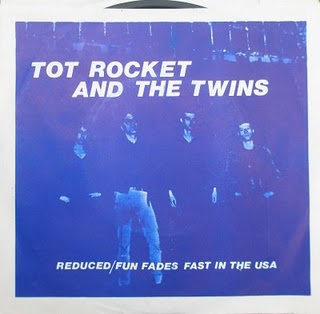
The record doesn’t look very promising, housed as it is in a horribly printed, ugly blue picture sleeve, the only distinguishing feature being song titles and the name of the band – Tot Rocket and the Twins, itself not a particularly provocative appellation.

The music, however, is another story. To be frank, Whiplash 45-107 hasn’t met with universal approval, but my ears tell me that the A-side, “Reduced,” is as spontaneous a blast of rock’n’roll energy as I’ve heard in sometime. The more heavy-metallic B-side, “Fun Fades Fast in the USA,” bogs down through 5:47 of constant repetition of the awkwardly alliterative title phrase. But the potential is obviously there; the possibilities for further growth and the development of a distinctive lyrical/musical outlook already apparent.

Tot Rocket and the Twins was founded in Connecticut in 1979, but the quartet’s roots go back several years earlier and a few hundred miles to the west. Three of the four members – Robert Michael Poss (Tot Rocket – “My friends call me “Tot”), lead guitar/vocals and writer of “Fun Fades Fast in the USA”; Andrew Halbreich, harp/guitar/vocals and writer of “Reduced”; Ron Spitzer, bass/vocals, went to Amherst (NY) Central High School and played in a number of pickup bands in Buffalo during the mid-‘70s. They gained a modicum of local attention at that time under the name Nothing New, though prior to the formation of the Twins, they hadn’t played together for several years.

Following Poss’ enrollment at Wesleyan University in Middletown, Connecticut, the Twins lived and worked in New Haven for a while. As Tot explains, “I wanted the band to have access to both Boston and New York, but away from the scene.” Although the Twins have since relocated to New York, they’ve retained their New England following, playing clubs in New Haven and Boston, and picking up considerable airplay in Boston and Providence.

The record was done at the band’s own expense while they were still in Connecticut, for the small Whiplash label (the label also recorded Killer Kane, among others). The Twins’ original drummer dropped out some time before the recording session, so Connecticut drummer Lou Farace was added for the record as a temporary fill-in. After moving to New York, Mitch Phillips joined as permanent drummer.

Unlike so many new bands, the Twins have a realistic idea of how the music business operates, and what it takes to get a new band off the ground. As Poss points out, “The first record was designed to be promotional, getting our name around to everyone we thought might be interested. We’re presently struggling to break into the New York club scene, which is not an easy matter. Skeptical, hardened, disinterested, trendy club owners seem to be the rule rather than the exception. Most of them seem to be interested in the band’s ‘draw,’ their ‘following’ – in other words, how much beer they’ll sell - rather than their sound or artistry. But, of course, it would be naïve to expect otherwise. The clubs in New York are taking fewer risks. They’re not taking unknown bands, but major-label acts and packages; even places like Max’s and CBGBs. There are new clubs opening up which book new bands, but so many records are coming out that having a record is no longer a foot in the door. We are being booked, however, and the response has been universally favorable.”

One of the most noteworthy aspects of Tot Rocket and the Twins is the political nature of many of their lyrics, an aspect which has been played down somewhat by most reviewers. Poss stresses that he would like “someone to review ‘Fun Fades Fast,’ mentioning that it’s about product-dumping, imperialism, the Nestle boycott, nuclear power, etc.” “Reduced” concerns itself with the loss of identity, personal dignity, and self-respect in an increasingly computerized, dehumanized society as a whole. Other songs, which appear on their upcoming EP, such as “Sacrifice,” “Employment Line” and “What Did You Expect?”, likewise probe many of the ways society, on its various levels, repress the individual.

One might conclude that Tot Rocket and the Twins is an overtly political band, perhaps an American equivalent to the Clash or Gang of Four. But according to Tot himself, “We wouldn’t call ourselves a political band. We, as individuals, are connected with these issues in everyday life, so we communicate that.”

Nonetheless, one can infer at least a quasi-political intent from the following excerpts of a carefully considered letter (which Tot refers to as an “Ideological piece”) Robert Michael Poss wrote to a review for the leftist paper, In These Times, reproduced here because of the degree to which Poss crystallizes the thinking of a certain segment of the New Wave:

“Our single… financed by our day jobs (we were working as janitors) represents the growing trend away from capital-intensive mono-cultural corporate ventures (e.g., disco and mainstream pop) towards more personal, regional or decentralized cultural statements. Without denying that success and acceptance is the goal of many New Wave performers, and that the financial pressures of running a band and releasing a record often inevitably lead to absorption into co-option by the mainstream recording industry; New Wave, in its essence, remains fundamentally non-corporate. The new young bands and the place in which they play represent a resurgence of an amateur idea, especially when contrasted to other forms of commercial music.

“It is a truism that one gets into trouble making extensive claims about the heroism of current rock and roll. Except for the Sumer of ’77, which in itself was less a threat than a promise, punk/New Wave has neither toppled the musical establishment or the larger sub-cultural milieu – but it has transformed it. The question asked and eventually abandoned by the Rolling Stones find both their echo and their answer in the Clash. Current music can provide and is providing what the proponents of so-called ‘political music’ are groping for: a progressive message fused to an appropriate musical form which yields an exciting and vital art form… Electric rock and roll need not consist of mindless misogyny and conspicuous hedonism.”


On the basis of their debut single, Tot Rocket and the Twins have yet to fully master that “exciting and vital art form.” The desperate excitement engendered by “Reduced” tends to obscure the message of the lyrics, unless one listens very closely or follows a lyric sheet (which is not provided). On “Fun Fades Fast,” the clarity of the lyrics is given greater emphasis, but on occasion, the words get in the way of the music; for example, “Why stop the poison when you can make the poison pay” makes its point clearly, economically, and unmistakably – but it doesn’t exactly trip lightly from the tongue.

Tot, however, feels the more recent songs resolve the problems by balancing lyrics and music to a greater degree. “Our new material is in many ways much stronger. I feel more comfortable with that material than with the record, and I’m confident we’ll be able to take off with it. Although the intensity is fully preserved and sometimes enhanced, there is an element of greater melodic depth to much of the material. I think it’s catchier. Not that it’s pop; perhaps it’s the balance between ‘catchy’ and ‘intriguing,’ more clearly struck.”

Their next release, a four-song EP, should tell how accurate Poss’ self-assessment is, and should also give an indication of how swiftly and in what direction the band is developing. There’s no question that the desire and determination are there. But desire and determination do not necessarily lead to mass appeal, particularly when there’s a message attached. At this point, Tot Rocket and the Twins are well worth encouraging, with at least one solid rock’n’roll tune (“Reduced”) to its credit. And that’s not a bad start at all.

Wednesday, January 20, 2010

KENNE HIGHLAND: Rock’n’Roll Superstar?

Original text by Tom Bingham, 1980
New introduction by Robert Barry Francos, 2010
© 2010 FFanzeen
Live photos © Robert Barry Francos (to come); album Images from the Internet


The word “cult artist” was created for people like “Krazee” Kenne Highland. He’s been in – or created – more groups than I can remember, such as the seminal Gizmos, the Kenne Highland Klan, the Afrika Korps (and its follow-up, the Korps), the Hopelessly Obscure, Kenne Highland and His Vatican Sex Kittens, Johnny and the Jumper Cables, the Exploding Pidgins, and Thee Psych-O-Daisies. I had the opportunity to hang out with Kenne a number of times during the early ‘80s up in Boston, and had a blast. He helped me understand what it means to thrive on I-IV-V.

These days, he’s sobered up, found religion of some sorts, and goes by Kenneth. But he has not lost his coolness, for sure, and he is back to performing and hopefully recording. And now here is the Tom Bingham interview, which appeared in the Number 4, May-June issue of
FFanzeen. Obviously, Web sites were added later on.

Ken Highland is a unique figure in rock’n’roll fandom.

His dedication to the music and to his concept of fan-as-contributor to the music has remained unswerving since the first golden era of fanzines in the early ‘70s. In an era when fanzines were devoted on one hand to documenting rock’n’roll from the ‘50s and ‘60s, on the other to serious analysis of then-contemporary rock, Ken’s Rock On was one of the first fanzines totally committed to the idea of rock’n’roll as fun.

But it was as co-founder, writer, singer, guitarist, and guiding spirit of the original Gizmos that Ken Highland made his most enduring mark on fandom. The Gizmos first EP on the Gulcher label (gulcher.gemm.com) both foreshadowed and transcended the then-developing New Wave.

Yet at the height of the Gizmo’s fame, Ken Highland was both physically and musically removed from the band – for the most part, tending to his duties as one of Uncle Sam’s “few good men,” yet leaving time to perform and record as a key member of the Afrika Korps, and more recently a duo (with Ken Kaiser) called the Korps.

While a lot of people know Krazee Kenne as a writer, as a Gizmo, as a Marine, as a Korpsman, as an image, little has been written about the real L/Cpl. Kenneth E. Highland; who he is, what he’s trying to do, how he got “that way,” whatever “that way” may be. The interview which follows, are his responses to my typed questionnaire.

We begin, logically enough, at the beginning:

Kenne Highland: I was born on a Monday, a day like any other day, April 2, 1956; same day Chuck Berry released “Roll Over Beethoven.” In December ’64, my parents got a D-I-V-O-R-C-E. My family atmosphere then was pretty WASP-y.

FFanzeen: As you look back, did moving about affect your eventual musical/lyrical outlook? For instance, did it expose you to different kinds of music, different sorts of people and experiences, etc.? I guess what I’m looking for is an “explanation” of how Ken Highland developed into Krazee Ken / Kenne “Gizmo” Highland.

Kenne: Yeah, moving about had one major influence on me and did kinda cause a chapter in my life. See, down south, I was exposed to what my parents listened to, which was typical Republican MOR like Ray Conniff, my homie Mitch Miller (from Rochester!), et al., plus my father liked Ray Charles and they also got into the early ‘60s clean-cut folk revival (heavy on the Peter, Paul and Mary, and Brothers Four LPs). Plus, my mother likes pre-Beatles ‘60s schlock a lot, which is why she grooves to all Kenny Kaiser’s tunes in that genre.

When I moved up north [to Brockport, NY, which is near Rochester], all I knew of the Beatles was that my mother and brother had heard “She Loves You” on the car radio one morning after they’d dropped me to school; plus Halloween, my neighbor gave me a Beatles bubblegum-with-card. So here it is, December ’64, and all my girl cousins are Beatlemaniacs; and even though I was a bookish Elvis Costello clone who hated music, it did affect me. In other words, this was my first real exposure to rock’n’roll.

FF: Were you a “punk” from the start, musically speaking, or did you try a little bit of this and that before you settled on your particular vision of crazy teenage rock’n’roll?

Kenne: Nah, I wouldn’t have labeled myself a punk in the ’60s. All the true punks hung out at Ida’s Soda Shop in downtown Brockport and went to the Panther’s Den. They were the school bullies, and I was too afraid of them to even walk on the same side of the street! I didn’t really get into music till 5th grade (’66-’67 school year) when this kid Carl Tagliabue transferred to our school from New Jersey. Since we were both outcasts, we became friends (ditto John Speary and Alan Baase, who played in primeval Highland bands in high school). Carl was a true record fanatic / Beatles freak.

Come ’68 and 6th grade, I sorta became a hippy, or at least had a more liberal outlook on life and music than did the jocks and greasers in my town.

I got a paper route summer ’68, and from then on became a full-fledged record fanatic, spending all my dough on vinyl, even belonging to three record clubs at one time. The ’69 “Back to Roots” fad started, so I became an archaeologist of sorts, discovering who did the originals to all those oldies the Beatles covered, then buying ‘em. ‘Seventy was my most eclectic year – I was into the “underground” sound: oldies, jazz (care of [Jack Kerouac’s] On the Road), folkies, Blues, even classical (Stravinsky, coz Zappa named him as an influence). As for becoming a “punk,” that came about due to 1) reading Nik Cohn’s Rock From the Beginning, which at first pissed me off, but later became my bible. I quoted from it when my sophomore English teacher praised all them folkies, who I dug as a hippie, but now scorned, coz I was wanting rock’n’roll; 2) buying Stooges’ Funhouse October ’71 (along with Go Bo Diddley) – at first I thought, “Are these guys serious?”, but I later loved it to death; and 3) reading the fanzine Flash #2, which again preached rock’n’roll, and to hell with heavy-metal, folkies, and all other hyphenated rock.

FF: Who would you name as the important influences in your music?

Kenne: Well, the Beatles for one; especially John Lennon – reading Hunter Davis’ biography on them [The Beatles] and how Lennon didn’t give a fuck and was just plain raunchy motivated me; that plus the Stones’ biography by, I think, David Dalton [Rolling Stones: An Unauthorized Biography in Words and Pictures - RBF], coz Jagger and the rest hated gym class as much as me and didn’t give a fuck. I’d also cite Bob Dylan in his speedfreak stage, coz of his bizarro lyrics, and Chuck Berry, and later on, MC5 / Stooges / Velvets / Dolls.

FF: Have your influences been drastically changed by the recent New Wave explosion?

Kenne: My influences weren’t drastically changed by the New Wave really. In fact, I resented the fuckers coz they were doing exactly what I was doing; only I was in boot camp and unaware.

FF: Do you feel the Gizmos in some way influenced the New Wave, since they were in it practically before anyone else?

Kenne: Naaah. Half the fuckers were heavy-metal dope-smoking hippies and coulda cared less! We were really too isolated to copy anyone, except maybe the Dictators and Patti Smith, coz they said anyone could be a rock star and make an album, so fuck it, we made a record.

FF: The world’s first exposure to Ken Highland was as a fanzine writer / publisher. How did you come to make the transition from rock’n’roll writer to rock’n’roll performer? Was this something you’d planned to do all the while, or did your move to Bloomington, Indiana, and your linking with Bob “Bear” Richert and Eddie Flowers somehow set things into motion?

Kenne: First things first, here. First off, I was a fucking musician before I was a writer! In ’69, I played guitar twice – my cousin had a Japasonic which I attempted to play the Sgt. Pepper’s theme on; goddam thing was so outta tune, it worked with open strings! That summer, my neighbor from India had an acoustic, and since I’d picked up The Freewheelin’ Bob Dylan for $1.88 in a Grant’s bargain-bin in Brockport, I was attempting to do a Guthrie-ish talkin’ Blues that was on the LP (and failed!). Instead, fall of ’69, I wrote a dozen tunes in 8th grade, all Dylan / Pepper’s obscuro stuff. Memorial Day ’70, I went to John Speary’s house and his sister had a Japasonic with amp and made my first recordings; a Bo Diddley-calypso version of “Old MacDonald” (I was on piano and maracas), plus John and I co-wrote one called “Sign Collector” (covered in ’74 by O. Rex; it sounds like “Sister Ray”). I was guitar-mad now; kept bugging my mother for a guitar and she finally relented by Xmas (I’d already bought a harp summer of ’70, which I blew Dylanesquely, till the next year I learned the Blues off a Canned Heat record).

Xmas ’70, I brought my brand-new acoustic to John’s place and we made some Godz-like tapes and officially had a band we were gonna form called The Squeeze, on Orange Records (coz Les Beatles had Apple). That cellar / bedroom band lasted most of ’71, till John became a jock and we drifted apart. Instead. In 10th grade (’71-’72), Alan Baase and I played around a lot. I’d bought my first electric August ’71, and got lessons from a punk-cum-hippie (after he discovered drugs). Big Al and I had a pseudo-band, Big Dick and the Penis Erections, sorta inspired by John Mendelsohn’s Christopher Milk essay in Rolling Stone. I envisioned this band as rockandroll, doing Stones / Kinks / Bo Diddley / Chuck Berry tunes and just going mental; sort of an Iggy / Jagger lead singer, a Chuck Berry / Keith Richards lead, the all important rhythm guitar, and a Stones-ish rhythm section. All this and more led Alan and I into fanzines, inspired by Bomp and the New Haven Rock Press. I got my style of writing from R. Meltzer and co.’s “fuck-it” style and the serious critique of the hippie papers. I didn’t even wanna do a fucking fanzine, but Alan, who was pretty tall, pretty much told me I was, so we mimeo’d off Rock On on a mimeo at work, using stolen supplies. Our junior year, Alan talked me into taking lithography and we put out two offset issues of Rock On in ’73, which lead to many fanzine connections, among them Flowers and Bear [Gulcher fanzine - RBF].

I’d been pen-pals with Solomon Gruberger since fall ’71; we met and jammed June ’73 (that’s me, him and his brother Jay, who already were O. Rex). I told everyone that when I graduated, I was gonna move to NYC and become famous (never did), and instead wound up moving to Bloomington to become a rock writer, coz, as usual, I’d quit playing guitar that summer, saying “Ill never get anywhere,” etc.

FF: After the first [self-titled] EP, your participation in Gizmos’ recording sessions was severely hampered by your enlistment in the Marines. Still, your songs appeared on the next two Gizmos EPs [Amerika First, Gizmos World Tour – RBF] and your personality seems to dominate them. What’s your opinion of those two EPs? Do you feel the rest of the band did a capable job translating your intentions to vinyl?

Kenne: I think it’s pretty obvious I didn’t give a fuck about them really, coz I was officially a member of the Afrika Korps, though I'd use the Gizmo fame to further my name. It was a weird trip going through my head – I’m supposed to be in an East Coast band with old high school friends, yet the Midwest band is doing good in print (not one bad review in ’76). Anyway, I met my wife-to-be [Linda a/k/a Miss Lyn of Boston Groupie News fame: bostongroupienews.com], so I wanted to spend time with her, instead of going into the studio. I said, “Fuck it. Rich Coffee’s a better guitarist than me, [Ted] Niemiec and Flowers sang better on that first EP than me; they don’t need me.” I finally showed up though, and sang two songs, one appearing on one EP, the other on the other. I’m not too proud of the singing.

As for the other Gizmos’ performance of my tunes, at the time I thought it was better, but my fans / friends / girlfriend didn’t. I dunno, I’m still a bit insecure about myself as a performer in the musical sense. I know I can perform, but technically I can’t sing on-key, despite what Martha Hull says, and I can’t tune a guitar worth a fuck. But again, Dylan and Lou Reed are idols to some clowns (myself included), so if they get over, so can I.

With the second [formation of] the Gizmos, Bear gave me the option of being a silent partner and I didn’t give a fuck; this is essentially his trip and he kept me informed of what was happening. But again, since all I knew was Ted Niemiec, it was hard for me to relate to faceless names. Besides, my closest friends in the Gizmos were Flowers and Coffee, so wit them out, I knew what we’d envisioned as a band (to be the Stooges / MC5 / Velvets / Dolls) wasn’t gonna happen that way, coz, well, Bear ain’t that way. [It is important to note at this point that Bob “Bear” Richert has been releasing much of the early works of Kenne on CD – both Gizmos and Afrika Korps/Korps – with his Gulcher imprint, so he must appreciate what Kenne was doing back then – RBF, 2010].

Let me define Gizmo here: I met a punk-cum-hippie kid who taught me guitar, while harassing me at other times. Digger said there was this spastic kid in school, had cerebral palsy or something – legs and hands all bent – and Digger and some other punk-cum-hippies were in study hall and we usta trip [him] all the time and the other [guy] said to Digger or visa-versa, “Hey…” and he pointed to said spaz – “Gizmo.” So this individual was the original Gizmos and, mostly to harass me, I got labeled with it, coz, well…I’m left handed and have 20/200 vision and can’t play sports worth a fuck, so I am pretty spastic, but then again, I concentrated on music so’s to make these nerds eat crow! I mean, man, they’re all working factory jobs, deserted guitar playing almost altogether, still carrying that San Francisco look and being 23-24, and still living in Brockport!

FF: How did you link up with Ken Kaiser, the Grubergers, and Kim Kane to form the Afrika Korps? How did the Ken Highland songs on the Music to Kill By album come to be recorded by the Afrika Korps, instead of the Gizmos?

Kenne: I linked up with Kenny Kaiser February ’77, via a Ft. Lee, NJ, Marine named Don Buckley, who was stationed at Ft. Meade, MN, with me. Buckley’d told me about Kaiser and visa-versa, and Kaiser had read about the Gizmos in Creem. I met the Grubergers through a pen-pal correspondence in Circus mag beginning fall ’71, and, like I said, we first jammed June ’73, again doing real rock’n’roll. Covering “Louie, Louie,” Alice Cooper, Yardbirds, Who, and a Grand Funk-ish “Gimme Shelter.” We thought we were good then (I should say Solomon did – I knew we sucked), but it went along with the punk aesthetic of “so bad it’s good”), and Solomon kept saying, “We’re gonna cut a record.” So Flowers and I were in Brooklyn the month after the Gizmos, and Solomon wanted to do a record, mostly coz he was jealous, but the tape fucked up, so instead, me, him, and Jay did the O. Rex maxi-45, which is an embarrassment to me, but the Kinks second record sold 127 copies and so did this, so we were happy with our failure.

After the O. Rex fiasco (I never did like the name), we hit upon Afrika Korps in an insomniac night of KISS Alive and neo-fascism. Solomon this time said, “We’re recording an LP”: I hoped to hell it didn’t sound like O. Rex. I met Kim Kane of the Slickee Boys one night at a Ramones concert in Georgetown. Kim and I talked all night, after being introduced as mutual fans. I told Kim / Marty of our plans to record an LP and we both agreed it’ll be neat to have a “supersession” of DC peeps on the LP, and the rest is history.

We recorded the session on my off-duty weekends at Ft. Meade. See, that duty station was the greatest and it was midway ‘tween Baltimore and DC, and only four hours from NYC, so I was closer to the Grubergers than when I lived in Brockport! Solomon and I originally envisioned the LP as one side his tunes, recorded in NY and one side my tunes, recorded in DC with assorted Slickee Boys. Didn’t quite work out that way, but we did record the LP in some very violent sessions from January-May ’77.

We originally recorded in NY in January, then February-May in DC, though there was an April ’77 session in NJ, which I didn’t attend coz I was either Gizmo-ing, dating Linda, on duty, or didn’t give a fuck; and it was there we got the best sound. The other engineers were clowns who didn’t even like what we were doing; unsympathetic.

I wrote quite a few three-chord numbers as a teen (recorded both by O. Rex and Gizmos), but once I went in the Marines, I started getting more complex, more melodic, and stole quite a few heavy-metal licks, too. I went on a spree of writing fall of ’76, while stationed at Quantico, VA – I was on guard duty late at night walking in circles, so my ever-active mind just made up songs, which I’d put to music at the Kane house my next off-day.

FF: How did the Afrika Korps become a duo called The Korps? Does the Korps exist outside the studio? Will it exist past the Hello World LP?

Kenne: The Afrika Korps officially became the Korps in December ’77, when the Grubergers split from us, or us from them. I don’t like to air dirty laundry, but suffice it to say the Afrika Korps had too many egos, and like Cream and the Beatles, were too good to last. Solomon and Jay are still together and they’re planning on doing other records. I stuck with Kaiser for some unknown reason – a great loyalty battle here, coz here’s my friends not getting along, as usual, and I had to rob Peter to pay Paul, but I stuck with Kenny, much to various ex-members’ chagrin. Sure, he’s a dictator, but when you’re as irresponsible as I am…

So after the Grubergers left, we auditioned nerds from NJ for bass and rhythm guitar, and that sucked, so I had Kenny move up to guitar and share vocals, coz as Afrika Korps’ drummer, he was the best guitarist in the band. Through ads in the Aquarian, we got a drunk Puerto Rican / Italian bassist from Jersey City and an 18-year-old pothead on drums, and played one gig Easter ’78 in Kenny’s basement and that Korps went kaput that night, for other fucked-up reasons. Kenny and I toyed with various names, like the Rabbis, Eddie and the Enemas, but stuck with the Korps for commercial reasons.

The way I see it, when I get out of the Marines, he and I will reunite in Boston, get a rhythm section and do what we can. He wants to record an EP as a follow-up to Hello World, and has talked of Album #3; and Album #4 has to be Korps Alive, so…

Hello World was recorded with just the two of us (stole the idea from White Boy) doing rhythm guitar and drums, then Kenny, technical genius that he is, overdubbed most all the instruments, and me singing a lot, plus gotta add those Slickee Boys (Kim Kane pays for a third of our records, so it’s pretty obvious…)! Since I had only two off-duty weekends a month, it’s like Kenny and I would do sessions every couple of Saturdays and I’d leave all the other bullshit to him to do while I was guarding our country’s defense. I’m still not all that keen on recording; the stage is my forte.

FF: Do you feel Hello World, or at least the Highland-sung tunes, accurately reflects Ken Highland as he is today, what you’re thinking, what you want to do musically, what you’re capable of doing? And how does Martha Hull always get to sing the best cut on any Highland-Kaiser album?

Kenne: Oh, hell, yeah! Even though all the Highland tunes on World, except “Lark” (which is ’72 circa “[Pumpin’ to] Playboy,” “[We’re Gonna] Rumble,” et al.), were 1977 composed, it’s still where I’m at more than the old Giz-Korps stuff. I’m especially proud of the “Do the Touch” / “Designs on You” / “Mad at the World” / “Gotta Be Pretty” sequence, coz I wrote all of them inspired by a week straight of watching the Slickee Boys, when they had Howard Wuelfing. I’d say it’s how I am today – I write a lot of Mersey-Beaters now, inspired by “Heart On,” Graham Gouldman [10cc], and Lennon-McCartney; only I’ll always have that Iggy / Dolls rasp to my voice. What I’m thinking… Well, these Mersey-Beaters are love songs full of pronouns, like the early Beatles, so peeps can’t accuse me of too many inside jokes. My main theme is love now, mostly coz I’ve been six months separated from my wife, and it motivates her to hear love songs inspired by her, though she’s not mentioned by name. What I want to do musically? Well, I’d like to improve the sound, clean it up, but keep the balls. Kaiser and I are like Lennon-McCartney – I have the rough diamond, he polishes it, and we keep the other in check, so as not to out-wimp the other.

As for what I’m capable of doing – well, you can hear the difference (Michael Miller, who co-authored “Amerika First” says Hello World sounds like Sgt. Pepper’s compared to the last LP [Music to Kill By]), but it can still get better, though a lot of it’s Kaiser’s doing. And the reasons Martha Hull always gets to sing the best songs on any Highland-Kaiser LP is because she makes it the best song on the LP; that chick can sing! [youtube.com/watch?v=mRy9BPn3au8]

FF: What’s your next musical step? Do you have any plans to do any more recordings during the rest of your Marine hitch? Do you think you’ll be making a career out of rock’n’roll when you get out, or will it remain an all-consuming hobby?

Kenne: I plan to get the fuck out of the Marines, and again, don’t look back; get with Kaiser, get with a band, and get famous! Linda is behind me 100 percent for a musical career.

FF: Now that you’re a married man, do you think that after you’re out of the Marines you’ll settle down to a nice cozy, middle-class existence like a “normal person?” If so, will Krazee Ken still be krazee; will you still be doing songs like “Gimme Back My Foreskin” and “Nobody’s Girl,” or will you vegetate into a prematurely middle-aged mellow FMer?

Kenne: Now, goddammit, too many think that coz you’re married, you gotta get a job, have a million baby Kennes with big smiles and big heads…bullshit! Muthafucka, I’ll be rockin’ like Chuck Berry and Jerry Lee and Link Wray when I’m fifty. Course, I won’t be doing “[Gimme Back My] Foreskin” / “Girl” type tunes – that was ’76; this is ’80! Naw, I see myself being like the AM stars of now, who were FM stars when I started. Like Bob Seeger – he commercialized just enough to get famous, but still screams and goes wild. Ditto KISS. When Bill Rowe and I saw Black Sheep our senior year, he said, “Ken, I like what Black Sheep is doing – that’s what we should do.” I said, “You’re fuckin’ crazy! We gotta be like Iggy and Alice and the Dolls and go wild and shit.” Guess I was wrong, huh?