In my daily job, I help train people
on how to use computers, mostly using the Microsoft Suite, but I also do a
class on Basic Computing and using the Internet and Email.
For the latter, many of the people
who come in are nervous because the computing world is new for them. Many are also
well over 30 years old, and this is a whole new world. It is part of my job to
reassure them, and give them confidence.
Though it seems like it is
anti-intuitive, one of the first thing I let them know is that it is okay to be
frustrated. In truth, no matter how beginner you are, or how proficient on
computers, odds are a couple of times a week you are going to want to throw the
machine out a window. This is normal, and it’s not just you, it’s everyone. I once said this to my class
while a new intern was at a computer in the room, looking at the screen. He is
a coder at a high level, and he even built his own computer from scratch. When
I uttered those words, without even looking at me, he nodded his head in agreement.
The fact of the matter is, even though this is true, the end results are worth
it.
I’ve had a number of older students who
get frustrated and complain that their kids can use the computer with ease, and
the younger ones lose patience with them. What I do is remind them that they
are now the age their own parents were when they had to be taught the VCR. I
say, “Remember how mad that made you feel? ‘All you have to do is hold down
Play and Record at the same time!’ That’s what their kids are feeling now.” Computers
are more complex than the video player/recorder, so that amps up the anxiety.
But a new user doesn’t need to feel that.
The biggest mistake in learning any
software is to only follow the instructions. To explain, I’d like to present a
true story: when I was eight years old, my mother brought home a portable Royal
brand typewriter she had bought at work. The thing weighed nearly as much as I
did at the time. When I showed interest in the machine, she gave me an official
practice book to type from, that stood up on its own, so you could flip the
pages. It had the usual “The quick brown fox jumped over the lazy dog” and “The
meeting with Mr. Johnson will be held at 1:00 PM” kinds of exercises.
Being a mere wisp of a lad, I found
this to be quite boring, so instead, I started to type out song lyrics. I found
that no matter how much I slowed it down in my head as I was typing, I could
keep some sense of rhythm. I used Simon & Garfunkel, the Temptations, the
Beach Boys, the Beatles, and whatever songs were either on the radio or the few
Broadway show tunes LPs my parents had that I grew up on. This made it fun.
When I was 10, I typed out the entire, “The Tell-tale Heart” by Edgar Allen
Poe, still one of my favorite short stories to this day.
This exercise helped to make the task
enjoyable enough for me to keep doing it, until I was typing at 55 words per
minute, which is not an easy feat on a manual typewriter when one is a mere
child.
It is not, however, just in typing
that this can be employed as a learning tool. For example, if you need to
improve your Microsoft Word skills, create something of your own. I suggest building
a letter to your friends and family to let them know how you are doing
(sometimes known as a “year-end letter”). Then add a photo, some borders, play
with the fonts and spacing, and make it “pop.”
One student was having trouble with
Excel, so over the summer, he made a list of every fish he caught, which lake
it was snagged, what lure was used, and the weight of the fish. By this process
he figured out which lure in what lake caught the biggest fish. He personalized
it and made it interesting for himself, and then understood the process.
This is also true for the Internet.
While you’re looking for jobs, for example, check out the location of the
company. Figure out the best route using a Maps program (e.g., Google Maps), go
to the Street View and see what the front of the building looks like. If you
want to start even easier, go to a search engine and type in the name of your
favorite musician/band, or actor. When
you find what you are looking for, try the different tabs, such as Images, News
and Videos. Try searching for your own name and see what comes up. This is
actually important to see what is displayed if you are looking for a job,
because in today’s technological culture, there is an ever better chance that
the possible employer will search your name than not.
Once you start getting comfortable
with the computer, you can think more on what you’re searching for than how you
got there. Much like a flashy guitarist does not think about what is being
playing note-by-note but rather the hands “know” instinctively where to go to
get the next note, typing and searching becomes more natural and reflexive.
This will transfer over to when you do a task for a job, and make your life a
bit easier and gain you more confidence.
I have done this myself, as well. The
way I figured out how to use Absolute References in an Excel formula (e.g.,
$B$4), I applied it to my time sheet while I was still technically on contract
per class. Now I use a timesheet (not mine) to explain how the formula works to my classes. I did a similar thing
with Pivot Tables. I was trying to figure out what goes into which of the four
boxes, so I made a list of every record review I’ve had published from 1977
through 2011 (came to over 2500), by listing (a) the Band, (b) the Name of
Record, (c) the Type, such as 12”, 7”, Cas, digi, (d) the Record Label, (e) which
magazine/fanzine/website published it, and (f) the date of publication. Then I
was able to make lists, for example, of every band from a particular label I
reviewed, and the name of the releases. To learn Word’s Mail Merge feature? I
created a list for sending out my Year-End letter, and I figured out how to do
it quickly, and then personalize any one I wanted.
Once a user can understand how it works on a personal level, it
makes it easier to use in a more professional setting, or explain it to others,
not just to do it yourself. It truly is a use-it-or-lose-it situation, so it is
also helpful to remember that teaching others is a good way to aid learning and
remembering the steps for yourself.
This interview was originally published in FFanzeen, issue #7, dated 1981. It was written and conducted by then-FFanzeen
Managing Editor, Stacy Mantel.
To be honest, I wasn’t a fan of Polyrock at the time, as I found them too…esoteric.
The whole synthesizer/techno-guitar thing was lost of me, but Stacy was a big
fan, hence the interview. I heard the albums back then, but never saw them
live. However, I do have an indirect tale about them:
In the early 1980s, after this article appeared, I applied for a job as
an Editor at a technology-based magazine, and was granted an interview. When I
got there, I found out that it was produced by Al Goldstein [d. 2013], and the interview
was in Screw Magazine’s office. The person interviewing
me was the brother of a member of Polyrock. He knew who I was because of this
piece, and said he was not going to give me the job as a favor to me, because
having Screw Publications on a resume was not a plus, and Al was a hard person for
whom to work. He did, however, show me Goldstein’s office, which was just
packed with memorabilia. He warned me not to touch anything because despite the
chaos, Goldstein knew if anything was moved. I thank him for that, even now, because
he was absolutely correct.
As for Polyrock proper, they released two major-label albums on RCA,
produced by Philip Glass, and disbanded a year after this interview was published,
in 1982. Looking back, I can appreciate some of their releases more, such as “Bucket
Rider,” but even today, the snyth/modulated material is still is not where my
interest lies. – RBF, 2017
Polyrock is not unique, but then
again, they are. It depends upon what angle you care to listen to them from,
and how contaminated your musical background is.
Everyone is talking about them. Some are
nervous, some elated, some speechless – but they are reacting. Polyrock
themselves are doing the least talking. They are modest experimenters, trying
to be a little different. Polyrock is: Billy Robertson, guitar / vocals; Tommy Robertson,
lead guitar / electronics / violin; Lenny Aaron, keyboards; Curt Cosentino, bass
machine / synthesizer; Joseph Yannece, drums / percussion / vocals; and
Catherine Oblansey, vocals / percussion.
I spoke with Billy Robertson at the Rock
Lounge, Saturday, February 28 of this year. He is very amiable and neat, and
smiles freely. When we spoke, a lot of sentences were left open where words
could not express certain artistic aims; sensibilities. For coherence, I had to
punctuate in my mind and on paper. Personally, they’re probably best left
unclosed, because in that, there is more understanding.
FFanzeen: In The
[Village] Voice, John Picarella compared
your sound to geometric paintings a la Mondrian.
But when I listen to your music, I don’t think of harsh, stark lines; I feel it’s
more impressionistic and imageful. What do you feel?
Billy Robertson: Well, it’s really hard to make a comparison to paintings or that kind of
art, but I see it more as impressionistic. It’s also an immediate type of thing
too, because it isn’t painting. Although when you go into the studio, you make
a record and it’s a piece, but when it’s written, it’s sort of an act of
aggression. The thing is to capture a live moment; an experience.
FFanzeen: What do you mean by “act of aggression”?
Billy: It’s a
weird word – it’s a performance. I don’t mean aggressive as a negative or
positive act of aggression or anything like that, but putting out something
immediate – something with a certain amount of intensity. And it’s a
performance. To answer your question more specifically, it’s more
impressionistic than mechanical.
FFanzeen: It’s felt mostly on “Your Dragging Feet.”
Billy: Oh,
yeah.
FFanzeen: It’s very hypnotic, almost like a mantra, because it’s somewhat repetitive.
Billy: It’s
packaged sort of in a form; it has levels. It’s a very pretty song to me.
FFanzeen: The systems approach and Philip Glass’ music deals with similar types of
repetition and levels.
Billy: That
song has a lot more of that mode or side of us than any other song, and I think
it’s something we really want to do; even in short pieces, and not so much a
trance-piece, but something that’s very subtle and right there with the instrumentals.
Some of the new stuff would make this clearer to you. That type of writing
style started, for me anyway, when I listened to Brian Eno; I heard it in the
Beatles and John Lennon songs like “I Am the Walrus.” And that’s what I like
about Philip. When I first heard him I appreciated the repetition. He was an influence,
but he was more someone we liked and respected. We really didn’t see his music
as being part of our music. I can really like jazz or other kinds of music, but
I play my music, and it just has been
coming more and more. I just identify with Philip so much. I think he identifies
with us, but he knows that we’re making pop music and we’re in a different
medium.
FFanzeen: How did that collaboration come about? Was it on your mind or –
Billy: It did
enter my mind, but I didn’t see it as becoming a fact. I never thought it would
become a fact because I didn’t picture Philip to be what he is, as open-minded
and just as versatile because he listens to all kinds of things. He makes music
that’s his music.
FFanzeen: Do you see Polyrock trying to bridge the gap between that kind of music
and pop rock’n’roll?
Billy: Yeah, I
think subconsciously. We’re trying to make a serious sort of musical type of music;
not just an occasion. A dance band. That’s definitely on our minds and that is
an aspect of our music. We really like John Cage and people like that, their
aspect of music, but we also enjoy playing for people and dancing. So, we’re
trying not to be that, as many writers said, “serious.”
FFanzeen: You’ve had a lot of problems with the critics about that aspect of being
serious. Some have asked, “How can a pop band have that in their musical or
personality makeup”?
Billy: Well,
it’s in the personality. I think it’s a real special thing. That’s what keeps
me going. I see it developing more and more for us. Sort of like bridging that
gap. I wouldn’t say so much as the repetitious thing or the minimalistic thing
because I don’t think Philip Glass is minimalist.
FFanzeen: I don’t think so either. Minimal is an Andy Warhol film.
Billy: “Grey
Canvas” is minimal.
FFanzeen: When you’re putting music together, do you take concrete ideas and put
one after the other, or do you use the kind of random approach that Eno takes
with his systems pieces?
Billy: I think
that when I write, I hear where it’s going. I can sit down with an acoustic
guitar and play it. Well, it’s sort of a systems approach because I’m doing
other people. I know what Lenny, as a keyboard player, will reflect into the
song, and I know what Curt will. And I have an idea what my brother will do –
he would definitely write his piece to it. But the others, even though I’m writing
the melodies and injecting it to them, I can already see what they’re going to
do. When I play with just an acoustic, I usually do the melodies with my voice,
and it’s weird because you keep the melody in that part of your head and you
write another melody, or you get someone to team up with you. There’s so many things
we have to stay away from when we write, Tommy and I. We try not to keep Blues
progressions out of it and funk feelings. We’re trying to start with these very
sterile sort of holes and these melodies. Mechanically, that’s what we start
with. But, we’re trying. I think we’re very emotional. I think we’re trying to
inject that, so the emphasis is not on funk, because what’s soul? That isn’t
soul. We can have soul in our music.
FFanzeen: Well, not having a bass is almost an anti-funk idea.
Billy: I’m not
anti-funk. I mean, I love it. I find it more challenging not to work with,
because it’s very easy to me. It’s because we have to stay away from these
things. I think it’s inevitable that we’re going to grow into something where
we wouldn’t have to sit around here and try to explain it. It’ll just be this
type of music that came through a process; but it’s just a process of trying to
strip down and get away from all these things that have been done; all these
different modes. I mean, it’s been 25 years since rock came about and pop music
still sounds the same way. You can make it different and change it into a different
shape, but it’s still the same medium. And funk’s been around and African music
has been around. Sometimes I think it’s a crazy thing to do [smiles] but if it can work and we can
do it, good. It’s a romantic thing to do, laying yourself on the line; but it’s
an experiment. We can fall flat on our faces, and we’ll just turn around and
try it a different way. I don’t think that I’ll ever put together a band that’ll
be accepted right away. I don’t think any of us would. We would try to do something
that had space for growing.
FFanzeen: Groups like Visage and Spandau Ballet are working with computers that go
beyond a synthesized bass; they’re computerizing a beat. People are saying you
are electronic. Isn’t that a bit off-base?
Billy: I think
that when using all synthesizer and rhythm generators, I see that sound as
getting too homogenized, too packaged too quickly. I think that just working
with guitars is more of an inside thing. I see that kind of electronic music as
getting too sterile. Like Gary Numan. I liked his first record, but he got too
sterile. The overall sound is too formulated.
FFanzeen: That’s what I meant, because those people are just programming in the
entire thing and they’re called inhuman.
Billy: Well,
that’s supposed to sound inhuman. I look back on this record and there are
reservations, because the fact that we have a serious edge doesn’t give us room
to be playful.
FFanzeen: What’s your definition of “serious”? The B-52s take themselves seriously.
Billy: Yeah, I
can think that, too. I could ask myself, “What is the definition of ‘serious’?”
And I think it’s totally absurd to think that way, but obviously there is a
whole overall thing that is looked at as serious and something that’s looked at
as playful. It’s not my definition though. If I really stop to think about it,
it’s just a type of seriousness where you have an attitude of just like when
you make a piece, it could be a serious piece, something that you’re really
thinking about and really trying to make different, but also trying to be very pretty
and aesthetic in a sense; something that’s not as playful, because if something’s
not playful, what else can it be?
FFanzeen: You mentioned new material. What stage is that at now?
Billy: It’s at
the stage where we have five or six songs down – not all at the performing
stage, though. We’ve been working. We’ve been to London, and we’re going to
Baltimore. When we get back, I just want to go back up to our house [in historic Woodstock], and get these
things down. We want to get back into the studio to make another album the end
of March.
FFanzeen: Will Philip Glass produce the next album?
Billy: I think
he will. It all depends on what the circumstances are, who we’ll be working
with. I see him as another member of the band with just a smaller part. He
doesn’t produce it; he’s not about that. And that’s what I was talking about –
one of the reservations about going into the studio again. Because we want
somebody who’s going to be more sensitive to the rock’n’roll aspects of it.
FFanzeen: Let’s get some more background. Before Polyrock, you played with the
Model Citizens for a while. What was Tommy doing?
Billy: This
was the first time he became visual, and marketed what he does. Before that he
made tapes and has a collection of his own tapes which may be marketed someday.
He’s been working mostly on his own music. This is more of something which we’re
trying to create. It’s not what we’re about. Right now, we have this thing and
it’s a band. We’re using our personae. We’re using the look. It’s a lot more
than just making music. I think if Tommy was to write music for himself, he
would explore a lot more different things; more subtle things, and not be so
accessible to himself. That’s what I’m into doing.
FFanzeen: Aren’t you afraid to explore so soon?
Billy: Yeah.
It definitely takes some time, and it’s good for me. I don’t think it’s a
compromise. I think that we’re going to get to the point where we’ll be ready
to do it, and we’ll know better how
to do it, and we’ll learn what directions we really like and want to go into.
But I think there’s a different attitude. A more spread-out kind of
experimenting. Next album, I’m going back to bass on a couple of tunes. On the
first record, for some reason, I just wanted to get away from electric bass. Maybe
now I can incorporate it into our sound, because we’re starting to get a good
idea of what we’re doing.
FFanzeen: How long were you in the studio recording the album?
Billy: About a
month and a half.
FFanzeen: Did you have anything to do with the ad campaign RCA launched, with “Polyvinyl,
Polyrock of the Future”?
Billy: No, not
at all. Did it seem like any of us did? I hope it’s clear to most people that
we had nothing to do with it. We really hated it, but I’m not going to turn around
and say “RCA stinks.” They just got a little away from us.
FFanzeen: Polyrock is the best name you could have come up with; it’s so
descriptive.
Billy: We thought
it had a nice sound, also.
FFanzeen: What about this “dance-trance” business? It’s applied to other groups
too, such as the Bush Tetras, and you two bands couldn’t be further apart.
Billy: It’s
obviously not an adequate description of the music. Even more general is the
term “New Wave,” which really freaks me out because Blondie is supposed to be
New Wave and even Talking Heads, because they made it through the same packaging,
the same channels. So I just have to say when people ask me what kind of music
we play, it’s “Polyrock.” We’re making it that and that’s what we called it.
The Take Back the Night march is an event I try to attend every year in Saskatoon, help this year on Thursday, September 21, 2017. I don't feel I need to go into the reason why it is important, because if you don't know, you should. This year it was held at the YWCA Saskatoon parking lot, and walked over to the University and back (about two miles, total).
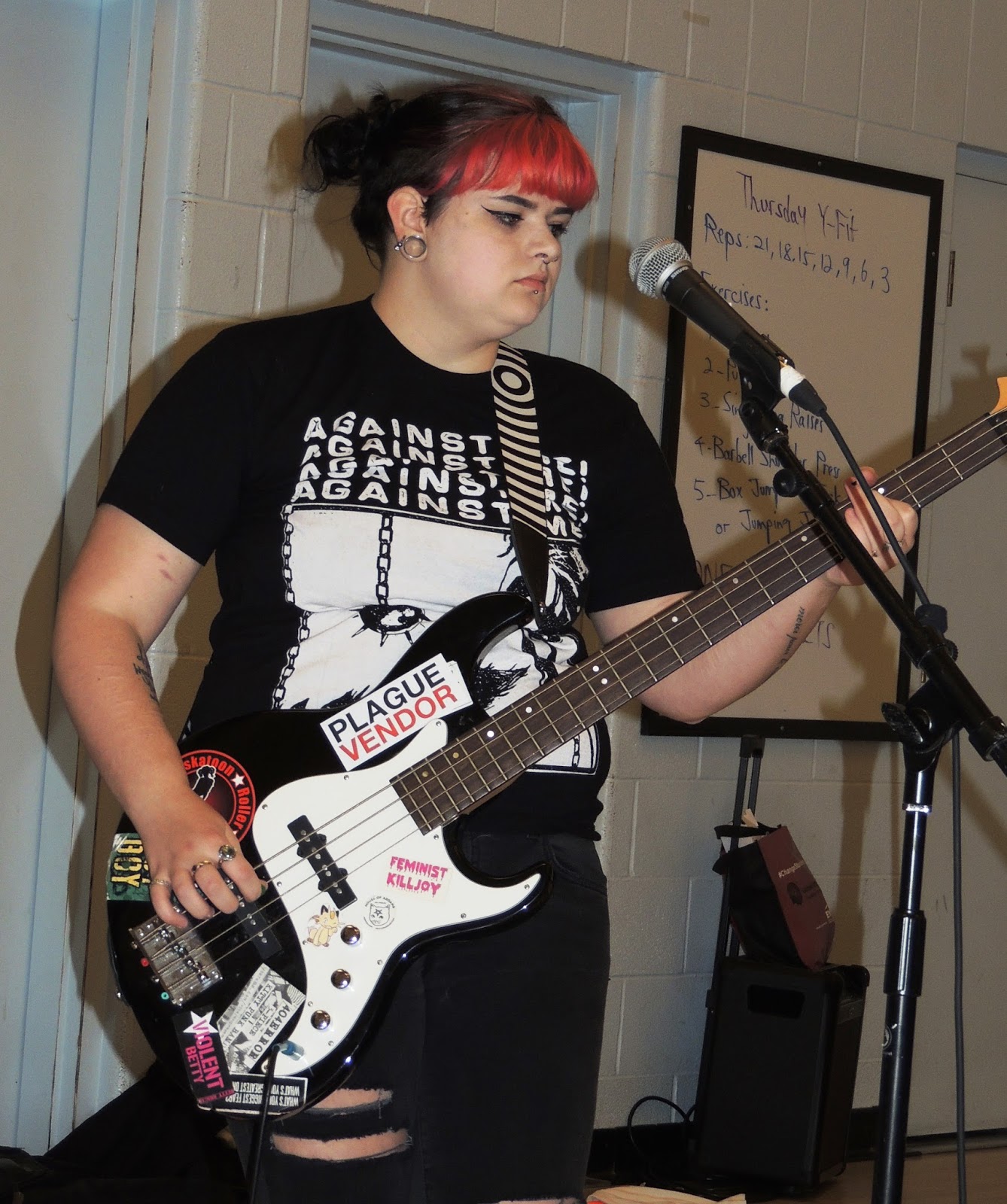
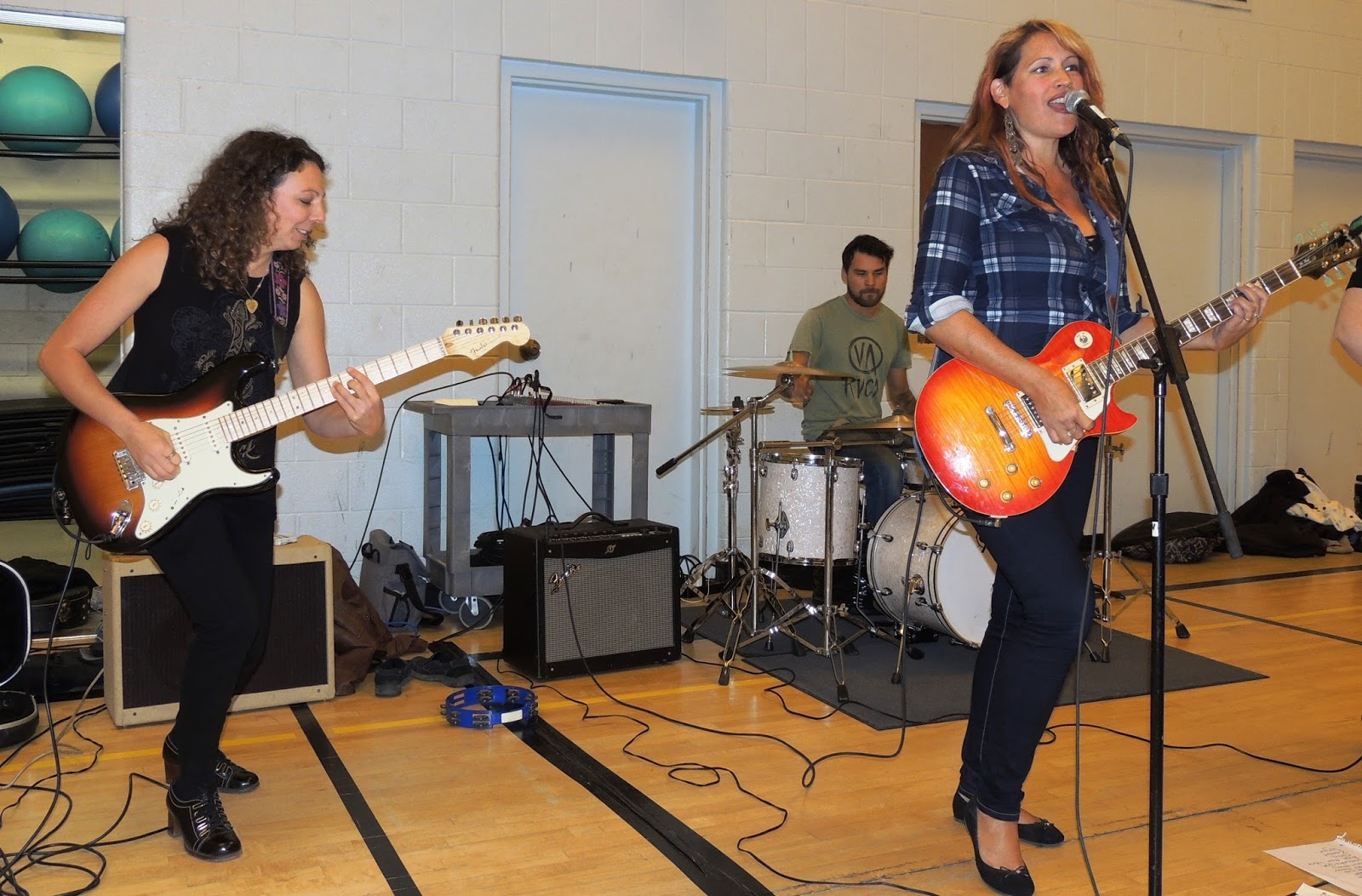
After the march, which had quite a few hundred people of all ages and genders, we met back at one of the rooms at the Y, and were treated to the music of local Saskatoon band, Jezebel. Yeah, I know, there are a few other bands with that name, but as I have not seen them, it's a moot point right now.
They had a nice contingent of fans at the event who danced in the back. Yeah, they were fun, that's for sure. They did a few covers as is expected for the crowd, including Jefferson Airplane's "White Rabbit" and Joan Jett's "I Hate Myself for Loving You." And as they describe themselves as "Unapologetic Bridge City prairie pop punk; pulling no punches with knockout hooks, hard hitting melodies and heart-on-their-sleeve lyrics, it's no surprising they do a cover of Britney Spears' "Toxic." While they were well done, I actually liked their original material better. They have an EP coming out, and perhaps I'll get the chance to review it.
Terri Bear-Linklater: vox; rhythm guitar
Mik Mak Bowman: vox; bass
Jovan Larre: lead guitar
Breton Cook: drums
It is bound to come, where applying
for jobs by cell phone will be the common procedure. The level of technology at
present day, however, makes that possible, but is it the most efficient?
Of course, the biggest attraction to
using the mobile over the desktop or laptop is ease, and yes, being able to
blast out your information to a large number of companies covers more ground.
Having your resume and/or cover letter in your email and forwarding it is a
snap. Even with that, there are more functional and possibly successful ways to
proceed in your job applications.
When you send your resume and cover
letter to a prospective employer, the email will indicate that it was sent from
a mobile device. This tells the Hiring Manager some assumptive information. For
example, it says that you are sending out resumes that are not directed to the
company’s individual needs, but as a “pin-the-tail-on-the-donkey,” cover-all
template. They want to know you are
willing to put in the work and research before you apply, and that you are
self-motivated and proactive. If you want to stand out, it is better to individualize
your resume and cover letter rather than sending a come one-come all version.
This is especially true for cover
letters. Some people will type in a version of a cover letter into the actual
email, but this is not as efficient in attracting positive attention as
attaching a document that is easy to print out.
A proper cover letter should be
dated, addressed to the company connected to the advertisement even if you have
to look up the actual physical address in a search engine, and mention the
position exactly as it is mentioned in the ad, including competition number if
one is attached. Sending out a cover letter that is undated and unaddressed
does not garner as much attention as one that is directed to the person and
company requesting your information.
Many companies also have online
applications, where the person looking for a job needs to attach a resume after
you create a sign-in with that website. These cannot be sent from an email as
of yet, so there is still a need for the physical presence rather than just a
click on a phone.
Microsoft Word or other word
processing software are not easily navigated on a mobile device, so it is
better at this stage of the technology development to actually work on the
application on a desktop or laptop.
Cheap Perfume were a rockin’, all-woman band that was underrated in the
New York Scene, and deserved better. I had the opportunity to see them a couple
of times in 1977-78, and was happy to give them their due by publishing this
piece. They have reformed a number of times, sometimes with the lead singer who
had moved to the other coast, other times with the rest of the band filling in
vocally.
Please note that this has nothing to do with the Colorado-based band with
the same name, which was formed in 2015.
This interview was originally printed in FFanzeen, issue #5, dated August/September 1980. It was written/conducted by Marc
Silver. I have lost track of Marc, so if anyone knows his whereabouts, please let
him know about this!
Cheap Perfume
occupies the niche of the top-drawing all-female band in New York. Their music
is self-described as “power-pop with a rock’n’roll edge.” Performances are
vibrant and chock-full of ass-kicking rock’n’roll. The majority of their material
is original, but their unique covers range from the Beatles’ “Boys” to a
version of the Tokens’ “The Lion Sleeps Tonight,” complete with choreographed
dancing in the aisles.
Brenda, the drummer, had
recently crushed her ankle and was partying the time away in the dismal dungeons
of the Metropolitan Hospital. Also present for the interview at the hospital
were L. and Nancy Street, lead singer and rhythm guitarist, respectively. Sue
Sheen [Palermo], bassist, and Bunny LeDesma, lead guitarist, were AWOL.
Brenda [Martinez-White]: In the beginning I created the Earth and the heavenly
bodies. No, at the start it was Zoey, Susan and me. But I didn’t consider that
the band.
Nancy Street: I noticed an ad in The[Village] Voice for a female vocalist
and I said to myself, “I know just the girl,” meaning L. She auditioned and I
tagged along.
L [Lynn Odell]: It was a package deal.
FFanzeen:When
did Bunny join?
Brenda: Eight months ago.
FFanzeen:After
Zoey left?
Brenda: Yes
FFanzeen:Did
your material change much?
L: The
material changed drastically. Most of the songs up to that point had been
written by Zoey and her boyfriend, so we had to give those songs up.
FFanzeen:Who’s
doing the writing now?
Nancy: Susan and I, and we’ve got friends who give us songs.
FFanzeen:How
would you describe your music?
Brenda: It’s hard.
L: It’s
pop. It’s definitely pop. It’s not punk. It’s not heavy metal. Pop pretty well
rounds it off. It’s under the genre of New Wave, but certainly not punk.
Nancy: Power pop, with a standard rock’n’roll edge.
FFanzeen:Who
are the major influences in your songwriting?
Brenda: Mostly guys.
FFanzeen:I’ll
ask you about that later.
Nancy: I’m influenced by the Beatles and the Who. Susan is influenced by…God
knows…Frank Zappa, Ian Hunter, Mick Ronson, Southside Johnny, Greg Kihn…
L: Uncle
Floyd.
FFanzeen:On
stage, Bunny for example, is styled after Keith Richards.
Nancy: Very Stones.
Brenda: Very stoned!
FFanzeen:Do
any of the rest of you ever mimic your rock heroes?
Nancy: I do try to do the Pete Townshend windmills.
L: And
it looks ridiculous.
Nancy: But I try. I don’t do it very often and I’m not very good at it. But
after a few vodkas…
FFanzeen:What
would it take to get you to slide across the stage on your knees?
Nancy: I’d pass out before then. But really, I don’t try to emulate anyone.
Brenda: I have my own style.
L: Nobody
plays like her.
Brenda:[to L.] And who do you try to
sing like?
L: Well,
my major influences are from acting. I’m very theatrical on stage. I move
around a lot. I don’t just stand there and turn around in circles, like Debbie
Harry.
Nancy: It particularly bothers me when you see a band who are obviously on a
Who trip or a Beatles trip. There’s a band in the New York area where the lead
singer is doing all the Roger Daltry moves, the lead guitarist is doing all the
Pete Townsend moves, and the drummer thinks he’s Keith Moon. It’s disgusting.
It’s stupid; I resent it. It’s one thing to have influences, but it’s another
to have it completely take over your performance.
FFanzeen:This
is the definition of a cover band. Have you played outside of New York?
L: We
played DC twice; Upstate at Hamilton College [Clinton, NY].
FFanzeen:What
were the audiences like?
L: In
Washington, they’re pretty civil. They’re a little too civil. They’re boring.
Brenda: They don’t get into it heavily.
L: Upstate,
forget it. We had to beat them back with hammers. It was like they had never
heard music before.
Nancy: We played the Hot Club in Philly. They loved us. We beat them off with
sticks.
L: They
were all lesbians. We had to barricade the dressing room.
Brenda: We played a prison once, in Danbury, Connecticut.
L: They
weren't wild about us. We were girls, and that they were into, not the music.
Nancy: It was a white collar prison; tax evaders.
L: Where
Nixon should be.
FFanzeen:What
makes you different from other all-girl bands?
L: Most
of them don’t get any further than forming a band. There are a few that you
hear about once or twice and then they’re gone.
Brenda: Do you know how hard it is to keep girls together?
FFanzeen:I
know how hard it is to keep them apart.
Nancy: Cheap Perfume is very significant to each of us. It is the first and
only band any of us have ever been in.
FFanzeen:On
stage, it looks as though there’s no jealousy over the spotlight.
Brenda: We’re pretty good about that.
FFanzeen:But
I have seen you run into each other on the way into the spotlight.
L: Well,
Bunny needs a pair of glasses.
Brenda: We should hold a benefit for Bunny’s glasses.
L: She’s
walked into my mic stand three times.
Brenda: But she never misses a cute guy.
FFanzeen:Being
an all-girl band might be thought of as a gimmick, but it’s obvious that you’re
serious about yourself as musicians. How do people seem to react to you?
Nancy: In the beginning it was a good gimmick and we never had any trouble getting
gigs.
Brenda: People still come up to me and say, “You know, you’re pretty good for
girls.”
L: At
first they were right, because nobody had come anywhere near mastering their instruments.
And now, although we don’t have it by the tail…
Brenda: – We have it by the asshole –
L: …We
do pretty well.
Nancy: I’d like to think that the timing is right for an all-girl band. It’s
more than accepted. Chrissie Hynde is the rhythm guitar player for the
Pretenders. Girls are becoming more than just the lead singer.
Brenda: Nancy Wilson of Heart is a fuckin’ hot lead guitar player.
Nancy: I think that the lack of female musicians is a problem from our
teen-age. It wasn’t accepted for little 13 year olds to be picking up an
electric guitar.
FFanzeen:There
were no role models.
Nancy: I think that now there will be a greater mix in the near future. There will
be more groups like the Nervus Rex and Talking Heads.
FFanzeen:Unisex
bands.
L: I’d
like to think that we’re responsible for a lot of girls getting musically involved
in the New York scene.
FFanzeen:Almost
all of your songs are about guys and are sexually suggestive. Despite your
musical social ability, it wouldn’t be outlandish to call this an exploitation
or even a gimmick since you’re an all-girl band.
L: Most
rock’n’roll songs are about guys, girls…
FFanzeen:Cars,
money…
L: Sex,
drugs. That’s all. They’re standard themes.
FFanzeen:I
don’t buy that. All your songs are about guys, not any of those other subjects.
Nancy: They’re really not. Only one: “Tommy.”
FFanzeen:What
about “Overnight Angel,” “Boys,” “Back Alley Lovin’,” “Todd’s Song,” and
especially “Too Bad”?
L: “Too
Bad”? No, you misinterpreted the song. It’s not about a guy, it's about missing
a chance, about being in a situation where you know if you did it right, you
could have it. Anything – a guy, a girl, money – anything. But you blow it for
one reason or another.
* * *
Anyway, Cheap Perfume
is a hot act with many surprises. They’re tight and fast and they’ll leave ya
beggin’ for more. They’re avoiding recording until they get the right producer.
Definitely a professional move.
As soon as Brenda is
out of the hospital, Cheap Perfume will be gigging up and down the East Coast
under the guidance of Spotlight Enterprise. I’m looking forward to it.
This article/interview was originally printed in FFanzeen, issue #5, dated 1985, by music Renaissance man, Gary Pig Gold.
If you grew up in the early punk movement anywhere around the Toronto / Mississauga / Hamilton (Ontario) hub, you knew who Gary Pig Gold was / is, and his fanzine, The Pig Paper. Gary is not only a writer, but also produces records and was/is a musician in such bands as The Loved Ones, Ghost Rockets, Dave Rave Conspiracy and most recently The Next Big Thing alongside his old pal from The Cheepskates, Shane Faubert. I have the pleasure to call him my friend, even though we don’t get the chance to hang out much lately, being 2000 miles apart.
Through the later years of FFanzeen, Gary had his own column called "Pigshit," which also ran in many other zines worldwide and still appears monthly online. I've long-stated that Gary is one of the better writers of rock history, especially about his own favorites such as the Beach boys, the Monkees, Paul Revere and the Raiders, and Elvis. His work at this moment appears alongside an all-star cast of musicians and movers in Harvey Kubernik's massive 1967: A Complete Rock Music History of the Summer of Love book from Sterling Publishing. Definitely check out more of his writing at https://www.rocksbackpages.com/Library/Writer/gary-pig-gold. - Robert Barry Francos, 2017.
As much as we’d love to forever blot
it from our ears, there was music
being produced, released and even broadcast during the post-Creedence,
pre-Ramones wasteland known today as the mid-1970s. Like many other now forms
of pure pop, I filled those dreaded years backtracking thru pop’s past via the
neighbourhood Kmart cut-out bins, and today sport an entire bedroom covered in
milk crates full of albums ($1.90 or less!) with holes drilled thru the
covers to show for my efforts… (Well, it was either that or spend circa ’71-’75
watching “Don Kirshner’s Rock Concert” and lining up for Who tickets…)
But suddenly one day, a song appeared
which effectively jolted me out of my Delete Zone exile and hinted that
perhaps, just perhaps, there was
still intelligent life left in the music bizness: a hook-studded gem, which
effortlessly rode up the charts atop a bedtrack cocky enough to spare it from a
fate worse than Manilow (sorry ABBA). The song in question? “I’m On Fire,” by
someone – or something- called The
Dwight Twilley Band. Sure, I was a fan of the Hollies-Revisited strains of
(The) Raspberries, not to mention the bozo-rock of the N.Y. Dolls, but Twilley’s
ditty made an impression for reasons other than nostalgia or camp: it was the
first evidence in godknowshowlong of
that elusive creature known as The Perfect Hit Single. Imagine my jubilation
when, after rushing to my local disc shop for the first time since the Raiders
broke up, I discovered an entire album
of Twilley in the racks – his classic debut LP Sincerely. Listening to this stunner today is akin to takin’ a
crash-course in trends-to-come: the cheesy electropop of “Could Be Love,” the
Edmunds-as-Spector lush of “You Were So Warm,” the mop-topped Rutle-rock of “Three
Persons.” Even the suede-o crockabilly of “TV.” Could it be at all possible that the likes of Martin
Rushent [d. 2011 – RBF], Nick Lowe,
Dougie Fieger [of The Knack, d. 2010 -
RBF] and Brian Setzer never heard and duly absorbed this record prior to
launching their own assaults upon the Top 40? I sincerely doubt it.
Several years and one New Wave later
(Dec. ’79 to be exact), I found myself in Southern California for my first of
several hunts for the ghost of Brian Wilson. It was then and there that I
chanced upon a surprise Twilley gig at the scenic Golden Bear club in scenic
Huntington Beach (where, speaking of the ‘60s, Peter Tork was once employed as
a dishwasher). By this point, Dwight had already lost one record company (Shelter,
due to bankruptcy), one record contract (with Arista, due to the lackluster sales
of his smash second album, Twilley Don’t
Mind), and even one-half of his band (when his long-time cohort, Phil
Seymour, buggered off for a short-lived career as Orange County’s answer to
Shaun Cassidy). Not surprisingly, the show that night was a slick, bitter affair
– it seemed Twilley spent most of his set screaming at the soundman for “more
fuckin’ Elvis Sun Sessions reverb on my fuckin’ mike.” Afterwards, I crawled
back to my motel room mightily disillusioned as Dwight spent the next several
years slowly burying himself beneath the scrap heap of
Next-Big-Things-From-L.A. alongside the likes of The Loved Ones (thanks for the
plug, Robert Barry! – GPG 1985), 20/20 and The Plimsouls (whilst nurturing a
quite unhealthy SCUBA diver fetish).
I was probably as shocked as Mr.
Twilley himself when last summer, he released a bitchin’ new platter entitled Jungle, which came complete with a
single smasheroo of even ultra-“I’m On Fire” proportions (the lethally-catchy “Girls”).
And once again, as if on some sort of cosmic cue, I found myself in scenic
Vancouver stumbling one night upon, in the far-from
scenic Nite Lites club, another surprise
Dwight Twilley gig! Bluffing myself onto the guest list as West Coast stringer
for FFanzeen (“FFanzeen?” “Oh, yeah, it’s a very
big mag back East – sorta like Circus…”)
and bluffing my mini-recorder past the bouncer in true Rock ‘n’ Roll High School style (…“It’s a hearing aid, okay?”), I sat thru one of the most sweaty sets of
sounds since Destroy All Monsters opened for The Young Fresh Fellows – with just the right amount of reverb on the
mike! Afterwards, what else could I do but BS my way backstage (“FFanzeen?” “Yeah – it’s gonna take up
where Trouser Press left off…”) to
interview The Man Himself.
Dwight Twilley? Can I have a few words?
Oh… just a couple, okay? We’re on our
way back to the room to watch some old Elvis videos…
I last saw you perform five years ago in California, and the improvement
since then seems practically incomprehensible!
Well, we’re touring more nowadays,
and I’ve got a better band nowadays. Plus, back then, I could never get enough
reverb on the mike.
Yes, I know. Also, “Girls” I think is your strongest song in ages.
However… I can’t help but detect the ghost of Brian Wilson running through it.
Oh? How’s that?
The riff in “Girls” sounds exactly like the riff
in “Dance, Dance, Dance”!
Yeah? Well, I think The Beach Boys suck!
Hmm… Who do you think you’ve been influenced by?
Elvis.
Uh-huh. And who else?
Scotty and Bill.
Elvis’ guitarist and bass player?
You bet.
Who else besides Elvis do you admire musically?
(Extended silent pause)
I see.
What magazine’d you say this was for?
FFanzeen
(Blank stare)
It’s sort of like the vintage old New York Rocker was
back in its heyday. You remember New York Rocker, don’t you?
Nope.
Anyways… Whatever became of your old partner, Phil Seymour?
Not a hell of a lot! (Laughs) I think the only time he works
now is when I let him sing a spot or two on my records. Phil missed his
calling, you see, when ABC refused to cast him alongside Parker Stevenson in “The
Hardy Boys” TV series. I’m afraid it’s been all downhill for ol’ Phil ever
since.
Your band seems to be getting along real fine without him.
Yeah… but something’s lacking in our
rhythm section, I think.
Who would be your ideal drummer then?
D.J. Fontana.
Elvis’ drummer.
You bet.
Not to change the subject any, but who would you consider to be your idea
girl?
Hmm… Probably a cross between Natalie
Wood and Ann-Margret. [PIGOSSIP #1:
Dwight is actually married to none other than Susie Cowsill – she of “Indian
Lake” and “The Rain, The Park and Other Things” fame – GPG, 1985]
How about your favorite food?
Hey! What is this? I thought you were
from Fan Scene [sic – 1985], not Tiger Beat! Uhh… favorite food… Fried
peanut butter and banana sandwiches. And cheeseburgers – double cheeseburgers – on the road.
What’s the one song you’re most proud of?
Oh… “Don’t Be Cruel.”
No, no… I mean of your own!
Well, that’s a pretty tough one… I’d
like to think Scuba Divers is my
strongest album overall, as well as being my all-time poorest seller (smirk). You see, each of my records has
its own set of circumstances and stories… and
lawsuits… and nervous disorders…
behind it. I mean, if it’s true that artistes create best under bleak and difficult
conditions, then I should’ve had fifty
Number One albums out by now! But, uhh, if I had to pick one single favorite
song, I guess it would have to be “10,000 American Scuba Divers Dancin’.” How
about you?
Without a doubt, my favorite would still have to be “I’m On Fire.”
Currently living in Saskatoon (email at RBF55@msn.com for address). From 1977-88, I used to publish a print version of a music magazine in New York called FFanzeen, which dealt with the wide-ranging independent music scene. I also photographed many bands from the period (and since). Now I write this blog. And the beat goes on.









 Posts

