Monday, January 23, 2017

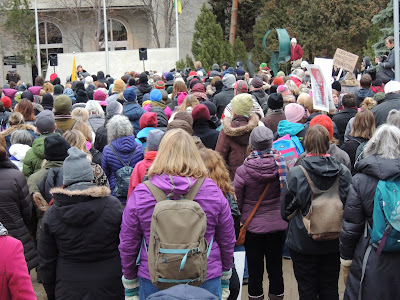
Women's March on Washington Solidarity March in Saskatoon, January 21, 2017

Text and Images (c) Robert Barry Francos

Shortly after I moved to Saskatoon from Brooklyn in 2009, I was involved in a march against George Bush Jr. speaking at a local engagement. Now, I found myself once again into the fray in a solidarity march against the anti-women policies of Donald Trump and his administration.

It was expected to be about 200 people meeting at 10 AM on a cold Saturday morning at City Hall, but the number has been estimated anywhere from 500 to more than 800. It was a positive experience (unlike Bush, for which the march felt angry) which signs and speakers, but very little Hey Hey Ho Ho chanting. Yet we were all stout of purpose.

Organized by Karen Brander and Alice de Cloedt, the speakers included First Nations elder Marjorie Beaucage, City Councillors Danielle Chartier and Hilary Gough, and Women's and Gender Studies professor (recently from Chile), Manuela Valle-Castro. They roused the crowd who then set off on a mile or so march through downtown Saskatoon. For those interested, down 4 Ave S., right onto 19 St, and then right to go up 3 Ave S, and back to City Hall, where the parade broke up just after 11:30 or so. Some petered off at the end, others met back in the park in camaraderie.

I had the honor to be a marshal along the route (you can see me in my red vest at :37 HERE).
Co-organizer Alice de Cloedt in the center.


Marshaling the marshals.


Matching, kinda-sorta


Amateur and pro...

Matching cat hats

Would lead the march

Speakers gather


Two good friends I went on a road trip to Yellowknife with a few years back


Dressed like a pussy-cat.

 First Nations elder Marjorie Beaucage leads off the rally


City Councillor Danielle Chartier


Marshals waiting to marshal


Friend and photographer par excellent Aloy Fleishmann posing i foreground

Alice did the speaker introductions

First-term City Councillor Hilary Gough


Professor Manuela Valle-Castro


Marjorie leads the group in a First Nations' song.

The March begins


Happily, it was widely covered by the media


Passing City Hall near the end of the March

Group shot of front-line marchers!

Brilliant umbrella (her idea)

Favorite sign


Networking

Closing it down


Tuesday, January 10, 2017

Who Says It’s Greensboring, NC?: By Nancy “Suzy Q” Foster

Text by Nancy “Suzy Q” Foster / FFanzeen fanzine, 1981
Introduction © Robert Barry Francos / FFanzeen blog, 2017
Images from the Internet

This article was originally printed in FFanzeen, issue #7, dated 1981. It was written by a woman of many names; back then she was Nancy Foster, or Nancy New Age, or Suzy Q. Today she goes by Nancy Neon.

Nancy grew up in Greensboro, NC. Even at a young age, she was a dedicated fan of music, and was an early member and President of the North Carolina Wayne Country Fan Club. When I met her in the late 1970s, she was running her own fanzine, New Age, before moving to New York City where we would oft meet up and attend shows at CBGB’s, and especially Max’s Kansas City. These days, Nancy calls Boston home, where she occasionally runs and books shows.
                                                                                                                         
After a brief stint returning to NC in the early ‘80s, Nancy wanted to move back to New York, and I had the pleasure (not sarcasm) to drive down to Greensboro from Brooklyn, and spend a week there, before bringing her to the Rusty Apple. I had the opportunity to meet some of the people mentioned in this article, including Molly Polly Sexual, and others such as musician Lynn Blakey.

We often hung out at a now-gone club called Friday’s, where the bands ranged from amazing, to Talking Head wannabes. But the scene was actually quite vibrant, and these groups are the focus of this article. – RBF, 2017
Mike and Ron of Butchwax

BUTCHWAX:
My first memory of Butchwax was walking into Friday’s (the Max’s Kansas City of Greensboro) in September and hearing the real neat lead guitarist, Mike Dupree, singing Johnny Thunders’ “You Can’t Put Your Arm Around a Memory.” Instant love. If this can happen in Greensboring [sic], North Carolina, then there’s hope for the whole world, right?

Butchwax does rave-up versions of songs by the Dolls, Heartbreakers, Pistols, Cochran, Jayne County, the Angels, Shangri-Las, plus a whole set of great originals, like “Borderline, “ “Looking for an X,” and especially the pop masterpiece, “Innocence.”

In addition to Mike, who drums “Baby Talk,” “Chinese Rocks,” and the such at 78 rpm, and makes all the go-go dancers strip their gears, there’s Ritchie Clerk, a real bitch of a bass player who makes an art out of abusing the fans; Ron “Butch Modern” Taylor, a consummate rock’n’roll songwriter (thief?) and screamer who gets extra points for being the editor of the fab fanzine Modern World; and then there’s Mike Dupree, the lead player.

An extra added attraction/distraction is the gorgeous blonde rock'n’roll Jezebel, Polly Sexual, who distills her own absinthe, gets intoxicated on French symbolist literature, and dances with Arthur Rimbaud in the poppy fields. She sings lead vocals on “My Boyfriend’s Back,” “Jeepster,” etc., and does a lot of hip shaking and heartbreaking.

I’m counting the days until I can get rocked/racked by Butchwax-mania again. Till then, this interview, done December 20, 1980, after their set at Friday’s, will have to do.

Mike Dupree: The last interview we did, I answered every question with “I’m hungry!”

FFanzeen: Are you hungry now? Where do you like to eat after the show? IHOP?
Mike: I like to go to my friend’s house and eat spaghetti at three o’clock in the morning.
Ron: Is there a Dave’s Diner around?
Mike: We stopped at this place between Asheboro and Silver City called Dave’s Diner. It was fantastic! Are you recording this?

FFanzeen: Yes. When did the group first get together?
Mike: Late 1976. First, it was Ron and Nick (Nasty), this guy we worked with. Then I started playing with them, too. Then, we got a whole bunch of weird drummers who played boxes instead of drums – whatever we had available. Our first drummer was pretty good, but we couldn’t get along with him because he was an asshole.

FFanzeen: Are you all from North Carolina?
Mike: Ritchie was born in Alabama, but he’s from Atlanta.
Ron: Mike’s from Tarboro.
Mike: No, (Ron’s) from Little Washington, and I’m from Raleigh.

FFanzeen: Who are your musical influences as a guitar player? That’s obvious, though.
Mike: Johnny Thunders, Steve Jones, Eddie Cochran, and Chuck Berry.
Fan 1: You guys were fantastic. Please shake my hand?

FFanzeen: Love, peace, and soul! [laughter] This is a crazy question: Isn’t playing hardcore rock’n’roll in North Carolina like being a martyr?
Mike: Here’s a Butch Modern quote: “Nobody who was hardcore in rock’n’roll every made money. Period.”
Malcolm Rivera (Butchwax Manager): You’d better ask more questions or they’ll smash your tape recorder.

FFanzeen: I’m gonna leave!
Fan 2: I could sell that tape recorder and replace some of the money I spent on drugs.

FFanzeen: A pal of mine said if he lived in Greensboring [sic], he’d have to become a sex pervert or junkie. Are you sex perverts and/or junkies?
Mike: I’m not a junkie…yet.

FFanzeen: An apprentice junkie. How hard is it to get smack in North Carolina [the crowd begins yelling and cursing about the lack of previously mentioned brain damage]?
Mike: It’s hard to get good stuff.
Fan 3: You know, I’m in love with Johnny Thunders.
Fan 4: He can’t fuck anymore. Who wants him?
Ron: I hear Little Washington is the place to get it.

FFanzeen: What, drugs or Johnny Thunders? What do you think about when you’re onstage?
Mike: Usually the little girls in the audience.
Ron: Yeah, the girls with the long legs!

FFanzeen: Describe your ideal girl.
Mike: Between 16 and 40. Between 5- and 6-foot tall. Between 90 and 130 pounds. She has to have either blonde, red, brown or black hair…

FFanzeen: Tell me your idea of a dream date.
Ron: Amanda Lear [artist/singer-songwriter/actress/model from France – RBF, 2017]
Mike: I don’t think I can answer that.
Ron: Brenda Lee at 15.

FFanzeen: What’s your favorite disease?
Ron: Anorexia nervosa; herpes simplex.

FFanzeen: Has the audience ever become violent other than tonight? [People were getting thrown across the dance floor – NF, 1981.]
Mike: You should’ve seen ‘em in Charlotte. Two guys kept being thrown onstage. One got thrown into Ron and almost knocked Ron into the drums. One guy was standing up front with his fingers up his nose, (then) holding his finger up to me.

FFanzeen: When and why did you start doing your fanzine, Modern World?
Ron: Right out of boredom. The first issue was supposed to come out in October of 1978, but never came out until June of 1979.

FFanzeen: That’s the story of publishing fanzines. I’ve been doing it over five years, so I know. How much money have you lost so far? [laughter]
Ron: About 3- or 400 dollars.
Mike: Most of them were given away instead of bought.

FFanzeen: Is your manager trying to book you in New York City?
Ron: We’re not sure that he’s doing anything.
Mike: Richmond, then D.C., then maybe New York City after that.

FFanzeen: Where’s the farthest you’ve traveled to do a show?
Mike: Charlotte
Fan 6: Y’all made 160? They had a redneck band that played here and made 700!

FFanzeen: Which was the first record that got you interesting in rock’n’roll?
Ron: Meet the Beatles. I listened to my parent’s C&W records, like Hank Snow’s Movin’ On. The first record I remember getting excited about was “Baby Sit and Boogie,” by Buzz Clifford. [laughter]

FFanzeen: What’s your fave song to perform?
Ron: One of our own, but it varies as to which one.

FFanzeen: I love “Innocence.” That should be a single.
Ron: When it goes well.
Mike: “Chatterbox” is the most fun for me to play.

FFanzeen: Have you done any recording? Any plans for a single?
Ron: We’ve had plans for a single before we completed the group!

FFanzeen: Who do you think is the best dresser in rock’n’roll?
Mike: Wendy Williams.
Ron: Eno.

FFanzeen: What kind of groupie do you attract?
Mike: Do we attract girl fans? I thought we attracted guys!
Ron: When we get one, we’ll let you know.

FFanzeen: How would you describe your following?
Ron: Nonexistent.
Mike: Small.

FFanzeen: Who do you think is better – Th’Cigaretz or Butchwax?
Ron: We are.
Mike: Even Flipside said that. I doubt Mouth of the Rat would agree with that. They said Th’Cigaretz are North Carolina’s answer to God.
Ron: We’re North Carolina’s answer to Satan.

FFanzeen: If you could invite anyone in the whole wide world to dinner, who would it be?
Fan 5: Iggy Pop!
Ron: The Shangri-Las
Mike: I’m still trying to think of the girl I’d most like to have for dinner.
Ron: The girl with the longest legs.

FFanzeen: What three things would you take to a desert island?
Mike: Heroin, coke, and pot.

FFanzeen: No girl? Just drugs?
Mike: Well, you said things. Are girls things?

FFanzeen: Yeah!
Mike: Three girls, then.

FFanzeen: The Shangri-Las.
Ron: The three girls with the longest legs and the biggest tits.

* * *

CRASH LANDON & THE KAMIKAZES:
It is Saturday morning and I feel great, because I saw Crash Landon and the Kamikazes last night.

When I heard they were 14-16 year-old boys, I knew I would be there with bells on. There’s a soft spot in my heart for underage rock'n’rollers. Something about living on pinball and wet dreams really inspires ballsy, thrilling rock’n’roll that older guys who have numbed their brains with too much drugs and mediocre sex cannot muster.

The second they started blasting their hardcore, purist rock’n’roll, the dance floor was packed with bodies jerking in convulsions like they were rocked with tarantism. All of the songs were riotous – the Rolling Stones’ “Fortune Teller,” the Monkees’ “Let’s Dance On,” Syndicate of Sound’s “Little Girl,” rock’n’roll classics like “Money (That’s What I Want)” and “Poison Ivy” (which was really humpy, like a mating dance), plus great originals bursting with power.

It’s all teenage dance/romance/sex anthems. “Let’s Dance On” was a rave. Most people find the Monkees uncool, but you have to be really cool to know how cool the Monkees are. Crash Landon and the Kamikazes are ultra cool!

“Little Girl” was outrageous with the Byrds-like jangling, agitated guitar sounds. Plus, it’s a great breakup up ain’t hard to do song, which has special meaning for me, as I wiped my slate clean for 1981.

These guys are fabulous and it’s really inspiring to see kids with their hearts and heads in the right place – not into Billy Joel, Queen, etc. After their intense set, I went outside (despite the cold and walking pneumonia), and began to praise the group to the rhythm guitarist.

The first words out of his mouth were, “Do you like the New York Dolls?” Sigh! Only to be 10 years younger! I know I had found a kindred spirit. We talked about the Heartbreakers. His name is John and he really digs Johnny Thunders. Merde! He must be all of 13 or 14 years old! [NOTE: Cult musician John Dexter Romweber would go on to be the lead of the Flat Duo Jets, and have a documentary made about him called Dexter Romweber: Two-Headed Cow (reviewed by me HERE). This may be the first article published to ever mention any of his bands. Thank you, Nancy! – RBF, 2017] 

I told John that they would do great at Max’s Kansas City, where the kids would shove the tables aside and dance up a storm like that it did for the teenage group, Nastyfacts. Then I spent the rest of the night in a booth talking to the lead singer, who told me more about psychedelic music than I have ever heard from any of my contemporaries.

These guys are the best. They know and love their rock’n’roll and play it with incredible energy and enthusiasm. They are the hottest things in North Carolina, along with Butchwax and the Orphans. I hope they stay “crazy kids”/rock’n’roll teenagers forever!

* * *

THE ORPHANS:
The Orphans are proof in the flesh that what I said about one-horse towns is true: that it is great to live in Greensboro because it is so far behind the times that punk is still new and fun. I am not ready for punk to be passé. The Orphans are the only true punk band I have seen in North Carolina, except for the short-lived Leeches, whose members (except me) were only doing it as a joke on the easily shocked provincials.

Yet the Orphans mean it, man! The difference between the Orphans and Crash Landon and the Kamikazes is the difference between late ‘70s punk and ‘60s punk. The Kamikazes are more old school-type rock’n’roll. Whereas, the Orphans play with that ‘70s punk buzzsaw fervor and with teenage anguish in their lyrics.

At the Orphans’ gig, I danced straight through three sets, except for one song, during which I was goo-gaaing at the group’s sartorial finesse. At the end of the show, I was joshing with them, saying how another local writer, Also Aswell and I were going to give them the “Best Dressed Band” award.

The other guitarist is the wildest, having an affinity for chasing into the walls, despite dressing elegantly a la the Jam. The drummer adds that emphatic punch and inspires a lot of headbanging. The Orphans made my head spin from so much dancing and excitement. Mike’s guitar hits you right in the guts (and lower – oops!). So great it hurts: pleasure/pain.


They do covers of the Sex Pistols, the Jam, Clash, Generation X, Undertones, Ramones, Dead Boys, etc., but their originals, like “Boredom” and “TV” prove that they can write hardcore rock’n’roll, as well as introducing punk classics to the unenlightened yokels. “I Love You” is a beautiful heartthrob song with Mike singing in a gorgeous, Anglo-style pop voice. The Orphans are from Charlotte, about 85 miles away, and I have a feeling that I will be getting acquainted with Greyhound very soon.

Monday, December 5, 2016

SIR DOUG SAHM: Rock’n’Roll Royalty [1988]

Text by Bruce “Mole” Mowat / FFanzeen, 1988
Introduction © Robert Barry Francos / FFanzeen, 2016
Images from the Internet

This article was originally published in FFanzeen, issue #15, dated 1988, beginning on page 11. It was written by Canadian music historian Bruce Mowat, who used to go by the name Mole in those heady days. For decades his locus was Hamilton, Ontario, but has since moved to the northern Prairies. Back east, during the time of this interview, Mole had a radio show, and this is actually a transcript of the on-air interview they did.
                                                                    
As for Doug Sahm, another of his popular bands was the Texas Tornados. However, one of the serendipitous thing about this piece is that while Mole now lives in Alberta, one of my favorite Doug Sahm recordings was for an Alberta label called Stoney Plains Records in 1987, just outside Edmonton (or as Mole might call it, “down south”). It was called Return of the Formerly Brothers, which Sahm recorded with Amos Garrett and Gene Taylor. It’s solid boogie blues, unlike the more psychedelic country blues of his earlier and better known band, The Sir Douglas Quintet, who had a big hit in the 1960s with “She’s About a Mover.” Sahm died in November 1999 of heart failure, in his sleep.  – RBF, 2016

FFanzeen: With the revamped Sir Douglas Quintet, you’ve had a number of albums out. The most recent was Rio Medina, and it wound up on a lot of people’s favorite albums of’85, including mine.
Doug Sahm: That’s what I’ve heard.

FFanzeen: I’d just like to go over some of the tracks of Rio Medina. One thing that really knocked me out was the version of the Police hit, “Every Breath You Take,” which is not normally something I particularly like; it’s the old adage of “It’s the singer, not the song,” but maybe you could tell me how it was arranged and how it came to be, covering that particular number.
Doug: Well, to be real truthful, it’s gonna take me a while to think about this, because when I made one record and move on to another, it takes me a while to get back into the details of it. You see, I do a lot of different types of bands. At that time, I was using my horn section from San Antonio, and I always thought that was a great song. I was inspired by Otis Redding, of whom I’m a big fan, who used to take “Satisfaction” and some of the pop songs and turn them into Rhythm & Blues. And that’s where I sort of came up with that idea. We had been playing it on our gigs at that time and everybody seemed to really like it, so it kinda developed from the stage act, really.

FFanzeen: “Viking Girl,” I guess that’s a reference to your big following in Scandinavia, and those areas of the world that you’re still very popular in.
Doug: The album just prior to Rio Medina [Midnight Sun – BM, 1988] has a real great drummer, Doug Clifford – he used to be the drums on the Credence Clearwater Revival – and Bobby Black, steel [guitar] player. At that time – that would be about two or three years ago – these country singers really got popular in Sweden and our timin’ was real good. That song “Meet Me in Stockholm” came to me and it became one of the largest hits there. It’s kinda strange in one way, though, ‘cause they kinda refer to me as a country star. I don’t really look at myself as a country star. I do so many different types of music that I think in some ways some people like it and some people it confuses, but I just kinda go with what I feel. We’ve always had this legendary drawing power. We’re one of the few bands from the ‘80s that you could go see that would play the hits, with most of the original guys.

FFanzeen: It’s kinda funny you mentioning you’re going back to Austin, after you did that song, “Can’t Go Back to Austin.” It’s a bit of irony.
Doug: Well, you know, a lot of people don’t really realize what’s going on back there. I’m from San Antonio and I like it. I really appreciate it and it’s one of the most soulful towns in the world, but I don’t prefer to live there. I like Austin, but even now, we’re having this giant influx of people comin’ there and it’s kinda changing it for the old timers. The young people like it but some of us old, kinda “cosmic cowboys,” we look at it as a kinda invasion right now. It went from a little over 100,000 (people) to half a million, and there’s no end in sight [in 2016, the population was 931,830, according to Wikipedia – RBF, 2016]… You know, I was real saddened at the passing of Richard Manual [of The Band, d. 1986]. I thought he was a real good musician. It’s kinda a shame in a way that he had such a unique American band, and in some ways America turned its back on ‘em ‘cause they’re not fashionable at the moment. One of the parts about my country I really don’t like is that you go to Europe and they just go completely bananas over American music. And a lot of them guys that can’t even hardly work here in the States can go to Europe and it’s really amazing. Me and Augie (Meyers) have maintained a real following, which we’re glad to have, but right now I’m kinda workin’ on that; I’m workin’ on a record that’s gonna be unique in that you might not even know it’s me [The Texas Mavericks, Who Are These Masked Men?, 1988 – RBF, 2016]. It’s a theory I’ve been working on for a while. We’ll see what the commercial aspects of it will be. Right now I’m playin’ again with my buddy Alvin Crow. He’s a real big country artist down here. He plays a lot of rock and roll. We also have a baseball team together. We have this gig right now, we have a drummer who usta play with Lee Michaels called Frosty [“Do You Know What I Mean?” – BM, 1988; full name is Bartholomew Smith-Frost – RBF, 2016]. He’s probably the finest drummer. Now there’s a studio here so we’re workin’ on a new album. I’m really quite happy with it, it’s about half completed. We’re really doing a lot of this West Texas rock and roll. We have this guy named Johnny X who’s a premier West Texas guitar player like Buddy Holly and Bobby Fuller. We did a remake of “I Fought the Law” that I think’s real good. We’re blending that with some of my new pop-kinda songs. I think it’s gonna be a real interesting album. I’m not really sure when it’ll be released, but I keep trying to be always forever changing. I think it does keep you very youthful in playing rock and roll, ‘cause a lot of guys get jaded after a while.

FFanzeen: Speaking of Buddy Holly and Bobby Fuller, I don’t want to say how old you are, but I can imagine you can remember working the same circuit as those people. Did you ever meet any of them?
Doug: No, I never did. In fact, I’m very proud of my age; I’m 44. I’m definitely a graduate of Haight-Ashbury. I was a kid for rock and roll, growin’ up in San Anton [sic]; I think I was 13 or 14 when Little Richard came out. That just completely blew me away. And then in the ‘60s, we all just packed it in and went west to San Francisco and became Texan flower kids or somethin’. That part of my life was quite successful as far as hit records goes. And then in the ‘70s, we came back to Austin, which then the “cosmic cowboy” was kind of a cowboy with long hair; and now it’s the ‘80s, we’re kinda goin’ wild, and it’s interesting ‘cause I’m happy to have the years because a whole lot has already went down, and some of the guys who aren’t quite that age now, a lot of the good times has already been done. And as far as musicians, Buddy was in and out so quick. I never was around West Texas much, and he was raised in Lubbock. Most of my influences in the early days came from the Black Rhythm and Blues guys like Bobby Blue Bland [d. 2013] and T-Bone Walker [d. 1975]. Me and Johnny Winters [d. 2014] and Stevie Ray [Vaughn; d. 1990], all those guys, we all sorta grew up diggin’ T-Bone and those guys. I would say we all were probably more Black-influenced. Buddy represented what we called the White music, which was great, but it seemed like he really wasn’t appreciated until he was dead, you know? But there wasn’t much of a country feel in the ‘60s; I mean the British Invasion kinda blew that right off the map for a while.

FFanzeen: That’s why you were called Sir Doug, I believe [their manager, Huey Meaux (d. 2011), attempted to pass off the SDQ as a Brit act – BM, 1988]
Doug: Well, that was part of the truth at the time. I kinda credit Willie Nelson a lot – my good buddy – he came back after he went away and did the Outlaws thing, plus he did all those big picnics and started (country music) all comin’ back. So the country thing – the real country thing – dates back to when I was very young – say the early ‘60s when I was, like, 10. I was born in ’41, so I remember the time in ’51 and ’52; I remember it very well, meeting Hank Williams [d. 1953], Lefty Frizzell [d. 1975], you know, he was an ex-boxer and I actually saw him punch a guy one night. It was one of the highlights of my young life, I wanna tell you. He was a great guy. I mean, it’s really funny when you compare (them) to the perfect-clean/squeaky-clean rock stars of the ‘80s. No offense in any way, but these guys were really soul guys to me; they were really hard-livin’. What they’d sing is really what they were. It wasn’t an act. That’s why I was really glad to see Little Richard make a comeback. I think that was really great.

FFanzeen: Being around the San Antonio area, you’re one of the people who’s credited to help develop the so-called Tex-Mex sound. I just wanted to maybe talk about all the different pieces that goes together to make that sound, and what you feel your role in it was.
Doug: Our role was quite clearly defined, I think. We were the first nationally/worldwide successful band with that sound. “She’s About a Mover,” you know, with the backbeat of the organ, is pretty much like Chuco polkas – are you familiar with Flaco Jiménez?

FFanzeen: I’ve heard bits and pieces, but that kinda material – original material – is very hard to get.
Doug: It is. There are some out. He’s getting really popular in Europe now, too. He’s been playing the circuit in England quite a bit. You see, one thing about living down there, you have a very large Chicano population, which is almost non-existent up here. They got a real great station in San Antonio. They call it “jalapeño radio,” and it was run by a guy named Rubio Polkas. Rubio means “blond guy,” and he’s a buddy of mine. It’s a family-run station [KEDA, 1540 AM – RBF, 2016] owned by Mr. (Manuel) Davila [d. 1997] who used to play our records 25 years ago when I had local hits, before there was a Quintet. So, that’s why that music is real popular, and I just love it. I mean, it’s a real alternative to be able to turn all the way to the right of the dial and get this weird sounding music. But the Tex-Mex thing, some people confuse that. Some people have called themselves Tex-Mex, which I don’t know if they are or ain’t. I don’t consider myself a critic, I just kinda tell it how it is. We were the first to do it. And then in the last four-five years, Joe “King” Carrasco [FFanzeen interview HERE], who’s also a friend of mine, he – oh, how can I put it without being too blunt – he popularized it through the press. He had a great press man, who’s a real good buddy of mine, Joe Nick Patoski, who’s a writer. (Joe) had this thing of kinda bringing it out to the kids. In other words, there’s a big gap now of 20 years with the fans who go to his gigs. When he plays in Austin now, he draws this large college crowd that I just don’t relate to any more. I’m from the old faction. When I play, you get all the old people there from the Silk Creek days or the Armadillo, when that was happening. You see, you gotta remember, that’s non-existent and that scene is almost over. And lately, a few of the bands out of there have done real well: the Fabulous Thunderbirds. I’m really happy for them. They finally cracked it. And Stevie Ray. But that’s more in the Blues’ side. The San Antonio thing is flourishing, but one thing about it, see, the Tex-Mex thing is very regional. Now y’all would really like it here (in Canada). I think if you really heard it more, if bands would tour –

FFanzeen: Absolutely!
Doug: - But it’s such an expense to bring people up here.

FFanzeen: It’s a long way
Doug: The Tex-Mex thing progressed. I mean, you remember Sunny and the Sunglows [formed in 1959 – RBF, 2016] was a big one. And then Freddy Fender [d. 2006] was definitely a big influence. Freddy’s almost not doing anything anymore. It’s amazing this up and down type of thing he’s had with his career. But I don’t know, it’s a certain type of people I think too, y’know? I was raised and still spend a lot of time in the barrio in San Antonio. You don’t really need to go to Mexico. It’s almost like being in Mexico, y’know? Yeah, me and Augie and a few of the White guys who kinda kept it going, they call me a nickname: Gavacho. A gavacho is a White guy who was raised by the Black and mostly Chicago influence. We just always liked that music, y’know, ‘cause San Antonio’s always had a blend of everything, of country and rock. Even now, like, my son is totally heavy metal, which the young Chicano kids just eat alive. They just love Ozzy Osborne, and KISS and Judas Priest, and that’s what they’re into, like most of the kids. And they really don’t like the Conjunta type.

FFanzeen: It’s, like, their parents’ music.
Doug: Yeah, exactly. I put on a polka station, and it’s, “Oh, man, turn it off. I hate it. I wanna hear KISS.” I guess every part of the world has its regional (music), but overall the American music scene on the soul level has become very homogenized. To me, it’s nowhere near where it was in the ‘60s, when you had the Byrds and us and Sam the Sham. We all worked shows like that. It would be, like, Dylan, the Byrds, Sam the Sham, us, the Kinks, directly to Stoney Plain (distributors). Throughout the world they’re a little clique or association of kinda got like everything else.

FFanzeen: Do you ever keep in touch with anyone from that era?
Doug: Sam’s (the Sham; aka Domingo Samudio) not around anymore. I understand Ry Cooder dug him up for that Border album, or somethin’ like that. I understand he’s driving a fishing boat to the (oil) rigs out there in New Orleans. He’s not even playin.’ And I’m sure you’ve been reading about David Crosby.

FFanzeen: Yeah, everyone’s pretty well familiar with his situation.
Doug: He’s been having a few problems. I was a fan of the Byrds. We still do “Mr. Tambourine Man.” I thought they were a great band. Boy, that’s ‘bout all I can think of right now. A lot of them are still in California. A lot of the bands are out there and I see them when I go out there occasionally. I think some of them made the transition into the new world and some of them didn’t. I feel quite fortunate to be able to, you know, have had a real, incredibly long longevity. I mean, look around and see 20, 25 years – a quarter-century – has popped by. There’s even an album out in Belgium that’s made up of stuff I recorded like five or six years before the Quintet, even.

FFanzeen: So that early material is being released.
Doug: Yeah, one of them is. This is a really great album. It’s on a label called Perceval. It’s out of Belgium [Texas Road Runner: The Renner Sides 1961-1964, re-released on Moonshine Records in Belgium in 1985 – RBF, 2016]. We were quite lucky to have that success over there. I didn’t have to play the American ballgame of this corporation kinda thing. I’m kinda an old rebel in some ways. I really enjoy working with our Swedish record Company. They lease it directly through Stoney Plain. Throughout the world they’re a little clique or association of the last of the good, independent record companies. They’re into makin’ good music and putting out Johnny Copeland [d. 1997] records, instead of the high-dollar, million dollar rock and roll records. And if they weren’t doin’ that, I think the whole sound would disappear from the face of the earth.