Friday, April 22, 2011

ORAL FUENTES: Bringing Positive Belize Riddems to the Canadian Plains

Text and photos © Robert Barry Francos


No one can deny that the Prairie winter of central Canada is a bit on the cool side, sometimes dropping down to -40, even before the wind chill. What better way to warm up a frigid night, than a hot reggae band?

When I first moved to Saskatoon from Brooklyn, I was tooling around my yard trying to figure out what was what, and started talking to a very enthusiastic and upbeat neighbor. A native of the Central American country of Belize and now a Canadian, he’s in a reggae band, he informs me. Later I find out that not only is he “in a reggae band,” but he leads the premier reggae band in the city, if not the province. Everyone I talk to knows of Oral Fuentes, and what I hear back is always positive.

Oral Robert Fuentes (no kidding) not only leads a band that plays regularly around the city, including at many of the festivals around town (Jazz, Blues, etc.), but started and runs his own fest. It started out as the Saskatoon Reggae Festival a few years ago, and recently was updated to the Saskatoon Reggae and World Music Fest, to allow a wider range of sounds.

Speaking of name changes, the Oral Fuentes Reggae Band, as they used to be known, have one CD as of yet, Oral Culture (what a great name to the ear of this Media Ecologist; Fr. Walter Ong would be proud), full of original slow and sensual beats. Supposedly (and hopefully), there is a new recording in the works, hopefully to be released by the 2011 festival.

Finally, after a over a year of joyfully talking over the fence about life and music, I had the chance to see the Oral Fuentes Band in action. At the Bassment, a top-notch jazz club in downtown Saskatoon with friends, we were all planning to see the first one-hour set of two, at the Mardi Gras Fest 2011. It should surprise no one who knows the band that we all stayed for both.

Shortly after, someone at the local community newsletter asked me to write a piece about Oral. The next day, I whipped off a bunch of questions and emailed them to him. When they came back, I turned his responses into a short, easy read piece, the kind neighborhood quarterlies are known for. However, I wanted to put the full answers out, so here they are. Note that I left Oral’s written patter pretty much untouched and unedited, with his permission, because he writes like he talks, in a lilting accent that sounds similar to Jamaican, but smoother in tone. I find his talking and writing manner musical, as well.


FFanzeen: Is it the Oral Fuentes Band, or the Oral Fuentes Reggae Band? Did you change it, and if so, why?
Oral: Fuentes: Although the band name was “Oral Fuentes Reggae Band,” we have change it to just “Oral Fuentes Band.” We did this change because we don't just do only reggae music, but other Caribbean rhythm and beats.

FF: Where else in Canada have you lived? In the world?
Oral: I have lived in Ontario, Oregon, Longview (Texas), Guyana and Belize.

FF: What can you say about how you feel about Saskatoon in comparison to Belize?
Oral: Man, I love both Saskatoon and Belize. The thing is the cold of course and Belize don't get this cold. But when it’s warm and hot, you feel right at home. I feel that I should be here for some reason... sharing and being an ambassador to my culture.

FF: Is there anything you miss from Belize?
Oral: I really miss the food. We have so many good food and fresh fruits. Although you can get some fruits here, it’s not the same when the products have to come so far. I also miss my family and friends.

FF: Is there a name for Belize-distinctive reggae?
Oral: Not really. It’s the same reggae “riddim” as we say... my style is that I mix it up with Latin sounds. Both Belize and Jamaica has the same influences of reggae artists. Most of the time though... these artists are not so much reggae artists but “dance hall” artists. Dance hall and reggae are two different things.

FF: Who are some of your inspirations?
Oral: Belizean Lord Rhaburn, musician Lord Laro, Ernie Smith, Bob Marley and Bob Dylan.

FF: Do you prefer to play the slower reggae or ska?
Oral: I like both... the slower reggae gets us in the groove. Then we put it up a notch, and by the end of the evening, people can't stay in their seats.

FF: Do you play any other kinds of music?
Oral: I play punta rock, Bruckdown (music from Belize), some dance-hall and a bit of soca.

FF: Do you play any other instrument than guitar?
Oral: I play the drums, (both) congas and djembe.

FF: Is there a set Oral Fuentes Band, or do the people backing you change from gig to gig?
Oral: Yes, we have a set band. Most of the fellows in the band have been with me, some for 15 years, some for 7, others for 4 years. We also get a few people to help out from other bands. Both Randy [Woods, guitar] and Geoff [Assman; keyboards] help me out at times, from Absofunkinlutely Band.

The Oral Fuentes Band:
Joseph Ashong – percussion
Oral Fuentes – vocals / guitar
Mike Kereiff – trombone
Zender Millar – bass
Dave Nelson – trumpet
Kevin Pierce - drums
Nigel Wright – lead guitar


FF: What other bands do you play in, here in Saskatoon?
Oral: Just with this band.

FF: What is the competition like here; is there a community or it is aggressively competitive?
Oral: If there is a competition I don't see it. All of the musicians know each other here. If we don't know each other personally, we know the band or heard the name. Each genre or style of music seem to have its own community of friends or people they hang out with. I personally try to stay about from all types of bad vibes or negativity.

FF: What was the music scene like when you first moved here in 1992?
Oral: The music scene was already going, but a lot of people were doing just covers at the time. My band, with a few others, were the only ones that were doing originals. At the time though, none of the night clubs would even hire me, because I wasn't a cover band and not known. People would laugh at me and said that it won't work, just doing my own songs. Others left the band because I wasn't doing covers. But I stick with it and saw the vision for it. We have to be ourselves in this business.

FF: How is it different now?
Oral: There are so many original bands now, which is awesome! Many of the night clubs and festivals want to hire people that writes their own songs. I, myself, have played many times at these clubs that had bias, via the booking guys, against us... and we bring in large audiences for them.

FF: How is the Saskatoon audience these days?
Oral: The audience in Saskatoon is awesome. Saskatoon loves cultural music and the celebration of other cultures. We have so many people that come out to see us. I am thankful for that!

FF: Is there a regular audience that comes to see you play, or does it vary from time to time?
Oral: Yes! We have our regulars that come out to see us. But it depends on where we play. At the night clubs we have that crowd, and at the Jazz Festival we have the family crowd, which is also very large.

FF: Is there anything you'd like to see change about the music scene here (for example, I would like to see a Folk Festival, like the one in Regina, Winnipeg, Edmonton, Calgary, etc.).
Oral: We are already trying to do some changes by bringing in the Reggae Festival. Making it accessible to other cultural artists or performing groups.

FF: Why did you start the Reggae Festival?
Oral: I saw the need to have a Festival that celebrates reggae and world music culture. There is a vast amount of people that supports this type of music here. The Festival changed from “Saskatoon Reggae Festival” to “Saskatoon Reggae and World Music Festival.”

FF: How did you go about starting the festival?
Oral: I started the Reggae Fest a few years back in 1995. The Festival started with many Latin and Caribbean shows at the Odeon Events Center, hosted by our band and DJ Juan Valdez. Then it develop into the Reggae Festival. We are now a registered non-profit.

FF: How do you recruit bands?
Oral: Bands hear about the Festival online [saskatoonreggaefestival.com]. When they apply, I get all their infos and go thru it. I usually check for Band's content... whether they are positive or not. I want to find the right fit for the Festival.

FF: What about the high level of homophobia in some reggae bands; how do you get around that in choosing bands to play at the Festival?
Oral: Most of these bands will not get hired at this Festival. I check online to see if these bands are like this, and they will not hear back from us. That’s just the way it is... Also, if a band gets hired we make sure that they know as part of their contract that they can't use profanity or any homophobia statement on stage. If they do there will be consequences.

FF: Since starting the Festival, you have expanded from Reggae to include World Music. What do you consider World Music? And why it's inclusion to the Reggae Fest?
Oral: I consider World Music all afro-beats or other musical cultural rhythm.

FF: When will it be this year (2011)?
Oral: On August 11 to 13th at the Friendship Park, downtown. Last year was at the Rotary Park... but have to be change because of the construction.

FF: How does someone go about hiring the Oral Fuentes Band?
Oral: People usually hire us via my website: oralfuentes.com, or after they see us at a show.

FF: How can someone go about buying your CD, Oral Culture?
Oral: People can buy our music online at cdbaby.com/cd/oralfuentes. It is also at 40 different online stores.

Tuesday, April 19, 2011

THE BEACH BOYS – Mike Love, 1984

Text by Mary Anne Cassata, intro by Robert Barry Francos
Interview © 1984; RBF intro © 2011 by FFanzeen
Images from the Internet


The following article / interview with Mike Love was originally published in FFanzeen magazine, issue #12, in 1984. It was implemented and written by Mary Anne Cassata.

Whatever one may think of Mike Love, be it a voice of the ‘60s, as a follower of Transcendental Meditation, hardcore right-wing conservative, litigious instigator, or power hungry tool, there is no denying he is one of the focal points of the original Beach Boys, whose music revolutionized a genre.

Dubbed “The Boys of Summer,” The BB’s early cool breeze guitar-based melodies over intricate jazz-arranged harmonies became a symbol of all things American, or at least West Coast. The band matured in style over the years, and yet their sound became lost in the post-
Sgt. Pepper’s emergence of rock; still, they became the phoenix of youth when they broke the news stations in 1983 for being banned from playing the White House. Suddenly they were everywhere, as the country collectively said, “Oh, yeah, we remember you guys!”

Back in the eye of the public as an “oldies,” feel-good vibration, they once again started recording, and even had some hits with the light “Rock and Roll to the Rescue” (a throwback to their early sound), a stunning cover of the Mamas and the Papa’s “California Dreaming” (the still-living M & Ps appeared in the video for the song, as does Roger McGuinn), and the dreadful-yet-infectious “Kokomo” (which has led to numerous bars to be named this).

Through the early history of the BB, Mike Love was one of four singers in the band, and after the Smile debacle resulted in leader Brian Wilson going into semi-retirement, Love grabbed the reins and became the Johnny Ramone of the group until their eventual and inevitable break-up.

Note that my updated comments are in [brackets]. – RBF, 2011


The Beach Boys, an integral part of rock’n’roll since the early ‘60s, still remarkably retain a forefront position. There are some that would agree lead vocalist Mike Love and cousin Brian Wilson have attributed to much of the Beach boys’ phenomenal success. Brian Wilson has been regarded somewhat of a genius by his peers and fans alike for his special ability to create musically, with instruments and arrangements, what recording engineers have done with sound effects and studio recording techniques.

Brian, with Mike, co-wrote many of the Beach Boys classics, such as “Good Vibration,” “Fun, Fun, Fun,” and “Help Me, Rhonda.”

These songs and others were crucial to the shaping of the American pop culture of the ‘60s called Surf Music. Other contenders, Jan and Dean (Jan Berry [d. 2004] and Dean Torrence), also helped pioneer the sound that was a cross between ‘60s rock’n’roll and the British Invasion. In the splendid days of surf music, the Beach Boys often shared their stage with Jan and Dean. Sometimes, the two surfer groups received equal billing. The popular duo, most famous for songs like “Little Old Lady from Pasadena,” “Baby Talk,” and “Sidewalk Surfin’,” often traded off songs wit the Beach Boys, which were equally well recorded by both groups.

After 22 years of singing songs about surfing, cars and pretty women, one might think the Beach Boys would eventually grow tired of the same old repetition of wondrous harmonies and arrangements. For over two decades the Beach Boys’ band member line-up has remained basically the same, consisting of Wilson brothers Brian, Dennis [d. 1983], and Carl [d. 1998], cousin Mike Love, good friend Al Jardine, and Bruce Johnson [who replaced Brian on many tours until eventually becoming an equal partner].

Mike Love is, without a doubt, a material element to the Beach Boys, but is also a versatile solo performer in his own right. Nearly two years ago he released his debut solo album, Looking Back with Love, and performed on tour with the Endless Summer Band to sold-out houses all over the country. In between gigs with Endless Summer, he managed to perform in a few concerts with his old cohorts.

The Looking Back album and tour were enthusiastically received by music critics and fans alike. Mike is an easily likeable person and immediately puts his company at ease. It’s not every day one is given the opportunity to talk to a Beach Boy. Recently, Mike Love has been involved in new projects, primarily with the Tandy Corporation, a subdivision of RadioShack.

Rock’n’Roll City, his latest effort, features a collection of ‘60s classics newly recorded by some of the artists from that decade. Among the few include Dean Torrence, Paul Revere, and the Association. These artists and others combined their musical talents in an effort to decrease rising record costs and developed the concepts for Rock’n’Roll City. Some of the album features renditions of “96 Tears” by Paul Revere, “Wild Thing” by Dean Torrence, and a special recording of “California Dreaming” by the Beach Boys.

In his luxurious hotel suite at the New York Grand Hyatt Regency, Mike Love spoke open and candidly about his life, career, and upcoming projects. Dressed in a deep blue jogging suit, Love frequently took to the floor to exercise calisthenics. He has also been practicing daily Transcendental Meditation sessions for many years now, and feels it has allowed him to cope with the pressures and constant changes of the music business.

“I meditate every morning and evening,” Mike Love said. “I have been doing so since the winter of ’67. The Maharishi taught me.” Love indicated he is an authority on the topic and would like to write a book about it someday. “I have gone on to advanced courses in the T.M. Sidi Program. I have a perspective on being American. I think writing a book would be a very good thing to do.”

While Love contemplates the possibility of writing a book, in the meanwhile he will promote Rock’n’Roll City. The concept was actually developed two years ago by Mike, with Dean Torrence, while both were on tour with The Spring Break concert series. The two musicians tossed around the idea of possibly doing some recording together after the tour ended. The Tandy Corporation was interested in their project and signed them to the Realistic Division.

“Our production company, Hit Bound, got in touch with them. They were interested in featuring Mike Love and the Beach Boys, and Dean of Jan and Dean, because they had a pretty good success with the Beach Boys and Jan and Dean compilations. We mainly wanted to do the number one songs of the ‘60s, and eliminated the Beatles, Beach Boys and Elvis Presley, figuring that those are so heavily identifiable with those artists. We wanted the stuff that was still some of the great songs of that time period.”

A few months ago, ex-Interior Secretary James Watts, ignited a nationwide upset when he thoughtlessly banned rock’n’roll music from the Washington Capitol Mall concert on the Fourth of July. The Beach Boys, scheduled to perform that day, were outraged with Watts’ action. “Watts said he wasn’t going to allow any more rock’n’roll to be performed at the nation’s capitol,” still fumed Love. “All of us need to be reminded just where rock’n’roll came from. Its roots are here in America. It was a blending of the black music of the ‘40s and ‘50s, with the hillbilly and country music that came out of the mountains of Appalachia.

“Thirty years ago, rhythm and blues was called ‘race music,’ and white music that was joined with it was ‘rockabilly,’” he continued. “A new wave of music was born incorporating all the facets of the musical spectrum. Then along came the singers – black and white – who had something new. These singers had a lot of soul, and they called it rock’n’roll. I’d probably think first of Fats Domino’s “The Fat Man,” but it was really his hit “Ain’t That a Shame” that opened the door to the rock era.”

The legend of the Beach Boys began half a decade later in Hawthorne, California. The three Wilson brothers were musically inclined and used to harmonize on songs together in their bedroom. In his early teen years, Brian became very influenced by the music of the Four Freshmen and Chuck Berry, and often would spend hours a day picking out parts of songs on the piano. Before long, Brian had assigned different voice parts to this brothers, cousin Mike, and high school friend Al Jardine – later joined by Bruce Johnson.

Of the newly formed Beach Boys, Dennis was the first to notice the surfing trend taking shape, and encouraged his fellow band members to write songs about it. In 1961, the group officially called themselves the Beach Boys and recorded their first single, “409,” on a small record label. The single, backed with “Surfin’ Safari,” became a national double-sided hit, which led to an exclusive record contract with Capitol Records. In the next few years, the Beach Boys’ songs continued to remain high on the charts with the likes of “Surfin’ USA,” “I Get Around,” and “Shut Down.”

At one point of their fascinating career, Brian Wilson found the pressures of performing and recording too intense and was forced to take a leave of absence. Although he didn’t perform with the Beach Boys, Brian still continued to direct their musical affairs. Over the years, there have been many different versions of the story told as to what actually happened to Brian. For three years the vulnerable musician remained confined to his room, and had been diagnosed a paranoid schizophrenic. Mike was asked to comment on Brian’s delicate problem.

“He took some drugs; Brian’s a very sensitive person,” Mike explained, “There are certain people that can take drugs that can maintain and certain people that can take them and blow it bad. It is the same thing with alcoholics. There are those who drink and go crazy; then there are the drugaholics, too. Brian is one of those people that are so sensitive that he took these drugs and it messed him up for quite a while. He is still recuperating from it, too. It was the most tragic thing that could have happened to him.

“He just stopped being dynamic, productive and creative. Brian was, at one time, the most creative producer in the business. He influenced the Beatles, and other people, too. I can’t imagine the Beach Boys without Brian. It was a bit of a tragedy and a loss. He didn’t die, but OD’d emotionally. That is why I am very much against the use of unprescribed drugs. It may be fine for some people, but may destroy others. Emotionally or literally, I am totally against the use of drugs. Once in a while it’s okay if you’re sick and a doctor prescribes them. That’s where they belong. I have seen it in my own life with the Beach Boys. It can really screw up someone’s life.”

Brian has performed periodically with the Beach Boys, most recently this past summer. Mike says he is “doing fabulous now,” and is learning to be responsible for himself again. “He was very paranoid for awhile, and wouldn’t come out. He would go into the kitchen and eat, and go back into his room again. Brian had been touring with us for a couple of years and wasn’t making any progress, physically or mentally. We said, ‘Forget it; we don’t want to see you die. You’re not carrying your own weight in the group.’

“He’s much more clearer now. He’s got it all together now. Brian is much more bright and positive now. Anything he puts his mind to he can achieve. He is a very dynamic, creative and intelligent person. A couple of years ago, I wrote a song called ‘Brian’s Back.’ I’ve been saving it. It should be coming out real soon.”

In 1966, Brian supervised the production on the album Pet Sounds. The Beach Boys had no idea what an impact it would make on the music scene. The album instantly became a rock masterpiece and the Beatles acknowledged it simultaneously with their Sgt. Pepper’s album. The single, “Good Vibrations,” was the Beach Boys’ largest selling record.

With the many changes that occurred in rock music the last two decades, Mike Love is not at all too concerned about keeping up with the times. “I am not a person who identifies strongly with current trends,” he relates. “I don’t listen to enough music constantly to be an authority on it. I tend to be like our brand of rock’n’roll: the Beach Boys. We were successful with ‘Fun, Fun, Fun,’ ‘I Get Around,’ and ‘Good Vibrations.’ That’s the kind of rock’n’roll I like.”

When Mike finds the time to relax, he says he listens to the music of Marvin Gaye and other older ‘50s and ‘60s black artists. “When we were younger, we used to listen to bands like the Coasters and other great R&B artists. People like Fats Domino and Little Richard have made such a tremendous contribution to American music.”

Mike also feels that something good can come out of any form of music, and because it may propose to be different does not necessarily mean it is bad. “A lot of trends really have nothing to do with music, but everything to do with the superficial part of it,” he stated, “the look of it; the makeup.

“The beautiful thing about the music scene is that it is so diverse and there is something in it for everyone. I am in my own little world when it comes to music. That’s why I use research to see what relates to people and to me. We really research the songs we record. There’s no use putting out a song that doesn’t appeal to everyone. That’s wasting your time and subjecting you to an ego trip.”

The Beach Boys’ music is eternal and represents different meanings to their millions of fans around the world. Does the lead singer of this legendary band ever become discontented about singing the same old wonderful songs all the time? “No, it’s a lot of fun,” exclaims Love. “It’s a recreation and, you know, a lot of fun. The audience provides the spontaneity. We may sing our songs a hundred times a year, but only once a night. If you are a big fan of ours, then, maybe, you see us seven times a week. That’s good for us and good for them, too.”

At this point, Mike’s publicist entered the room with his order of watermelon and red zinger tea. This has been his steadfast diet for the past three months. Love is a strict vegetarian, too.

In conclusion to our conversation, he stresses it is “the responsibility of the entertainer to please his audience. What good does it do if you don’t give the audience what they want? My place is to entertain the audience and give them what they want.”

No doubt, Mike Love and the Beach boys will continue to give more wonderful and satisfying performances for another decade. It’s hard to get tired of listening to “I Get Around” for the hundredth time so far this year.


BONUS VIDEOS:

Saturday, April 16, 2011

Amy Rigby’s “Dancing with Joey Ramone”

Text © Robert Barry Francos, 2011
Music and images from the Internet


Amy Rigby is one of the cooler singer songwriters on the scene. She’s the girl your parents didn’t want you to play with, or date. Tough and tender at the same time, with a rough and lovely voice, and a hard strum on her acoustic guitar, she can be considered an anti-folk poster child – er – woman.

More one of the guys, she retains a strong sense of oomph that one might link to the Shangri-Las or Ronettes; she’s a smooth bottle of malt that has just the right kick at the end. Okay, enough with the analogies, here is one of my favorite songs of hers, “Dancing with Joey Ramone” (from her Little Fugitive album), accompanied by her husband, the Wreckless Eric.


She mentions a lot of great music within the song. So raising it from the meta-, here is are the tunes she references:

The Temptations: Papa Was a Rolling Stone
While a club may not play the full 7-minute version (depending on the venue, of course), it’s still a sharp number with a throbbing rhythm that highlighted an urban problem that was not commonly discussed in the ‘60s, but if anyone could do it with a sharp tone and keep the melody, it’s the Temps to show us it’s still a ball of confusion, even if it’s within one’s own family.

Blondie: Hanging on the Telephone
One of the better Chrysalis period songs by Blondie (I still like the first Private Stock album best) from the Parallel Lines album, this is a solid cover of the Nerves’ song. You can hear Debbie’s solid Jersey accent in it.

The Nerves: Hanging on the Telephone
Though most likely it was the Blondie version that she was talking about, Rigby is cool enough to be possibly referencing the original, so I’ve included them both. Yes, I own this, and yes, I prefer it of the two. Jack Lee (vocal / guitar) is killer on it, and it also helps that he’s backed by the likes of Peter Case (bass) and Paul Collins (drum). They only released one 7-inch EP.

The Brooklyn Bridge: The Worst That Could Happen
Johnny Maestro and the Brooklyn Bridge were discovered at a nightclub in Bay
Ridge, Brooklyn (it was on 86 St and Sixth Ave., across the highway from the now-Blockbuster Video Store). Even after fame would rise and fall for Maestro (d. 2010), he would often play at that club, as well as do local shows such as at the Walker Theater in Bensonhurst. He had a pure doo-wop voice that never failed, sounding great throughout his life. Before the BB, he was the lead singer of the Crests, who did “16 Candles,” “The Angels Listened In,” and one of my faves of the period, the lyrically silly-but-fun “Trouble in Paradise.” Unfortunately, the BB did not have as many hits as the Crests, though everyone knows “The Worst…” (written by Jimmy Webb).

The Crystals: He Hit Me (And It Felt Like a Kiss)
This controversial song is loved now for its kitsch factor (and that it was done by one of the better girl groups of the ‘60s), but when it was released it was quickly pulled from radio rotation because of the message it was delivering (i.e., promoting violence against women). While I agree, it also seems a double standard since it’s the same tale as “Judy’s Turn to Cry,” except rather than Johnny hitting the other dude for dancing with “his” girl, he smacks her instead for being unfaithful. Both are ridiculous messages, despite being catchy tunes.

Dave Clark Five: Glad All Over
Growing up in the ‘60s, the DC5 were one of my favorite British Invasion bands (more so than even the Beatles at the time). Mike Smith’s (d. 2008) vocals were strong, and the band’s drive and harmony had me hooked. The “thump-thump” between chorus lines and Smith’s soaring keys hooked me in right away. They had so many great songs, like “Catch Us If You Can” (the first song of theirs to catch my attention when I saw the film Having a Wild Weekend), “Bits and Pieces,” and “Anyway You Want It.”

The Searchers: Needles and Pins
Written by Sonny Bono for Cher's solo album, fortunately it was the Mersey Beat group The Searchers who made it to the charts with the tune. I actually had the priveledge to hear them play at a Richard Nader show at a half-filled Madison Square Garden in the early '70s (one of my first shows). There has always been sort of a cult following for the Searches, more so it seems than many of the other MB bands.


The Ronettes: Be My Baby
The story goes that Ronnie Bennett only needed a single take to make this classic, one of the many great songs she did before being locked away for years by her producer husband Phil Spector (as for Phil, now that, my friends, is karma). And Ronnie being friends with Joey (as well as the Dead Boys and Patti Smith!) makes it all the more appropriate to be included here. This is not just a song, but it is iconic for the time and girl-group style.

The Shadows of Knight: Gloria
Along with “Wild Thing,” “Gloria” is one of the first songs a novice guitarist will likely pick out. Written by Van Morrison and first recorded by his band, Them, the cooler kids know that it’s the Shadows of Knight version that is definitive. Sure, Patti Smith would turn it over and make it her own, but in the garage rock lexicon, “Gloria” belongs to the SoK. This rendering below is a live recording, and is pretty long. Like “Roadrunner,” its basic melody can be played for an extended periods, looping along the identifiable riff.

The Chiffons: He’s So Fine
“Doo-lang-doo-lang-doo-lang…” My ex-managing editor, Stacy, had a fixation for this song back in the late ‘70s, and quite understandably. Even though they had so many great recordings, such as “One Fine Day” and the gender groundbreaking “Will You Still Love Me Tomorrow,” the “doo-lang” of the chorus is instantly recognizable and keeps one singing along.

The Coasters : Charlie Brown
Mostly considered a “novelty” group (“Yakety Yak,” “Along Came Jones”), the Coasters also had many straight hits, such as “Poison Ivy.” They definitely were a fun band who pushed the envelope on what was becoming standardized doo-wop, into a bit of the wild side, which again makes it appropriate to be mentioned here. For example, this song is one of the first that has a juvenile delinquent as the main protagonist. I’m sure that sat well in the Deep South.

The Dovells : Can’t Sit Down
This song from 1963 was the precursor to some of the wilder side of American rock’n’roll that wouldn’t be tamed by the Beatles, such as the Count V’s “Psychotic Reaction” or even Sam the Sham and the Pharaoh’s “Wooly Bully.” The Dovells started out with the wonderful “The Bristol Stomp,” and continued to be hard edged through this song, which was quite frantic and fast for its period.

The Ramones : Blitzkrieg Bop
Do I really need to explain (a) why this is here, (b) how important this song is, and (c) just how amazing a tune it is (albeit overplayed)?


Bonus Videos:
Ramones: Needles and Pins


The Dahlmanns: Dancing with Joey Ramone


The Crests: Trouble in Paradise


Dave Clark Five: Having a Wild Weekend trailer


L7: Hanging on the Telephone


Sleater-Kinney: I Wanna Be Your Joey Ramone

Wednesday, April 13, 2011

Theatre Review: La Maculée / sTain, March 2011

Text © Robert Barry Francos
Images from the Internet


La Maculée / sTain
Written by Madeleine Blais-Dahlem
Directed by Marie-Eve Gagnon
La Troupe du Jour
The Refinery (Saskatoon)
Latroupedujour.ca


Outside of Canada, it is probably not widely known that Quebec is not the only province with a large Francophone population. Actually, between the Métis, gold rush migrants and homesteaders, Saskatchewan has many residents who have families that originated in Quebec and settled on the prairies.

This fact is just a beginning point in the thematically complex and compelling play La Maculée / sTain, staged by La Troupe du Jour, which focuses on a Montreal native become Saskatchewan resident, Françoise, who moves to the province when she marries Bernard, a resident of the Battlefords area. What starts as a deep love that sired five (unseen) children, twists into a bitter resentment, providing the frame for the storyline. But I jump ahead.

Set in the in 1920s, the play is mostly in French, with subtitles projected above the stage. The story jumps back and forth from the time the couple met toward the denouement, explaining how and why the situation has deteriorated. Using a very simple and yet eloquent stage (designed by David Granger), every element is used at one point or another.

[writer Madeleine Blais-Dahlem]
Devising a story that started out with a memory from her mother’s time, Saskatchewan writer Madeleine Blais-Dahlem was propelled to craft this drama when she heard about a female suicide bomber, and thought spontaneously: “Religion is still killing women.” These two points wove together in her consciousness to generate this play, which does not denounce religion as evil, but treats it as something that can be used for that purpose. As Bernard transforms into a Pentecostal snake-oil salesman searching for big bucks through tent revivals, while his innocent and deeply Catholic wife, Françoise, struggles with the toll it takes on her beliefs. As a result, Françoise eventually checks herself into the local mental clinic on a more-or-less regular basis to get away from the situation; Bernard wants to lock her away forever.

There are six characters in the play, each embodying the symbols of a patriarchal (Father, Son, Holy Spirit) and matriarchal (Maiden, Mother, Crone) belief system. I’ll go in that order:

The Father figure is Dr. Maurice Johnson, the head psychiatrist of the mental hospital, played with just the right amount of sanctimonious blindness and condescension by veteran stage actor Ian C. Nelson. He knows that Françoise is not crazy, but rather than trying to root out why she keeps checking herself into the hospital, is more interested in proving himself right in relation to contemporary theory. Father does not know what’s best for Françoise, and since she is “merely a woman” in his eyes, he listens to her, but does not necessarily hear, much like one might say the “Man above” does with prayers.

Bernard, strongly portrayed by Gilles Poulin-Denis, is mentored by another religious faker who trains and uses Bernard to front his operation of religious fervor. Poulin-Denis convincingly plays his character as he is slowly transformed from a struggling farmer into a high-powered and abusive man who will let nothing stand in his way, be it his loving wife or using his children to further his aim. Through his retraining from a shy French-speaking Catholic into the hellfire English-tongued Pentecostal, he grows up to be someone feared rather than loved. Poulin-Denis walks the line between the two sides of Bernard, as he travels back and forth between before and after his “conversion.”

As for the Holy Spirit, New Brunswick native Bruce McKay is electrifying as the Real Preacher Man (as his character is listed), lighting up the stage from the moment he enters Françoise and Bernard’s lives as a door-to-door salesman, selling bottled religious remedies. He convinces the couple that his “medicine” (actually poured straight from a liquor bottle) is a miracle elixir. Through the transaction, he sees something in Bernard that convinces him to take him under his tutelage by teaching him English, and fostering enough confidence to take on the role of leading revival groups. McKay commands the stage as soon as the door opens for him, making him quite convincing as this evil, conniving, shady character.

Françoise is the poor Maiden, taken advantage of by the patriarchy in a system and time period where she has few rights. Torn between her religious beliefs, and having been taught that she is supposed to be “obedient” to her husband who is becoming someone else before her eyes, she watches as her children are exploited under Bernard’s tent as props to lure people in; they are also used as a weapon as Bernard turns them against their mother. Marie-Claire Marcotte using a full range of emotions from timidity to fear to absolute rage in a fit of futility, portrays Françoise as a person torn both emotionally and physically by everything she loves. It is a powerful role in which Marcotte shines.

The Mother image is personified in the hospital’s nurse, Louise, played by Alicia Johnston. Like Françoise, Louise is an intelligent woman who is forced to operate under the direction of a man, Dr. Johnson, who is less empathic than she is. She understands Françoise’s plight better than perhaps anyone in the play, including Françoise, but is powerless to do much about it. Instead, she takes Françoise under her wing and gives her what none of the males who control her life can: compassion. Johnston’s role is warm and nurturing for the audience as well, as a lonely symbol of what is right. Nurses who know better are too often stuck being subservient to doctors and systems who do not have the time or inclination to do the deepest caring work, even today.

The last character is Françoise’s mysterious neighbor, a First Nation’s woman who is seen fleetingly. As the embodiment of the wise Crone, she is someone who occasionally takes care of Françoise in times of need, drawing on tribal knowledge, without dialogue, and with no expectation of reciprocation. She is such an enigmatic individual, covered over from head to toe, that she is not even listed in the program (my guess is she is played by McKay, who has little to do in the second act).

Even the very title of the play is more than it seems. For example, there is no English word for Maculée, loosely translated as the opposite of “Immaculate,” as in the Immaculate Conception (Mother Mary is a significant symbolic presence in this story in the form of a statuette). The term “Stain” may be one way to interpret the term, but it is spelled in lower case here, with the “T” capitalized to represent the Cross.

[Director Marie-Eve Gagnon]
While being drenched in symbolism, the play is actually quite accessible, though emotionally wrought. Despite the tendency for these kinds of stories have all the men function as oppressors and all the women as the oppressed, it’s a moral tale for all about how a sexual caste system is unhealthy both for the exploited, through social constructions of victimization, and for the persecutor, whose potentials are distorted under the rigors of a culture of masculinist training.

As an amusing sidenote, I found it mildly ironic that the production was put on in the Refinery, which used to be a church rectory.

Sunday, April 10, 2011

Book Review: Hüsker Dü, by Andrew Earles

Text © Robert Barry Francos / FFanzeen, 2011
Book cover image and videos from the Internet


Hüsker Dü: The story of the noise-pop pioneers who launched modern rock
By Andrew Earles
Voyageur Press (Minneapolis, MN), 2010
288 pages; USD $24.00 / CAN $27.00
ISBN: 978-0-7603-3504-8
voyageurpress.com


I remember that day in 1984 when I went to my Post Office box and there was a package from SST Records. This wasn’t too unusual, except this one was heavy like a brick.

Rushing home I opened it up. Inside were two albums, each one a double disk: The Minutemen’s Double Nickel on the Dime and Hüsker Dü’s Zen Arcade. Apparently, they had both come out the same day. Then I took them out for a spin.

Hüsker Dü had grown quite a bit since their first LP, Land Speed Record, one I found excellent, but not a stand-out. With each HD release, though, their growth excited me more as they became somewhat more melodic. Still their rise was 45 degrees up until the end.

So what began as an above average fast-as-fuck hardcore band started to include some melody, rather than just trying to rely on proving how Speedy Gonzalez they were (after all, even a ratón rápido has a physical speed max). This is when HD became, well, more.

Throughout the ‘70s and ‘80s, there were lynchpin bands that were of great influence, such as the Ramones (NY punk), Talking Heads (art rock), Sex Pistols (punk rock), Blondie (New Wave), REM (college rock), and Black Flag (hardcore); HD to were to become highly influential about mid-way through their history. While the subtitle of the book seems a bit hyperbole, there is no denying that HD played an important hub in the huge wheel of indie music in the ‘80s.

Other than a 37-page full chapter in Michael Zaerrad’s intriguing Our Band Could Be Your Life (acknowledged by Earles), there has been nothing extensive written on HD. That is, until this book, which follows the career somewhat before, during, and somewhat after. Drummer / co-singer / co-songwriter Grant Hart and bassist Greg Norton both took part in the process, giving Earles extensive quotes about the band. Only guitarist / co-singer / co-songwriter Bob Mould does not raise a voice here, except in quotes from previous sources such as fanzine interviews from the period. This could be because (a) he is currently working on his own auto-bio and didn’t want to be redundant, (b) he would not participate in anything that has to do with Grant Hart and / or Greg Norton, (c) he does not want to be associated with anything as singularly focused as a HD book that is not also about his other projects, or (d) all of the above. While his lack of participation does not eliminate the message of the book, it does leave a bit of a vacuum, and also a less-than-subtle message to the reader and / or previous members of HD.

Hüsker Dü is a fact filled telling of their early years, about finding each other, the growth of the band, recording sessions, the eventual break-up and a chapter-long follow-up of what-happened-since and where-are-they-now. What it does not reflect much, is the dynamics of the inner workings of the band (what made them tick).

In other words, as important a document as the book is, there is something missing as far as the band’s “personality,” even with extensive quotes by Hart and Norton and the fact that Earles is completely willing to face that HD were not perfect (e.g., there is, gratefully, no histrionics on the lines of “I have seen the future of…”). While the details are there, it’s a bit shy in the hues.

For example, it is clear that Grant and Mould were having huge ego attacks against each other, and that they fought for who would have what number of cuts on each release, but there is nothing about the form the “battles” took, just that they did. While their tours are discussed extensively, describing songlists, crowd reaction, and press mentions, there is no Get in the Van backstage stories, other than that Grant and Mould flew on separate planes while Norton rode back with the equipment. While not a dirt hound per se, I would like to see a little bit of juice to get the feel of being on the road with them, especially considering how often they toured. In other books there are wonderful stories about being on the road with the Ramones or the Clash, for example, and D.O.A.’s Joey Shithead wrote some wonderful road / war stories in I, Shithead. This book is dry meat with a hint of gravy (note that I would be just as critical if this was mostly gravy with little meat).

The last thing I will say in this direction is wondering if there was any fact checking going on with the book; there are some blatant errors that pop up here and there. For example, in discussing HD’s influence, Earles mentions Bostonian “all girl band” Salem 66. While they were all females for a very, very short period at their inception, during most of their career the two main women in the band were aided by a revolving series of males to round out the trio (and why he didn’t mention somewhat similarly sounding Boston band Christmas is a curiosity). But the biggest error I found was the repeated mention of Seymour Stein and his Sire bands (in a negative tone), including the Ramones, Talking Heads, Blondie and Television. Well, at least two of them were never on Sire (Blondie on Private Stock and Chrysalis, and Television on Elektra). Makes me wonder what else was off that I missed…

Despite these flaws, there is a lot to actually recommend about Hüsker Dü I was extremely glad to be able to read this more extensive story of their career. It made me go back into my collection and play all their records (yes, vinyl) again, as he discussed them in detail. I also appreciated the sometimes extensive republishing of articles about / interviews with the band during the period, especially those by Mould, since he did not participate in this venture.

I’d met HD during an interview on New York cable access show Videowave, when I was the cameraperson for the shoot. I noticed that while they all interacted well together, Grant and Mould never looked at each other (of course, having given them copies of FFanzeen, they decided to keep reading them during the actual interview, so there was little eye contact anyway). They were all pleasant enough, even Mould (who was known for being snarky), and their soundcheck was killer. A photo I took of Mould during the check was published in Brian Cogan’s The Encyclopedia of Punk Music and Culture.

Speaking of photos, there are two sections of great pictures (my favorites by Kathy Chapman; see kathychapman.com) of the band’s history (and after), flyers, and the like. Tour songlists are sporadically added throughout the text, and there is quite a few appendices, including (but not only) an extensive discography and filmography, bands who have covered HD songs, and bands who were influenced by them. Also included with the book is a free bumper sticker that states “What Would Hüsker Dü?”

Considering the strong personalities that inhabited the members of Hüsker Dü, this book could have been more, but even with the lacks mentioned within this review, there is surely more than enough of the history of the band and the world in which they spun, to keep the ardent fan’s attention, and inform those who are curious.


Thursday, April 7, 2011

Vanity Plate 3: The Peat Marwick Mitchell Newsletter

Introductory piece © Robert Barry Francos, 2011
Main body text and photo from
Park Avenue Peat Newsletter, 1980

When I worked as a proofreader for the Fortune 500 accounting firm Peat, Marwick, Mitchell [PMM], I had already started publishing FFanzeen, and with their kind permission, I personally typeset the ‘zine in their in-house production department where my desk was also conveniently located (in exchange for filling in when the company’s typesetter was out), which was located in the basement of the Park Avenue building (they have since moved to New Jersey). I also learned how to use the Vydec word-processor, but that’s another story.

It was the early days of
FFanzeen. I had recently graduated from college and had moved on from a local Bay Ridge newspaper in Brooklyn called The Weekly (though due to missing a couple of missing letters on the sign outside the storefront entrance, it was known to us as The eekl), where I had learned to photo typeset on a machine that had a screen that displayed only 13 lines of only text and cues (looking much like HTML codes). As it was not WYSIWYG, one had to imagine what the final output would look like until the copy was pulled out from the processor (full of concentrated photograph developing chemicals) in long strips that would then be cut to the size needed.

One day while at my desk, comparing pages upon pages of lists of numbers, I received a call from someone who worked on the company newsletter,
Park Avenue Peat, named such because the company was on Park Avenue and 50th Street; it has since moved to New Jersey. She said he had heard about my independent endeavor, and would I like to be interviewed for the newsletter. Sure, why not?

We met in the company cafeteria (as I remember it) and talked during a lunch break. After, we went outside where she took some photos of me sitting cradled in a large modern sculpture that stood on the south side of the building. Unfortunately, I don’t remember her name, but she made it very easy. In October 1980, the article came out, with the photo, which follows:


Francos puts out music mag for fun and maybe profit

Nobody has ever said publishing a magazine was an easy and profitable vehicle to fame and fortune. Putting out one’s own tabloid can be, however, fun, creatively rewarding, and a great way to write about whatever one wants, and perhaps break even in the process.

Robert Barry Francos, 25, a proofreader in the word processing department, spends his spare moments editing and publishing FFanzeen, a New Wave rock‘n’roll tabloid with a circulation of about 5,000. Robert created FFanzeen in 1977 while getting a degree in communications at Queens College. Since then he has produced six issues, circulated mostly in Greenwich Village, but with some national distribution – copies are now appearing in still limited number in places like Berkeley, Chicago, Toronto, and Greensboro.

Robert’s passion for New Wave music began about 1975. “I saw bands like The Talking Heads and Blondie before they became famous. I’ve interviewed The Ramones and Tom Petty, and have an interview in the next issue with Ronnie Spector – remember the Ronettes? I really only interview the bands I like, but if I wasn’t impressed with the group I’ll say so. Most of them are very nice and more than willing to talk to me, but every now and then, they’ve been giving so many interviews they’re tired and bored, and don’t say too much.”

Unlike many rock n’ roll magazines with little content and an artsy style, Robert puts as much information into each issue as possible. “I hate magazines that don’t have anything in them but pictures and white space. Some people don’t like our layout, but they always say there’s plenty to read!”

Robert does most of the photography himself and his own typesetting, which he learned while working for the now defunct Bay Ridge Weekly. His friends donate their time and talent to help get each issue off the presses. “I can’t pay anybody now, and the most I’ve ever been paid for an article is five dollars,” he said with a smile. “I guess a lot of writers getting started have to be content with only a byline.”

The name FFanzeen is a derivation of the term “fanzine,” which is any magazine put out by fans, for fans. There are a good number of such magazines across the country, and their editors exchange issues, ideas, and sometimes even stories. “Sometimes if I need a story, I’ll call one of the other fanzine editors,” Robert said, “and I’ve been published in several magazines across the country that way. It’s also made me quite a few friends, many of whom I’ve only met over the phone.”

Though not yet too financial lucrative, editing FFanzeen does have its little perks – often Robert gets in free to various New York nightspots, and he receives lots of promotional records. He estimates his current record collegian at around 1,000 LPs, and 2,000 singles, some of them New Wave collectors’ items.

Robert, with true entrepreneurial spirit, is confident of FFanzeen’s success. “People are reading it, and I’ll just keep putting it out,” he says matter of factly, “and hope that someday I can make a profit.”

Monday, April 4, 2011

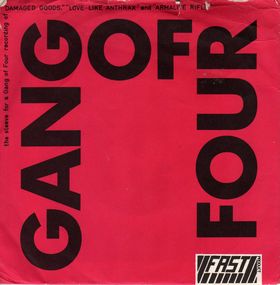
THE GANG OF FOUR – They Really Mean it, Man!

Text by Dale Ashmun, intro by Robert Barry Francos
Interview © 1980; RBF intro © 2011 by FFanzeen
Images from the Internet, except where indicated


[Jon King at Irving Plaza © RBF]
The following article on iconic political British rockers the Gang of Four was originally published in FFanzeen magazine, issue #5, in 1980. It was written by Dale Ashmun.

Musically, I never really got the Gang of Four. There is a whole series of northern British bands that just did nothing for me, such as the much of the Manchester scene (though I like the early Buzzcocks). But just because I was not a fan of the sound I certainly respected what some were doing, such as with the Gang of Four. Most of the bands from northern England either had an electronica undertone, whiny and depressing singers, or rhythms and melody lines that did not connect to me.

Despite this, I went to Irving Plaza on November 11, 1980, to check them out. While they were good, for me they were absolutely blown out by their opening act, Boston’s own Mission of Burma.

What I especially like about Gang of Four, though, is their level of politics. It was closer to Stiff Little Fingers than, say, the Pistols or Crass. GoF were involved with so many of the public causes that were more prevalent in the UK than there were here (not counting the big, corporate-sponsored AID tour de forces, all I remember in the States is the No More Nukes concert, and to save independent radio station WPIX corporate greed… neither worked), such as those discussed below; many of them were successful on some level.

The band at the time of the interview is as follows; note that the Gang of Four has since reformed and are now once again a viable unit:

Jon King (vocals): He now writes for films and television, and is managing director of London’s Story Worldwide, a digital content marketing agency.

Andy Gill (guitar): Produced much of the output of the band, and went on to produce the likes of the Red Hot Chili Peppers, Killing Joke, The Jesus Lizard, and the Stranglers.

Mark Heaney (drums): Having a career as a studio musician for the likes of Badly Drawn Boy and the Seahorses, he also released a solo record which is, naturally, drum-oriented.

Dave Allen (bass): The only member not to rejoin into the Gang of Four redux, Dave founded the band Shriekback in the 1980s. Joining the digital revolution in the U.S. Pacific Northwest, he started out as director of consumer digital audio services at Intel, followed by the president of Overland Agency’s entertainment department, and then co-founded Fight, a firm that focuses on digital strategy. And as this isn’t enough, he also runs the indie label Pampelmoose. – RBF, 2011


Some people go to rock’n’roll shows to forget about what is going on around them, to escape that impending sense of doom that looms over their noggins every time they read the newspaper or listen to the news. This audience is usually satisfied by songs dealing with hot cars, luscious girls, wild parties, and the joys of an alcoholic or drug induced stupor. This camp might not take quickly to the Gang of Four, an English band who, heaven forbid, actually expresses political attitudes in their songs. For those who welcome a little message with their medium, the Gang of Four’s first LP, Entertainment, is available on Warner Bros. Records (EMI released it in England last October). It’s one of the most exciting, thought provoking LPs I’ve head since John, Paul, Steve and Sid presented their unique world view to Mr. and Mrs. Average Consumer a few years ago.

The Gang formed in Leeds, where drummer Hugo Burnham, lead singer Jon King, and guitarist Andy Gill attended Leeds University together. Bassist Dave Allen joined them in 1977, being the only member with previous band experience.

Recently, the Gang of Four finished their second tour of America, having visited the States last summer with the Buzzcocks. At Irving Plaza, Friday, May 3, I was immediately won over by the band’s power and precision – and I wasn’t alone. The riveting impact of the band was evident on the packed dance floor, from the opening guitar feedback of “5:15,” to the encore offerings of “Armalite Rifle” and “Glass.”

Two days after they opened their second assault on America, I spoke with Hugo Burnham and Jon King in a comfortable Warner Bros. conference room. Both musicians were extremely open and generous with their time as we discussed the Gang of Four and related topics for the next hour.

FFanzeen: Where you in a band that once played at CBGBs?
Jon King: No, no, that’s not the case at all. It’s just that when we were in America about three years ago – not with the Gang of Four – we were just there one night getting drunk with J.D. Daugherty [Patti Smith Group – RBF, 2011] and some bloke came up and said, “Are you the band?” and we said, “Yeah, yeah, that’s right.” He said, “Are you playing later on?” and we said, “Yeah,” and the guy says, “Hey, can I jam with you guys?” and we said, “Yeah, go and get your guitar.” So he took off. It was only a joke; we didn’t actually play at all.

FF: When was the first appearance of the Gang of Four?
Hugo Burnham: It was in Leeds, in Yorkshire, where we’re based. It was underneath the Corn Exchange in a club called the Cellar Bar. It was in the basement.
Jon: About the same size as CBGBs.
Hugo: It was around May the 7th, 1977.

FF: Were you students at Leeds University at the time?
Jon: Yeah.

FF: I hear you studied acting, Hugo.
Hugo: Well, English Literature and Drama, actually.
Jon: But he didn’t do any English
Hugo: [Laughs] I didn’t do any English.

FF: Were you involved in any plays?
Hugo: Yeah, I did quite a lot, actually. I spent more time doing that than anything else.
Jon: He left the band for about a month and a half. No, longer than that – it was about three months.
Hugo, No, no, it wasn’t as long as that. It was just to do the Edinburgh Festival… it was about a month and a half, about six or seven weeks.
Jon: He got really good reviews in the play. He’s quite good at it. I mean, he’s acted as drummer for quite a while. He bluffed that out!

FF: Was this a Shakespearean festival?
Hugo: There’s a whole lot of stuff. It’s like a huge dramatic, operative arts festival. I was taking part in two shows. One was called A Bit of Me. It was a play about football, uh, soccer…
Jon: Hooligans!
Hugo: Yeah, hooligans. I was doing that with this guy I met in Leeds and we started up a theatre company, the two of us, which is why I left the Gang of Four for about six weeks. When I finished university, I had the choice between the two and I wanted to do this theatre company because if I didn’t at the time, he wouldn’t have carried on. He would have given up.
Jon: And we went through the hellish thing about auditioning millions of drummers; none of them could play “Armalite Rifle. I mean, on the surface it seems like the most simple drum pattern to play, but very few drummers can do sort of Charlie Watts-style of drumming, which is what Hugo is good at. And that slow high hat with the bass drum. No cone could do that. We eventually got a guy as a drummer. We had a temporary drummer who was a real asshole. You know, he’d use the band phone to make all his phone calls. We’d get bills for a hundred pounds.
Hugo: He ripped us off of a lot of money.
Jon: We auditioned loads of drummers and went through quite a few people and eventually chose Kelvin (Knight), who’s now the drummer for the Delta 5. He’s a really good drummer and the day that we said, “OK, you’ve got the job,” Hugo, he’d been thinking about it, and he said, “OK, I’ve decided to rejoin” because his heart was in [affected voice] “rock’n’roll,” and he gave up the other. When the Delta 5 began, we recommended Kelvin to other friends of ours who were doing Delta 5. Basically, at that stage, it was girlfriends of us and the Mekons.

FF: I saw “Hello to the Mekons” on the album sleeve. They must be close friends.
Jon: Yeah, I mean, like the Mekons – Kelvin, Tom (Greenlaugh) and Mark (White) – went to the same school. Then we went to the same university. Andy Corrigan, who was the other singer in the band, was in the same year as me… him and me and Mark used to share a flat so we’re all really good friends, long before the bands got started.
Hugo: David’s (Allen) the only guy who sort of from a different group of people.
Jon: Yeah, he came from further North and he left school when he was 16 and worked in factory jobs and things.
Hugo: He did a lot of years with workingman club bands, show bands, doing country-western cover versions, pop, jazz; really fucking-good training.
Jon: But he was more into modern jazz. That’s what he really liked.

FF: I wanted to ask you about your first impressions of America when you toured with the Buzzcocks last summer.
Hugo: It was really exciting. Most of the people had come to America for the first time because we were doing it as a band. Six of us came over… there were the four members of the band: there was our former manager, Rob Warr, and there was Jol (Burnham), my brother, who was one of our two roadies, which is all we could afford to bring. We had a Dodge Van…
Jon: [disgusted snicker] Dodgy… Dodgy Dodge!

FF: Broke down a lot, huh?
Hugo: Oh, yeah.
Jon: It didn’t have any license plates.
Hugo: Broke down in the Lincoln Tunnel at 5 o’clock Friday afternoon.
Jon: We backed up all the traffic leaving New York
Hugo: Anyway, there were six of us. We used to book two hotel rooms wherever we went so we had to take turns sharing a double bed. We drove everywhere, except to the West Coast because we couldn’t afford to fly. We had $10 a day cash.

FF: Were you still signed to Fast Records at this time?
Hugo: No, we had signed with EMI.
Jon: But that was for the rest of the world. They actually wouldn’t give us any money for North America.
Hugo: We were headlining at sort of small clubs, playing two shows a night, two nights sometimes, and we supported the Buzzcocks on seven big shows. All in all, we did about 31 dates in about 36 days.
Jon: It was great. It was the first tour we’d ever done - ever - in America.
Hugo: Up to recently we’d been students. We’d only done two or three days on the truck. In fact, it did the band a hell of a lot of good, that tour.
Jon: It proved we could work together and sit on top of each other all day long. We tend to argue a lot, and always have done. When it came to the crunch, everyone sort of knew when to stand off. I think people argued just for the fun of it.

FF: Did you get to look around the cities much where you played?
Hugo: We got to see New York quite a bit because we were here for about a week. And L.A.
Jon: But places like San Francisco, we just went in there, played the gig and had to leave. We played Geary Temple [Jim Jones’ church], which was really far out.
Hugo: San Francisco was a fantastic place, a fantastic city. We were there for 24 hours and I wish we’d been there for 24 days.

FF: Did you play the Whiskey in Los Angeles?
Hugo: Yeah, but I didn’t like it.
Jon: But we’re playing the Starwood this time. We weren’t too keen on the Whiskey because it was formal in a funny sort of way.

FF: Did you play the Golden Bear in Huntington Beach?
Jon: Yeah. That was great because that was really badly promoted and only about two or three hundred people…
Hugo: The very last gig we did, right (Jon)?
Jon: Yeah.
Hugo: There were only about 60 or 70 people, right, that was all. We had this crappy support band, a real Beach Boys/Beatles rip-off, and they were shit. So we were upstairs getting really pissed. This was the end of the tour (and) we were absolutely shattered and shagged out, and we sort of went, “Fuck it, it’s the last show; it doesn’t matter because there’s nobody here really, so let’s just have a really good time.” And those 60 people were as good as six or seven hundred; they were fucking great.
Jon: Yeah, it was brilliant.
Hugo: We just did a full tilt show and they were a full tilt audience.

FF: How did you like the Irving Plaza shows?
Jon and Hugo: It was great; terrific.
Jon: What we had arranged originally was to play a warm-up gig, which is low profile, which was to be in Aberdeen with the Shirts, just to warm up because we hadn’t played for a week and a half. Someone drove into power lines the night before, so we had to cancel, and had no warm up gig. And that first day [Friday] the PA wasn’t working at Irving Plaza, so we didn’t even get a proper soundcheck.
Hugo: Three hours late on the soundcheck.
Jon: We literally just played a couple of songs and that was it. So we hadn’t played at all and before that gig we sort of thought, “Hmmm, could do with a bit of rehearsing here, boys,” but we just went on there and it seemed to come off. But Saturday went bananas compared to Friday night.
Hugo: Look, look, look… it’s a good place, a lovely atmosphere; it’s a good gig.
Jon: A very English gig there.
Hugo: I don’t know what the situation will be like when we come back, but I’d rather do 5 nights there than play a shithole like the Palladium. At Irving Plaza, people can dance, it’s not too big, you’re close enough to the band you don’t feel like you’re seeing a super-group like Ron Delsner running it and it’s all a big heavy deal, and I just don’t want to know.
Jon: If they had a theatre, something like the Electric Ballroom in London, which is one of our favorite halls… we always do two nights there rather than do a bigger gig.
Hugo: The only place I would consider playing in New York bigger than Irving Plaza is Shea Stadium [Laughter].

FF: Not Madison Square Garden?
Jon: It’s too small for the band [more laughter].

FF: Two show!
Hugo: Two shows at the Madison Square Garden, yeah. Anywhere Charlie’s (Watts) played I don’t mind playing. [Should we tell him about the Stones at the Palladium? – Ed.]

FF: Did you ever play the Roundhouse in London?
Hugo: No, but I’ve acted there.
Jon: No… that closed down by the time we got started. Thing was, being from the north of England, I suspect it’s the same in the States – if you’re from Minneapolis, you’re just fucked unless you come to New York. What we did was play ‘round the sticks in England, in the north, which is totally ignored. And for two years, apart form the second gig from which we got a slag-off review, for the next two years we didn’t get a single review or a single article. Not a single one because it’s all so London centered, and there’s a few papers that come out in Manchester. But if you’re in Leeds, Yorkshire, they just don’t want to know… and we’d played ‘round everywhere, ring up and say, “Can we get a gig?” “Who the fuck are you?” You know, “Never heard the name,” and that went on for two years. Then the Fast Products single came out (and) got really good reception. We did this job with all the Fast Products bands in London, and suddenly London woke up to the fact that there were a hell of a lot of things going on. Then everybody sort of wanted to buy us drinks.

FF: I’ve read about your involvement in Rock Against Racism concerts in England. I also noticed that you played in the first Rock Against Sexism benefit. How did that come about?
Hugo: Rock Against Sexism arose from within the depths of Rock Against Racism. People involved in RAR really got RAS going with the help of some other people. They had asked us to do several gigs, but we weren’t available, and then they scheduled one in London and we said, “Yeah, we’ll do it.” There were two other bands – the Delta 5 and the Spoilsports – who were basically an unknown all-girl soul band.
Jon: Lucy Toothpaste, who is one of the writers for Rock Against Racism, and Graham Locke, who writes for NME, were among the leading lights of Rock Against Sexism.

FF: Are the RAS people still putting on shows?
Jon: Yeah, it concentrates on smaller scale, local events. That was a fundraiser, actually. Their goals are to get women involved in all areas of music… like other friends of ours, the Au Pairs, two men and two women; they’ve got a female roadie. There’s a hell of a lot of bands in England with women, an enormous amount, which is good, but there are very few women sound engineers, disc jockeys, and such.

FF: I also read about your involvement in a benefit to open an inquiry into the death of Blair Peach (who was killed by the police during a demonstration against the National Front). What is the status of that case?
Hugo: They just brought it up again and it looks like something might get started.
Jon: It was incredible! It was a demonstration where the number of Black and Asian People… it was nearly all Asian people… so it wasn’t that the Socialist Worker’s Party – as the police tried to imply – infiltrated the local community and rabble-rousing. Now most of the people arrested were Asian.

FF: Was this during a RAR concert?
Jon: No, no, this was just on the street because the National Front were having a rally, which was, you know, to send the Blacks out, send the Asians out, all this business. So the local community demonstrated and the papers went on about the police injured, but the number of severe, serious head injuries… and groin injuries were to the Asians in the crowd… and you wouldn’t believe the way the actual trials of the people were rigged. They went to Magistrate’s Courts, which are held outside the area. For example, the police would say things like, “I recognize this man because he had a green suit on,” and the police would say, “Well, it could have been a brown suit.” The conviction rate for those trials… in England, the conviction rate was something like 50 percent…. In some of them it reach a 90 percent conviction rate, on the word of an officer against people like doctors, ambulance drivers, etc., etc. A band called Misty and the Ruts, they had a rehearsal room –
Hugo: - In the community center, which was destroyed -
Jon: - Destroyed by the police. I mean, things like speakers, cabinets, guitars… I don’t see how those can jump out and hit a police officer’s boot. But there’s nothing written about that. And this guy Blair Peach was killed [ en.wikipedia.org/wiki/Blair_Peach – RBF, 2011]; he was seen being beaten by the police. He died of head injuries and the hospital man said he had been hit by a heavy object, probably a lead-filled truncheon. A search of the special patrol group lockers, after a lot of fuss to do so, actually found things like pick-axe handles, a lead-filled truncheon, bits of wire, everything. They found all this stuff in the lockers and that was it. That even got written up in the right wing press and yet nothing happened. You know, a guy is murdered and they find weapons that are not police issue. The special patrol refused to cooperate with the courts.

FF: Aren’t they required to testify?
Jon: Yeah. There’s an antiquated law in England, which is a Victorian law called Suss… which means “suspicion of intent to commit an offense against person or persons unknown.” And it’s basically a victimless crime that’s been used almost exclusively against Blacks. It’s not used against whites or in areas where there is a lot of mugging or street crime, like in Glasgow, which is all white. The Suss law is never used (there). For example, they’ll descend on a bus stop where a couple of Black guys are hanging around.
Hugo: If they don’t get on the first bus that comes along they’re “loitering with intent.”
Jon: They get busted; they get charged with a crime that they are intending to steal somebody’s property. They don’t even have to produce a victim or even any witnesses to the event, and these people get sent down for it.

FF: Will you have a large say in the decision as to what your first domestic single will be?
Jon: We basically can decide what we put out. We’ll have to talk to (Warner Bros.) about that because what happens here is different than England. In England, you can’t sell LPs in any quantity without a single in the charts. Whereas in the States, you have an album and only if they think the single’s going to chart do they promote it, because album cuts get played on the radio more here.

FF: I know that EMI has given you total control over the packaging of your records and that you design the sleeves yourselves. Will Warner Bros. be giving you this same control?
Hugo: Yeah, that’s why we signed with Warners, and why we signed with EMI – because they were the only people prepared to give us a contract that went beyond the band being dumb idiots who didn’t really know what they were signing, who are good at writing songs and, “Well, get on with that boys and we’ll take care of this.”
Jon: You see, the thing that’s a hassle is like with the Clash album, they want to put out a single now, but CBS in London don’t reckon it’s commercial enough, so they won’t put it out.
Hugo: But we won’t get in that position, you see.

FF: I notice that the whole group is credited on the songs. Do you write most of the lyrics, Jon?
Jon: Yeah, I do, but what happens is (I just sort of throw out some idea and we sort of put it together
Hugo: The genesis of the lyrics come from Jon, but everything – the drumming, lyrics, guitar – are subject to discussion
Jon: What tends to happen is you put it to the group and see what they think, and then go back and change it. Then Andy would maybe lob in a few lines. You find out what the band wants, which makes writing a lot easier.

FF: Do you want to make videotapes of any of your songs?
Jon: I do want to, but EMI won’t pay for it. They won’t pay of it because they don’t show videotapes on British TV. Top of the Pops won’t show a video of a band unless you’re out of the country or have a song in the Top 30. It’s musician union rules. There’s only about one other program that will show videos, so they say it’s not worth the cost.

FF: What do you think about the idea of video discs being put on the market?
Hugo: I’m not really that keen on entering into all that until it becomes more established. Besides, they’re going to be so expensive, it’s ridiculous.
Jon: Who’s got video players, anyway? I haven’t even got a TV.

[At this point, FF was told its time was up, as the Gang of Four had a photo session scheduled and a soundcheck for their appearance that evening on Long Island]

FF: So let me get in a few short answer type questions. When do you start recording your second LP?
Hugo: Later this year
Jon: The thing is to avoid repeating yourself.

FF: OK, last question: what do you think of the Mod revival and ska movement currently taking place in the music business?
Jon: It’s a classic thing that happens with pop music. To maintain a selling momentum, you recycle and reintroduce fashions and trends. It’s the same with many other things. It’s part of marketing; it’s selling style as a new thing.

* * *

So, after listening to the Gang of Four’s music and reading their lyrics, I found it very curious that this band is signed by two of the largest record conglomerates in the world. Yet, if both these companies are willing to give the band the artistic freedom they demand, as well as putting their mammoth distribution network to work for the Gang of Four, perhaps this union of a fiercely independent, intelligent rock band and the powers that push their vinyl will set a positive trend for the music industry to follow during the 1980s.


Bonus Videos
The Mekons


Delta 5


Buzzcocks


Au Pair


Mission of Burma