Interview © 1980; RBF intro © 2011 by FFanzeen
Images from the Internet, except where indicated
[Jon King at Irving Plaza © RBF]

The following article on iconic political British rockers the Gang of Four was originally published in FFanzeen magazine, issue #5, in 1980. It was written by Dale Ashmun.
Musically, I never really got the Gang of Four. There is a whole series of northern British bands that just did nothing for me, such as the much of the Manchester scene (though I like the early Buzzcocks). But just because I was not a fan of the sound I certainly respected what some were doing, such as with the Gang of Four. Most of the bands from northern England either had an electronica undertone, whiny and depressing singers, or rhythms and melody lines that did not connect to me.
Despite this, I went to Irving Plaza on November 11, 1980, to check them out. While they were good, for me they were absolutely blown out by their opening act, Boston’s own Mission of Burma.
What I especially like about Gang of Four, though, is their level of politics. It was closer to Stiff Little Fingers than, say, the Pistols or Crass. GoF were involved with so many of the public causes that were more prevalent in the UK than there were here (not counting the big, corporate-sponsored AID tour de forces, all I remember in the States is the No More Nukes concert, and to save independent radio station WPIX corporate greed… neither worked), such as those discussed below; many of them were successful on some level.
The band at the time of the interview is as follows; note that the Gang of Four has since reformed and are now once again a viable unit:
Jon King (vocals): He now writes for films and television, and is managing director of London’s Story Worldwide, a digital content marketing agency.
Andy Gill (guitar): Produced much of the output of the band, and went on to produce the likes of the Red Hot Chili Peppers, Killing Joke, The Jesus Lizard, and the Stranglers.
Mark Heaney (drums): Having a career as a studio musician for the likes of Badly Drawn Boy and the Seahorses, he also released a solo record which is, naturally, drum-oriented.
Dave Allen (bass): The only member not to rejoin into the Gang of Four redux, Dave founded the band Shriekback in the 1980s. Joining the digital revolution in the U.S. Pacific Northwest, he started out as director of consumer digital audio services at Intel, followed by the president of Overland Agency’s entertainment department, and then co-founded Fight, a firm that focuses on digital strategy. And as this isn’t enough, he also runs the indie label Pampelmoose. – RBF, 2011

Some people go to rock’n’roll shows to forget about what is going on around them, to escape that impending sense of doom that looms over their noggins every time they read the newspaper or listen to the news. This audience is usually satisfied by songs dealing with hot cars, luscious girls, wild parties, and the joys of an alcoholic or drug induced stupor. This camp might not take quickly to the Gang of Four, an English band who, heaven forbid, actually expresses political attitudes in their songs. For those who welcome a little message with their medium, the Gang of Four’s first LP, Entertainment, is available on Warner Bros. Records (EMI released it in England last October). It’s one of the most exciting, thought provoking LPs I’ve head since John, Paul, Steve and Sid presented their unique world view to Mr. and Mrs. Average Consumer a few years ago.
The Gang formed in Leeds, where drummer Hugo Burnham, lead singer Jon King, and guitarist Andy Gill attended Leeds University together. Bassist Dave Allen joined them in 1977, being the only member with previous band experience.
Recently, the Gang of Four finished their second tour of America, having visited the States last summer with the Buzzcocks. At Irving Plaza, Friday, May 3, I was immediately won over by the band’s power and precision – and I wasn’t alone. The riveting impact of the band was evident on the packed dance floor, from the opening guitar feedback of “5:15,” to the encore offerings of “Armalite Rifle” and “Glass.”
Two days after they opened their second assault on America, I spoke with Hugo Burnham and Jon King in a comfortable Warner Bros. conference room. Both musicians were extremely open and generous with their time as we discussed the Gang of Four and related topics for the next hour.
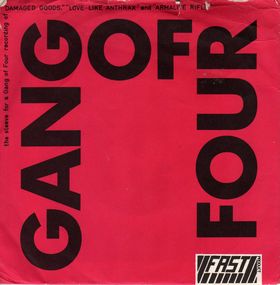 FFanzeen: Where you in a band that once played at CBGBs?
 Jon King: No, no, that’s not the case at all. It’s just that when we were in America about three years ago – not with the Gang of Four – we were just there one night getting drunk with J.D. Daugherty [Patti Smith Group – RBF, 2011] and some bloke came up and said, “Are you the band?” and we said, “Yeah, yeah, that’s right.” He said, “Are you playing later on?” and we said, “Yeah,” and the guy says, “Hey, can I jam with you guys?” and we said, “Yeah, go and get your guitar.” So he took off. It was only a joke; we didn’t actually play at all.
FF: When was the first appearance of the Gang of Four?
Hugo Burnham: It was in Leeds, in Yorkshire, where we’re based. It was underneath the Corn Exchange in a club called the Cellar Bar. It was in the basement.
Jon: About the same size as CBGBs.
Hugo: It was around May the 7th, 1977.
FF: Were you students at Leeds University at the time?
Jon: Yeah.
FF: I hear you studied acting, Hugo.
Hugo: Well, English Literature and Drama, actually.
Jon: But he didn’t do any English
Hugo: [Laughs] I didn’t do any English.
FF: Were you involved in any plays?
Hugo: Yeah, I did quite a lot, actually. I spent more time doing that than anything else.
Jon: He left the band for about a month and a half. No, longer than that – it was about three months.
Hugo, No, no, it wasn’t as long as that. It was just to do the Edinburgh Festival… it was about a month and a half, about six or seven weeks.
Jon: He got really good reviews in the play. He’s quite good at it. I mean, he’s acted as drummer for quite a while. He bluffed that out!
FF: Was this a Shakespearean festival?
Hugo: There’s a whole lot of stuff. It’s like a huge dramatic, operative arts festival. I was taking part in two shows. One was called A Bit of Me. It was a play about football, uh, soccer…
Jon: Hooligans!
Hugo: Yeah, hooligans. I was doing that with this guy I met in Leeds and we started up a theatre company, the two of us, which is why I left the Gang of Four for about six weeks. When I finished university, I had the choice between the two and I wanted to do this theatre company because if I didn’t at the time, he wouldn’t have carried on. He would have given up.
Jon: And we went through the hellish thing about auditioning millions of drummers; none of them could play “Armalite Rifle. I mean, on the surface it seems like the most simple drum pattern to play, but very few drummers can do sort of Charlie Watts-style of drumming, which is what Hugo is good at. And that slow high hat with the bass drum. No cone could do that. We eventually got a guy as a drummer. We had a temporary drummer who was a real asshole. You know, he’d use the band phone to make all his phone calls. We’d get bills for a hundred pounds.
Hugo: He ripped us off of a lot of money.
Jon: We auditioned loads of drummers and went through quite a few people and eventually chose Kelvin (Knight), who’s now the drummer for the Delta 5. He’s a really good drummer and the day that we said, “OK, you’ve got the job,” Hugo, he’d been thinking about it, and he said, “OK, I’ve decided to rejoin” because his heart was in [affected voice] “rock’n’roll,” and he gave up the other. When the Delta 5 began, we recommended Kelvin to other friends of ours who were doing Delta 5. Basically, at that stage, it was girlfriends of us and the Mekons.
FF: I saw “Hello to the Mekons” on the album sleeve. They must be close friends.
Jon: Yeah, I mean, like the Mekons – Kelvin, Tom (Greenlaugh) and Mark (White) – went to the same school. Then we went to the same university. Andy Corrigan, who was the other singer in the band, was in the same year as me… him and me and Mark used to share a flat so we’re all really good friends, long before the bands got started.
Hugo: David’s (Allen) the only guy who sort of from a different group of people.
Jon: Yeah, he came from further North and he left school when he was 16 and worked in factory jobs and things.
Hugo: He did a lot of years with workingman club bands, show bands, doing country-western cover versions, pop, jazz; really fucking-good training.
Jon: But he was more into modern jazz. That’s what he really liked.
FF: I wanted to ask you about your first impressions of America when you toured with the Buzzcocks last summer.
Hugo: It was really exciting. Most of the people had come to America for the first time because we were doing it as a band. Six of us came over… there were the four members of the band: there was our former manager, Rob Warr, and there was Jol (Burnham), my brother, who was one of our two roadies, which is all we could afford to bring. We had a Dodge Van…
Jon: [disgusted snicker] Dodgy… Dodgy Dodge!
FF: Broke down a lot, huh?
Hugo: Oh, yeah.
Jon: It didn’t have any license plates.
Hugo: Broke down in the Lincoln Tunnel at 5 o’clock Friday afternoon.
Jon: We backed up all the traffic leaving New York
Hugo: Anyway, there were six of us. We used to book two hotel rooms wherever we went so we had to take turns sharing a double bed. We drove everywhere, except to the West Coast because we couldn’t afford to fly. We had $10 a day cash.
 FF: Were you still signed to Fast Records at this time?
 Hugo: No, we had signed with EMI.
Jon: But that was for the rest of the world. They actually wouldn’t give us any money for North America.
Hugo: We were headlining at sort of small clubs, playing two shows a night, two nights sometimes, and we supported the Buzzcocks on seven big shows. All in all, we did about 31 dates in about 36 days.
Jon: It was great. It was the first tour we’d ever done - ever - in America.
Hugo: Up to recently we’d been students. We’d only done two or three days on the truck. In fact, it did the band a hell of a lot of good, that tour.
Jon: It proved we could work together and sit on top of each other all day long. We tend to argue a lot, and always have done. When it came to the crunch, everyone sort of knew when to stand off. I think people argued just for the fun of it.
FF: Did you get to look around the cities much where you played?
Hugo: We got to see New York quite a bit because we were here for about a week. And L.A.
Jon: But places like San Francisco, we just went in there, played the gig and had to leave. We played Geary Temple [Jim Jones’ church], which was really far out.
Hugo: San Francisco was a fantastic place, a fantastic city. We were there for 24 hours and I wish we’d been there for 24 days.
FF: Did you play the Whiskey in Los Angeles?
Hugo: Yeah, but I didn’t like it.
Jon: But we’re playing the Starwood this time. We weren’t too keen on the Whiskey because it was formal in a funny sort of way.
FF: Did you play the Golden Bear in Huntington Beach?
Jon: Yeah. That was great because that was really badly promoted and only about two or three hundred people…
Hugo: The very last gig we did, right (Jon)?
Jon: Yeah.
Hugo: There were only about 60 or 70 people, right, that was all. We had this crappy support band, a real Beach Boys/Beatles rip-off, and they were shit. So we were upstairs getting really pissed. This was the end of the tour (and) we were absolutely shattered and shagged out, and we sort of went, “Fuck it, it’s the last show; it doesn’t matter because there’s nobody here really, so let’s just have a really good time.” And those 60 people were as good as six or seven hundred; they were fucking great.
Jon: Yeah, it was brilliant.
Hugo: We just did a full tilt show and they were a full tilt audience.
FF: How did you like the Irving Plaza shows?
Jon and Hugo: It was great; terrific.
Jon: What we had arranged originally was to play a warm-up gig, which is low profile, which was to be in Aberdeen with the Shirts, just to warm up because we hadn’t played for a week and a half. Someone drove into power lines the night before, so we had to cancel, and had no warm up gig. And that first day [Friday] the PA wasn’t working at Irving Plaza, so we didn’t even get a proper soundcheck.
Hugo: Three hours late on the soundcheck.
Jon: We literally just played a couple of songs and that was it. So we hadn’t played at all and before that gig we sort of thought, “Hmmm, could do with a bit of rehearsing here, boys,” but we just went on there and it seemed to come off. But Saturday went bananas compared to Friday night.
Hugo: Look, look, look… it’s a good place, a lovely atmosphere; it’s a good gig.
Jon: A very English gig there.
Hugo: I don’t know what the situation will be like when we come back, but I’d rather do 5 nights there than play a shithole like the Palladium. At Irving Plaza, people can dance, it’s not too big, you’re close enough to the band you don’t feel like you’re seeing a super-group like Ron Delsner running it and it’s all a big heavy deal, and I just don’t want to know.
Jon: If they had a theatre, something like the Electric Ballroom in London, which is one of our favorite halls… we always do two nights there rather than do a bigger gig.
Hugo: The only place I would consider playing in New York bigger than Irving Plaza is Shea Stadium [Laughter].
FF: Not Madison Square Garden?
Jon: It’s too small for the band [more laughter].
FF: Two show!
Hugo: Two shows at the Madison Square Garden, yeah. Anywhere Charlie’s (Watts) played I don’t mind playing. [Should we tell him about the Stones at the Palladium? – Ed.]
FF: Did you ever play the Roundhouse in London?
Hugo: No, but I’ve acted there.
Jon: No… that closed down by the time we got started. Thing was, being from the north of England, I suspect it’s the same in the States – if you’re from Minneapolis, you’re just fucked unless you come to New York. What we did was play ‘round the sticks in England, in the north, which is totally ignored. And for two years, apart form the second gig from which we got a slag-off review, for the next two years we didn’t get a single review or a single article. Not a single one because it’s all so London centered, and there’s a few papers that come out in Manchester. But if you’re in Leeds, Yorkshire, they just don’t want to know… and we’d played ‘round everywhere, ring up and say, “Can we get a gig?” “Who the fuck are you?” You know, “Never heard the name,” and that went on for two years. Then the Fast Products single came out (and) got really good reception. We did this job with all the Fast Products bands in London, and suddenly London woke up to the fact that there were a hell of a lot of things going on. Then everybody sort of wanted to buy us drinks.
FF: I’ve read about your involvement in Rock Against Racism concerts in England. I also noticed that you played in the first Rock Against Sexism benefit. How did that come about?
Hugo: Rock Against Sexism arose from within the depths of Rock Against Racism. People involved in RAR really got RAS going with the help of some other people. They had asked us to do several gigs, but we weren’t available, and then they scheduled one in London and we said, “Yeah, we’ll do it.” There were two other bands – the Delta 5 and the Spoilsports – who were basically an unknown all-girl soul band.
Jon: Lucy Toothpaste, who is one of the writers for Rock Against Racism, and Graham Locke, who writes for NME, were among the leading lights of Rock Against Sexism.
FF: Are the RAS people still putting on shows?
Jon: Yeah, it concentrates on smaller scale, local events. That was a fundraiser, actually. Their goals are to get women involved in all areas of music… like other friends of ours, the Au Pairs, two men and two women; they’ve got a female roadie. There’s a hell of a lot of bands in England with women, an enormous amount, which is good, but there are very few women sound engineers, disc jockeys, and such.
FF: I also read about your involvement in a benefit to open an inquiry into the death of Blair Peach (who was killed by the police during a demonstration against the National Front). What is the status of that case?
Hugo: They just brought it up again and it looks like something might get started.
Jon: It was incredible! It was a demonstration where the number of Black and Asian People… it was nearly all Asian people… so it wasn’t that the Socialist Worker’s Party – as the police tried to imply – infiltrated the local community and rabble-rousing. Now most of the people arrested were Asian.
 FF: Was this during a RAR concert?
 Jon: No, no, this was just on the street because the National Front were having a rally, which was, you know, to send the Blacks out, send the Asians out, all this business. So the local community demonstrated and the papers went on about the police injured, but the number of severe, serious head injuries… and groin injuries were to the Asians in the crowd… and you wouldn’t believe the way the actual trials of the people were rigged. They went to Magistrate’s Courts, which are held outside the area. For example, the police would say things like, “I recognize this man because he had a green suit on,” and the police would say, “Well, it could have been a brown suit.” The conviction rate for those trials… in England, the conviction rate was something like 50 percent…. In some of them it reach a 90 percent conviction rate, on the word of an officer against people like doctors, ambulance drivers, etc., etc. A band called Misty and the Ruts, they had a rehearsal room –
Hugo: - In the community center, which was destroyed -
Jon: - Destroyed by the police. I mean, things like speakers, cabinets, guitars… I don’t see how those can jump out and hit a police officer’s boot. But there’s nothing written about that. And this guy Blair Peach was killed [ en.wikipedia.org/wiki/Blair_Peach – RBF, 2011]; he was seen being beaten by the police. He died of head injuries and the hospital man said he had been hit by a heavy object, probably a lead-filled truncheon. A search of the special patrol group lockers, after a lot of fuss to do so, actually found things like pick-axe handles, a lead-filled truncheon, bits of wire, everything. They found all this stuff in the lockers and that was it. That even got written up in the right wing press and yet nothing happened. You know, a guy is murdered and they find weapons that are not police issue. The special patrol refused to cooperate with the courts.
FF: Aren’t they required to testify?
Jon: Yeah. There’s an antiquated law in England, which is a Victorian law called Suss… which means “suspicion of intent to commit an offense against person or persons unknown.” And it’s basically a victimless crime that’s been used almost exclusively against Blacks. It’s not used against whites or in areas where there is a lot of mugging or street crime, like in Glasgow, which is all white. The Suss law is never used (there). For example, they’ll descend on a bus stop where a couple of Black guys are hanging around.
Hugo: If they don’t get on the first bus that comes along they’re “loitering with intent.”
Jon: They get busted; they get charged with a crime that they are intending to steal somebody’s property. They don’t even have to produce a victim or even any witnesses to the event, and these people get sent down for it.
FF: Will you have a large say in the decision as to what your first domestic single will be?
Jon: We basically can decide what we put out. We’ll have to talk to (Warner Bros.) about that because what happens here is different than England. In England, you can’t sell LPs in any quantity without a single in the charts. Whereas in the States, you have an album and only if they think the single’s going to chart do they promote it, because album cuts get played on the radio more here.
FF: I know that EMI has given you total control over the packaging of your records and that you design the sleeves yourselves. Will Warner Bros. be giving you this same control?
Hugo: Yeah, that’s why we signed with Warners, and why we signed with EMI – because they were the only people prepared to give us a contract that went beyond the band being dumb idiots who didn’t really know what they were signing, who are good at writing songs and, “Well, get on with that boys and we’ll take care of this.”
Jon: You see, the thing that’s a hassle is like with the Clash album, they want to put out a single now, but CBS in London don’t reckon it’s commercial enough, so they won’t put it out.
Hugo: But we won’t get in that position, you see.
 FF: I notice that the whole group is credited on the songs. Do you write most of the lyrics, Jon?
 Jon: Yeah, I do, but what happens is (I just sort of throw out some idea and we sort of put it together
Hugo: The genesis of the lyrics come from Jon, but everything – the drumming, lyrics, guitar – are subject to discussion
Jon: What tends to happen is you put it to the group and see what they think, and then go back and change it. Then Andy would maybe lob in a few lines. You find out what the band wants, which makes writing a lot easier.
FF: Do you want to make videotapes of any of your songs?
Jon: I do want to, but EMI won’t pay for it. They won’t pay of it because they don’t show videotapes on British TV. Top of the Pops won’t show a video of a band unless you’re out of the country or have a song in the Top 30. It’s musician union rules. There’s only about one other program that will show videos, so they say it’s not worth the cost.
FF: What do you think about the idea of video discs being put on the market?
Hugo: I’m not really that keen on entering into all that until it becomes more established. Besides, they’re going to be so expensive, it’s ridiculous.
Jon: Who’s got video players, anyway? I haven’t even got a TV.
[At this point, FF was told its time was up, as the Gang of Four had a photo session scheduled and a soundcheck for their appearance that evening on Long Island]
FF: So let me get in a few short answer type questions. When do you start recording your second LP?
Hugo: Later this year
Jon: The thing is to avoid repeating yourself.
FF: OK, last question: what do you think of the Mod revival and ska movement currently taking place in the music business?
Jon: It’s a classic thing that happens with pop music. To maintain a selling momentum, you recycle and reintroduce fashions and trends. It’s the same with many other things. It’s part of marketing; it’s selling style as a new thing.
* * *
So, after listening to the Gang of Four’s music and reading their lyrics, I found it very curious that this band is signed by two of the largest record conglomerates in the world. Yet, if both these companies are willing to give the band the artistic freedom they demand, as well as putting their mammoth distribution network to work for the Gang of Four, perhaps this union of a fiercely independent, intelligent rock band and the powers that push their vinyl will set a positive trend for the music industry to follow during the 1980s.
Bonus Videos
The Mekons
Delta 5
Buzzcocks
Au Pair
Mission of Burma


 Posts
Posts

