Showing posts with label Dave Rave. Show all posts

Thursday, September 15, 2011

Jersey Beat’s Quiet Corner, Fall 2011: Part 3 of 4

Text © Robert Barry Francos, 2011
Originally in Jersey Beat webzine, 2011
Images and video from the Internet


Here are the reviews that were in my Quiet Corner column at the excellent Jersey Beat webzine (jerseybeat.com). Rather than publish all the reviews at once, I will be publishing them on this blog a few at a time. If I found a video of an exact version of a song from the release, I attached it. Other videos by these artists (usually live) exist, so you can check them out.

If you are in a band and want me to review your release, be it CD, vinyl, DVD or digital, write to me at rbf55@msn.com, or if it’s digital, just send it along.


LED TO SEA is Alex Guy, her viola, and an array of loop pedals. While this has the potential of be an electronica nightmare, her release Into the Darkening Sky (ElevenRecords.com) shows that one can still be loopy and musical. In fact, she has quite the lovely voice, and she employs the strings in a melodic manner (more often plucked than bowed), using it to enhance the sound she’s going for, rather than to mask it. With unusual timing phrases in the structure of the song (i.e., putting spaces in unusual places, or taking an extra beat between choruses, such as in “Rust”), she makes the music experimental, but keeps the integrity of the song. Yes, there are moments of dark and atmospheric sounds and lyrics, but led by Alex’s voice, the veracity remains intact; note it works with the occasional instrumental songs, as well. The lush parts have more of a floating underwater feeling of freeness rather than skimming, and others bouncing on airbags, landing on her voice and viola with a comfortable thud. There is a lot of great music here, such as my fave cut, “Is This the Last Time.” The tunes are recognizable enough to be comfortable, yet off enough not to be formulaic, and kudos for that. It’s not often a viola is the lead instrument in an alternative setting, and especially when used in such a diverse way as Alex does. Yeah, it’s worth getting.
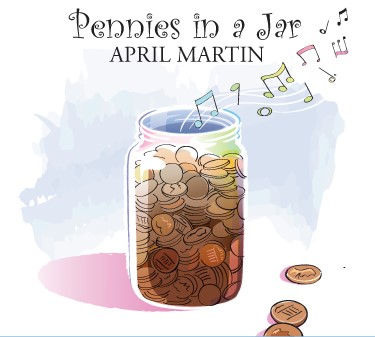


I know APRIL MARTIN has released Pennies in a Jar (Shrimp Toast c/o aprilmartin.com) in a CD format, but at its heart, it really is an LP, with two sides; but I get ahead of myself here… Coming into being as a singer-songwriter in the form of an artist rather than a consumer a bit late in life, April shows that some things are worth the wait. She has a very clear voice, which is smartly put right up front by producer Peter Calo, along with his own, show he has sharp ears), resonates in a way that feels like she is sitting in the living room singing to the listener, and there is some comfort in that. Backed by Peter on guitar, along with some other fine musicians, she is obviously singing from the heart. The first “side” of this release focuses in on the feeling of a slight lack of control in one’s life, where things are just out of reach, or mysterious. “Out of My Hands” (“All my schemes are written in sand”), “Got a Way to Go” (“Don’t know where there is / But I’m heading down the line”), “I Don’t Know” (“I don’t know just how much is in our hands / “I don’t know, is there any sort of plan?”), and “Love’s Been a Long Time Coming” (“Thought it would surely be here by now”) bring life’s experiences of “hunh? wha?” to an emotional depth that is far from alienating an audience, but rather touches the heart gently. The tone of the CD changes with the sexy “When She Says Yes,” or as I like to call it, the start of side two. From here we enter different phases of love from the aforementioned lust (along with an amusing flapperish ‘20s rag style “It Ain’t About the Chassis Anymore”), affection (“One Kiss in the Rain” and “Warrior of the Heart”), and the goodbye (told in both sad mode with “I Won’t Make That Mistake Again” and the Lisa Loeb-style empowering “Bye-Bye”). Not a bad cut here. This may be her first release, but I’m hoping it won’t be her last, nor that it will be too long a wait.


JIM McCARTY was a key player in two major Brit groups during the ‘60s experimental period, being the drummer for both the Yardbirds and Renaissance, as well as being a major songwriter for both. After a few post-period bands and solo excursions, his latest is Sitting on the Top of Time (Easy Action c/o jamesmccarty.com). For this release, he plays drums (as expected), writes all the music (ditto), and fronts the top-notch musicians called in to record this collection. The songs definitely lean more toward Renaissance than Yardbirds, with a prog tone touched with mellow notes, some excellent guitar flourishes, and lush melodies. The topics are about life being impermanent, and accepting with peace one’s place as time passes. In “Temporary Life,” he states, “Feeling all the time go by / Accelerating every day / Letting go the fear I find / That everything is just slipping away.” With “Hummingbird” (one of my fave cuts here), he posits, “Moving through the air transforming / Into dignity / With a new found poise that’s really free.” Rather than dwelling on the short visit on earth we all get, he joyously feels the peace that one can find with age. There is also a smattering of really lovely instrumentals. Now, my one contention with the set is not Jim’s vocals, which is well and good, but that he double-tracks them all. Once in a while, the harmony is nice, but throughout is unnecessary, as he sounds fine. Perhaps it’s lack of vocal confidence, or experimenting, but I’m just putting forward that he does not need that studio heavy-handedness, and he should be as at peace with his voice as he is with the rest of the music.


BEN MILLER / degeneration plays his multiphonic guitar while it’s still on the stand, with pick-ups all over it and electronic doohickeys attached, employing it more as a totally different instrument than classically called for. On his one-man Eyelands Under Eyelid (gulcher.gemm.com), recorded in New Jersey, Miller produces sonic soundscapes that are idiosyncratic and certainly amelodic, but at the same time keeping it interesting. It’s definitely more Brian Eno than the static feedback noise of Metal Machine Music, but it is also not formulaic in any sort of way. As is common in this kind of experimentation, the pieces are longer than standard song length, as once a groove is reached, it’s up to the artist to figure out where it must go from there. Using an SK1, electronics, radio, and tape, these pieces are all improvised and played live in the studio, without overdubs. While listening, I kept imaging this as the backdrop to panning images of planets on something like Nova show. Very ethereal and esoteric, this could be good music to get totally wasted to, but as I don’t imbibe in recreational hoo-ha, it’s just an assumption.


STUART MOXHAM first came to light as a member of Young Marble Giant, and he has had a thriving career as a solo artist (including as Gist), songwriter, and producer. He has collected some of his rare output into a nearly hour-long anthology titled, Personal Best (youngmarblegiants.com). Moxham has a definite flair for songwriting, on a low-fi scale. In fact, about half of this I found kind of uninteresting, honestly, with a plunky keyboard and rhythm machines, but the half I did find remarkable was majorly so. Songs like “Warning Signs 2,” “No More Words” and “Cars in the Grass” show that within the frame he’s shown, there is huge possibility achieved. The tunes are catchy without compromising his aesthetics. Two cuts here that immediately perked up my ears, were “My First Gun” and “Untitled #2,” which appeared on Barbara Manning’s excellent “Barbara Manning Sings With the Original Artists” in 1993 (another CD that’s also worth looking up). Now mind you, this is all my opinion, which doesn’t really account for much in the real world. Low-fi seems to work better for me in some genres than others (the ‘80s garage revival, for example), but considering how many cuts here I did like, I feel it’s easy to recommend the whole lot for fans of the genre.


Someone once told me that they thought Dana Carvey was not funny on Saturday Night Live because his impressions were so accurate to their subjects that they were indistinguishable from the reality. In addition, there is a history of songs that became embraced by the very style they were initially meant to mock, like Blotto’s “Metalhead,” Rick Dees’ “Disco Duck,” and “Cooky Puss,” the first rap by the then-hardcore Beastie Boys. These two thoughts are the issues I’m having with AARON PETA and his release, I’m Not a Hipster (aaronpeta.com). I just didn’t get it at first, because it sounds too much like what it’s trying to mock, but at the same time is successful at it. Peta is pop in a Plastic Bertrand mode, with a bouncy melody line, a smattering of electronica, and (for others, I’m sure) infectious rhythms. They lyrics are wry, such as “You you you you you you you you / Everywhere we go, everything we do / It’s always always always always always about you,” from “You You You”, or “I got the rock / I got the talk / Can’t find my keys (aw man) / The door is locked,” from the title cut. While not my speed (though “Ca plane pour moi” still gets to me), I can appreciate what Aaron is aiming to accomplish, and that he is successful at what he is doing so well, perhaps the same kind of Blotto-Dees-Beasties success may follow. I’ll be with him in spirit and respect, but I probably won’t have it on my player again.


I had wanted to hear some of the legendary O. REX recordings for years, and now thanks to the 2-CD My Head’s in ’73! (gulcher.gemm.com), I can get my fill. In the early years of 1973-74, covered in the first hour-long, 18-song disk, the “band” was primarily Solomon Gruberger and his younger ‘tween bass-master brother Jay (d. 1993 in an auto accident) who lived in Brooklyn, and Krazee Kenne Highland (he would go on to cult fame in bands like the Gizmos, the Korps, Kenny and the Kasuals, and Kenne Highland and His Vatican Sex Kittens). Kenne, the king of I-IV-V, would travel down from the Rochester area to play with the bros (about 350 miles). They were all fans of the likes of Alice Cooper, Mountain, Black Sabbath, and other touchstone bands of that period, and along with occasional others like Kenne’s friend Bill Rowe (who would later be immortalized in Kenne’s classic “Jailbait Janet”), they would record themselves on a very cheap reel-to-reel. The needle must have been consistently in the red, because there is high distortion and lo-lo-lo-fidelity. All of this, of course, makes these tapes of songs that average about 2-minutes each, legendary, if occasionally painful (and I say that with a smile). It is cool to hear them working out their sounds from the beginning, as each of them trade off instruments (which they occasionally tune), vocals, and songs. Right from the start there are some covers, like the Stones’ “Gimme Shelter” and Link Wray’s “Rawhide,” but there are so many originals, which despite the crappy sound, one can see the unpolished gems there just waiting for some polishing (and hopefully, better recording equipment). For example, there’s Kenne’s “I Shoot Up” (inspired by Lou Reed’s “Heroin”) and “That’s Cool (I Respect You More)” (sung by Jay here; it would become a Gizmos highlights), and Solomon’s “When I Get There” and “Schizoid Girl.” The second hour-long, 24-song disk covers 1976, in which Eddie Flowers, who was with Kenne in the Gizmos at that time, and later would be (and currently still is) in Crawlspace, played in this group. Starting the year with a cover of the Yardbirds’ “Shapes of Things,” most of the first batch of 8 songs are Solomon’s originals, influenced by the likes of Blue Oyster Cult and Brownsville Station. The following group of tunes was recorded in the fall, which is after the Ramones influence was introduced to the band, shown in tunes like Solomon’s “Next Time” (which is essentially “Now I Wanna Sniff Some Glue”). Their cover of Cream’s “Sunshine of Your Love” and Solomon’s “My Head’s in ’73” are also clear examples of possibilities. The song’s topics are occasionally period pieces wallowing a bit too much in their rock misogyny (such as “Crazy Jill,” “Right Between the Hips,” “Make Her Know She’s Getting Fucked,” and “Star Girl”), and even some questionable racist overtones (“Boogying With the Jubas”), but it was a different time. I could go on and on about the potential presented on these disks, but I’ll cut this “short.” The next stage of this band is when Kenne, Solomon, and Jay joined with Ken Kaiser and formed the superior Afrika Korps, who released some truly killer tunes. The booklet to this set has members of the band discussing their memories of the songs and their recording, with both humor and hindsight. Whether this is a meaningful 2-hours plus depends on the listener, but I found it worthwhile, despite being questionably amateurish.


JACK PHILLIPS is a singer-piano man, and his release is To Whom It May Concern (Magnolia Group c/o jackphillipsmusic.com). There are a smattering of different styles on here, and most work well for him, especially the Elton John-ish ones such as the title track, “Alowishus,” and the gospel-inspired closer, “Bright One.” His foray into C&W with the traditional style “Motherlode” succeeds for his voice as well. The ‘80s sounding “The Trip Will Make You Well” is a bit retro, but it’s okay. My biggest complaint about this collection is the song order. It starts with his weakest cut, “I Can’t See,” and it isn’t until halfway through that he starts to pick up some real steam. While I can understand why the highly produced (it works here) “Bright One” is the closer, but I would actually have liked this more if the rest of the songs were in the reverse order: start strong and work your way down. As for the songs themselves, the melodies blend well with the lyrics, which are occasionally a bit abstract, especially in the early cuts. The second half of the songs, however, tend to be repetitious, especially lyrically. Entire stanzas and chorus are repeated, sometimes more than once, sometimes in a different order, but the point is made, so either add stanzas or move on (in my opinion). I like Jack and his songs, despite the issues, and I am hoping future releases by him are a bit stronger in the songs themselves, even though the music backing it is pretty solid.


DAVE RAVE has been associated with some great rock bands, like Teenage Head and the Dave Rave Conspiracy. But as the years went on, he bent increasingly toward his origins, which is more on the pop side. Oh, I’m not talking about Top 10 radio, I’m talking Dave Edmunds and Nick Lowe ‘60s style (I remember my first conversation with Dave in the 1980s being about Edmunds). Presently, he’s had a relatively recent yet lasting work relationship with jazz aficionado and musician Mark McCarron, and a partnership with ex-rocker, folker, and more recently chanteuse Lauren Agnelli. On top of adding to his pop side with his long-standing relationship with producer / musician / music historian / fellow Canadian Gary Pig Gold, his more melodic side is gaining momentum. In fact, this whole collection is like old home week with various members of Teenage Head and Rick Andrew (from Dave’s first group the Shakers back in Hamilton, Ontario) making some contribution here. Even Richard X. Heyman and Michael Mazzarella (of the Rooks) make an appearance. One would think with all these varied artists chipping in, it would be a complex mess, but just the opposite seems to be true. Even with the diverse recording spaces, such as New Jersey, London, Paris, and various Ontario studios, it all sounds cohesive. Live with What You Know (bongobeat.com), put out by ex-Diodes manager / musician / poet (and also Canadian) Ralph Alfonso, is a culmination of all those influences into a beautiful package of songs, starting strong with “Anne-Marie,” and never letting up. Some other toppers (though they are justthisfar from that level) include “One of a Kind,” the later-Beatles sounding “One Day Your Sun Will Shine,” the country-twinged “Silverline” (where Dave gives up the lead vox to the lovely voiced Kate MacDonald), the sweet ballad “Rows and Rows,” “All the Love You Can Handle,” and… well, I could just go on. Most of Dave’s CDs are a reason to celebrate, and this one is especially so.


What pleases me about alt-country THE RUNNING KIND (named after a Merle Haggard ditty) is that their sound is just a bit off. On The Girl For All the World (Bossanova Music, c/o therunningkind.net), the vocals are shared by real-life Massachusetts-bred couple Leslie Ann Bosson and Matt Bosson (also on acoustic guitar), and their sounds are not what one would expect for the genre. Leslie Ann has a forced operatic (excuse the redundancy) tone that adds an unusual but effective element; Matt sounds a bit like he’s straining at times, especially on the Neil Young cover, “Don’t Cry No Tears.” When they sing together, it reminds me a bit of Rank & File – not in sound, but how two different and non-formulaic voices can blend and be idiosyncratically interesting. Along with some really fine originals, such as the outstanding “Old Girl” and “I Still Love You (Like I Loved You Before),” there are a couple of noteworthy covers of Gram Parson’s classic “Return of the Grievous Angel” and the George Jones standard, “Life to Go.” The rest of the band holds Leslie Ann and Matt up with strong support.

Tuesday, March 9, 2010

This is the Hammer Sound: Music from Hamilton, Ontario

Text by Bruce Farley Mowat, introduction by Robert Barry Francos
© 1986; introductory comments © 2010, FFanzeen
Images from the Internet

The following article on the phenomenal music scene in Hamilton, Ontario was originally published in
FFanzeen magazine, issue #14, in 1986. It was written by Bruce Farley Mowat (listed as Bruce “Mole” Mowat).

This reprint is to be a companion piece to my review of Liz Worth’s excellent book,
Treat Me Like Dirt: An Oral History of Punk in Toronto and Beyond, 1977-1981, which is currently up at jerseatbeat.com – RBF

Hamilton is the undisputed rock’n’roll capital of Canada. Affectionately dubbed “The Hammer” by the natives, it is a town of about 350,000 odd people who make their livelihood in and around the local steel mills, making it a sort of scaled-down Pittsburgh. For many, rock’n’roll is not only an escapist way to get “out,” it is a career way to get out. (Play the Animal’s “We Gotta Get Out of this Place” while reading this article…)

The musical legacy of The Hammer must start with King Biscuit Boy (a/k/a Richie Newell), one of the world’s best blues harpists, who recorded three LPs in the early ‘70s, two on the now defunct Daffodil label: Official Music, Gooduns and one self-titled LP, produced by the legendary Allen Toussaint for CBS Records, featuring the Biscuit being backed by the Meters (who featured some of the Neville Bros.). Biscuit is alive and well and released an LP, Mouth of Steel, on the Canadian Stoney Plain label a couple of years back – and touring with Kelly Jay’s revamped Crowbar.

You may remember Crowbar from a smallish hit they had in the early ‘70s, “Oh What a Feeling,” which was banned by several US stations for the alleged pro-drug line, “What a rush.”

In the mid-seventies, it was Hamilton that first answered the call of New York’s Bowery (and not the Viletones, as several Toronto punkers would have you believe).

The legendary Teenage Head hail from The Hammer, and you better believe it pilgrims, they are currently one of the 10-Best Live Acts On The Planet Today, especially with new idol lead vocalist, Dave “Rave” DesRoches and Blair “Mojo” Marin on traps. But let’s backtrack a bit…

Back in ’74, lead guitarist Gord Lewis and current bassist Steve Marshall were looking around for members influenced by classical rock’n’roll of both the old (’50s-‘60s) type and the new (York Dolls) type. Drummist Nick Stiparitz filled in when he wasn’t gigging at YMCAs for $20 a night with the Almost Bros. Feature vocalist Frank “Venom” Kerr was recruited on drums and sang from a microphone attached to a bird cage. For their first gig (June ’74), Dave Rave sang and Steve Parks played bass (while Marshall roadied that summer). When Steve returned, Parks moved over to second guitar and Nick assumed drum choices on a regular basis. Frank took over the front man role and Dave left to become a singer / songwriter with Rick Andrews in Fulcrum.

In 1975, the band played all the local high schools and was promptly banned from same for “an overly aggressive stage act.”

In 1976, Steve Parks was kicked out (or left, depending on whom you talk to) of the group, which contracted into a quartet that held steady for almost eight years. Steve Parks went on to join Simply Saucer, a quirky pop / rock group who released a 45, “She’s a Dog” / “I Can Change My Mind,” on Pig Records in 1978 (79?), a label run by FFanzeen’s very own columnist, Gary “Pig” Gold. All SS info can be gotten from him (plug, plug).

Meanwhile, the Head moved to Toronto to absorb and dominate the Diodes / Viletones cultural milieu. By 1979, they had released a shoddily produced but still classic first LP (which was re-mixed and re-issued in ’82) and, in 1980, they released a second LP, Frantic City, which went gold and eventually platinum, and spawned a Top-10 hit (in Canada only) with “Something on my Mind.” They were inciting riots at Ontario Place and generally looking hot.
http://www.youtube.com/watch?v=VlZGyPywouw&feature=related
A lot of Hamilton musicians took note of the Head’s success and the burgeoning club scene in the area. Dave Rave and Rick Andrews took note of this and, in the Fall of ’79, released the 45 “Out the Door” / “Till I’m Gone,” as the Shakers. This 45 must be ranked as one of Canada’s All Time Greatest Rock’n’Roll Records Ever. “Out the Door” features an accelerated acoustic guitar intro scrubbed out and kicks in with the rhythm section and an electric rockabilly lick. Rick and Dave kick in with Everly Bros. vocals, going at full tilt. And halfway through the song, Gord “Crazy Legs” Lewis rips a single note Chuck Berry solo with some magnificent slurs for effect. The flip is a folk / pop / rock number that drips brightness. Radio up here jumped on it, but backed off when no distribution could be arranged, and then when there was no touring band to support it, it died.

The latter problem was rectified with the addition of Tim Gibbons on lead guitar and Claude DesRoches (Dave’s cousin!) on drums. This version of the band released a live-in-the-studio EP, Rock’n’Roll (consisting of old covers), a studio LP, In Time (which includes the first 45, a 7” EP, Shake Some Action (in double-time), and another 45, “Do Anything” / “California.”

In 1982, Tim left to form the Trouble Boys (more on them later) and the band went through several guitarists before settling on Dan Gibbons (Tim’s brother!). A second full LP, Weekend, was released. But by 1983, the band had collapsed due to loss of momentum (and Dan’s vocal chords to nodes!).

Dave Rave found Tim Gibbons washing dishes in a club and recruited him on the spot to play in the Shakers. But Tim was too dominant a personality to play second fiddle (or even lead guitar), so in 1982, he started to put together his own projects. A single 45, “Good Rockin’ Tonight” / “Keep a Knockin’” was recorded under the name of the Rhythm Rockets that featured Rick Andrews on drums. The single was recorded from a cassette deck in a three-quarters empty campus cafeteria! Eventually, Tim formed the Trouble Boys and, after two years of going through rhythm sections like most people go through socks and underwear, they finally settled on Mike Williams (bass) and Ray Curse (drums). Last year (’85), they put out an LP, Pass the Bottle Baby, on Booze Records, and are currently working on a follow-up, provisionally entitled Brain Scurvy. PTBB was allegedly recorded and mixed on 13 hours of studio time won on the pool table, and features great three-chord throwaways like “Lamppost,” “Graveyard Shift,” and the manic title track.

Shock rock’n’glam rock left its mark on The Hammer in the form of the Forgotten Rebels. Formed by founding member Mickey DeSadist in 1977, the band specializes in sensitive interpretations of such original material as “Third Homosexual Murder” and “Nazis,” both of which were taken from their classic first EP, Tomorrow Belongs to Us (a response to arch-rival Teenage Heads’ motto, “I’ll Take Today, You Take Tomorrow”). Released in 1979, original pressings of that now fetch $50 among collectors. The original members of that group were Peter “Treason” Lotimer on drums, who later went on to the Loudmouths, and is now in the Throbs, and bassist Chris “Suicide,” who went on to form Slander, Hamilton’s first hardcore group (they even released an LP, Hami-Conscious). Slander disbanded in 1983 (Ray Curse of the Trouble Boys drummed for them for a while and has a million stories, none of them reprintable – yet).

Meanwhile, back with the Rebs. A full length LP, In Love With the System, was released and featured a predominantly non-Hamilton line-up of Al “Mocambo” Smolak on guitar, Larry Electrician on drums, and Chris “Pogo Au Go Go” Houston on bass. Chris has just released a solo LP on Zulu Records (out of Vancouver) entitled Hate Filled Man. The other two disappeared into anonymity.

A second LP, This Ain’t Hollywood, was released in 1982, and the band’s peak achievement. This LP featured Mike “Taster” Mirabella on lead guitar (who is still in the group – and runs a restaurant in town. Shades of Zal!), Rob Allen on drums (who is retired and just hangs around with this author nowadays), and John Welton on bass (who is now in the legendary as-yet-recorded Moon Crickets). After personnel changes and several fortune reversals, the band released an EP last year, Boys Will Be Boys, and are entering the studio this year to record a full length LP. The line-up currently is Mike Mirabella, lead guitar; Bob Luman (no, not that Bob Luman), bass; Damien McGlieu (nee Dave McGee), drums; and of course, Mickey on lead vocals.

Another coffee-circuit veteran, Tom Wilson (no not that Tom Wilson), decided to go electric in ’80 and formed the Florida Razors, who have since become a staple item on the South Ontario bar circuit. Originally, a four-song 7” EP was recorded and released in 1981 with a sextet of musicians plus guests Tim Gibbons and Dave Rave. The sextet proved to be unworkable (and unprofitable) so the band was cut down to a quartet, and a 45, “Break Down Your Door” / “She’s A Real Nice Girl,” was released in 1982.

It was the quartet, featuring Grey Cannon on drums, Carl Keesee (formerly of Lazarus) on bass, and Jason Avery on lead guitar, that also cut the first LP, Beat Music, which is a must-have for several reasons:

1) The cover is a modern art original by local artist / nutcase David “Zip” Liss. You gotta see this…
2) Side two is a live recording, recorded off-the-board onto a cassette deck at the Dollar Bills lounge, in Kingston. It is of such surprisingly high quality that, well, let Tom tell the story: “I played the tape to Dan Lanois (producer of Eno and Gabriel) and he said, ‘Great, where’s the master?’ and I said, ‘That is the master.’” The LP was released in March of ’84 (as was the first issue of Mole [Bruce Mowat’s fanzine - RBF], and features strong pop / rock / blues tunes like “Take My Heart,” “Let’s Go,” and “Italian Sunglasses.”

During the Summer of ’85, the Razors recorded and scrapped a full length LP, Boom, because they felt the record didn’t reflect the band’s live show. A live-in-the-studio EP, Half a Rock’n’Roll Record, is just that: a one-sided record with the flipside bearing Tom’s rendition of the Hamilton skyline with the band’s motto, “More or Less,” engraved in the vinyl. A new LP, Kings of Clang, is slated for a Fall release.

Teenage Head, whom we dealt with earlier on in this article, have gone through traumatic times in the past 5 years. In September ’81, just as the band was about to make a serious assault on the US, the lead guitarist was severely injured in an auto accident. Replacements were used but the momentum was lost. A third LP, Some Kinda Fun (1982), was less than stellar (but still features some worthwhile tracks), and suffered sales losses due to the label changing distributors three times in six months. The band changed labels and were signed to MCA on the condition they change their name to “Heads,” as the singular was construed to be, uh, overly suggestive.

An EP, Tornado, was released in May of ’83, and was even released in the USA. Unfortunately, it was the group’s nadir performance, and when So. Cal.’s Agent of Fortune Irving Azoff (Eagles, etc.) took over MCA, Heads rolled (‘scuse the bad pun).

It was around the end of ’83 that Dave Rave started gigging as rhythm guitarist / back-up vocalist (as documented in Mole No. 3); somewhere in the middle of ’84, he became an official member (the exact date is lost in an alcohol-induced stupor) and he appeared on the live / greatest hits package, Endless Party, recorded New Year’s Eve ‘83/’84, in Hamilton.

Naturally, under such conditions, the band came up with an ace LP. Some of the live versions of material on this LP eclipse studio version…in other words, it cooks.

However, the band continued to have problems. Management ties were severed and the band proceeded to record a final LP, Trouble in the Jungle, during the beer strike of ’85. Under such conditions, the band bogged down. Nick Stipanitz, in particular, sounds especially leaden, and the resulting LP sounds murky and listless, although their choice of material is always impeccable. And their version of Bobby Fuller’s “Let Her Dance” should have been a hit this year.

Nick must have been depressed because he quit and, finally, in March of ’86, Francis Hannah Kerr, official left to form Frank Venom and the Vipers, with Nick and Zeke Taylor (of the Bopcats / Rock Angels). A single is due out this summer.

Meanwhile, the revamped Head is busy recording demos in preparation for yet another full length LP (slated for Autumn release later this year). New Blood Blair Martin on drums and Dave Rave on vocals have given this band a new lease on life, and they are setting sights on the US of A again.

Lately, there have been a slew of new acts popping up in the area. From the old Loudmouths / Bad Apples / Mad Daddys / Untouchables alumni have spring two bands: The Throbs, featuring ex-Daddys Jeff Campbell, guitar, Mike “Dupe” Lotimer, bass, ex-Rebel / Loudmouth Pete “Treason” on drums, and Ron Collie on lead vocals (who comes from Toronto). An EP (12”) will be out by the time you read this. The band has a Stooges / Ramones approach (Proud To Be Loud, Precision Records).

The other offspring of this branch of Hamilton’s musical mayhem crew are the (Legendary) Moon Crickets, featuring ex-Rebels’ Turk Thrust, bass, and Joe Rockhead, drums, ex-Daddys / Untouchables / etc., etc., DL Lee, mouth, and Dave Howitt, lead guitar (same as DL for band credits).

This band could be pegged as a ‘60s garage band except that their timescope goes both ways. They will probably never record for Midnight or Bomp!, and they don’t want to. They have turned down more gigs / record offers / etc. in the past three months than most bands receive in a lifetime, and are looked upon by Those In The Know as the Next Big Thing from Hamilton.

Just to close things off and generate Mouth Foaming Controversy, I’d like to say that Hamilton bands blow away 90% of the competition on the East Coast of the US, and when they come to your town, you will pledge allegiance to the Hamilton Sound.

Thank you for your kind indulgence.

Thursday, January 14, 2010

DAVE RAVE & TEENAGE HEAD: Rave On!

Text by Bruce “Mole” Mowat, with new intro by Robert Barry Francos
Live images by RBF; album covers from the Internet
Interview © 1988; RBF intro © 2010 by FFanzeen


The following article/interview with Canadian rocker and Hamilton, Ontario legend Dave Rave was originally published in FFanzeen magazine, issue #15, in 1988. It was taken from a May 1987 CFMU-FM broadcast in Hamilton, Ontario. I’ve seen him play a number of times now, and he’s a blast, whether he’s doing his rock stuff, his softer material with Lauren Agnelli, or when he shows his jazz side with Mark McCarron. For a while, back starting in 1985, Dave had replaced lead singer Frankie “Venom” Kerr (d. 2008: www.youtube.com/watch?v=ztWlilC-e70&feature=related) in Teenage Head, until Frankie eventually came back. Dave has had many bands and projects over the years, and is still heavily recording and touring. I recommend picking up both of his collected works from Bullseye Records of Canada, Dave Rave Anthology I and II. All Web links are, obviously, added in for this revision.– RBF, 2010

[Teenage Head at Tramps, in New York]
Teenage Head is Canada’s best-known and potentially its best ever rock’n’roll band. In the past couple of years there has been a personnel shake-up. This is a conversation with Dave “Rave” DesRoches, the new lead singer for “The ‘Head.”

[Hamilton, Ontario]
FFanzeen: Can’t Stop Shakin’ is the first record that establishes yourself as the new lead singer of Teenage Head.
Dave “Rave” DesRoches: That’s right. The way Shake Some Action identified new Flamin’ Groovies’ Chris Wilson into the band after Roy Loney left.
FF: Yeah, it’s sorta the same situation. So Roy Loney leaves and does his thing and the middle part of the band, George (Alexander, bass) and Cyril (Jordan, guitar) carry on with the new lead singer. Except that Teenage Head have a longer history.
Dave: I guess so.
FF: You go back to the first gig [Hillview Street Dance – BM]. And that was in ’74, right?
Dave: Yeah. ’75. About that time period.
FF: And it was warm out.
Dave: It was very warm out. It was a nice night. I remember that really well. It was a nice period of time, too.
FF: And naïve at the time, too. Young and naïve.
Dave: Very naïve.
FF: And you grew up in the same neighborhood – Westdale High School. But you went separate paths from Teenage Head.
Dave: Yeah, well, you see, I was interested in doing original material more and, at that time, in 1975, the band I was trying to put together wasn’t exactly welcome in the bars. Not that its any more welcome in ’87, but the band I was trying to put together then was similar to I guess what would be a pop equivalent – Squeeze or Crowded House. Not to that extreme, but more rock’n’roll than those bands. But it was more of a pop style of band. And at that point, Deep Purple and Doobie Brothers were “in” in the bars. If you didn’t know “Machine Head” and “Captain and Me,” you couldn’t play in the bars. It’s like that today; if you don’t know U2 and Led Zeppelin, you can’t play.
FF: Both yourself and the Head during the past 12 years pursued original material anyway.
Dave: Yeah. Pardon me, I should correct myself there. Teenage Head were going through quite a unique thing, too, at this time. They were doing New York Dolls, the Dictators, and Aerosmith, and more in the Glam rock vein until the Ramones came along. And I think that’s when that sound sorta got into Teenage Head, too.
FF: But you maintained ties throughout that period. On every Teenage Head album, you or Rick Andrews (The Shakers), or a combination of the two, have always materialized.
Dave: And a reason why, again, was because it was our neighborhood. Number two is that you had to be a fool – and there were a lot of fools, too – not to realize how good Teenage Head were, though maybe at the time, people were saying, “Oh well, they don’t sound like King Crimson,” or “They’re not jazz-rock,” or they’re not this rock. I knew, instinctively, when I heard them play, that there was something there that was magic. Oodles of magic. And I could tell because of the old Al Kooper theory: if Al Kooper walked out of a concert, you know it’s a good gig. No, I knew from the very first gig, the way people reacted so violently against the band, that this was a good band.
FF: When you had only an association with the ‘Head, doing backing vocals and that, what would they ask, specifically, you to do on the record? I mean, did you stick with vocals or would you contribute other things as well?
Dave: To be honest with you, I guess they knew I could play guitar, and also know a little bit about music and was pretty flexible. Maybe I was one of the few musicians that could sing harmony that they knew so I contributed a bit with the vocals. I contributed a bit on rhythm patters with Gord (“Lazy Legs” Lewis, guitar) and played some rhythm guitar. We’re all from the same background. I knew what they were doing.
FF: That was it for, what, a good four or five albums?
Dave: Really. And I think Frank (Venom, vocals) felt comfortable with me singing with him ‘cause we had a certain pitch that was similar. I could blend with his voice very easily. Sometimes it almost sounded like double-tracking. It was very easy to do. So I guess they trusted me. They knew I had studio experience. But on the whole, I think it was just to be there, and have some fun and drink some beers with the boys, and that was really the main thing.
FF: What is your background? Where did your interests original lie?
Dave: Well, my own background, I think, arrived right from when I was very young, and it was just listening to the radio – AM radio. I can remember listening to the radio and my first knowledge is around ’62-’63. A lot of my cousins were quite older than me. My sister is five years older than me. She was a perfect Beat Generation Baby Boomer. So when the Beatles, the Stones, the Herman’s Hermits, Animals (arrived), she was right into all of it. I, being five years younger, being six or seven, was perfectly influenced. I loved it, y’know? It just sounded so alive to me. So I originate from there and, as I grew older, I got into everything my sister would get into. Then, finally, by 1971, I guess, Alice Cooper and Glam, just like everybody else. So my background might be able to stretch back a little bit further than a lot of my peers because a loft of them maybe wouldn’t have had the older ones in the family that I did. So my background comes from AM radio. Bubblegum, pop music; I really like that. And that’s still where I come from, to be honest with you.
FF: Right. In the mid-‘70s, you chose to go along with what was left of the coffeehouse circuit.
Dave: Because that was where we could do our original material and our own stuff was harmony, ‘cause I performed with Rick Andrews. I think he came into the picture in ’72, and we started writing in ’73. It seemed an acoustic guitar was easier to bring into a place than a full band. We could still practice with the band on the weekend but we could go into an acoustic situation very easily, maybe make about $100 or $50 or something like that. We could always do that, where a band wasn’t feasible. That’s why we stuck with the acoustic thing. ‘Cause the ‘Head, in those early years, scraped along.
FF: Oh, yeah
Dave: Well, there were a few gigs. I t wasn’t until 1977, really – that’s when they started to get a chance to play because all of a sudden a new attitude came through. You could feel it coming. Still, in ’76, the place Duffy’s was a big deal and that was still Top-40, really. Max Webster was one of the original bands – Canadian bands – around the (Hamilton) area. But there wasn’t anybody around saying, “Oh, wow, here are another Talking Heads-type band.” So, really, the ground had to be broken somewhere.
FF: Okay, now the Shakers. That developed basically from you and Rick, and for a long time it was a folk duo.
Dave: Yeah.
FF: Then you did the single of “Out the Door.”
Dave: Right.
FF: Now, at that particular time – this is the fall of ’79 – you cut this first single. Was this an off-the-cuff thing?
[Dave Rave, New York, 2007] Dave: Yeah, it really was. We knew we had to record. I had done backup singing up to that point at Grant Avenue (Studio) doing commercials and singing on friends’ albums. Teenage Head, in ’77, did “Picture My Face,” and started doing their very first album (self-titled) and the demos. We sorta looked at each other and said, “Why don’t we do something.” We actually planned “Till I’m Gone” as the A-side, and for the B-side, we said, “Let’s do ‘Out the Door’,” a song we had just written. We were really just getting into (the Dave Edmunds album) Get It at the time. Get It really killed us; it was such a great album. Dave Edmunds and Nick Lowe together; we finally found the picture that we could fit into. And the Flamin’ Groovies’ Shake Some Action, those two combinations made sense to us. Harmony rock’n’roll was back in. It wasn’t just a screaming singer.
FF: So “Out the Door” is a very flippant sort of thing.
Dave: Yeah. It was going to be “Poison Ivy” originally. The production of it was sorta like Trouble Boys and “Here Comes the Weekend” [a Hamilton band and from Get It, respectively: http://www.youtube.com/watch?v=2_ADCbFOaAQ – Ed.]. That was really our whole idea. Then suddenly we realized we didn’t have a lead guitar player at the time, and Gord Lewis was perfect for this tune ‘cause of the rhythm. So I called up Gord and, of course, Gord said yes, he’d love to do it. We also met Bill Billon and Dan Lanois [who later went on to produced Peter Gabriel, Eno, U2, etc. – BM; http://jam.canoe.ca/Music/Pop_Encyclopedia/L/Lanois_Daniel.html - RBF] at that session, so in a lot of ways it was a real meeting point. Like, I knew Danny before from other sessions, but that’s when we really started working together as a team.
FF: You knew Danny when he was doing a lot of the Woodshed productions.
Dave: That is not a well known thing. All the ‘70s Woodshed stuff with the Dave Essig stuff [ www.davidessig.com/production.html - RBF] and the whole local folk scene, all that engineering was done with Danny up in Ancaster (Studio) before Grant Avenue. That’s how I got to know him. We were always doing commercials and very jazzy things, professional sounding things, or very acoustic things. I said, “Danny, would you like to do some rock’n’roll?” And he said he’d love to do it. We got him in and it was really fun. I mean, real easy.
FF: I don’t think people realize the importance of the Shakers because if (Dave) Edmunds and (Nick) Lowe were the first harmonized rock’n’roll stuff to re-emerge, the Shakers were certainly the only equivalent I can think of in Canada.
Dave: I honestly don’t think there’s anyone else. I guess in the States a few groups, but not really that many. And I’m a bit proud of that, because I think what we tried to do was take Dave Edmunds/Nick Lowe/John Lennon & McCartney, and early Everly Brothers, and just made it 1970s/’80s. Then, musically, the sound of the late ‘70s and the early ‘80s, which is the rhythm guitars playing a lot of eights and the drums playing very fast, with what I call the “bean-beat.” That’s the wrong word for it, but I call it that: when you do a lot of “bennies” – the “bennies beat.” That, to me, is the ultimate of that sound. That’s pretty well what we were doin’.
FF: Just a bit of history on the Shakers. You’re pretty well a two-year phenomenon – ’80-’81. The classic Shakers lineup: yourself, Tim Gibbons [now in The Trouble Boys], Rick and Claude [DesRoches, Dave’s cousin – BM]. Now, with Tim, how does he figure into this?
Dave: Well, from the folk days when I met him. He was playing acoustic guitar. I knew he played pretty good; he was really good at finger picking acoustic. He was learning the Coburn style of picking. Then I ran into him in Toronto, where he moved. He’d always liked rock’n’roll of course, on the other side, but I didn’t meet him in that vein. I think I met him in ’79 again. I hadn’t seen him for a year or two. Then when it came to the point where we needed a guitar player, I asked Timmy. I thought he was perfect, and y’know, he was. I’m really glad that we ran into each other. It was a good music combination. He added himself to our sweetness, I think.
FF: He, of course, did the In Time album, and he did the Rock’n’Roll EP?
Dave: Yeah
FF: He did “Mustang Ford.”
Dave: Yeah, yeah.
FF: He also showed up on the Shake Some Action7-inch?
Dave: Yeah. And our last record he played on was “Do Anything,” which was our single in ’82 – the very last session we did with Dan Lanois, which “California” was on the other side. So then Tim, with the Trouble Boys, started his new direction.
FF: That’s his solo spot. But it was an amicable split, though.
Dave: Yeah. I knew he’d eventually want to do his own thing ‘cause, knowing Tim, he’s that kinda guy. He doesn’t stay in one place too long. I was hopin’ he’d stay longer but I realized, y’know, when somebody has their mind made up, what kin ya do? It had to be amicable. We’re all living in the same town. We’re not hiding in mansions or anything like that. I knew where he lived and he knew where I lived. And if I was going to go to downtown Hamilton, I was going to see him, so I’d better keep it cool. And he didn’t really want to fight.
FF: He shows up a lot on the later records you’d do with the ‘Head.
Dave: Tim’s a good spirit. And he knows rock’n’roll. He knows what he’s talkin’ about. He’s instinctive. And I always enjoy having him around. I always enjoy his energy and what de does. It’s always a little “magic in the night” when he’s in there. He’s one of the few guys I can sit with, besides Rick or the guys in my band now, like Gord, that I can actually trust. When I say, “What do you think, Tim?” he’s gonna tell me an honest opinion. And that’s why I think he’s as good as he is, and that’s why I enjoy having him in the projects.
FF: Basically, the Shakers’ problems after that was finding a replacement guitarist.
[Dave Rave with long-time singing partner, Lauren Agnelli, in New York, 2007] Dave: We were somewhat inexperienced at the time, and so young. I think that instead of going, “Oh well, Tim left, let’s grab somebody,” we fretted. We got all worried and instead of just grabbing some rookie, which we should have done and just let him play, we got all excited and said, “We gotta go find somebody da-da-da-da-da…” We ended up with two guitar players, who were excellent, and I got nothing bad to say against them, but they were just the wrong guys for us. We went through Bill Dillon and John Lewis, and I think when we actually found Dan Gibbons, I thought we found the right guy, but it was too late. I think by that time everybody’s heart had gone out of it. Rick was gettin’ tired of it, y’know, and Claude had lost his spirit, and I’d lost the sprit myself, even though I didn’t know it at the time. Now, retrospectively, I think that if we had gotten Dan right after Tim, wow, it would have been a good move.
FF: And you could have just scratched out Tim on the cover and just put Dan Gibbons on it.
[Dave Rave and Mark MacCarron fronting Vancouver's Bedsit Poets in New York, 2007] Dave: Yeah, but Dan did help out and he’s a great guy, and I’m glad he’s playing with Tommy [Wilson – of Florida Razors – BM; jam.canoe.ca/Music/Pop_Encyclopedia/F/Florida_Razors.html] now. It’s ironic that him and Jon Lewis are playing together in the same band with Tommy, ‘cause I worked with both of ‘em.
FF: Alright, then you became the official fifth member of the ‘Head.
Dave: In ’83.
FF: What led that on? Was it a conscious thing or something you just fell into?
Dave: Again, it seems like a lot of the stuff that happens to us is unconscious. The band was starting to break up. Gord had asked me – to be honest with you, it was Jack (Morrow) that asked me, their manager, to play with them on a few dates. And so I said sure, why not. They asked me to go to Nashville with them. And that was sorta the beginning. I kinda rehearsed with them, played with them and went to Nashville with them. We did that show with Cheap Trick, Joan Jett, ‘n Greg Kihn, and it was really a lot of fun. We drank a whole keg of Miller beer. We all hit it off real well. I knew the material. I didn’t need to rehearse much; and I knew the backgrounds from the studio sessions, of course, so it was just natural.
FF: So it was a year of doing that before you got the phono credits.
Dave: I guess it was endless partying that did it. Jack called me up and said, “We’re playing the 31st. Can you play? We’re doing a live album,” and I said, being as I am, “Sure, why not.” And it was again, so much fun they asked me to do the Western Tour, and then again, when they decided to make the album, they said, “Well, do you want your picture on it?” So there I was, y’know, and that’s really how it happened. It just continued from there till now, here I am.
FF: At that time, the band was breaking. Was that a matter of loss of sprit?
Dave: Well, when I originally joined in ’83, the band obviously had taken some kicking in terms of press, though not that bad. I guess they were in a mid-life crisis. And, after being through my crisis, I was relieved to play with some guys again. So, in reality, that just sorta sparked off initially a lot of fun and the band was really getting good. I was thinking, the unit was really starting to pull together and we were getting some new tunes. But we had one more obstacle which was mainly the management problem, which was an unfortunate thing because that was really a problem. It was only then the spirit started sinking, and that was about ’85. Around the Trouble in the Jungle period.
FF: What was the problem with the management?
Dave: Well, basically the typical management problem anyone goes through. You’re young when you first start the business; you just wanna play music, it’s great, y’know, you’re 19-20, and you think, well, this guy must be doing the right thing. And then you suddenly start realizing, maybe he was the wrong guy, at the moment. So I think that’s what it was, y’know, a bit of naïveté. And once you realize that, it’s a fight.
FF: It even sounds on Trouble in the Jungle that Nick and Frank would rather be somewhere else. You could almost hear that, in a sense.
Dave: It’s an unfortunate thing.
FF: There was also a beer strike at that time.
Dave: I think that was more important. And the (Maple) Leafs didn’t did do that good in the playoffs [laughs]. It was a combination of all three.
FF: That’s why the original Teenage Head broke up.
Dave: I think that’s the real reason. That’s when the sprit was dying. I could feel it myself. I was really havin’ a good time, but I could feel the spirit deaden in ’85. And then Nick quit in June, which was the first crack in the wall. We started hearing rumblings after that that Frank wanted to leave. Of course, he’d already done the album so Frank stuck with us and continued on, and then, history, right?! We started the new thing with me singing.
FF: Before we do that, some of the highlights of Trouble in the Jungle. One is the re-cut of the Bobby Fuller song, “Let Her Dance.” Was that your idea?
Dave: Actually, the reason that tune came in was we had gotten a Phil Seymour album. That was one of the tunes when we’d always play the tape, we’d all start singing, so I think when we were on the bus one day, traveling somewhere in Regina or someplace like that, we had the acoustics out. That tune and “Get Down” were the two tunes we worked out. Then we made it part of our show.
FF: So, Nick left. Was he dispirited?
[Gary Pig Gold, Dave Rave, Shane Faubert, IPO showcase in New York, 2007] Dave: Well, I think (so). Any band around 10 years or longer, it happens, especially being on the road. This is a road band. It wasn’t pampered like some bands; they get these contracts and sit in the studio. Every record was earned by the band. So I think it was the years of wear, of strain. The band had worked so hard that I could see the crack about to happen. But I don’t think it was anything that any other band wouldn’t go through. I know we went through it in two years in the Shakers. Teenage Head took eight-nine years to do it. I don’t think it was anything personal. It’s like the break-up with a girlfriend. At the time it’s very serious and you‘re saying all these bad words about each other, but a month later you realize it was just the strain that made me say that. I don’t really feel that way about that person. And that’s how I feel now. I think that’s how everybody feels about each member. I saw Nick just about Christmas time and it was great. I really liked seeing him.
FF: He’s basically retired to installing coffins or something like that?
Dave: [Laughs] I think something like that, but bless ‘im. He’s a sweet guy; a fun person to be with. I’m glad he’s doin’ something he likes and he’s getting’ on with his life.
FF: And Frank’s in the Dice. And before that Blue Angel. Well, at least he’s not getting bored.
Dave: No, no.
FF: Okay, now you took the group and totally restructured it.
Dave: Yeah, that’s true. Jack [Pedler – ex-Buxton Kastle: look that up, you pop archivists! – BM; www.youtube.com/watch?v=GegO8LsrDB8] joined the band in August (’86), that’s when his new real band – this is the most real band, I think, since the first incarnation of Teenage Head, after Steve Parks left.
FF: Alright, give us a little bit of background on “Can’t Stop Shakin’.”
Dave: Yeah, Basically, Rick and I wrote this tune. We wrote it when we were still a partnership. This is about ’83; I sorta had it sittin’ around. The only reason it came into existence is Brian Eno’s brother Roger Eno. I met him at Grant Avenue. It seemed we had a little reunion of the Shakers at a club; we were doin’ acoustic. Danny started playin’ some drums. Roger was there; we all got drunk. We wanted to play a song that was very easy to do. I remembered “Can’t Stop Shakin’.” Rick was there. We did a version of it. Tim played guitar. Roger Eno some keyboards. It was on this digital machine. I think we even used Joycelin, Danny’s sister, of Martha & the Muffins, on bass. Then we did another version of it with the Trouble Boys, which was really fun. And then when we realized we needed some new material, I brought out these tunes and we used them. We also did a version of “She Rips My Lips,” with the Trouble Boys.
FF: The future?
Dave: Right now, our main goal is to promote this new record we’ve made, then to get the new album out with all the full material, like 10 songs, to really show the cross-section of the band. I think on this new record, we’ve touched a few new bases that we’ve never been before, musically, and we’ve gone back to some of the very roots of the very first thing we’ve done. Some of the loose potato-sorta rock’n’roll.
[Dave Rave and Shane Faubert, IPO in New York, 2007]

Partial Dave Rave discography:
http://www.dave-rave.com/disc.php

Friday, November 16, 2007

International Pop Overthrow, Baggot Inn 11/8/07

I’ve known Gary Pig Gold since the late 1970s, when he used to write for my magazine, FFanzeen, while publishing his own fanzine at the same time, the Pig Paper; I saw him play in his country roots inspired band, The Ghost Rockets. Shane Faubert I met in the early ‘80s when he fronted the band the Cheepskates, all of us hanging out playing pool in the bar attached to Irving Plaza, while the Super Bowl played on the television on the wall. Dave Rave, I met in the mid-‘80s, when he first came to New York, but he’d been in my magazine in an article written for me by Hamilton (The Hammer), Ontario, music historian Bruce “Mole” Mowat. In various modes, I’ve seen him play as lead in Teenage Head, projects with Lauren Agnelli, and recent solo projects. Yes, I’ve seen this trio of pals all perform individually, but never together. That changed on the opening night at the International Pop Overthrow (IPO) Festival (www.internationalpopoverthrow.com/), the New York branch held at the Baggot Inn on W3 Street in New York.

But I jump ahead of myself here.

The Baggot Inn (www.thebaggotinn.com) is a very cozy place with a bar in the back, and then a lower area towards the back with tables and a low stage (either that, or the band may have to crouch). Through various incarnations, the bar has been there for about 100 years. I’d been there twice before, once for a Dawn Eden birthday party, and once to see Contraband (based around the Bowler brothers, David & Howard).

This opening night, a number of bands played, and THAT is what I’m here to talk about, actually.

Thanks to our “lovely” MTA transit system, by the time I showed up – and I was only traveling from Midtown, mind you – I had missed most of the first set by THE VOYCES. From what I heard, I was sorry I didn’t get to hear more. Singers Brian Wurschum and Jude Kastle have a lush sound and harmonize quite velvety on their ballads-based style. What makes them even more enjoyable is that the songs aren’t mopey, but actually have an edge to their sweetness. But after three songs, there was Mr. IPO (aka the very nice David Bash) to thank them and introduce the next band.
* www.thevoyces.net/

Next up, in a solo fashion, was singer-songwriter and rocker, BIBI FARBER. She has worked with Richard Lloyd (Television) a number of times, and he produced her first CD. She is tall, stately, and willowy, with an expressive demeanor and a self-demeaning character that was charming rather than cloying, she explained how her voice was going, but she was going to try her best. Actually, it kept her performance to an amiable low key that enhance the songs in a sultry way, and her guitar work (on a guitar borrowed from The Voyces, thanks to technical problems) showed there was a second texture there. Her song topics included someone talking too much, and a brief love during an affair. I’m interested in hearing her CD with a full on performance. Meanwhile, this evening she was quite satisfying. After she finished, she sat down next to me at the communal table (similar to the late Max’s KC and the Bottom Line). After a few more performances, she left, leaving behind her pick, which I took with me. If anyone is interested, it’s a Fender Medium.
* www.bibifarber.com/

I’ll come right out and say it now, and get it over with… The singer of the eponymous JESSE BRYSON is the son of Wally, of the Raspberries. Jesse was also in Qwasi Qwa and Rosavelt. Okay, now that we got that out of the way, Jesse’s moved from Cleveland to Brooklyn, and now he’s using his genes to further the pop rock sound, bringing it up to date, while mixing other sounds, including Mersey and a touch of country. With his Shemp hair flying, he bounces around while he plays in front of the group, with good hooks and melodies, and strong vocals. I could certainly appreciate what they were doing.
* www.myspace.com/thebrysongroup

The night was about to rev up a few notches with JAKE STIGERS AND THE VELVET ROOTS. At the forefront of the band is guitarist/producer Nunzio Signore, and singer/guitarist Jake Stigers. It’s pretty obvious from the way they play and interact that they are tight enough to enjoy what they’re doing without worrying about the other. Jake has a very large personality that makes his a showman in the best of ways. Whether it’s the banter betwixt tunes or the hair flailing during the more upbeat numbers, he keeps the stage presence. I can see this band going onward and upward. Sound-wise, they remind me of T-Rex, with that rolling guitar, sharp melody, and assessable and hook-laden sound. After the set, Jake gave me his latest CD, “I Do No Want What I Haven’t Got”, which I will be reviewing at another time, but I will say it’s worth seeking out. Meanwhile, according to their own list, here is their set:
1. Miss Reality
2. End World
3. Girl
4. Love is Spoken
5. Do Not Want
* http://www.jakestigers.com/

Another highlight of the evening was THE DUKES JETTY, who came all the way from Rugby, Midlands, UK. David Bash explained they played at the UK version of the IPO, and were so well received they were invited over. And they came, just for this gig, amazingly enough. Welcome, guys. The five fellas who make up this band are solid post-Mersey Beat. Even their clothes could have been Twiggy era Carnaby Street. The Dukes Jetty sound could easily fit besides the Searches, the Chad & Jeremy, the Zombies (sans organ), and the like. There are lots of lush harmonies, perky melodies, and strong musicianship and songwriting. All string players sing, with the other two sharing mics, very Paul and George. They’re young, and they’re in touch with the ‘60s.
* www.myspace.com/dukesjetty

Hailing from California, cult idol Phil Rosenthal brought most of his band, TWENTY CENT CRUSH. The exception was the wonderful Nancy Heyman on bass (when she was still Nancy Street in the ‘70s, she was a member of pre-grrrl rockers Cheap Perfume. This time I’ve seen her perform since 1977. Also hanging around, but not playing, was her husband, Richard X. Heyman (another cult legend). I’m not familiar with TCC’s material, but was happy to bop my head to their mildly quirky melody lines and lyrics. Phil’s voice sounded a little rough, but hey, that’s what cult legendry is usually about. And as a person with little practice time, Nancy kept right up. About two-thirds through their set, they brought up a guest, ex-Rooks’ Michael Mazzarella. Dressed in black, with a black pork-pie-ish hat, he sat down at a keyboard and joined right in, also keeping up. He played for a couple of songs. After the set, I had the chance to get momentarily reacquainted with Nancy, who remembered me.
* www.myspace.com/twentycentcrush

A young band, THE ATTORNEYS have a pretty large and growing following. While, they were the least enjoyable band this evening for me, I could also tell that it was much more my taste than it was their talent. Their style is very ‘80s, being keyboards focused, and just reminds me of bands like Duran Duran and A Flock of Seagulls. Vocalist and said keyboardist William Ryan George has a very sweet voice a la Boy George and a cross-face Peter Zaremba-style hairstyle; he emoted constantly, moping over the keys, throwing his shoulders as in sorrow, and at some point, he put on goggles. Okay… Again, the whole band is talented, just not my cup of wax (he said, mixing metaphors). I do have to say, though, that their drummer, Ken Weisbach, was amazing.
* www.theattorneysband.com/

Last up was the band I was waiting for, THE NEXT BIG RAVE. The aforementioned Dave Rave, Shane Faubert, and Gary Pig Gold hit the stage, with Gary’s wife Doreen watching from room center. From left to right, Gary was on a plugged in acoustic guitar, Dave’s was a hollow body electric, and Shane was on a solid body. Just three guitars. And when they started, what a treat. They did songs across all their careers, including one of my favorites of Dave’s “When Patti Rocks”, and a slowed down and thoroughly enjoyable version of Shane’s “Run Better Run”. His voice is as smooth as ever. While this is the first time I have seen Dave play without Lauren Agnelli joining in (it was Thursday, literally a school night, as Lauren is a schoolteacher these days), this all boys night rocked just like Patti. It was a very loose ensemble of songs, which seemed to be mostly picked on the spot and covered all periods of their careers. And because these guys have known each other for so long, they all were able to play anything of any of their songs that came up.
Again, MICHAEL MAZZARELLA came up, drink in hand, this time to sing a couple of his own numbers. Also joining at the end were first drummer Chris Mehos (who was in the Ghost Rockets with Gary), and then Chris Peck (formerly of Oral Groove and (Joe) Mannix). It was easy for the audience to be having fun watching, because it was pretty obvious the musicians on stage were having a blast.
* www.dave-rave.com
* www.garypiggold.com
* tinyurl.com/34rnyv
* tomlou.com/nextbigthing.html
* www.earcandymag.com/michaelmazzarella-2005.htm


After the set, I stayed and said my hellos to Gary and Dave, though I somehow lost track of Shane, with whom I was hoping to get reacquainted. Eventually, I headed to the subway, where, of course, I just missed my train, which led to a 20-minute wait, resulting in a nice 4-hour sleep workday. Well damn worth it, too.

My photos of that night: http://community.webshots.com/user/ffranzos2006v1
All band photos (c) Robert Barry Francos

Monday, August 20, 2007

2 Live Shows: Dave Rave, Randy Nerve/Toli Nameless/Kung Fu Grip

Dave Rave/Mark McCarron CD Release Party, D Lounge, NYC 6/20/2007

Many rockers and punkers, as they reach a level of maturity, seem to seek out a more varied means of expression. Even some hardcore SoCals have started releasing singer-songwriter output.
One of the more flexile artists over the past few years seems to be Dave Rave DesRoches. While not going through as many bands as, say, Kenne Highland, Dave has shown his versatility through such diverse acts as the Shakers, Teenage Head (both back-up and lead), The Dave Rave Conspiracy, and Dave and Agnelli (to name just a few). While there has been some consistency in his pop rock/punk, he also has not stagnated into a formula. One may say he’s more of an auteur. This is quite evident listening to his CDs, “The Dave Rave Anthology”, volumes 1 and 2 (Bullseye Records of Canada).
Lately, Dave has collaborated with Mark McCarron, a first-rate journeyman jazz/rock guitarist. Mark has deepened Dave’s palate, as has Dave’s association with Vancouver’s Bongobeat Records’ founder, Ralph Alphonso (who used to manage the Toronto punk band Diodes, and now fronts the more jazzy RALPH).
Dave and Mark have now released a CD of (all but one) originals titled “In The Blues of My Dreams” (Bullseye). On April 20, 2007, Dave had a CD release party at D Lounge, off Union Square Park in New York. As a fan of Dave, I was interested in going. Also, I had just gotten my digi camera, so I was itching to try it out in a live music situation. End result was not great, but I’m learning. Link to the photos are below.
The place was warm and intimate, with an occasional celeb sighting, like
Television’s Billy Ficca. My partner and I sat towards the back, and settled in. While waiting for the show to start, I had the opportunity to finally meet Bullseye’s rep and v-mail tag partner, Lisa Millar. I was also grateful to get to say hello to Dave’s (sort-of) ex-musical partner, Lauren Agnelli, whom I first met when I interviewed her earlier band, Nervus Rex (I was the first!). Of course, this was post her gig as a rock writer, and pre her folkie days as a Washington Square). By the way, check out her own CD of chanteuse material, “Love Always Follows Me” (Bongobeat).
As the set began, Mark came out with his full group, including strings and woodwinds. This was a similar set-up as when I saw Dave play with the Vancouver group, Bedsit Poets (their CD is also on Bongobeat, but I have not heard it yet).
The music was quite fresh. So new, Dave had the lyrics with him. Between songs of life and love, Dave pattered in his usual and charming self-deprecating way, curly hair tussled and bouncing. He immediately put everyone into the groove.
Most of the songs were off the new CD, like the catch-laden and very memorable “At the End of Day”. There was also “Sunday of My Dream” and the humorously sad, “Bad Day”, which had a bit of audience participation built in.
Of course, with Lauren in the audience, anyone familiar with them at all knew (and hoped) she was going to join in on stage for a few duets, and she even managed a solo.
On the way out, I made sure to snag a copy of the new CD, which I have to say, glows with Dave’s personality and Mark’s musical leading. I won’t lie, I would love to see Dave strap on the electric guitar again, but meanwhile, we can all enjoy his sounds for a rainy afternoon.

Randy Nerve/Toli Nameless/Kung Fu Grip, Vox Pop, Brooklyn, 6/22/2007
For those who don’t know, there is a small leftist bookstore on Courtelyou Road in Brooklyn that serves up great coffee, interesting lectures, and some diverse musical acts.
On June 22, 2007, I moseyed over there. When I arrived, The Sea That Dried Up was on stage, who is basically a guy with a vibraphone and a feedback machine. He would hit a couple of notes, loop it, and then add a few more, until it was a continuous, loud, and incredibly annoying sound. I’m not a fan of electronica, and this is an example of why. I tried to be open, and looked through some books, finding one I liked. After a few minutes, I knew I had reached saturation, so I brought the book to the front, asked them to hold it, and went out for some pizza, hoping it was over when I was done with my two squares (aka Sicilian style).
When I got back, he was still on. I put in some earplugs and checked out some more books. After the stage noise ended, I took out the earplugs and went back for the book and a big cup o’ coffee, meeting the cool server who is a punker recently moved here from Boston. .
Then I sat down with my cup and waited for the first act I wanted to see, Randy Nerve. I got to know Randy from his previous group, the Nerve! The first time I saw them was at the belated Brooklyn venue, the Punk Temple. Meanwhile, I’d seen Randy perform solo a few times, and it was always enjoyable.
With a love of ‘60s rock (e.g., Pink Floyd) and punk (e.g., Ramones), Randy uses the acoustic guitar no different than an electric, as does Ed Hammil (Hammil on Trial), playing rock and punk styles on hollow wood. This gives his songs a dialectic reversed answer to Dylan going electric. Mixed with some Nerve! songs and cool covers, there was also some newer material he wrote solo, or with sometime writing partner (and ex-drummer of the Nerve!) Anthony, of Kung Fu Grip.
As Randy played, the place began to fill, including some familiar faces. Also arriving were KFG’s Anthony & Ricky, along with their lovely companions, Desiree and Laura (respectively). When not jumping around taking pictures (link is below), I sat with the KFGers.
Between sets, I talked to them about work, school, and overzealous subway cops. Anthony gave me a copy of their CD (myspace.com/kungfugrip), which I highly recommend.
Amid gigs, Randy is a regular subway busker, usually on the F line. During his travels, he meets other musicians. In typical Randy style, he invited the next artist to play this night, Toli Nameless.
Toli is known for her jazzy vocals, and her trombone playing. She was accompanied by poet/rapper/musician Yako on guitar and percussion. When Toli opened up her case, it seems the trombone was broken, so that was out, unfortunately. But it also gave the audience a chance to listen to more of her voice.
Rather than jazz, Brooklyn native Toli focused on some political-dominated Rasta reggae, full of rev-o-lu-tion and social commentary. Very powerful stuff that surely would have made Marley proud. And through it all, Yako kept the rhythm going.
Last up were cousins Anthony and Ricky, formerly of Good Grief (led by Ricky) and now the core of Kung Fu Grip (led by Anthony). Ricky is a phenomenal guitarist and Anthony is a solid songwriter in the post-grunge vein. Together, in this case with both on acoustic guitars, they are quite formidable.
Their songs are actually quite adaptable from full rock band to softer acoustic, definitely lighting up the evening even more. I fought the urge to call out for some of their pre-KFG material like “Intro” and “Greatest Band in the World”. These guys are tight. It wouldn’t surprise me to hear of their success in the biz.
After saying my byes, I took a couple of pictures of Desiree dancing to Randy’s conga drumming. Yeah, this night, the rhythm was right.

Photos: http://community.webshots.com/user/ffranzos2006v1