Thursday, April 7, 2011

Vanity Plate 3: The Peat Marwick Mitchell Newsletter

Introductory piece © Robert Barry Francos, 2011
Main body text and photo from
Park Avenue Peat Newsletter, 1980

When I worked as a proofreader for the Fortune 500 accounting firm Peat, Marwick, Mitchell [PMM], I had already started publishing FFanzeen, and with their kind permission, I personally typeset the ‘zine in their in-house production department where my desk was also conveniently located (in exchange for filling in when the company’s typesetter was out), which was located in the basement of the Park Avenue building (they have since moved to New Jersey). I also learned how to use the Vydec word-processor, but that’s another story.

It was the early days of
FFanzeen. I had recently graduated from college and had moved on from a local Bay Ridge newspaper in Brooklyn called The Weekly (though due to missing a couple of missing letters on the sign outside the storefront entrance, it was known to us as The eekl), where I had learned to photo typeset on a machine that had a screen that displayed only 13 lines of only text and cues (looking much like HTML codes). As it was not WYSIWYG, one had to imagine what the final output would look like until the copy was pulled out from the processor (full of concentrated photograph developing chemicals) in long strips that would then be cut to the size needed.

One day while at my desk, comparing pages upon pages of lists of numbers, I received a call from someone who worked on the company newsletter,
Park Avenue Peat, named such because the company was on Park Avenue and 50th Street; it has since moved to New Jersey. She said he had heard about my independent endeavor, and would I like to be interviewed for the newsletter. Sure, why not?

We met in the company cafeteria (as I remember it) and talked during a lunch break. After, we went outside where she took some photos of me sitting cradled in a large modern sculpture that stood on the south side of the building. Unfortunately, I don’t remember her name, but she made it very easy. In October 1980, the article came out, with the photo, which follows:


Francos puts out music mag for fun and maybe profit

Nobody has ever said publishing a magazine was an easy and profitable vehicle to fame and fortune. Putting out one’s own tabloid can be, however, fun, creatively rewarding, and a great way to write about whatever one wants, and perhaps break even in the process.

Robert Barry Francos, 25, a proofreader in the word processing department, spends his spare moments editing and publishing FFanzeen, a New Wave rock‘n’roll tabloid with a circulation of about 5,000. Robert created FFanzeen in 1977 while getting a degree in communications at Queens College. Since then he has produced six issues, circulated mostly in Greenwich Village, but with some national distribution – copies are now appearing in still limited number in places like Berkeley, Chicago, Toronto, and Greensboro.

Robert’s passion for New Wave music began about 1975. “I saw bands like The Talking Heads and Blondie before they became famous. I’ve interviewed The Ramones and Tom Petty, and have an interview in the next issue with Ronnie Spector – remember the Ronettes? I really only interview the bands I like, but if I wasn’t impressed with the group I’ll say so. Most of them are very nice and more than willing to talk to me, but every now and then, they’ve been giving so many interviews they’re tired and bored, and don’t say too much.”

Unlike many rock n’ roll magazines with little content and an artsy style, Robert puts as much information into each issue as possible. “I hate magazines that don’t have anything in them but pictures and white space. Some people don’t like our layout, but they always say there’s plenty to read!”

Robert does most of the photography himself and his own typesetting, which he learned while working for the now defunct Bay Ridge Weekly. His friends donate their time and talent to help get each issue off the presses. “I can’t pay anybody now, and the most I’ve ever been paid for an article is five dollars,” he said with a smile. “I guess a lot of writers getting started have to be content with only a byline.”

The name FFanzeen is a derivation of the term “fanzine,” which is any magazine put out by fans, for fans. There are a good number of such magazines across the country, and their editors exchange issues, ideas, and sometimes even stories. “Sometimes if I need a story, I’ll call one of the other fanzine editors,” Robert said, “and I’ve been published in several magazines across the country that way. It’s also made me quite a few friends, many of whom I’ve only met over the phone.”

Though not yet too financial lucrative, editing FFanzeen does have its little perks – often Robert gets in free to various New York nightspots, and he receives lots of promotional records. He estimates his current record collegian at around 1,000 LPs, and 2,000 singles, some of them New Wave collectors’ items.

Robert, with true entrepreneurial spirit, is confident of FFanzeen’s success. “People are reading it, and I’ll just keep putting it out,” he says matter of factly, “and hope that someday I can make a profit.”

Monday, April 4, 2011

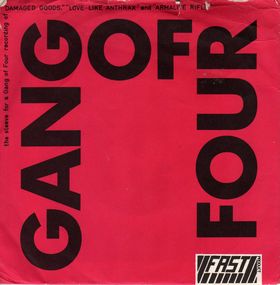
THE GANG OF FOUR – They Really Mean it, Man!

Text by Dale Ashmun, intro by Robert Barry Francos
Interview © 1980; RBF intro © 2011 by FFanzeen
Images from the Internet, except where indicated


[Jon King at Irving Plaza © RBF]
The following article on iconic political British rockers the Gang of Four was originally published in FFanzeen magazine, issue #5, in 1980. It was written by Dale Ashmun.

Musically, I never really got the Gang of Four. There is a whole series of northern British bands that just did nothing for me, such as the much of the Manchester scene (though I like the early Buzzcocks). But just because I was not a fan of the sound I certainly respected what some were doing, such as with the Gang of Four. Most of the bands from northern England either had an electronica undertone, whiny and depressing singers, or rhythms and melody lines that did not connect to me.

Despite this, I went to Irving Plaza on November 11, 1980, to check them out. While they were good, for me they were absolutely blown out by their opening act, Boston’s own Mission of Burma.

What I especially like about Gang of Four, though, is their level of politics. It was closer to Stiff Little Fingers than, say, the Pistols or Crass. GoF were involved with so many of the public causes that were more prevalent in the UK than there were here (not counting the big, corporate-sponsored AID tour de forces, all I remember in the States is the No More Nukes concert, and to save independent radio station WPIX corporate greed… neither worked), such as those discussed below; many of them were successful on some level.

The band at the time of the interview is as follows; note that the Gang of Four has since reformed and are now once again a viable unit:

Jon King (vocals): He now writes for films and television, and is managing director of London’s Story Worldwide, a digital content marketing agency.

Andy Gill (guitar): Produced much of the output of the band, and went on to produce the likes of the Red Hot Chili Peppers, Killing Joke, The Jesus Lizard, and the Stranglers.

Mark Heaney (drums): Having a career as a studio musician for the likes of Badly Drawn Boy and the Seahorses, he also released a solo record which is, naturally, drum-oriented.

Dave Allen (bass): The only member not to rejoin into the Gang of Four redux, Dave founded the band Shriekback in the 1980s. Joining the digital revolution in the U.S. Pacific Northwest, he started out as director of consumer digital audio services at Intel, followed by the president of Overland Agency’s entertainment department, and then co-founded Fight, a firm that focuses on digital strategy. And as this isn’t enough, he also runs the indie label Pampelmoose. – RBF, 2011


Some people go to rock’n’roll shows to forget about what is going on around them, to escape that impending sense of doom that looms over their noggins every time they read the newspaper or listen to the news. This audience is usually satisfied by songs dealing with hot cars, luscious girls, wild parties, and the joys of an alcoholic or drug induced stupor. This camp might not take quickly to the Gang of Four, an English band who, heaven forbid, actually expresses political attitudes in their songs. For those who welcome a little message with their medium, the Gang of Four’s first LP, Entertainment, is available on Warner Bros. Records (EMI released it in England last October). It’s one of the most exciting, thought provoking LPs I’ve head since John, Paul, Steve and Sid presented their unique world view to Mr. and Mrs. Average Consumer a few years ago.

The Gang formed in Leeds, where drummer Hugo Burnham, lead singer Jon King, and guitarist Andy Gill attended Leeds University together. Bassist Dave Allen joined them in 1977, being the only member with previous band experience.

Recently, the Gang of Four finished their second tour of America, having visited the States last summer with the Buzzcocks. At Irving Plaza, Friday, May 3, I was immediately won over by the band’s power and precision – and I wasn’t alone. The riveting impact of the band was evident on the packed dance floor, from the opening guitar feedback of “5:15,” to the encore offerings of “Armalite Rifle” and “Glass.”

Two days after they opened their second assault on America, I spoke with Hugo Burnham and Jon King in a comfortable Warner Bros. conference room. Both musicians were extremely open and generous with their time as we discussed the Gang of Four and related topics for the next hour.

FFanzeen: Where you in a band that once played at CBGBs?
Jon King: No, no, that’s not the case at all. It’s just that when we were in America about three years ago – not with the Gang of Four – we were just there one night getting drunk with J.D. Daugherty [Patti Smith Group – RBF, 2011] and some bloke came up and said, “Are you the band?” and we said, “Yeah, yeah, that’s right.” He said, “Are you playing later on?” and we said, “Yeah,” and the guy says, “Hey, can I jam with you guys?” and we said, “Yeah, go and get your guitar.” So he took off. It was only a joke; we didn’t actually play at all.

FF: When was the first appearance of the Gang of Four?
Hugo Burnham: It was in Leeds, in Yorkshire, where we’re based. It was underneath the Corn Exchange in a club called the Cellar Bar. It was in the basement.
Jon: About the same size as CBGBs.
Hugo: It was around May the 7th, 1977.

FF: Were you students at Leeds University at the time?
Jon: Yeah.

FF: I hear you studied acting, Hugo.
Hugo: Well, English Literature and Drama, actually.
Jon: But he didn’t do any English
Hugo: [Laughs] I didn’t do any English.

FF: Were you involved in any plays?
Hugo: Yeah, I did quite a lot, actually. I spent more time doing that than anything else.
Jon: He left the band for about a month and a half. No, longer than that – it was about three months.
Hugo, No, no, it wasn’t as long as that. It was just to do the Edinburgh Festival… it was about a month and a half, about six or seven weeks.
Jon: He got really good reviews in the play. He’s quite good at it. I mean, he’s acted as drummer for quite a while. He bluffed that out!

FF: Was this a Shakespearean festival?
Hugo: There’s a whole lot of stuff. It’s like a huge dramatic, operative arts festival. I was taking part in two shows. One was called A Bit of Me. It was a play about football, uh, soccer…
Jon: Hooligans!
Hugo: Yeah, hooligans. I was doing that with this guy I met in Leeds and we started up a theatre company, the two of us, which is why I left the Gang of Four for about six weeks. When I finished university, I had the choice between the two and I wanted to do this theatre company because if I didn’t at the time, he wouldn’t have carried on. He would have given up.
Jon: And we went through the hellish thing about auditioning millions of drummers; none of them could play “Armalite Rifle. I mean, on the surface it seems like the most simple drum pattern to play, but very few drummers can do sort of Charlie Watts-style of drumming, which is what Hugo is good at. And that slow high hat with the bass drum. No cone could do that. We eventually got a guy as a drummer. We had a temporary drummer who was a real asshole. You know, he’d use the band phone to make all his phone calls. We’d get bills for a hundred pounds.
Hugo: He ripped us off of a lot of money.
Jon: We auditioned loads of drummers and went through quite a few people and eventually chose Kelvin (Knight), who’s now the drummer for the Delta 5. He’s a really good drummer and the day that we said, “OK, you’ve got the job,” Hugo, he’d been thinking about it, and he said, “OK, I’ve decided to rejoin” because his heart was in [affected voice] “rock’n’roll,” and he gave up the other. When the Delta 5 began, we recommended Kelvin to other friends of ours who were doing Delta 5. Basically, at that stage, it was girlfriends of us and the Mekons.

FF: I saw “Hello to the Mekons” on the album sleeve. They must be close friends.
Jon: Yeah, I mean, like the Mekons – Kelvin, Tom (Greenlaugh) and Mark (White) – went to the same school. Then we went to the same university. Andy Corrigan, who was the other singer in the band, was in the same year as me… him and me and Mark used to share a flat so we’re all really good friends, long before the bands got started.
Hugo: David’s (Allen) the only guy who sort of from a different group of people.
Jon: Yeah, he came from further North and he left school when he was 16 and worked in factory jobs and things.
Hugo: He did a lot of years with workingman club bands, show bands, doing country-western cover versions, pop, jazz; really fucking-good training.
Jon: But he was more into modern jazz. That’s what he really liked.

FF: I wanted to ask you about your first impressions of America when you toured with the Buzzcocks last summer.
Hugo: It was really exciting. Most of the people had come to America for the first time because we were doing it as a band. Six of us came over… there were the four members of the band: there was our former manager, Rob Warr, and there was Jol (Burnham), my brother, who was one of our two roadies, which is all we could afford to bring. We had a Dodge Van…
Jon: [disgusted snicker] Dodgy… Dodgy Dodge!

FF: Broke down a lot, huh?
Hugo: Oh, yeah.
Jon: It didn’t have any license plates.
Hugo: Broke down in the Lincoln Tunnel at 5 o’clock Friday afternoon.
Jon: We backed up all the traffic leaving New York
Hugo: Anyway, there were six of us. We used to book two hotel rooms wherever we went so we had to take turns sharing a double bed. We drove everywhere, except to the West Coast because we couldn’t afford to fly. We had $10 a day cash.

FF: Were you still signed to Fast Records at this time?
Hugo: No, we had signed with EMI.
Jon: But that was for the rest of the world. They actually wouldn’t give us any money for North America.
Hugo: We were headlining at sort of small clubs, playing two shows a night, two nights sometimes, and we supported the Buzzcocks on seven big shows. All in all, we did about 31 dates in about 36 days.
Jon: It was great. It was the first tour we’d ever done - ever - in America.
Hugo: Up to recently we’d been students. We’d only done two or three days on the truck. In fact, it did the band a hell of a lot of good, that tour.
Jon: It proved we could work together and sit on top of each other all day long. We tend to argue a lot, and always have done. When it came to the crunch, everyone sort of knew when to stand off. I think people argued just for the fun of it.

FF: Did you get to look around the cities much where you played?
Hugo: We got to see New York quite a bit because we were here for about a week. And L.A.
Jon: But places like San Francisco, we just went in there, played the gig and had to leave. We played Geary Temple [Jim Jones’ church], which was really far out.
Hugo: San Francisco was a fantastic place, a fantastic city. We were there for 24 hours and I wish we’d been there for 24 days.

FF: Did you play the Whiskey in Los Angeles?
Hugo: Yeah, but I didn’t like it.
Jon: But we’re playing the Starwood this time. We weren’t too keen on the Whiskey because it was formal in a funny sort of way.

FF: Did you play the Golden Bear in Huntington Beach?
Jon: Yeah. That was great because that was really badly promoted and only about two or three hundred people…
Hugo: The very last gig we did, right (Jon)?
Jon: Yeah.
Hugo: There were only about 60 or 70 people, right, that was all. We had this crappy support band, a real Beach Boys/Beatles rip-off, and they were shit. So we were upstairs getting really pissed. This was the end of the tour (and) we were absolutely shattered and shagged out, and we sort of went, “Fuck it, it’s the last show; it doesn’t matter because there’s nobody here really, so let’s just have a really good time.” And those 60 people were as good as six or seven hundred; they were fucking great.
Jon: Yeah, it was brilliant.
Hugo: We just did a full tilt show and they were a full tilt audience.

FF: How did you like the Irving Plaza shows?
Jon and Hugo: It was great; terrific.
Jon: What we had arranged originally was to play a warm-up gig, which is low profile, which was to be in Aberdeen with the Shirts, just to warm up because we hadn’t played for a week and a half. Someone drove into power lines the night before, so we had to cancel, and had no warm up gig. And that first day [Friday] the PA wasn’t working at Irving Plaza, so we didn’t even get a proper soundcheck.
Hugo: Three hours late on the soundcheck.
Jon: We literally just played a couple of songs and that was it. So we hadn’t played at all and before that gig we sort of thought, “Hmmm, could do with a bit of rehearsing here, boys,” but we just went on there and it seemed to come off. But Saturday went bananas compared to Friday night.
Hugo: Look, look, look… it’s a good place, a lovely atmosphere; it’s a good gig.
Jon: A very English gig there.
Hugo: I don’t know what the situation will be like when we come back, but I’d rather do 5 nights there than play a shithole like the Palladium. At Irving Plaza, people can dance, it’s not too big, you’re close enough to the band you don’t feel like you’re seeing a super-group like Ron Delsner running it and it’s all a big heavy deal, and I just don’t want to know.
Jon: If they had a theatre, something like the Electric Ballroom in London, which is one of our favorite halls… we always do two nights there rather than do a bigger gig.
Hugo: The only place I would consider playing in New York bigger than Irving Plaza is Shea Stadium [Laughter].

FF: Not Madison Square Garden?
Jon: It’s too small for the band [more laughter].

FF: Two show!
Hugo: Two shows at the Madison Square Garden, yeah. Anywhere Charlie’s (Watts) played I don’t mind playing. [Should we tell him about the Stones at the Palladium? – Ed.]

FF: Did you ever play the Roundhouse in London?
Hugo: No, but I’ve acted there.
Jon: No… that closed down by the time we got started. Thing was, being from the north of England, I suspect it’s the same in the States – if you’re from Minneapolis, you’re just fucked unless you come to New York. What we did was play ‘round the sticks in England, in the north, which is totally ignored. And for two years, apart form the second gig from which we got a slag-off review, for the next two years we didn’t get a single review or a single article. Not a single one because it’s all so London centered, and there’s a few papers that come out in Manchester. But if you’re in Leeds, Yorkshire, they just don’t want to know… and we’d played ‘round everywhere, ring up and say, “Can we get a gig?” “Who the fuck are you?” You know, “Never heard the name,” and that went on for two years. Then the Fast Products single came out (and) got really good reception. We did this job with all the Fast Products bands in London, and suddenly London woke up to the fact that there were a hell of a lot of things going on. Then everybody sort of wanted to buy us drinks.

FF: I’ve read about your involvement in Rock Against Racism concerts in England. I also noticed that you played in the first Rock Against Sexism benefit. How did that come about?
Hugo: Rock Against Sexism arose from within the depths of Rock Against Racism. People involved in RAR really got RAS going with the help of some other people. They had asked us to do several gigs, but we weren’t available, and then they scheduled one in London and we said, “Yeah, we’ll do it.” There were two other bands – the Delta 5 and the Spoilsports – who were basically an unknown all-girl soul band.
Jon: Lucy Toothpaste, who is one of the writers for Rock Against Racism, and Graham Locke, who writes for NME, were among the leading lights of Rock Against Sexism.

FF: Are the RAS people still putting on shows?
Jon: Yeah, it concentrates on smaller scale, local events. That was a fundraiser, actually. Their goals are to get women involved in all areas of music… like other friends of ours, the Au Pairs, two men and two women; they’ve got a female roadie. There’s a hell of a lot of bands in England with women, an enormous amount, which is good, but there are very few women sound engineers, disc jockeys, and such.

FF: I also read about your involvement in a benefit to open an inquiry into the death of Blair Peach (who was killed by the police during a demonstration against the National Front). What is the status of that case?
Hugo: They just brought it up again and it looks like something might get started.
Jon: It was incredible! It was a demonstration where the number of Black and Asian People… it was nearly all Asian people… so it wasn’t that the Socialist Worker’s Party – as the police tried to imply – infiltrated the local community and rabble-rousing. Now most of the people arrested were Asian.

FF: Was this during a RAR concert?
Jon: No, no, this was just on the street because the National Front were having a rally, which was, you know, to send the Blacks out, send the Asians out, all this business. So the local community demonstrated and the papers went on about the police injured, but the number of severe, serious head injuries… and groin injuries were to the Asians in the crowd… and you wouldn’t believe the way the actual trials of the people were rigged. They went to Magistrate’s Courts, which are held outside the area. For example, the police would say things like, “I recognize this man because he had a green suit on,” and the police would say, “Well, it could have been a brown suit.” The conviction rate for those trials… in England, the conviction rate was something like 50 percent…. In some of them it reach a 90 percent conviction rate, on the word of an officer against people like doctors, ambulance drivers, etc., etc. A band called Misty and the Ruts, they had a rehearsal room –
Hugo: - In the community center, which was destroyed -
Jon: - Destroyed by the police. I mean, things like speakers, cabinets, guitars… I don’t see how those can jump out and hit a police officer’s boot. But there’s nothing written about that. And this guy Blair Peach was killed [ en.wikipedia.org/wiki/Blair_Peach – RBF, 2011]; he was seen being beaten by the police. He died of head injuries and the hospital man said he had been hit by a heavy object, probably a lead-filled truncheon. A search of the special patrol group lockers, after a lot of fuss to do so, actually found things like pick-axe handles, a lead-filled truncheon, bits of wire, everything. They found all this stuff in the lockers and that was it. That even got written up in the right wing press and yet nothing happened. You know, a guy is murdered and they find weapons that are not police issue. The special patrol refused to cooperate with the courts.

FF: Aren’t they required to testify?
Jon: Yeah. There’s an antiquated law in England, which is a Victorian law called Suss… which means “suspicion of intent to commit an offense against person or persons unknown.” And it’s basically a victimless crime that’s been used almost exclusively against Blacks. It’s not used against whites or in areas where there is a lot of mugging or street crime, like in Glasgow, which is all white. The Suss law is never used (there). For example, they’ll descend on a bus stop where a couple of Black guys are hanging around.
Hugo: If they don’t get on the first bus that comes along they’re “loitering with intent.”
Jon: They get busted; they get charged with a crime that they are intending to steal somebody’s property. They don’t even have to produce a victim or even any witnesses to the event, and these people get sent down for it.

FF: Will you have a large say in the decision as to what your first domestic single will be?
Jon: We basically can decide what we put out. We’ll have to talk to (Warner Bros.) about that because what happens here is different than England. In England, you can’t sell LPs in any quantity without a single in the charts. Whereas in the States, you have an album and only if they think the single’s going to chart do they promote it, because album cuts get played on the radio more here.

FF: I know that EMI has given you total control over the packaging of your records and that you design the sleeves yourselves. Will Warner Bros. be giving you this same control?
Hugo: Yeah, that’s why we signed with Warners, and why we signed with EMI – because they were the only people prepared to give us a contract that went beyond the band being dumb idiots who didn’t really know what they were signing, who are good at writing songs and, “Well, get on with that boys and we’ll take care of this.”
Jon: You see, the thing that’s a hassle is like with the Clash album, they want to put out a single now, but CBS in London don’t reckon it’s commercial enough, so they won’t put it out.
Hugo: But we won’t get in that position, you see.

FF: I notice that the whole group is credited on the songs. Do you write most of the lyrics, Jon?
Jon: Yeah, I do, but what happens is (I just sort of throw out some idea and we sort of put it together
Hugo: The genesis of the lyrics come from Jon, but everything – the drumming, lyrics, guitar – are subject to discussion
Jon: What tends to happen is you put it to the group and see what they think, and then go back and change it. Then Andy would maybe lob in a few lines. You find out what the band wants, which makes writing a lot easier.

FF: Do you want to make videotapes of any of your songs?
Jon: I do want to, but EMI won’t pay for it. They won’t pay of it because they don’t show videotapes on British TV. Top of the Pops won’t show a video of a band unless you’re out of the country or have a song in the Top 30. It’s musician union rules. There’s only about one other program that will show videos, so they say it’s not worth the cost.

FF: What do you think about the idea of video discs being put on the market?
Hugo: I’m not really that keen on entering into all that until it becomes more established. Besides, they’re going to be so expensive, it’s ridiculous.
Jon: Who’s got video players, anyway? I haven’t even got a TV.

[At this point, FF was told its time was up, as the Gang of Four had a photo session scheduled and a soundcheck for their appearance that evening on Long Island]

FF: So let me get in a few short answer type questions. When do you start recording your second LP?
Hugo: Later this year
Jon: The thing is to avoid repeating yourself.

FF: OK, last question: what do you think of the Mod revival and ska movement currently taking place in the music business?
Jon: It’s a classic thing that happens with pop music. To maintain a selling momentum, you recycle and reintroduce fashions and trends. It’s the same with many other things. It’s part of marketing; it’s selling style as a new thing.

* * *

So, after listening to the Gang of Four’s music and reading their lyrics, I found it very curious that this band is signed by two of the largest record conglomerates in the world. Yet, if both these companies are willing to give the band the artistic freedom they demand, as well as putting their mammoth distribution network to work for the Gang of Four, perhaps this union of a fiercely independent, intelligent rock band and the powers that push their vinyl will set a positive trend for the music industry to follow during the 1980s.


Bonus Videos
The Mekons


Delta 5


Buzzcocks


Au Pair


Mission of Burma

Friday, April 1, 2011

DVD Review: History Lesson Part 1: Punk Rock in Los Angeles in 1984

Text © Robert Barry Francos/FFanzeen, 2011
Images from the Internet


History Lesson Part 1: Punk Rock in Los Angeles in 1984
Directed by Dave Travis
Historical Records, 1984-2010
57 minutes, USD $14.95
AHistoryLesson.com
MVDvisual.com


Hardcore spread like a wildfire through the indie scene, ignited first by the New York (etc.) underground, added to the fury of the British punk movement, and fed by the election of little Ronnie Reagan. A nonconformist segment of youth was angry at the failure of the populace electing a restrictive, overbearing government that would have negative effect on nearly everyone’s lives possibly for seven generations.

There are arguably two locations where this fervor took off from, though both connected by a single person: Henry Garfield: DC and LA. And yet, he has absolutely nothing to do with this documentary. Go figure.

Back in the 1980s at the height of the LA hardcore explosion, Dave Travis videotaped a large number of bands, both in concert and in interview, and thereby pretty much documented the history of the scene. After all these years, he has compiled and edited some of these into an hour-long show, hinting that it may be just the first part of a series.

For his first release, he has picked some heavy hitters (and some not as much): alphabetically, it’s the Meat Puppets, the Minutemen, Redd Kross, and the Twisted Roots. Which are which (in my opinion)? Well, all in due time.

First let me state right off the bat, the sound quality of the music is pretty lo-fi, obviously taken from the camera’s (camcorder?) built-in mic rather than the stage or soundboard. There’s barely a sung or spoken word from the stage that’s legible. And for all that, well, who cares, this is still exciting as all get-out, to actually watch these bands play, getting an idea of what they were like live. I didn’t get to see many of the LA groups (though I did see the Dickies play at Irving Plaza in the early-to-mid ‘80s, though I can’t remember the opening band[s]; I was kinda chickenshit and stayed in the back, far from the more volatile than usual mosh pit), so having the opportunity to see this is a thrill, no matter what the sound quality.

The interviews between each of the songs are verbally crystal clear. Various members of each of the bands are tapped, some around the time period of the recordings, and some later; one of my only gripes about the package is that the date of the interviews – or even years – is not indicated. So, step by step, here are some of the (expanded) notes I made while watching the tape.

The credits roll over the Minutemen playing; I believe, “A History Lesson Pt. 2,” which would make a lot of sense. First up is some opening interviews. We meet the dread-locked and ironically facial haired Paul Roessler (keyboardist of Twisted Roots, 45 Grave, Geza X, the Screamers, the Mommymen, etc.) and his wife Hellin Killer (of The Plungers) – and their cat and dog. Then there are quick clips each of Jeff McDonald (Redd Kross guitarist), Curt Kirkwood (Meat Puppets guitarist) and his brother Cris Kirkwood (Meat Puppets bassist). There are lots of sibling pairs on this tape.

The first group up is the Meat Puppet (I have 8 of their SST albums – keee-rist), taped at Perkins Place in Pasadena, May 12, 1984. They open up with “Melons Rising,” off their first self-titled LP. All the camerawork (and editing) is done by Travis, so to give the impression of multi-camera work, he edits bits of different parts of the show into a song, which is totally fine, just amusing because it tricked me for a while until I realized that some clothing was different from shot to shot. Cris plays in a woman’s slip, and all is right with the world, as fuzzy the visuals and sound is. Hey, this was high-end for back then, in those wonder years before HD, and when video cameras weighed more than 7 lbs when loaded (well, mine did).

The next set of interviews is bobbing back and forth with the Kirkwoods, where they discuss drugs, Black Flag, and recording processes.

“Saturday Morning” (also from the eponymous LP) is the next song. Another kick asser, and almost literally as Kurt almost gets into a fight with someone in the audience at the end of it. Fun!

After another Cris interview, they break into “Lake of Fire,” from the Meat Puppets II album. This one is less hardcore, and slower. Though all these live bits and even some of the interviews, there is a lot of effects going on that were new at the time. If his Toaster (I’m guessing) could do it, Travis used it at one point or another. It’s very late ‘70s-early ‘80s, so again, it’s amusing to watch the slides, fades, fisheyes, bluescreen overlays, twirling prisms, etc.

Interviewed next is the ever dynamic and fidgety Minutemen bassist, Mike Watt. A ball of motion (especially with his hands), he explains how Minutemen songs were written. It’s an interesting piece, as Watt is almost always engaging when he talks. The first song by the Minutemen is “No. 1 Hit Song,” from the Double Nickels on the Dime LP (I have 7 Minutemen albums, all on SST). Even following the lyric sheet from the album, I can’t follow the song, so I just say screw it and sit back and enjoy it. By far, the Minutemen are the best group on here, and if not for the car accident that took vocalist / guitarist D. Boon’s life, who knows where they may have gone. They jangle and crunch their songs, which are great. D. Boon is a electrifying front man, even though he wears the same shirt for every performance (white, ripped in the back), including this one from the Olympic Auditorium on the same date as the Meat Puppets show above, May 12. It must have been a great day for Travis, and a fortunate one for us that he was there with his camera.

One more shot of Watt further describing the songwriting process, and we move to “Martin’s Story,” also on Driving 55 MPH on Highway 10… I mean Double Nickels on the Dime. It’s a short tune. In fact, most of the songs here are pretty brief, and when tallied, I’m guessing the interview times are probably as long as the music shots.

Watt again (why not George Hurley?…I’m just askin’), of course, and the Minutemen do “Jesus and Tequila,” from the same LP, but this time it is taped at the Cathay de Grande in Hollywood, dated simply 1984. This is one of the MM’s bluesier numbers, and it’s nice to hear them shift gears a bit.

After Watt discusses how he misses D. Boon (they had been friends since the age of 13), we’re back to the Olympic Auditorium on May 12 for “The Big Foist, again from that same LP (hey, it was a double disk, y’know). D. Boon puts on a great show.

Anyone who has followed the Minutemen know that Watt has his own musical language (e.g., mersh = commercial; merch = stuff of the band’s to sell), and here he explains how a band’s world is basically either flyers or gigs. Watt gives great interview; he’s as intriguing a talker as D. Boon was a frontman. Their last number is “Bob Dylan Wrote Propaganda Songs,” from the What Makes a Man Start Fires? album, again at the Olympic. As with all their songs, the lyrics are deeper than one can tell aurally; thank God for lyric sheets.

After being reintroduced to the Roesslers, who describe how the Twisted Roots was formed and picked their sound (Germs meet Screamers, Paul claims), we get to hear their first cut, “Never Was” (I do not own their one EP, if I remember correctly), recorded at the Music Machine in LA during the spring of ‘84. Maggie Ehrig (who acted in the punk film Suburbia) is a decent front person, and of course there’s Dez Cadena (Black Flag, Misfits, DC3, etc.) on guitar, and yet, I found them kind of lacking. The song sounds a bit classic rock mixed with a tinge of folk. I’ve heard them described as more new wave than punk. Either way, they didn’t really do much for me.

Paul explains that he sees the band as “Public Image meets the Beatles,” which partially explains their next number, “Love Your Friends,” which has a nascent Goth vibe, again with just a tinge of folk in there; maybe it’s Maggie’s colorful skirt? I kid, of course.

Following another ho-hummer with Paul and Hellin, the Twisted Roots play their best song here, “Mommy’s Always Busy in the Kitchen.” By far, it has the widest musical range, and kept my interest throughout.

For Redd Kross, the interviews are a brief one with bassist Steve McDonald, and mostly with his bro and guitarist, Jeff McDonald. Steve claims that band was anti-dinosaur rock, but pro rock star attitude, while Jeff claims KISS and Alice Cooper as major influences of the band. The line-up for this version of the band is different than the one Posh Boy 12-inch EP of the band that I have, when they were still Red Cross, and it included Black Flag’s Ron Reyes and the Circle Jerks’ Greg Hetson. For this show, it’s Dave Peterson on drums, and his sister – and future Bangle – Vicki Peterson (no sign here of other sibling, Debbi).

Their first number is “Janus, Jeanie and George Harrison,” taped at the Pasadena Valley Auditorium in June of ’84. To me, they sound more like a hybrid glam metal and hair band, though they dressed like a cross between Aerosmith and the Small Faces, with furry clothes and long hair that they whip around. They’re noisy, thudding, and guitar-focused, with few lyrics and lots of instrumentals between. Vicki is barely seen except in the dark or in profile (with that sparkling black top that slides off one shoulder she would wear often in the Bangles; she has since gone on form the Continental Drifters and the Psycho Sisters, both with her sister-in-law Susan Cowsill).

I think I’m going to quicken this up a bit as this is getting long now. The last two tunes they do are also name songs, “Linda Blair” and one (or a version of one) that’s on my Posh Boy 12-incher, “Annette’s Got the Hits.” All the songs are intriguing, but sound pretty much the same.

During the interview segments, the rest of which are of Jeff obviously years after the band was gone, he tells how Vicki was his girlfriend for six years, and this was the only time they every played together during that time, not even jamming at home, which I find odd (and now is he married to ex-Go Go’s Charlotte Caffey). He also goes on to say more than once that he did not like the sense of community in the scene and that he and his brother Steve preferred to imagine themselves separate from the audience. Further, he states distaste on having been on SST, claiming “they were a cult.”

The only other quibble I have with this collection is that while the chapters are broken up by band, each the secondary search leaps may stop anywhere from the beginning of a song or at an interview. After watching the Q&A for the first time, on further viewings I would want to see just the music (some of the final tip ends are cut off), so if the talking heads were put at the end of the subchapters, all one would have to do is hit the search at the end of each song, and then jump from tune to tune to tune, etc.

I am so glad that Dave Travis took this live footage (along with the interviews shot by himself, Dave Jones, and Dave Markey), and that he is releasing it to a waiting and wanting audience.

Meanwhile, I am so looking forward to Part 2. Let ‘er rip, Dave!

Sunday, March 27, 2011

DVD Review: Derailroaded: Inside the Mind of Larry “Wildman” Fischer

Text © Robert Barry Francos/FFanzeen, 2011
Images from the Internet


Derailroaded: Inside the Mind of Larry “Wildman” Fischer
Directed by Josh Rubin
Produced by Jeremy Lubin
UbinTwinz Productions, 2005
86 minutes, USD $16.95
Derailroaded.com
MVDvisual.com


It is nearly impossible to have any kind of real discussion about what is known as outsider music without bringing up Larry “Wildman” Fischer. He is a figurehead of a musical subgenre that is often ignored, dismissed, or just doesn’t make it to mainstream consciousness.

Outsider music is a separate subgenre than the more populist novelty song, though oft-times they get lumped in together. Some examples of novelty songs may be anything by Weird Al Yankovic and Allan Sherman (“Hello Muddah, Hello Faddah”), or Napoleon the XIV’s “They’re Coming to Take Me Away, Ha-Ha.” On the other hand, some of the Outsider artists are (or were) Jandek, the Legendary Stardust Cowboy, and the Shaggs. Arguably, among the biggest (including Tiny Tim) were Barnes and Barnes (Billy Mumy and Robert Haimer), the creators of “Fish Heads,” and Larry “Wildman” Fischer, who all collaborated in the 1980s.

Diagnosed as a manic depressive paranoid schizophrenic, Larry Fischer spent some time in psychiatric hospitals as a youth in the early 1960s and underwent numerous electroshock and pharmaceutical therapies, which may have done more damage than help. This happened after he, according to legend, attacked his mom with a kitchen knife. Ending up in Los Angeles, he became a street performer singing original songs for a dime apiece. This is where he probably developed his talent for songwriting, making up songs on the spot, with a minimalist, almost Gertrude Stein-style wordplay. He also remembered and could repeat them, a talent unto itself.

Somehow, he came to the attention of his first patron, Frank Zappa, who produced his first (and double) album in 1968. Not surprisingly, as is true with most Outsider releases, it did not sell well. This caused the rift between Fischer and Zappa; that, and Fischer throwing an object in a fit of anger, and it just missing infant Moon Unit, leading to a break-up of collaboration. His time with Frank would be come a fixation point to the Wildman, who believed Zappa was trying to keep all the money the record supposedly made (he even wrote an angry ditty about it called, well, “Frank”). Despite that, the song “Merry Go Round” from that release became a cult classic over the years - though I’d always preferred “Do the Taster” - and it lead to an appearance on Rowan and Martin’s Laugh-In.

From there he spent a few years roaming around living in Paranoiaville, and finally alit at Rhino Records, where he became not only their “mascot” (in his words), but also their first release (“Come to Rhino Records”), which was also used as an advert slogan. From there he wound up in the studio of Mumy and Haimer, who released the next batch of Fischer’s LPs, sometimes under quite trying circumstances. Still, for over two decades, Mumy became the closest thing to a friend he had; Fischer even guest appeared with Billy’s band, Seduction of the Innocent (made up of comic book artists and writers), on occasion. After that went the way of another dose of mental illness-inspired fury and delusion, Fischer’s life started a further downward spiral.

That’s when the team of Lubin and Rubin (hence, the wittily monikered Ubin Twinz) stepped in with their film crew. Through countless meltdowns, intense phone calls (many are shared in a commentary track), and looking for a lost dog, the UT have released a touching portrait of the man. While they never shy away from Fischer’s illness, they also don’t only focus on it. It’s more about what has happened to the man than a reflection on his problems (though many times they’re obviously related). Included are photos and home movies of his early and teen years, film clips of him on Laugh In that are jaw dropping (as much for his great performance as the way he is both mocked and promoted on it; mind you, Rowan & Martin did this with the likes of the Legendary Stardust Cowboy and Tiny Tim, as well).

One thing that is obvious through this film, and it’s probably very important to acknowledge, is that this is a document of admiration of the artistry and personage of Larry Fischer, despite all the mishegas the UT went through to get this down, including numerous daily phone calls, accusations by the man, and never really knowing if they would actually succeed in finishing it. That is dedication, and it shows. Fischer is never talked down to or belittled (though occasionally they have to bring him down from a manic state). This is a serious film about an artist has become lost in both his inner and outer worlds, though sometimes it’s hilarious in the sheer extremes.

There are a number of interviews here, including Fischer’s older brother David (who helps support him financially, but is derisive of his music), his aunt who houses him latter in life in her squalid house, a New Jersey psychiatrist who specializes in mental disorders and the arts, Devo-leader Mark Mothersbaugh (still wearing that stupid hat, only now dyed black), Gail Zappa to explain their side of the story in the present and some old footage of Frank (d. 1993) himself talking about the feud, Barret Hansen (aka Dr. Demento) who helped put him on the map of a larger public, Rock and Roll Hall of Fame inductee Solomon Burke (d. 2010), for some reason Weird Al Yankovic (I’m a fan, but as I stated before, he’s in the novelty sub-genre; I must add that he does a great impression of “Merry Go Round” in the deleted clips, though), and most telling, Mumy and Haimer, who are the hub of this film.

For me, this is as important a presentation as, say, The Mayor of the Sunset Strip, about DJ Rodney Bingenheimer, another case of a walk on the bizarre side that deserves the telling. I do have to wonder, though, if any of this would have happened if Zappa hadn’t decided to record him. I remember a guy with Down Syndrome who was loved and legendary named Vinny Bo Bo back in Bensonhurst, who would stand on the corner of 86th Street and Bay Parkway by the Chock full o’Nuts with his guitar of two strings, and shake back and forth and sing away for over 30 years (facebook.com/topic.php?uid=2210285303&topic=7341), who never had the chance that Wildman did. I fully recognize, though, that there was something special about Fischer, and I’m glad he got the attention he deserved, but I still gotta wonder on a higher abstractive level, why him, and how would his life had been different – better or worse – if he and Zappa never met. One of those great philosophical questions, I guess.

There are lots of great extras included here, including additional scenes, a very bizarre and overly long 20+ minute interview with Dolemite’s own Rudy Ray Moore (d. 2008), who tries to pinpoint in a rambling and condescending way just what he thinks about Fischer, and whether or not Larry’s music is the bluesc. Now, I’ve met and talked with RRM, and he was an absolute gentleman, but he comes across as a snob here.

The two commentary tracks are exceptional. On one, it’s just phone conversations with Larry and the Ubin Twinz which is occasionally scary, and often heartbreaking, yet also seeing-an-accident amusing. The other is both Jeremy and Josh talking about making of the film, and what they had to go through, how they lucked out with particular footage (such as the high school years and the only existing film of Frank and Larry together) and photos (for example, the front cover Frank and Larry contract image), how they financed it, and mostly how it was to deal with Larry.

While Larry’s story is not all butterflies and rainbows, it’s important to recognize his place in the spectrum of his time, and the Ubin Twinz did more than an admirable job.


EXTRA VIDEOS:


EXTRA EXTRA VIDEOS:


Thursday, March 24, 2011

DVD Review: Jim Settee: The Way Home

Text and photos © Robert Barry Francos/FFanzeen, 2011
other images from the Internet


Jim Settee: The Way Home
Written, Produced and directed by Jeanne Corrigal
Inner Nature Productions
48 minutes, 2009
jeannecorrigal@sasktell.net


When examining a series of smaller communities in a somewhat remote area, one may be able to find a single person who can make a large difference and touch many lives. Such a man was the subject of this documentary, Jim Settee.

We are introduced to Settee indirectly at first, through the eyes of filmmaker Jeanne Corrigal, who I am happy to count among my acquaintances. She grew up at the Fish Lake Métis Settlement community in Central Saskatchewan in the Prince Albert area, which was created in the most part by Settee, technically a Métis, but self-identified as Cree.

During a dark period of Canadian / First Nations / Métis history, the federal government of Canada declared that those of mixed Aboriginal and white ancestry (Métis) were not permitted to live on the same reserves as “pure” First Nations, so Settee helped create the Fish Lake Settlement near the reserve where he was raised to help keep families at least close by.

This is just one legacy of a man whose presence reached through his command of oral history of the area, leadership, and tracking skills, just to name a couple of venues (which are lovely and fascinatingly described in this project). But due to his passing away before the film was finished, well into his 90s, much of his story is told by others. Fortunately, there is footage of him and lots of still pictures. Most of his life, however, is told in testimonials by those who loved him, including his immediate family who convey some touching tales, such as those involving tall towers and matchboxes.

[Filmmaker Jeanne Corrigal]

This film, however, is more than just about Jim Settee; its focus is, indeed, the way home for both Settee and filmmaker Corrigal. There is a parallel passage as both of them search for their own spiritual journey at different points in their lives. The two’s paths intersected at a time when Corrigal was feeling lost (in her words), and her reacquaintance with the elder Settee after he had found his own road helped her find hers. For Settee, it was being ordained in the Anglican Church at age 86 (this is not a spoiler, as this fact is stated on the film’s box). As for Corrigal, the way was in a totally different direction, as she now leads a Mindful Meditation group in Saskatoon (contact her at the email above for further information). How Settee’s Anglican background and Corrigal’s own passage were able to transcend each other to find a meeting place is a touching and central focus of the film.

Spirituality, in all forms rather than just Anglican, is key here, though that plays an important broken-rather-than-double line down the film’s center, permitting changing lanes for the viewers with which to identify.

When I saw this documentary, it was being sponsored by the University of Saskatchewan’s Aboriginal Student Centre and an on-campus multi-faith organization, represented at the screening by a Lutheran Reverend and a Conservative Rabbi, neither one of which embodied Settee’s Anglican leaning; however, there was a strong-yet-gentle spiritual guidance to the film, thanks to Corrigal’s tender touch and commentary (she appears in The Way Home as well).

There are many moments in the film that are moving, possibly transforming, for those who still feel lost, or perhaps needing reassurance. Thanks to Corrigal, Settee’s mentorship goes beyond his life, perhaps to the seventh generation.

Monday, March 21, 2011

Vanity Plate Volume 2

All other writers retain their own copyright.
Links to articles follow each piece


Here are some recent sightings of your FFanzeen publisher on the Web (marked in bold in the piece). Note that I have not edited the text of the pieces, so all materials are as they were in the originals.

First up is a blog by Walter Ocner, who has been a good friend for decades. A record collector for years, he only just started blogging recently. Hopefully, he’ll continue with some longer (i.e., more than a couple of paragraphs) pieces like this one. Hi, Sandra!


1. Why I Love Records Stores – Rockit Scientist and Rebel Rebel in NYC, by Walter Ocner
I always loved collecting. When I was a kid I really got into coins and used to read magazines about them and tried hard to collect V nickels and Morgan silver dollars. There was a precious metals store a few blocks away I used to go to after school and pick up indian head pennies and whatever else I could afford. I would buy magazines like Coins and Coin Collecting and salivate at the thought of one day owning a $20 gold piece. Unfortunately my meager savings couldn’t keep me in the hobby I was so passionate about and eventually I began to lose interest. You just can’t sustain a hobby on wishing alone.

As i got older, music became my passion. I guess you could say everything else fell by the wayside, like school. This was during the days of vinyl when You could go into any music store and flip through the bins of new and import LP’s. I used to go to a few neighborhood stores in Queens such as Numbers Records or The Record Room. I would pick up singles for 99 cents by The Beatles, Icicle Works, Rod Stewart or The Smiths. They usually came with cool picture sleeves which made you want to take a chance on hearing the music inside.

Manhattan was a goldmine for new and used records. For me, it wasn’t just about enjoying the music but the treasure hunt aspect of collecting. I used to dream of finding rare British pressings of Beatle albums or bootlegs with unreleased material. My collection grew, much to the ire of my parents who proclaimed it a waste of money. Every cent I had went to records. I can’t blame them for being so angry, they were struggling to support a family and here I was, blowing all my cash on vinyl.

I have a huge record collection now. My friend Robert Francos (Editor of FFanzeen) once told me when we were in his room, which looked like a record store, that one day I would have a collection like his. I thought he was nuts and now, I probably have more than he does. I still love the hunt, the search for the elusive gem. Two of my favorite places to shop are in Manhattan, Rockit Scientist Records at 33 St. Marks Place and Rebel Rebel on 319 Bleecker Street. Both John and Dave run amazing shops that are brimming with reasonably priced goodies.

The thing I love about going there is what I don’t get from buying online from Amazon or whatever. That is the personal touch and the sense of discovery. You walk in and something will catch your eye or ear. John at Rockit Scientist and Dave at Rebel will play you things based on your musical taste. They will engage you in discussion and help you discover groups and albums you never would have found on your own. I might find music cheaper online, but I would rather pay a bit more and keep the independent record store alive and give me a place to discover and learn about music. These are the best stores around and cannot be replaced by an impersonal online retailer. You will find things here you will never find at a WalMart, so in essence, you are also keeping independent labels and bands alive and thriving as well.

I urge all of you to visit these guys and the “mom and pop” stores in your neighborhoods. You will make new friends and discover a world of exciting culture that will enrich your life!
http://walterocner.wordpress.com/2009/06/03/why-i-love-records-stores-rockit-scientist-and-rebel-rebel-in-nyc/


* * *

Next is AC/DC Machine, a Swedish metal webzine. The interview was run by Niclas Müller. Here he Q&A’s the publisher of a new book about the band which contains photos I took of AC/DC at CBGBs in 1977.

2. Intervju med Dennis Pernu
Detta är en komplettering till intervjun som Niclas Müller Hansen gjorde med Phil Sutcliffe. Här pratar de om arbetet bakom AC/DC boken, High Voltage Rock'n'Roll: The Ultimate Illustrated History.

Where did you get the idea for this kind of AC/DC book?
We had published Whole Lotta Led Zeppelin (2008) and Queen: The Ultimate Illustrated History (2009), both of which were well-received. Ever since, we’ve been constantly casting about for other bands and artists with long, engaging histories and rabid worldwide followings. AC/DC seemed to fit the bill, and so far that hunch has proven correct.

How long did it take to put together?
Just about a year, from the time I asked Phil if he was interested in writing the main narrative to the day we had finished books sitting in our warehouse! Ideally we’d have more time to put books like this together, but because our music publishing program was still relatively young at the time, we were still getting up to speed on getting books into the marketplace.

Did you know of Bill Voccia before this project or any of the other ones involved in the book?
I did not know Bill before beginning this project but was fortunate to find him and have him agree to get involved. You’ll notice a lot of the more interesting items depicted in the book come from his vast collection. A few of the other writers and photographers featured in the book had contributed to previous projects, notably Detroit-based photographer Rob Alford, Garth Cartwright (who penned the piece exploring AC/DC’s brief dalliance with the world of punk rock), Dave Hunter (who wrote the sidebar on Malcolm and Angus’s gear and who also wrote a stellar book for us last year called Star Guitars), Andrew Earles (who contributed to the Zep and Queen books but also wrote a full-length narrative history about Hüsker Dü, which we also published last year). Let’s see . . . Gary Graff has also written pieces for us in the past (he gathered all those great musician quotes on the endpapers), as has Sylvie Simmons. Other than that, I tried to target writers who I felt were considered some of the world’s top scribes in the realms of hard rock, heavy metal, and AC/DC—guys like Ian Christe, Daniel Bukszpan, Martin Popoff, Joe Bonomo, Anthony Bozza—and photographers like Robert Ellis, Philip Morris, and Bob King who had iconic images of the band. Happily, I was able to agree to terms with all of them.

How did you go about picking out the items featured in the book?
Believe it or not, aside from Voccia’s items, the bulk of the memorabilia was the result of 4 or 5 months of scouring eBay on a daily basis.
Tell us about the "spinning Angus cover"!
Whenever we decide to publish a book we have a preliminary meeting to discuss possible cover concepts. I had already seen Rob Alford’s photo of Angus spinning on the stage at the 1979 World Series of Rock and half-jokingly suggested we incorporate an actual spinner to assimilate Angus’s famous stage antics. At the time I got the impression that most of the room thought I was nuts. But the person who managed the book’s design process and the person who arranges for the manufacturing of our books took up the idea and ran with it. When everyone else saw that they were pursuing it and that it was actually possible, it just took on a life of its own. I think it really captures the manic energy of the music in a way a static photo can’t. The spinner is also a bit goofy, just like Angus’s stage performances. “Goofy” in a good way, of course. It’s interesting, my 6-year-old son and I just saw School of Rock and Jack Black’s character shows his students footage of Angus spinning on stage. My son thought it was hilarious. It really speaks to the band that they can appeal to rock fans from ages 6 to 60.

Was there a lot of cool stuff that didn’t end up in the book?
Arnaud Durieux has a mind-bending gigography that I wanted to license for the book, but he respectfully declined, citing his own future book project. Other than that, one of the main problems with assembling these books is that usually a day or two after it goes to press you stumble upon a killer piece of memorabilia or photo that you missed or that wasn’t available when you were gathering materials.

How did you get Phil Sutcliffe involved?
Phil penned the main narrative of our aforementioned Queen book. He was such a pro’s pro on that project, and I was aware of his old Sounds review of a 1976 AC/DC show at the Marquee in London, so I asked him if he wanted to write this one. I think the fact that all these people whom I badly wanted to be involved with the book agreed to it speaks to how much people really love this band.

Tell us about your first AC/DC show? How many times have you seen them live?
Unfortunately, I’ve never seen the band live! The thing I realized about AC/DC while putting this book together is that they were always pigeonholed in the States as a metal band, which of course they’re not . . . they’re just a loud, fast rock ’n’ roll band. But that categorization turned me off when I was younger, even though I’d heard a lot of their stuff. So as someone who came of age listening to bands like the Replacements in the ’80s and then going to tons of club shows in the ’90s (Soul Asylum, Mudhoney, Rev. Horton Heat, Run Westy Run, the Cows, Dinosaur Jr., Sonic Youth, the Jayhawks, Wilco, etc.), I was too doctrinaire to go back and explore AC/DC, because, well, the ’80s and even the early ’90s weren’t altogether kind to them and they were considered dinosaurs. I regret not getting to know them earlier. Despite the “indie rock” ethos that I bought into, AC/DC were clearly a band that paid their dues and that even influenced, to varying degrees, the bands I was listening to.

Favorite AC/DC item in the book and why?
That’s a tough one. The spread of silkscreened Black Ice tour posters is cool, but I would have to say that a handful of photos are my favorites, particularly Robert Francos's CBGB photos and Jenny Lens’s Whisky A Go Go shots (check out Jenny’s image showing Angus’s sweat-drenched SG). I mean, who doesn’t wish they saw AC/DC in a small rock club? Also, there are a couple of two-page spreads showing crowds at the Apollo Theater in Glasgow and at Monsters of Rock, which I love. And, the Rob Alford shot on page 88. You always read about the prodigious amounts of snot that would fly from Angus’s nose at shows. Here, you can actually see the boogers in his nose!

Favorite AC/DC record and why?
Ooh, another difficult one! I’d have to say the High Voltage (the Atlantic debut)—the LP that introduced the band to the rest of the world. It’s just tight, blues-based rock full of Bon’s trademark wit. Plus Rolling Stone called it an “all-time low” for hard rock, so the boys had to be doing something right. I wish they’d included their version of “Baby, Please Don’t Go.” Seems just about everyone’s covered the song, but I don’t think anyone’s surpassed AC/DC’s take. Budgie and Lightning Hopkins came close. . .

Any other projects going on?
Speaking of “Baby, Please Don’t Go,” we have a similar treatment of Aerosmith due in September (written by Guitar World executive editor Rich Bienstock), and Iron Maiden coming next spring (by UK-based metal journo Neil Daniels).
www.acdcmachine.com/files/interview_dennispernu.php


* * *

Wow, this was on the Huffington Report Blog page. It also appeared in a number of other sites, a couple of which I’ve listed at the bottom of the article. It, again, pertains to Phil Sutcliffe’s “High Voltage Rock'n'roll”

3. Mike Ragogna HuffPost Reviews ACDC

Email
Written by bestsellerelectronic on Dec-19-10 9:00pm
From: bestsellerelectronic.com
So, you consider you know all things AC/DC? Really. Well, take a hit of the essays, chronological photos, memorabilia, and ubiquitous profusion contained in in between the over 225 pages of High Voltage Stone 'N' Roll: The Ultimate Illustrated History and you'll be intimidated indeed. Stone edition residence Phil Sutcliffe (with a small assistance in sidebar form from folks similar to Robert Ellis, Joe Bonomo, Philip Morris, and a expel of 17 others) reserve the biographical and chronological grit which takes us from Angus & Malcom Young's prophesy by the Brian Johnson and Chris Slade register adjustments and, of course, way beyond. Commentaries and reflections by Jimmy Page, Billy Gibbons, Joe Perry, Steve Vai, Ace Frehley, Meat Loaf, Jack Johnson (yes, Jack Johnson), and Joe Elliott spin out the over-the-top jubilee which is Illustrated History. A small of the early shots of the rope by Philip Morris and Bob King are value the cost of the book alone. But add bar cinema by Jenny Lens and Robert Francos and the behind-the-scenes images contributed by Robert Ellis and Robert Alford, and you have a visible story which is as current as any of the authors' contributions or researchers' timelines and discography. Who knew there was so many to know about this steel antecedent from Australia, one which many dont consider about contributed to the tough stone theatre in the U.S. some-more than many American bands did. Now you know, and the rest, as they say, is Illustrated History.
http://www.zimbio.com/Chip+Taylor/articles/38VMKfSRbA4/Mike+Ragogna+HuffPost+Reviews+ACDC+Jane+Roman
Also appeared on:
legal-sleaze.com
allword-news.co.uk/tag/pete-finney
thoughtandword.com/rss/author/Mike


* * *

Thus Spoke the Spectacle is a multi-media performance focused on the
way mass media is used against it’s audiences, or at the very least, for their own purposes. Much of it is focused on the material of Marshall McLuhan, Neil Postman and Jacques Ellul. I had the pleasure to see it a few times, and took photos that they used on their Website.


4. Thanks to the MEA organizers who invited us to perform, including Sara van den Berg, Paul Soukup, Janet Sternberg, and Lance Strate. Special thanks to Abigail Lambke and Dan Frierdich for securing a great performance space and managing all the tech issues; Robert Francos for his many excellent photographs; and all of our MEA friends and supporters for making this performance of Thus Spoke The Spectacle truly one to remember.
http://www.thespectacle.net/blog/2009/06/

* * *

The Echoes are a fun band whose CDs I had the pleasure to review for my Jersey Beat column, “The Quiet Corner.” The Echoes’ response was nice to read.

5. The Echoes Official Website

The 2007 Release Of "NOW HEAR THIS" Having Stimulated A New Interest In 2005's "LISTEN UP... IT'S THE ECHOES," Famed Music Critic ROBERT BARRY FRANCOS Wrote The Following REVIEW For The Spring 2008 Edition Of JERSEY BEAT:

"Kentucky-bred and New York based, THE ECHOES are a twosome who have released "LISTEN UP... IT'S THE ECHOES," which is available at theechoesofficalwebsite.com. They sing in a folk style reminiscent of Ian & Sylvia, and give us all original tunes written by Mark Alexander, though most of the lead singing is (wisely) handled by Teresa Starr. The songs are full of love and tenderness, with Starr's high voice and Alexander's supporting guitar and voice (he does sing a lead here and there). This is definitely an easy listen on many levels, including a joyful melody line and a to-the-point lyrics structure ("I met you just the other day/You made it in my dreams that night" are the CD's opening lines, from "IF I DO"). This is the folk equivalent of lite jazz, and I don't mean that as an insult; it's a style that is very listener friendly. Like cocoa and a blanket on a chilly evening." -- Robert Barry Francos, JERSEY BEAT, Quiet Corner

THE ECHOES Would Like To Thank ROBERT BARRY FRANCOS & JERSEY BEAT For Their Support !!!
http://theechoesofficialwebsite.com/echonews.html

Friday, March 18, 2011

DVD Review: The Pisim Project

Text and live photo© Robert Barry Francos/FFanzeen, 2011
Other images from the Internet


The Pisim Project
Produced and directed by Marcel Petit and Angela Mae Edmunds
Office of Outreach & Transitions, College of Engineering, University of Saskatchewan
46 minutes, 2010
www.outreach.usask.ca/programs/pisim_project.html www.Pisim.ca


The Charlebois Community School is located in the remote northeast town of Cumberland House, Saskatchewan (known locally as Washahikanihk). With about 2000 residents and primarily populated by First Nations (Cree and Métis), it is located on an island that until recently was accessible only by ferry in the summer and an ice road in the winter (a bridge was completed in 1998). In 2008, the high school decided on a project that was quite ambitious, to put it lightly.

Pisim (the sun in the Cree language) was the key word when a bunch of 15 year olds decided that they would build an eco-friendly and solar-energized house as a class project.

What started out as and idea blossomed into a plan. Fortunately, filmmakers Marcel Petit and Angela Mae Edmunds decided to join in on the ride by taping the whole sequence of events, from beginning to end. Someone from the school wisely contacted the School of Engineering at the University of Saskatchewan (in Saskatoon) to help with the soundness of the house. They immediately recognized a good thing, and sponsored the event.

The audience is introduced to the ten young teens (including one with the appropriate name of Rayne Bo) as individuals who are shy, as they verbally stumble in front of the camera during their first soundbites. We watch as the kids (and some teachers, parents and locals who get swept up in the synergy) while they meet up with experts in building engineering and solar power from Prince Albert, Saskatoon and Regina. This gives the students an opportunity to open up their world substantially, as they travel to those cities to meet these mentors, most leaving Cumberland House for the first time.


Co-Director Marcel Petit; pic by RBF
During the first year of the Project, the kids assemble with their respective specialists, and from that they begin to design the house, a two-story bungalow made from local materials (and the use of some heavy equipment lent by their various advisers and local businesses).

At summer break in 2009, they actually began to build the energy-efficient dwelling, with the plan to sell it through a raffle. There are lots of challenges and drawbacks, as one would expect in such a huge venture for such a group of inexperienced youth, but they manage to stay together as a collective, and keep up the good fight. Do they succeed? Watching the documentary will answer that.

Along with the struggles of both successes and failures, not only is the process enjoyable to watch thanks to the guidance of the filmmakers who never dwell too long on any particular matter and help the viewer to be right there alongside the students, but we also get to see them in their other activities, such as sports, serving to make the students into fuller characters. We watch as the teens get older (for fun, when the DVD end, start it over again to see the difference in age and attitudes during the end and beginning interviews), and become more confident in their project and themselves as they figure ways around the problems that arise. While the adults are mentoring, they also do not interfere, so it is truly theirs, whatever the outcome.

This documentary was certainly a fun watch. The viewer gets to cheer on the kids, learn a bit about solar energy themselves through the osmosis of watching, and get a glimpse of a culture that one does not get the opportunity to view often. This release is being shown at film festivals throughout Canada, and perhaps in some areas of the States, but is worth seeking out even in the digital version.

More on Cumberland House: en.wikipedia.org/wiki/Cumberland_House,_Saskatchewan
More about the school: http://www.nlsd113.org/charlebois/