Live Review
/ Photo Essay:
D.O.A. and Dayglo Abortions
D.O.A. and Dayglo Abortions
Amigo’s Cantina, Saskatoon
September 17, 2016

Text and all images © Robert Barry Francos /
FFanzeen, 2016
Poster from the Internet
Photos can be enlarged by clicking on them
There are
four or five spaces in Saskatoon which are especially superb for seeing live
bands, some of which cater to particular genres. For punk bands like the
legendary D.O.A. and the Dayglo Abortions, it’s hard to beat Amigo’s Cantina
(for those who plan tours, pay attention).
Saskatoon is
a school town, with a university and a college, so the audience for these shows
are relatively quite impressive. When it comes to bands like these that have
been around since the ‘70s – not to mention homegrown Canadian icons – yeah,
people are going to show up; even those around legal age (meaning drinking, at
19), fans will sing along. Sure, as at all punk shows, there are going to be who
are there to raise heck in the pit (please go away), but there is a strong
fanbase, and they turned up at Amigo’s on Saturday night, September 17, 2016.
The show was
scheduled to start at 10:30, so in my non-drinking way, I showed up around
9:40, since there really was no reason to get there earlier. I ran into someone
I know and hung out with him and his brother-in-law (both are musicians, and
one had even opened for D.O.A. a couple of decades ago) until near the start of
the performance.
At about
10:10, I started inching and gliding my way towards the front. The place was
crowded, but not so packed that it was very difficult to maneuver around
people. I went to the side of the stage, which I have found to be a relatively
safe place not to get trounced by the moshers, and prepared my camera for the
fun of the night ahead.
To my left
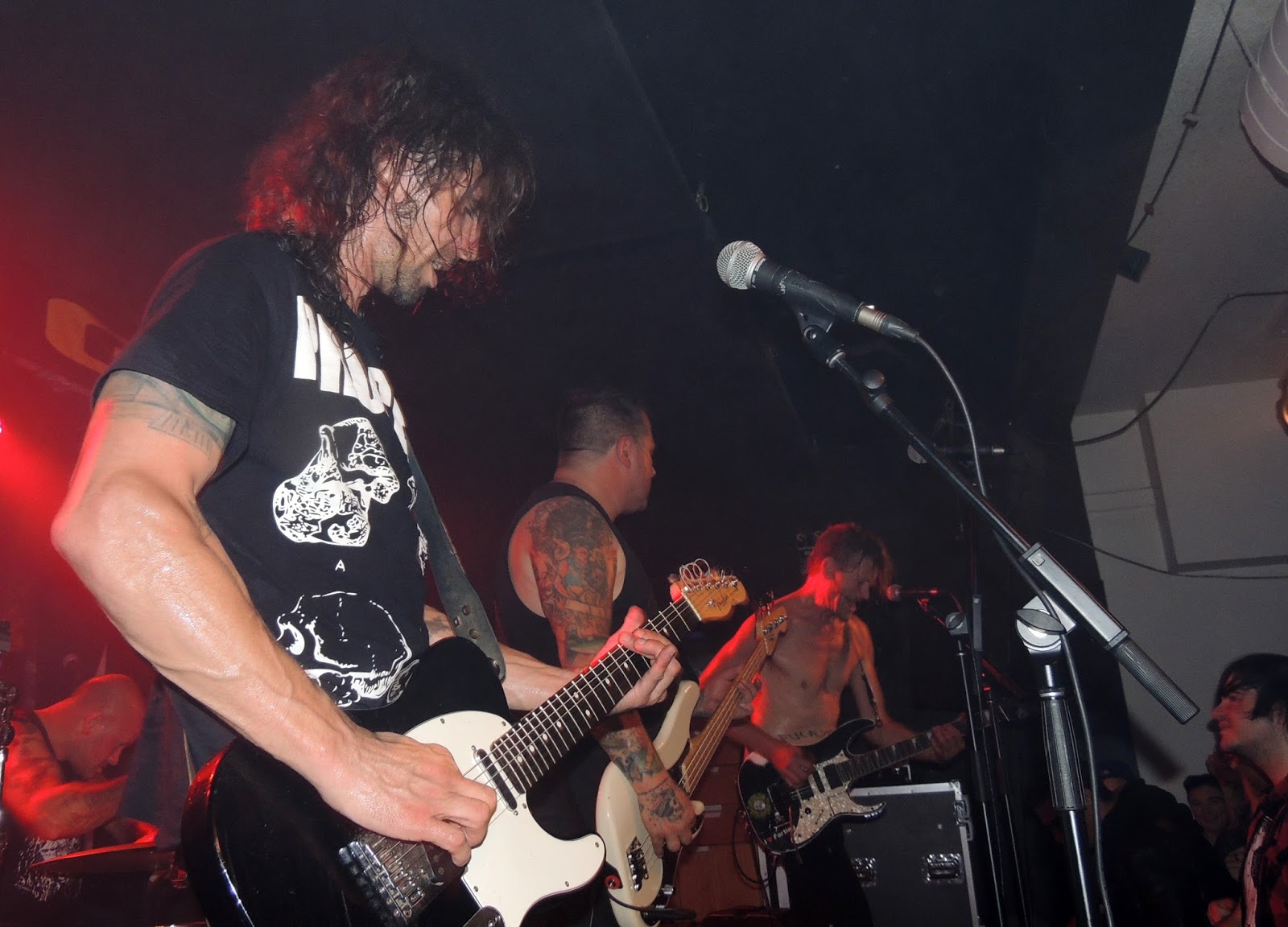
was the Dayglo Abortions’ guitarist warming up sans amplification, so I could see the fingers move, but could not
hear the twang of an unplugged electric over the jukebox. The majority of the
crowd was to my right, mingling ever closer to the stage as it got closer to
show time, getting more compact. Of course, room would needed to be found for
the pit. But what I found interesting is just how many of the audience was already
wasted. One woman in her twenties (most of the audience was in that range)
walked up to the stage with a full pitcher of beer; no glass, she drank
directly from the plastic carafe. I was amused when she was bothered that she
was having trouble drinking it later as the moshers rebounded off of her, but
I’m getting ahead of myself here.
Just before
the Dayglos came on, I saw a motion out of the corner of my eye, and was
suddently hip checked by this tiny young punkette who placed her drinks (yes,
multiple) directly in front of me, like a dog peeing to announce its territory.
I looked at her and she was quite frenetic, screaming toward the band. To give
her credit, she knew the music and sang along with the songs, sometimes to an incredibly
obnoxious and shrill (did I mention off-key?) level, putting her hands over her
head and pushing me. Again, in her favor, a moshing wave motion caught me off
balance, and she steadied me. She asked if I was with the local entertainment
paper, and I repeatedly had to say no. She found it to be conservative (I mostly
find it opposite), but I politely nodded in agreement to move the topic along. Then
she apologized for being so adamant, and said in a lightbulb moment way, she
recognized me from the early punk shows “back in the day.” I was a bit confused
and bemused, as I’ve only been in Saskatoon for a few years now, and for me,
the early punk shows I saw “back in the day” was probably when her mom was too
young to get into the bar. What pissed me off, though, is she put her beer
bottle in front of my camera lens, and purposely clinked it against the front
of camera. I snapped, “Please don’t do that.” About halfway through the set, I
looked over and she was gone.
I’d never
seen the Dayglo Abortions before. Compared to the Toronto/Hamilton corridor, west
of Ontario was not necessarily rife with hardcore bands in the ‘70s and early
‘80s as far as I know, but those that were there at the cusp were solid. The
Dayglos’ songs focus on the contrary,
with somewhat leftist leanings, and it has a history more of trying to provoke
more than anything else. This audience was up for it, some carring artifacts,
old (LPs) and new (CDs, or from the merch table). One of the women in front had
a constant look like she wanted to flail on someone. She came to the stage
early on with some Dayglo albums (not sure if original or reissues purchases at
the back of the room), and fiercely guarded them as she was pushed from the
pulsating mass behind her. She was also not happy about that; at one point I
could read her lips saying to someone something like, “they should be here for
the music!” I’m not sayin’ she’s wrong…
There are
some interesting guitar smashes in their songs, though a lot of it was classic rat-tat-tat
style, old school hardcore. This is meant as kind of a refreshing change. With
so many bands modeling themselves after post-punk
grunge or power punk (such as Green Day and Blink 182), I was pleasured by the
stylings of the Abortions. The only issue I had with the band was that they
used some kind of smoke machine that added a just more-than-subtle mist to the
air that made it much harder to snap some decent pix. Or perhaps it was the
club that did it, I’m not sure, but it was definitely thicker during this band.
For those
who don’t know, the Dayglo Abortions is fronted by vox / guitarist Murray Acton,
who also goes by the moniker “The Cretin.” Looking hard and angular, he took
off his Russian CCCP red shirt shortly into the sweat-filled set, and with the
short pants, kinda reminded me of Angus Young. He’s been playing forever, on
tour for most of that, and even though he looks a bit ragged, he sounded and
played with a strong conviction. He was joined by bassist Willy Jak, drummer Blind
Marc, and another guitarist whose name I didn’t catch (anyone care to let me know,
I’ll add it).
As I said,
the set was well received, as they spanned their career, including “I Killed
Mommy,” “Stupid Songs,” “Ronald McRaygun,” “Black Sabbath,” and “Drugged and
Driving” (well suited for this crowd). But the one that received the most
enthusiasm was “Proud to Be Canadian.”
[As a side
note, Dayglo Abortions were mentioned in an engaging novel that is about to be
republished called Punk Like Me, by
the amazing JD Glass. Worth a read].
After the Dayglo’s
set, and the front of the front of the stage emptied for people to get drink refills,
I moved my butt over to the other side of the room. I knew from experience that
D.O.A.’s singer, Joey, usually stands on the far right, so I moved over to that
wall, so there would be less smoke between him and my lens. I stood on a chair
against the wall, and waited.
The room
changed for D.O.A., as some of the more diehard Abortion fans left (never
understood that; you go to see some bands play, you stay and check them out and
you leave if you don’t like them, not before they’ve come on… But I digress…). The
intermission was thankfully short, with D.O.A. coming to set up as the Dayglo
Abortions broke down. This gave me the opportunity to snap Joey and the Cretin
talking, getting two BC punk legends in one shot (see below). This made me
happy.
While D.O.A.
certainly has as much energy as the Abortions, they definitely present a very
different view of the music. While the last band’s songs were somewhat goofy
and pure fun, sort of like the musical version of putting your thumb to your
nose and sticking out your tongue, D.O.A. are much more political and I would
add somewhat more melodic. Both are “chantable,” but D.O.A.’s messages make the
profanity and what is being said “behind” the genre formula much stronger for
that reason, in my opinion.
The lead of
the band, guitarist / vocalist Joey Shithead Keithley, was wearing a shirt that
had a drawing of Donald Trump holding a gun directly at the reader, with the words "Fucked Up Donald" (one of their songs) and the band name down the side (available at the back, or online at the D.O.A. store). With all the work Joey has done
politically (he ran for local office a few times now) and musically, my favorite
thing he’s posited is “Talk - Action = 0.” Simple, to the point, and powerful
stuff.
Backing him
up was Mike Hodsall on bass, and a fuzzy Paddy Duddy on drums. There was also
someone equally (if not more) fuzzy dong some back-up vocals, but I didn’t
catch the name.
I really do
believe that D.O.A. are as important as, say Black Flag and the Dead Kennedys,
when it comes to political thinking, and their music definitely has the chant
lyrics and melodies to back it up (bands like the DKs were more into formula
and rhythm than melodies, such as their classic “Rise Above”). Joey’s vocals
can be fast like the Descendants, joyously out there like the Circle Jerks, but
there is something about how his songs are constructed that are his own, with a
determined liberal agenda (that is close, yet slightly left to my own,
actually).
Likewise,
they covered their canon, such as “Race Riot,” and more than one song about Police
violence, very apropos for the current climate. Also, as always, there are a
couple of covers, including his stunning standard of Edwin Starr’s “War (What
is it Good For?),” and as is tradition, one that you might not expect, such as
by one of the original punks, Johnny
Cash. I’m blanking out of the top-40 one he did (I was having too much fun to
take notes), which they totally made their own, and improving it by far. There
were also some new ones, such as “Fucked Up Donald.”
Joey is
pretty active on stage, kicking up his leg, prowling around and going right up
to the audience at stage center… I mean centre. He also holds his guitar straight
out, plucks the strings with his teeth, makes that verbal noise when you shake
your head back and forth real fast, and it felt like he connected with some of
the audience (the one’s not blasted out by alternative substances, that is). It
also seemed like this set went by really fast, though it was probably as long
as was the Abortions’.
After the
show, I happily went home. I could have stayed around, but considering the
number of people that were in another state
of being, I thought I should get in my car before they did. It was a
pleasant ride home after a killer show. The photos follow.




 Posts
Posts

