Tuesday, September 20, 2016

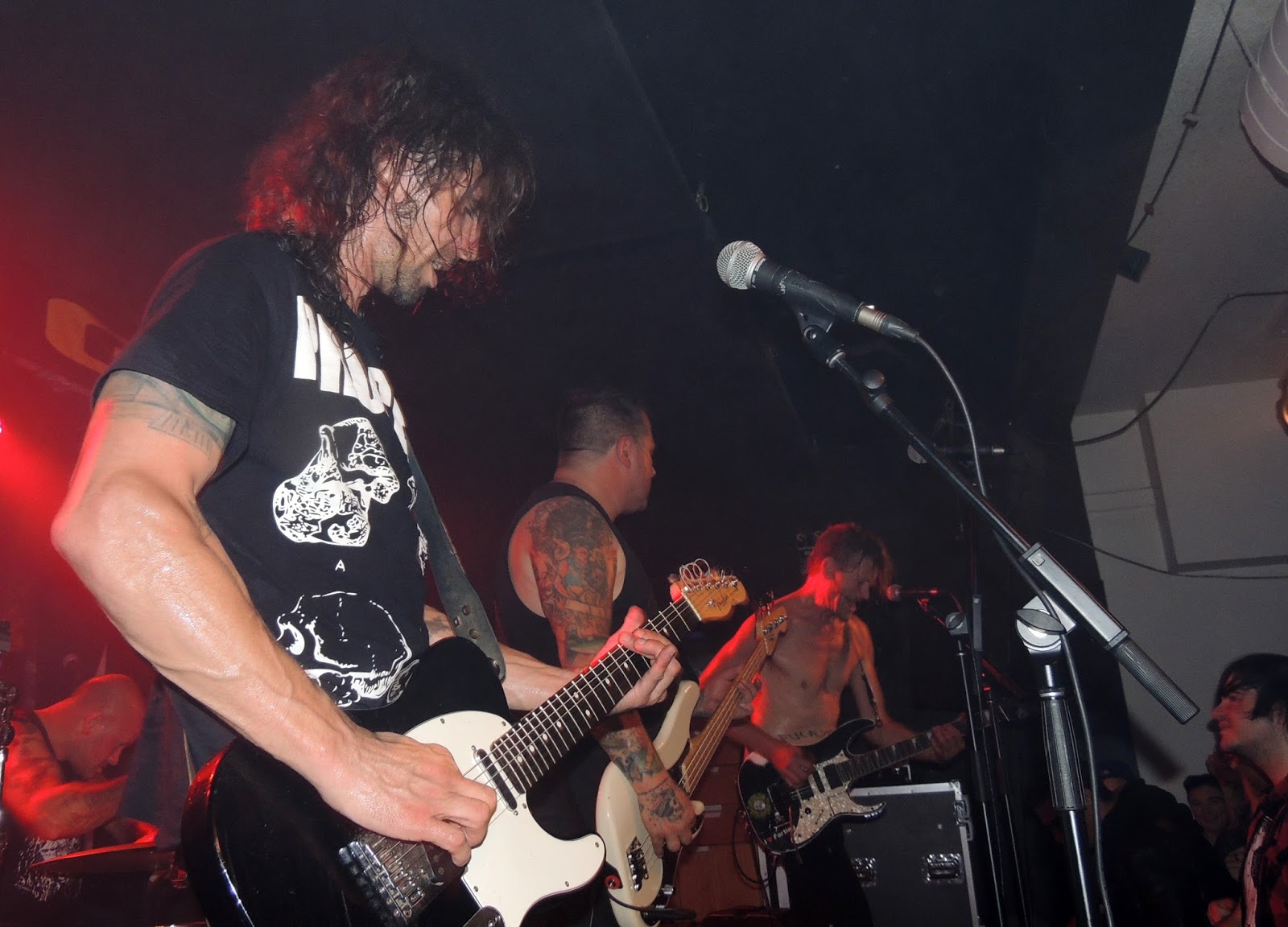
Live Review / Photo Essay: D.O.A. and Dayglo Abortions, Amigo’s Cantina, Saskatoon: September 17, 2016

Live Review / Photo Essay:
D.O.A. and Dayglo Abortions
Amigo’s Cantina, Saskatoon
September 17, 2016

Text and all images © Robert Barry Francos / FFanzeen, 2016
Poster from the Internet
Photos can be enlarged by clicking on them

There are four or five spaces in Saskatoon which are especially superb for seeing live bands, some of which cater to particular genres. For punk bands like the legendary D.O.A. and the Dayglo Abortions, it’s hard to beat Amigo’s Cantina (for those who plan tours, pay attention).

Saskatoon is a school town, with a university and a college, so the audience for these shows are relatively quite impressive. When it comes to bands like these that have been around since the ‘70s – not to mention homegrown Canadian icons – yeah, people are going to show up; even those around legal age (meaning drinking, at 19), fans will sing along. Sure, as at all punk shows, there are going to be who are there to raise heck in the pit (please go away), but there is a strong fanbase, and they turned up at Amigo’s on Saturday night, September 17, 2016.

The show was scheduled to start at 10:30, so in my non-drinking way, I showed up around 9:40, since there really was no reason to get there earlier. I ran into someone I know and hung out with him and his brother-in-law (both are musicians, and one had even opened for D.O.A. a couple of decades ago) until near the start of the performance.

At about 10:10, I started inching and gliding my way towards the front. The place was crowded, but not so packed that it was very difficult to maneuver around people. I went to the side of the stage, which I have found to be a relatively safe place not to get trounced by the moshers, and prepared my camera for the fun of the night ahead.

To my left was the Dayglo Abortions’ guitarist warming up sans amplification, so I could see the fingers move, but could not hear the twang of an unplugged electric over the jukebox. The majority of the crowd was to my right, mingling ever closer to the stage as it got closer to show time, getting more compact. Of course, room would needed to be found for the pit. But what I found interesting is just how many of the audience was already wasted. One woman in her twenties (most of the audience was in that range) walked up to the stage with a full pitcher of beer; no glass, she drank directly from the plastic carafe. I was amused when she was bothered that she was having trouble drinking it later as the moshers rebounded off of her, but I’m getting ahead of myself here.

Just before the Dayglos came on, I saw a motion out of the corner of my eye, and was suddently hip checked by this tiny young punkette who placed her drinks (yes, multiple) directly in front of me, like a dog peeing to announce its territory. I looked at her and she was quite frenetic, screaming toward the band. To give her credit, she knew the music and sang along with the songs, sometimes to an incredibly obnoxious and shrill (did I mention off-key?) level, putting her hands over her head and pushing me. Again, in her favor, a moshing wave motion caught me off balance, and she steadied me. She asked if I was with the local entertainment paper, and I repeatedly had to say no. She found it to be conservative (I mostly find it opposite), but I politely nodded in agreement to move the topic along. Then she apologized for being so adamant, and said in a lightbulb moment way, she recognized me from the early punk shows “back in the day.” I was a bit confused and bemused, as I’ve only been in Saskatoon for a few years now, and for me, the early punk shows I saw “back in the day” was probably when her mom was too young to get into the bar. What pissed me off, though, is she put her beer bottle in front of my camera lens, and purposely clinked it against the front of camera. I snapped, “Please don’t do that.” About halfway through the set, I looked over and she was gone.

I’d never seen the Dayglo Abortions before. Compared to the Toronto/Hamilton corridor, west of Ontario was not necessarily rife with hardcore bands in the ‘70s and early ‘80s as far as I know, but those that were there at the cusp were solid. The Dayglos’ songs focus on the contrary, with somewhat leftist leanings, and it has a history more of trying to provoke more than anything else. This audience was up for it, some carring artifacts, old (LPs) and new (CDs, or from the merch table). One of the women in front had a constant look like she wanted to flail on someone. She came to the stage early on with some Dayglo albums (not sure if original or reissues purchases at the back of the room), and fiercely guarded them as she was pushed from the pulsating mass behind her. She was also not happy about that; at one point I could read her lips saying to someone something like, “they should be here for the music!” I’m not sayin’ she’s wrong…

There are some interesting guitar smashes in their songs, though a lot of it was classic rat-tat-tat style, old school hardcore. This is meant as kind of a refreshing change. With so many bands modeling themselves after post-punk grunge or power punk (such as Green Day and Blink 182), I was pleasured by the stylings of the Abortions. The only issue I had with the band was that they used some kind of smoke machine that added a just more-than-subtle mist to the air that made it much harder to snap some decent pix. Or perhaps it was the club that did it, I’m not sure, but it was definitely thicker during this band.

For those who don’t know, the Dayglo Abortions is fronted by vox / guitarist Murray Acton, who also goes by the moniker “The Cretin.” Looking hard and angular, he took off his Russian CCCP red shirt shortly into the sweat-filled set, and with the short pants, kinda reminded me of Angus Young. He’s been playing forever, on tour for most of that, and even though he looks a bit ragged, he sounded and played with a strong conviction. He was joined by bassist Willy Jak, drummer Blind Marc, and another guitarist whose name I didn’t catch (anyone care to let me know, I’ll add it).

As I said, the set was well received, as they spanned their career, including “I Killed Mommy,” “Stupid Songs,” “Ronald McRaygun,” “Black Sabbath,” and “Drugged and Driving” (well suited for this crowd). But the one that received the most enthusiasm was “Proud to Be Canadian.”

[As a side note, Dayglo Abortions were mentioned in an engaging novel that is about to be republished called Punk Like Me, by the amazing JD Glass. Worth a read].

After the Dayglo’s set, and the front of the front of the stage emptied for people to get drink refills, I moved my butt over to the other side of the room. I knew from experience that D.O.A.’s singer, Joey, usually stands on the far right, so I moved over to that wall, so there would be less smoke between him and my lens. I stood on a chair against the wall, and waited.

The room changed for D.O.A., as some of the more diehard Abortion fans left (never understood that; you go to see some bands play, you stay and check them out and you leave if you don’t like them, not before they’ve come on… But I digress…). The intermission was thankfully short, with D.O.A. coming to set up as the Dayglo Abortions broke down. This gave me the opportunity to snap Joey and the Cretin talking, getting two BC punk legends in one shot (see below). This made me happy.

While D.O.A. certainly has as much energy as the Abortions, they definitely present a very different view of the music. While the last band’s songs were somewhat goofy and pure fun, sort of like the musical version of putting your thumb to your nose and sticking out your tongue, D.O.A. are much more political and I would add somewhat more melodic. Both are “chantable,” but D.O.A.’s messages make the profanity and what is being said “behind” the genre formula much stronger for that reason, in my opinion.

The lead of the band, guitarist / vocalist Joey Shithead Keithley, was wearing a shirt that had a drawing of Donald Trump holding a gun directly at the reader, with the words "Fucked Up Donald" (one of their songs) and the band name down the side (available at the back, or online at the D.O.A. store). With all the work Joey has done politically (he ran for local office a few times now) and musically, my favorite thing he’s posited is “Talk - Action = 0.” Simple, to the point, and powerful stuff.

Backing him up was Mike Hodsall on bass, and a fuzzy Paddy Duddy on drums. There was also someone equally (if not more) fuzzy dong some back-up vocals, but I didn’t catch the name.

I really do believe that D.O.A. are as important as, say Black Flag and the Dead Kennedys, when it comes to political thinking, and their music definitely has the chant lyrics and melodies to back it up (bands like the DKs were more into formula and rhythm than melodies, such as their classic “Rise Above”). Joey’s vocals can be fast like the Descendants, joyously out there like the Circle Jerks, but there is something about how his songs are constructed that are his own, with a determined liberal agenda (that is close, yet slightly left to my own, actually).

Likewise, they covered their canon, such as “Race Riot,” and more than one song about Police violence, very apropos for the current climate. Also, as always, there are a couple of covers, including his stunning standard of Edwin Starr’s “War (What is it Good For?),” and as is tradition, one that you might not expect, such as by one of the original punks, Johnny Cash. I’m blanking out of the top-40 one he did (I was having too much fun to take notes), which they totally made their own, and improving it by far. There were also some new ones, such as “Fucked Up Donald.”

Joey is pretty active on stage, kicking up his leg, prowling around and going right up to the audience at stage center… I mean centre. He also holds his guitar straight out, plucks the strings with his teeth, makes that verbal noise when you shake your head back and forth real fast, and it felt like he connected with some of the audience (the one’s not blasted out by alternative substances, that is). It also seemed like this set went by really fast, though it was probably as long as was the Abortions’.


After the show, I happily went home. I could have stayed around, but considering the number of people that were in another state of being, I thought I should get in my car before they did. It was a pleasant ride home after a killer show. The photos follow.


Monday, September 5, 2016

Review: Ray Harryhausen – Special Effects Titan

Text © Robert Barry Francos / FFanzeen, 2016
Images from the Internet (to enlarge, click on image)

Ray Harryhausen: Special Effects Titan
Directed by Gilles Penso
Frenetic Films / Ray and Diana Harryhausen Foundation /
Arrow Video / MVD Visual
92 minutes, 2011 / Blu-ray 2016

I grew up with Ray Harryhausen (d. 2013 at age 92); well, not personally, but on his work. After Willis O’Brien (d. 1962), who created stop-motion pixilated films like the The Lost World in 1925 and the original 1933 King Kong, Ray Harryhausen (RH) would pick up O’Brien’s mantle and become the leading and deservedly most renowned stop-motion photographer in the world with his own spin, called Dynamation. In fact, he would take mixing this type of animation mixed with live action to levels that could only be bested by digital effects.

Ray Harryhausen and friends
There is nothing but an abashed “we’re not worthy” to the man and his family… and rightfully so. There is rightfully a reason why he has the Ray and Diana Harryhausen Foundation named after him to preserve his legacy and to teach others how to do the craft, his materials are preserved in a museum (sponsored by director Peter Jackson), he has won both an Oscar and an honorary BAFTA (he moved to England at some point), and even a Star on the Hollywood Walk of Fame (certainly more deserving than so many over the past few years, such as the Olson Twins, but I digress…)

This documentary is broken up into chapters by each of the dozen films he has made (I have come to realize I have seen all but two: The Animal Word from 1956, and Sinbad and the Eye of the Tiger, from 1977), and while this goes into detail about how they came about around his contribution, it also takes the entire time to talk about how his craft was honed, accomplished, and of course there are tons of testimonials to praise the Maestro, such as directors Steven Spielberg, Tim Burton, James Cameron, Guillermo del Toro, John Landis (and his crooked glasses), Peter Jackson (of course), Joe Dante, special effects wizards (especially those who have done stop animation, such as Henry Selick, who directed the likes of Coraline in 2009), and those who have appeared in his films, including the lovely Martine Beswick and Caroline Munro. There is also some footage of reminiscences by one of RH’s nearly lifelong friend, Ray Bradbury (d. 2012). Some of the clips are directly for this; others are culled from convention presentations or press conferences. But all of these were donated, including the film clips, donated for free by the companies and people in honor of RH. That is a lot of respect.

There are plenty of shots from all RH’s films, but what is also entrancing is the clips from those that followed which built upon his work, such as Peter Jackson’s King Kong (2005), Splice (2009), and Jurassic Park (1993). Also shown are many of the original models in their modern state, some in sore disrepair thanks them being built in latex rubber, which is infamous for breaking down over time.

One of the more interesting discussions that crops up once in a while through this release is the difference between stop motion and CGI. It is correctly pointed out that both are “tools,” but stop-motion usually takes one to three people (in the case of Harryhausen, with one exception, all his work was solo), but computer generation takes dozens, often with one person working on a single aspect of an image, such as an eye or tail). But what struck me the most as accurate is while people tend to marvel at pixilation, computer generation tends to be dismissively viewed as “Oh, it’s just CGI.”

The Beast From 20,000 Fathoms
While one of his first jobs after World War II (where he worked with the likes of Frank Capra) was doing most of the animation of Mighty Joe Young (1949; though Willis O’Brien received nearly all the film credit, RH was O’Brien’s “assistant”), RH’s first real solo feature credit begins with a film oft seen on TV in my youth, The Beast from 20,000 Fathoms (1953). The filmmakers in the documentary make the same connection I made, in that it led to the direction in the formation of Godzilla (1954) in Japan. RH’s opinion of that film was smile-inducing.

One of my favorite and completely accurate comments in this is that whomever directs the picture, it’s still described as a ”Ray Harryhausen” film. It’s similar to how many early ‘60s songs were considered “Phil Sector” records.

Included here are clips of some of RH’s hearly test works that he did for himself to learn his craft just after the Second World War, and his first professional releases, which were based on Grimm’s Fairy Tales that were still playing on television in my youth in the early ‘60s. They also show many of RH’s original storyboard sketches. He was quite the artist with a pencil and paper, as well as on the screen where he also built his own creatures, usually in his home in a room that was his workshop, fired in the kitchen oven.

Jason and the Argonauts
One of the discussions I enjoyed were when some of the SFX professionals and directors discussed their favorite scenes from RH films. For me? The skeleton fight scene in Jason and the Argonauts (1963). Actually, I love that whole film, which I saw in the theater in my youth, and many times after on TV. Most of his films I saw on television, and I’m grateful to have been able to do that; as far as I know, they don’t play older films like this anymore.

As with all of Arrow’s rereleases, there is a teeming amount of extras. First up is the mandatory commentary. While there are many good tidbits of info given, the problem is there are too many people on it, and I have no clue who is talking, and they often talk over each other. Honestly, this is a commentary pet peeve of mine. But yes, I watched the whole thing.

Earth vs. the Flying Saucers
Next up is the 14-minute “A Treasure Trove” that follows the director and producers opening up some of the boxes in storage for an exhibition that include original models such as the UFO from Earth Vs. The Flying Saucers (1956; a film I’ve always liked) and Pegasus from HR’s last film, Clash of the Titans (1981). It’s interesting but more for the close-ups of the models than the ooo-aaah commentary. Then there is “Interviews” at 16-minutes, with director Edgar Wright (e.g., Shaun of the Dead [2004]), Terry Gilliam, Peter Lord (one of the directors of stop-motion Wallace and Gromit), make-up maven Rick Baker (including American Werewolf in London [1981], Videodrome [1983]), and actor Simon Pegg (Shaun of the Dead), all discussing their fanhood, and how it affected and effected their own careers.

“Interview Outtakes” are 13 interviews over 55 minutes that are either extended pieces from the film, or outtakes by filmmakers who worked with him, were inspired by him, or were just fans of his canon. Also included is his daughter, Vanessa, who is the Trustee of the Foundation. “Message to Ray” is a two-minute collection of six people, including Ray Bradbury, Guillermo Del Toro, James Cameron, and Vanessa, to send a message of thanks and love, probably played to him at a celebratory ceremony, talking directly to the camera. My fave part was Cameron asking, “What ever happened to the first six voyages of Sinbad?”

“Deleted Scenes” is a collection of nine sections totaling 8 minutes that feature different excised clips for reasons of timing or redundancy. The original cut was 15 minutes longer than the final. Thankfully, they put text at the beginning of each clip to explain why that particular one was snipped. All seem right to be removed, but still glad they kept it, even in its rough-cut version. While some of the next one was used in the main feature, “On the Set of Sinbad” is a 2-minute sort-of-behind the scene of The 7th Voyage of Sinbad footage shot in silent 8mm. Damn, the late 50s camera looks better than my Super8 from the early ‘70s.

The original Kraken from Clash of the Titans
The 18-minute “Paris Cinemtheque Q&A” is from December 2012, in which the filmmakers answer questions from the audience about the film, and about Ray. Half of it is in English, half in French (with subtitles), and mostly interesting. The month before, the 9-minute “London Gate Cinema Q&A” was filmed after a showing, but in this case it included RH himself, Caroline Munro, and John Landis, among others. Landis asks a question I actually thought throughout the film, which is, “Where is Sam Raimi?” (a clip from 1993’s Army of Darkness is shown in the documentary, however). I also wonder, is this the last public appearance of RH?

The last two items are the “Original Trailer” for this film, and the “Ray Harryhausen Trailer Reel,” which includes the coming attractions of nine his films in 22 minutes, short clips of which are included in the documentary, but it’s good to see them in their totality.

This documentary – and the extras – excellently shows on so many levels why the history and legacy of Ray Harryhausen is important to keep fresh, because his influence keeps growing. In 2016, a new stop-motion animation picture has hit theaters to success, Kubo and the Two Strings. This Blu-ray explains the reasons for the adoration all quite nicely.


Thursday, September 1, 2016

DVD Review: Blowing Fuses Left and Right – The Legendary Detroit Rock Interviews

Text © Robert Barry Francos / FFanzeen, 2016
Images from the Internet

Blowing Fuses Left and Right: The Legendary Detroit Rock Interviews
Directed by Gil Margulis
O-Rama / MVD Visual
180 minutes, 1988 / 2013

It was 1988, and print fanzines were kind of petering out, and the Internet was still a gleam in the eye. It was more a time of cable access coming into the realm of fan possibilities. New Jersey native and future tech-wiz Gil Margulis knew that. Being a big fan of the sound that had come out of the nascent punk scene of the Grande Ballroom in Detroit, he grabbed his camcorder and with a birthday present plane ticket from his parents for his 19th birthday, he set out to find out more.

What he came away with was phenomenal, including extensive interviews with Ron Aston, Rob Tyner, and Dennis Thompson, three legends from the Detroit music scene of the late 1960s that are presented here. There were others (an extended version of this DVD exists with more interviews), which would be culled into a documentary directed by Margulis called Back on Shaking Street. Now he’s released the original, full interview tapes.

There is a recent documentary I reviewed about the Grande Ballroom called Louder than Love, and missing were interviews with Ashton and Tyner, as they both had passed on a while back (both of heart attacks), so it was good to hear their take on it all, even from nearly 30 years ago.

There is no doubt that the bands that Ashton, Tyner and Thompson represent are part of the pantheon of what was to become not just punk rock, but heavy rock and metal in general. No one presented rock and roll the way they had before, be it the fuzz and noise of the Stooges, or the sheer weight and pounding of the MC5. For its time, it truly was musical anarchy.

Back in the days of camcorders, which generally weighed about 7 pounds (bought mine in ’85), it seemed like an amazing tool: a video you can make yourself was proto-Social Media. Looking back after years of High Definition and wear-and-tear on the breakdown of the magnetic tape in the VHS, the quality is kinda… iffy by today’s standards. But oh, what gloriousness has been captured by the little folks who previously could only view what was presented rather than creating what you want to see.

The DVD is broken up into four parts. The first is just over a minute long of Margulis standing in front of his Westfield, New Jersey high school, where the MC5 played in 1969 (around the time he was born), talking about how the music that came from that city changed his life. He isn’t the only one, as even Henry Rollins has oft discussed the turning point of hearing the Stooges and MC5. For some, I know it’s Alice Cooper; others, the garage madness of the Amboy Dukes. But the Stooges and the MC5 were a different, rougher breed that relied on power more than shock theatrics or psychedelia (without my meaning to disparage either of those bands).

Ron Ashton, who died in 2009, was the guitarist of both the Stooges and noise-punk pioneers Destroy All Monsters. Thing is, Ashton had a reputation for being, well, cantankerous and standoffish. But for Margulis, that didn’t seem to be an issue. With the camera set up in the kitchen of Ron’s mother, a few Coors and ciggybutts, Ashton frankly tells his story of the Stooges, straightforward and very relaxed. You can hear his mom in the background, and someone named Bob answering a phone, but Margulis askes some decent (but not overly deep) questions about the Stooges history.

In describing the early Stooges, their volume was infamous, and that is where the title of this DVD comes from, as Ashton comments that when the Stooges played early on, they were “blowing fuses left and right.”

Destroy All Monsters doesn’t come up until nearly the end of the interview. After being finished with the basic Q&As, we are taken to and shown the front of the house where the band rented to first practice for the summer before their gigging started. After a few minutes there, we are next taken to the house of the Stooges first manager. The importance? It is where the Stooges played their very first gig, in the front living room of that (then) tiny house, which is now a business. We don’t see the insides to these two places, but hey, that is really okay. It is a treasure to hear the Stooges story from Ashton, as it tends to come from either Iggy Pop or James Williamson, the band’s second guitarist who joined after the band was established. This segment last for 40:19. Hell, it’s almost worth it just to hear him use the phrase grok.

The next segment is a lengthy 1:13:00 with Rob Tyner, the vocalist of the MC5, who changed the world with his now infamous battle cry, “Kick out the jams, motherfucker!” Margulis’s camera is set up in his home, and he is also very straightforward and quite charming, as he sips his mug and talks about what Detroit was like when he was growing up, where your choices were the factory, the military or college, and how he was determined to do none of those.

One of the interesting topics he covers is how competitive the Grande was, especially to the British touring bands, rather than a communal “flower power” mindset. Tyner tells about how Cream found it rough to play with them, and reported them as “Insolent” to Grande owner Russ Gibbs. But Tyner says, matter of factly (but with a gleam), “This is Detroit and they’re lucky we didn’t shoot ‘em.”

Tyner especially starts to perk up when he talks about political philosophy, discussing Reganism, violence, and especially his bitter feelings towards the MC5’s association with political poet John Sinclair, who managed the band. According to Tyner, the way Sinclair described himself was as “Pharaoh of the Hippies,” as he drained the money from the MC5 to further his own Maoist and “White Panther Party” rhetoric and movement. One of Tyner’s major regrets was the association of the MC5 with politics, which he believes brought down the band in the long run.

Thanks to some more comprehensive questions from Margulis, Tyner elaborates a lot of what he thinks of the then-flourishing punk movement (NME sent him to England to write a story about the British scene), the differences of Detroit then and now both musically and communally, and his work with the band Vertical Pillows.

However, he never mentions a single other member of MC5 by name. It’s also interesting to hear Tyner talk about the future, and his fear about where the world is going when he’s old. He further mentions that he could die at any moment, thoughtful considering he died just three years after this interview at only 46 years, in 1991.

Last up is the MC5’s drummer, Dennis Thompson, for 45:12. Thompson sits in a room in mirror sunglasses (which he takes off early on, thankfully), Hawaiian shirt, smoking a series of cigarettes, and for some reason has an assault rifle behind him next to a window. Thompson was also the key for Margulis to contact and set up the rest of the interviews.

While he starts of a bit on the pretentious side (“today’s music sucks because they don’t have fast cars; now it’s all four cylinder”), when he gets down to it, he really strips it down, explaining how the band was not the political vanguard, it was all hype, and other than being against the Vietnam war, they were apolitical. Their manager, John Sinclair, however, was not, and knew how to manipulate the media. All the MC5 wanted, he posits, was to be a great rock and roll band. And that, he further states, was ruined in part by Jon Landau: the MC5 were the first band he produced, and Thompson states he didn’t know what he was doing, so the record – and band – suffered for it.

In the second half of the interview, Thompson starts plays schoolteacher to Margulis by holding a globe and explains how people are now mediated and revolutions from the ‘60s were buried and controlled, which also affected the legacy of the MC5. He challenges Margulis with “you have to go back to look at bands that are dead and gone because they had something to say, and you don’t hear that nowadays.”

The last third of the interview is the most interesting (it’s all worth watching, but this especially), when Thompson goes on an absolute political rant about governments, capitalism, terrorism and the world under Reagan. Wow.

Honestly, it took me a while to get to this DVD, being 3 hours long, but now that I’ve watched it, it was a good time spent. It gave me a bit more of a background of the Detroit scene of that time, which really was a unique macro-ecology/-economy of thought and sound, which has since spread this message beyond the barrier of the time in which it took place.


Thursday, August 25, 2016

DVD Review: Louder than Love: The Grande Ballroom Story

Text © Robert Barry Francos / FFanzeen, 2016
Images from the Internet

Louder than Love: The Grande Ballroom Story
Produced and directed by Tony D’Annunzio
74 minutes, 2016

When most people think of music from Detroit in the ‘60s to ‘70s, the first bound to come to mind is Motown. Great stuff, no doubt, but there was more to the city than that. Out of the industrial city came a thunder of guitars, unprecedented attitude, and attack-mode rock from a venue called the Grande Ballroom. The title of the documentary comes from the music of the Grande being more voluminous than another club called Love a few blocks over, but I also think it could be interpreted as being louder than most of the other music from either Coast during that Summer of Love. The MC5, the Stooges (with Iggy Pop), Alice Cooper, the Frost, and even the Amboy Dukes rose out of the Grande to change the face of music and prepare the way for the punk movement that was to come nearly a decade later out of New York.

The Grande Ballroom (pronounced Grand-ee), however, was not the “Detroit CBGBs,” but more like an explosive Fillmore (pick East or West), in which many of the touring rock bands, such as the Who, Big Brother and the Holding Company, and Cream would play on their way across the States.

Though actually only around for a relatively short while (1967-1972), the effect on American – and British for that matter – music is undeniable. Sure the Stones had Toronto as their fave place, but the Who were so enamoured with the Grande that they premiered Tommy on its stage. Alice Cooper points out here that the talent level on that stage so was high that it was either get better to get lost. To inspire bands, the crowd was known to shout out, you got it, “Kick out the jams, motherfucker!” which is the origin of the MC5’s infamous and ground-breaking call to arms.

The amount of interviews throughout the documentary are staggering including nearly all surviving members of the MC5, Roger Daltry, Alice Cooper, Dick Wagner (d. 2014), BB King (d. 2014), Slash, Lemmy (d. 2015), Grand funk Railroad’s Mark Farner, the omnipresent Henry Rollins (who was 11 years old when the club closed, but is acknowledged to be a huge Stooges fan), Stooges’ second guitarist James Williamson, and even scuzzbucket right wing nutcase Ted Nugent (while I didn’t necessarily need to hear anything he had to say, the Amboy Dukes were an amazing band). No Iggy, though, FYI.

For me, one of the important interviews was with Russ Gibb, who was the owner and founder of the Grande, on the level of Bill Graham without the ego. Well, him and most of the staff of the place are interviewed in detail with lots of anecdotes. Which brings me to:

There are three themes in this that are worth nothing. First and foremost are the interviews, including with Ruth Hoffman, a self-described groupie who tells a tale of getting drunk with someone and comparing men’s butts, only to find the person get up on stage and it’s Janis Joplin. Or, the stories of the whole audience participating in loading up a band’s gear so they can make it to the airport. Then there’s someone bringing Eric Clapton and Ginger Baker to their parents’ home for supper. There are these, along with the “The Stooges!” “Alice Cooper!” “The Who!” meshugas.

Second, there are the images. I am not talking about the talking heads interviews, I mean both the live footage and stills from the day that show just how extreme the entire scene quickly became. There’s everything from onstage action to, well, Eric and Ginger at the family supper.
What I found also interesting was the juxtaposition shots of what the Grande looked like then and its condition now, but more on that later.

For me, the weakest spot is the use of music. Listen, I understand that if all the music discussed would be played as a focal point, this film would be about 20 hours long. That being said, most the sounds you hear are in the background; it runs through the whole film, but little of it is identified except in the song credits at the end. Also, in most cases, it’s snippets… well, probably, because it is in the background under the dialog, so it’s hard to pay attention to it except peripherally. But if that’s the biggest complaint I have, it’s a mere four bars considering the magnitude of the story behind it.

There are a number of really nice extras. The first, at nearly 16 minutes, is “Grande Tales,” which is further interviews (with no indication of who is talking, so watch the film first). At nearly a half hour, you can see what their infamous light shows looked like (sans sound… or mind altering substances). After the 5-minute long trailer, there’s “Dave Miller Grande Wedding,” at nearly 4 minutes. Dave was the MC, and his wedding show was infamous among the inner circle; he wore outrageous make-up that makes Alice Cooper’s look moderate, and it’s also silent, as is the next 10-minute long “Dave Miler’s Home Movies” (I’m guessing 16mm), where he shoots various band members at his parent’s house. It’s a lot of fuzzy fun. Last up is “Belle Isle Love In” (1967), another silent home movie lasting over 5 minutes that focuses in on the audience (especially the women) as much as the bands.

When the Grande closed in 1972 (though there is no mention of why here), the building was abandoned and is in a state of severe disrepair. Watching the comparison shots of the place then and now is both fascinating and heartbreaking. Personally, I’d love to see it become a heritage building, and have the Detroit government not only fix it up, but turn it into a museum. But, of course, Detroit is broke, so that’s not gonna happen anytime soon.

Considering the number of talking heads, the stories are fascinating enough to keep the viewers’ interest for the entire time, and D’Annunzio keeps his ego in check to make this just the right length to do that. A must for anyone who is into rock history, the nascent beginnings of punk, or just love to hear stories about that period. A visual kicking out of the jams.


Bonus video (not on DVD):

Saturday, August 20, 2016

DVD Review: Janis – Little Girl Blue

Text © Robert Barry Francos / FFanzeen, 2016
Images from the Internet

Janis: Little Girl Blue
Written and directed by Amy J. Berg
Disarming Films / Jigsaw Productions /
FilmRise / MVD Visual
103 minutes, 2015 / 2016

If you look at the director’s credits, most of Amy Berg’s films are documentaries about children and women who have been abused by the system, especially by those in power in a religious setting. It kind of makes sense why she’d choose this topic because Janis Joplin’s life was also a series of failures on the part of support systems as she reviled in the church of Rock and Roll.

For anyone who grew up listening to her music, the stories of rejection in high school and in the town of Port Arthur, Texas, resonates. That’s part of why the cult of Janis started, because people of her generation and beyond heard and saw in her the pain, which gave voice to their own, possibly for the first time; this is especially true for women.

Now, there have been umpteen books and documentaries about Joplin over the years since her death in 1970, and even Bette Midler’s film, The Rose is somewhat based upon her, but most try to paint her as a victim, be it of her culture, of the time of drug experimentation in San Francisco, of bad management (such as Albert Grossman), of other musicians, of the music lifestyle, record producers, a failed relationship, whatever. Despite “Little Girl Blue” in the name, Berg takes a somewhat different and more even-handed approach, which makes it a better film.

Berg does not shy away from anything, be it Joplin’s bisexuality (though barely), her drive to fame and success, her fragile ego, and her substance ab/use, which makes the film all that more compelling. She paints Janis as a human, not just a myth. Part of the way she does this is by vocalizing some of the letters she wrote over the years to her family in Texas, spoken by Chan Marshall (better known as musician Cat Power), who gets the tone and intonation spot-on, without it being a caricature impression.

Actually Berg makes many good choices throughout. For example, she hits the high points in Janis’s rise, such as Monterey and Woodstock, but also doesn’t dwell on them by looking at some questionable choices, giving some balance to her life and career.

There are many archival images and videos, both as a young’n and throughout her famed career, both onstage and off. I’m a fan of Joplin’s music and talent, but I would be hard pressed to say I was an expert on her. I’ve seen lots of performances, thanks to YouTube and the like, but there were a lot here that I had never seen before, including some interviews both on national and local television (e.g., Dick Cavett) and regional press.

Along with that, there are numerous interviews with those who were there with her, including her family, childhood (and beyond) best friend, members of all of her bands (Big Brother and the Holding Company, the Kozmic Blues Band, Full Tilt Boogie Band), Kris Kristofferson, Country Joe MacDonald, Dick Cavett, Clive Davis, and so forth. But rather than the standard talking heads, she makes the talker seem more intimate with strong close-ups, and by incorporating what they are saying into archival footage rather than just watching them jaw.

There are also some cool extras, so even if you have seen the airing, it may be worth checking out anyway. First one up is titled “Avalon vs. the Fillmore,” at 4 minutes. Bob Weir (of the Grateful Dead), among others, discuss the difference in atmosphere between the two clubs, and how Janis got kicked out of one of them (not telling which). At nearly 1-1/2 minutes, the remaining members of BBHC get together for this film in “Big Brother Acapella,” and do a modified version of “Papa-Om-Mow-Mow.” It’s almost surrealistic (but no pillow).

Especially powerful is the next 5-1/2 minute “Influences,” in which women musicians (Chan Marshall, Pink, Melissa Etheridge and Juliette Lewis) talk about what Janis meant to them, and what it is like to give all and then be alone at the end of the show (Melanie Safka has a great song about this phenomenon called “Leftover Wine,” FYI). For the last extra, the 4-minute “Walk of Fame Ceremony” follows Janis’s brother and sister to Hollywood in 2013 to see Clive Davis uncover her star. As one fan rightfully states, “The Olsen Twins have one and it took them this long for Janis? Shame.”

This documentary has been heaped with praise since its release and airing on PBS’s “American Masters” program. I’m not surprised, as it’s one of the better rock bios I’ve seen in a while. It clearly shows Janis as a flawed human without either excusing her behaviour, or pointing a finger.


Monday, August 15, 2016

DVD Review: I Need a Dodge! – Joe Strummer on the Run

Text © Robert Barry Francos / FFanzeen, 2015
Images from the Internet

I Need a Dodge!: Joe Strummer on the Run
Directed by Nick Hall
Tin Dog Productions / Cadiz Music / MVD Visual
67 minutes, 2015

If you have to ask who Joe Strummer is, well, you’re reading the wrong blog post. Honestly, he was the only one of the Clash I actually thought was cool (though Paul Simonon had his moments). That being said, the Clash started out as one of the biggest punk bands out of the English phase, and turned into one of the biggest disappointments. London Calling was a mixture of amazing work and commercial dreck, and by the time Combat Rock came out, I couldn’t listen to their stuff anymore. It was almost a relief when Strummer left the group around 1985.

Thanks kind of where this documentary really starts to pick up. I didn’t realize that Strummer headed for Spain; he had a fling with an Iberian woman early in his career, learned some Spanish, and fell in love with the country.

While there, Joe hooked up with a band in Granada called the 091. This seemed ironic, since his first recordings in England were with the similarly titular number-oriented and underrated 101ers. Pre-Joe, the 091 considered themselves punk, but musically I would say they were closer to the New Romantics pop, along the lines of Simple Minds or Tears for Fears (at least in the short clip we see of an early incarnation of the band). Gathering a popular Spanish band called Radio Futura, he then recorded with them as well.

Most of the members of these bands, and other friends from that period and before, are interviewed in the film, which is mostly recorded in Spanish in oral history mode, meaning there are no questions heard to be asked, just the participants telling their stories. There are some nicely done captions in English with a few other languages available. Also included is a Spanish version of the film on the DVD as one of the extras, which I did not watch.

And where does the title of the film come in? Joe Strummer bought a Dodge (or Spanish knockoff, depending on the storyteller) while in the country, even though he had neither licence nor registration (in someone else’s name) and somehow he lost it by forgetting where it was parked. During a radio interview in Madrid, he mentions how he wants to find it, and there is the premise. It’s kind of a slim one as it’s not discussed all that much at the beginning, but that’s fine. What we get instead in a post-Clash Strummer who was mostly out of the Western Hemisphere’s eye, and this fills in the gaps quite nicely.

Most of the early part of the story is more of Joe’s involvement with the musicians, including trying to produce their LP and battles with the ill-equipped record label that was more used to classical Spanish music than anything as raucous as Joe would tip is toe into.

I like that the story has a few different layers, like a history of Strummer (d. 2002) in Spain, the involvement of the car, and also Strummer’s working with the Spanish bands. All these threads are conveyed by those who were there, rather than a third party, such as a journalist who had written about it.

At first, the car comes into the conversation on occasion, focusing more anecdotally of his involvement with the 091 and Radio Futura, but as the tale plays out, the focus lingers on the titular subject more. We watch the director become the focus as he looks for the mystery car. Does he find it? Well, I’m not tellin’.

There is a lot that is formulaic about the formatting of the film, with multiple talking heads, but it remains interesting because they were there, and stories about Joe tend to be never dull. Also, Nick Hall is wise enough to know that most likely the audience for this film will not know these musicians and friends, so the title captions for each person come up pretty often. Thank you for that.

Another smart choice is that Hall keeps the film relatively short. Rather than dragging it out, he gets to the point in a mostly enjoyable roundabout way, not focusing merely on the car or the musicians, but edits it in an ever growing arc that keeps the interest level high.

There are a bunch of extras that go with the DVD, including a stack of deleted interviews that are mostly around a minute long, with a couple being around 3 to 5 minutes, and a 25-minute one with Pete Howard and Nick Sheppard, two members of the reformed Clash (who talk in detail about Joe’s troubled relationship with manager Bernie Rhodes). Taking these out were right, but so was adding them into the extras.

Another two bonuses are audio tracks of interviews with Joe, one being 13 minutes from 1984, and the other is also 13 minutes, from 1997. Both are in Spanish with subtitles. As an extra bonus sweetener, this is interview is also on a cassette (you read right) that is included with the DVD box. Sure it takes up more space on the shelf, but hell, it really is cool, proving once again what Marshall McLuhan said, that replaced technologies come back as art. In this case I might say art as fuck.


Sunday, August 7, 2016

Ming, 1998-2016

Text and images (c) Robert Barry Francos


Yesterday, we had to put down our precious Ming. She had a fast growing mass in her gut, and had lost nearly a third of her body weight. It was all very fast, and she let us know it was time to join her litter-sister, Memphis, who passed in February 2014. In just over a month, Ming would have been 18 years old, which is 90 in cat years (we looked it up).

Ming was an affectionate kitty who liked to curl up between us at night, or rest with her head on some part of our body (usually the one trying to get things done, like type or write). She would headbutt us to ask for a rub, and was very kind tempered, especially as she aged. She seemed to take an instant like to my dad, though he was not impressed with pets, but she was insistent. Ming was strong willed and usually got what she wanted.

Sleep well, little one, you are missed and loved.

You can find of more her and her sister's story HERE.