© Robert Barry
Francos / FFanzeen, 1982/2022
Images from the Internet unless indicated
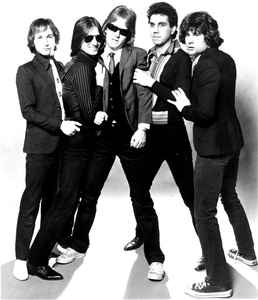
Jeff Salen is on the far right, next to Robert Gordon

Excuse me, but
Jeff Salen was robbed. You ask, who is Jeff Salen? Well, that just proves the
point. Jeff was the brainchild of a group called Tuff Darts that was thisclose
to breaking. Then, just as the labels started to come sniffing, the lead
singer, Robert Gordon, took a powder to go his own separate rockabilly way as a
solo act and joined forces on occasion with Link Wray along the way. For a long
time, Gordon refused to even acknowledge his stint in the band, but the cuts
from the Live at CBGB’s album of Tuff
Darts with Robert Gordon, “It’s All for the Love of Rock’n’roll” and “Slash,”
are arguably the best cuts on the collection. The former was written by fellow
bandmember Jeff Salen. When Gordon left, Jeff tried to reform the band with
another singer, Tommy Frenzy, and even recorded the Tuff Darts! album, for Sire
Records. It was a failure, basically because, in my opinion, lead singer Frenzy
could not fit the image of the band. He tried nobly but the songs felt false
under his tutelage. Decent singer, wrong band for him.
But Jeff’s contribution
to the scene goes beyond the music, he was also a driving force in the style of
the time, going in the opposite direction of the Richard Hell minimalism and instead
he went for flamboyance, like the Byrds and Bowie. This is actually not very
surprising, considering he worked for such flashy fashion icons as
MainMan/Bowie and Wayne/Jayne County.
During his
tenue with Tuff Darts, Jeff sidelined as a studio musician for the band Sparks
in their heyday.
After the Tuff
Darts broke apart, Jeff started working with the American Passions, which also crashed
and burned. Between bands, jeff opened his own high-fashion clothing store on
the Upper West Side of Manhattan, near the Beacon Theater. It was here I caught
up with the man.
This interview was published in FFanzeen, No 9, dated 1982.
Jeff at far left
Jeff Salen: Not So Tuff
Back in 1975, when I
started going to CBGB, Max’s, and others, I slowly but surely became aware of
the name of Jeff Salen. At that time, it was of his work in one of the better-known
underground bands, Tuff Darts. But he began way before that.
Many years ago, Jeff worked
as a studio musician for the ill-fated MainMan operation, David Bowie’s
organization. When that ended in the early 1970s, he worked his way up to Tuff
Darts. All was going well with the world until the lead singer, Robert Gordon, left.
The band floundered and, despite a LP released on Sire (Tuff Darts!), the band slowly but surely dissolved. The public was just too used
to Robert.
A few years ago, he became
involved with a band from Washington, DC, called the American Passions, but
again, that just didn’t work out.
While all this trial and
error with the Passions went on, he worked in a clothing store on the Upper
East Side, a perfect setting for him since he was always engrossed in fashion,
feeling that fashion is an integral part of rock’n’roll. This led him to owning
his own clothing store extraordinaire, called simply Jeffries, at 50 West 72
Street, in New York City.
Time passed, and now Jeff is ready to put another band together, for as fashion is a part of rock’n’roll, rock’n’roll is also connected to fashion. He’s halfway there.

FFanzeen: So, tell me about your
pre-MainMan days.
Jeff Salen: I started out in a group called Butch, with Tommy Ramone. We used
to play the Mercer Arts Center, and one of the bands that played there was
Queen Elizabeth, which was Wayne County and the Miamis, put together with Dale
Powers. Tommy and Jimmy Wynbrandt. [both were in the
Miamis – RBF, 2022]. So, they broke up and we
broke up. Wayne got signed to MainMan, which was Bowie’s production company.
They had all these artists [e.g., Cherry Vanilla,
John Cougar (Mellencamp), Cindy Bullens, Iggy Pop, Mott the Hoople – RBF, 2022].
I got signed by MainMan to back up all these
people, to be a guitarist for them. So, I was in the Back Street Boys for Wayne
County for a long time – for about two years. We were, like, the No. 2 band
under the Dolls at the 82 Club. The 82 Club was a good scene. We had a good
time. Bowie had a good time. And then something happened with Bowie. He had a
lawsuit or something with MainMan - with Tony DeFries – and that was the end of
MainMan. And so we got off the gravy train and we broke up. Then I joined Tuff
Darts, which was John DeSalvo of Jim Morrison’s band. That got pretty popular
and I was pretty popular at that time from the Back Street Boys. We played and
we were pretty good. You’d have bills like the Ramones, Tuff Darts, and
Blondie. Blondie was third billed, believe it or not. That was, like, at
rehearsal studios. There’s a studio called Performance Studios, which the
Ramones owned. Everyone used to play there because there were no venues; there
was no places for a band to play, except for CBGB’s. I don’t think Max’s even
had bands then. Max’s had bands, but they were, like, Kinky Friedman. They were
like the Lone Star is now. Tuff Darts took off; all the bands took off, and
there got to be more clubs.
FFanzeen: Was
Robert Gordon in Tuff Darts when it formed?
Jeff: Yeah. Tuff Darts played only with Robert Gordon in the beginning. There
was this guy, Richie Rich, who played rhythm guitar, but they threw him out before
I was in the band. That was it. Then we auditioned singers and Robert pushed
his way into the audition. We had a whole bunch of people in line, and he said,
“I’m the guy,” and he pushed his way right into it. He sang like Paul Rodgers [of the band Free – RBF, 1982] then. And that was what was happening at the time. It was very Bad
Company-oriented. We were really knocked out with Robert. We stayed with him
for about three years. We built things up pretty good and then he got a deal
and he went.

FFanzeen: How
did you get approached to do the Live at CBGB’s album?
Jeff: It all had to do with Hilly (Kristal; d. 2007). He picked all the best
bands. The only band that had a record deal then was the Ramones. Everybody
else didn’t. Everybody except Talking Heads, who backed out of [the live album]
at the last minute. But they’re on the back cover. I think that’s pretty funny.
The front cover looks like a pizza. It’s, like, one of the worst covers of all
time. It looks like a bunch of hippies, ya know? But I can’t bad-mouth Hilly. I
have to watch my Ps and Qs. It was a nice scene, though; I was pretty happy.
And, you know, if you played CBGB’s you couldn’t play Max’s. Our album (on
Sire) came out in early ’79-late ’78. And then I did this thing with Lisa
Burns, Sal Maida from Sparks [and Milk and Cookies
– RBF, 1981]. Bobby Butani from Tuff Darts, and David
Bowler from the Marbles.
FFanzeen:
After Robert left, why did you have so much trouble keeping a lead singer?
Jeff: We didn’t know what to do. Ian Hunter set us up with this guy, Kelvin
Coney, from England. He was okay, but nobody liked him. He got disgusted and he
wanted to get paid, like, to stay in this country, and we didn’t have any money
to pay him. Actually, he was causing turmoil between Ian and us. So he went. We
tried a bunch of kids from New York, like one gig apiece. Then we got Tommy
Frenzy, ‘cause Tommy was a fan. He was the guitar player in a band called
Frenzy up in Westchester. They used to do our songs. When they would play
CBGB’s, I would jam with them. He was a nice guy and he was into what we were
doing, so we figured he would be cooperative. He was pretty cool. I liked what
he did, but the critics, like, tore him apart. I wanna go on record, I thought
the record was pretty good. Cream’s Mitch Comb says that I’m really good when left to my own devices,
but he didn’t like the John DeSalvo songs. The sexist songs. But it’s all fine;
it’s a joke. Actually, that’s what got us attention. My songs are just love
songs, very standard fare, but they’re not things that would draw attention in
a jaded music scene here in New York. John’s were the one’s that got attention,
like, “I’d rather slash my wrists and cut my throat (then have to spend the
night with you)” [“Slash”]. I think it’s a great song. The critics ripped it apart and they ripped
Tommy apart, and I don’t know why. He did it pretty close to how Robert did it.
He did his best.
FFanzeen: I
think that was part of the complaint, that he was imitating Robert rather than
being original.
Jeff: What else could he have done in that situation?
FFanzeen:
Created his own style, like Ultravox did after John Foxx left. .
Jeff: Yeah, Midge Ure in Ultravox did that. I’m glad they could do that. I saw them down at Irving Plaza
and I was glad they could do that. Maybe that’s what Tommy should have done,
but he decided what he wanted to do. We were just happy doing the record. I was
just working on my guitar parts and trying to keep the band together. That sort
of thing.
FFanzeen: When
you were at MainMan, did you record anything?
Jeff: Yeah, we did recordings with Michael Tschudin producing, who used to run
the Mercer Arts Center. When people read this article, somebody will remember
these names. He’s a cool guy. I wonder what ever happened to him. We did nice
little recordings with him; we did a movie. It was a movie with me kissing
Cherry Vanilla, or something. And we did a show called Wayne County at the Trucks. You know what the “trucks” are? It’s like a gay thing. All the boys are
at the trucks, you know, fist-fucking. Anyway, we did this movie and we rented
out the Westbeth Theater, which I’ll come back to later, ‘cause it’s
interesting, I think. That was MainMan. They spent, like, you know, $50,000 on
this show and filmed it for a movie, with other footage, too, with Bowie and
Mick Ronson (d. 1993), and all the MainMan artists: Iggy, Cherry – mainly
Cherry Vanilla – and Wayne County, because they were New Yorkers. People came.
Everyone thought Wayne and the Back Street Boys would get a record deal from
this. This was, like, when Alice Cooper was happening. I played guitar. I was
just into being popular.
FFanzeen:
Fame. The star-trip.
Jeff: I liked it. They had little ushers who wore cock-and-balls shoes. That
was fabulous. Papier Mache cock-and-balls shoes.
FFanzeen: You
were going to say about the Maspeth Theater –.
Jeff: Westbeth Theater. Maspeth is in Queens, where I went to Junior High School.
Okay, what was I gonna say? The Westbeth Theater pops up all the time because
Bobby, from Tuff Darts, did a play. He did some recordings with some guys who
worked at Westbeth who were directors there. The guitarist – the other
guitarist, Bobby Butani – and I did a couple of gigs with him in a group called
the Passions. Maybe people will think that it’s a continuity. Maybe they think I’ve
been working on this band for a long time [giggles]. It’s not true! I just joined this band [American
Passions – RBF, 2022] a couple of months ago.
FFanzeen: How
did you come to join the American Passions?
Jeff: Jonathan Blank is a lawyer for a lot of musicians, like Richard Lloyd, the
Rockats, Lisa Burns. Anyway, he’s the lawyer for the manager of the group. He’s
not my lawyer now, but at the time he was. Now I’ve got Blondie’s lawyer, the
Cars’ lawyer. I’ve moved up in the world a bit. I had come back from LA and I
called up like everybody I knew in New York, and said, “What’s happening? Who
should I play with? What should I do?” And he told me about this wonderful band
in Washington D.C., that were about to be signed, and they just needed a lead
guitarist. I said, “I’m not interested because I’m a songwriter, I’m not a lead
guitarist.” He said, “Well, go down there anyway, maybe they’ll do one of your
songs.” So I went down and I joined the band, primarily because the singer
(Steve Avery), like, really loved my songs and was willing to do my songs. And
now, it’s, like, half-and-half between Steve Avery and me. We’re even trying to
write together with some success.
FFanzeen:
Sparks –
Jeff: Sparks is great. Sparks is the most fun I’ve had.
FFanzeen: How
did you get involved with them?
Jeff: We had just finished working on the Live at CBGB’s
album and the guys from Sparks came to see
us. At this time, everyone was comin’ to see us. Mick Jagger came to see us,
Ian Hunter, Bowie (d. 2016) – in fact, a great many people – notable people –
told us that Robert (Gordon) was more trouble than he was worth; that we would
be better off without him, believe it or not. I never thought that. When it
came time for Robert to leave, I tried to pull a Henry Kissinger and tried to
beg him, please don’t go, stick around. But he thought he was prostituting
himself. Tuff Darts was more like John and my band. It was John’s band when he
did his songs and my band when we did mine. The other guys were pretty passive.
Bobby came more to the front towards the end, but basically it was pretty much
playing rhythms and keeping things going in the background. Robert Gordon
didn’t have much of a personality in Tuff Darts. Maybe he has one now. I don’t
know – I don’t think so. You can print that, I don’t care [giggles].
FFanzeen: Do
you ever talk to him?
Jeff: Yeah, we’re amicable.
FFanzeen: The
reason I ask is because he practically denies those days even existed.
Jeff: He’s not as reasonable about it as we are. Put it this way: I thought it
was a bad time to leave a band. You work together a certain amount of time and
you’re accomplishing something – we were supposedly doing very well. At that
point, (Amos Poe’s) The Blank Generation movie came out. It just looked like everything was going great. A lot
of major labels were interested in us, not just Sire. It was kind of a crummy
time to leave a band. Couldn’t he have waited until at least the rest of us had
gotten something? I remember he thought he was prostituting himself and he
wanted to do something else. Other people had gotten involved with him, and
everything seemed to have been falling into place when he left. We just kept
trying other singers. We didn’t know what else to do. Did I handle that
diplomatically? I hope so. I don’t have anything against Robert; I don’t have
any great love for him, but I don’t – he’s a professional. He did what he
thought was good for him. I picked up the pieces and did what I could with
them; I think he’d acknowledge that. And he’s not doin’ so hot either. Like I
said, at the time, a lot of people told us that if he wanted to leave, let him
leave. Aside from artistic or aesthetic reasons, I thought it would be bad for
him to leave because people had associate him with our songs already. With my
songs and John’s songs. I tried desperately to get him not to leave. He didn’t
want to know. His management didn’t help. Everybody always thinks they know
best. At some point, I’d like to be a producer so I can be the one who knows
best.

FFanzeen:
Sparks –
Jeff: Okay, Sparks was produced by Rupert Holmes, who did Sailor, Barbra
Streisand, and John Miles (d. 2021). Anyway, I remember they called me up –
they had Joseph Fluries called me up, who worked for them, and he said, would I
be interested in joining Sparks. I said, well, I’m in a group that I really
think is gonna break big – this is Tuff Darts with Robert – so I said I would
love to come down and talk about it. I’d play on the album, but I wouldn’t join
the group. He said come to the Carnegie Deli that night, ‘cause they were
staying at the Warwick Hotel, and they were sitting in the back – in the very back.
My girlfriend at the time wasn’t into Sparks. I was into the MC5. And Motown; I
was really into Motown at that time. I wanted to be black, like Eric Burdon.
So, we went to the Carnegie and they said they liked the way I played guitar
and would I like to play on the album. They were going to do the album in New
York. Sal Maida recommended me. This guy Sal is always doin’ me favors. Sal had
been with Roxy Music and Sparks at one point, I think [he was in the band, including on the 1978 album Big Beat, and with the band in
the 1977 film Rollercoaster – RBF, 2022]. So I said, sure, I’d love to do it and we talked about the money and
that sort of thing. Then we rehearsed for two weeks. They already had a title
for the album, Big Beat, so we concentrated on that. Hilly Michaels was the drummer, who later
became Ian Hunter’s drummer, because I played on the Sparks album. Anyway, we
rehearsed. I’m trying to find a good story outta this. I don’t think there is
in this one. We rehearsed, I did the record, had a good time doin’ it, got
paid, and declined to tour [missing out on the Rollercoaster appearance – RBF,
1982]. If I would have toured, there would never
have been a Tuff Darts album. [Big Beat] was the most fun album I ever worked
on. I had a ball working that record.
FFanzeen: Why
was it so much fun?
Jeff: First of all, they’re really easy to work with, Ron and Russell (Mael). I
have no idea why they have such a difficult time in this business. They can’t
get a record company to push their records. They always get shafted. I don’t
know what the fuck it is. They’re just wonderful to work with. They’re so
loose, they’re so much fun. Very talented. I think they’re great lyricists. I’m
just really into what they do. Everything they did was clever and it was so
challenging for me to find intelligent guitar parts, ‘cause they just wanted
loud guitar, you know, which is sorta my trademark, but there is a sensitive
side to me and I try to be in tune with what I’m doing. There was no pressure
because it wasn’t my band; I didn’t have any worries. I just showed up at
rehearsals, showed up at sessions, and when I left I had a clear head. I had no
concerns. Tuff Darts was so mind-boggling with concerns. Not in the beginning,
because I was oblivious. I didn’t care. I was still into being just popular and
being creative and just living out my Ronnie Wood/Keith Richards fantasy.
Towards the end, trying to save it and everything, that took years out of my
life. Not just mine, everybody’s. The whole band tried. Bobby tried hard. We
kept trying to do things. If I have any success with this, I’m gonna try and do
something with Bobby, like produce him or something.
FFanzeen: Is
Bobby in a band now?
Jeff: It’s hard to find sympathetic musicians. There are a lot of musicians
like Lydia Lunch – that sort of thing – like, what can you do? I can’t play
that stuff. Bobby can’t play that stuff. I like avant-garde things. I like
innovative bands. I like, you know, John Lydon’s band (PiL). I love all those
English bands like Spandau Ballet and Ultravox. They all sound like King Crimson to me, with a disco beat, but – I
like the way they look, you know.

FFanzeen: I
always picture you on stage in vests and three-piece suits. Are you still into
that?
Jeff: In Tuff Darts, but not anymore. I like layers. I’ve always been into
fashion. I’m not a superficial person, but I like the trappings of things. We’ve got a whole bunch
of pirate clothes now.
FFanzeen: Oh,
no! Adam and the Ants strikes again!
Jeff: Actually we got them before Adam and the Ants came to town. We were
already into it from reading about it before, and we know some people who work
for Ian’s, the clothing store (in New York). They go to England all the time
and they told us what was happening. They usually keep me in good clothes. I’m
like a mannequin for them, sometimes. We wore a lot of that stuff when the
American Passions played Bonds. (Fashion) is what I got off on when I first got
into music. I liked the way the Stooges dressed; I like the way they looked. I
liked the whole bit. It was, like, you didn’t have to be that handsome –
naturally handsome – you didn’t have to be George Hamilton or some shithead
like that, but you could still be cool. I think that’s a big part of
rock’n’roll. You didn’t have to be perfect – you could be Keith Richards or
Mick Jagger, who are not perfect looking but are really cool. Brian Jones (d.
1969) was prettier than most girls, though. You didn’t have to be so manly with
this macho-silly thing. I picked up on that and that stayed with me. I like
fashion. I think fashion is very important in music.

I lost track of Jeff Salen
after this. I do know that in 2002, the Tuff Darts reformed (sans Butani and,
of course, Gordon) for the CD release of Tuff Darts!, going on to record the 2007 album You Can’t Keep
a Good Band Down. His presence as a
rock’n’roll icon was still underappreciated and underserved by the scene,
however, when he passed away from a heart attack on January 26. 2008.
Since his passing, as Wikipedia announced, “Tuff Darts have been
performing since 2011 with a reformed lineup in and around New York City.”


 Posts

