Showing posts with label Suzi Quatro. Show all posts

Thursday, June 25, 2020

Documentary Review: Suzi Q


Text © Robert Barry Francos / FFanzeen, 2020
Images from the Internet


Suzi Q
Directed by Liam Firmager
Utopia; Screen Australia; Film Victoria; Acme Film Company Production; Madmen Films
100 minutes, 2020

My first experience of Suzi Quatro was on May 5, 1975, when I went to see Alice Cooper play at Madison Square Garden as part of the Welcome to My Nightmare Tour. Our seats were literally the last row of the upper balcony, facing the stage; you could not get any further away. Suzi was less than an inch tall from that distance. As it is, she is petite, but her sound was humongous, and made an impression on me (more than Cooper, quite honestly; it was my second time to see him there). The next day I went out and bought the then-recently released Your Mamma Won’t Like Me album, during her funkier period (the same month I would see the Ramones for the first time).

Women in rock seemed to come in waves up until the mid-‘70s: the first innovators were in the 1950s who never really got the credit they deserved, such as Wanda Jackson, which lasted until after the Shangri-Las’ boom of girl groups through early ‘60s. Then there were the blues rockers, such as Grace Slick and ended with the death of Janis Joplin. The next wave started a few years after Joplin’s 1970 passing, when Quatro released her eponymous proto-punk/metal album in 1973.

With songs like “Devil Gate Drive” and “Can the Can,” through her MTV-fueled “Rock Hard,” her vocals and starting with the employment of a huge 1957 Fender Precision bass hit a strong note. It’s been over 50 years since she started at age 14, but the story of that journey is the bassist – I mean, basis of this Australian documentary.

Suzi was huge all over the world, selling tens of millions of records, but here in the US of A, she was barely promoted by her record distributor (though she did make the cover of the Rolling Stone) and her sales were flat in her own ‘hood, relatively speaking. That’s part of why, even though she was born and raised in the Grosse Pointe area of Detroit, she has spent most of her life in England, starting the very early 1970s when she was brought over by infamous producer Mickey Most. All across the globe she was a presence on television on shows like “Top of the Pops,” but I remember mostly import LPs in stores that dealt with those (such as Disc-O-Rama on 8th Street, off McDougal, where I bought most of the early punk releases, but I digress…).

With hits all over the world but never really respected on a level she deserved in her own country, no wonder she stayed in the UK. Though I liked Suzi’s music, I really didn’t know much about her or her career. That is part of why I was so excited about this documentary, for which Suzi is incredibly deserving and involved. The fact that her first big hit in the States was a limp duet with Chris Norman, “Stumblin’ In,” shows how shallow the tastes of the mainstream American audience had become at the time.

Most documentaries, including this one, focus mainly on the high moments of fame, but one of the aspects I found interesting was the earlier years, covered in the first 15-20 minutes, when she was part of a “family” band of her sisters, starting with The Pleasure Seekers, which transformed into Cradle. One thing missing from here that I found interesting is the lack of mention of the only male in Cradle, future New York Dolls and Heartbreakers (with Johnny Thunders, not Tom Petty) drummer Jerry Nolan, who became involved with one of the sisters. Not even a picture, and there are lots of the band. But then again, this isn’t about him or the sister, but more my own personal interests.

Upon her fame in the mid-1970s, this documentary touches on two points I would have liked to have heard more of, and that is how she challenged the Glam scene (nice comment here about how Suzi’s band didn’t see themselves as Glam because Suzi was the only member “who wore make-up,” much like the Ramones didn’t consider themselves punk), rivaling the charts with artists like Marc Bolan, David Bowie, and Sweet (guitarist Andy Scott is interviewed here). The other is more of a social context of Feminism pushback by the British press, postulated by the juxtaposition in that at first people complained that women weren’t allowed to rock like the boys, and then grumbled when they did just that, threatening the machismo machine of rock and roll. Both While this is not a complaint, really, Glam and Feminism are given a couple of minutes each. I am glad at least they were addressed.

I am amused that there is a section devoted just to Suzi’s first Aussie tour in 1974. Of course, this actually makes sense, as footage is more readily available there for this home-grown piece. Again, this is more of an area I’m not familiar with in Suzi’s career, so I am incredibly grateful for the footage and information.

The film also rightfully focuses on the magnitude of the influence Suzi has had on the lives and careers of other musicians. So many women have picked up music as a vocation thanks to Suzi, including members of The Runaways (here represented by vocalist Cherie Currie, guitarist Joan Jett looking “Cher-ized,” and lead guitarist Lita Ford), The Go-Go’s (bassist Kathy Valentine), and Talking Heads and The Tom Tom Club (bassist Tina Weymouth and drummer Chris Franz).

Interviews also include (but not only), alphabetically, Rodney Bingenheimer (KROQ DJ), Clem Burke (Blondie drummer), Mike Chapman (1970s British record producer), Alice Cooper, John ”Norwood” Fisher (Fishbone), Deborah Harry (Blondie), Garry Marshall (producer of “Happy Days”; d. 2016), Don Powell (Slade drummer), Donita Sparks (L7 guitarist and vocals), Suzi’s ex-husband and member of the Suzi Quatro band Len Tuckey, KT Tunstall, and of course, the Fonz, Henry Winkler (“Happy Days”). Members of her family, including her sister Patti, who would become a member of Fanny, and brother Michael, who was her manager in the early days, are also represented.

But don’t think that this is just another one of those talking head interview extravaganzas. Hardly. This is jam packed with rare footage of Suzi playing live, photos of her on and off the stage (childhood, backstage, onstage, living her life), press and magazine covers, and clips of rare interviews (e.g., on the radio such as Rodney on the ROQ, and television mainly in the UK and Australia).

The best, of course, is the direct interviews with Suzi herself. She is extremely candid, bright-eyed, and humorous looking back on her 70 years, nearly 55 of them in the public eye. It’s obvious that her contribution was taken over a period of time, because we see her in different settings, rather than just the one-camera-one-shot that is so common with these kinds of biography films.

Then, there is also the music. Lots of music. No song is shown complete, but there are clips of her recordings and live shows, and all of it is quite thrilling, actually, giving a decent overall picture of why she was/is such a role model. Most people with whom I have talked about Suzi seem to know her mostly as Leather Tuscadero, during her stint on “Happy Days.” In my opinion, this role kind of put a dent in her reputation as a foundation artist, but she bounced back. Also, it was the mortar to what would become a strong acting career.

So many life documentaries are formulaic with interviews mixed with some photos or videos. Firmager mixes it up quite a bit. There is also a nice intermingling of genders, which I find to be often lacking in these kinds of adventures, especially for that period of rock and roll. In addition, I would like to point out that nearly all the people who talk about Suzi are those who are first-person connections, rather than merely journalists or writers spouting second-hand retellings, (such as, “In [date] at [location], the story goes that Suzi did this such thing…”). This is an incredibly well-assembled account of the life of a career musician.

Though the main focus is the height of Suzi’s career in the mid- to late-1970s, the beginning and the later British West End stage acting phases of her life are not glossed over, which is good because I did not know a lot of it.

As the film was ending, I checked in with myself and realized I had an unconscious smile on my face. Honestly, I have been wanting to see the film since its Australian opening in November of 2019. Was it worth the wait? Oh, hell, yeah, it – err – rocks hard.


Thursday, February 15, 2018

Book Review: Stranded in the Jungle: Jerry Nolan’s Wild Ride; by Curt Weiss

Text © Robert Barry Francos / FFanzeen, 2018
Video from the Internet unless indicated


Stranded in the Jungle: Jerry Nolan’s Wild Ride – A Tale of Drugs, Fashion, the New York Dolls, and Punk Rock
Written by Curt Weiss; forward by Chris Stein
Backbeat Books; Hal Leonard LLC
294 pages, 2017
ISBN: 9781495050817

In my opinion, the punk rock that is generally acknowledged by the mainstream as Punk Rock officially started with the Ramones. However, the role of both the proto-punk New York Dolls and paradigm-changer the Heartbreakers cannot be under-appreciated for bands like the Ramones to have existed, and more importantly, to succeed.

The first time I saw the Dolls play, it was just after guitarist Johnny Thunders and drummer Jerry Nolan had left the band, I’m sorry to say (I started in the scene in Spring of 1975). For me, my love affair of the music of Johnny and Jerry started at CBGBs in early ‘76, at the premiere of Amos Poe’s film, Blank Generation. The band that opened that night, with the tiny stage still on the left side of the club, was the Heartbreakers, when the “lead” was still Richard Hell. I found the musicianship kind of rattling and lovingly sloppy. Johnny style of guitar and Hell’s bass playing was all over the map, but they could do that because of the consistency of Jerry’s drumming.

After Hell was ousted, I saw Jerry in many different incarnations, including the revamped Heartbreakers with Thunders and Walter Lure up front (probably the band I’ve seen live more than any other), the Rockats, and the final time at Johnny Thunders’ memorial just a few short months before it was Jerry’s turn to join Johnny one more time.

Johnny and Jerry,
pic (c) Robert Barry Francos
It’s true that Johnny received more relative fame than Jerry. Hell, Walter was technically a better guitarist and just as enjoyable onstage as Johnny, but Johnny had that danger element that Walter lacked (not meant as an insult; I’m looking forward to someone doing a book about him as I find Walter fascinating), and Jerry was so consistent and excellent, that it almost worked against him for standing out. However, other musicians knew how good he was, including the author of this book, Curt Weiss, a drummer in his own right.

There are definitely some themes that flow through the Jerry Nolan story, such as style, women, music, temperament, and especially drugs. It’s hard to underestimate just what a lynchpin hard drugs were to the New York scene on the Lower East Side, which is one of the reasons why I would go see these bands and write about them, but did not hang out with them very much; they scared the shit out of me. This book does not shy away from it, and rightfully so.

Depending on whom you talk to, Jerry Nolan was either a really nice guy or a complete self-absorbed shit. Johnny had a reputation of being more on the asshole side, but Jerry could be either, depending on what his needs were, what he could get out of you, or what condition his state of fix was in at the moment.

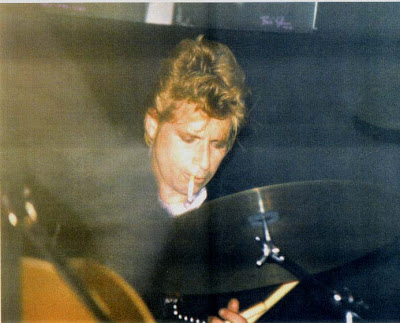
The term “Wild Ride” is appropriate for Jerry’s life, and there was so much about him I did not know, such as his being a member of the Suzi Quatro band early on (I saw them in 1975, after Jerry left, opening for Alice Cooper at Madison Square Garden), his relationship with Bette Midler, and that’s only the tip of the story.

Told in mostly chronological order, right from birth, Curt manages to avoid many of the traps of biographies (and autobiographies) that seem to follow the same path: troubled youth, find an instrument, bunch of bands, hit the big time, and then fun and trouble brings it all down. Yeah, there is some of all of that here, but it’s kept interesting. I like how rather than quoting people by saying “Joe Blow recalls that…” and similar passages, Weiss breaks it down to simple “Joe Blow: quote”. It may not be as literary, but it’s certainly more effective. My one complaint about this, though, is that after the person is quoted later, even if it’s dozens of pages than being introduced, he just uses the first name. As someone familiar with the scene, I usually knew who he was quoting, but a casual follower, with this many people interviewed, it’s easy to get lost in the names of who is who. My rule of thumb would have been if the person isn’t mentioned in 10 pages, give both names as a reminder. Perhaps I’m nitpicking?

Still, the book and especially the story kept me drawn all the way through. There is no doubt in my mind, and Weiss also makes this pretty clear that he holds the same belief, that Jerry tended to blame others for his own lack of success, but that falls straight into his own lap. Or vein, anyway. Jerry hated sloppy drug users, but he did not see past his own blinders. Sure, he could play under the influence better than, well, just about anyone in his bands, but that does not mean when he wasn’t on stage he wasn’t sabotaging himself at every turn. That’s why managers of his bands always warned other managers about him, another consistent theme in the book.

One of the more powerful and interesting motifs here is the relationship between Jerry and Johnny. Someone mentions near the end of the book how they were like an old married couple, and that’s pretty accurate. Johnny was always his best when he was backed by Jerry – but I want to add that Johnny was especially effective when he shared a stage with Walter more than anyone else, in my opinion; their verbal putdown exchanges were part of the reason to go see them perform. With Jerry and Johnny though, it was more their between gigs interactions that made them the best of friends and the worst of enemies, sometimes at the same time. Walter has told stories about how Jerry would beat the hell out of Johnny if he was acting up or sloppy-drugged. Yet, it was obvious when they worked together in front of any crowd, it was a bond that was hard to break. Even at times when they despised each other, they would still find a way to play. And it was a joy to watch.

As enjoyable as the book is, there is some controversy about it, such as questions about the means Weiss used to get some of the information. He made some of the people mentioned and quoted in the book not too happy, one in particular threatening to take legal actions. The question here is one of whether the ends justify the means. I’m not going to judge one way or another.

My other issue with the book is that there is a certainly level of assumptions, with Weiss stating things like “Jerry felt that…” or “Jerry thought that…” That’s solid Victor Bockis territory. Second hand “feelings” are untrustworthy, and I would have preferred if he had more often used the style on page 231, where he has the direct source of Swedish musician Hank Eriksson quoting Jerry saying, “Don’t worry about it. It’s rock ‘n’ roll.” Other people quoting him is not the same as assuming what Jerry was thinking or feeling, unless a direct source is given.

Jerry at Johnny's memorial concert,
pic (c) Robert Barry Francos
Towards the end of Jerry’s life – and the book – is where Weiss makes the most assumptions, mostly about his relationships and his means of death. I’m not saying Weiss is right or wrong, I don’t know as I do not have the direct sources, but in this case when he states on page 256, “There was no doubt…”, it is still an assumption on his part, unless someone in the medical field or someone close to him told him directly, and he can use that person as a citation.

To be fair, I have read an “Advance Uncorrected Reader’s Proof,” so I’m not sure what has been changed between this and the final printing. Heck, I don’t even know if there are photos added. What I do know is despite all the possibly rightful controversy over this biography of arguably one of the best drummers to every hit the rock’n’roll skins, it is an enjoyable read, and an important piece about someone, under different circumstances, would (and should) be on everyone’s list of important musicians in his field.


Tuesday, May 5, 2015

DVD Review: Welcome to the Machine

Text © Robert Barry Francos / FFanzeen, 2015
Images from the Internet

Welcome to the Machine
Directed by Andreas Steinkogler
MVD Visual
90 minutes, 2013
www.welcometothemachine.at          
www.mvdvisual.com

 The catch phrase of the documentary is as follows: “The 12 Commandments of music business in one film. Become a star just by watching it!” Okaaaaaayyyyyyy…

There have been the odd times my life where I read some self-help books. They were huge in the ‘80s and ‘90s, and each one had a single point of focus: do this and you will have success. The same is true with philosophy: It’s either “people are good” or “people are bad.” The thing is, there is no one way for anyone, because everything is causal due to both spacial and temporal components. In other words, what happens is effected/affected by where you are and what is happening in culture at that moment. There is no “here is how you do it” primer for success in any media, you just have to plug at it. But this German / Austrian film begs to differ.

The “lab rats” of this is a German band called The New Vitamin (pronounced VIT-amin). The supposition is that by the end of the film they should be big stars if they follow instruction. I have a music promoter friend who is also a musician, and he often tells me “if so-and-so wanted to be a star, he would do what I said.” Well, he’s certainly not a star; does he not follow his own direction? But I digress, though I make a point…

So, The New Vitamin is mix of rock and DJ-fueled techno, so yeah, it’s awful. But that’s not the point, which is whether they get successful or not. As for the States, well, I never heard o’ them, but I’m not aware if it had any success in Germany. Oh, speaking of which, before I forget, this film is in English and German (with subtitles).

But then the film drowns the information by trying to give too much of it, without having any real content. Broken down into different chapters (if you haven’t devised that from the “12 Commandments”), including early live gigs, dealing with the record company, publicity, genres, and using media, from the Internet to music videos.

What is impressive is the sheer number of musicians from around the world of multiple genres that Steinkogler interviews, including (and this is just a small sample, in no particular order) Peaches, Nada Surf, Adam Green (still trying to figure out his popularity), Xiu Xiu, Nada Surf, Megadeth, Steve Akoi, Flogging Molly, the great Suzi Quatro, Kim Wilde, and even anti-musician Lydia Lunch.

Many of these artists tell of their own experiences, rather than saying, “Do this,” which contradicts the whole message of the documentary. Not only that, the film does not even give stories, it’s a 90 minute series of 15-seconds or less soundbites with absolutely no cohesion, therefore there really is no central message on how to do anything, but instead aligns with what I said in the first paragraphs.

One topic discussed, which actually came close to interesting was that as digital music rose in prominence, downloading went way up, but money to musicians went to shit, because of the ease of digital piracy, though the majors are raking in billions (using piracy as an excuse not to pay their artists?). But what does this have to do with becoming successful in the music biz? Dunno.

And The New Vitamin, who formed in 2008? Well, I noticed that their last post on Facebook is dated June 2013. That does not bode well, and it seems they haven’t followed the “advice” of this documentary and played the machine successfully.

Whether you like one of the Legion of musicians here or not, there is so much partial and muddled data that the end result is that there is no useful information in the long run, so this DVD defeats its own purpose by overkill. Pretty to look at, nice to see what Suzi and Kim look like now, but mostly this is an example of a failure of its purpose. Shame, though.


Bonus Video:

Tuesday, November 2, 2010

The FFanzeen Art of Alan Abramowitz

Introductory Text by Robert Barry Francos, 2010
Art and art text by Alan Abramowtiz, 1977-88.
Art can be made larger by clicking on it.


The following artwork was featured as a regular full-page column in FFanzeen through most of its history. I highly suggest you detatch it and use your photo software to enlarge further to full get the full effect of both the art and the text. These are presented in no particular order. -- RBF, 2010

Blondie

Patti Smith

Rockpile (Nick Lowe and Dave Edmunds)

The Yardbirds

Roy Orbison

The Heartbreakers (Johnny Thunders, Walter Lure, Richard Hell, Jerry Nolan, Billy Rath)

Suzi Quatro

Sparks

Buddy Holly

Rock and roll philosophy: The Outsider and the Edge

Tuesday, November 11, 2008

The Runaways at CBGB's and Palladium, 1976-78

FFotos (c) Robert Barry Francos

I was interested in seeing the “Queens of Noise” (as opposed to the noise of Queens) when they played in New York City for the first time, in 1976. The five barely-post-adolescent The Runaways were scheduled to play CBGB. Their self-titled album was rocking, but was still a more pop version of what Suzi Quatro was doing – which was rock on out like the boys.

Before compromising her credibility by appearing as Leather, Pinky Tuscadero’s twice-thigh-slapping-and-pointing sister on Happy Days, Suzi was a guiding force and prime inspiration in woman-led rock. She was cute and she could pound her ax, growl, and “rock hard” with the best. When I saw her open for Alice Cooper at Madison Square Garden, I went out and bought a few of her LPs.

[Joan Jett, The Runaways, CBGB's, 1978]
The Runaways, as envisioned and “created” by mentor Kim Fowley, were a group of valley girls (well, at the time, any teenage female from LA was a valley girl to any self-respecting New Yorker) who could fill the fantasies of teenage heavy music boys (and some horny old coots). The music press couldn’t get enough of the band in the late 1970s, covering them in several magazines, including People, Rock Scene, Trouser Press, Crawdaddy, and Who Put the Bomp (where I first read about them).

The album started off with the instant classic tease, “Cherry Bomb” (“Hello daddy, hello mom/I’m your ch-ch-ch-ch-ch-ch-ch-ch-cherry bomb!”: see video below), which was written by co-member and guitarist Joan Jett (aged 16 – the ages were duly and helpfully noted on the album cover), ground out by fellow guitarist Lita Ford (oldest at 17), and accompanied by drummer Sandy West (16) and bassist Jackie Fox (16). Sung with a smugness that befit the lyrics was Cherie Currie (16), who had a penchant for wearing a widow corset and bustier on-stage, and swinging the microphone through her legs. While no other song on the album could hold up to “Cherry Bomb,” the music piqued our interest. Bernie Kugel and I knew that they would be interesting to see live, as a media event in its own right. We had wondered how much of the sound was studio, and how much of it was the Runaways. With Kim Fowley backing them, it seemed a valid question, him being known for media manipulation, and I don’t mean that in a necessarily negative way; he’s a showman much like Malcolm McLauren, or more likely akin to how David F. Friedman was to films.

[Lita Ford, The Runaways, CBGB's, 1978]
When we arrived at CBGB’s, early as usual, there was a line just starting. We were near the front, fortunately. Seems the record execs had set this show up as an industry showcase, so the place was packed with lots of suits (if you can imagine them in 1976 CBGB) who were more interested in either the free drinks, the shmooz-factor, or the possibility of seeing some cute young rock chicks. As always, we were there for the both the music and the joy of being at this historic concert.

When the management finally got around to acknowledging and letting in the relatively long line of fans, there was only room enough left for about a dozen or so of us. Despite being near the front, we were at a table way towards the back of the club, against the brick wall opposite the bar. Luckily, with the tiny stage being on the same side, we had some possibility of a view. This was more than a year before I would have my camera, so I have no photos of the event. We both stood on our chairs and leaned against the wall. The waitresses were too busy with the execs to have time to abuse us. The concert was everything we had hoped it would be – a good old rock’n’roll show.

A year or so later, the Runaways were big hits in Japan and their second album, Queens of Noise, had been released. This collection was quite a bit more “glossy” on the production end than the first, again with a few memorable songs, like “Road to Ruin,” and the title cut. The band played at the Palladium (nee the Academy of Music), a much larger venue, opening for the Ramones on January 7, 1978.

[The Runaways, Palladium, 1978]
Our seats were pretty far back, and the gig was great for a theater show, One of things I remember the most about this concert was an incident involving the intermission. As the lights went down after the Runaways finished their set and we waited for the Ramones, suddenly the intermission music started, which was the opening chords of Beethoven’s Fifth Symphony. The audience became suddenly very tensely quiet, waiting… When it became clear it was really Beethoven’s Fifth, and not the dreadful Walter Murphy travesty, "A Fifth of Beethoven," the audience gave a huge sigh of relief and the conversations started once again. We were punks, but we were not ignorant masochists.

The third and last time I saw the Runaways play New York, they were again at CBGB’s. Cherie Currie had already left the band (as did bassist Jackie Fox, who was replaced with Vicki Blue) and Joan Jett rose up the ranks as the lead, giving Lita Ford more of a chance to show off her metal-influenced guitarwork. They were quite competent, which did not surprise me, since Joan had been handling some of the songs even while Cherie was in the band. This time, near the new stage on the right side of the club, Alan Abramowitz and I sat by the speaker on the right.

Opening for the Runaways was a Toronto-based band, the B-Girls. I had their single, “Fun at the Beach,” b/w “B-Girls” (on the Bomp! label) and enjoyed it, so it made sense to go to the show. The B-Girls had attitude, but they were a good surf/pop/rock’n’roll style band.

The Runaways, too young and immature at the time to grow more formidable as a whole, drifted apart and some became famous names with their own careers. Cherie Currie released a couple of decent but not overly strong albums with her twin sister, Marie (though their song, “Since You’ve Been Gone” is a standard listen for me), came clean about her drug use on some daytime talk show, probably in 1989 when she released her autobiography for the first time.

[Cherie Currie, Chiller Theater, 1999]
The last time I saw her in person was in May of 1999 at the Chiller Theatre Horror and Model Convention in Secaucus, New Jersey, where she was, I’m guessing, still trying to break into B-movies (as she’d already appeared in Parasite – which was also one of Demi Moore’s early flicks – and Foxes, co-starring Scott Baio and Jodie Foster; her character dies in both...anyone looking for an omen?). She looked buffed and was signing autographs (for money) at a table next to Neal Smith and Michael Bruce from the Alice Cooper Band. She smiled pleasantly for my request for taking a picture of her, and when I mentioned that I had seen her play CBGB’s about 23 years earlier (at that time), she became very cold and distant, and gave me a “who gives a fuck, fan-boy?” look. I said thank you for the snap, and beat a hasty retreat. Brrrrr..