Showing posts with label musician interview. Show all posts

Tuesday, July 5, 2022

JEFF SALEN of Tuff Darts: Not Too Tuff (1982)

© Robert Barry Francos / FFanzeen, 1982/2022
Images from the Internet unless indicated

Jeff Salen is on the far right, next to Robert Gordon

Excuse me, but Jeff Salen was robbed. You ask, who is Jeff Salen? Well, that just proves the point. Jeff was the brainchild of a group called Tuff Darts that was thisclose to breaking. Then, just as the labels started to come sniffing, the lead singer, Robert Gordon, took a powder to go his own separate rockabilly way as a solo act and joined forces on occasion with Link Wray along the way. For a long time, Gordon refused to even acknowledge his stint in the band, but the cuts from the Live at CBGB’s album of Tuff Darts with Robert Gordon, “It’s All for the Love of Rock’n’roll” and “Slash,” are arguably the best cuts on the collection. The former was written by fellow bandmember Jeff Salen. When Gordon left, Jeff tried to reform the band with another singer, Tommy Frenzy, and even recorded the Tuff Darts! album, for Sire Records. It was a failure, basically because, in my opinion, lead singer Frenzy could not fit the image of the band. He tried nobly but the songs felt false under his tutelage. Decent singer, wrong band for him.

But Jeff’s contribution to the scene goes beyond the music, he was also a driving force in the style of the time, going in the opposite direction of the Richard Hell minimalism and instead he went for flamboyance, like the Byrds and Bowie. This is actually not very surprising, considering he worked for such flashy fashion icons as MainMan/Bowie and Wayne/Jayne County.

During his tenue with Tuff Darts, Jeff sidelined as a studio musician for the band Sparks in their heyday.

After the Tuff Darts broke apart, Jeff started working with the American Passions, which also crashed and burned. Between bands, jeff opened his own high-fashion clothing store on the Upper West Side of Manhattan, near the Beacon Theater. It was here I caught up with the man.

This interview was published in FFanzeen, No 9, dated 1982.

Jeff at far left
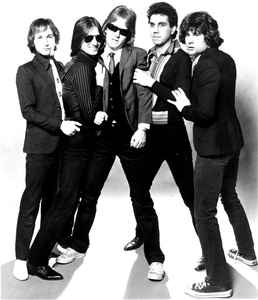
Jeff Salen: Not So Tuff

Back in 1975, when I started going to CBGB, Max’s, and others, I slowly but surely became aware of the name of Jeff Salen. At that time, it was of his work in one of the better-known underground bands, Tuff Darts. But he began way before that.

Many years ago, Jeff worked as a studio musician for the ill-fated MainMan operation, David Bowie’s organization. When that ended in the early 1970s, he worked his way up to Tuff Darts. All was going well with the world until the lead singer, Robert Gordon, left. The band floundered and, despite a LP released on Sire (Tuff Darts!), the band slowly but surely dissolved. The public was just too used to Robert.

A few years ago, he became involved with a band from Washington, DC, called the American Passions, but again, that just didn’t work out.

While all this trial and error with the Passions went on, he worked in a clothing store on the Upper East Side, a perfect setting for him since he was always engrossed in fashion, feeling that fashion is an integral part of rock’n’roll. This led him to owning his own clothing store extraordinaire, called simply Jeffries, at 50 West 72 Street, in New York City.

Time passed, and now Jeff is ready to put another band together, for as fashion is a part of rock’n’roll, rock’n’roll is also connected to fashion. He’s halfway there.

FFanzeen: So, tell me about your pre-MainMan days.
Jeff Salen: I started out in a group called Butch, with Tommy Ramone. We used to play the Mercer Arts Center, and one of the bands that played there was Queen Elizabeth, which was Wayne County and the Miamis, put together with Dale Powers. Tommy and Jimmy Wynbrandt.
[both were in the Miamis – RBF, 2022]. So, they broke up and we broke up. Wayne got signed to MainMan, which was Bowie’s production company. They had all these artists [e.g., Cherry Vanilla, John Cougar (Mellencamp), Cindy Bullens, Iggy Pop, Mott the Hoople – RBF, 2022]. I got signed by MainMan to back up all these people, to be a guitarist for them. So, I was in the Back Street Boys for Wayne County for a long time – for about two years. We were, like, the No. 2 band under the Dolls at the 82 Club. The 82 Club was a good scene. We had a good time. Bowie had a good time. And then something happened with Bowie. He had a lawsuit or something with MainMan - with Tony DeFries – and that was the end of MainMan. And so we got off the gravy train and we broke up. Then I joined Tuff Darts, which was John DeSalvo of Jim Morrison’s band. That got pretty popular and I was pretty popular at that time from the Back Street Boys. We played and we were pretty good. You’d have bills like the Ramones, Tuff Darts, and Blondie. Blondie was third billed, believe it or not. That was, like, at rehearsal studios. There’s a studio called Performance Studios, which the Ramones owned. Everyone used to play there because there were no venues; there was no places for a band to play, except for CBGB’s. I don’t think Max’s even had bands then. Max’s had bands, but they were, like, Kinky Friedman. They were like the Lone Star is now. Tuff Darts took off; all the bands took off, and there got to be more clubs.

FFanzeen: Was Robert Gordon in Tuff Darts when it formed?
Jeff: Yeah. Tuff Darts played only with Robert Gordon in the beginning. There was this guy, Richie Rich, who played rhythm guitar, but they threw him out before I was in the band. That was it. Then we auditioned singers and Robert pushed his way into the audition. We had a whole bunch of people in line, and he said, “I’m the guy,” and he pushed his way right into it. He sang like Paul Rodgers
[of the band Free – RBF, 1982] then. And that was what was happening at the time. It was very Bad Company-oriented. We were really knocked out with Robert. We stayed with him for about three years. We built things up pretty good and then he got a deal and he went.

FFanzeen: How did you get approached to do the Live at CBGB’s album?
Jeff: It all had to do with Hilly (Kristal; d. 2007). He picked all the best bands. The only band that had a record deal then was the Ramones. Everybody else didn’t. Everybody except Talking Heads, who backed out of [the live album] at the last minute. But they’re on the back cover. I think that’s pretty funny. The front cover looks like a pizza. It’s, like, one of the worst covers of all time. It looks like a bunch of hippies, ya know? But I can’t bad-mouth Hilly. I have to watch my Ps and Qs. It was a nice scene, though; I was pretty happy. And, you know, if you played CBGB’s you couldn’t play Max’s. Our album (on Sire) came out in early ’79-late ’78. And then I did this thing with Lisa Burns, Sal Maida from Sparks
[and Milk and Cookies – RBF, 1981]. Bobby Butani from Tuff Darts, and David Bowler from the Marbles.

FFanzeen: After Robert left, why did you have so much trouble keeping a lead singer?
Jeff: We didn’t know what to do. Ian Hunter set us up with this guy, Kelvin Coney, from England. He was okay, but nobody liked him. He got disgusted and he wanted to get paid, like, to stay in this country, and we didn’t have any money to pay him. Actually, he was causing turmoil between Ian and us. So he went. We tried a bunch of kids from New York, like one gig apiece. Then we got Tommy Frenzy, ‘cause Tommy was a fan. He was the guitar player in a band called Frenzy up in Westchester. They used to do our songs. When they would play CBGB’s, I would jam with them. He was a nice guy and he was into what we were doing, so we figured he would be cooperative. He was pretty cool. I liked what he did, but the critics, like, tore him apart. I wanna go on record, I thought the record was pretty good.
Cream’s Mitch Comb says that I’m really good when left to my own devices, but he didn’t like the John DeSalvo songs. The sexist songs. But it’s all fine; it’s a joke. Actually, that’s what got us attention. My songs are just love songs, very standard fare, but they’re not things that would draw attention in a jaded music scene here in New York. John’s were the one’s that got attention, like, “I’d rather slash my wrists and cut my throat (then have to spend the night with you)” [“Slash”]. I think it’s a great song. The critics ripped it apart and they ripped Tommy apart, and I don’t know why. He did it pretty close to how Robert did it. He did his best.

FFanzeen: I think that was part of the complaint, that he was imitating Robert rather than being original.
Jeff: What else could he have done in that situation?

FFanzeen: Created his own style, like Ultravox did after John Foxx left. .
Jeff: Yeah, Midge Ure in Ultravox
 did that. I’m glad they could do that. I saw them down at Irving Plaza and I was glad they could do that. Maybe that’s what Tommy should have done, but he decided what he wanted to do. We were just happy doing the record. I was just working on my guitar parts and trying to keep the band together. That sort of thing.

FFanzeen: When you were at MainMan, did you record anything?
Jeff: Yeah, we did recordings with Michael Tschudin producing, who used to run the Mercer Arts Center. When people read this article, somebody will remember these names. He’s a cool guy. I wonder what ever happened to him. We did nice little recordings with him; we did a movie. It was a movie with me kissing Cherry Vanilla, or something. And we did a show called
Wayne County at the Trucks. You know what the “trucks” are? It’s like a gay thing. All the boys are at the trucks, you know, fist-fucking. Anyway, we did this movie and we rented out the Westbeth Theater, which I’ll come back to later, ‘cause it’s interesting, I think. That was MainMan. They spent, like, you know, $50,000 on this show and filmed it for a movie, with other footage, too, with Bowie and Mick Ronson (d. 1993), and all the MainMan artists: Iggy, Cherry – mainly Cherry Vanilla – and Wayne County, because they were New Yorkers. People came. Everyone thought Wayne and the Back Street Boys would get a record deal from this. This was, like, when Alice Cooper was happening. I played guitar. I was just into being popular.

FFanzeen: Fame. The star-trip.
Jeff: I liked it. They had little ushers who wore cock-and-balls shoes. That was fabulous. Papier Mache cock-and-balls shoes.

FFanzeen: You were going to say about the Maspeth Theater –.
Jeff: Westbeth Theater. Maspeth is in Queens, where I went to Junior High School. Okay, what was I gonna say? The Westbeth Theater pops up all the time because Bobby, from Tuff Darts, did a play. He did some recordings with some guys who worked at Westbeth who were directors there. The guitarist – the other guitarist, Bobby Butani – and I did a couple of gigs with him in a group called the Passions. Maybe people will think that it’s a continuity. Maybe they think I’ve been working on this band for a long time
[giggles]. It’s not true! I just joined this band [American Passions – RBF, 2022] a couple of months ago.

FFanzeen: How did you come to join the American Passions?
Jeff: Jonathan Blank is a lawyer for a lot of musicians, like Richard Lloyd, the Rockats, Lisa Burns. Anyway, he’s the lawyer for the manager of the group. He’s not my lawyer now, but at the time he was. Now I’ve got Blondie’s lawyer, the Cars’ lawyer. I’ve moved up in the world a bit. I had come back from LA and I called up like everybody I knew in New York, and said, “What’s happening? Who should I play with? What should I do?” And he told me about this wonderful band in Washington D.C., that were about to be signed, and they just needed a lead guitarist. I said, “I’m not interested because I’m a songwriter, I’m not a lead guitarist.” He said, “Well, go down there anyway, maybe they’ll do one of your songs.” So I went down and I joined the band, primarily because the singer (Steve Avery), like, really loved my songs and was willing to do my songs. And now, it’s, like, half-and-half between Steve Avery and me. We’re even trying to write together with some success.

FFanzeen: Sparks –
Jeff: Sparks is great. Sparks is the most fun I’ve had.

FFanzeen: How did you get involved with them?
Jeff: We had just finished working on the
Live at CBGB’s album and the guys from Sparks came to see us. At this time, everyone was comin’ to see us. Mick Jagger came to see us, Ian Hunter, Bowie (d. 2016) – in fact, a great many people – notable people – told us that Robert (Gordon) was more trouble than he was worth; that we would be better off without him, believe it or not. I never thought that. When it came time for Robert to leave, I tried to pull a Henry Kissinger and tried to beg him, please don’t go, stick around. But he thought he was prostituting himself. Tuff Darts was more like John and my band. It was John’s band when he did his songs and my band when we did mine. The other guys were pretty passive. Bobby came more to the front towards the end, but basically it was pretty much playing rhythms and keeping things going in the background. Robert Gordon didn’t have much of a personality in Tuff Darts. Maybe he has one now. I don’t know – I don’t think so. You can print that, I don’t care [giggles].

FFanzeen: Do you ever talk to him?
Jeff: Yeah, we’re amicable.

FFanzeen: The reason I ask is because he practically denies those days even existed.
Jeff: He’s not as reasonable about it as we are. Put it this way: I thought it was a bad time to leave a band. You work together a certain amount of time and you’re accomplishing something – we were supposedly doing very well. At that point, (Amos Poe’s)
The Blank Generation movie came out. It just looked like everything was going great. A lot of major labels were interested in us, not just Sire. It was kind of a crummy time to leave a band. Couldn’t he have waited until at least the rest of us had gotten something? I remember he thought he was prostituting himself and he wanted to do something else. Other people had gotten involved with him, and everything seemed to have been falling into place when he left. We just kept trying other singers. We didn’t know what else to do. Did I handle that diplomatically? I hope so. I don’t have anything against Robert; I don’t have any great love for him, but I don’t – he’s a professional. He did what he thought was good for him. I picked up the pieces and did what I could with them; I think he’d acknowledge that. And he’s not doin’ so hot either. Like I said, at the time, a lot of people told us that if he wanted to leave, let him leave. Aside from artistic or aesthetic reasons, I thought it would be bad for him to leave because people had associate him with our songs already. With my songs and John’s songs. I tried desperately to get him not to leave. He didn’t want to know. His management didn’t help. Everybody always thinks they know best. At some point, I’d like to be a producer so I can be the one who knows best.

FFanzeen: Sparks –
Jeff: Okay, Sparks was produced by Rupert Holmes, who did Sailor, Barbra Streisand, and John Miles (d. 2021). Anyway, I remember they called me up – they had Joseph Fluries called me up, who worked for them, and he said, would I be interested in joining Sparks. I said, well, I’m in a group that I really think is gonna break big – this is Tuff Darts with Robert – so I said I would love to come down and talk about it. I’d play on the album, but I wouldn’t join the group. He said come to the Carnegie Deli that night, ‘cause they were staying at the Warwick Hotel, and they were sitting in the back – in the very back. My girlfriend at the time wasn’t into Sparks. I was into the MC5. And Motown; I was really into Motown at that time. I wanted to be black, like Eric Burdon. So, we went to the Carnegie and they said they liked the way I played guitar and would I like to play on the album. They were going to do the album in New York. Sal Maida recommended me. This guy Sal is always doin’ me favors. Sal had been with Roxy Music and Sparks at one point, I think
[he was in the band, including on the 1978 album Big Beat, and with the band in the 1977 film Rollercoaster – RBF, 2022]. So I said, sure, I’d love to do it and we talked about the money and that sort of thing. Then we rehearsed for two weeks. They already had a title for the album, Big Beat, so we concentrated on that. Hilly Michaels was the drummer, who later became Ian Hunter’s drummer, because I played on the Sparks album. Anyway, we rehearsed. I’m trying to find a good story outta this. I don’t think there is in this one. We rehearsed, I did the record, had a good time doin’ it, got paid, and declined to tour [missing out on the Rollercoaster appearance – RBF, 1982]. If I would have toured, there would never have been a Tuff Darts album. [Big Beat] was the most fun album I ever worked on. I had a ball working that record.

FFanzeen: Why was it so much fun?
Jeff: First of all, they’re really easy to work with, Ron and Russell (Mael). I have no idea why they have such a difficult time in this business. They can’t get a record company to push their records. They always get shafted. I don’t know what the fuck it is. They’re just wonderful to work with. They’re so loose, they’re so much fun. Very talented. I think they’re great lyricists. I’m just really into what they do. Everything they did was clever and it was so challenging for me to find intelligent guitar parts, ‘cause they just wanted loud guitar, you know, which is sorta my trademark, but there is a sensitive side to me and I try to be in tune with what I’m doing. There was no pressure because it wasn’t my band; I didn’t have any worries. I just showed up at rehearsals, showed up at sessions, and when I left I had a clear head. I had no concerns. Tuff Darts was so mind-boggling with concerns. Not in the beginning, because I was oblivious. I didn’t care. I was still into being just popular and being creative and just living out my Ronnie Wood/Keith Richards fantasy. Towards the end, trying to save it and everything, that took years out of my life. Not just mine, everybody’s. The whole band tried. Bobby tried hard. We kept trying to do things. If I have any success with this, I’m gonna try and do something with Bobby, like produce him or something.

FFanzeen: Is Bobby in a band now?
Jeff: It’s hard to find sympathetic musicians. There are a lot of musicians like Lydia Lunch – that sort of thing – like, what can you do? I can’t play that stuff. Bobby can’t play that stuff. I like avant-garde things. I like innovative bands. I like, you know, John Lydon’s band (PiL). I love all those English bands like Spandau Ballet and Ultravox.
 They all sound like King Crimson to me, with a disco beat, but – I like the way they look, you know.

FFanzeen: I always picture you on stage in vests and three-piece suits. Are you still into that?
Jeff: In Tuff Darts, but not anymore. I like layers. I’ve always been into fashion. I’m not a superficial person, but I like the trappings of
things. We’ve got a whole bunch of pirate clothes now.

FFanzeen: Oh, no! Adam and the Ants strikes again!
Jeff: Actually we got them before Adam and the Ants came to town. We were already into it from reading about it before, and we know some people who work for Ian’s, the clothing store (in New York). They go to England all the time and they told us what was happening. They usually keep me in good clothes. I’m like a mannequin for them, sometimes. We wore a lot of that stuff when the American Passions played Bonds. (Fashion) is what I got off on when I first got into music. I liked the way the Stooges dressed; I like the way they looked. I liked the whole bit. It was, like, you didn’t have to be that handsome – naturally handsome – you didn’t have to be George Hamilton or some shithead like that, but you could still be cool. I think that’s a big part of rock’n’roll. You didn’t have to be perfect – you could be Keith Richards or Mick Jagger, who are not perfect looking but are really cool. Brian Jones (d. 1969) was prettier than most girls, though. You didn’t have to be so manly with this macho-silly thing. I picked up on that and that stayed with me. I like fashion. I think fashion is very important in music.

I lost track of Jeff Salen after this. I do know that in 2002, the Tuff Darts reformed (sans Butani and, of course, Gordon) for the CD release of Tuff Darts!, going on to record the 2007 album You Can’t Keep a Good Band Down. His presence as a rock’n’roll icon was still underappreciated and underserved by the scene, however, when he passed away from a heart attack on January 26. 2008.

Since his passing, as Wikipedia announced, “Tuff Darts have been performing since 2011 with a reformed lineup in and around New York City.”


Wednesday, August 5, 2020

RUPERT HINE: Hine-Sight [1981]

Text by Julia Masi / FFanzeen, 1981 / 2020
Images from the Internet

RUPERT HINE: Hine-Sight [1981 Interview]

This interview with Rupert Hine was written by Julia Masi, and was originally printed in FFanzeen Number 8, dated 1981. Rupert Hine died recently on June 4, 2020. Along with his own material, he always produced worked by the likes of Rush, Saga, The Fixx, The Waterboys, Tina Turner, Howard Jones, Chris De Burgh, Thompson Twins, Stevie Nicks, Bob Geldof, and so many others. – RBF, 2020.


In his effort to “avoid the usual,” Rupert Hine tries to experience situations from both sides. At an interview, he insists upon pointing a loaded Super-8 sound movie camera at an innocent FFanzeen reporter and firing off a few cliché questions. After thoroughly interrogating her, in a whisper-soft English accent that’ll make any kid from Brooklyn crack and spill her guts, he agrees to discuss his career.

Rupert Hine started out in the business as a singer/songwriter, “just before the war,” though he’s not saying which. He captured the spotlight briefly with the British band Quantum Jump in the mid-‘70s, then went on to producing people like Yvonne Elliman, “in her more adventurous days, before she was Stigwood-ized.” These days, Hine owns and operates his own recording studio where he recorded Immunity, the A&M album that re-establishes his singing and composing career.

With a sound that is sort of aesthetic, esoteric, bordering on science fiction but not exactly electronic, he is trying to shock us out of our apathy.

“It’s not immediate music,” he says, his grey eyes fixed in an intense stare. “it’s not immediately accessible.” It is also, at this point, undefinable – even by its creator.

“It’s the categorization of music that has kept it so backwards and prevented more adventurous, spirited music from coming through.”


He admits that when he set out to make the album, he was not thinking in terms of a hit single or a particular market of sales. He believes that you shouldn’t “actually do anything musically unless you’re committed to the music.” In this case, the music is presenting something powerful enough to affect the listener, “not necessarily pleasantly,” in the same way as film.

“It doesn’t worry me that I might be disturbing, provided it has some reason – provided it isn’t angular sound for the sake of it, which is also something which we have experienced in the past couple of years with punk and New Wave music.” Hine was both exhilarated and disturbed. Although he was happy to see a rebellion against music’s “mega-stars” and record company bureaucracy, Hine was worried that independent record companies might think it meant that “anybody could make a record.

“I heard a lot of anti-reaction from old wavers, obviously, saying “Good God! Listen to that racket! These guys just obviously can’t play.” And I can remember when my father said that to me when I was playing the Rolling Stones’ records. Here was proof that the next generation was coming up, because contemporaries of mine were putting this music down.

“I went through a short period where I found it difficult to take. And realizing that, in hearing all these comments, everybody had lost focus. What was apparently happening was the very thing I was speaking about, that musical ideas were what was important and the craft and all that bullshit didn’t count. If you have something to communicate, something worth saying, that was important. If guitars were out of tune or anything else, that was not important. The spirit was really committed. They knew what they wanted to say and they were saying it.”


Hine is very much in tune when he plays. There are few three-minute songs on his album. Most are longer and, at times, it seems that all the songs on the album run into each other. The main theme running through the album is, “fear and/or fearlessness.” He is trying to wake us up to our surroundings with songs like “Psycho Surrender” that has a solo made out of a yawn, “Samara,” which is laced with traffic sounds, and “Controlled Voltage,” to give it a rhythmic feel; they are dually humorous and profound.

Hine describes his songs as “a series of actualities. Each track represents a fairly specific idea.” The music is very effective, although sometimes elusive; it can be the audio of a horror film or the bells ringing in the ears of your subconscious, but it’s definitely not Top-20 material.

Hine wouldn’t be surprised if his music was shunned by American radio stations. And he is only minimally concerned with the business impact of his record. “At least I’ve gone out on something I believe in.”


Friday, July 31, 2020

An Interview with CHINGA CHAVIN [1979]

An Interview with Chinga Chavin

Text by Robert Barry Francos / FFanzeen, 1979/2020
Live image by Robert Barry Francos 
Other images from the Internet

This interview with Country Porn lead singer Chinga Chavin and the introduction has never been published before. FFanzeen printed an article about Chavin back in 1977, written by Western New York scholar Lincoln D. Kirk, in FFanzeen #2 (which will make it to this blog eventually). At the time of the interview, Chinga Chavin had released two albums, Country Porn and Jet Lag. Years later, he also released Live and Politically Erect, which I have not yet heard as of this publishing.

I don’t remember exactly how I connected to him, but I did the interview in the office of his advertising company in 1979 in promotion for Jet Lag; I had the opportunity to see him play at the Lone Star Café in New York City, and may have approached him then. It was a kind of Country-punk-boogie show even a punk rocker like myself could love, or maybe because of it. Note that this was years before country punk bands like Rank and File and Uncle Fucker.

When reading this again in retrospect, there are some attitudes by myself and Chinga that I find cringeworthy when it comes to discussing certain sexual details, gender bias, or racist terms (inherent or blatant). It’s important to see this in the context of 1979 when I was still a young’n. The wording of my questions are different than ones I would ask today, for certain. My apologies in advance. – RBF, 2020.


Chinga on the left (photo by RBF)

El Paso, Texas, and across the bridge is Juarez, Mexico, the most infamous of all border towns due to its open carnality and perversions in the mid-1950s to mid-’60s. Whatever you wanted was there for a price – and not an expensive one, at that. Sex, drugs, anything.

In this environment grew a not-so-quiet boy named Nick Chavin. By his early teens, he was well indoctrinated into the ways of Juarez, a short distance from where he lived. After hanging out in this town for a few years, he developed his nickname: “Chinga,” which is a Mexican slang word for fuck. Thus was born Chinga Chavin.

Despite the depravity of his youth, he grew up and became, of all things, an English Teacher. Together with his knowledge of the English and Spanish languages and their slang, he added his musical influences of rock’n’roll. Eventually, he quit his schoolwork for the fame and fortune of the stage.

Chinga formed a band, Country Porn, which he fronted. Becoming quite popular in areas of the Southwest and California, he put out an album, titled after the band, Country Porn, sponsored by Penthouse, which sold it through ads in the magazine. On it were such diverse cuts as “Cum Stains on My Pillow (Where Your Sweet Head Used to Lay,” “Four A.M. Jump,” “First Piece O’ Ass Blues,” “Cum Unto Jesus,” “Tit Stop Rock,” and his most famous song, “Asshole from El Paso” [Editor’s Note: the latter was co-written with Chavin’s college roommate, singer and mystery novelist Kinky Friedman – 2020]. Along with this track, his trademark is his guitar, which is made out of a toilet seat.

And now there is his new album, Jet Lag. It is new in both style and song. Some of the songs include “$49 Divorce,” “Hard Love,” “Mechanical Man,” “One More Ride,” and the only cut that sounds anything like the previous album, “Jailbait” [Editor’s Note: at the time, this was a surprisingly common theme, with examples being The Marbles’ “Jailbait” and The Gizmos’ “Jailbait Janet” – 2020.]

I interviewed Chinga Chavin at the beginning of the Autumn of 1979, the day after his first New York appearance. The show was at a Country & Western club on Fifth Avenue in the Village called The Lone Star Café. The audience was enthusiastic and included the likes of Al Goldstein [d. 2013], editor of Screw magazine, and family. It was enjoyed by all.

Chinga is not overly tall, but he is very thin, with a large-ish nose, a mole on his cheek, shoulder-length hair, and a not-too-pronounced Texan accent (due to living in California for so long). His wit is sharp and is a fun person with whom to talk.

The following is the transcript of the time I spent with him, proving him to be one of the few unpretentious musicians I have met. As many times as he as been interviewed and God knows how often he’s had to answer some of the questions I asked, he was enthusiastic – and that made it a lot easier.

* * *

FFanzeen: What’s one of your sets like?
Chinga Chavin: The second set has the finale of “Cum Unto Jesus,” from the Country Porn album, along with “4 A.M. Jump” and a stripping nun. It turns from a nun’s habit to a punk rock outfit. It’s all leather with her breasts sticking out. It’s the erotic environment of Catholicism: I think Catholicism is naturally erotic. Catholicism is the S&M branch of Christianity. That’s part of the whole monologue I do, setting (“Cum Unto Jesus”) up. The sets are hot.

FF: Do you sell out most places you play?
Chinga: In California, yeah. Last week I played my first East Coast performance with Vassar Clements [d. 2005], and it was sold out. I opened for Vassar and they shot the shit out of us. They popped our hemorrhoids. That band is very Christian. The Lone Star Café was reasonably sold out since they wouldn’t let any more people in after the first show. It will take me a while in Manhattan to develop that word of mouth. It depends on where I play. I wouldn’t sell out a 3500 coliseum. Up to five or six hundred seats, I probably could. When I develop a word of mouth type thing and have played a few months in an area or club, that’s when I really start packing people in, because without the massive airplay – even though Jet Lag is an airplayable record – I can’t sell out in the same traditional manner. It has to be word of mouth. It was in New York on WNEW-FM’s playlist, but I didn’t get the promo push since I am not on any major label. Word of mouth is the only thing I have going for me.

FF: Do your audiences come to see the singer, the songs, or the girls?
Chinga: I’d say the singer and the songs, because I’ve worked without women. A year or a year-and-a-half ago was the first time I started working with women. Okay, the answer to that question: the songs and the idea of using the girls in that way comes from me. So, I think it’s sort of the whole demented approach I use for the stage set. Like, once I used a mannequin on stage. I’ll eat live chickens. I’ll do crazy things on stage. That’s the main catch. I don’t just do a straight set. There are going to be some people coming for the girls, but I use skin in a one-hour show in the last 120 seconds. That’s two minutes of skin in a one-hour show. I mean, I really don’t think it applies to that. Here in Manhattan, you can go see a topless show, or see anything you want, but for five bucks at the door and another five or ten for drinks for two minutes of skin, well, if I thought that were true. I’d leave show business and throw 30 women on stage.

FF: Because of your set, is there any place you’ve been afraid to play?
Chinga: Last week with Vassar Clements, I had serious misgivings. He’s an ex-Klansman and a strong Christian. Yeah, the Palomino Club, I’ve been afraid to play in Los Angeles. It’s getting a little more rock’n’roll there now. I’ve played army bases, service man’s clubs; sex is sort of a common surrogate that cuts through a lot of things. It’s hard to find some place that’s devoid of sex, unless it’s a nunnery or something like that. I’d have a real hard time playing the Vatican. Yeah, the Vatican. It started with a fear of Mexicans, what with using the name “Chinga” and the whole Chicano thing, but Chicanos loved the set. Texans are bananas. I have played in Texas and I usually play at conventions – and they go bananas. There’s a corporation called BWM, Inc. – Blue Water Maintenance, Incorporated – that cleans oil pipelines and refineries, who put on conventions with the oil companies twice a year, and they have us there. We do “Asshole from El Paso” 15 times. Texans are as reasonably chauvinistic about Texas, as I am, having lived there some years. Since a lot of the songs deal with Texas, they love it. The thing I fear more is that since I use some religious stuff in the show, I get more of the people on the religious things. Occasionally, there’ll be a guy with veins popping and he’ll walk out, but basically, in the early days of my shows when I was in a bar band and someone was coming in that bar, and they heard we were Country Porn and they knew we were playing there, with “Dry Humping” and “Cum Stains on my Pillow,” when he was giving his money he knew what he was coming to see. I mean, he’s either bought the record or read about us, so it’s like, we have to live up to his expectations. I play to a following. It’s not massive, but it’s a following. They come specifically to see this thing called Country Porn. That is, unless they mis-read it as Country Prune, or Prawn or Country Prone, that type thing. It would be like going to see Deep Throat and being offended by the sex.

FF: Do you ever get hostile audiences?
Chinga: I know what it’s like to have a hostile audience. Like last night, during the second set, I got some real good response on “Catholic Girls.” During the first set, they were pretty good, but there was one line they didn’t laugh on: “Pornography is just technology’s contribution to jerking off.” I couldn’t believe it . I never knew a West Coast audience not to go bananas over that. And there was no recognition. They just didn’t understand what I was trying to say: that without media, this thing called pornography would not exist. But, I mean, even the thing that the courts call “pornography” is media’s and technology’s slotting in to whacking off. The first caveman that wacked off from a drawing on the wall as opposed to in his mind, I mean, that was it. There is no such thing called pornography. What there is, is masturbation. And that’s why I added sensuality; that’s why I added that rap. And then they started laughing when I said that guys don’t have to apologize to the palm of their hand for cumming too quick.

FF: George Carlin [d. 2008] has a whole bit about masturbation – you know, don’t tell your right hand you’re doing it with your left. It’s called “Teenage Masturbation.” It’s on the Evening with Wally Londo Featuring Bill Slaszo album.
Chinga: Oh, no. I didn’t know that. I gotta check some dates ‘cause I played with George Carlin in San Quentin. There’s an article about it in the San Quentin News. That was quite a few years ago and I did that rap. I wonder if that son-of-a-bitch ripped me off. Goddamn! I thought that approach was unique. The line of rap that I go at is psychological. Like, the idea that all connotations that deal with reproduction and excrement are bad. You don’t mind being called an ankle.


FF: Who made up the line the announcer said, that you “put the cunt back in country”?
Chinga: I did. I didn’t like the way the announcer said I was coming on stage for the second time – get it? – a second time. I can make love up to once a night, that’s it. Next question.

FF: Out of pure curiosity, do your friends refer to you as “Nick” or as “Chinga”?
Chinga: Chinga.

FF: What happened when you were supposed to be signed with Motown and they signed Pat Boone instead?
Chinga: Oh, that was years ago. Motown, unbeknownst to me, in those days, was just using my titles and staff. They needed publicity. They wanted a few random notes so they used me. I don’t think they ever really seriously considered signing Country Porn. Not since Debby Boone’s “You Light Up My Wife.”

FF: How about when you played at a prison and got locked in overnight?
Chinga: Well, I wasn’t actually locked in. We were just detained there for a while. What happened was I brought in these North Beach strippers, my own side of Sodom and Gomorrah, and they were wearing tops that were see-through, and I got a little carried away and ripped it off one of them. These guys started fighting for a better view and a small riot started. It wasn’t because of what was happening on stage, but this mass fight started. Then there was an investigation and we had to fill out a lot of forms. It took quite a few hours. We just thought we might not be leaving for a while. I have a review of the show at San Quentin that said it went real good.

FF: Have you ever been arrested?
Chinga: I was arrested for indecent exposure in Haywood. This is a couple of years ago. Haywood, California. I used to go on, in those days, in Bermuda shorts that were cut-offs, cowboy boots, and a raincoat or trench coat. It looked like I was naked underneath it so they grabbed me. It was only after taking off my clothes that they could see that I actually wasn’t indecent. I thought it was sort of a paradox situation. Removing clothes to show you’re not indecent.

FF: What’s some of your upcoming unrecorded songs?
Chinga: “Remedial Dancing for Whites.” It’s a comedy disco concept. We did one tape of it already. The music stops with a percussion break, and I say, “Alright we’re all gonna learn to clap right on the beat. We’re going back to basic remedial rhythm.” “I got a Ph.D. in Sociology to clap? Whaddya mean, like this?” “No Debbie, turn your hands over the other way and clap.” Then there’s this spastic arhythmic clapping.

FF: Sounds good.
Chinga: It goes right after the white dancer. I’m becoming sort of a New Wave artist, which is sort of a joke because, my Country Porn album, that’s punk; I mean that pre-dates punk by years. I always considered myself a lot more outrageous. My engineer, who coproduced the album, Ed Stasium, did the Ramones and Talking Heads. The Jet Lag album is pretty New Wave in sound.

FF: Country Porn was basically a mail-order album. Can you buy Jet Lag in the stores?
Chinga: It’s in stores. It’s in New York right now. We set up CP Records, an independent record distributor. You can buy it in Korvettes or Sam Goodys. The first album’s in 49 states. The only state we’re not in is New York. It’s in Alabama, but not New York. I can’t find a major distributor in New York to take Country Porn.

FF: That’s surprising.
Chinga: Yeah. Well, the big distributors like Alpha and Malbern are the main honchos. We got Jet Lag, but we haven’t got Country Porn in New York yet.

FF: I have seen it in some stores in New York, but it sold for list price of $8.95.
Chinga: It does not lose anything off the list price when it hits the used record stores.

FF: How is Jet Lag different from Country Porn in sound?
Chinga: The first album was a humorous look at human sexuality. It’s very innocent and very humorous. Of course, it cannot be played on the radio. [Jet Lag] is look at relationships, a breakdown; from “Jailbait” to “$49 Divorce.” Jet Lag, of course, can be played on the radio. There are no X-rated lyrics though. The first album was fun and no airplay, and the second, treacherous, convoluted – all the airplay you want. The second one’s the obscene album. I had to go obscene to get straight radio play.


FF: The first album was recorded at Quadrophonic Studios in Nashville. Jet Lag, too?
Chinga: No, I did the one with Don Oriolo. I started in Fur Studios in San Francisco and then we finished it in Media (Sound Studios), in New York. I really recorded it in New York.

FF: Is your present Country Porn band new?
Chinga: I brought one guy out. I’m what you might call a bi-coastal band. I have an East Coast band and a West Coast band. John Erokan, my co-writer and guitarist, he and I are the common denominator. Like, I’ll play both East and West Coast gigs with him.

FF: Is the old album getting any airplay?
Chinga: The new album is. The old one gets airplay on certain occasions. A very, very progressive station, and WBCN is playing “Dry Humping” now in Boston. A disc jockey decided to play suicide by playing Country Porn and leaving his job that way.

FF: Oedipus [aka Edward Hyson]?
Chinga: Oedipus, right. He loved Country Porn. It never gets a lot. The new one is getting, though. Radio play is the name of the game.

FF: Are there other Country Porn songs not yet recorded?
Chinga: Yeah, some of them that did not make the album are “Feeling You, Feeling Me”; another song called “Feeling Pornographic Over You,” “Muff Divin’ Man,” “Sado-Masochistic Transvestite,” “Pin-Up Boy,” “Edna’s White Nigger Band,” “Groupie Therapy.” I probably wrote 50 Country Porn songs. “Pity the Lonely Pervert,” which used to be in the show, sounds like “Tumblin’ Tumbleweeds.” “Pity the Lonely Pervert” was one of my favorites. I wrote it as a straight song, no dirty words. Audience anxiety to that, man, is, well, they don’t know how to take that. You know, you can pity the coal miner, but this is pity the lonely pervert. I found the most effective thing I used to go off the stage with was with this.

FF: Yeah, the way I see it, is to have the girls sing the chorus and then you come back with the trench coat.
Chinga: That’s what I did. That was the whole bit. I really want to do Country Porn II. Another idea I had was the Country Porn Songbook. All music books are sold in music stores, right? I’ll get some photos of some girls and have music, and then pictures, or the song right over the pictures, and it’ll come out on the newsstand. The first songbook ever to make the newsstand. Is that a hot idea or not? I’m going to write some people about it.

FF: Have you ever confronted Merle Haggard [d. 2016]?
Chinga: Yeah, but it’s gonna sound a bit anticlimactic. When Kinky Friedman recorded “Asshole From El Paso,” lawsuits came in; not from Merle Haggard, but from Buck Owens [d. 2006]. You see, Buck Owens owns that song. Merle has no interest in it. We went over to Merle’s house in L.A., and we played “Asshole” for him and he loved it. He loved the shit out of it. But he said, “Hey, I don’t own it.” I’ll show you how treacherous the music business is. Buck gets every penny from that song. Merle Haggard would never have become Merle Haggard if he hadn’t sold out the interest of that song. Personally, I’d welcome a lawsuit.

FF: On the record it says “Buck Owens”?
Chinga: No, I claim it as my own.

FF: No, I don’t mean on your record, I mean on Merle’s.
Chinga: On his, it says that Merle Haggard wrote it, but the publishing company is Buck Owen’s publishing company. In other words, Owens doesn’t claim he wrote it, but anyone who writes a song can write away their writer’s royalty. Merle Haggard had to write away every penny to Buck Owens. Theoretically, I ripped his music and didn’t list his publishing company because I want that lawsuit. Buck Owens is scared and won’t sue Chinga Chavin, man, he won’t. He’d come out mangled if he sued Chinga Chavin. CBS backed down and took it off the record. They still call “Asshole from El Paso” Kinky’s record. Do we want to get sued by Buck Owens? Oh, we’d love it. In court, we’d do “Asshole from El Paso” in choir. I’d get on the wire service. Buck has an attorney, Larry Groene, whose job is nothing more than dealing with litigations suing people for rip-offs.

FF: Are you upset that credit for it always goes to Kinky?
Chinga: Yeah, Kinky fucked me. I mean, he was a college chum. I gave him the name Kinky when we were pledge brothers together.

FF: You were roommates?
Chinga: We were roommates in University of Texas together. I mean, he not only claims he wrote it on the Rolling Thunder Tour, but there’s a book called On the Road with Bob Dylan [Editor’s Note: written by Larry Sloman, with introduction by Kinky Friedman; the “Ratso” character in Friedman’s mystery novels is based on Sloman – 2020] and in it, it reprints “Asshole from El Paso,” and in the front of the book it says, “reprinted with permission of the author, Kinky Friedman.” We wrote to Bantam and Bantam said, “Hey, well, they told us they did it, and sorry, next pressing we’ll print a retraction.” I mean, to go so far as to tell Bantam Books that he wrote it. What am I supposed to do, sue Kinky? I mean, I can’t even prove damages.

FF: Do you ever see him?
Chinga: Yeah, he was there last night. We’re still real good friends. With Kink, it’s like, “Hey I don’t know how it happened.” Now that I’m around, he introduces me as the author of “Asshole from El Paso.” But he, in actuality, pulled a Milton Berle [d. 2002] on me. For me, “Asshole from El Paso” is a second-rate song and a first-rate parody. Like “Dry Humpin’” is a great rock’n’roll song, but not “Asshole.” From the very beginning, when everybody told me to write it up, I said, naw. I never believed in the song from the beginning. It’s a bitch. On the Rolling Thunder Tour, Dylan would do all his heavies, everyone would do their heavies, then Kinky would do “Asshole from El Paso” and upstage everything. I mean, that was done at every performance of the Rolling Thunder Tour, did you know that? And all those people think he wrote it.

FF: Do you consider yourself New Wave or Country?
Chinga: The Country Porn album isn’t really Country. It’s rock’n’roll. “4 A.M. Jump” and “Dry Humpin’” and “Head Boogie” are all straight rock. But the second album, stuff like “Mechanical Man” and “Ain’t No Mommy an’ Daddy No More” and “Jet Lag” are more New Wave. It’s really amazing that Oriolo was ahead of his time with that Jet Lag stuff. The man is a genius – an absolute genius.. The new band is Walter Thompson on drums, Jack Sonni with guitar, Michael Bart on bass, and my own co-writer and musical director and guitarist par excellence, John Erokan. Sweet Johnny Guitar is his stage name. Lyrics class with me, music class with him.


FF: Who were your influences?
Chinga: My influences? Real basic, primal rock’n’roll. I open the show with “Little White Middle Class Rock and Roll,” which is gonna be on our next album. Heavy Chuck Berry [d. 2017], heavy all the rockabilly people, a lot of Rhythm & Blues, Blues, and now I like the Rolling Stones, AC/DC. I like real, raw rock/rock’n’roll. I always sort of liked that, you know; real boogie-woogie type stuff. My comedy influences are Lord Buckley [d. 1960] and Lenny Bruce [d. 1966]. More Lord Buckley than anyone else. I can do a great version of “The Nazz.”
 Originally, I was interested in jazz for a while. But with rock’n’roll, I never really knew how primal it was in my life. Really thumping rock’n’roll. When I was growing up in El Paso, that was real Rockabilly country. Buddy Holly [d. 1959]-Last Picture Show type country. I really like screaming, loud music. I don’t like Country music. The parody of Country was always in my act. You’ll notice that sometimes I talk in a Western accent on stage. I used to do it a lot more. The kind of persona I developed was incarnate parody at the very beginning.

FF: Do you still visit Juarez?
Chinga: I was in El Paso about two years ago to visit and it changed a lot.

FF: In what ways?
Chinga: Well, it smells the same. El Paso has changed less, actually. El Paso is a few years behind the rest of the country. Juarez isn’t the fantastic bed of primal decadence it was when I was growing up there. It was a climate condition created by abject poverty from the largest border city in Mexico. It’s the third largest city in Mexico. Abject poverty suddenly infused with American dollars and two big military bases. What this does is form a perversion stew. I worked at the Club Conquistador as a bartender, in Juarez. Now it’s slicker and more commercialized with rats in the street and potholes. I remember once there was a big rain and I was there at about five in the morning, and I was ready to go home after a night’s work, and there were torrential rains. They have no kind of drainage system so the streets just flood. All the whores were walking down the street with their dresses pulled over their heads because of the waist-high waters. They didn’t want their dresses wet and there’s fuckin’ tits and cunts all over the place. All they wanted was to protect the dresses. It was so funny seeing 50-60 women walking down the street like that.

FF: I wanted to go to the Juarez of the 1950s.
Chinga: God, it was exciting, man. At age 14, you could go across and do anything. I mean, you could eat out a chick while also ass-fucking a goat. Whatever you want. You know, the Federales and cops come in and you give them a big smile and a dollar and everything’s fine. You have to understand Mexicans. What can get you locked up a Juarez jail and never heard from again is peeing on the streets real blatantly and then insulting a cop. Like, they’ve got a weird pride. Money won’t even buy that off. Money and being hostile will not buy you off a Mexican cop. They’ve got a lot of deep-seated hatred. It’s an official thing against the State of Mexico to pee in the middle of the street. The Juarez jail was something else.

FF: What was it like growing up in the Juarez of twenty years ago?
Chinga: Being young, the whole carnal aspect of it was so fucking great. My teenage years were my heavy drinking years. I don’t drink now, but I really got into it. I’m not talking about adulthood; I’m talking about the year after Bar Mitzvah time. That’s when it started. I mean, I could actually do it. I had hooker girlfriends at 15 or 16. Juarez and El Paso join up so I’d leave El Paso High School at lunchtime and drive over to Juarez, rip off a piece of ass, and have a plate of tacos for 20 cents. Then we’d go back to high school drunk; I mean the whole afternoon in high school, I was drunk on my ass. I was in the AZA [Aleph Zadik Aleph], a Jewish youth organization when I was 15, up until the time I brought my hooker girlfriend to a dance. She made a lot of money off those horny young boys. She must have turns 14 tricks. There was another great thing. The Mexican maids there for your house – your mommy’s maid – got about 50 cents an hour. That’s $4.00 for a whole day. We’re talking about in the early ‘60s, back in El Paso, with all the nice, horny little Jewish boys. The trick was to try to talk your mom into hiring a good-looking maid because when mommy was gone and the maid was there, the maid would fuck and it was bang-o city. So we were fucking each other’s maids, and everything. They would come over and they didn’t speak a word of English and it would be like, “Hey, Ira’s mom got a new maid, and she is so fuckin’ good looking.” So mom was paying the maid $4.00 and their sons were screwing her. We never even thought twice about that sort of shit. What we didn’t do was pay heavy attention to the average El Paso white girls, if you were hip then. There were straights, but we would abandon El Paso for Juarez. Our girlfriends, our friends, our contacts were all Mexican. I had this friend, Tommy Hernandez, from one of the very rich families in Mexico. He was vice president of a bank while in high school. I didn’t know him in grammar school, but in grammar school, a famous event happened in the fifth grade: Tommy Hernandez drove to school – himself – in his own Corvette. In the fifth grade! He was in the school yard burning rubber in the fifth grade. He had a valid Mexican driver’s license. These were the guys I hung out with in Juarez. If you killed someone by accident or even on purpose, it cost you 1,000 pesos, if you knew who to pay off.

FF: How much was that?
Chinga: I could get 40 pesos for a $5 bill. Everything was so fantastically corrupt. I used to get drunk and go to the bull fights. It was all tied together. I can’t explain it. It’s the same whirlpool that comes from the American dollar and abject poverty. It was just a spectacle. It may not be apocalypse now but it was apocalypse then. No one got hurt real bad, and so it was okay. If only those Jewish mothers knew that their kids were banging away at whores. And on the other hand, the maids were stealing socks. The whole poverty thing was amazing. I was shocking.

FF: Are you afraid of reaching the point where you are no longer shocking?
Chinga: No, I’m not. Being shocking has always been with me since I was a real little kid. It’s like hearing a mirror image of myself. When George Carlin stepped up, I thought, that’s what I’d be doing if I was doing stand-up. That kind of street jargon. Anyway, I was always a troublemaker/agitator type that shocked people. I worry more about the fact that I want to do that sometimes more than pursue the straight artistic integrity of a project. I worry on the other hand that I’m all shock value. I’m not worried about not being shocking. I worry about the fact that I really love to fucking do it. I love the feeling that the audience is a little bit frightened. Ever since my experience with the Cub Scouts, I’ve been very, very anti-authority and I like being a troublemaker. I was drummed out the Cub Scouts. Did you ever hear of anyone being drummed out? I forgot my parents’ signatures on the electives. I hate authority. That’s not to say I hate bondage or S&M!