Showing posts with label music videos. Show all posts

Saturday, October 15, 2022

RBF’s Eclectic Excitement Playlist – October 2022

RBF’s Eclectic Excitement Playlist – October 2022

Text © Robert Barry Francos / FFanzeen, 2022
Images from the Internet

Here is my limited monthly column of some relatively cult music, be it due to initial limited release, or just having fallen out of the mainstream eye. These will be of a multitude of genres, from punk to folk, to just out there.

The songs are listed alphabetically by first letter of the artist or group, and not in a “ratings” order. Art is subjective, so I hope you like these as much as I enjoy them.

Note: There is no advertising on this page, so I will not be making anything off the work of others.

Babes in Toyland
“Bruise Violet”
WMG
Part of Seattle’s Riot Girrrl scene, they were overshadowed (as was everyone else) by Hole, though I thought this group was more interesting. The song is about the Kat Bjelland (vox) and Courtney Love rivalry. I always felt the Riot Girrrl movement was more interesting than the testosterone-fueled concurrent grunge sound. I’m glad I was able to see them live at CBGB.


Get Wet
“Morton Street”
Boardwalk / Columbia Records
Sherri Beachfront has an amazingly powerful voice, and for a brief moment of time, it was recognized on a major scale, with a relative hit single of “Lonely” and a cover of “Where the Boys Are.” The music is pure pop with Zecca’s keyboard soaring. I interviewed them at the time, just as their album was released. There is a lot of good music with a bend toward the theatrical on the album, but this song always felt the strongest, if not mainstream radio friendly. This is the live version from a show at the Ritz where I was also in attendance.


HER and Kings County
“My Backyard”
WMG
Mixing country, rock and a tad of rap, HER hails from Brooklyn, but has since moved to Nashville to be closer to the source. She has a good voice for both country and rock, and has a new album. Not to be confused with current rapper H.E.R.


Lizzie Borden and the Axes
“Out of Touch”
Never Found Guilty Records
I first heard this Boston pop ditty on a local indie music channel (“V66”) in BossTown. They were pretty popular on their own turf, but I find this very infectious melody keep popping up in my head all these years later.


The Pandoras
“Stop Pretending”
Rhino Records
The band is better known for “Hot Generation,” but I like this cold-hearted attack so much more. They were commonly crossing over between garage and rock, until the death of lead singer Paula Peirce. Although they were a California band, I saw them play once at Irving Plaza, in New York.


Patsy Montana and the Prairie Ramblers
“I Want to Be a Cowboy’s Sweetheart”
Melotone Records
It’s funny that this should be here, because at one time this was such a major hit, it is the very first record disc (78) by a woman to ever to sell a million copies, way back in 1935. It’s definitely the yodel that makes the song, but I love the lyrics, as well as Patsy’s voice. Lyrically, a sweet other-side to Doris Day’s “Button’s and Bows.”


The Planet Smashers
“Fabrication”
Stomp Records
I actually know very little about this ska punk band from Montreal, but their intensity is striking, and the social statement of the song also attracts me. Should be right up there with The Specials, rather than the more amusing-toned Madness. The drive in this song is what helps propel the message.


The Slickee Boys
“Ya Gotta Tell Me Why”
Dacoit Records
Man, not only were the Slickee Boys a great band out of the DC area, like the Fleshtones, they were even more so live. Luckily, I saw them more than once at CBGB. They are better known for “Heart On” and their cover of “Glendora,” but the beat and excitement of this song keep me coming back.


The Speedies
“Let Me Take Your Photo”
Golden Disc Records
Like the Jag’s “Back of My Hand,” there was a time when this power pop song was all over the clubs. Not surprising, though, because it has an extremely catchy chorus. Happily, I saw them open for The Tourists (who would change their name to the Eurythmics) at the Bottom Line, in New York.


The Vipers
“Cheated and Lied”
Passport Records / Jem Records
When the garage revival was at its height during the early-to-mid-‘80s, one of the regulars on the scene were this garage pop band, led by Jon Weiss, who later helped organize the CaveStomp! series of shows. I interviewed them when their Outta the Nest LP was released. Their “Nothing’s From Today” is better known, but I like this one even more.


Monday, August 15, 2022

RBF’s Eclectic Excitement Playlist – August 2022

 RBF’s Eclectic Excitement Playlist – August 2022

Text © Robert Barry Francos / FFanzeen, 2022
Images from the Internet

Here is my limited monthly column of some relatively cult music, be it due to initial limited release, or just having fallen out of the mainstream eye. These will be of a multitude of genres, from punk to folk, to just out there.

The songs are listed alphabetically by first letter of the artist or group, and not in a “ratings” order. Art is subjective, so I hope you like these as much as I enjoy them.

Note: There is no advertising on this page, so I will not be making anything off the work of others.

AgesandAges
“No Nostalgia”
Knitting Factory
What is noteworthy about this ensemble, of course, is the harmony that brings out the rhythms as well. Even the solos are interesting if occasionally breathy. I like this live rendition as much as the original studio recording.


Cherie and Marie Currie
“Since You’ve Been Gone”
Capitol  Records / Renaissance Records
After leaving The Runaways (who I saw her play with at CBGB), lead vocalist Cherie went on to her own solo career, highlighted by this gem featuring her twin sister. Though they look alike, it’s easy to tell which is which by the way they dance. Cherie has some very distinctive splits. This song actually charted in the US Top 100, but faded as fast as it came.


Chris Stamey
“Summer Sun”
Ork Records
Known for his work with Alex Chilton and the dBs, this solo release (produced by Chilton) is a sublime slice of love on a hot afternoon in a pop format. Stamey’s voice is perfect for what he is trying to say. I’m surprised this did not become bigger. I once spent a fun afternoon hanging out with Stamey and Chilton while they were being interviewed for another fanzine. 


Cycle Sluts From Hell
“I Wish You Were a Beer”
Epic Records
A tongue-in-cheek metal cult classic, this is off the band’s only album. It’s co-writer, Honey 1%-er, would go on to the She Wolves as Donna She Wolf, and then Star & Dagger. I interviewed her more than once. The song is wild, ridiculous, and incredibly catchy. The whole “Singing in the Rain” part is a distraction, but the rest is gawdy good.


The Diodes
“Tired of Waking Up Tired”
Bongo Beat Records
This group is part of the Toronto First Wave punk movement, and occasionally still tour. Their other songs include the hook-laden “Child Star” about the death of Anissa Jones, and a cover of the Cyrcle’s “Red Rubber Ball.” But this live version of their song is, for me, my fave version.


John Watts
“URSo”
SoReal Records
The story I heard is that the song was originally supposed to be “You Asshole,” but Watt’s daughter suggested the change to make it more marketable. I agree. John is the lead of the British group Fischer-Z, as well as having a solo career. I had the opportunity to introduce him at a General Semantics conference where he performed. John’s voice is deep, and the regret of the song permeates the message.


Jonathan Richman and the Modern Lovers
“The New Teller”
Beserkley Records
Yes, I know Richman is an indie artist icon, and many of his songs, such as “Roadrunner” and “Abominable Snowman in the Market” are must haves. His appearance in the film There’s Something About Mary (1998) solidified his role as cult. I’ve seen him live at last four times since 1977 through 2018. However, this song is different as it wasn’t on any of his releases, but rather a compilation album called Beserkley Chartbusters Vol. 1. It remains my fave of his songs.


Psycotic Pineapple
“Hang on for Your Life”
Richmond Records
A song about driving that you should never listen to while driving, because odds are you’ll be speeding by the end. The vocals are unique and the song is hilarious. But it should be noted that all their songs off their album are worth a listen, such as “I Wanna Wanna Wanna Wanna Get Rid of You,” “I Forgot Who I Forgot Who I Was,” and the deadpan “Headcheese,” which is another favorite. The whole LP is spectacular in their quirky way.


Rachel Harrington
“Summer’s Gone”
Skinny Dennis Records
Americana music, a branch of Bluegrass, can be perky as hell, or hauntingly beautiful in gothic tones and themes. This falls into the latter. The banjo is striking in its slow pace as the ballad tells the story of the rains after the harvest, and a mystery of a family. It has stuck with me from the first time I heard it.


X-Teens
“Change Gotta Come”
Dolphin Records
Hailing from the DC area, this is a pop rock band with some punk attitude. The chorus is catchy as fire, amid the topic of the possibility of the end of the world. Note that, in my opinion, the video is too much, so you may want to forward to the actual song at 1:30. And maybe you will be able to answer the question, “Whatever happened to the Love Generation”?


Wednesday, July 20, 2022

RBF’s Eclectic Excitement Playlist – July 2022

RBF’s Eclectic Excitement Playlist – July 2022

Text © Robert Barry Francos / FFanzeen, 2022
Images from the Internet

Podcast radio is the big thing, I know that. But I am more interested in listening to the obscure music arena than prattling on about it, despite my brief comments. So, here is my limited monthly column of some shamefully cult releases, be it due to initial limited release, or just having fallen out of the mainstream eye. These will be of a multitude of genres, from punk to folk, to just out there. 

The songs are listed alphabetical by first letter of the artist or group, and not listed in a “ratings” order. Art is subjective, so I hope you like these as much as I enjoy them.

Note: There is no advertising on this page, so I will not be making anything off the work of others.

 The Allen Ward Trio
“I Need a Friend”
This folk group came to me at a used furniture/record shop in Kingston, Ontario. Though this Canadian release is obscure, it seems to have a strong cult following. The entire album is an interesting mix of folk classics with some unique arrangements without losing its folk sensibilities, and some new material, such as this one.


 The Cynics
“Girl, You’re On My Mind”
Covering a Mystic Eyes/Bernie Kugel penned song, this garage-tinged group of rockers from the Pittsburgh area add some fuel to their sound here. An extremely fun live band, they are still active so see ‘em if they come to your town.


Harry Chapin
“Sniper”
This is the song that hooked me onto Harry Chapin, who I saw live a half dozen times, even singing on stage with him one night. This is not just a tune, this is a sociological study of Charles Whitman, the first mass sniper shooter in Texas in the 1960s, that includes criticisms of loneliness, insanity, and mass media manipulation. All these years later, I am always struck by its strength and perception.


Haysi Fantayzee
“Shiny Shiny”
With a fashion sense that was allegedly lifted by Boy George, this British threesome never clicked in the US, despite a couple of hits on their own turf. While not a style that enraptured me, generally, this song reached me in places Culture Club never did.


Lenny Kaye Connection
“I've Got a Right”
This song was originally geared towards the Ronnie Reagan period of introducing the Silent Majority into the government, but with the fruition of that movement, the song has now become more relevant than ever. Lenny is better known for his early single, “Crazy Like a Fox” (as Link Cromwell), but his solo period while Patti raised her kids produced an excellent album on which this is the opening cut.


Louis Armstrong and His Orchestra (featuring JC Higginbotham)
“St. Louis Blues”
There are so many versions of this 1929 standard, even by Armstrong, but I grew up hearing this raver on a Swing compilation owned by my mother. The exchange between brass mavens Armstrong and Higginbotham is jaw-dropping considering the notes they reached in their prime.


Mystic Eyes
“My Time to Leave”
Hailing from Buffalo, this group presents a pop garage sound that mixed Jonathan Richman with the Invictas. This may be a break-up song, but the upbeat rhythms and smart lyrics are exceptionally catchy.


Nervus Rex
“Don’t Look”
This was a major label release that didn’t really go anywhere, sadly. I was the first person to interview the band who played at CBGB and Max’s Kansas City.


Rachel Lynch and the Daydrinkers
“Wrecked”
I first heard this song on the soundtrack of a film adaptation of Lady Usher,
 based on EA Poe’s story. It very quickly grew on me.


Ronnie and the Jitters
“She’s Not the Girl For Me/Rockaway”
Infamously, they played the last weekend that Max’s Kansas City was open. I co-interviewed  the band with Stacy Mantel, who introduced me to their rockabilly infused rock. A band that should have made it. All really nice guys, by the way.


Wednesday, May 5, 2021

MTV: Watching Rock’n’Roll History [1983]

By Julia Masi / FFanzeen, 1983
Introduction © Robert Barry Francos / FFanzeen, 2021
Images from the Internet


This article was originally printed in FFanzeen, issue #10, dated 1983, by FFanzeen Managing Editor, Julia Masi.

There is a maxim in Media Ecology theory that states that when a technology is introduced to a culture, it does not change any one thing, it changes everything. With the state of MTV these days, it’s hard to fathom just how revolutionary MTV was during its heyday. You know, when they actually played music rather than be a boring, same-old-same-old reality television station; “Big Brother”? More like “Why Bother”?

How did MTV chance the face of music since its inception in 1981? It introduced a lot of music to the culture that would have normally been missed. Ultravox is mentioned below as an example, but it went well beyond that. But as another Media Ecological bon mot goes, every positive thing a technology brings, there is an equally powerful negative that comes with it that is unforeseen (what Marshall McLuhan called “Reave View Mirror Thinking”). In this case, it became such a juggernaut that if a band didn’t have a professional-level video, it went unnoticed on the station. As it became bigger and more powerful, other stations would try to show music videos (such as “New York Hot Tracks” (WABC), “Friday Night Videos” (WNBC), “Night Flight”(USA Network), and U68 in New York and V66 in Boston), but MTV insisted on exclusivity or nothing.

As much as J.J. Jackson talks below about MTV being more “progressive” than radio, yeah, it started that way, but it was not long before you saw the same videos over and over, making it merely a visual Top-40. Also, Jackson posits about how people were into the looks of bands. MTV actually became a leader in this due to its visual nature. If the band was not “pretty,” odds were they were not seen.

As MTV became more popular, the videos also started to change to try and try harder to catch the eye. The editing quickened from a few seconds at a time, to rapid-fire, shortening the attention span of its audience. This quickening of edits would influence feature films, video games, and so many other aspects. In short, MTV became everything it proposed to be against in this article.

What ended MTV as it was when this article came out? In my opinion, it was their fight against R&B music. Other than the likes of Michael Jackson and a few other artists, it’s could have been called WhiteTV. I can’t remember if it was an actual lawsuit or the threat of one, that they added hip hop and rap to their roster, introducing it to a white, suburban audience. This was also ground breaking in spreading rap beyond its East and West Coast bailiwicks. But as much as it turned on a new audience to the style, it also lost a lot of its older audience, and eventually its stock just couldn’t mandate its shareholder profit demand. MTV became…something else. Sure, it began VH1, MTV2, MTV Classics, and the like, but it never really held the sway it once did.  – Robert Barry Francos, 2021.


Slightly more than a year ago, Warner Amex Communications set the cable industry on its ear when they launched MTV, Music Television, the most unique and successful concept ever to hit the airwaves. Offering 24 hours, 7 days a week, of non-stop rock’n’roll music, videos, interviews, concerts and movies, MTV has captured the hearts and viewing time of the 12 to 36 year-old market in over six million homes. And as it sheds a much deserved spotlight on up and coming music and video artists, it also gives a boost to the sagging sales for the record companies.

MTV sprang forth from the dreams and dedication of Bob Pitman and John Lack. Pitman, Senior Vice President of Warner Amex and a veteran of commercial radio, had always wanted to do something with music on television, but felt stagnated by the old format of simulated concerts or just watching kids dancing to records. As more and more bands began making videos, Pitman became inspired with the concept of MTV. He realized that music television could be a viable program at Warner Amex, and was willing to experiment with its possibilities.

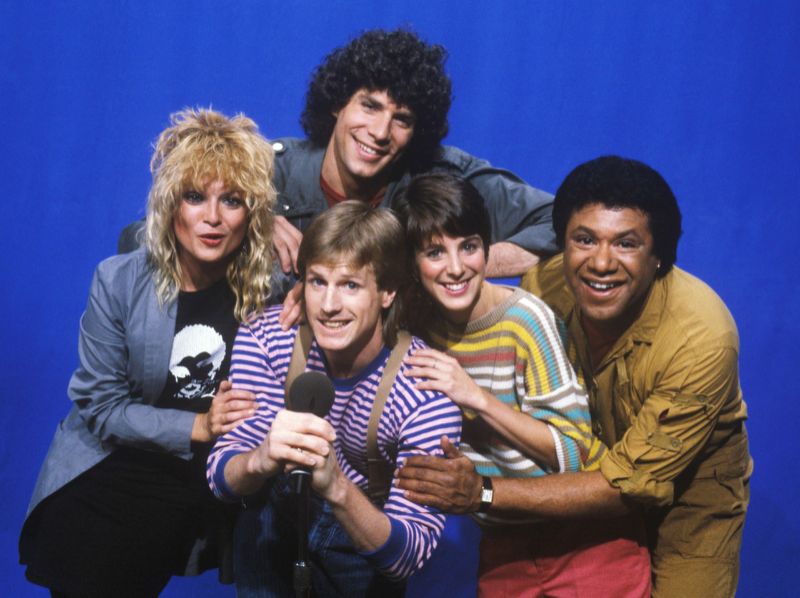
JJ Jackson, Nina Blackwood, Mark Goodman, Martha Quinn, Alan Hunt
He spent months researching his target audience before recruiting a dedicated crew of 23 technical people, three directors and five “perfect” personalities to act as VJs – Video Jockeys – to host particular segments of the programming day, as well as special interviews, concerts and MTV parties. Each of the VJs, Nina Blackwood, J.J. Jackson, Mark Goodman, Alan Hunt and Martha Quinn, have either a background in radio or theater. But the common denominator among everyone at MTV is the endless enthusiasm and unlimited energy that they’re willing to pour into the project.

Executive Producer Julian Goldberg believes that MTV is “advancing the speed at which cable was going to go anyway. One of the promises of cable,” he claims, “was that it would not be an imitation of the networks. You can have 100 channels and each one could be a specific channel. You could have a channel of comedy all day, a channel of finance, a channel of cooking all day. But people were afraid to tackle that and MTV, and other Warner Amex channels, The Movie Channel and Nickelodeon (programming for children) are the first to actually take on one specific audience all day long. We don’t want you to tune in if you want the news or sports information, or financial information. We want you to tune in when you want music. And we don’t mind if you leave us a while because we know that you’ll always come back for the music because that’s what we give you 24 hours a day, every day.”

Before he made the move to MTV, Goldberg was happily employed as a freelance Field Producer for a number of magazine programs, including “Kids Are People Too,” “Hour Magazine,” “Real People,” and “Good Morning America.” Although he’s given to working 10 hours a day, 5 days a week, he still possesses an elegant demeanor and athletically trim physique that would be just as at home in front of the camera, as in a Brooks Brothers ad. “I came over as a consultant to the television end,” he recalls, “just to get the visuals together as a producer, without the producer’s title. I liked it so much, and was so blown away by how innovative it was, and the opportunity to build something that was new and completely different, that I’ve stayed.” He is extremely proud that MTV “has the fastest growth of any cable system anywhere, ever. We’re getting 25 million letters a week from viewers, which is unprecedented by anything anybody has ever done. And, at the same time, we’re pulling it off. Nobody’s ever tackled anything for 24 hours a day where they’re really producing it all the time and getting it on the air. A telethon is the only thing I can think of. And that only once a year. We’re doing it every day and we’ll continue to do it far, far in to the future.”

Actress Nina Blackwood first heard about MTV while wrapping up her work on the film Vice Squad. “I first saw an advertisement in one of the trades for this new music channel and quickly sent in my resume,” remembers the sultry blonde. She’s been involved with some form of rock’n’roll for quite a while, having made a bit of a name for herself singing and playing rock’n’roll harp in clubs around Los Angles. “From my outlook, it’s an obvious metamorphosis of the industry. Video is a logical progression. People really seem to watch hours and hours of it. And the artists are benefiting from the sales. I love video. I went home on vacation and sat up until dawn with my friend who works on them. I just did the interworks, with ideas. I’ve never actually done the editing but I know what it takes to be done. And I know that your eyes go and everything starts looking like a video.” Nina, who is an art buff, is pleased with the way MTV offers outlets for those who “have really been pushed aside for a long while. They really starve, literally, and can get jobs with videos, by doing set designs.

“Russell Mulcahy, he’s an artist who has done the Ultravox videos, and they are just gorgeous. People I know that are that kind of artist, are getting involved in video. It’s a very valid form of art. It’s also a retrospect going back to opera, in a funny way. When opera was in its heyday it was the story with the music. It’s not the same type of singing, but it’s the same type of thing with the technical aspect.”

Alan Hung came to MTV by way of the Shakespearean theatre and television commercials. With his quick open smile and smooth Southern drawl, he doesn’t have to try to be charming. “I don’t think video will have an adverse effect on theatre or film,” he states, “or that the entertainment media has an effect on video. In other words, you’re getting all these film directors that are really starting to get involved, but maybe as a sideline, some as a full-time thing. Russell Mulcahy is a Video Director / Producer that has been talked about a lot, and he’s done some super videos that are film quality. Actually, he does them in film. So, we’ll see the film industry or theatre side of things; there are certainly a couple of clips that are theatrical in that sense. The Tubes do theatrical stage work in their shows and that transfers to video.

“It will all help video; it will make the rock’n’roll artist come out of their shell a little bit more, if they’re gonna do video work. And a lot of them like the chance. They like that thought of ‘now I get to act a little,’ and in some concept, like storyline videos, they play a little character. But I think video will come from theater, or from quality film rather than video having an effect on the others. Theater will be what they are, regardless of where this video thing goes. But video is gonna take off because of its roots.

“If they get the television screen down, like they think they will, I’ve heard all sorts of things about holography and three-dimensional television. I think that certainly is going to come. And we’ll have laser TVs or whatever. Video you can’t say anything, but it’s gonna be like the thing. It’s gonna be up there with the films and the theatre. And video music is ‘here to stay,’ as they say. A cliché.

“You’re gonna get artists with whole albums, you know, like Blondie and Olivia Newton-John. There’s probably a financial problem with that right now in the record industry. They just can’t afford to put the money into that. And they’re not quite sure of the market yet. MTV is starting to prove that there is a market for this thing called viewing music, video music. So they’re starting to see the advantages of not only marketing the records through radio stations, but making videos of the artists as well, ‘cause that doubles the pleasure, I guess. Not only to hear your favorite artist, but to see him, too, in stereo.

“I think video music is going out the top of the roof. There’s no stopping it. Everything is going to be visual. You’re gonna have everything right in your own home. And if you can see it as well as listen to it, why not? Radio may take a different form, but people will always want to listen to the radio. Sometimes you may feel you’re inundated with too much by all your senses and you might want to just rely on your ears. I still think it’s a whole lot of fun to listen to a story told on the radio and invent your own imagery. There will still be a place for radio because certainly we’ll still have a car and people won’t want to watch television while they’re driving. As far as the kind of music that will be played on radio, it’s hard to say. I don’t think it’s going to just be Top-40 AM radio. It will always have a talk format. But I still believe there is an audience for music radio. (MTV) won’t be the death of the radio.”
The very first nationwide VJ was Mark Goodman. A former Philadelphia disc jockey, Mark interrupted his 7-year stint in radio to be part of MTV. Although soft-spoken and seemingly sincere, you can’t help but notice the spirit of a frustrated comedian in his bright brown eyes. When pushed for an answer, he admits that he “sort of” plays an instrument. “I play the stereo,” he quips. “I used to play the drums; in Junior High, I was in a band called Mach Five. We played one gig and I decided, ‘This is not for me’: small problem with the beat. Just a minor thing. So I figured, I’m out of this. I love music. What am I going to do to make my living at it? So I became a DJ, and this was the next step. The rest is rock history!

“It’s gonna grow and mean the birth of a new kind of artist and a new kind of musician who will think in terms of a broader concept than other artists have. I don’t think it’s the death of radio; I think it’s going to do a wonder for radio because television, just by its nature, is just more crass. I can’t remember which  side of the brain – I think it’s the right side - that’s working harder when you need your associate functions, your imaginative functions; when you read something you have to use that side of your brain to put things together to give you a picture. Television shuts that off. Here it is – blah! That’s both a blessing and a curse at the same time. That’s why I’m checking into video art, because all of a sudden then it starts to work outside the brain.

“Radio is magic in and of itself. Because it’s only audio, it’s magic to me. We’re never going to replace that. (MTV) is the next step. It can be the future of rock’n’roll. I think it can give it this shot in the arm that it needs. I think we’re gonna shake up the networks. Cable TV, in general, is gonna shake up the networks, and us specifically, because we have people watching us in the middle of the night. They’re (network executives) thinking they’d better do something at night. We’ve got people watching. Where it goes, for me is another question.”

Petite, blue-eyed Martha Quinn began her broadcasting career as the soul DJ at the New York University Radio Station (WNYU), “the magic of radio.” Her musical tastes include “everything from folk to funk,” and the variety of MTV’s videos is one of the reasons she’s so proud to be a VJ.

“I really believe your cable dial will be similar to your radio dial in that you can find these kinds of formats. We will by no means be the only one. We can always say we were the world’s first. As far as what it will do to radio, I think it will always find a niche. You cannot take MTV with you in your car. You can’t run around the block listening to MTV on your headphones. You just can’t do it. You’d run into somebody! It’s the same thing when television came in: people thought it would destroy radio. They just found their own place.”

J.J. Jackson [d. 2004, age 62 – RBF, 2020] had been a rock’n’roll DJ for 13 years. Most of that time he spent in Los Angeles, where he made a name for himself as a pioneer in FM radio. He was attracted to MTV because it reminded him of everything that was good about Progressive Radio. “One of the problems, what’s missing today, is that kids don’t’ know enough about music as it was before. They think that guitar started and stops with Jimmy Page. And it really didn’t. And if they’d listen to what Page had listened to they’d know more about their own instruments, but that’s neither here nor there.

“American kids today are really uninformed. It’s like, my record library, which is really quite extensive, sometimes you walk into a place where you have too much choice, therefore you don’t make a very good one. That’s why I think the English have dominated the music scene for so long, because they have very little choice in radio and so little money to play with, that it means an awful lot more to them. Having been over there a number of times, when they go out to buy a record, they don’t buy it because Joe Blow is cute. Where in this country, an awful lot of your success depends on how good looking you are, not how well you play your instrument. And I’m not putting America down, it’s just that sometimes it’s just too much.

“I think that’s why the music came to a head in the late ‘60s. If nothing else, what the hippies gave to the kids, which is rarely mentioned, was how to appreciate music. Which, unfortunately, has been bastardized to the point where kids don’t know anymore, because FM radio has gotten very much like Top-40 radio was in the ‘60s.

“When I was doing FM at WBCN [Boston], it was free form radio. The only record a disc jockey knew he was going to play was the first record, and that’s because he had it in his head. From then on it was a spin-off. He didn’t care about names or labels or whose record was selling like hotcakes in Seattle. You played it ‘cause you liked it, or whatever.

“Also, you could build themes. You could play Django Reinhart and Stockhausen and Mozart, and as the night progressed, evolve into ELP. Therefore you could entertain and be quite educational.

“A good example of what I’m talking about is, you take Led Zeppelin’s second album, where Robert Plant says, ‘Squeeze my lemon,’ which, when it came out, was a very salacious line, which it is no longer. Then a kid could learn on a radio station like WBCN that it wasn’t an original line, but that it was taken from Robert Johnson, and not the Robert Johnson we know now with “Read Hot,” but the Robert Johnson from 1936, an old Black blues star, because Plant’s very much into those kinds of people: Elmore James and Robert Johnson. That (line) was taken from an old 1936 song. You could play that one line from the record and go into Led Zeppelin and the kids not only become entertained but educated. And the kid learns that there really is nothing new under the sun, and that all those riffs have been done before.

“It’s a shame that we’re living in a time when you can turn on the radio, with the possible exception of WNEW, and hear an Elvis Presley, and not hear an Elmore James, not hear a Muddy Waters, on a so-called rock station.

“One of the things I do take pride in MTV is that it is more progressive than radio stations are; it truly is. Where else are you going to find Spandau Ballet on the radio stations in New York City? Spandau Ballet is no big deal for us. We play a lot of unsigned bands, New Wave bands, and mainstream bands. Since video is fairly new and there’s not that many things you can go back to, radio stations, and in this case television stations, should reflect what happened yesterday, because that has a great deal to do with what’s happening today. And today has a great deal to do with what will happen tomorrow. And if you can reflect that in your programming, and at the same time entertain as well as inform, then you’re giving them the whole ball of wax.

“I think we’re doing a service that radio doesn’t do any more. It’s easier to get a video on MTV than it is to get your record played on most radio stations in the country. I’m really proud that MTV is that progressive, but I’m really sorry for the state of radio.

“It’s nice to get letters in from, say, the Midwest, that has been a bastion of supporting bands like REO Speedwagon and basic mainstream rock’n’roll bands, saying ‘I thought I hated New Wave,’ because they thought New Wave was a term that appealed to everything from Black Flag and X, to Fear, all the way over to Ultravox. Maybe they’ve found that they can’t handle Black Flag, but they can handle Ultravox. Or some of them can handle Black Flag. But that’s the whole thing, once they see them; Ultravox’s ‘Vienna’ is an incredible piece of work and I think that bands will do an awful lot better when they come through America again because of video.”

And from the looks of things, America seems to think that video equals MTV.

Wednesday, January 10, 2018

Music Reviews: January 2018

Text © Robert Barry Francos / FFanzeen, 2018
Images from the Internet
Reviews are in alphabetical order, not by ranking

Chesty Malone and the Slice ‘em Ups
We’re Still Dead
I have to say, their initial LP, Now We’re Gonna See What Disaster Really Means, was a killer punk record with a hard line towards horror and murder, much like the early Cramps (though replacing the voodoobilly with hardcore screaming). While I missed the sophomore release, Torture Rock (review coming soon), I’m so glad to have the opportunity to review this and, meanwhile, if you get a chance to see them live (usually locally in New York at Brooklyn’s Lucky 13 Saloon and around the Tri-State area), avail yourself. From the first cut, “Destroy All Humans,” with its cutting and jerky guitar riff, you know this is going to be in for a shit load of fun. Anthony Van Hoek’s guitar is electric in its tone and attack, well matched by lead vocalist Jaqueline Blownaparte, who wisely talks-screams-sings her material to get the most punch out of them. This song is followed by the even better “HSH” (“Hellfire Shitfire Hellfire”), which plays around with the tempo. It also shows that Ms. J can handle the speed, spitting out the voluminous lyrics, as much as Ant follows suit on his axe. Now I can go on and on repetitiously about how much fun this release is, so I’m going to let you mostly extrapolate. Just know there’s not a bad (or slow) cut here. Even with a couple of silly ones (not an insult; after all, the Cramps did “I Was a Teenage Werewolf”) like “Fun Things to Do During Robberies” and “Gorilla Girl from Outer Space,” the choruses are very chantable for the audience (the rest of the band fills in singing for us on this collection), as with most of these. Make sure you listen to it in stereo form, because they play with the balance quite nicely, bouncing from ear to ear (i.e., kudos on the engineering!). And for those acquaintances of mine who make horror films (e.g., James Balsamo, Bill Zebub), this would make some great soundtrack material, such as the excellent “Midnight Madhouse”!
chestymalone.bandcamp.com

Clockwork Revolution
One could almost consider this Ft. Lauderdale-based hard rockin’ band a supergroup considering the past members have been or are currently in bands like Yngwie Malmsteen, W.A.S.P., Leatherwolf, Crimson Glory, and Kamelot, among others. They’ve also be compared to the likes of Dio and Judas P. Of course, this debut is metal, but what kind of metal?, you may be asking. It’s the grinding, mid-speed kind that’s not trying to impress with many speedy guitar solos. They work tightly as a unit, which is impressive. I certainly appreciate the lack of the need for guitarist Dewayne Hart having the ego in check and to not need to play with his cock out (metaphysically speaking, of course). The bottom is quite solid with Dirk Van Tilborg on bass and drummer Patrick Johansson. For me, the first weak point is that there is little variation between songs in speed or tone. They’re good at what they do, don’t get me wrong, it’s just repetitious (and this coming from someone who adores the Ramones). The second is actually Wade Black’s vocals. Again, he’s a decent singer, there’s nothing wrong there, it’s just… he sounds stereotypically pretty much like every other metal singer with the warble at the end of the musical bar. He’s singing, “A violation, I’m feeling mean / Don’t tread on me, I’m venomous,” but it feels empty and same-old-same-old. And every song has the same vocal tone. Again, not bad, just… whatever. But what the hell do I know about this kind of metal. If the bands I mentioned before are your speed, there is a good chance you’ll like this. Sometimes serviceable is good enough. Lyrics included with the CD.
www.sonicnightmusic.club / www.mvdaudio.com

Fred Gillen Jr.
What She Said
I’ve oft contended that punk is folk music, played acoustically. They’re both protest-focused, lo-fi and stripped down. Look how many punk musicians have released singer-songwriter collections as they aged. Gillen falls into this category, as well. Playing in the homeland of punk during the 1980s, at the likes of CBGB and Irving Plaza in bands like Rain Deputies, he too has come around to the acoustic, though he has lost none of his punch in this, his 10th album (though the first I’ve heard). This release is strongly pro-American, but it’s amazing how strongly opposite in attitude of, say, the hard rock-based group Kinlin. Rather than fight for your your America to keep it strong, it’s more thoughtful, opening with the powerful “Prayer for America” (“I may not believe in God / But I say a little prayer for America”). Gillen doesn’t look at refugees as a danger, rather he takes their side to show how important they are for the continuation of the country (“Future American”). He also looks at people who are persecuted with the likes of “Julia” and in “Baltimore Burns,” he presents a list of evils in modern culture, such as the death of Trevor Martin, yet points a finger at both sides of governmental Aisle. The latter is a powerful piece. There is a mix of positiveness and negativity throughout, but in both cases there is a measure of hope. Gillen’s voice is well-suited for this style, and it’s worth a listen if you want music with a conscious.
Dys Records / www.fredgillenjr.com

James Lee Stanley
Alive at Last – In Philadelphia
The last time I heard Stanley, he was teamed with John Batdorf, doing acoustic and folkish covers of the Rolling Stones. Here, we are presented with a full concert with a small group of what sounds like good personal friends. Yeah, this definitely has more of the feel of a house concert than being in a big hall (or even a club). This model fits Stanley well. Let’s get the obvious out of the way first: there are a couple of covers, one of which is a very soulful version of the Stones’ “Miss You.” Not one of my fave Stones songs, being a disco-era production, but Stanley actually brings some emotion to it rather than the shell of machismo. There is also a version of the Beatles’ “Drive My Car” (can a Beatles cover album be far behind, I wonder?), that is without the annoying “Beep Beep yeah!” Backed by Cheryl Prashker on percussion and Chad Watson on electric bass, they take a back step to let Stanley and his guitar stand out front. In typical (happily) modern singer-songwriter fashion, his songs are filled with sentiment, and just a bit of exotic musical flairs and influences (e.g., “All I Ever Wanted”). It’s a long player, but his music is relaxed and enjoyable. Also included are the song introductions, which are mostly fun, though at least one is cringeworthy (i.e., for the lovely “Worry Bout You”). Politics does make a couple of appearances, such as “Do It in the Name,” and “The Street Where Mercy Died,” written after the Bush treatment of Katrina (though it could reflect in the Trump-era Puerto Rico fiasco). The finale, “The More I Drink” also has a touch of current affairs, as well as audience participation. This isn’t naval gazing as much as bringing the passion to the forefront as it’s not whiny, but it does touch on something deeper without being cryptic (as was REM’s “Losing My Religion”). It’s a fine release and it does show Stanley’s gifts, which is a positive.
Beachwood / www.jamesleestanley.com

Kinlin
The Last Stand
Sharing two members of the band Clockwork Revolution, this SoFla is very different in tone and sound, and I’m happy about that. While keeping the heavy tones, drummer Patrick Johansson and guitarist Dewayne Hart are joined by Tom Lynch on guitar and bassist Chris Eversoul; Hart does double duty as vocalist. While his vox is often double-tracked, it actually works quite solidly. The songs are musically strong with some great crooning chops and are definitely quite chantable in parts; the pace often changes from ballad to rave-ups. The lyrics of the songs tend to be a bit on the Conservative side, with topics often veering towards insisting you’re part of an evil machine out of your control and there’s a war coming with “the radicals are at your door.” For example, in “Unthinkable,” they posit “The time has come for fighting wars / Even if it’s on our shores.” This is definitely jingoistic stuff wrapped up in some phenomenal music. If you’re into chanting “USA! USA! USA!” (not that this band does that), you might find yourself grooving to it. I picture pick-up trucks, gun-racks, Coors (the beer of gun lovers by gun lovers), and red MAGA hats. Politics aside, the music and vocals are really great. My liberal heart that loves America as much as you guys may have issue with nationalistic songs like “The Last Stand,” “Unthinkable,” “Stand or Fall,” and “Blood of Our Fathers,” but I am content with the zeitgeist beauty of “Monday Rain.” 
www.sonicnightmusic.club / www.mvdaudio.com

Oral Fuentes
Rise Up 
When I talked to Oral a few years ago, before listening to Oral Culture, his Oral Fuentes Reggae Band’s first album, he said, “We’re a bit faster in concert than the record.” He was right, but it was still a killer release. Now here’s the second self-released product, again recorded by Randy Woods in his studio. Well, his earlier comment becomes moot in the first song, with the extremely energetic “Creole Man,” and then rarely lets up. All but one song is an original, so you know the messages that the band brings is going to be positive, because that is Oral’s thing. It shows here. I’ve heard most of these songs live now, and some are just killer, like “Punta Rock,” “Feelin’ Dread,” the ‘60s-ish “I Saw You,” “Do Me Like That,” and the call-and-response “Dance,” for example. One thing about that last song is that it is an audience pleaser live, which is hard to translate to studio, but odds are you’ll find yourself chanting along, so you’ll get it. Being from Belize way back when, Oral’s style of reggae is not the same as the Marley slow grind, but more somewhere between that and ska, and I’m okay with that. The last two pieces, “Rise Up” and “Praising Jah” are closer to traditionally what you might imagine reggae to be, but with as powerful a band as this is, there is magic here.
www.oralfuentes.com

Paul Carrack
Soul Shadows
Despite his history with the likes of Roxy Music, anti-Semite Roger Waters and Mike + the Mechanics, I became aware of Carrack during his collaboration with Nick Lowe. Left to his own devices, such as this collection, his output could – and probably should – be considered blue-eyed soul. I mean, he sounds like a white guy singing soul, in much the way the Police sounded like white guys singing reggae, but Carrack has a better voice than Sting. Backed with horns, and especially numerous strings, he plays most of the main instruments (guitar, bass, keyboards) and is usually backed by his co-producer Peter van Hooke and Jack Carrack (both on drums and percussion, with rare exception). While occasionally delving in the Lite-jazz equivalent of soul, Carrack’s passion comes through on all the tunes. This is good music to be driving with, especially since it’s an across-the-board sound that probably won’t be offensive to anyone. The reason I’m not picking out particular songs is because they are all consistently decent, including a dip into country with “Watching Over Me.” Good stuff. The CD has a nice booklet with lyrics included.
www.paulcarrack.net / www.MVDAudio.com  

The Tracy G. Group
Tramp
This is some serious and solid hard rockin’ metal, led by Tracy G (is it okay to say Grijalva?) and his wild guitar playing. Michael Beatty meets the metal with equally mad vocals, and they are backed solidly by Randy Oviedo’s bass and Patrick Johansson on drums (though Adrian Aguilar and Ray Luzier occasionally fill in on skins). The tone of the music is definitely harsh and angular, which is matched equally by the lyrics of songs like “The Leech” and “Arrogant Prick.” The latter fits well next to Stiff Little Fingers’ “I Don’t Like You,” The Dickies’ “Hideous,” or the more obscure “Dreaming of Saturday Again” by Boston-based Blackjacks. Dense and unyielding, the sound is a musical sledgehammer that follows its own rules. There is little here that is formulaic. One could almost see it as metal punk since its anger and unconventionality make it a strong standout. Whether the songs have lyrics or are instrumental, Tracy’s guitar attacks with a whiplash sound, and Beatty’s eccentric reading gives the listener something to chew on. Not quite “Other Music,” it’s still something that may make you sit up and go, “saywhatnow?” That’s a good thing. I’d love to see them live; it’s a bit off-beat for mosh pit skanking, but definitely can rave up a crowd. The CD booklet contains lyrics.
www.sonicnightmusic.club / www.mvdaudio.com

Various
The Demo That Got the Deal: Joe Vig’s Pop Explosion Vol. 4
Boston musician Joe Viglione has been releasing compilation albums for decades, and he has a pretty good ear. As has come to pass in this series incarnation, there is a music section and an interview one based on his Pop Explosion podcasts programs. Thankfully, he doesn’t mix them, but has the music first followed by the conversations, so you can listen to the tunes uninterrupted. As he once told me, he considers the talking parts as historical documents, and I agree, and it’s a wise choice to make it “side one” and “side two.” There are definitely some standout artists and songs. For me, they include Steve Gilligan’s (of Boston perennials Fox Pass) “Before the Fall,” Kitoto’s “Proud Soul Heritage,” the powerpop of Australian group Audioscam’s “Bridgetown Girls,” JASON’s quirky ‘80s pop “Hylas” (reminding me “Out of Touch” by Lizzie Borden and the Axes), two heavier tracks with Joe Black’s “Armageddon,” and Metal Pistol’s “D.O.A.,” and the soft rock of Kenny Selcer’s excellent “It’s All Around Me” and Joe’s own “Secret Things.”  The interview segments include Ian Anderson (lead singer of Jethro Tull), glam rocker Alan Merrill (who wrote Joan Jett’s “I Love Rock and Roll,” and is a huge pop star in Japan), top-line producer Rob Fraboni (such as Dylan, Clapton, the Stones, and the Beach Boys), and Dick Wagner (Alice Cooper and Lou Reed; d. 2014).
Varulven

Various
THEY: Pay Tribute (A fan collaboration and tribute to TMBG)
If you are not sure, TMBG is the eccentric Brooklyn-centric They Might Be Giants. I assume that most people know them from the “Malcolm in the Middle” theme “You’re Not the Boss of Me.” While I never did get the chance to see them live (even though I’ve spent most of my life in Kings County), I’ve been aware of them since the 1980s starting with “Don’t Let’s Start.” Now, if I may digress a bit, themes of a tribute albums are a tricky thing because there are two thoughts about it, namely whether to do a “sounds like” or to take the material in a totally different direction and make it one’s own. Well, that choice is a bit easier with TMBG’s music, since they are so quirky to begin with; I would think it would be more acceptable to take the latter road. This is pretty obvious from the outset with Corn Mo’s bizarre talk/scream version of “Someone Keeps Moving My Chair.” Much of the material here is respectful it its own way, albeit in a very electronic (rather than electric) way. Lots of synthesizers abound. Not saying that’s a bad thing, but it’s a contemporary selection for certain. My issue is more that with TMBG, their off-beat lyrics are out front, where here it often gets a bit second shrift to the synths, such as Nuclear Bubble Wrap’s “Trouble Awful Devil Evil” and Holy Bongwater’s “Marty Beller Mask.” There are some more traditional cover methods, such as James K. Folk’s singer-songwriter-style “Meet the Elements,” Pearl and the Beard’s “Destination Moon,” and Insane Jan’s “Doctor Worm.” Also some are more loyal to the original, like Smashy Claw’s “Don’t Let’s Start,” and Bonecage’s “Particle Man.” A couple of other stand-outs are Rachel Hayward’s nice instrumental electro-version of “Sapphire Bullets of Pure Love” and Tom Brislin’s minimalist “Birdhouse in Your Soul.” The end cut, I believe actually are TMBG (sounds like them, though there’s a typo in the name), is the very strange “Fingertips,” proving no matter how you approach their music, there is no wrong way. There are 27 cuts on this collection, so there’s lots of music and styles from which to choose.
www.adamriveramusic.com 

Walter Lure and the Waldos
Live in Brooklyn
If I was going to pick a musician that I have seen live more than any other, it would probably be Walter Lure. Through the 1970s, ‘80s, and ’90s, there were numerous times I watched the Heartbreakers (dating back to the Richard Hell years), the Heroes (Walter’s band with his late brother Richie Lurie), and then the Waldos. The latter’s 1994 album, Rent Party, was as much a staple on my turntable as was the Heartbreakers’ L.A.M.F. (or Live at Max’s Kansas City); hell, I even got into an argument with Tom Petty over his use of the name Heartbreakers just before his first LP came out, but I digress…). When I saw this new live record, to say I was excited would be an understatement. Truth be told, I’m not sure if musician and retired stockbroker  Lure has even written a new song since the first LP, but y’know what, I don’t care; hearing him cover his 3-decade career is enough, to paraphrase what they say during Passover. There are the “standards,” if you will, such as “Get Off the Phone,” “Too Much Junkie Business,” and “Chinese Rocks,” but he also does some of the songs more associated with ex-teammate Johnny Thunders, including “Born to Lose” and “London Boys.” It’s also great to hear some of the underrated songs, such has “Golden Days” (taking new meaning these days), “Countdown Love” and the great “Never Get Away” (sorry not to see my two fave Waldos’ songs, “Crazy Little Baby” and “Sorry,” but my excitement is not diminished). My sister-from-another-mother, Nancy Neon once described “Uncle Walter” (her name for him) as “My favorite stand-up comic.” He was always amazingly self-depreciatingly wry between songs, but here it’s more focused on how great he is during the musical treats. Backing him up are a whole different tribe (EZ on bass, Joe Rizzo on drums, and Takto on guitar). The sound is clear for a live recording, and the energy level is still super high (no pun intended). Walter’s voice is a bit shakier than it was back when, but his guitar isn’t, and still more fun than most. You want to know one of the major reasons why New York was so important to what would be known as punk? Well, here ya go. And while I’m at it, Nancy’s two-part interview with Walter from 1981 is HERE  and HERE. 
O-Rama / www.MVDaudio.com