Showing posts with label music history. Show all posts

Wednesday, May 5, 2021

MTV: Watching Rock’n’Roll History [1983]

By Julia Masi / FFanzeen, 1983
Introduction © Robert Barry Francos / FFanzeen, 2021
Images from the Internet


This article was originally printed in FFanzeen, issue #10, dated 1983, by FFanzeen Managing Editor, Julia Masi.

There is a maxim in Media Ecology theory that states that when a technology is introduced to a culture, it does not change any one thing, it changes everything. With the state of MTV these days, it’s hard to fathom just how revolutionary MTV was during its heyday. You know, when they actually played music rather than be a boring, same-old-same-old reality television station; “Big Brother”? More like “Why Bother”?

How did MTV chance the face of music since its inception in 1981? It introduced a lot of music to the culture that would have normally been missed. Ultravox is mentioned below as an example, but it went well beyond that. But as another Media Ecological bon mot goes, every positive thing a technology brings, there is an equally powerful negative that comes with it that is unforeseen (what Marshall McLuhan called “Reave View Mirror Thinking”). In this case, it became such a juggernaut that if a band didn’t have a professional-level video, it went unnoticed on the station. As it became bigger and more powerful, other stations would try to show music videos (such as “New York Hot Tracks” (WABC), “Friday Night Videos” (WNBC), “Night Flight”(USA Network), and U68 in New York and V66 in Boston), but MTV insisted on exclusivity or nothing.

As much as J.J. Jackson talks below about MTV being more “progressive” than radio, yeah, it started that way, but it was not long before you saw the same videos over and over, making it merely a visual Top-40. Also, Jackson posits about how people were into the looks of bands. MTV actually became a leader in this due to its visual nature. If the band was not “pretty,” odds were they were not seen.

As MTV became more popular, the videos also started to change to try and try harder to catch the eye. The editing quickened from a few seconds at a time, to rapid-fire, shortening the attention span of its audience. This quickening of edits would influence feature films, video games, and so many other aspects. In short, MTV became everything it proposed to be against in this article.

What ended MTV as it was when this article came out? In my opinion, it was their fight against R&B music. Other than the likes of Michael Jackson and a few other artists, it’s could have been called WhiteTV. I can’t remember if it was an actual lawsuit or the threat of one, that they added hip hop and rap to their roster, introducing it to a white, suburban audience. This was also ground breaking in spreading rap beyond its East and West Coast bailiwicks. But as much as it turned on a new audience to the style, it also lost a lot of its older audience, and eventually its stock just couldn’t mandate its shareholder profit demand. MTV became…something else. Sure, it began VH1, MTV2, MTV Classics, and the like, but it never really held the sway it once did.  – Robert Barry Francos, 2021.


Slightly more than a year ago, Warner Amex Communications set the cable industry on its ear when they launched MTV, Music Television, the most unique and successful concept ever to hit the airwaves. Offering 24 hours, 7 days a week, of non-stop rock’n’roll music, videos, interviews, concerts and movies, MTV has captured the hearts and viewing time of the 12 to 36 year-old market in over six million homes. And as it sheds a much deserved spotlight on up and coming music and video artists, it also gives a boost to the sagging sales for the record companies.

MTV sprang forth from the dreams and dedication of Bob Pitman and John Lack. Pitman, Senior Vice President of Warner Amex and a veteran of commercial radio, had always wanted to do something with music on television, but felt stagnated by the old format of simulated concerts or just watching kids dancing to records. As more and more bands began making videos, Pitman became inspired with the concept of MTV. He realized that music television could be a viable program at Warner Amex, and was willing to experiment with its possibilities.

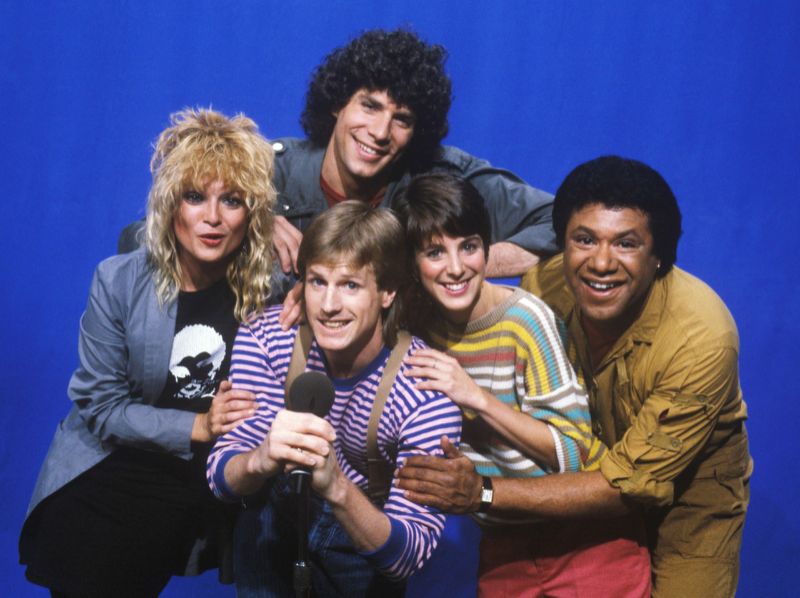
JJ Jackson, Nina Blackwood, Mark Goodman, Martha Quinn, Alan Hunt
He spent months researching his target audience before recruiting a dedicated crew of 23 technical people, three directors and five “perfect” personalities to act as VJs – Video Jockeys – to host particular segments of the programming day, as well as special interviews, concerts and MTV parties. Each of the VJs, Nina Blackwood, J.J. Jackson, Mark Goodman, Alan Hunt and Martha Quinn, have either a background in radio or theater. But the common denominator among everyone at MTV is the endless enthusiasm and unlimited energy that they’re willing to pour into the project.

Executive Producer Julian Goldberg believes that MTV is “advancing the speed at which cable was going to go anyway. One of the promises of cable,” he claims, “was that it would not be an imitation of the networks. You can have 100 channels and each one could be a specific channel. You could have a channel of comedy all day, a channel of finance, a channel of cooking all day. But people were afraid to tackle that and MTV, and other Warner Amex channels, The Movie Channel and Nickelodeon (programming for children) are the first to actually take on one specific audience all day long. We don’t want you to tune in if you want the news or sports information, or financial information. We want you to tune in when you want music. And we don’t mind if you leave us a while because we know that you’ll always come back for the music because that’s what we give you 24 hours a day, every day.”

Before he made the move to MTV, Goldberg was happily employed as a freelance Field Producer for a number of magazine programs, including “Kids Are People Too,” “Hour Magazine,” “Real People,” and “Good Morning America.” Although he’s given to working 10 hours a day, 5 days a week, he still possesses an elegant demeanor and athletically trim physique that would be just as at home in front of the camera, as in a Brooks Brothers ad. “I came over as a consultant to the television end,” he recalls, “just to get the visuals together as a producer, without the producer’s title. I liked it so much, and was so blown away by how innovative it was, and the opportunity to build something that was new and completely different, that I’ve stayed.” He is extremely proud that MTV “has the fastest growth of any cable system anywhere, ever. We’re getting 25 million letters a week from viewers, which is unprecedented by anything anybody has ever done. And, at the same time, we’re pulling it off. Nobody’s ever tackled anything for 24 hours a day where they’re really producing it all the time and getting it on the air. A telethon is the only thing I can think of. And that only once a year. We’re doing it every day and we’ll continue to do it far, far in to the future.”

Actress Nina Blackwood first heard about MTV while wrapping up her work on the film Vice Squad. “I first saw an advertisement in one of the trades for this new music channel and quickly sent in my resume,” remembers the sultry blonde. She’s been involved with some form of rock’n’roll for quite a while, having made a bit of a name for herself singing and playing rock’n’roll harp in clubs around Los Angles. “From my outlook, it’s an obvious metamorphosis of the industry. Video is a logical progression. People really seem to watch hours and hours of it. And the artists are benefiting from the sales. I love video. I went home on vacation and sat up until dawn with my friend who works on them. I just did the interworks, with ideas. I’ve never actually done the editing but I know what it takes to be done. And I know that your eyes go and everything starts looking like a video.” Nina, who is an art buff, is pleased with the way MTV offers outlets for those who “have really been pushed aside for a long while. They really starve, literally, and can get jobs with videos, by doing set designs.

“Russell Mulcahy, he’s an artist who has done the Ultravox videos, and they are just gorgeous. People I know that are that kind of artist, are getting involved in video. It’s a very valid form of art. It’s also a retrospect going back to opera, in a funny way. When opera was in its heyday it was the story with the music. It’s not the same type of singing, but it’s the same type of thing with the technical aspect.”

Alan Hung came to MTV by way of the Shakespearean theatre and television commercials. With his quick open smile and smooth Southern drawl, he doesn’t have to try to be charming. “I don’t think video will have an adverse effect on theatre or film,” he states, “or that the entertainment media has an effect on video. In other words, you’re getting all these film directors that are really starting to get involved, but maybe as a sideline, some as a full-time thing. Russell Mulcahy is a Video Director / Producer that has been talked about a lot, and he’s done some super videos that are film quality. Actually, he does them in film. So, we’ll see the film industry or theatre side of things; there are certainly a couple of clips that are theatrical in that sense. The Tubes do theatrical stage work in their shows and that transfers to video.

“It will all help video; it will make the rock’n’roll artist come out of their shell a little bit more, if they’re gonna do video work. And a lot of them like the chance. They like that thought of ‘now I get to act a little,’ and in some concept, like storyline videos, they play a little character. But I think video will come from theater, or from quality film rather than video having an effect on the others. Theater will be what they are, regardless of where this video thing goes. But video is gonna take off because of its roots.

“If they get the television screen down, like they think they will, I’ve heard all sorts of things about holography and three-dimensional television. I think that certainly is going to come. And we’ll have laser TVs or whatever. Video you can’t say anything, but it’s gonna be like the thing. It’s gonna be up there with the films and the theatre. And video music is ‘here to stay,’ as they say. A cliché.

“You’re gonna get artists with whole albums, you know, like Blondie and Olivia Newton-John. There’s probably a financial problem with that right now in the record industry. They just can’t afford to put the money into that. And they’re not quite sure of the market yet. MTV is starting to prove that there is a market for this thing called viewing music, video music. So they’re starting to see the advantages of not only marketing the records through radio stations, but making videos of the artists as well, ‘cause that doubles the pleasure, I guess. Not only to hear your favorite artist, but to see him, too, in stereo.

“I think video music is going out the top of the roof. There’s no stopping it. Everything is going to be visual. You’re gonna have everything right in your own home. And if you can see it as well as listen to it, why not? Radio may take a different form, but people will always want to listen to the radio. Sometimes you may feel you’re inundated with too much by all your senses and you might want to just rely on your ears. I still think it’s a whole lot of fun to listen to a story told on the radio and invent your own imagery. There will still be a place for radio because certainly we’ll still have a car and people won’t want to watch television while they’re driving. As far as the kind of music that will be played on radio, it’s hard to say. I don’t think it’s going to just be Top-40 AM radio. It will always have a talk format. But I still believe there is an audience for music radio. (MTV) won’t be the death of the radio.”
The very first nationwide VJ was Mark Goodman. A former Philadelphia disc jockey, Mark interrupted his 7-year stint in radio to be part of MTV. Although soft-spoken and seemingly sincere, you can’t help but notice the spirit of a frustrated comedian in his bright brown eyes. When pushed for an answer, he admits that he “sort of” plays an instrument. “I play the stereo,” he quips. “I used to play the drums; in Junior High, I was in a band called Mach Five. We played one gig and I decided, ‘This is not for me’: small problem with the beat. Just a minor thing. So I figured, I’m out of this. I love music. What am I going to do to make my living at it? So I became a DJ, and this was the next step. The rest is rock history!

“It’s gonna grow and mean the birth of a new kind of artist and a new kind of musician who will think in terms of a broader concept than other artists have. I don’t think it’s the death of radio; I think it’s going to do a wonder for radio because television, just by its nature, is just more crass. I can’t remember which  side of the brain – I think it’s the right side - that’s working harder when you need your associate functions, your imaginative functions; when you read something you have to use that side of your brain to put things together to give you a picture. Television shuts that off. Here it is – blah! That’s both a blessing and a curse at the same time. That’s why I’m checking into video art, because all of a sudden then it starts to work outside the brain.

“Radio is magic in and of itself. Because it’s only audio, it’s magic to me. We’re never going to replace that. (MTV) is the next step. It can be the future of rock’n’roll. I think it can give it this shot in the arm that it needs. I think we’re gonna shake up the networks. Cable TV, in general, is gonna shake up the networks, and us specifically, because we have people watching us in the middle of the night. They’re (network executives) thinking they’d better do something at night. We’ve got people watching. Where it goes, for me is another question.”

Petite, blue-eyed Martha Quinn began her broadcasting career as the soul DJ at the New York University Radio Station (WNYU), “the magic of radio.” Her musical tastes include “everything from folk to funk,” and the variety of MTV’s videos is one of the reasons she’s so proud to be a VJ.

“I really believe your cable dial will be similar to your radio dial in that you can find these kinds of formats. We will by no means be the only one. We can always say we were the world’s first. As far as what it will do to radio, I think it will always find a niche. You cannot take MTV with you in your car. You can’t run around the block listening to MTV on your headphones. You just can’t do it. You’d run into somebody! It’s the same thing when television came in: people thought it would destroy radio. They just found their own place.”

J.J. Jackson [d. 2004, age 62 – RBF, 2020] had been a rock’n’roll DJ for 13 years. Most of that time he spent in Los Angeles, where he made a name for himself as a pioneer in FM radio. He was attracted to MTV because it reminded him of everything that was good about Progressive Radio. “One of the problems, what’s missing today, is that kids don’t’ know enough about music as it was before. They think that guitar started and stops with Jimmy Page. And it really didn’t. And if they’d listen to what Page had listened to they’d know more about their own instruments, but that’s neither here nor there.

“American kids today are really uninformed. It’s like, my record library, which is really quite extensive, sometimes you walk into a place where you have too much choice, therefore you don’t make a very good one. That’s why I think the English have dominated the music scene for so long, because they have very little choice in radio and so little money to play with, that it means an awful lot more to them. Having been over there a number of times, when they go out to buy a record, they don’t buy it because Joe Blow is cute. Where in this country, an awful lot of your success depends on how good looking you are, not how well you play your instrument. And I’m not putting America down, it’s just that sometimes it’s just too much.

“I think that’s why the music came to a head in the late ‘60s. If nothing else, what the hippies gave to the kids, which is rarely mentioned, was how to appreciate music. Which, unfortunately, has been bastardized to the point where kids don’t know anymore, because FM radio has gotten very much like Top-40 radio was in the ‘60s.

“When I was doing FM at WBCN [Boston], it was free form radio. The only record a disc jockey knew he was going to play was the first record, and that’s because he had it in his head. From then on it was a spin-off. He didn’t care about names or labels or whose record was selling like hotcakes in Seattle. You played it ‘cause you liked it, or whatever.

“Also, you could build themes. You could play Django Reinhart and Stockhausen and Mozart, and as the night progressed, evolve into ELP. Therefore you could entertain and be quite educational.

“A good example of what I’m talking about is, you take Led Zeppelin’s second album, where Robert Plant says, ‘Squeeze my lemon,’ which, when it came out, was a very salacious line, which it is no longer. Then a kid could learn on a radio station like WBCN that it wasn’t an original line, but that it was taken from Robert Johnson, and not the Robert Johnson we know now with “Read Hot,” but the Robert Johnson from 1936, an old Black blues star, because Plant’s very much into those kinds of people: Elmore James and Robert Johnson. That (line) was taken from an old 1936 song. You could play that one line from the record and go into Led Zeppelin and the kids not only become entertained but educated. And the kid learns that there really is nothing new under the sun, and that all those riffs have been done before.

“It’s a shame that we’re living in a time when you can turn on the radio, with the possible exception of WNEW, and hear an Elvis Presley, and not hear an Elmore James, not hear a Muddy Waters, on a so-called rock station.

“One of the things I do take pride in MTV is that it is more progressive than radio stations are; it truly is. Where else are you going to find Spandau Ballet on the radio stations in New York City? Spandau Ballet is no big deal for us. We play a lot of unsigned bands, New Wave bands, and mainstream bands. Since video is fairly new and there’s not that many things you can go back to, radio stations, and in this case television stations, should reflect what happened yesterday, because that has a great deal to do with what’s happening today. And today has a great deal to do with what will happen tomorrow. And if you can reflect that in your programming, and at the same time entertain as well as inform, then you’re giving them the whole ball of wax.

“I think we’re doing a service that radio doesn’t do any more. It’s easier to get a video on MTV than it is to get your record played on most radio stations in the country. I’m really proud that MTV is that progressive, but I’m really sorry for the state of radio.

“It’s nice to get letters in from, say, the Midwest, that has been a bastion of supporting bands like REO Speedwagon and basic mainstream rock’n’roll bands, saying ‘I thought I hated New Wave,’ because they thought New Wave was a term that appealed to everything from Black Flag and X, to Fear, all the way over to Ultravox. Maybe they’ve found that they can’t handle Black Flag, but they can handle Ultravox. Or some of them can handle Black Flag. But that’s the whole thing, once they see them; Ultravox’s ‘Vienna’ is an incredible piece of work and I think that bands will do an awful lot better when they come through America again because of video.”

And from the looks of things, America seems to think that video equals MTV.

Saturday, February 15, 2020

Review: Melody Makers: The Bible of Rock n’ Roll

Text © Robert Barry Francos / Indie Horror Films, 2020
Images from the Internet


Melody Makers: The Bible of Rock n’ Roll (aka Melody Makers: You Should’ve Been There)
Directed by Leslie Ann Coles
2053152 Ontario / Eggplant Picture and Sound; Film PaniK /
LA Coles Fine Art Films / Cleopatra Entertainment / MVD Entertainment
78 minutes, 2016 / 2019

During the mid-1960s through ‘80s, if you wanted to learn about music in the States, you had to turn to mainstream magazines like Rolling Stone, which tended to be more corporate (just look at how badly they’ve mishandled the selections for the Rock and Roll Hall of Fame and Museum over the years). Sure, there was Rock Scene for the New York Dolls, the Ramones, Blondie, and the like – and I’m grateful for that – but it was only in smaller mags like Crawdaddy to cover the newest and upcoming groups. Also, those were monthly. To get info from weeklies like The Village Voice, it was just a small section of the entire issue.

It was different across in England where there were a number of weekly papers focused mainly on music, such as Sounds, New Music Express (NME) or Melody Maker (MM). Many of us picked it up as often as we could to find out the latest and greatest of the obscure and mainstream scenes.

Melody Maker is older than rock and roll, and that’s for certain, first publishing in 1926 and lasting until 2000, when it merged into NME, essentially killing it. But, as usual, I’m jumping ahead of myself.

Essentially, until the mid-1960s, MM was a musician’s trade magazine, listing gig for various types of music (including – gasp – jazz), a place for musicians to find each other to form groups, and musical instrument for sale. This all changed with the inclusion of a cover story about some upstart band called… oh, what was it now?... The Beatles (Paul McCartney, specifically). After that, they introduced a lot of groups or solo artists that are part of the culture now, such as the Rolling Stones, Genesis, Pink Floyd, Jimi Hendrix, Led Zeppelin, and the like.

One aspect that made MM important was their respect for the musician, and especially the message that they were presenting in their music, to almost a political level. Luckily, in this well-put together documentary, we are introduced to the people who worked there in the “golden age” of the paper, namely the mid-1960s through the mid-1980s, when it began its natural decline. But more on that later.

Barrie Wentzell with his final pics of JImi Hendirx
Rather than presenting just talking heads discussing the glory days, we see the staff interviewed now, though mostly we see photographs of various bands in the 1960s and 1970s during their rise to fame and their heydays. Bowie (who is often called “BOW-ie” here, rather than “Bow-IE”), Jimi, and mostly British bands are shown in glorious black and white stills (and the occasional film footage), mostly taken by Barrie Wentzell, who really is the center piece of this film. Why? Simple: he moved to Toronto, and this is actually a Canadian film, so it had to have a certain amount of Canadian content.

Much of the staff is interviewed throughout, such as writer Christopher Welch (who worked there 1964-’79), and editors Christopher Charlesword (1970-’77), Richard Williams (1970-’80), Alan Lewis (1969-’73), and Alan Jones (1974-97). Also contributing are a bunch of musicians from the period, including Ian Anderson (Jethro Tull), Eric Burdon (Animals), Judy Dyble (Fairport Convention, etc.), Dave Cousins (The Strawbs), Chris Squire (Yes), Rick Buckler (The Jam) and a couple of members of Nazareth. There’s also a bunch of industry types including band managers and record execs, among others.

As you may have noticed, there are not many women represented here, barely even Janis or Diana Ross (Supremes era), other than Sonja Kristina of Curved Air, and photographer / founder of Rockarchive Gallery, Jill Furmanovsky, which seems odd to me considering this is by a woman director. Note that I am not pointing fingers since at the time, this was what it was like: testosterone heavy music and writing (though NME infamously had the great Caroline Coon); that being said, in my own ‘zine which ran from 1977 through ’88, I had more female writers than male.

The point is that all of these accounts are firsthand. I’ve always been annoyed at documentaries that interview writers who have written books and discuss second-hand events. These people lived the moments, and have the stories to back it up. I’m also grateful that the people are often identified by subtitles, rather than just a couple of times. That makes for easier viewing and comprehending, especially when it’s been so many years and people don’t look like they did back when.

But not just stories about musicians, we hear how the internal creation of the paper worked, such as when in meetings it was discussed, “Who’s going to be the main interview of the week?” This was important because whomever was on the cover could help make the band and/or sell a lot of records. They use Genesis as the example, here. It was also amusing to hear that they would occasionally make up sensational stories to sell copies (oh, those Brits!), such as how Springsteen would supposedly open for the Strawbs, or the Beatles were planning to reform (I remember those rumors right until Lennon’s assassination).

The film is loosely broken up into segments, including one I really enjoyed about interactions with musicians and their bands. For example, one of the writers talks about how he was in the recording studio with the Rolling Stones when they all found out about the death of Brian Jones, and what was their reactions. Others include tales of Jimi, Syd Barrett and Bowie.

Now I have said this before about particular local music scenes, how they would start small, blow up to become huge, and that would end up being the death knell of that very scene, drowned in its own success. That was kind of what happened to the MM. As the bands became mega-stars, and the rest of the British press started honing in on them/hounding them, the groups would close ranks and start to bar the very journalists and photographers that helped make their careers in the first place. Around that time, punk started to rise (about 1 hour into the film), and the musical taste of the MM audience began to change, leading to staff leaving (much in a mirrored way they first came in as rock’n’roll was on the rise and the old staff left in the mid-1960s in a huff).

The DVD extras are the trailer for this film, and some other music-related Cleopatra Entertainment coming attractions.

The director (and sometimes actor), Leslie Ann Coles, does a magnificent job in her first full-length feature, keeping the pace fast without quick edits, and lets us see the bands through the eyes of the people who wrote about them, and also those who snapped some pictures that have become iconic. There are also many here that have never been printed before. I’m not a fan of many of the bloated bands that are covered here (e.g., Tull, Nazareth, Zeppelin), but still found it compelling and fascinating to watch. That says a lot.


Thursday, February 1, 2018

Review: Act & Punishment – The Pussy Riot Trials

Text © Robert Barry Francos / FFanzeen, 2018
Images from the Internet


Act & Punishment: The Pussy Riot Trials
Produced, written and directed by Evgeny Mitta
Cleopatra Entertainment / 2Plan2 / Paperworks / MVD Visual
90 minutes, 2018

You say you want a revolution…

Pussy Riot is now more than just a band, they are the symbols of a social movement that have spawned a few documentaries. Unlike the United States, in many countries it’s the art students that are on the forefront of revolution. They see an imaginative vision of what is possible and what is needed through eyes of those who have studied philosophy, art history, and culture, and have the education to extrapolate from what is to what can be. This scares a lot of politicians.

This documentary wisely starts off with this theme, interviewing painters and art historians, and showing how the “artist” has been at the forefront of activism, even in the time of Ivan the Terrible. This motif is picked up repeatedly as a subtopic throughout the film. When we first meet our heroes, however, they are at trial, stating their names, places of birth, etc., to the judge.

Once we get to know identify the trio that make up the core of Pussy Riot (PR), we “meet” see them individually, talking to the director on camera, discussing how they came to where they met, and from there forward. Present are some consistent themes, such as politics, art, and especially Feminism. Some might call them post-Feminists (a term of which I am not fond), as they are seen in feminine make-up and wearing fine dresses, as opposed to the stereotypical gear (plaid shirts, overalls, etc.). To me, PR is more punk rock Feminism, by taking on the oppressive image of sexualized women and reclaiming it as something else. This is the empowerment that spawned PR.

PR played a post-punk rock sound music reminiscent musically of the likes of Black Flag’s “Rise Above,” spitting out lines of protest like bullets, but spiritually they are closer to the riot grrrls of the mid-1990s (aka the better half of grunge), and ideologically leaning toward anti-capitalists like the Crass. In a few impromptu performances, they played guerrilla style in places like on top of a bus in a terminal, or in front of a prison. However, it was an attempted show which was shut down before they could even play that got them arrested for “hooliganism,” which was in the main Russian Orthodox Church – the equivalent of St. Peter’s in Vatican City – whose congregation includes Putin. The head priest had come out in favor as Putin for President, and this was PR’s comment on that. Before they could even play, they were overwhelmed by a bunch of men, and shortly were arrested.

It was at this point PR became a meta-symbol for revolutionary vision and tactics as art. The video posted of them went viral and the music actually became secondary to what they stood for, which is, in my opinion, unfortunate. Movements can come and go, but the message of the music will remain afterwards. But I’m adding to what is beyond the scope of the documentary.

It’s very well put together in a mostly chronological order, mixed with post-event interviews with the trio of PR (Nadia, Masha, Katia; though up to 11 others have been in and out of the band over time), as well as thought-out placements of art-as-activism, as I mentioned. The whole she-bang is in Russian, of course, and there are subtitles throughout.

By switching back and forth between PR and art-proper, the interest in both is kept at high levels, never sinking to overexposure of people nor ideology.

An interesting aspect for me is how what is going on in Russia in this documentary is echoed in current United States under a Republic president, House and Senate. The assumption of power, the use of religious symbolism by the government (here it’s Evangelicals, there Russian Orthodox), and having an emboldened right wing – err – wing that uses force to smash their counterparts in a cowardice of indirect contact by officials; in the film, we see muscular men destroying peaceful protests by kicking down tents, and assaulting people who they deem as threats. Charlottesville, anyone?

My one complaint about the whole PR movement, and this documentary in particular, is that as a punk rocker, I am interested in the music, as well as the activism. Talking about, say, the SoCal scene without hearing “Holiday in Cambodia,” for example, sort of confuses the point, and takes out a key factor of both why and especially how the protests work.

There’s lots of footage of various marches of protest both in support of PR (mostly outside Russia), and those who oppose (the largest segment inside Russia). An interesting one that is massive is led by the Church, full of women in traditional babushka headgear reminiscent of the hijab, or sheitels. It’s almost like religion does not want women to have hair. But I digress…

In a very short time, Pussy Riot went from relative obscurity to them and their crude woolen hats turned into hood-type balaclavas becoming iconic to the 2010s (arguably replaced in culture by the anti-Trump pussy hats); that is the political cache of PR. And yet, the name Pussy Riot immediately gets a nod from everyone. Yet, very few in the West know what they look like, what they actually stand for, and what is their musical direction. That’s part of why this documentary is so important on the world stage. It humanizes both the movement and who is behind it.

This is especially necessary in today’s political environment, where societies in general are becoming more isolated and reactionary, and religious fanaticism (in the guise of fiscal conservativism) threatens the fabric of modern culture and the social bonds. As much as I appreciate and respect the real #metoo movement, I’m glad this came before it, otherwise it would just most likely be lumped into a single wheelhouse.

With Madonna
The movement is worldwide, but the focus is on Russia here, with protesters, and bands like Faith No More (“We Care a Lot”) playing in Moscow while wearing PR-inspired woolen headgear. When PR are sentence to prison in Russia, the worldwide protests are compiled into a powerful montage while we hear the song “Free Pussy Riot” by Peaches and Simonne Jones.

The extras are English subtitles, chapters, a 2:00 photo slideshow (mostly taken from the film proper), over the “Free Pussy Riot” song, and the trailer. I would have liked to have had a couple (at least) of their music videos included, if possible).

The documentary ends at the same time as the trial does in 2011, which is not surprising considering the film’s title. What happened after, well, I’m guessing that may just be a sequel, which I will also look forward to seeing.


Extra Videos:


Tuesday, June 20, 2017

Book Review: Lost Rockers, by Steven Blush (etc.)

Text © Robert Barry Francos / FFanzeen, 2017
Live images by Robert Barry Francos
Book cover image from Internet


Lost Rockers: Broken Dreams and Crashed Careers
By Steven Blush, with Paul Rachman and Tony Mann
powerHouse Books (Brooklyn, NY), 2016
160 pages (hardcover); USD $15.00
ISBN:
978-1-576-87766-1
www.powerhousebooks.com

If the name Steven Blush sounds familiar, I’m guessing it is due to his previous seminal book, American Hardcore. Presently, he is assisted by Paul Rachman, who directed the 2006 documentary based on that first book, and by Tony Mann. who has drummed with just about everyone in the New York scene.

Tony Mann
Anyway, the book looks at some might-have-beens in the music biz in the past few decades, essentially some who had a touch of major stardom, coming thisclose, but who had it evaporate into the clear blue, be it through wrong timing, sometimes by the fault of third parties such as record companies, bitter rivalries, or occasionally by shooting themselves in the foot by the likes of ego or substance abuse.

While I’m not amazed that there are quite a few I have never heard of before this, I am even more stunned at how many I have seen in both their heydays and beyond. I will indicate those I have watched perform with a [*].

If you’ve been around any music scene for a while, you must know some bands that deserved the break and never got it. Off the top of my head, I think of the Marbles and the original formation of the Shirts, and of course the Dictators from New York, Willie Loco Alexander in Boston, the Jumpers from Buffalo, and I would even add in the Cramps to that list. Most of them were signed to major labels at some point, or on the verge of it, and then it all just went away.

There are 20 musicians (rather than bands) covered here. Some had relatively major hits, such as the opening article subject, Evie Sands, who was the first to record the classic Chip Taylor tune “Angel of the Morning.” Then there’s Robert Fleischmann, the original singer for Journey and Vinnie Vincent Invasion. Marc Bolan’s common-law wife and baby mama Gloria Jones is here, her career evaporating when the car she was driving crashed, which ended Bolan’s life.

Corpse Grinders
But not everyone has star turns, though should have, such as Gass Wild [*], who helped form the Pretenders, though I saw him in a version of the Love Pirates at Otto’s Shrunken Head in the early 2000s. I met him through the band The She Wolves, whose drummer was Tony Mann. Rick Rivets [*] was in a couple of bands I saw in the early New York scene days, the Brats and Corpse Grinders.

One of the people here who is not just famous but also a bit infamous is Cherry Vanilla [*], an ex-groupie who helped Bowie and MainMan conquer the States. She was at the forefront of the Max’s scene, and I saw her on a stunning bill with the Fast and (then) Wayne County in late ’76 or early ‘77. Some of her band members back then would be part of the core of Get Wet, another deserving band that almost broke and could be included in a sequel.

Cherry Vanilla
An interesting inclusion is Chris Robison [*], who was sort of an early sexually fluid musician who flowed between men and women (similar to Bowie and Lou Reed). As well as a solo act, he was associated with the touring band Steam (“Na Na Hey Hey [Goodbye]”). Also, he played with Elephant’s Memory (he may have been in the band when I saw them at Prospect Park with Brownsville Station opening) and the local New York group Stumblebunny (they opened for Peter Tork at CBGBs in ‘77, but I have no memory of the band).

Marge Raymond in Flame
One of the rockers in the ‘70s I really enjoyed was Flame, fronted by Marge Raymond [*], who is represented here. I saw the band play at Zappaz in Brooklyn in 1977. She’s in a ‘50s/’60s cover band now. Which brings me to a point: Marge seems pretty happy now, and who knows if “success” would have made an end-total betterment or crashing of a lived life. I mean, do you get the feeling that someone like, say, Axl Rose or Alan Price or Tommy Lee are actually happy in their relative career success?

Yes, there are certainly some depressing tales here, such as with Bobby Jameson [d. 2015], whose life has been street hardcore after the near-fame, but for most here, there is still wishin’ and hopin’ and thinkin’ and prayin’ going on, and some positive thoughts. Most are still making music on their own terms and through the book we learn that they deserve our respect.

Most of the pieces tend to run a couple of pages, though a few are nicely quite lengthy. There are also lots of photos, of which the “now” pictures particularly interested me; for example, Cherry Vanilla has not lost her zing at all.

Blush, who conducted all the interviews himself, does a fine job of keeping the interest of the reader. I found that even with those of whom I was unfamiliar, my curiosity was kept whetted and I read the articles through. At first I wished there was a disk of some of the music included, but then I remembered YouTube, so I could check to see what some of the recordings were like (especially check out Flame’s “Beg Me” and Cherry Vanilla’s “The Punk,’ but I digress…).

As a side note, I found it interesting that producer Jimmy Iovine makes more than one appearance as being a hindrance (personally, I find a lot of his stuff overproduced and clinical, but that’s for another day). The only real issue I had with the writing itself was the overuse of the term “left high and dry,” but that’s just the nitpicking hell that my brain does. Point is, if the repetition of that phrase is the worst I can come up with, well, that’s saying a lot in favor of release.

This is not the first book to be written about cult artists who never broke the big time. For two examples, there are Jake Austen’s Flying Saucers Rock’n’Roll: Conversations with Unjustly Obscure Rock’n’Soul Eccentrics (reviewed by me HERE) and Unknown Legends of Rock’n’Roll: Psychedelic Unknowns, Mad Geniuses, Punk Pioneers, Lo-Fi Mavericks & More. Each one has its own take on the lives and output of the musicians under the microscope.

While Blush takes a deep look at some of the artists, he does not analyze the music, and I feel the book is the better for it. He doesn’t talk down to the reading audience, which also makes sense, because the person who has the book in-hand most likely has a history of following music to some extent, and probably will have some knowledge of at least some of those discussed.

The name of the book is a slight misnomer, I’m happy to say, because it is not only rock that is covered, as there is both soul and folk included in the batch. Still, I would not change the title.

I’m pleased to know that as with American Hardcore, a documentary film version of this book is in post-production by Rachman. As much as I enjoyed reading this, I am also looking forward to the film. While there probably will be music in the documentary, this book is still essential, and certainly worth the read.

As a brief post-note, Blush actually has a new book out since this once came out last year, titled New York Rock: From the Rise of the Velvet Underground to the Fall of CBGB. I'm hoping to get the chance to check that one out, as well! 

Musician subjects in book:
Evie Sands
Alan Merrill
Chris Robison
Ginger Bianco
Brett Smiley
Betty Davis
Pat Briggs
Bobby Jameson
Rick Fox
Charlie Farren
Gloria Jones
Chris Darrow
Gass Wild & Johnny Hodge
Rick Rivets
Cherry Vanilla
Robert Fleischman
Kenny Young
Marge Raymond
Jake Holmes


Friday, March 7, 2014

DVD Review: DEVO: The Complete Truth About De-Evolution

Text © Robert Barry Francos / FFanzeen, 2014
Images from the Internet

                                                      
DEVO: The Complete Truth About De-Evolution
MVD Visual
70 minutes, 1993 / 2014
www.MVDvisual.com

Looking back, the Dada-inspired band Devo represents everything I would come to hate about the ‘80s onward, i.e., electronica and arty theatrical music. And yet, they hold a bit of a special place in my musical history, even though I never saw them live.

I remember buying the original “Jocko Homo” single on Booji Boy Records (their own imprint) on 8th Street at Disc-O-File when it was first released; yes I still have it. It definitely sounds stronger than the album version that was turned into a hit song/video on MTV not much later. Singer/creator Mark Mothersbaugh’s voice was sharp as a razor on the catch phrase “Are we not MEN!?” But then again, there was no sideways dancing as he would do on the video that attracted so many other fans. I remember seeing people dancing like that when they played the song on the PA at the Peppermint Lounge.

 The basic premise of this DVD is a collection of 20 of the band’s videos over the years (listed below). I’ll comment on some of them, as the odds are you’ve seen them at some point or another if you – er – wanted your MTV.

 While not as disturbing as the Resident’s version of the Stones’ “(I Can’t Get No) Satisfaction,” the Devo cover is probably among the best well known. The spastic British second wave punk dancer flipping himself over in the occasional shot has become iconic of the early 1980s video days. As for the song, well, they certainly made it their own and it truly is an ear worm that is enjoyable.

If you’re like me, there are three things you remember about the “Come Back Jonee” video/song is (a) the cowboy outfits, (b) the repetitive rhythm (a Devo hallmark), and (c) the girl dancing by the keyboard. ‘Nuff said.

By the time they reached the “Whip It” stage, Devo sort of said everything they were going to say musically, but this is a band that wasn’t just oral, they were also optical. Their work in early digital video technology pushed its limits, using the medium as a palate of art, through color, effects, animation and experimentation. To me, that is one of the more important legacies of the band. Also, as far as I remember, they were among the pioneers of having videos that went beyond the song, and often had prologs and / or epilogs, making the songs into mini-movies, especially in the earlier ones, a wave that Michael Jackson would successfully jump on for Thriller.

Speaking of “Whip It,” watching it in retrospect, as this is the uncut version, it really does go into the whole promotion of rape culture. One woman’s clothes are violently and literally “whipped” off, while a cross-eyed woman is sexually assaulted by a rancher while his girlfriend yells (via caption scrawl) “Ride ‘em cowboy.” And, of course, the victim in this case is shown as willing (where is Tex Antoine when you need him). But at least the song is catchy, right? They do address it in the commentary, explaining, in part, that the cowboys represent the Reagan Republicans. Still…

An interesting aspect about watching these videos in a row is that you can notice themes, such as many of the songs are about individuality (e.g., “Freedom of Choice.” “Through Being Cool,’ and “Peek-A-Boo”), but the images promote getting it by being like everyone else. Reminds me of when Culture Club was first popular, in New York they had a Boy George lookalike contest (teenage girls showed up), and when questioned why they were dressing that way, one girl said, “Boy George is unique, and I want to be unique just like him” (shades of the crowd scene in Life of Brian). Uniformity is not unique; even within subcultures (e.g., hardcore and suspenders, grunge and plaid). Even when one is trying to be an individual, to fit into an ostracized group you must be recognizable to that collective. Devo seem to promote that. I’m not saying it’s good or bad, as it’s natural, I’m just pointing it out.

There is also a surprisingly large amount of images of violence, “Whip It” is the easy choice, but people are shooting others with ray-gun (usually to transform them into uni-bots), stabbings, electrocutions, and the like. Yes, it’s also used as social commentary in “Beautiful World,” but just check out “Love Without Anger.” Even in the later “Post-Post Modern Man” someone shoots the band’s name into a wall with a machine gun.

Sadly, by the end of these videos, they had gone from New Wave to jumping on the post-disco wave (much like the Clash). Meh.

To call this merely a collection of videos, though, is a major understatement because it extras are clearly as numerous and as historically important. In part, as there are too many to mention here, there is a collection of live footage from throughout the band’s tenure, including some crude b&w video from their very first performance at Kent State in – are you ready for this? – 1972. Even then, you can see what was coming, though they weren’t there yet. Humorously, there are a lot of empty seats in the theater. There are also commercials, shorts, a brief interview with the director their first video (“Secret Agent Man”), Chuck Statler, and the obligatory yet consistently interesting commentary track by band co-founders Mark Mothersbaugh and Gerald V. Casale.

The only thing missing was the spoof, "Dare to Be Stupid" by Weird Al Yankovic.

Song List:
Devo Corporate Anthem
Secret Agent Man
Jocko Homo
(I Can’t Get No) Satisfaction
Come Back Jonee
The Day My Baby Gave Me a Surprise
Worried Man
Whip It
Girl U Want
Freedom of Choice
Through Being Cool
Love Without Anger
Beautiful World
Time Out For Fun
Peek-A-Boo
That’s Good
Theme from Dr. Detroit
Disco Dancer
Post-Post Modern Man
Post-Post Modern Man (Remix)
 
 Jocko Homo (LP version):

 
BONUS VIDEOS:


Weird Al’s “Dare to be Stupid”