Thursday, August 26, 2010

DVD Review: “Paul McCartney Really is Dead: Last Testament of George Harrison”

Text © Robert Barry Francos/FFanzeen
Images from the Internet


Paul McCartney Really is Dead: The Last Testament of George Harrison
Directed and produced by Joel Gilbert
Highway Entertainment, 2010
95 minutes, USD $14.95
Highway61ent.com
MVDvisual.com


According to this documentary style film, someone sent a package to Highway 61 Entertainment which contained some audio tapes supposedly recorded by ex-Beatle guitarist George Harrison while he was in Reading Hospital after begin stabbed by a reportedly insane man. This DVD is based on those tapes, and includes them within.

Producer / Director Joel Gilbert describes these events in the prolog, claiming that the tapes had been to three voice analysis labs, and the tests were “inconclusive.” Thus we are launched into a history of the Beatles, as told by George [Note that from this point, I will just use “George” when referring to the narrator of this DVD, and Harrison when talking about the man] in a very dissonant tone as he is preparing the listener for a shocking revelation.

Now, I consider myself a Beatles fan, but would hardly say I was an expert (someone chided me for making a mistake about Lennon in a recent blog), but even I could tell the voice was not Harrison’s; it was a worse impression than the ‘60s Beatles cartoons. It didn’t even sound Liverpudlian, but rather someone from the States trying to sound like it. For example, bubblegum comes out as “booblegoom.”

That being said, let me set this clear: this DVD is great, truly. I enjoyed it from beginning to end, it was such a hoot. I’ve always enjoyed conspiracy theories, from the JFK assassination to the question of Americans on the moon, from Reagan being our “best” president (yeah, sure) right through to the destruction of the WTC. I rarely agree with the theories, but they are fun to hear. And even if I argue with what this film states, it still brought a smile to me face (sorry I thought I was channeling Ringo, who does not come across too well in this, by the way).

The first question about this DVD is, well, why was the tapes sent to Highway 61 Entertainment? Why not The New York Times? Rolling Stone? Oliver Stone? This made no sense to me, and I kinda wish Joel Gilbert would have at least given some theory to that effect, and that he didn’t bring that up seems suspicious, right from the gate.

Getting back to the narrative, George goes on to discuss Paul’s mid-‘60s trouble with the law and teenage girls in Minneapolis, some detail about how the Jesus protests effected the Beatles and their fans, and so on. In fact there are quite a few news clips of the band, and as so many have seen those same interviews so many times, it is the clips of the fans that are more enjoyable (though my favorite one is not there: in front of the Plaza Hotel in New York, some hysterical teen with a thick Brooklyn accent complaining that she’d been waiting for hours to see the band and the police wouldn’t let her). There is even a very short clip of Lennon and Dylan stoned out of their minds in the back of a limousine [see at bottom of this blog].

Then, in November of 1966, apparently Paul left Abby Roads Studio in a huff at 5 AM, and was killed dramatically in a car crash after picking up a fan named Rita, who caused the accident that would not only take Paul’s life, according to this, but would graphically destroy Paul body, which is given in sharp detail. This leads to someone from MI5, British Secret Service, calling up the band to identify the body. His name is Maxwell, and he forces the boys to silence for fear of Paul’s death causing teen girls to commit suicide on a global scale. A Paul look-a-like contest is held in the States, including on Dick Clark’s American Bandstand, and though a winner is never announced, supposedly someone named William Campbell is selected, flown to England, and is then given extensive surgery to make the transition complete. And of course everyone involved is sworn to secrecy under threat of death by – er – Maxwell’s “silver hammer.”

John, being John, rebels and he nicknamed the new Paul - who is never really accepted by the rest of the band - Faul (short for False Paul), and then he leaves lots of hints of the occurrence, such as calling the album Rubber Soul after “Rubber Paul, and Apple means “A-Paul” (as opposed to “the” Paul). Lots of songs are credited to trying to give hints, including “Nowhere Man,” “and the overly abstract “Come Together.” Backward masking in the recordings is added in, and examples are a-plenty on this DVD (including subtitles, I’m happy to say), some successfully and some questionable.

Much of the “Paul is Dead” theorizing has been discussed before over the years, since Detroit DJ first came out with the story in October 1969. But there is much stretching of credulity as far as I’m concerned, such as Revolver meaning the “Revolving door” of replacing Paul, Yellow Submarine meaning Paul’s coffin (rather than a more widely held belief that it has a drug reference), and that’s just the start of it.

Later on, Feorge…I mean George states that the reason they went to India was to get the Maharishi Mahesh Yogi to transfer Paul’s soul into Faul, because it seemed that Faul is not as smart or loveable as Paul (“We all loooved Paul,” George states more than once). The tape states the reason they left the ashram in a huff was because the switch didn’t work, not because of the Yogi making a pass at Mia Farrow, or Brian Epstein’s suicide (which is not mentioned, I’m surprised; I half expected him to have been offed by Maxwell).

George states that when the information came to light of Paul’s death by Russell Gibb, that is why John divorced Cynthia, to save her and Julian’s life, and then he moved to the U.S. That is also why the States was trying to deport John, as a favor to MI5 so he could be sent to England where Maxwell had more control of him. When John told George he was going to tell, he was killed by Mark David Chapman two weeks later; and when George told Faul he was going to confess, that is when he was attacked and stabbed.

But my favorite stretch is of having rabid fan Rita undergo facial surgery and come back as Heather Mills. That is like the Broadway show Tommy that had the title character marry Sally Simpson. Just doesn’t work for me, and as Tom Bingham points out in his review of this DVD, “I might point out that Internet bios of Heather Mills have her being born in 1968, two years after the accident.” [http://genecdvd.blogspot.com/2010/08/paul-mccartney-really-is-dead-last.html].

I envision it this way: in 1966, the band is bored, stoned, or both, and hear about the Paul look-a-like contest. They figure, like the old Prince and the Pauper story, what if they pretended like Paul was dead, and would give clues to see if anyone would catch on. Creative wiseass John kept it going when the others gave up, got bored, or sobered up, and then it blew up in their faces when someone actually started to put the “clues” together in their own obsessive moment, added by their own imagination. Surely a prank by an art student gone to the nth degree. That is my theory which is mine, too.

The DVD’s Website clearly states that this is “Not affiliated with estate of George Harrison, Paul McCartney, William Campbell, Apple Corp or The Beatles” [paulreallyisdead.com]. While none of the music of the band (or their solo material) is used (i.e., licensed), Wayne Peet does a fine job hinting at it enough through instrumentals to make the connection, but not enough to get sued (one would think), much like the Rutles.

But this DVD is entertaining, don’t get me wrong, but part of the joy is the side-splitting connections that are made to reach the conclusions, no matter how thin. In the same way the Kingsmen’s version of “Louie Louie” was a blast despite that there was nothing really going on to elicit the salacious accusations, The Last Testament of George Harrison makes bold steps and is a fun piece for just what it is, rather than what it is trying to imply.
________
Also on the DVD is a link to MP3s of Peet’s music, and a short documentary of and interview with the late music historian icon Al Aronowitz (who I once met at an Andy Pratt concert, of all things). Al tells of how he introduced Bob Dylan to the Beatles, and how at the confab, Dylan introduced the Beatles to pot. Only a few minutes long, but it kept me interested, despite Al’s slurred speaking (due to age); thankfully, the entire conversation is captioned.


Bonus video:

Tuesday, August 24, 2010

DVD Review: “Inbred Redneck Vampires”


Text © Richard Gary/FFanzeen
Images from the Internet


Inbred Redneck Vampires
Directed by Edward Hegg and Joe Sherlock
Sub Rosa Studios, 2004
77 minutes, USD $9.95
SRSCinema.com
MVDvisual.com


Inbred Redneck Vampires actually began its life in 2004 under the title Bloodsucking Redneck Vampires. Huge difference, hunh?

I’m wondering if there is a future lawsuit in the making from this production, as here is the basic plot: a female vampire decides to raise an army of vampires to wipe out a threat. Did that Eclipse anyone else’s mind?

Well, although the basic storyline pastiche is the same, that is where the similarity ends, and this film is a throwback to those drive-in flicks that rarely made it up north (except perhaps at one of those theaters that was the glory of 42nd Street at Times Square, in New York, now gentrified into oblivion. But I digress…), but did so well in the Deep South, though they were usually about truckers and moonshine, rather than vampires.

This film really is a hoot. There are two plots going on, which of course will converge by the end. While the [Transylvanian?] vampire countess Catherine (Felicia Pandolfi) and her oh-so-not-smart servant / familiar (Warren E.E.B.) work on their plans to (wait for it, Pinky) take over the world, the little town of Backwash (filmed in Winlock, WA), where beer and Dixie flags are common, is slowly transformed during the height of the annual Tripe Days Festival.

This is no 2000 Maniacs, but more a dumbed down Dukes of Hazzard, and I mean that in a positive way. The protagonists of the story is the Poissier (pronounced ‘pisser”) family of Ma (Carrie Davis), sexy daughter Eva (Lindsey Hope), and dumb-as-dirt Lil’ Junior (Rob Merickel). Oh, and there’s Pa who is always off somewhere “tryin’ to read” something. Lil’ Junior (which sounds like a name from The Sopranos, even though it predates it) has a friend, little person Cletus (Bill Bradford), who is rude, crude, and always at full volume, but compared to Lil’, he’s Einstein.

Into this house comes very - er – cosmopolitan French interior designer, Jean-Claude Les Eaux (Scott Shanks), who is shocked by the state of the room he is supposed to redecorate (seems Ma won a contest from a bull inseminating magazine), which is, of course, the bathroom. Along the way, this Parisian poisson out of eau slowly but surely comes to an understanding of the town and its folks, just as they begin to “turn” into Catherine’s intended army.

But it seems Lil’ Junior ain’t the only one with the porch lights on and no one home, as, well, I don’t want to give it away. It actually is smart in its own silly way. For example, the local house of worship is the Church of St. Festus the Tipsy.

The acting is a bit, well, local theater, but the cast give it their all, and they seem to be having a lot of fun, which in turn comes across to the viewer. As with just about all indie films of this type, one has to put their reality check into a closet with Jean-Claude, and enjoy the ride. The script is actually quite witty in spots, when it’s not trying to out coarse Porky's-type material. In fact, there’s more “gross out” than gore, but I would also like to add that there was more than one time I actually had a good laugh. Intentionally.

This isn’t Scorsese (but these days is Scorsese Scorsese?), but it’s not Ed Wood, either. This is a romp, and should be seen as such. People in the south will either see this as an extension of some of the – er – southsploitation films of the ‘60s and ‘70s, or will be highly offended. Either way, we up north can laugh, and hope they’ll join in.

There is a full film commentary, lots of trailers, an amusing and relatively extensive behind-the-scenes featurette, and a decent blooper reel.

Monday, August 23, 2010

Road Trip to Yellowknife, Day 4: Lady Evelyn Falls to Yellowknife

Text and photos (c) Robert Barry Francos, 2010
Photos can be made larger by clicking on them

Day 4 of our roadtrip began at the Lady Evelyn Falls Campsite in the Northwest Territories (NWT). It had rained heavily during the night and so the day started out quite cool, which was fine as it kept down the flying insects. We were planning to make it to Yellowknife on this day, even with John and Ian driving the limit (110 kph / 65 mph), and agreed-upon frequent stops for photos, food, etc.

By this time, my co-travelers, who are coffee mavens, had devised a way to make coffee they liked by using the means they had: boiled water slowly poured into fresh coffee grounds that John brought, which were housed in a filter cased by a plastic funnel.
After breakfast and packing up our gear, we headed back onto Highway 1 North. The mileage (okay kilometers) is indicated on the side of the road all the way and the directional signs are clearly marked, making it easy for this navigator. My lap was filled with maps and info, and we traveled along a good road. However, someone appaarently managed to clip a road sign on the far side. We all speculated on how that could have happened
We were still in the parkland forest, heading toward the shield, and the trees were not sparse, but were much thinner and shorter than they had been even yesterday.
Passing through Kakisa (NWT), we switched over to Highway 3, known as the Heritage Route.

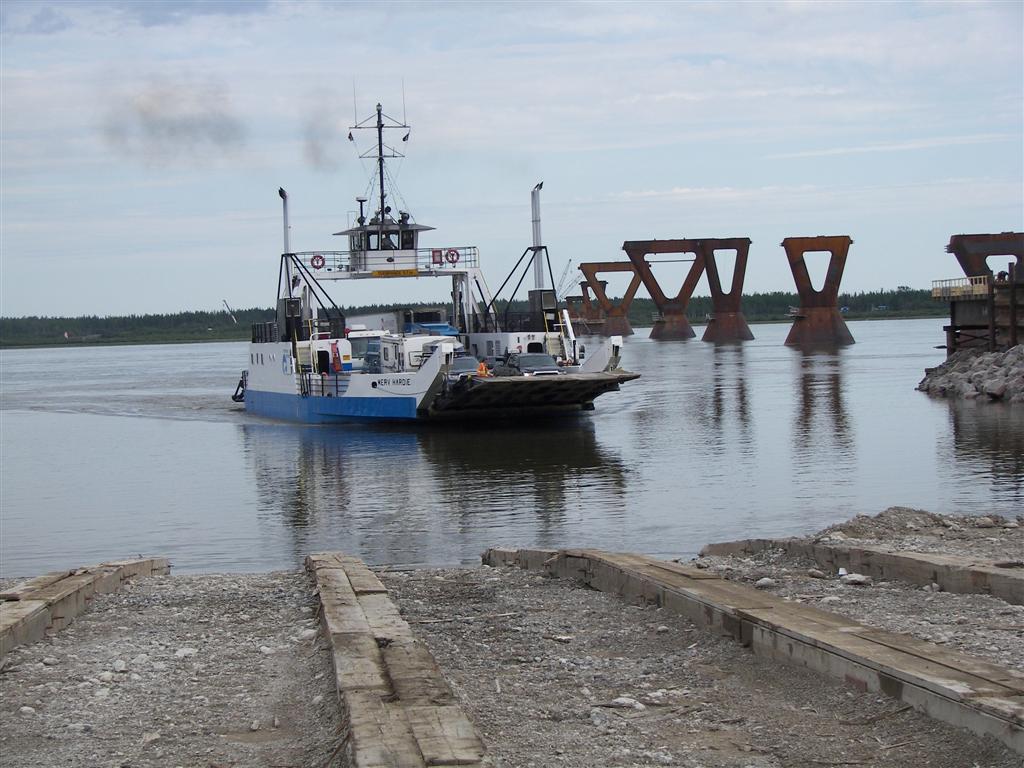
We rolled up and joined the queue for the Mackenzie River ferry. The Merv Hardie is a good sized boat that can hold four full factor trailers. When we crossed, there was only one trailer (parked directly in front of us) and the rest was cars. The ferry runs regularly and has no fee, which is wonderful. As this service is the only connection to the north on ground level, it is well kept and runs smoothly. It takes about 1o minutes to cross the river, and we roamed the ferry for the duration taking photos and stretching our legs. How much longer the ferry will run is in question as the province is building a bridge to replace the summer-only service (over the winter, once the ice sets, people just drive over the river on an ice road, though there is a month or so during setting and melting where the river is uncrossable). From what I understand it has taken years to get to where they are on building the bridge due to frequent workers strikes and short summer season availability, so when it will open is still in the "eventually" stage.


Once over the Mackenzie River, the road was now adjacent to the Mackenzie Bison Sanctuary, which ran about 80 kilometers (50 miles) along the road. We were ready to see some buffalo, and hoped that would happen.

Ft. Providence was the first town, but we decided not to check it out, and stopped off at the Big River service station for some highly priced gas (and a snack). The station had a scary looking motel and bar (the latter was closed, and seemed to have people waiting for it to open). Outside the service station, three local teens sat and smoked, checking out the visitors).


After the fill-up of the car and the emptying of the bladders, we started on our way. Warning signs about buffalo started to appear often. As the visitor's guide says, "...the road is the northwestern edge of this huge range set aside for free-roaming wood bison. They are commonly seen along the highway... Treat these animals with respect; they may look slow and docile, but can move with amazing speed and aggression."
After about 20 minutes, sure enough, there was a bull just calming walking along the road. We drove on the wrong side (keeping attention for any oncoming traffic, which did not come) to give this majestic animal some room, and took pictures as we very slowly passed. I nicknamed him Cheektowaga, in honor of my friend in Buffalo, NY.


A few miles further, we came across a herd. This included a few bulls, more cows, and a number of calfs, who were still nursing. The young ones' horns had not come in yet, but they were starting, as there were black spots where the horns would emerge. The group seemed very nonplussed by our snapping away (we exited the of the car, but did not stray from it in case they charged). Ironically, perhaps, they were lounging across the road from the buffalo warning sign.


After many photos, we kept going, happy and chatty that we had the opportunity to see some wild bison. These wood bison are bigger than the prairie bison more common in Saskatchewan (on farms). Except for the occasional deer and rodent (e.g., squirrels, chipmunks), we didn't see much wildlife on the drive, not counting roadkill.

Just south of North Arm Territorial Park, we pulled over to enjoy the sea of wildflowers that grew along the road. The Great Slave Lake, which we had been circling around since Hay River, could be seen in the background. It was a lovely day that was clear and warm, but not hot. We were all very happy.


After crossing a steel double-hump bridge, we stopped off to check out the settlement of Edzo, located on the shore of Marian Lake (which feeds into Great Slave Lake). It was a small place, and we drove down the road to the river. We passed a couple of homes with tepees in front, a beat-up warehouse, and a series of houses in a row that would become similar sights in many of the towns we saw. From a dock on the lake, we could look back and see the bridge we had just crossed.


And, of course, back on the road, there was the inevitable construction. There is a joke that Canada has two seasons: winter and road repair; this appears to be truer the further north one goes and the shorter the season that infrastructure can be worked upon.

At the next town, a few miles off the main road, the larger Rae (also known as Edzo-Rae, and Behchoko), with a population of about 1500, we decided to drive through, and perhaps find a place to have lunch.

The community hall is run by the local Dene Dogrib Nation. The town was obviously not a rich one, and from what I understand to be plagued with drugs, but driving through it seemed like a peaceful - albeit financial struggling - place.


What I found amusing about this picture is the image of the hawk to scare away birds, and yet there is the seagull resting on the chimney.


This centre/center is run by the community, and is a help space, where the locals can get aid with employment, see counselors, and other social services.
Right next door is a restaurant. We saw it on the way into town, and figured if nothing else turned up, we could go there, which we did. Imagine our surprise when we entered and found out it was a Chinese restaurant. Along with general food, such as "pizza" and whitefish (which is what we three chose), there was also a range of Chinese cuisine. I found the restaurant interesting in the mixture of First Nations and Chinese imagy side by side. Most of the former material was for sale, the latter not. We did not buy any souviners, but we did enjoy what we ate. To be honest, we were a bit nervous about eating fish, but it proved to be pretty good (battered and deep fried). The gentleman who runs the place, who is also was the cook, is friendly and accomodating.


Back on Highway 3, you'll never guess what we found...
After we had passed over the bridge near Edzo, the road was surrounded by more and more large rocks, much of which had been blasted through to make way for the road (as is common to see in the Catskills and the Burkshires). We were entering the Shield.
There were signs warning of bears, but we never saw any, even on the side of the road. I had seen bears years before in Jasper (Alberta), and knew what to do: stay in the damn car!
Finally, we reached Yellowknife, and the first thing we did was to go to the campgrounds to set up, before going into town to explore and pick up some provisions. We went to the Fred Henne Park Campgrounds, which is right by the airport just on the outskirts of town. It was actually a very lovely spot. We were right next to a huge rock formation. John and I went climbed over the rocks and found ourselves at a beautiful beach, right on the campgrounds property (though we found out it was easier to walk around the rocks in the future, as the entranceway near us was locked, so we had to go to the far side to get in). Long Lake Beach is a private one, but anyone could buy a day pass, and many locals did just that.
Just beyond the far end of the fence is the rock formation that was near our tents.
We were worried about this guy sleeping on the beach. He was pale as a ghost, and we were speculating that he was going to be hurting when he woke up. But the seagull was certainly happy for the chance to grab some chow while he napped.
We took the Old Airport Road (aka, the long way) into Yellowknife so we could go all the way down the main road, Franklin Avenue, and see as much of the town as we could. We drove straight through downtown, and saw that the core was actually a pretty modern city with a population of about 20,000. We drove east, towards what's commonly known as Old Town.
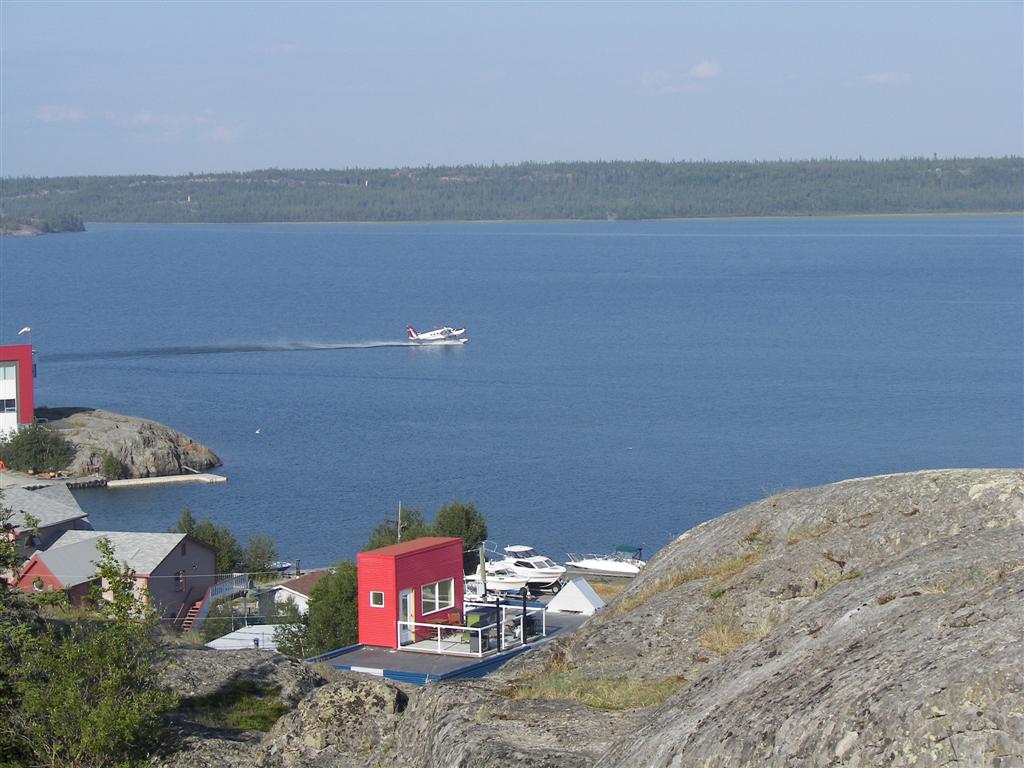
Old Town is at the west end of a peninsula, and continues over a bridge to Latham Island, also known as Ndilo, a Dene-dense area. Just over the bridge in Ndilo, we got a little confused by the one way streets, and ended up at a dock on Mitchell Drive, which was actually a beautiful spot on the south shore. There was a dock filled with boats and seaplanes. Tindi Air is the main airline servicing the areas outside of the city, only accessible by plane in the summer. The seaplane below was being loaded up for a camping trip (note the canoe).
This building looks like it's sliding down the hill, but it is actually built that way (note the windows on the side). We were saying we would love to see the inside, and how it is designed. There is a lot of interesting and innovative construction in this city.
Seaplanes were abundant, as were houseboats.
Great Slave Lake is a tourist haven in the summer, with camping, boating, and hiking available. We were doing the sightseeing part, though we all agreed we wish we had the time to take some of the hiking trails. It was about 27C / 80F degrees while we were there.
Crossing back over the bridge onto the mainland, we stopped at the Pilots Monument, dedicated to avaitors who helped build the northern areas. Generally, it is known simply as "The Rock" (I'll wait while you work through your Dwayne Johnson puns). It is one of the highest natural points in the city, and the view is spectacular, and worth the climb.
The monument at the top is subtle, and modern looking (this version of it was installed in 1999).
This is looking back at the dock where we took some of the previous pictures (below the red and white Tindi Airlines building), and in fact, the plane taking off is the very one we saw getting loaded.

The view to Lathem Island in the east shows more rocks, a smaller community, and lots of water.
This view is western, leaning towards the south. Downtown can be seen in the distance, beyond the harbors for the recreational and fishing boats. The rest of The Rock dominates the bottom of the image.
To the south is the large Jolliffe Island, with smaller islands beyond, all of which are accessible only by boat (during the summer). The islands are scattered with small houses, and houseboats are a common site, in all shapes and sizes.


A woman and her dog gently and lesiurely paddle their way back to the mainland.
The Rock is one of the major tourist spots in the area, and rightfully so. This is one of my favorite pictures that I took in Yellowknife, also known simply as YK.
Another tourist magnet, very close to The Rock, is the Wildcat Cafe. It is a wood cabin restaurant that was built in 1937, serving the local population and pilots. After some repair in 1976, it was reopened as it appears today, a hotspot attraction. We decided to go in and check it out. It was hot and musty inside, with about six long and shared tables. There was one small table near the door and we grabbed it. A waitress came over for our order and I chose an iced tea, while John and Ian inquired about varieties of beer available. "Will you be having lunch as well?" she asked. When they said no, she informed us that we could not be served alcohol unless we had a meal, as well. So we left. I was not sorry to go, as I could see the beer was $10.50 a glass. Seems the Wildcat Cafe is also a tourist trap so they charge premium prices for a place that is crowded with no air conditioning. I don't mind touristy places, but cannot stand when they charge a premium for the "priviledge" of eating there. You hearin' me T.G.I.Friday's in Rockafeller Center (NYC)?!?!


As we drove back west down Franklin Ave. towards the supermarket, we found that even here there are tools. Check out the license plate:

In case you can't make it out, it says: "for you to envy." My response? For you to bite me.

After picking up some veggies, fruit, and the like for dinner at a supermarket on Old Airport Rd, we went back to the campsite. As we had our supper, a raven called out from the tree across our way. After we ate, we decided to walk back down to the beach, as it was getting late (around 10 PM). The sun was low, but would not set for hours yet, but it gave us a longer "golden hour," as the light shone though the flowers along the way.
We were not the only ones who decided to take in the late hour at the beach, as it was not crowded, but there was still plenty of people enjoying the longer day. Unfortunately, this also included some noisy jet-skiers.

The birds were making short work of the munchables left at the blankets while the people were in the water.
There was a sudden loud noise above us, and I swung the camera up just in time to get this shot of a plane heading toward the Back Bay of Greak Slave Lake, just over the ridge. Fortunately, as with many small cities, flights usually start more in the morning than in the evening, so we were not disturbed by the planes as we slept, even though we were right near the airport.
It was the end of another beautiful day.
We had driven 436 K / 271 miles today (including around town) and had come a total of 2244 K / 1394 miles so far on this journey. Tomorrow would be the half-way point, when we stay in town and explore a bit more of Yellowknife. It will be the only time we remain camped in one place for two nights in a row.