The way one approaches a space can be affected by its
history, and especially time. It can also be warped by our own perceptions of
context.
We have all visited museums, a place where objects are
taken out of its original space/framework, and placed in an unrelated location
where it becomes a collection of objects, often transforming it into something
else devoid of meaning. For example, at the British Museum,there are a number of dead bodies on display,
from the “Bog Man” (also known as Lindow Man) to Ancient Egyptian mummies. Museums
can be, in fact, cemeteries, but because there is no tomb, no hole in the
ground, the meaning of the persons’ life and especially death, becomes trivial
for the observer. Their existence transforms into a museum art object rather
than the corpse of someone who had a life that was either recognized or not at
its time. But more about this later.
In 1993, while my partner was at a conference in
Washington, DC., I visited the newly opened Museum of Jewish Heritage –
Holocaust Museum. Being the age I am, and that I grew up in a neighborhood with
Middle-Class Jews like myself, the Holocaust was not unfamiliar to me: for
example, the couple who ran the local grocery store of my childhood had numbers
tattooed on their forearms. As I managed my way through the museum, I saw the
edicts showcased on the walls, the photos and videos strewn here and there, and
felt, honestly, nothing much. It was all so out of context, bright and shiny,
soaked in neon lights, and familiar at the same time.
Making my way along the pathway, it took me through a
boxcar, one that was used to transport the Jews to the death camps. As soon as
my foot hit the bare wooden floor, suddenly everything changed. I was no longer
in a museum, but in an actual place. Truthfully, I immediately felt different.
The context had changed. No longer was it images posted on a wall, or videos on
closed circuit televisions, I was in the place. Frankly, it took me by
surprise, how uncomfortable and disoriented I felt about my surroundings. When
I crossed to the other side, and stepped back onto the polished linoleum museum
floor proper, the feeling instantly vanished. Deep down, I did not understand
what happened, or what intergenerational trauma was at the time.
During the Summer of 1998, I had the opportunity to
visit the beautiful city of Krakow, Poland, the buildings of which mostly were
untouched by World War II. Charming houses, squares, and parks are for the
locals and tourists on which to marvel.
From Krakow, we took bus tours to various
destinations, such as a 22-minute ride southeast to the Salt Mines that were,
indeed, turned into amazing works of art.
We also went to Auschwitz, the German death camp,
which was an hour west of Krakow. I was surprised by how green it had been
transformed. Rather than keeping it in the state of mud and dirt that pervaded
it while 1.1 million Jews, gays, Gypsies, and political dissidents were
systematically killed, the land was full of grass and flowers. I found that odd
and almost uncomfortable that they would try to make it peaceful, like it was a
living non-sequitur.
During the tour of the camp, some of the buildings
were filled with luggage, others with hair, shoes, or eyeglasses, and the like.
I noticed at least three bags that had the name “Weiss” on it. In grade school,
I had a friend named Joel Weiss who lost much of his family to the camps, and I
wondered if any of these belonged to them.
There was a lot of unease, as one might expect in a
place like that, but it was more the way the space was projected and described.
At one point, we passed a wall that had been used as a backdrop to a firing
squad to execute people. Our tour guide, a middle-aged woman, pointed to it and
said loud and plain, “Against this wall, they shot the great Polish martyr [his
name].” And then in a lower, quick voice as if it were secondary, “And 10,000
Jews.” Going to another building, there was a cell, and she announced, “In this
cell, the great Polish poet [his name] was tortured and brutally killed,” and
again lower, “…and 30,000 Jews.” I found it quite startling.
Towards the end of the tour, we approached the gas
chambers. I stepped inside, and for a few moments, I was the only one in there.
It was quite profound for me, looking around this surprisingly large room with non-functioning
shower heads and numerous finger scratchings along the walls. This felt
incredibly visceral to me, and I had the thought, “If I was here in the 1940s,
while I would have been conscious walking in, I would not be aware going
through the back door,” which led to the crematorium.
I stepped through that back door and there was a
younger couple already ahead of me. The woman was pointing to the oven like
Vanna White when she just-turned a letter on “Wheel of Forturn,” with a big grin
on her face, while her boyfriend was taking some vacation snapshots. I was
appalled, and my partner and I had a long talk about it on the bus ride back to
Krakow.
What I have come to realize is that there is a
difference between the space in a museum and the actual location where an event
happened. A museum tends to be safe, its dangerous material like weaponry or
other material of a violent past is removed from context, and it becomes benign,
turned into artifacts. That certainly is its goal, I would wonder.
Despite it being before the big Internet boom, that
young couple who were taking the vacation photos in the crematoria was
separated from that real/museum dichotomy, and did not really comprehend the
difference. They had grown up with museums, and for them, this was merely one
of them, a site they had probably heard about in class from teachers that were
as far removed from reality as the tour guide. That’s part of culture, that the
Other is distanced from the every day. There was no connection for them as
it was for me, who had also lost family to this death machine. It went beyond
mere history books to a personal, instinctive
level for me, but not for them.
Since moving to Saskatchewan, I have wondered if the
local First Nations and especially Metis people have that intergenerational trauma experience when they
visit Batoche, the site of the Louis Riel Rebellion of 1885, or the stone
circles near Eastend left by First Nations peoples who were starved by the North-West
Mounted Police. Do the Settler generations react the same as that couple, that
it is a story from a book, even though they are in the actual spot where a
rebellion occurred? Do the tour guides discuss the brave Canadian soldiers, and
blithely mention the genocide that let up to the rebellion?
It is all in the context of the place and how it is
approached as either a museum or a location of angst. It is also in the perspective
of the person viewing it, and their relationship to the events, if any. In her 2012
book, A Geography of Blood, I believe that author Candace Savage, though
of Settler stock, was tuned in enough to the land to realize of what the rock
circles were indicative. If I went to Batoche, I am not certain I would feel
that, but I would hopefully be more aware of my consciousness and take a check
on my own placement in its violent history.
It should be noted that I did take a single picture of
myself on the grounds of Auschwitz: on the way out, I stood under the gate sign
that reads “Arbeit Macht Frei” (work will set you free). I did this in
defiance, to say in my own way, “You didn’t get me, you Nazi bastards!“
Note that these reviews are alphabetical by first
letter, and not listed in a “ratings” order.
Albums:
James Lee Stanley & Dan Navarro All Wood
and Led
www.allwoodandled.com This
release is just part of a series of covers of classic rock songs, where the
“wood” represents acoustic guitars, which have included albums of material by
the Rolling Stones and the Doors (both previously reviewed on this blog). As
Navarro says, “With absolute respect and admiration, we chose not to simply
duplicate the originals, but instead imagined, ‘What if Led Zeppelin had lived
in Laurel Canyon in 1967 instead of England?’” The folkie soul in me is quite
satisfied with the rocker part of this collection. While not a popular opinion,
I was never a Zep fan, and honestly, a lot of this material is new to me for
that reason, giving it some virgin ears. They nail such classics like the
obvious “Stairway to Heaven,” “Whole Lotta Love” and “Dazed and Confused,” but
they also do a stack of non-radio saturated numbers like “Good Times Bad Times”
and “Hey Hey What Can I Do?” True to their word, they reinvent the songs to
their own spirits and it works out incredibly well. The Doors was a pretty easy
translation, and the Stones’ blues riffs fit quite well into the model, but Zep
is more of a transition, but the hand-to-glove still works in surprisingly good
ways, mainly due (in my opinion) to Zep’s use of Olde English melodies in rock
form, such as “The Battle of Evermore.” If you are either a folk fan or a
curiosity seeker, this may meet your needs on multiple levels. Full sample song HERE
Nine Pound Hammer When the
Sh*t Goes Down
www.acetate.com As the
sticker on my CD clearly states, “Original members Blaine Cartwright and Scott Luallen
team up with Ramones Super-Producer Daniel Rey.” Who in my shoes could not have
their curiosity piqued? Especially since I am not very familiar with the Kentucky
cowpunk (their description) band. I must say, after most of my life being force-fed
Southern Rock like Skynyrd with the occasional good stuff like Rank & File and
Nashville Pussy (which shares Blaine as guitarist), this is so refreshing. From
the opening, using a clip of Mel Blanc’s Foghorn Leghorn, you know they don’t
take themselves too seriously (meant in attitude, not aptitude). Starting strong
with “What Kind of God,” and especially the second, title cut, you can
definitely hear the Rey influence as the sound is laid bare and stripped,
though Cartwright’s guitar flairs brilliantly here and there. It’s almost like
the Ramones zeitgeist if they listened to country rather than surf and girl
groups. At gut-wrenching speed, most songs are quite short at about 2:30, with
a couple being longer. Their mindset can be seen in titles like “Street
Chicken,” “Mama Lied,” “Billy Lost His Feet,” “Get the Hell Off the Farm,” “Daviess
Co Tractor Massacre,” and “Lizard Brain.” I know I haven’t gotten the full
effect of the lyrics yet, but this one is so much fun and kicks so much butt, it
will certainly be replayed, so I’ll get there and enjoy the ride. Just wish there
was a lyric sheet included. Full title cut can be heard HERE
Yod Crewsy The
Longings of Paul Roalsvig
www.darkmarbles.com Before he
was in bands like the Splatcats, the Sky Cabin Boys, the Dark Marbles and the
Bernie Kugel Experience, Yod was known by his birth name, Paul Roalsvig. This
two-disc collection is split into a “Love” group and “Peace” selection. There
are 31 cuts in total, being a mix of covers both infamous and obscure, and
originals. Some of Buffalo’s musical royalty appear on here, such as Dave
Meinzer, Russell Steinberg, and Cathy Carfagna. He starts off strong with
Icehouse’s “Crazy,” which follows one of Yod’s personal favorites, the poppy
theme to the film “That Thing That You Do!” Third cut in is when we get our
first original, “I’ll Keep Sending You Flowers,” proving that Crewsy knows his
way around creating both a melody and a strong lyric. Of course, I won’t be discussing
all the cuts, but will pick and choose. His cover of the Stones’ “Dead Flowers”
is almost projected through a folk lens which actually works quite well. More
somewhat obscurities with Dylan’s bluesy “I Threw It All Away” and the Monkees’
“Sometime in the Morning,” and then a deep version of Orbison’s classic “In
Dreams.” The more folk-oriented Peace disc starts off with one of my fave
tunes, “Eve of Destruction”; here it is handled more folk pop leaning towards
the Turtles cover rather than Barry McGuire, but the stanzas are intact. Included
are masterful covers such as Dylan’s snarky “With God on Our Side” (banjo led),
Nick Lowe’s “(What’s So Funny About) Peace, Love and Understanding,” and a raucous
Five Man Electrical Band’s “Signs,” But the gem here is the back half of this
second disc that is solid originals, including “Edie” (about Edie Sedgwick) and
the timely ballad “When They Stormed the Capital.” Full sample song HERE
Singles:
Chesty Malone and the Slice ‘Em Ups Turn to
Crime
1332 Records / www.chestymalone.com/ Despite
moving relatively recently to the hinterlands of Pennsylvania, CMatSEUs have
lost none of their drive or appeal. The main focus is still vocalist Jacqueline
Blownaparte and her partner in – er – crime, guitarist superb
Anthony Begnal, with a new bassist and drummer. Their aggressive hardcore both
brings reminiscence of the 1980s style of in-your-face madness with a touch of
harmonies that do not fall into the wishy-washy ‘90s Green Day kind of fluff. What
I especially like about the chorus is that it can be both chantable, and can be
used in the fist pumping way to build up adrenaline for the mosh pit (or in
lieu of it; I’m old enough to be a lieu of person, but I digress…). Possibly
the best comparison would be the flavor/attitude of the Cramps mixed with the
influence of the likes of GBH. This is just one side of their new single (7”-er,
remember them?). This is some of the better post-hardcore sound I have heard in
a while, and a high mark even for them, and they set the bar high. Can be heard HERE
The Dictators “Let’s Get
the Band Back Together” 2:25 minutes Dictators Multi/Media I have liked the Dictators (DFFD) since I heard their
introductory album, and even more when I saw them live (CBGB in 1975) for the
first of multiple times (including at The Bottom Line, The Left Bank, and
Irving Plaza). Over the years, HDM got most of the attention, but I always
thought that the songs Andy/Adny Shernoff voxed were amazing, as well. They had
a style that was metal and could be juvenile at the same time, which was part
of their charm. Songs were singalongs and often brilliantly silly (such as
“Master Race Rock”), but they could also be profound (“Steppin’ Out”). Over the
years through various incarnations of the band, they are back, with Andy on
vocals and bass, ace metal guitarist and right winger Ross “The Boss” Friedman,
Albert Bouchard (ex-Blue Oyster Cult) on drums, and for this recording, the recently
late, great rhythm guitarist Scott “Top Ten” Kempner. This song feels, in tone,
like it could fit somewhere between the first and second album. The “C’mon” in
the chorus, sung by Manic Panic/Sic F*cks’ own Tish and Snooky Bellomo, is
certainly chantable, layered with Andy’s New Yawk accent, sounds like fun. The phrasing
of the song is a bit melodic rock, even with Ross’s solo burst, but with
its occasional hint of early rock’n’roll on some parts, it is definitely an
enjoyable listen. While I look forward to the full album, as an aside, after
you have heard this Dictators’ song, it is also worth hearing an earlier, more
pop solo Shernoff version of it from almost a decade ago HERE. Full song can be heard HERE
Gary
Louris “Almost Home” 3:31 minutes https://orcd.co/jumpforjoy This
travel song has a nice “hoo-hoo-hoo” chorus to sing along with, with it’s poppy
and upbeat singer-songwriter tone. Of course, as should be, the rhythm is
steady like the wheels of the car (truck?) humming along a highway, not too far from
the final exit. Louris’ vocals fit the sound so well, and the video that
accompanies it is arty without being obtuse. It’s as simple as the driving beat.
Humorously, I wonder about the line “When I close my eyes, I see your face…”
Err, aren’t you driving? Still, the chorus is extremely catchy possible earworm
and a hoot. A good listen, but that should come as no surprise as he was in the
seminal band The Jayhawks, and a founding member of “supergroup” Golden Smog. Can be heard HERE
Text by Julia Masi / FFanzeen, 1985 / 2021 Images from the Internet unless indicated
Miki
Zone Sings Gene Pitney
This
article was originally published in FFanzeen, issue #13, dated 1985. It was written
by Julia Masi.
The Fast essentially
went through four phases, starting in the early 1970s and ending well into the
1980s. At the core of The Fast were three Brooklyn brothers: Armand “Mandy” Zone
(keyboards, vocals), Miki Zone (guitar and vocals), and Paul Zone (vocals). The
first phase was before Paul joined the band; I saw them play the bandshell in Prospect
Park around 1973 or ’74. Next was the Fast’s golden era (in my opinion), when
they were on the Live at
Max’s Kansas City album, doing songs like “Kids Just Wanna Dance,” “Boys Will
Be Boys,” and “It’s Like Love.” The third was after Mandy left to form his own
band, Ozone, when the Fast became more metal and leather based. They did the
same songs, but a lot stronger without Mandy’s pop synth. The last was when
Miki and Paul became a Eurobeat twosome with a strong gay focus called Man 2
Man (though originally called Man’s Favorite Sport for a brief moment).
Through
all this, Miki’s guitar was a fireball, as he mastered the craft and he became
one of the most underrated guitarists on the New York scene. Not surprisingly,
he became bored playing the same notes and the same songs, so he would improvise,
such as using the eraser ends of pencils to play rather than a pick.
Miki also
had some side gigs going on, with a solo project of singing the songs of the
great Gene Pitney (d. 2006). Miki died in 1986, and Mandy in 1993. – RBF, 2021
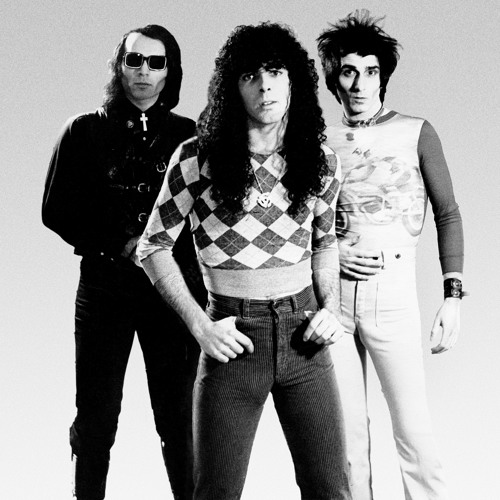
Miki Zone in The Fast (photo by Robert Barry Francos)
In any medium, the most difficult part
of performing is interpreting someone else’s material, so that it remains fresh
and intact, while still allowing individuality and talent to surface. In an era
when cover songs are the junk food of our musical menu and “incredible
simulations” infest the stage and screen, it’s rare and refreshing to find a
performer like Miki Zone, who honors his idols without imitating them.
Last Spring, Miki Zone’s Gene
Pitney Review slipped into the New York club circuit without enough
fanfare. It’s a short (approximately one hour) cabaret act that’s campy, classy
and reveals another side of Miki: his voice!
It shouldn’t surprise anyone that Miki
can sing. Nothing he does should surprise his fans after all the musical styles
he adapted and discarded over the years, with his brother Paul, in The Fast.
But throughout his career, he’s always been known as an instrumentalist and
songwriter with a distinctive style. A style that, unfortunately, has yet to be
rewarded in the mainstream markets.
Gene Pitney in his heyday, was very
heavily absorbed into the mainstream. He is most often remembered for “Town
Without Pity,” but he also wrote several dozen Top-40 tunes for himself and people
like Roy Orbison, Rick Nelson, the Crystals, and Steve Lawrence. He had a
country hit with George Jones, as well as numerous hits in foreign countries
that he sang and recorded in almost every language.
Mandy Zone, Paul Zone, Miki Zone
According to the fact sheet that Miki
graciously compiles for interviews, Pitney “played all his own instruments on
his first single, “I Wanna Love My Life Away,” and would over-dub seven of his
voices on the record.” The most interesting item on the list, however, claims
that he was “an amateur taxidermist,” a hobby that probably fostered many weepy
love songs. He dropped out of the public eye about a decade ago and, since
then, there have been only vague rumors concerning his whereabouts or career. [Ed.
Note: Pitney died after a performance in Wales, and is buried where he lived in
Connecticut. – 2021]
“I don’t want to be a messenger to the
masses,” explains Miki, “but it feels good to have people react to the things
that they like.” Part of the reason why this act is entertaining is that you
don’t have to be a die-hard Pitney fan to appreciate it. In fact, you don’t
even have to know who he is to enjoy it. The set is filled with familiar, catchy
pop ditties that have been nestled in the cobwebs of our brain for ages. And
Miki is not a Gene Pitney clone. He may be able to croon in the same key as the
eclipsed star, and dress in the elegant smoking jackets of that era, but only
the blind could confuse their faces. Miki’s eyes are riveting. They’re like
tiny, brown computer screens beaming with information until he hears a dumb
question, then they abruptly shut down to an icy darkness. Luckily, a sincere
inquiry – like why would a talented songwriter want to sing someone else’s
lyrics – flicks their light switch back on.
“I’ve got a big romantic part of me
which I’ve never brought out in the music, which I’m starting to do now. I’ve
written a lot of things like that which I’ve never performed. I’ve never used
them in any of my past groups.
“I always had an affection for… would
you call it torch singing? Or crooning? Not crooning like Alfalfa, but like, crooning
like the way Gene Pitney did it. He could sing a rock song like “I’m Gonna Love
My Life Away,” or “Hello, Mary Lou,” and he would also sing a ballad like “Town
Without Pity” or “Half Heaven, Half Heartache” and still make you wanna cry.
Those emotions used to amaze me in any singer, even female singers like Dusty
Springfield. People like that amaze me with the way they can milk all your emotions.
I always felt that I could do that. Wanted to do that. And that’s what I’m
doing. I used to try to emulate his voice. I used to be able to sing like that
for years, but I never had a chance to sing in any of my rock bands. I never
would sing. It was always up to my brothers (Paul and Armand) to sing.
“The reason I am doing Gene Pitney is
it’s a tackling thing to do. He’s got an amazing voice. I’m not saying I can
sing like him, but I hang in there with the notes, and I’m proud of that!
“There’s a lot of things in me that I
don’t want to have to be Miki Zone to keep on changing them. I’ve changed many,
many times over the years. I’ve put The Fast through heavy metal, through
glitter rock, through pop, through punk, through many different things. What I
did wrong, I’d say, is that it should have been a different group each time.
That would have saved a lot of problem and a lot of egos, and a lot of people’s
confusion. I should have called it something different every time I went in a
different direction. I have a lot of those ambitions to do different kinds of
music and I don’t want to be stuck under one name doing it. I’m not in the position
of David Bowie, where I can do what I want and still be the chameleon. I have
too many other things in my head that I want to do and be. I think I can do
them under different titles, ‘cause none of them will step on each other.
Gene Pitney
“The Gene Pitney thing is just the
beginning of the acts I’m gonna do. I think I’m gonna be doing a couple of
other acts of different people’s materials; other singers, because I like to
sing as much as I like to play an instrument. And I just want to get it out of
me. It’s just satisfaction for me. Maybe it’s ego, too, to see people enjoying
me doing things. I’ve got the best reactions, I think, ever in my career, since
I’ve been doing the Gene Pitney thing, just through the response of people.
“I’d rather have different outlets for
different things. And if one of them works out better than the others, I’ll
follow that one up. But me and my brother will always work together.” Paul and
Miki now have a band called Man’s Favorite Sport. Paul is very supportive of
his brother’s solo endeavors, and usually helps out with the lights.
Although he’s trying to keep the identities
of his other solo personas a secret, Miki has mentioned that one of them will
be Bruno Beats, an original character who sings all of Miki’s “romantic, lush pop
things. It’s going to be very pop, maybe ‘60s. All the things I wouldn’t use in
the group.”
“What Walks There Walks Alone”: A
Comparison of Shirley Jackson’s The Haunting of Hill House and Robert
Wise’s The Haunting
While going
for my advanced degree in Media Ecology at New York University, I took a class
with Professor Joy Boyum, “Fiction into Film,” and wrote this as a report. It matches
one of my favorite books with one of my best-loved films. The paper is dated
May 5, 1993. Please note for those who have neither read the book or viewed the
film, there are spoilers.
Clown:
“O mistress mine, where are you roaming?
O, stay and hear, your true-love’s coming.
That can sing both high and low
Trip no further, pretty sweeting;
Journeys end in lovers meeting.
Every wise man’s song doth know.”
– Twelfth Night, Act 2, Scene 1
Robert Wise’s direction of The Haunting (1963),
an adaptation of Shirley Jackson’s The Haunting of Hill House (1) (1959),
remains one of the more memorable psychological supernatural thrillers brought
to the screen. The film’s success has much to do with the cinematic elements
brought to the story as the tale itself.
Wise’s choice to not show the apparition(s),
with one brief exception a heartbeat long, is an effective tool for presenting
a stronger psychological narrative edge to the story that perhaps might have
been lost if he had chosen the easier “fright” route of wraith effects. The
doorknob jiggling and mysterious hand-holding is all the more convincing because
of the riddle of who or what is roaming the halls of Hill House.
Wise also emphasizes an element of
claustrophobia that is sometimes lacking in the novel. Jackson places much of
the action during the day on the grounds and hills surrounding the house;
invisible footfalls in the grass appear less horrific. Wise, however, used the darkness
of mahogany interiors, earth tones and shadows to give the viewer a sense of
entrapment and depraved evil. Once the lead protagonist, Eleanor, arrives at
Hill House, the only outdoor scenes are two on the terrace (first in daylight,
then at night) and two on the grounds, by the front door, when Mrs. Markway
arrives (day) and Eleanor’s final departure from the house (night).
One of the perplexities of Hill House is the
way the house is designed. Eighty years earlier than the story is set,
the house’s architect, the overbearing Hugh Crain, build a structure that was as
distorted and enigmatic as its contriver. Wise sets a somber tone through the
use of quick, jerky editing and especially irregular camera angles to reveal
the skewed house design and a conundrum of doors that shut themselves (by
design, not spirit).
The key theme of the film, as well as the
novel, is loneliness. Both are introduced by a prologue (narrated on film),
“Hill House, not sane, stood by itself against its hills, holding darkness
within… and whatever walked there, walked alone.” Entering into this dark
isolation are four characters, each lonely in his or her individual way.
Eleanor Lance (Vance, in the novel), played by Julie Harris, arrives after
years of isolation spent taking care of her domineering and sickly mother.
Eleanor views her stay at Hill House as a chance to flower, to belong. In the
novel, she repeatedly utters a line from Shakespeare’s Twelfth Night: “Journey’s
end in lovers meeting.” Though this is only quoted once in the film, the theme
remains the same: there is a sense of love’s absence, of a desire to find a
place in the universe where she is her own person, accepted by others for who
she is. Eleanor has no real home (she lives with her sister’s family), no one to
love, and no one to love her.
There is an almost claustrophobic feel of
dread and naivete about the world within her, as she created a dream life of an
apartment of her own with matching stone lions on the mantlepiece. Eleanor is desperate
to fit in and gain back what she believes she had lost through many years of
solitude.
The future owner of Hill House, Luke Sanderson
(Sannerson in the film, played by Russ Tamblyn), is also rejected by his
family. His lonely past has produced a “liar…also a thief.” The novel presents
Luke as an in-depth character who is a scalawag, but also has a heart, and is
merely acting out of his sadness and need to be accepted. He is presented as
the first possibly lover at “journey’s end” for Eleanor. In the film, however,
he remains undefined, reduced to comic relief.
Whereas in the novel, Dr. John Montague
(Markway in the film, Richard Johnson), who leads the supernatural “expedition”
into the house, is known by Eleanor to be married from his first introduction;
this fact is hidden from her in the film, setting up a possible liaison between
them. Is John the lover at “journey’s end”? Many of the romantic actions taken
by Luke in the book are given to John in the film, such as offering a steadying
hand to Eleanor as she looks up at the tower (nearly toppling over a balcony),
or rescuing her from the shaky ladder in the library. The novel presents John
as lonely, due to the shrewish nature of his wife, unnamed except as Mrs.
Montague. She is presented as a person who has no regard for her husband’s methods,
dismissive of Montague as a person, self-promoting, and a supernatural
“expert.” The film merely hints that John is lonely, and might end up in
the company of Eleanor.
A subplot of possible lesbian romance is then
presented by the last of the four main characters, introduced by Theodora
(Claire Bloom). This theme is interjected in the novel as Theo arrives at Hill
House after a painful fight with her “roommate,” feeling dejected and somewhat
bitter. In the film, Theo’s orientation is broached through dialogue, presented
more as the reason for her loneliness: “By the time I’m through with you
Nell, you’ll be a different person”; elsewhere asked what she is afraid of, Theo
responds, “Of knowing what I really want.” Her sarcastic manner is treated as
rooted in the sexual orientation, as well. Though Eleanor is repulsed by
Theodora’s sexuality in the film (“The world is full of inconsistencies.
Unnatural things. Nature’s mistakes, they’re called. You, for instance.”), in
both the film and the novel, Eleanor eventually wants to go off and live with
Theodora. The author posits this as another possibility of “journey’s end where
lovers meet”.
A third theme of the story is that of
parental/daughter relationships. Although Hugh Crain designed the house, he
barely resided there, and eventually died in Europe. It is his warped vision
that dominates the house, however, with a malevolent (male-violent) influence.
His evil is that of control. Even in designing the house, he materialized his
own vision rather than relying on others, with skewered angles and unmatched
lines, going against architectural conformity to express his will. It was with
this will that he ran his house while occupying it with his daughter(s). His
religious fanaticism, which evolved from his bitterness over his wife’s/wives’
demise led him to warn his daughter, “Honor thy father and thy mother,
daughter, authors of your being, upon whom a heavy charge has been laid, that
they lead their child in innocence and righteousness, along the fearful narrow
path of everlasting bliss…” Though his physical presence in the house was
minimal, his influence remains, and it is this warped domination which seems to
affect the weakest of those who enter the house, subduing them to the power of
his control.
Hugh Crain’s malevolence is directed at women.
All who die at Hill House are women: first the wife of Crain, who is killed in
an accident on the grounds before even viewing the house; second, their eldest
daughter (only daughter in the film), Abigail (Sophia in the novel), who dies of
pneumonia at an elderly age in her bedroom, the nursery (“the heart of Hill
House”), while her young servant/companion “dallied in the garden with some
village lout”; third is the companion, who inherits Hill House, who hangs
herself in the library. The last woman to die is Eleanor herself, a possible suicide
who seeks to remain at Hill House, under the influence of the evil will of Hugh
(2) Crain.
There are overlapping images in the context of
the story. An example is that both Eleanor’s mother and Hugh Crain’s daughter
die while banging on the walls for help. This “mother/daughter” parallel is
further mirrored by Eleanor’s guilt over presumed negligence in having slept
through her mother’s knocking, as did the companion, who “dallied” while her
mistress died in distress. Both Eleanor and the companion become obsessed with
the house and the staircase in the library. Both eventually commit suicide. Similarly,
Hugh Crain’s wife died without ever having entered the house, whereas Eleanor
dies driving into a tree at the same spot on the grounds so she does not have
to leave.
In Wise’s vision even more than Jackson’s,
Eleanor is treated by all as a woman-child, though she is in her early 30s,
because of her innocent and cloistered life. In a scene where she is seeking
permission to use what is essentially her half-owned car from her sister’s
family, the relatives reject her request because they view her as childlike and
consequently irresponsible. This scene is dramatized while a child’s melody is
played in the background. Also, throughout the film, again more than the novel,
Theo often calls her by the nickname “Baby,” sometimes in a patronizing tone.
This, of course, reflects back to the nursery, the heart of Hill House, which
has been collecting victims for years. The inflection is present in the novel,
but in a more subtle, sardonic way.
The characterization that is most changed from
novel to film is that of Mrs. Montague (named Grace for the film, played by
Lois Maxwell). Whereas she is a totally disagreeable character in the book
owing to her obnoxious ego and dismissal of concern for nearly all others, the
cinematic version lives up to her first name, presenting her as a strong and
decent person who is unintentionally triangled between John and Eleanor. In the
movie, Eleanor suggests Grace sleep in the “evil” nursery in a pique of jealous
spite, while in the novel, John makes this suggestion because he is acquiescing
to his wife.
Two other characterizations that are altered
from the original source are those of Dr. Montague/Markway and Luke Sannerson/Sanderson.
In the book, Montague, while the leader of the psychic exploration to Hill
House, is seen as a three-dimensional character who is sometimes flawed and
always human. In the film, perhaps because he is presented as a potential love-interest
for Eleanor, Markway becomes a near-swaggering Petruchio-type hero; one can
almost her him slap his knee in self-righteousness. Luke, on the other hand, is
treated the opposite: whereas Montague to Markway comes from human to hero,
Luke Sanderson to Sannerson goes from possible love-interest to practical
joking comic chorus.
An obvious problem in adapting the novel to
the film would be similar that of any phycological drama, the inner narrative
voice. Thought processes are the crux of psychological drama, as the
protagonist struggles with distressing events, and the consequences that are
faced become more severe. Wise takes the most direct approach, and has
Eleanor’s thoughts presented via voice-overs. Though this may be a potentially
overbearing and distracting technique, Wise uses it to optimum effect, holding
back and letting the actor’s expressions tell us of her own inner turmoil in particular
scenes, while voice-overs detail the trauma in others.
In the novel form, the horror story, be it temporal,
spiritual or psychological, has its work before it. Unless the subject matter touches
on the personal fear of the reader, such as something/someone hiding in a
closet or a phobia, like fear of heights (e.g., Vertigo, 1958), the
printed word needs to be worked harder to be shocking, especially to those who
grew up watching film. Historical horror novels such as Mary Wollstonecraft
Shelley’s Frankenstein (1818) or Nathaniel Hawthorne’s “Rappaccini’s Daughter” (1844), were
written when there were no moving images that could shock with a sudden “Boo!”,
so the imagination of the reader of the stories is needed to be able to
horrify. Present-day writers such as Clive Barker and sometimes even Stephen
King manage to frighten, but their shocks come from the gross and the gory. The
Haunting of Hill House was published during a period when the horror novel
was based more on the psychological than “visual” manifestations, therefore
crating a timeless horror that does not need to go “boo” or bleed.
Film has a great potential for
frightening the viewer. Whereas the novel can horrify by leaving the terror “unnameable”
(as H.P. Lovecraft was fond of doing) and inviting the reader to realize his or
her worst fear. A film can frighten by presenting a haunting image or a sudden
shock. For example, while the echoing, pounding on walls and jiggling of the
doorknob as “whatever walked there” searches for Eleanor and Theodora in the
Haunting of Hill House creates fear, in The Haunting, the dimension
of fear is heightened by watching the door bend under the weight of the
spirits, the wall- and door-pounding becomes deafening (especially as the
cadence gets perceptually louder, faster and more menacing), and the dissonant disembodied
voices of the mysterious forces (such as what sounds like hard fire and
brimstone preaching by Hugh Crain to his daughter) fill the senses by filling
the screen. Add to this the cinematic touches of shadow and light, juxtaposing
camera angles, eerie music (3) by Humphrey Searle, and dissonant editing
(4).
Through cinematic devices, Wise hold
back on visual information about the antagonistic spirits, to heighten the
sense of mystery and fear through the unknown. He uses the occasional lack
of music to make the terror feel more imminent and tangible, and skewed
closeups to place a fearful image immediately before the viewer in arresting
perspective. While Jackson has Eleanor see spirits in one form or another
(spying invisible foots falls in the grass or viewing ghostly picnics), Wise
chooses not to rely as much on the visual to frighten, but by way of a literary
perspective, employing the imagination, all the while using the cinematic
process to make the viewer’s imagination hold one in terror. The fear of the unknown
usually tends to be less challenging to accept on film because of the
temptation to show precisely what is there for which to be afraid. By choosing
not to display some blatantly showy special effects (other than an occasional
breathing door, for example), and relying on cinematic techniques, wise raises
the stakes from cheap thrills to high horror, without gore and without
hackneyed effects (5).
By viewing the film before reading
the novel, I was able to grasp some concepts that may not have been so obvious
from using the book as the primary source. Details in print are usually more
thorough in pointing out specifics, consequently more information is passed to
the reader. Due to the time in literary history the book was published,
however, less emphasis was placed on the homosexual aspects of the characters
of Theodora and, more subtly, Eleanor (6). The subtlety of this aspect
may have been lost on the reader, but to the viewer, these themes were clearer
and more straightforward.
Another interesting aspect of the
film that Wise added is having the final prologue spoken by Eleanor, after her
death. The closing line was changed from “Whatever walked there, walked alone,
to “We who walk there, walk alone.” By adding this change, Wise
solidifies the realization that the main character and antagonist in both the
film and the novel is Hill House itself. It is the neediest and most demanding.
It is the most appalling, and yet seductive. It is Hill House that is the lover
Eleanor meets at “journey’s end.”
Footnotes:
1. Screenplay by Nelson Gidding.
2. “Hugh” is Old German for “Will”.
3. Music by Humphrey
Searle.
4. Editing by Ernest Walter.
5. For the opposite school of thought, see the Roger Corman films of the same
period.
6. Though novels such as Radclyffe Hall’s The
Well of Loneliness (1928) and Lillian Hellman’s play, The Children’s
Hour (1934) had already been published with the themes, mainstream fiction
still apparently considered the subject a taboo.
Text by Julia Masi / FFanzeen, 1983 / 2021 Images from the Internet
A
Mixture of Music and Theater Conjures Up an Original ELIXIR
This
article was originally published in FFanzeen, issue #10, dated 1983. It was written
by Julia Masi.
I never
saw Elixir play. That being said, FFanzeen received an enormous amount of
outpouring of mail from Elixir’s fans upon this interview’s publication, arguably
more than anyone else who appeared in the ‘zine. They had a single out, which
can be found at the end of this article. Note that they are not to be confused with
the British metal band, or New Zealand Christian music group. – RBF, 2021
“We are a modern band. We’re not last week’s
act,” professes George Conrad, chief songwriter and focal point of Elixir, the
most original entry into rock’n’roll theater since F.S. Sorrow in 1968
[Ed. Note: F.S. Sorrow by the Pretty Things, is credited with being the
first rock opera – 1983]. Incorporating elements of mime, Kabuki, opera and
synthesizer-based rock’n’roll, Elixir, Donny Hathaway, Skipp, Jim Copering,
Eddie Rossario and Conrad, literally change faces as fast as other bands change
chords. Employing a succession of elaborate masks, costumes, and props, Conrad
brings to life the everyday heroes and fantasy figures of his songs.
For “Northern Industrials,” he becomes a hard
hat, for “Shanghai Sideshow,” he is disguised as a Chinese peasant. A graduate
of the New York High School of Performing Arts, Conrad came up with the concept
for Elixir when he was in junior high school. “There really is no before Elixir,”
he states as he muses about his past. “I’ve been doing this a long time. I
started a very long time ago when I used to be shipped down to Florida on
breaks (from school).
“I was 12 or 13 and the band was 18 or 20. There
was a novelty element and depending on what I was into, as I grew older, I
brought that into it.
“The thing that really got me into it mostly
was a group called Behemoth that I’d thrown together. We were high school kids
but we were gigging our asses off. Much more than we are now.
“The Elixir band is about five years old with
maybe seven or eight different line-ups. This band is new,” he says, pointing
to four musicians rehearsing on the opposite side of the plexiglass window in a
Queens studio. They’ve been rehearsing about three weeks.
“There’s a show that people like to come to
see that we do. It’s like TV. We do learn our lines and it’s how good an actor
you are to carry it off.” His acting ability is quite good, from having spent
part of his performing career working in various mime troupes. “Kids really love
mime because it’s the control of the body. I like it now to watch, not so much
to do anymore, because of what I’m doing now. But I do rip it off. We react to
illusion. People like illusion.”
Conrad likes creating illusions through music.
Despite the fact that he is Elixir’s lead singer, he enjoys writing
instrumentals for the band. “It’s magic,” he says of his song writing prowess. “You
know, one of those things you just can’t explain? Instead of saying, ‘You know,
one of those things you call magic.’ For some reason, the instrumentals are basically
coming from me, until the band starts saying, ‘We’re doing too many instrumentals.
Start singing.’
“It’s as if it’s a puppet show where the puppets
control the puppeteer. It’s pure entertainment. What annoys us most is when
people say, ‘Well, what does that mean? What did you do that for?’ We’re not
saying anything religious, or anything political. We’re saying if you paid $8
or $10, I hope you get your money’s worth because we really drain you
out and make you feel sad or make you smile or make you say, ‘How stupid.’ We’re
here to make you say all those things and do achieve it.
“I like to think of it more as entertainment.
It’s like a rock circus. Even without us doing it. We don’t’ use fire and we
don’t use smoke because it’s cliché. It’s been used. It works, too. I still see
people go” – mimes jumping back in fear – “We use little subtle things to make
it work. The appearance is a very drastic thing.”
But it’s what he describes as “subtle little trips
that are played on the audience, the dry humor and the lyrics that are very descriptive,”
that gives Elixir it’s ambiance. “It’s not just the music, it’s the
presentation, the way we start a gig. A lot of bands come out,” he shouts, “’one-two-three-four,’
and they start the show. We do it differently. It does take a bit of acting and
loosening up because that’s all acting is: loosening up.”
The concept changes from day to day. It’s such
impressionable music. This he stops to call attention to the band, “is Melted
Colors. The band’s primary example of chromesthesia, is if you close your eyes
you really can see and feel the sound blending together like a rainbow. The music
is very impressionable and traditional. It’s a modern sound. We write about tropics
before we come up with licks. People will have licks and say give me something,
how about rain. And somebody starts to play rain. It’s very easy to tell a drummer,
‘play me rain.’ He hits the cymbals and give you tinkles, but when you tell a
guitar player to play rain, he has to come up with something.
“When you say, ‘give me a violent storm, give
me rain,’ tell the drums, ‘give me a flood,’ and he starts making a pattering
sound, and it feels like the streets are starting to build with rain. We work
that way. Not like, ‘Why, what is this about?’ there is no question of what it
is about because the main concern is what we’re starting out with.
“’Northern Industrial’ is inspired by New York,
Philadelphia, and Boston, where the production lines, the pulse of the whole
country, are found in the North. ‘Northern Industrial’ just describes what a
day in the life is in a Northern industrial town.
“’Hold that Line’ is about overpopulation and
how everything relates to a line. I got poised off standing in line waiting for
a token or when I pulled up to a toll booth. I just couldn’t get away from the
line. If I drove up or walked up, I still had to stand in line. I cashed my
checks, I’d go to spend the money, even to buy goods I had to stand in line.
And I said, ‘Hey, I gotta do something,’ so I wrote ‘Hold that Line.’
“We use a lot of pre-recorded tapes in the
show, which is fun. It’s difficult, because you have to make sure you’re in
sync with the tapes. You’ve gotta do it with the machine. The machine doesn’t
have to do it with you.”
Their repertoire is limited to about 15
pieces, only six of which are played during any given 45-minute set. “The
shorter the list, the more of a blitz you can lay out,” believes Conrad. “When you
give people something they haven’t heard before, you’re gonna give it to them
in small doses, or they OD.”
Currently living in Saskatoon (email at RBF55@msn.com for address). From 1977-88, I used to publish a print version of a music magazine in New York called FFanzeen, which dealt with the wide-ranging independent music scene. I also photographed many bands from the period (and since). Now I write this blog. And the beat goes on.




 Posts

