Thursday, August 5, 2021

WALTER STEDING: Essence of an Artist [1983]

Text by Julia Masi / FFanzeen, 1983 / 2021
mages from the Internet

WALTER STEDING: Essence of an Artist [1983 Interview]

This article was originally published in FFanzeen, issue #11, dated 1983. It was written by Julia Masi.

Currently, Walter Steding is a painter and actor who writes film scores and is in the group Crazy Mary, based in New York City where he resides. This is a companion piece to one Julia wrote in Issue #10, reprinted HERE. – RBF, 2021 


His special loft on the Bowery is littered with the canvases of his labor. Portraits of pop-culture aristocracy, like Andy Warhol and Deborah Harry, sit on the chairs and sleep on the floor. A painting of a bright blue chair rests against the wall. The furnishings are sparse: a table, his synthesizer, and a clock. In the corner, he’s sectioned off a rustic little bedroom, so neat and compact that it looks like it was built for a movie set, furnished mostly with things he’s found in other people’s garbage.

Simplicity is the essence of Walter Steding’s style. His music and his art, like his loft, are uncluttered. There is a child-like wonder in his work. Some of his paintings show cheekbones or eyes much wider than God would mercifully bestow on anyone. And his songs and performance style are as unpretentious as entertainment can get. Yet, there is great sophistication in how every line, note and color is calculated to transmute his feelings.

“To be a musician and live on the Lower East Side, there is a kind of feel about society, about the way things are. Graffiti artists or whatever, there is always a movement that suggests how people are. That’s always the way it is with art,” comments Walter. “The paintings come from the same kind of thought that I live and experience what is happening. I try to express the way things are through the music and the painting so they’re similar in the sense that I see colors. Like green – a typical industrial restroom color. It really doesn’t say much, but in not saying much, it says a lot. And the same thing with my tunes. I try to keep them really simple. I work with a really simple formula. Even though the format is simple and I only use a few colors it’s the combination of those colors that create the music. Maybe I just use the standard 4/4 beat, but it’s what I apply to that.


“I’m painting portraits but I’m not painting portraits in the same way as (John Singleton) Copley (d. 1815) or any other great portrait painter painted because they wanted to create a likeness. I’m painting portraits in an era when photography has existed for almost 100 years. And it’s easier to take a person’s image and have that image reflected on chemicals that separate various tones of light and create an image instantly. Then why do a portrait? It’s much easier to take a picture. But what I am is a portrait painter working with paints in the year 1983, and that’s what it is. It’s me, the portrait painter. It’s not the portrait itself. The painting is insignificant compared to the fact that I’m doing it. And by the looks of my paintings, that’s immediately revealed.

“I try to make it look like there’s a background. There’s no portrait there then – flash – someone is there! And they are portraits that you can see are done after the invention of photography to help me get a likeness, but I really work from a mental perspective or how a person would appear.”

Actually, Walter doesn’t even need a photograph to create a mental image of a person. He has that special kind of sensitivity that gives you the impression that he can read a person’s face as easily as he can read a letter. And when he reads letters, he absorbs every detail and nuance of a person’s personality so fully that he’s able to create a convincing character on canvas. Some of the faces in Walter’s exhibit at the Semaforte Gallery last Spring were inspired by a box of letters that he found in the garbage. Some of the letters date back to the early 1800s. Most of the correspondence in between three men – Jordean, Matheson and Dent – the families who set up the Hong Kong Shanghai Bank, the institution that, in this day, sets the standard for gold prices in the Western world. These letters document the beginnings of our economic system, the common market, opium/slave trade and economic crash.

It’s doubtful that anyone who has attended Walter’s exhibit really knows exactly what Jordean, Matheson or Dent looked like, but Walter’s images are so strong you believe that they’re accurate.


And just in glancing around his loft you can see what he’s learned from the letters and get a clue to his perception of the evolution of America’s society.

“In the olden days, even though you didn’t have any dollars, you had opportunity because you could go out West, meet some savage Indians and give them trinkets for furs and sell them and get cash for it. And if not cash, you could take those furs to a foreign country, like in China, because furs became fashionable, so they could take those furs and trade them for tea. And then they could take the tea and bring it back and sell the tea here.

“People came to this country with nothing, like John Jacob Astor and Steven Gerard and Vanderbilt. Individuals who could actually go out and make a fortune.

“In today’s world, an individual can no longer go out into the wilderness and start a trade. It’s all tied up by those original families who have kept their money and survived the crash, ‘cause they never had it to lose in the first, since they were the ones who were causing the crashes. Today, for anyone to accomplish any achievement monetarily, the only thing you can sell is a kind of software, and that’s selling an idea that’s selling yourself. You become a famous actor. You become a famous pop musician. You can start from nothing and make a lot of money. But you can’t go into the world and dig up Uranium and convert it into nuclear energy on your own. You have to have a whole team of physicists and a whole complex of other people. The only way you can do it today, the only field, is this kind of mental activity.”

In the not-so-distant future, Walter worries that history will repeat itself. When he reads the daily newspapers, he often notices how certain events are similar to situations cited in the letters. For instance, a recent report claims that the U.S. government will be printing more money to counteract inflation. When this situation was tried in the past, it had quickly led to an economic crash. He feels fortunate to have found these letters and to have learned so much from them.

“Because I have this knowledge, I see my position as being a communicator, even through my music. My music is part of my art. It says on my contract ‘recording artist.’ It doesn’t say ‘pop star’ or anything like that. It says recording artist because that’s what I am. I write all of the songs. I produced them. I carry the records on my back and take them to the stores. And what’s in these songs is what I feel. What’s in these songs is a kind of message. They’re not saying ‘Let’s revolt’ or anything like that. They’re saying, ‘Let’s have compassion for one another, ‘cause we’re all in this together.’

“That’s why I don’t want to stand up there and create an antagonistic mood. The whole punk thing was great because it made its statement, but now let’s definitely go on. You have to find compassion for your audience.”

If there is any gift Walter could give his audience, it would be “non-violence. Just getting along with each other. There’s always a way for people to become one with their environment or nature or whatever.

“I always try to be close with nature. I make sure I get in the woods.” His basic philosophy of life is “not to believe in anything except what exists. It’s not my will to believe anything. Whenever you say, ‘I believe,’ you don’t believe. Because it’s not your will to believe anything. It’s your position to accept what is correct. And then you leverage your mind open for that source to come direct and without your will interfering.

“It’s when you start to think that these ideas are your own, that’s when they stop. What I do, I don’t feel is my own (ideas). I like to get ideas out and perpetuate. Let someone else take over. Just set it down. I feel that there is a never-ending source. The more things that you can express and you put out, the more ideas you will get.

“I hope I can paint now, and if I get discouraged with the painting, I can be a writer or play music.”


Tuesday, July 20, 2021

Kingsborough Community College Memories

Text © Robert Barry Francos / FFanzeen, 2021
Images from the Internet

Kingsborough Community College Memories

While I started this blog in 2008, the notebook in which it was handwritten was packed up when I moved. Recently I found the first draft, finishing it in June 2021. This is the first time it is being published.

Thanks to my being truant for my Sophomore year at Lafayette High School, in Bensonhurst, Brooklyn, due to bullying, I was granted a year-long Grade Point Average (GPA) of 47; that was the public school system’s “Scarlet Letter” notification that marked me as truant, as surely as if it were branded on my forehead. Due to this, my overall GPA when I graduated was 73. That is two points lower than most four-year CUNY (City University of New York) and SUNY (State University of New York) schools would accept. Brooklyn College turned me down flat, due to those two points. That is how I ended up attending Kingsborough Community College (KCC).

Campus then

Kingsborough was on the eastern peninsula tip of the same “island” that contained Brighton Beach in the center and Coney Island to the west, in a neighborhood called Oriental Beach (just past Manhattan Beach Park). It was an old military base, and was built as a series of bland barracks that were long, low, and squat buildings. Soon after I started attending the school, they started construction of the beautiful campus it is now. At the time, the parking lot was outside the school campus, about a quarter mile away; now it is on-campus. We were in classes through all the noise and, of course, the formation was completed the end of the semester after I graduated.

While I will not say that KCC was a party school back then, I will admit that drugs and alcohol were rampant, because in 1974, many who ended up in KCC were never expected to go any further in an educational facility. The college was full of early vestiges of the disco “Tony Manero” mentality, prog and what is now known as classic rockers, often wearing tee-shirts with the likes of Yes, Kansas, and especially CSNY, and having a contingent of heavy metal fans (in fact, the first time I heard “Stairway to Heaven” was on a jukebox in their annex cafeteria; I was a folkie, and was not impressed). While I was there, I was getting into Sparks’ Kimono My House, and just started seeing The Ramones and Talking Heads at CBGB in 1975, starting my immersion in the New York “punk” scene.

Towards the end of my freshman semester, I was playing 500 Rummy with the first pal I made there, Hoi Wan John Louis (I called him Louie; though I haven’t seen him since we graduated, we are still Facebook friends). We played the same game for two years and I eventually lost by a couple of thousand by the time the score had reached into the twenty- thousands (somewhere in a box, I still have the scoresheet). Louie and I were talking about how we did not want the space under our photos in the yearbook to be blank when we graduated, as I never got the yearbook in high school; technically, I graduated from a Junior class since I had to repeat my Sophomore year, which also meant no prom and no graduation ceremony; I was not heartbroken, so after some thought, I decided to join the school’s newspaper, The Scepter. It seemed like a good thing to have listed in the book.

On the following Thursday, I walked into The Scepter office, and explained my purpose to write for them to the first person I met, which was to hopefully do some film reviews; again, this is pre-seeing the Ramones, which developed my interest in music substantially. I was ushered into the high office of the Faculty Advisor, English professor John Manbeck. He remained there in that position until 1999, during which my Master’s school mate and good friend Thom Harkins also worked there while he attended KCC, and would go on to write the book, Woodstock FAQ: All That's Left to Know About the Fabled Garden.

When I told Prof. Manbeck that I wanted to write for the paper, he asked in what position was I interested. I jokingly said, “Arts Editor,” knowing I was a novice writer. As soon as I said it, I realized that I was probably overstating my bounds, stepping on someone’s toes. One does not walk into a job and say, “I want my boss’s position.”

But Manbeck said, without missing a beat, “Editorial Board elections are on Tuesday, and we currently have no Arts Editor.” I put my name on the ballot, and after running unopposed, I started off as the head of an entire section of the paper, arguably the most read part; there was no deep political investigative reporting going on, and honestly, in my tenure, it was frowned upon by the administration. I did not realize the commitment it would take yet, nor the doors it would open for me.

This being pre-computers, the articles were placed into cold type. This meant that every line of text was made by huge machines that used melted lead to form it letter-by-letter (luckily, not by us). We received huge yellow proof sheets that we have to correct, and they would only make the revisions for misspellings. The linotypers were not going to retype everything for text changes.

The paper came out every three weeks, and the days before were long, getting ready for publication. We had to cut and paste on blue graph boards to give to the printer. And I learned layout the hard way. If I did something foolish like “tombstone” the headlines (two headlines that were side-by-side, making it confusing to read), Manbeck would correct me, after literally smacking me on the back of the head.

When the boards were all laid out, they were given to the printers, who made negatives, which were used to make metal plates, and then run off on newsprint. It was also this process that was used for issues four through fifteen of my fanzine, FFanzeen, which ran from 1977-’88. Learning how this procedure worked helped me understand how to create a newsprint publication. I used to create FFanzeen by using computer typesetting, which I learned to do myself, and it became a career for me in the late 1970s through late 1980s. Computerized layouts ended my profession, which was fine as it gave me a leg up on learning computer software.

While I was at The Scepter, it gave me the opportunity to see multiple films before they were released, and to see some exciting live performances and plays (such as Yentl with Tovah Feldshuh in the lead, and the one-man show Diversion and Delights with Vincent Price as Oscar Wilde). It also led me to interview the likes of Tom Petty (the article was eventually published in the first issue of FFanzeen), Marcel Marceau, Rod Steiger (promoting WC and Me), Lynyrd Skynyrd (pre-crash), the Mael Brothers (Sparks), Jim Dandy from Black Oak Arkansas, and Lady Flash, who were Barry Manilow’s back-up singers and had a solo album out; my regret is that I was kind of ignorant, and did not realize that the lead, Reparata, was from Reparata and the Delrons, or I would have chose a bunch of different questions. I also met Jack Nicholson, Jeff Bridges, Walter Matthau, George Burns, Jack Nietzsche, and Milos Foreman, among others at various screenings.

During my tenure at the paper, I did get into a heated argument with another English professor, whose name I will leave out here. He put together a theater production put on at KCC called The Bite of Irish Laughter. This was scenes from a bunch of Irish plays, such as The Importance of Being Earnest. The problem was most of it was done with the actors reading the scripts while stationary on the KCC stage. This took a lot of the humor away as body language was muted, and the audience was obviously both not prepared having never seen this style before, and seemed uncomfortable in the process. I mentioned this reaction in the review, titled “Readers’” Theater Strikes Out: The Bite of Irish Laughter. Apparently, I was the first to pan a production put on by a KCC professor, and he was not having it. He wrote an editorial (that was published) admonishing me, that I did not understand the process, nor that the audience reaction should be considered when discussing what is on the stage. I published my own editorial in the following issue, answering the complaint step-by-step. I became a bit infamous among the faculty for that. Luckily, I never had him as one of my professors, or I definitely would have failed that class. This taught me, however, to not be swayed by my not liking something that I am expected to enjoy, which I would carry over to FFanzeen, and to this day.

Campus now

Sadly, while I was there, one of my classmates, 22-year-old Kim Jarvis, was murdered on campus between classes by an ex-boyfriend. This made headline news in New York, including a write-up in The New York Times She was an English Major, but I knew her best as a DJ on the campus radio station, WKCC. While I did not really know her well, it was a shocking event for the entire campus.

Speaking of WKCC, I applied for a job as a DJ at the station, and the record they wanted me to introduce was a Tower of Power song that I was not familiar with (heck, I had never even heard of them before that), nor had any knowledge of the genre, and because of that I had no spiel to describe it. I stuttered and stammered, and naturally did not get the position. But then again, with the time I was spending at The Scepter, it was already affecting my study time, so it was probably best that happened the way it did.

There were two other campus organizations that I joined. One was a Jewish-based one that was pretty well disorganized, so that lasted less than a semester. The other was an Irish Catholic group, the Newman Club, because I had a mild and short-lived crush on one of the members. There was no future for a connexion as she had a rock-steady relationship with a jock who was a football player. A senior in high school, he was her younger man. But she was in my Sexual Health class, which we students referred to, in short hand, as “the Sex class.” One day she did not show up, so when I arrived at the Newman Club the next day, I said to her, “I missed having “Sex” with you yesterday,” referring to the class with absolutely no innuendo intended, and that’s exactly how she heard it; however, sitting next to her, unbeknownst to me, was that boyfriend. He heard it as literal, and took a lunge at me, held back by the other members (nearly all women). I smartly got the hell out of there. The next class she apologized, but I knew I had to leave the club, which I did.

One of the outcomes of my being a member of both the Newman Club and the Jewish groups is that I started to be hounded by the Jews for Jesus on the campus, believing that because I was in these two organizations, I must be of like mind with them. I was not.  Often while walking across campus, they would stop me and try to pressure me to join, or would leave flyers in my The Scepter mailbox. It came to a conclusion when I was invited to an on-campus showing of a ridiculous and cringy heavy-Christian rip-off of The Exorcist called The Enemy (starring Judith Ivey in her very first film!). Even if I was a believer, it was a really bad film; and I slammed it in my review. Rightfully harshly. They stopped bothering me after that.

Don Imus

I had a Sociology professor who was young and cool, who taught me some things that I still remember now, such as that trends tend to start in the poorer demographics, then get copied by the rich demographic trying to appear “cool,” and then by the Middle Class, who are emulating the rich, with the goal to also fit in.

But her claim to fame was when she brought Don Imus (d. 2019) to perform/talk in the auditorium. It was going to go out over the radio (again, WKCC), so she asked him not to curse because they could lose their licence. Since he was a radio DJ himself, he said he understood and agreed to it. He came onto stage to great applause and a full house. There were two microphones taped together in the center of the stage. As he strode up and said hello, he asked, which one was for the radio. Someone told him, and he leaned over it and said, “Fuck all of you.” He then continued on a long, profanity-filled bit which got a positive reaction from the crowd, but you could see the panic on the faces of the administrators, and especially on the Sociology professor, as Imus was her responsibility. Honestly, I never forgave him for destroying that trust. Luckily, at that time, the range of the radio station was essentially two blocks past the front gates, so it went unheard by the FCC. The professor received a reprimand, but was not fired. She was also subdued for the rest of the class.

Towards the end of my tenure at the paper, I received a service award from the College for my contributions, which included a third of the paper. Even my dust-up with the English professor did not stand in the way. However, my grades had started to slip; because I spent so much time at The Scepter and going to free films and theater, I had less time to study. In my last semester, I cut back my non-scholastic extra-curricular activities. I buckled down, and was placed on the Dean’s List. I graduated from KCC in February 1976.

From there, I went to Queens College; Brooklyn College accepted me, but since they turned me down the first time, now it was my turn to do the same. I graduated Queens in 1979. From 1991 until 1994, while working full time, I went to New York University where I aced a Master’s degree in Media Ecology (media theory). For a guy who was truant in high school and graduated with a 73 GPA, I think I exonerated myself and did pretty well.

Saturday, July 10, 2021

A Letter to Sue and Alex: June 10, 1978

Text © Robert Barry Francos / FFanzeen, 2021
Images from the Internet

 A Letter to Sue and Alex: June 10, 1978

While I was publishing my FFanzeen from 1977-’88, I had the chance to connect with many other fanzine publishers. Among my favorites were Sue Starstruck and her partner Alex, who ran the ‘zine /: The Fanzine Without a Name (sometimes subtitled The Fanzine for the Blank Generation). They started out living somewhere near Disneyland, and then moved to England, where their (punk) heart lie. Wherever they lived, we would write letters for a while, until I lost touch with them. This is one of the letters I sent them on June 10, 1978 (though this is slightly edited), about music I was seeing in New York at the time. In some places I have placed some clearly indicated explanatory comments written now, in [brackets]. I would love to hear from them again.

Dear Sue,

Yesterday, I finally graduated from college [Queens College – RBF, 2021]. YEAAH, eh-hem. Got carried away. Actually, it was quite boring. They read off all the graduates. All 5,000 of them. The worst part was we had to stand during the whole thing. Approximately 2 hours. Plus, the sun was out and it was real hot and muggy, and our gowns were black.

In my last letter, I told you how I was trying to arrange an interview with Crayola. I sort of did it Wednesday. I went down to see them at CBGB and started the interview rather poorly. When there is a new band that has only been around for a short while, it’s hard to think up some questions other than boring stuff like influences and how long the band has been around. After 10 minutes of these stupid questions, I gave up. However, I talked to the cute drummer, Hayden [Brasseur], who’s a writer, to do a story of the group for me (HERE – RBF). She’s from Michigan (the rest are from NY).

The week before, I interviewed the Sic F*cks [HERE]. That was a lot of fun. Jokes were being passed back and forth. [The jokes, which I added to the letter, were politically incorrect, so I will skip them – RBF] … Like I said, a fun interview!

Tonight, I am interviewing a r’n’r band called The Fleshtones. I had met lead singer, Keith [Streng, but I was mistaken at that time: Keith is the guitarist, with Peter Zaremba on vocals – RBF, 2021], at his Halloween Party [in 1977 – RBF]. I was invited by drummer Miriam Linna (ex-Cramps, ex-Nervus Rex, now of The Zantees). I met him gain at a Zantees concert at CBGB (I got in free, as a roadie for the group, though I’m not). Then, finally at a Dictators concert out on Long Island. But I’ll get to that.

The Dictators were second fiddling to the band called Flame (they have 2 albums out). To get to see the ‘Tators, I called up Flame’s company, RCA, and gave them all the bullshit about love I have for the group [After seeing them, I did become a fan – RBF]. They got me in. Well, actually, what happened was when I got there, my name was not on the list. I had to wait outside. In walked Keith, Miriam and Billy (Miller), lead singer of the Zantees. They were joined by the prez of the D*F*F*D (Dictators Forever Forever Dictators), the ‘Tator’s fan club. They had a little trouble getting in, also, but Handsome Dick (Manitoba) himself got them in. I asked him for an interview, and he said yes, the next time he was in NY ‘cause Adny Shernoff, Top Ten and Ross “The Boss” were heading out to California the next day to handle biz. So anyway, the guy from RCA comes over and I not only get in, but he hands me his chit for drinks and tells me to order what I want! I could have drunk all night (I drink Tequila sunrises [a brief phase – RBF]), but I had to drive, so I stuck with my usual two [over the night]. I sold a copy of FF(anzeen) to a guy at my table. The crew, Miriam, Keith, et. al, were at the next table. After Flame (they did a rendition of Bobby Lewis’ “Tossin’ & Turnin’”), I started talking to Keith and arranged the interview for tonight (they were playing Max’s with The Erasers).

Then the Dictators came on. Adny was on bass, so they couldn’t do “Steppin’ Out,” but it didn’t matter ‘cause they were so great! They started off with “Master Race Rock” and did a lot of neat stuff off their third and forthcoming album, Bloodbrothers (out in 3 weeks). After 4 encores, they came out for their fifth and did “Cars and Girls,” which I had never heard them do (live) before, and I have seen them a lot. Just great. I got one of Top Ten’s pics [which I still own…somewhere – RBF] that has his name stenciled on it. Also, I almost broke my hand on “Next Big Thing” [I also almost killed HDM during the song when they played at the Bottom Line; story is HERE – RBF] You know, the part that goes, “Da-da-da-da-da-DOM!? Well, I banged my hand so hard on the table, I thought I broke it. All’s well, it’s all for the love of Rock’n’Roll.

Want another story? Okay (all true, too). Last week, I went down to a club called The Great Gildersleeves to see The Marbles and The Brats. We got there and the guy at the door took our money ($4) and we had to practically insist they stamp our hands. When we sat, we mentioned what a shitty attitude the guy had (he weighed about 200 LB and had a moustache). When my other friends Freddie and Janet came later, the first thing they said was “Gee, that guy at the door is nasty!” Later, when the waitress came around, Janet, asked for a salad. The place didn’t sell any, but the waitress suggested we get some from the deli across the street. Janet and I went. She bought a yoghurt and I bought a small bag of potato chips (Wise, of course).

When we tried to get back in, the fat guy gave us a hard time.
He: “What you got in the bag?”
Me: “Yoghurt” (I could have lied but he could have looked to see).
He: “We sell food here!”
Me: “Not yoghurt.”
He: “I said we sell food here!!”
Me: “C’mon it’s yoghurt, man, it’s yoghurt. She’s on a diet.”
He: “What’s in your bag?!”
Me: “Potato chips.”
He: “We sell potato chips here!”
Me: (still calmly) “For $1.50 a handful. I bought a bag for 49 cents.”
Him: “You can’t bring – Look, just take your money back and get out!”
Me: “No, I came to see the show. I’ll leave the bag here.”
Him: “Why don’t you just take your goddam money and get the hell out!?”
Me: I want to see the show. Just hold onto the bag!”

With that, I went and sat down. After a long discussion of 2 minutes, we all decided it wasn’t worth it and leave. I walked over to the guy and said, very flatly, “I decided to take you up on your offer.”

* I was at work at the theater (when I wrote that), now I am home *

He threw the bag at me and then threw the money (I’m glad I caught it ‘cause I would have had to kneel down in front of him). I finally started to get mad and said, “You know, you’ve got a real shitty attitude.” He came after me and looked like he was going to hit me, so I said, “You touch me and I’ll sue you for every fucking penny you have!” He said, “I don’t have any cents.” “You’re right, you don’t have any sense!” With that, he pushed me hard out of the club. I turned around and said, “Keep your hands off me, you fuckin’ fat pig!!” He came after me and put those piggy little hands around my throat and started to choked me and did so for about 10 seconds. Then he left me and went back inside. It happened so fast. I didn’t know what to do, especially since he was about twice my size. My friends came out and asked what happened, and I told them. As I did, one of the club’s lackeys came out to (a) overhear me, and (b) make sure we did not come back in. I was, of course, steaming. I noticed a cop car across the street. I went across and told them, and they tried to turn it around so I instigated it. I persisted and finally the cop went over.

One of my friends commented that she didn’t get her money back though Freddie, Janet and I did. We were at least gonna get her money back if the cop wouldn’t do anything. I was at a dilemma: do I go in and possibly start another fight by showing up, or do I wait outside and let the cop handle it? On the other hand, if I just wait outside, does it look like I was afraid? The cop settled it by asking (or rather telling me) to wait. My friend told me that this guy got really nervous when he saw the cop. He gave her the money without any problem and even had the balls to ask, “You’re not going to stay?” My friend said, really snotty back, “What, are you kidding?” and walked out. I felt a lot better, but I will never, ever forget it. I just went to my friend’s house all night (talking).

I talked to this guy about it who owns a clothing store and he said it was not the first time it happened. It seems they pay the cops off. I was the first one who was persistent to the point where they went into the club. Nobody fucks with a Francos!!! [Note that I have told this story in a bit less detail in another blog.]

Have you ever bought a record because the group has an interesting name? I came across the group called The Cryan’ Shames. Don’t you just love that name? They do great stuff like, “Hey Joe,” “Sugar and Spice,” “I Wanna Meet You,” “Heat Wave,” “We’ll Meet Again,” and a fake live “We Gotta Get Out of This Place.” The record was recorded August 1966. They came from Illinois but sound English (a lot like the Ramones, who came from Queens, NY, and sound British).

The Troggs are playing next week at Max’s. I’m gonna try to get tickets.

I’m now in Max’s waiting for the Fleshtones to come on. It’s first come-first served seating for the Troggs. The night I can go, they are playing with The Fast. Should be a great show [It was – RBF].

‘Nother true story: Wednesday, when Crayola [at CBGB – RBF] were just starting, some drunk comes over to me and leans over my table and tells me, “If Diana comes, tell her I was here.” I said sure and after repeating it four or five times, he leaves. A couple of minutes pass and I reach for my camera to take some pictures, and the camera is gone! At first, I panicked and tried to look around, then I remembered the drunk. I ran outside and he was a few feet away, walking away (if he wasn’t drunk, he would be long gone – the camera was given to me as a birthday present last year). I walked over to him and saw my camera straps hanging out of the bottom of 

[This is where the letter stops, as I have lost the last page, but this is how the story ends:]

his coat. I stepped in front of him, and said, “That’s mine,” and grabbed the camera out of his hands. He looked confused. I walked back into the club, showing my stamp, and sat down at the same table. The band was hot that night.

As a footnote: I never stepped foot into Great Gildersleeves again. I also never mentioned them in FFanzeen.

Monday, July 5, 2021

The Power of Paisley [1985]

Text by Nancy Foster / FFanzeen, 1985 / 2021
Images from the Internet

The Power of Paisley

This article was originally published in FFanzeen, issue #13, dated 1985. It was written by ultracool Nancy Foster.

When one thinks of 1980s underground garage revival music, the tendency is to lean towards hardcore punk or either springy or dirge-like synthesizers. For me, that period was alive with the garage revival, with bands like the Chesterfield Kings, the Tryfles, the Vipers, the Mosquitoes, the Brood, the Cheepskates, and of course, The Mystic Eyes. This also revived a clearly defined retro-look that was a post-Hippie/post-punk style. Nancy took a look a what makes a cool, neo-garage fashion statement. – RBF, 2021  


To quote The Catalog of Cool! [by Gene Sculatti], “Cool is not a fad or a fashion. Therefore, cool’s enemies are not ‘preppy’ or ‘punk’ or last month’s unearthed or invented sensibilities. Cool’s beef is with misapplied style, false expression-attitudes and tastes that have nothing to do with the person who adopts them. Thousand-bucks cowboy ensembles, idle jet-setters who send nanny out of find them New Wave togs for the cocktail party, ‘Fatigue chic’ (you want khaki parachute pants? Enlist).”

If you want to think you are hip and that you are a trendsetter instead of a lemming, since all fashion is cyclical, take some hints from the swinging ‘sixties. As the mini-skirt is the only logical garment for a modern girl to wear, with parental supervision grab the scissors and start cutting six to eight inches pre-knee for minis, and if you’re really daring, seven inches pre-knee for micro-minis.

A cool place to find clothes is the closet, attic, or basement of mom, an aunt, or an older sister, especially if one of the aforementioned relatives was a teenager in the ‘sixties. Black jeans are also a must! White is great if you’re into beachcombing. They deflect the sun’s deadly rays. Try Trash and Vaudeville on St. Mark’s Place. Yet, to get that painted-on look, expect to do some altering.

Paisley shirts can also be found at Trash at reasonable prices.  They also have a lot of nice, well-tailored, sharp looking shirts for the discerning mod-strips, dots, paisley, etc. These shirts are gorgeous. So, if you’re into Paul Weller, the Mod Revival or Wall Street, these are for you.


Shoes and Boots

The Chesterfield Kings have their “Puerto Rican fence climbers” made for them. You can get Beatle Boots at Trash.  Girls, pumps are a classic, but flats and go-go boots are better if you want to go-go all night. Go-go boots are got-got gotten at Manic Panic and Trash. For ‘sixties style flats, check out Capezio or Bandolino. They haven’t lost their touch. Danskin makes a great folk-dance shoe so you will be ready for the hootenanny!

Legs Galore

Da foot bone connected to da leg bone, and you have to decorate that, too. You can pull an Edie Sedgewick and wear black tights exclusively. They are great for hiding any imperfections and they don’t run. Fishnets, windowpanes, any texture – lacey, dots, etc. – are all groovy. Shazam. Manic Panic and Trash have a wide array of colors and styles.

Accessories

Chain belts are great, especially with a short, A-line mini of body-hugging, clingy fabric. For pocketbooks, try the little girl’s department of the 5 and 10 stores. I found some great chain, shoulder bags and groovy green and yeah-yeah yellow plastic.


Make-up

Maybe suntans figure into the Paisley Underground in L.A., but I’m not into that. Being cool means being extreme; contrasts. Dye your brown hair black. Dye your auburn hair flaming red. Dye your blonde hair platinum. Lancome made a perfect shade of foundation called Ivory Mist, but they discontinued it. A good substitute is Ivory, by Stagelight. Black eyeliner is a must – draw out to there! Cleopatra style!

Pale lipsticks – whites, silvers, golds, sometimes with a hint of pink – are great! Barone has a fab shade called  Strawberry Ice Cream, but don’t eat it! Chorus Line has a great mother of pearl shade called (get this British Invasion fans) Moody Blue. Revlon remembers the ‘sixties with white lipstick and nail polish – White On White.

Someone, please import some Yardley. Twiggy used to wear their triple layer false eyelashes. Cake on the mascara and make it waterproof because Fuzztones’ Rudi Prodrudi is sure to make the little girls cry!


Street Chic

For the urban and suburban guerilla, black jeans, black t-shirt, black boots, black leather jacket, and Wayfarer shades are the best gear! Though if you can’t use camouflage to protect yourself, blind the muggers with neon color a la  Stephen Sprouse.


Friday, June 25, 2021

The Book of the Dead: Control and Entropy in Ancient Egypt

Text © Robert Barry Francos / FFanzeen, 2021
Images from the Internet

 The Book of the Dead:
Control and Entropy in Ancient Egypt

In 1993, while going for my Master’s in Media Ecology at New York University, I took an independent course which took place in Egypt, titled “Communication and Culture in Ancient Egypt,” led by Dr. Terence P. Moran. We visited the Giza Pyramids and Sphinx, the tombs of Im-Ho-Tep (architect of the Pyramids) and Tutankhamun, the Valley of the Kings and Queens, Karnak, and many other monuments. This is the paper I wrote as my final project, about the religion of Osiris, and how the Ancient Egyptians looked at the technology of textual communication regarding life, and especially death. I have included the notes written by Dr. Moran.

* * *

Socrates was apprehensive of the written word and the harm to society that may arise from its use. Quoted by Plato, in Phaedrus, Socrates stated [Moran: speaking as Amun]:

“The discovery of [the written word] will create forgetfulness in the learners’ souls, because they will not use their memories; they will trust to the external written characters and not remember of themselves… You give your disciples not truth but only the semblance of truth; they will be heroes of many things, and will have learned nothing; they will appear to be omniscient and will generally know nothing.”

Plato wrote down this statement during the third century BCE.

Scribe

Nearly four millennia before Socrates expressed his conviction, writing had already been in wide use in Egypt in the form of hieroglyphics, or word-pictures (from the Greek hieros, “sacred,” and gluptein, “to carve in stone) [Quirke and Spencer, p. 121]. An entire caste of society was trained as scribes. Through years of training, a scribe would know as many as seven hundred hieroglyphs. Nearly every statue, temple, tomb and wall were inscribed with stories of the artists, or the pharaoh, or with religious legends of mythology. Meticulously carved into stone, or painted on wood or sheets of papyrus, the scribes’ work survived over the centuries to describe like during this flourishing period of Egyptian History. [Moran’s comment: It is worth noting that all the Pharaoh’s family were also taught how to read and write. Then, as now, communication meant control.].

Many of the surviving texts of this civilization describe invoices of textiles, livestock and other goods. There also remain texts of poetry, daily religious prayers and magical incantations, ceremonies and beliefs, histories of gods, the origin of the universe, and a large quantity of information on the afterlife of the dead. The latter has been collected into what is commonly known as The Book of the Dead, or Pert em hru, literally translated as Chapters of the Coming Forth by Day [Hope, p. 17] [Moran: Note the differences between these two titles; the original one tells so much about how the Egyptians viewed life and death].

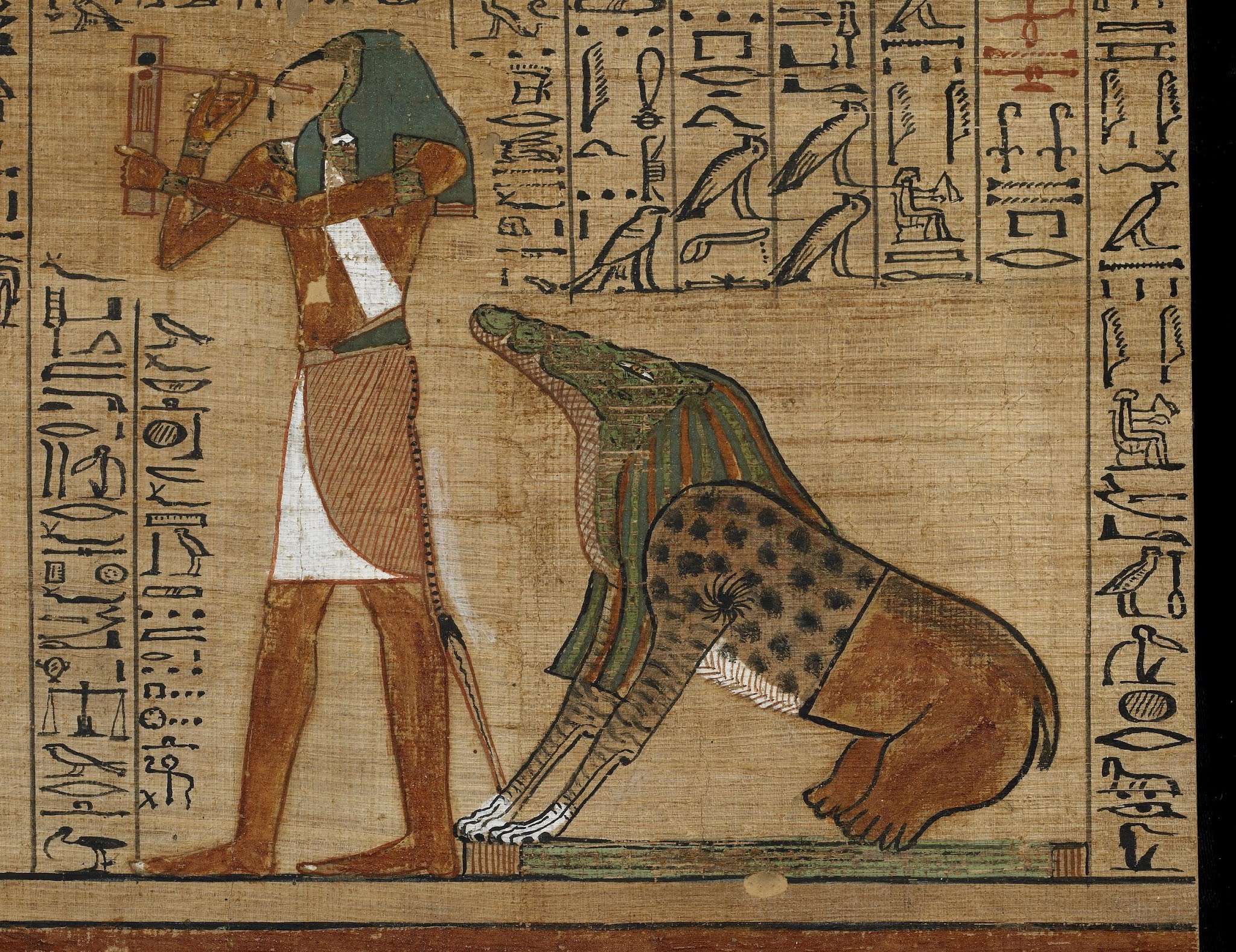
Thoth and Ammit

The Book of the Dead, which dates from the early New Kingdom (c. 1567-1320 BCE) [Armour, p. 10], is a primer for the recently deceased, a guide to understanding how to protect oneself from the dangers of the afterlife, how to get servants to do the required labor for the basic necessities (food, shelter, clothing), and especially how to behave and converse with the gods when one meets them (including Thoth, Anubis, Horus, and especially Osiris, the Lord of the Dead) as, for instance having to avoid the devouring of one’s heart by the demon goddess Ammit (whose body was part lion and hippopotamus, with the head of a crocodile).

The origin of The Book of the Dead, a compilation of numerous texts collected from fragments of papyri, is unknown and may be older than the Egyptian culture itself. The beliefs were possibly brought by immigrants or invaders. For the Egyptians, The Book of the Dead dealt with the realm of the mystic, and was controlled by the clergy.

Saqqara

The earliest known recorded versions of these passages and stories are usually referred to as the Pyramid Texts, beginning approximately 2345 BCE. The texts were taken from hieroglyphic inscriptions on the walls of various pyramids and tombs as ancient as the V and VI Dynasties in Saqqara (Memphis).

The Pyramid Texts, also known as the Heliopolitan Recension, were made up of 714 “utterances,” which had a number of functions, including “a funeral ritual and a ritual of mortuary offerings at the tomb, magical charms, very ancient rituals of worship, ancient religious hymns, fragments of old myths, and prayers and petitions on behalf of the dead king” [Breasted, 71]. The oldest texts are based on the dominant belief in the sun-god Ra (or Re). There is no mention of death in the early Pyramid Texts except in reference to the unworthy or a foe. The pharaoh did not die, bur rather went to join Ra and other gods in the celestial hereafter, becoming an equal with the gods.

Pyramid Texts

In the religious tradition of the solar faith [Breasted, pp. 65-93], there was no heaven or hell, but a heaven-like celestial place which the dead follower shared wit the gods, as one of their members. Osiris, on the other hand, “represented the realm and the dominion of death, to which the follower of Re was not delivered up” [Breasted, p. 93]. Osiris’ acceptance rose later in Egyptian mythology.

The tradition of Osiris as the king of the netherworld, which grew more popular with the collective community, originated in the Delta region of Northern Egypt (e.g., Alexandria) and “migrated up the Nile” [Breasted, p. 107]. This belief came in direct conflict with the State’s official religion of a celestial afterlife for the pharaoh and Ra. In much of the early Pyramid Texts, there was an open hostility towards the Osiris netherworld by the celestial hereafter, including some exorcisms to keep Osiris and his family (e.g., Isis, Horus, Set, Nephthys) from entering the solar tomb of the pyramid. Diametrically opposed, Ra ruled the afterlife of the sky and Osiris ruled the underground netherworld. In time, the popularity of the netherworld would overcome that of the celestial sun-god. Part of this acceptance was the belief in a resurrection by Osiris from death. As with Christianity, the possibility of a life-after-death meant a hard life might have its rewards (as well as punishments) in the next “world,” even if it meant as a servant to the pharaoh and his god companions.

Osiris and Maat

Also rising out of the Osiris myth was the Maat (the concept of truth and ethics, as she is the goddess of truth who judged the deceased and was the daughter of Ra; sometimes known as Ma’at) [Armour, pp. 161-162]. This trial increased the possibility of resurrection and regeneration if the heart of the deceased is lighter than the feather (or total obliteration in the jaws of Ammit, the “devouress,” if the heart outweighs the feather).

Through the found fragments in the pyramids at Saqqara and Heliopolis, it has become evident that as “the Pyramid Texts were eventually Osirianisied” [Breasted, p. 109], which included some editing of the Pyramid Texts by priests following each successive pharaoh, found throughout the chiseled hieroglyphics in a series of five pyramids.

The mortuary passages of this period were excavated exclusively in the royal tombs and were meant only for the kings and gods, and especially Ra. The Pyramid Texts were mostly absent in the tombs of the nobles [Breasted, p. 72].

The information encased within the Pyramid Texts were held closely by the priests of the Solar religion. What information they “published” was chiseled into tombs that were sealed, never to be opened or seen, thereby creating a cybernetic system to control the contents of knowledge that was the privilege of the priests, pharaohs, and gods. The priests and scribes were not permitted to use the information for their own “souls” to guide them to the celestial grounds.

Ra

The purpose of any cybernetic system is to effect control, and any system is vulnerable to entropy, including information. Over time – in this example, hundred of years – as the religion itself changed from a Ra-based center to the overwhelmingly popular Osiris-based center, as explained above, belief in Osiris became egalitarian: everyone dies. It is the favourability of the possibility of resurrection through Osiris that became the religious equalizing factor, among the peasant classes, though the nobles were the first to employ the mortuary texts [Moran: Note how writing was used to control death (entropy), first by the pharaohs, the by the nobles, later by everyone].

Through the centuries, as the priests slowly lost their thrall-like grip on the funerary texts, it became common to find sections of what has been collectively known as the Pyramid Texts painted on the many layers of the sarcophagi of nobles, who could afford to hire the priests to prepare the texts, and the highly trained scribes to do the writing and art work needed to prepare the to meet Thoth, on the path to join Osiris. At this stage the funerary texts are known as the Coffin Texts because of the location of their inscriptions. The time frame for this function is the Middle Kingdom, or XI to XIII Dynasties [Hope, 186].

Coffin Text

This period, approximately 2080 to 1650 BCE, saw the reunion of the Two Lands (North and South), private burials in mastabas and rock tombs, and the appearance of human-shaped sarcophagi. It was on these multi-layered anthropoid inner (wooden) and outer (stone) casings that the Coffin Texts began to appear.

There were still differences between the pharaoh’s burials and those of lower classes in the elaborateness of the ceremonies and the size of the burial place, and in the hearing of the priests to recite prayers and magic spells. However, the texts and rituals – and the resurrection – were shared by all. These texts were similar to the later Pyramid Texts, serving the same functions, but having been appropriated and adopted by the middle and official classes, they included the addition of “unofficial” popular mortuary literature. In theory, even the lowest class of peasants could be allowed to purchase the possibility of deification, but they could not afford the fee [Wilson, p. 117].

The influence of the previous Ra-based celestial religion was a strong foundation on which the beliefs were raised, so there was a coalescing of the celestial and netherworld afterlives. James Breasted states that “in the Pyramid Texts Osiris was lifted skyward, while in the Coffin Texts and The Book of the Dead, Re was dragged earthward” [Breasted, p. 237].

Much of the funerary literature of the time consisted of charms to protect the deceased from various dangers, such as having one’s head removed or the body decaying in the netherworld. As the priests found the selling of these charms quite lucrative, they became more creative about the possible dangers in the hereafter, continually writing new charms and spells that became part of the increasing Coffin Texts.

Due to the desegregation of the funerary texts to numerous classes of people, a need arose for a more substantial number of coffins to have the information inscribed upon them. No longer needing to be carefully chiseled on the stone walls of pyramids, stelas and tombs, as they had been for royal personages, the Coffin Texts, carved and written with pen-and-ink onto wood, were often copied from previous texts with “carelessness and inaccuracy, the effort being to fill up the planks with writing as fast as possible” [Breasted, p. 236]. Often the same chapters were rewritten a number of times for this purpose.

Whereas redundancy tends to defeat entropy, in this case the repetition did not overcome this process due to the lack of consistency in the information. This produced a text that proved more erratic and less understood, rather than clarified by repetition. The information, rather than evolving into precision, becomes superfluous due to the dissimilarities in story and detail. At the early stages of the texts, much of the content was dogmatic rhetoric not wholly understood by most who used it; as it was copied more and more inaccurately, it was increasingly misunderstood and communicated by rote. It is this lack of concordant detail that proves the entropic character of the textual information.

The final stage of the funerary text, the aforementioned The Book of the Dead, was made possible by the rise of the use of papyrus paper which was relatively inexpensive and, more importantly, portable. As the centuries passed, it was becoming more impractical for nobles to have large tombs built, especially for those of the lower classes and of lesser wealth. As the population grew, space became more precious and less affordable, both economically and geographically.

Book of the Dead: Anubis weighs heart and feather, 
while Thoth and Ammit watch and wait to left,
with negative confession judges above

One of the inclusions to the funerary texts of this period is a higher sense of moral vision to achieve divine recognition and a joyous afterlife. Besides Thoth, Anubis and other principal gods of judgment, there were now forty-two additional judges who had names such as “Bone Breaker that Came out of Hierakonpolis” and “Blood Eater that Came out of the Place of Execution” [Breasted, p. 257]. For these gods arose what became known as the negative confession, in which the deceased must state one confession to each of the forty-two judges (e.g., “I did not rob,” “I did not make falsehoods in the place of truth”) [Breasted, p 257]. The newly departed must know the names of each of the gods verbatim, and chapters of The Book of the Dead were produced by the priests to guide the deceased’s progress through these trials.

The term “Book of the Dead” is actually a misnomer, as the “guide” is not actually a “book” but a collection of random chapters to prepare the deceased for the next world, as well as religious invocations and ceremonial prayers.  Written on papyrus scrolls ranging from 20 to 90 feet in length, 14 to 18 inches in width, and containing from 75 to well over 100 chapters [Budge, p. xxx], the scrolls were usually placed between the legs of the deceased before mummification.

The popularity of the papyrus invocations was so widespread that priests and scribes pre-prepared scrolls and later filled in the names of the deceased, such as with the most complete copy of The Book of the Dead presently known, called The Papyri of Ani, which is housed in the British Museum. Dating from the XVIII Dynasty (1500-1400 BCE), it was found at Thebes in the 19th Century CE.

As with the Pyramid and Coffin Texts, there is no fixed order for the vignettes; it was up to the scribes or priests to choose which selections would be included and in which order. The amount of money paid determined how many chapters would comprise a particular roll (The Papyri of Ani contained 186 chapters and was 78 feet long [Budge, pp. cxliii-clii]).

Due again to economics, one of the major changes in the evolution of the Pyramid texts to The Book of the Dead was the addition of the ceremonial chapters.  Previously, priests and mourners would be hired to sing prayers and hymns for the deceased. Through the entropic necessity of catering to a mass population, the texts became more common, less specified, and less complex. Much of the ceremonial texts were eventually removed. What remained of the highly ritualistic mortuary texts were the prayers and chants to be said by the deceased themselves in the netherworld [Budge, p. xxx].

As well as the religious significance of The Book of the Dead, the technological aspects leading up to the mass use affected is “time binding.” [McLuhan, p. 37] [Moran: McLuhan is here using a concept he learned from Harold Innis’ The Bias of Communication], inherently cybernetic due to its resistance to modification, as well as low accessibility to the general population, resulting from its lack of mobility. A high degree of skill, artistic endeavor, and training (“technic”) were necessary to become a scribe who worked with a stone medium. This was especially true concerning the funeral carvings, which were located inside sealed tombs. Even in many temples, the inner chambers were sealed to all but a hierarchy of priests, with only a solitary high priest(ess) allowed into the core cell.

Although McLuhan refers to the hieroglyphic form of writing as a cool medium, the use of papyri caused its “hotting up,” thereby “unifying spaces horizontally, both in political and entertainment empires” [McLuhan, p. 37]. This is also true for religious – as well as funerary – texts. As the information pluralized, the knowledge of the texts centralized a larger portion of the civilization. The accessibility of the papyri medium resulted in a speeding up of communication technique, enabling the religious authority a means to extend further throughout the kingdom [McLuhan, p. 96].

In this case, a hotter medium, or technology, can dominate over an older, cooler one. Through the rise of the use of papyri, the spread of the information of the possibility of a life-after-death as presented in The Book of the Dead was no exception. Despite this outgrowth, the Egyptian culture managed to survive for many centuries beyond the introduction of the revolutionary process of recording and transporting information on a portable medium. Partially, this was due to the need for the development of transportable culture [Ellul, p. 116]. As the Egyptian civilization crept upriver on the Nile, further from the Delta and toward Aswan and beyond, the stories of the gods and an Osirian netherworld came with it.

Despite the flexibility of content imparted by the copied text, which exposes the communication method to an entropic loss of information, part of the reason why the culture remained strong for so many millennia, was the older, cooler medium of “writing” hieroglyphics on stone. Since some information was chiseled in rock, some consistency was preserved in the stories that remained throughout most of the texts. This was solidified more after the rise of the Osiris myth since it was not until after Ra was superseded that the texts were preserved in more public places (e.g., obelisks, or stelas), rather than in the sealed tombs.

Through the long history of Egypt’s fascination with the soul (ba) after death, the leading cause of change in the stages of culture pertaining to the mortuary texts was not the advancement of hieroglyphic writing, but the technological advancement of the medium upon which it was stored. Starting on static stone, moving to painted and cared wood, and then to transportable papyrus, the dissemination of information, which started from the aloof royalty alone, was able to reach the mass population. Paradoxically, despite the many changes, growth, and “hotting up” of this culture, it was able to maintain some level of consistency, somewhat holding at bay the ever-raging tides of entropy, by having at its core a heart of stone.

Bibliography

Armour, Robert A. (1986). Gods and Myths of Ancient Egypt. Cairo: The American University in Cairo Press.

Breasted, James Henry (1933). The Dawn of Consciousness. New York: Charles Scribner’s Sons.

Budge, E.A. Wallis (1967). The Book of the Dead… The Papyrus of Ani in the British Museum: The Egyptian Text with Interlinear Transliteration and Translation, a Running Translation, Introduction, Etc. New York: Dover Publications (Reproduction of 1895 edition).

Campbell, Jeremy (1982). Grammatical Man: Information, Entropy, Language, and Life. New York: Simon & Schuster, Inc.

DeFleur, Melvin L. and Sandra Ball-Rokeach (1966). Theories of Mass Communication. New York: David McKay Company, Inc.

Ellul, Jacques (1964). The Technological Society. New York: Vintage Books.

Hope, Murray (1984). Practical Egyptian Magic. New York: St. Martin’s Press.

Ions, Veronica (1982). Library of the World’s Myths and Legends: Egyptian Mythology. New York: Peter Bedrick Books.

McLuhan, Marshall (1964). Understanding Media: The Extensions of Man. New York: Penguin Books.

Quirke, Stephen and Jeffrey Spencer, Eds. (1992). The British Museum Book of Ancient Egypt. New York: Thames and Hudson.

Wilson, John A. (1951). The Burden of Egypt: An Interpretation of Ancient Egyptian Culture. Chicago: The University of Chicago Press.